Buying and upgrading
Why Property Can Outperform Other Asset Classes
Published 2026-11-21. Adapted from the episode published 2025-12-26. Figures, illustrations and data reflect the episode’s original publication date.

Avoiding Properties That Lose Money
The key to every investment is you don't lose money. I can still get back my original 980 and 180K; all in, I can get back $1.18 million for doing nothing just by holding for four years.
This is my opportunity cost of investing. Today we're going to talk about this topic: a $500,000 quantum paper margin gain.
Paper margin — we're not even talking about net gain, we're just talking about a paper margin gain, still possible in the days and years moving forward. Let's say I've evolved to invest and I've arrested in the till end of 2025, towards 2026.
Maybe I'm getting ready or I'm in the midst of selling my place, but I'm planning to really see how I can enhance and grow my wealth through real estate as one of the vehicles. In the asset class, of course there are many different asset classes.
We believe in diversification because you don't have to really plonk everything in real estate; real estate is highly illiquid, but if you select the correct real estate, you can let the asset valuation grow your wealth portfolio, as what we have shared in many, many previous webinars and of course on our NOTG YouTube channel content as well as on Spotify.
You can have a look at those past few episodes that we have. We talked highly about this thing called growing an equity triangle because not everybody is highly skilled in the equities market, not everybody is technically skilled to hunt for the right investment, and sometimes the stock market can be volatile.
If you don't want to play the leverage game over there, which is high risk high returns, then of course real estate is a very safe way to grow your wealth on a very disciplined approach so that you can focus on your professional work.
So for today's episode, let's have a look at this main title. It's 500K still possible.
Why? If let's say we invest in the wrong class of real estate as an asset and there's zero appreciation and your rental cannot cover installment, this is a no-go.
Why? There's a lot of opportunity cost if you deploy your capital in something that does not grow.
For example, if I were to come to this screen, I deploy into a $3 million property and I need to put in at least $900,000 of my investment capital, and we are talking about your capital can come from your cash and CPF.
$900,000 — take a very simple approach, multiply by 30%, which comprises 25% of the down payment, which comprises 5% minimum cash, 20% CPF, and you allocate another roughly 5% for the buyer's stamp duty. So this is just a rough calculation, which is about 30%, but it covers most of the cost of entry.
Now, your capital is about 30%, and that's about $900,000, and you leverage another 75% from the bank, and this 75% plus your 25% makes up 100%. Now, 5% is an additional cost because of buyer stamp duty to the government.
Now when you look at this $900,000, it is very important that with your minimal holding period of four-year seller stamp duty, how hard has your $900,000 worked for you?
We want to find out the return on capital, because when I exit, I want to get back my original investment of $900,000. I don't want to lose this $900,000.
The first principle of all investing is that I do not want to lose money. All right, so first investment principle is: do not lose money.
As Warren Buffett said, the key to every investment is you don't lose money. If you lose money, then what's the point of investing in the first place?
The point of investing is to grow your wealth, and you need to make sure that your opportunity cost is taken care of. Why is it important?
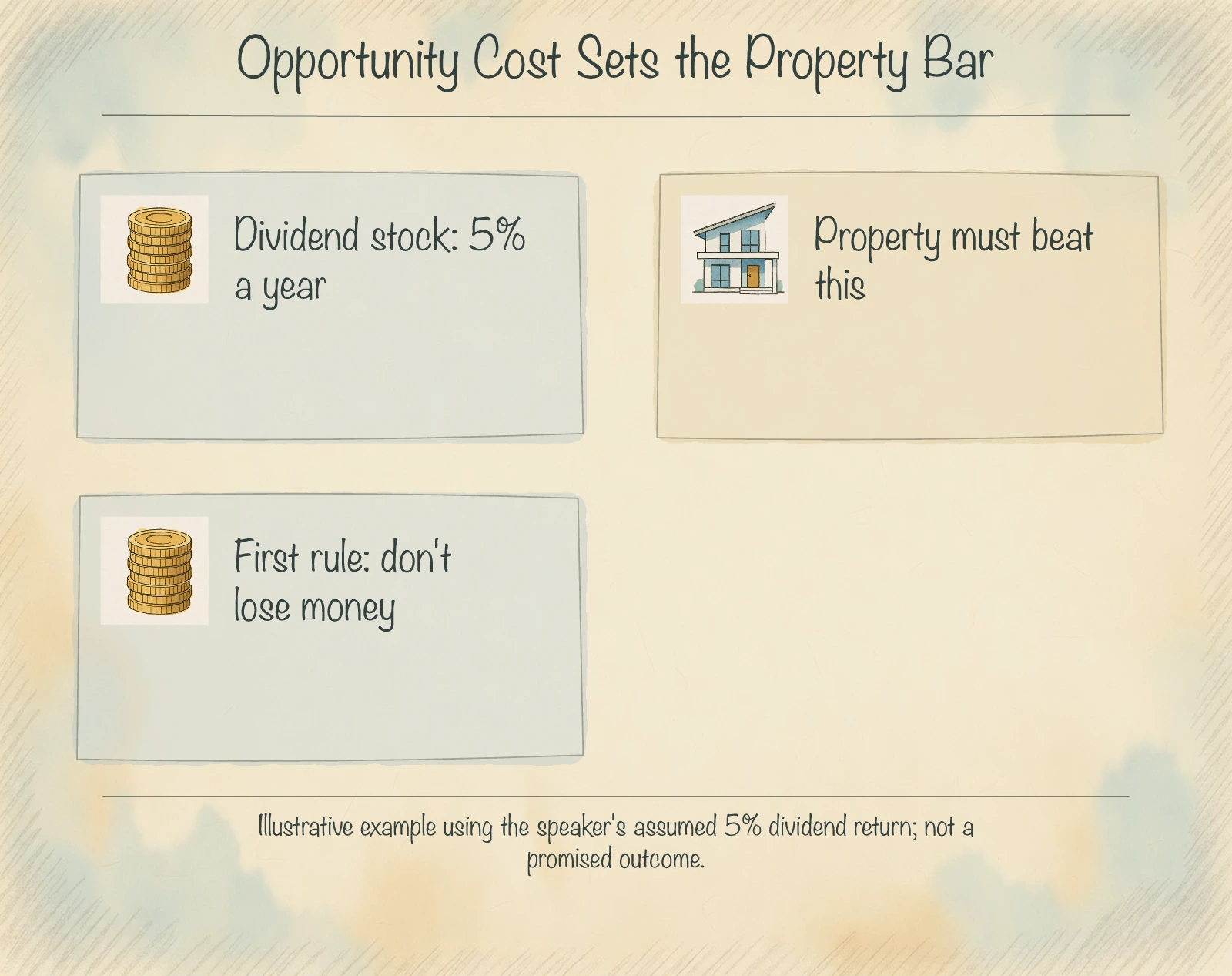
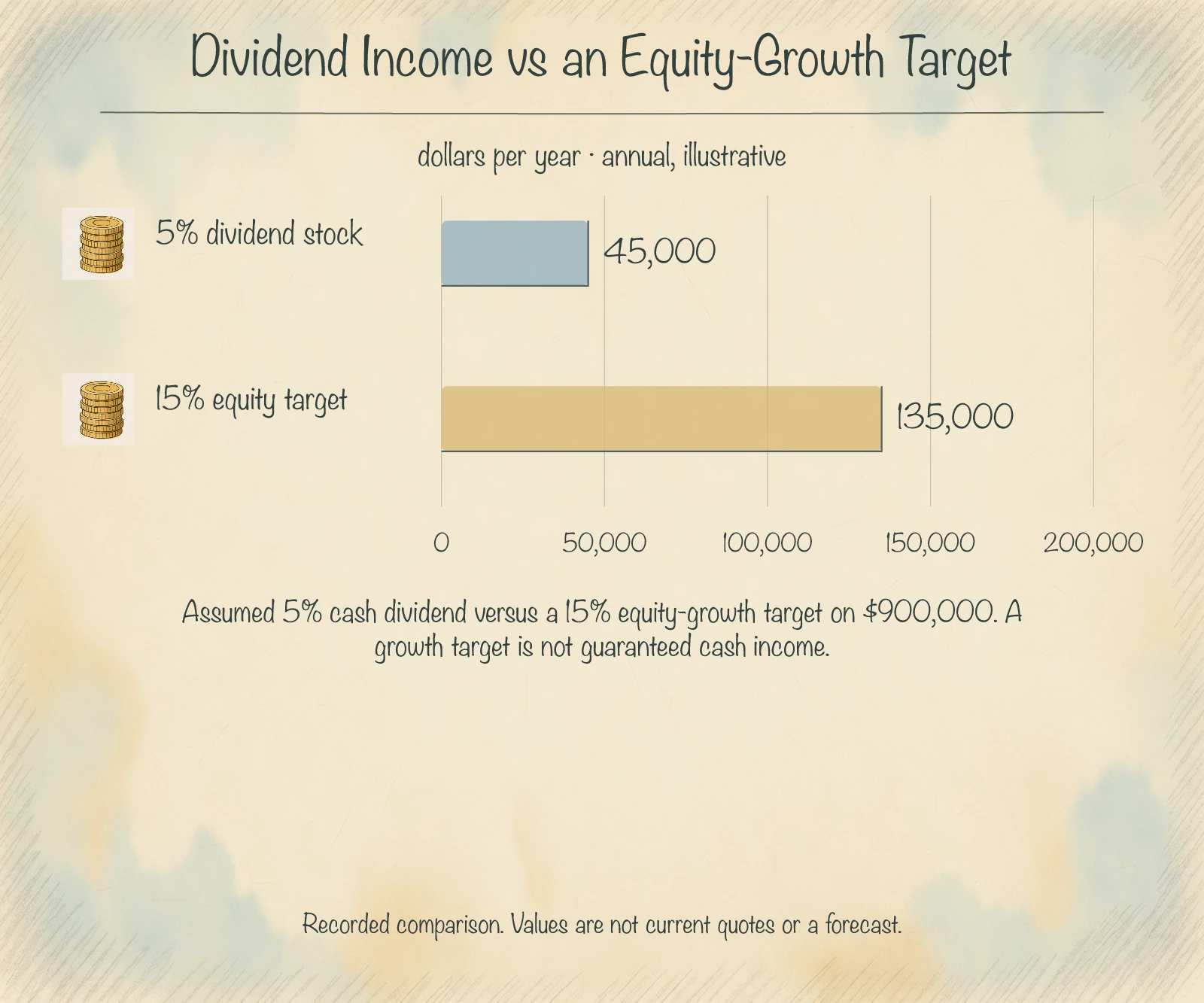
Because if I would just put this $900,000 in a fixed D just to earn 1–2%, that would be better off than me losing my $900,000. I'll evolve to put my $900,000 into a dividend stock and I can earn at least 5% on a year-to-year basis.
I'm earning $45,000 just for doing nothing. So if I buy a blue chip stock in Singapore, let's say I just buy the safest stock, DBS Bank, I can earn 5% — $45,000 with zero management on my end.
I don't have to do anything. I hold for four years, times four.
Easily I can get $180,000 in four years by doing nothing. I can still sell the stock, provided the stock price maintains or goes up.
I can still get back my original 980 and 180K; all in, I can get back $1.18 million for doing nothing just by holding for four years. Now this is my opportunity cost of investing, because at the base, the fundamental reason, there's a very safe alternative for me to do.
I can put in FixD, I can put in Dividend, or I can just put $900,000 in my bank. All right, but my first principle is I don't want to lose money in any real estate investment, which is why hunting for the right investment is very important, and we want to hunt for property that does not stagnate.
All right, so first principle, I avoid the first type of property.
Read chart values
annual, illustrative · dollars per year
| Comparison | dollars per year |
|---|---|
| 5% dividend stock | 45,000 |
| 15% equity target | 135,000 |
Avoiding Low-Growth Properties Despite Good Rental
I also avoid the second type of property which is if there's no growth in the valuation, I don't want to touch it even though if the rental is good now. This second type of property is fantastic.
If I want to go low quantum in my winter season, let's say I'm 55 to 65, I want to invest in something very low quantum but the H and balance lease is old and let's say the balance is 60 years and the quantum is very low.
Let's say I found something 1.35 million dollars for a 3-beta balance is 60 years old but the rental is great because the rental can fetch me maybe about $6,000. I want to go for low quantum high rental.
I give it one star suitable for winter season. Why is it important for winter season is because I don't want to put in too much capital.
I don't want to put in too much capital in my winter season. I want to use more capital for things that I love to do.
Passion projects, traveling, I want more liquid cash. I want to park less cash in any form or asset during my winter season.
I want to enjoy it for myself. Provided that is your goal.
For those of you who want to leave a lot a lot to your kids, then there's another set of financial wealth planning but for most people they want to have a more liquid kind of season in their winter season now.
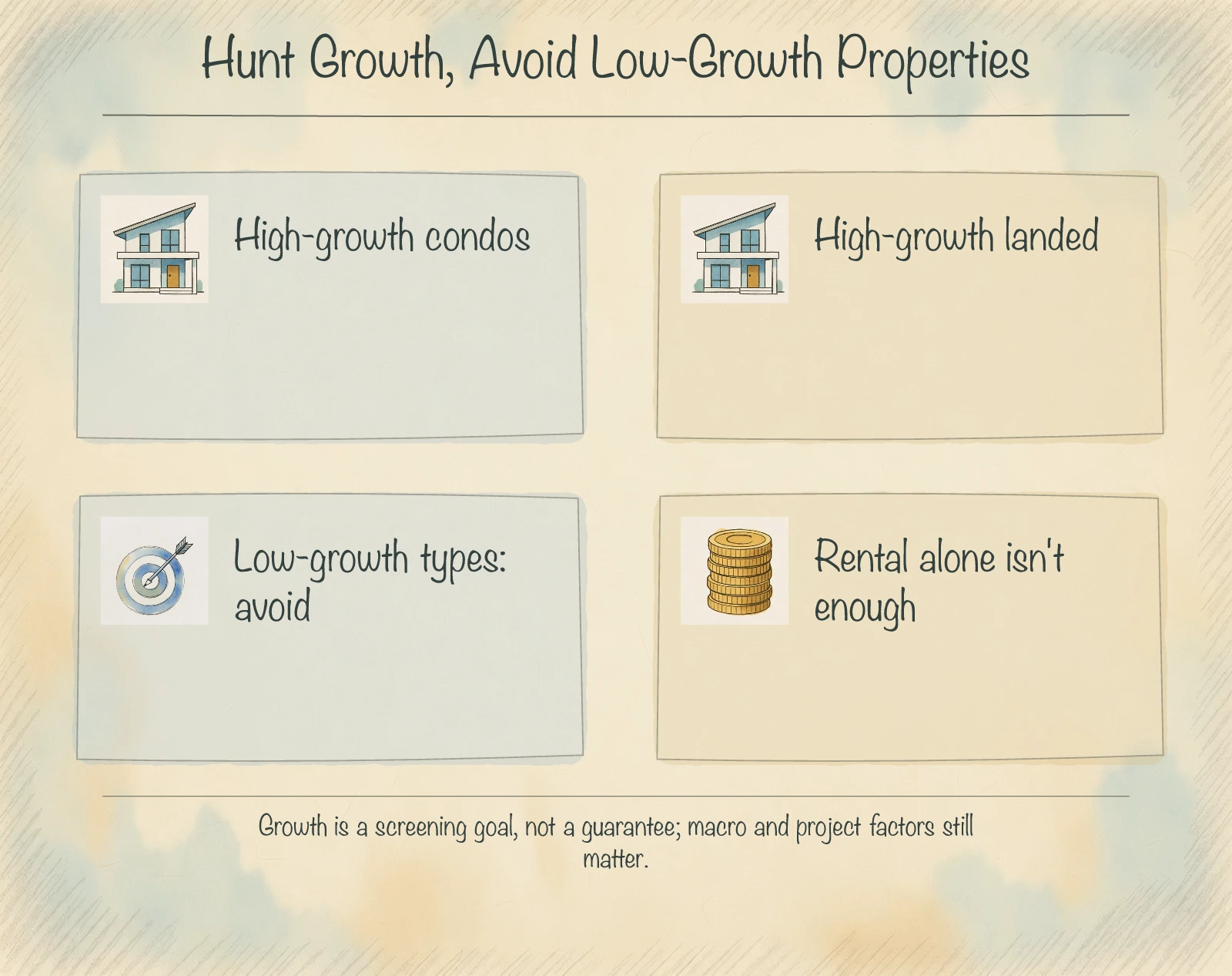
So in your growth season which is your spring summer and autumn season between the age of 25 all the way to 55 you want to hunt for properties with this stick at the front which is it appreciates in value because even though it doesn't cover your money in stock market for a rental you still have a very good performing asset.
So we talked about these four types of properties and to hit that that three and four star you need to make sure that you invest in either quadrant one or quadrant two type of properties. Which is condos with high growth appreciation potential characteristics so we call this high appreciation potential characteristics and fast renter speed.
Number two is our hunt for landed properties with high growth but of course landed properties have low rental yield but this is extremely strong in terms of asset appreciation. I want to avoid these two properties with low growth.
The moment I have low growth, I avoid them totally.
Alright, so a quick example. The moment I don't appreciate I buy a property $2 million, I exit at $2 million five years later, my return of capital is extremely negative.
Alright, the moment I can cover my installment from a rental but the price stagnates at $2 million to $2 million, my return of capital is still negative. And the moment I see appreciation 2 to 2.5 million in 5 years just by a 5% appreciation alright my return of capital is at least 300%.
And then of course the moment my rental cancel cover installment return of capital is definitely positive. So main objective is to see appreciation and have ease of exit so that I can switch my assets as and when I want after I fulfill the seller's 72t period.
Now imagine if your property were to stagnate. This is what is going to happen.
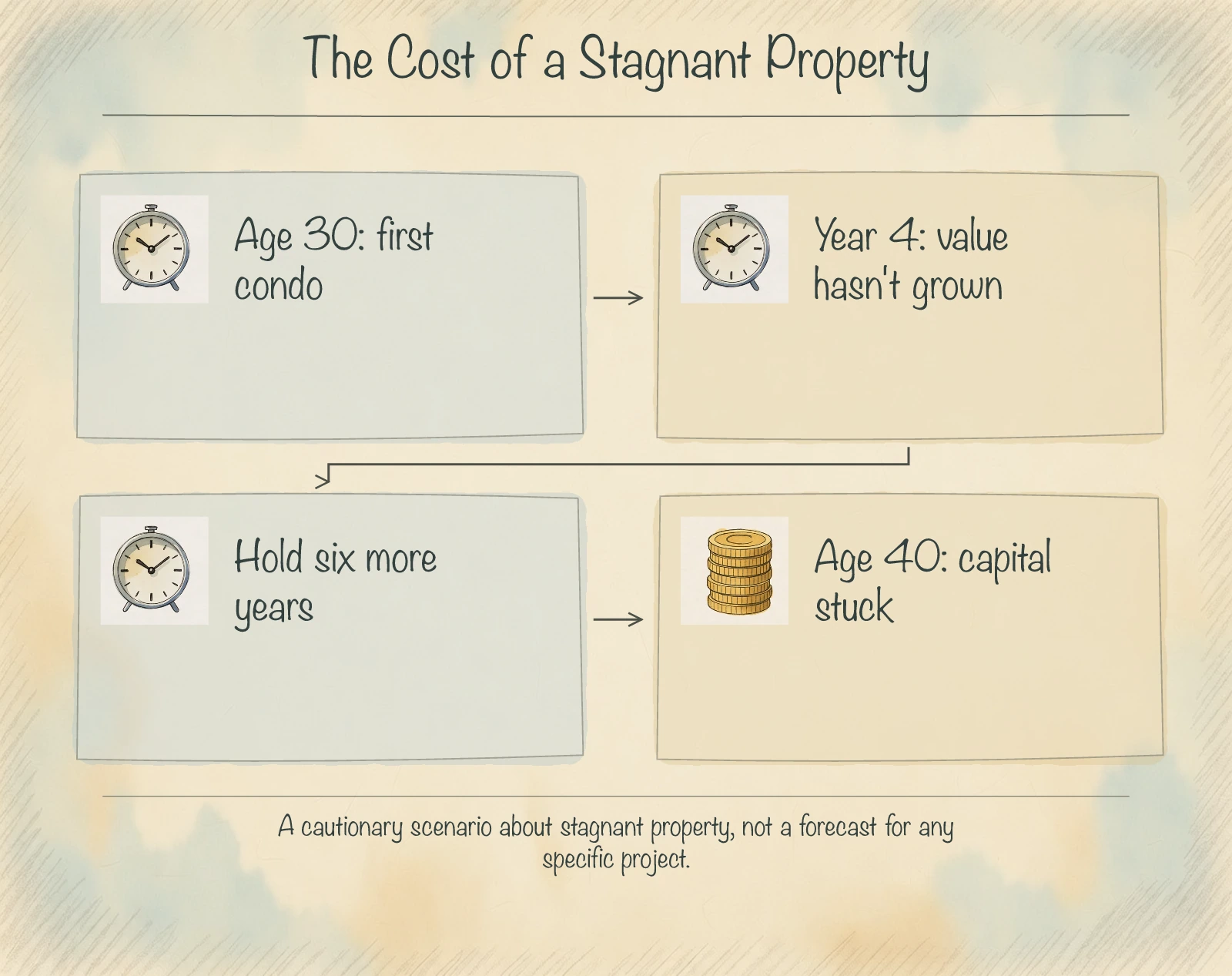
At age 30 years old, you bought your first condo but because at a point that you can sell after four years, you realize that the value sheet doesn't grow. What's going to happen?
Your mindset is that. Since it doesn't grow, let me just run out.
And it continues and continues and continues until you hold it for another six years.
You realize that you're 40 years old, you have high earning power but your name is stuck in the property that does not appreciate what's going to happen, then you will decide whether should I hold and continue until it recover and earn some money or should I just chop and then buy into another asset that can have better appreciation power.
Now the moment you hold the order you get and we only have one life, what's going to happen is that your boring power will start to dip because of TDSR, your boring capability, your leveraging capability because it relates a lot to your loan channel which is directly correlated to your TDSR based on your age.
So while you have a highest earning potential power, your boring power starts to dip as you age. So it's very important from age of 25 to 50 plus.
You must make sure your capital is deployed in high appreciation potential characteristics properties and then do not invest hastily just for the sake of investing in property because there are winners and losers.
When we look at every low growth it consumes for the nice of a life, there are a lot of projects that has suffered because of their entry price, project characteristics. We talked about this in our PRB mode analysis as a 10-point analysis format to highly help ourselves to avoid these kinds of mistakes.
Four Strategies: Go Big or Go Home
Of course, we don't have the crystal ball. We have to caveat that in terms of every property investment, it also correlates to macro-micro factors, but there are project factors and pricing disparity that we can hunt for, to analyse, to reduce the amount of mistakes that we make.
So there are a lot of projects in different districts, sometimes freeholds, sometimes 99 years. So coming back to this topic, I have 4 strategies to share with everybody today.
Let's come to this screen. 4 key strategies to talk about whether 500k is still possible.
Come back to the TV first. Strategy number one is called go big or go home.
What do I mean by this go big or go home? Let's have a look at this case study.
So in October 2020, we have our client. We talk about their portfolio in terms of we have to move from different stages to different stages.
And they exited this particular older condo in the RCR region. And one of the reasons
is because they have a need for space, they want a bigger space, but at the same time the lease is also decreasing, and they were deciding between these two different projects which are actually just across the street from one another.
One is Real Fund Residences, one is Real Vista, which is an older project. Now there are different seasons to strategise this first strategy called Go Big or Go Home, alright, and this is one of the seasons that I think, in my opinion, that you can deploy this strategy.
Because later I'm going to show you some facts and figures and charts and analysis on a macro-micro level on why I think this could be one of the seasons that you can do it. Because we are at a new price point, of new PSF level, this could be something that will be very interesting.
So what happened was that we recommended them to go for a penthouse. All right, why do we want to go for a penthouse?
Because we don't want to, let's say, deploy our capital in an asset, not saying that
the new one, three-bedder, is no good, because this is brand new, it's going to TOP very soon, the three-bedder is actually a very good layout, a good project, a lot of facilities as well, but if they had went for that, they would have made about 354k at a point of exit.
So they have already exited their property, and when we had them exit their penthouse, basically they have made about $850,000 in terms of paper margin in less than four years. So we invested into a 3 plus study penthouse.
This is a penthouse example. Total size is about 221 square meters, which is about 2003-plus square feet, and basically they exited at about 2.42 million dollars.
Made here at 55,000. If they had went for the three-bedder at a point of exit, which is a similar timing to the penthouse, they would have only made about 350,000.
All right, so if I were to come to this approach, why did we talk about the go-big strategy? Because this is one of the seasons
whereby we are seeing this disparity. When we talk about disparity, we want to look at, first thing, what is the current new launch PSF level?
We are heading on into the territory of OCR seeing 2225, RCR 28 to 3000, and then CCR 3000 all the way to 4000. All right, so this is the current territory now, and in terms of PSF level, because of PSF, the resale 99 years also has went up by a brand new PSF.
So resale sellers are very bullish now, nothing wrong. All right, everybody needs to sell and buy something, because I've seen the PSF of new launch going up to this level.
I also want to command more to keep pace with the PSF, and my asking price now is very bullish. Now when my asking price is bullish, I need to see what particular type of property is bullish.
And what the rationale is, also because of the macro environment, that now we are entering into the territory of lower interest rates. So now interest rate
is about 1.45%. We used to be 3% in 2022 to 2024.
Now it's coming down with the rate cuts. There's already two rate cuts.
There'll be more rate cuts coming in December. We already have two rounds this year.
So in the year 2025, the Fed has slashed rates by two rounds. And now we are at about 1.45% for mortgage, which the market is very bullish.
That's why the show flats are flooded. All right.
And once I identify that this is a macro season of a sellers market, meaning that I know buyers are coming back, if I have a property to sell, I call the shots, in the sense. All right.
So I want to make sure that if I have a resale 99-year condo, I want to ask for a price to test and challenge the market, to see if any buyers will buy, all right?
So that I can have a chance to have more paper margin and then I can move on to a landed property and stuff like that.
Seller's Market and Balance Lease Trade-offs
But of course this goes across the board. If I want to buy landed, the landed seller is also very bullish.
I want to buy new launch, developers are also bullish because developers are sellers also, all right? So we call this a sellers' market because every seller knows that buyers are coming back to buy resale 99, resale freehold, new launch condos, landed property, and the market is in a very very bullish state.
You will get more bullish as more rate cuts happen, provided there's no new cooling measures which later I will talk about it. All right, and then of course I want to also see the TOP condos.
Those condos that just received their keys, how much is their asking quantum. Because here I'm asking at a higher quantum.
My PSF is definitely lower if I have a bigger size unit. All right, I also want to see what's the asking quantum.
I also want to see what is the resale freehold asking quantum. And when I compare this four, one of the best strategies to protect yourself
during this season is for example if I see that this particular project, let's say this new launch 99 years, and most GRS they're all 99 years. There's no more freehold GRS, so you want to find freehold, there's only on-block projects, all right?
So if let's say I saw a 3-bedder at about $2.7 million dollars example and I'm considering a resale 99 years condo and I saw this that okay maybe that's like 2.5 million, 2.7, maybe in the OCR region there's like 2.2 million, this OCR maybe this is RCR price, all right?
So if I see something 2.2 million and I go across the street there's a resale 99 that's maybe about 15 years old, 15 years old means that the balance, this is 84 years. This is brand new new launch 2.2 million and then there's a 99 3-bedder that's asking at 2.1 million.
Naturally my thought process is that I should go for this because why? This is brand new full-blown 98 years because the developer takes one year to calibrate
get controller housing approval and everything they launch, I buy, balance 98 years. I hold for four years it will be 94 years once I want to sell, but this guy once I buy four years later it's going to be 80 years old.
So when I see that the quantum has a difference, even though this is slightly bigger, this is maybe smaller but the quantum is too close for me to make a decision on this guy here.
So when I see this kind of closeness I need to have a red flag because I want to buy something with a fresh lease. All right, that's why I always calculate balance lease.
If I've been to a lot of webinars, but then one other way to hash against myself: if I cannot wait, that means if I cannot wait for the new launch to be completed, I want to buy something for stay and maybe I want to deploy a one resale one new launch strategy.
I want to get a resale for me to settle down
my kids, family, schools and everything. I want to move it immediately after exiting from my current property to move there and I can use my spouse name to buy a new launch.
I want to have like a two separate strategy. One other strategy that a lot of people overlooked is I want to deploy Gobiq.
Rather than me just biting the bullet and buying this guy, which to me the risk is there because I know four years later if I buy this guy and I have a balance lease of 80 years in the year 2029 and I want to sell at 2.6 million because I want to see like 500k gain, all right?
But then there's right across the street this guy that has a balance here on 94 years just he TOP and they are selling at 2.7 mil. Now take note this is going to be a new kid on the block in the resale market that will compete with me and I want to sell 2.6
mil 80 years balance. This guy sell 2.7 mil, then he foils this balance and this brand new facilities everything is new, nobody's take before, wanting to defect warranty check.
Who do you think the buyer will choose?
Very likely I might lose with this guy even though they are 936 square feet and 1002 square feet but they are harmonized, they have no AC ledge for sale, I have AC ledge, bay window and stuff like that and there's a lot of all these other factors right, but then just by price alone and my balance lease I'm already at a disadvantage, all right?
So I'm not saying that this is no good. Some people will still buy this, why?
Because I maybe I only have 2.2 million dollars of investment budget range and I don't want to wait, I will just buy this to stay. All right, because I can make my money elsewhere.
All right, so really it depends on different scenarios. But then one other strategy is to go big, which is
Penthouse Demand After COVID
Let me try for the biggest unit, which the quantum does not deviate too much from this $2.1 million option, and this could be the penthouse. Now, one thing about penthouses is that after the era of COVID, a lot of buyer behavior has changed.
Why did it change? Because now a lot of people have preferences, and last time, penthouses—actually a lot of people don't want to buy them.
They feel that the roof terrace is not important. But after COVID, let me just show you, the penthouse absorption rate is so good, and people are starting to realize that the penthouse is a price asset.
It really resumes its status as the villa in the sky, the landed in the sky, the only one that's at the top. And in terms of the valuation of the roof terrace space, it has also changed.
We are in fact starting to see that a lot of penthouse PSF is getting stronger and stronger. Last time, the roof space used to be 50% of the livable space in terms of valuation.
So for example, if let's say the normal valuation for livable space is $2,000 PSF, maybe the roof terrace is only $1,000 PSF, but now even the roof terrace PSF has improved in valuation; it's no longer just 50% of the normal PSF.
But of course, every project behaves very differently. I know you put a disclaimer here, but what I'm trying to say is that you can leverage on the size, and your bigness—your largeness in size has no bigness, that's a wrong vocab, sorry.
Your largeness in size can compensate on how hard your property works. Alright, so for example, if I can hunt for a penthouse rather than going for a $2.1 million three-bedder there, but I can hunt for, let's say, a three-bedder penthouse at, let's say, $2.6 million—example.
But then this three-bedder is 1,002 square feet. This penthouse is 2,000 square feet.
Technically speaking, this 2,000 square feet can work to my advantage because all I want is for the perceived notion that even though this PSF is different—
Alright, so for example, this PSF definitely will be higher, this PSF will be lower, but all I need is that I just need a mere $100 PSF to increase. I can already see a $200,000 quantum gain.
When this increases by $200 PSF, I can see $400 quantum gain. If this increases by $300 PSF, I can see a $600k PSF gain.
But then this $100 PSF here only translates to $120k gain, which is very different from this PSF gain. And that is one of the reasons why, when you look at this, the gain is very different.
So because of the largeness in size at a point of entry—let me just come to you—this client entered at $658 PSF at $1.65 million. Right across the street, they can buy something at maybe $1 million.
They can buy something at $1 million for the three-bedder back then. I mean, this was pre-COVID.
You cannot get back this price anymore. But then, when they exited, the PSF went up by about $350–$360, and instantaneously the gain
is $850 over $1,000 because the size is big. When the size is big, your property doesn't have to work as hard.
And when the size is big, what you can do is that you can leverage and enjoy the space.
You can just live in a larger property, you enjoy the space because you are big, and the quantum difference is not too much, and you have a key positioning because when you are big, your positioning is there; you don't have to compete with maybe the distribution mix.
So a lot of people overlook this: the unit distribution. A lot of people say, "Okay, let me just go with the biggest percentage," which is true, but sometimes not very true.
For example, they say that all the three-bedder norm, there's at least 40% of the unit mix being three-bedder, because maybe there's one-bedder, two-bedder, four-bedder, and then you have all the penthouses as well. But they say, "I want to go with the crowd."
But sometimes, if you're a bit different—a three-bedder penthouse—you attract a targeted audience with more buying power. And when you want to sell, it differentiates you on the portals.
It differentiates you from the market because people that are seeing maybe there's like 25 listings when you want to sell, and these are all 1,000+ square feet, but then they saw that your penthouse is 2,000 square feet—"Hey, let me have a look." And the quantum is not too far, because this is currently $2.1 mil, this is $2.6 mil.
And then when they want to exit, maybe this guy wants to sell at $2.6 mil, this guy basically by that time could be commanding a range of about—I don't know—they entered at about $2.6 million, maybe they're commanding about $3.4–$3.5 million.
So sometimes big size creates a big difference, because at the point of exit, based on that example of our client, they could have gone for $1 mil and exited at $1.35 million, but they went for $1.55
Why Bigger Units Widen Exit Gaps
Million and they exited at 2.45 million. The gap back then was small.
It was about 550k, but at a point of exit the gap went bigger. It was about a 1.1 million key difference.
Why is that so? It's because the preferences in the market have changed.
People start to realize that big units are very rare. So that's the first strategy that you can start to look for in this environment of higher quantum in the resale market because of the higher PSF in the new launch market.
Let's have a look at the second version, which is go strongest, but you have to be very, very careful of the exit quantum. What do I mean by this?
Now if I come to this screen, go strongest it will mean I want to hunt for quadrant one, landed property.
Now if you only look at the URA charts and you say that hey, the returns on, let's say, resale is very low, I rather put my money into equities, all right, and landed property five million dollars I have to put in like one and a half million dollars, I think the return is not that high.
Now take note when we have this top process, it's good to dissect the number. So let me just take a base case on the $3 million investment.
So for example, let's say my equity portfolio is performing on a 15%, which is very powerful. Let's say I'm an expert in hunting for growth stocks in the S&P 500 market, AI stocks, tech stocks or whatever is health care stocks, and I study how to invest.
I'm good with technical analysis. I'm good at maybe growth investing as well, different methodology.
Some people have the growth kind of investing methodology; for Warren Buffett that's called value investing. Some people are into really technical analysis, they go mid to long term, or some people just do like day trading, which is a totally different thing.
But when we look at deployment of your capital, let me just break it down a little bit and see how does numbers look like.
So let's say if I'm thinking about deploying some of my capital into a $3 million asset.
Now the moment you don't leverage, you don't see that power in terms of leveraging, because real estate is meant to be leveraged because this is a fundamental good debt that the bank is very willing to loan to you for the collateral of a property.
You just need to make sure your cash flow on a three months basis, month to month you make the money. In stock, the moment you don't make payment for three months, they take back your property.
I deploy $900,000 into a $3 million asset and the bank loans means 75%, 2.1 million. How did I get 900,000?
Because I need to put in 25% down payment, the bank put in 75%, but why is that additional 5% is because this is the buyer's stamp duty. Buyer's stamp duty is between 4% to 6% on a pro rata basis based on certain calibration, but usually just for simplicity, we just take it as 5%.
Now, I need to hold for four years. At the end of four years, I want to make sure my return on capital is of a few different level.
If I'm hunting for 15%, because if I can put this into the stock market and I can get 15% of my 900,000, I minimally want to see 135,000 per year. And I want to see 540,000 in total.
And let's just remove the compounding thing, alright, because maybe you'll be saying hey, if I earn 135,000 in the first year I can put it to 940K, it will become 1.035, then based on 15% of 1.035 it should be more, okay, but just for simple illustration sake let's remove the compound effect, alright.
135,000, 135,000, 135,000, total 540,000. That means when I exit I must get back my capital of 900,000 plus a paper margin of 540,000.
Let me put it in another kicker here. When I exit, I have to take note of exit costs.
Take note, this 900,000 already taken care of my entry costs.
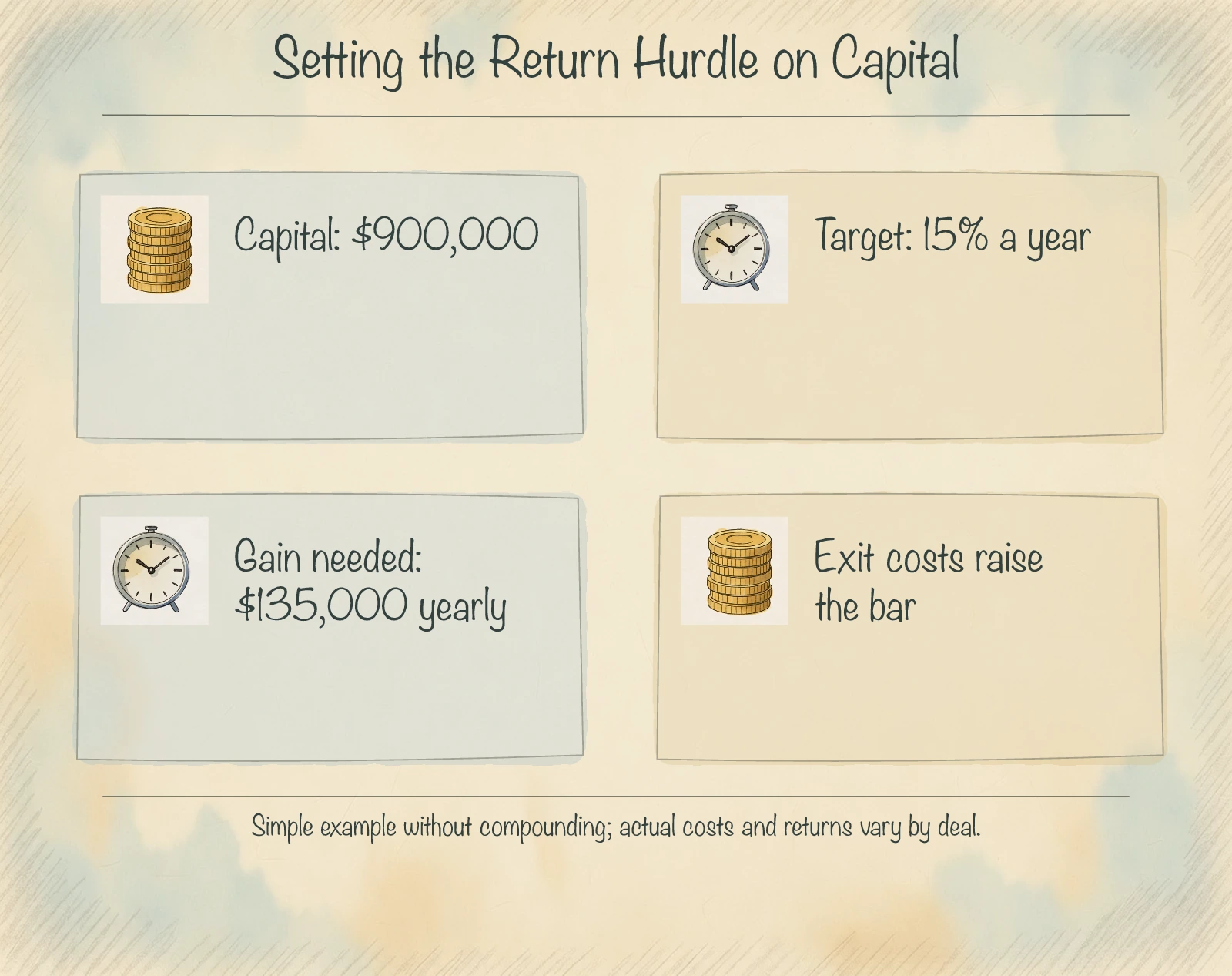
This is my entry costs. Entry costs is my buyer's stamp duty largely, and it comprises of a few thousand dollars of legal fees.
Okay, when I exit there is an exit cost because my exit cost there's another 2% of brokerage fee that I have to pay a professional to sell my property if I don't want to sell myself.
All right, so let's say I engage a real estate brokerage and say that, sell my property for me, usually professional fee is 2% of my selling price. And let's say if I want to exit with minimum 540, I enter at 3 mil, I want to exit at 3.55 mil, paper gain.
And because of that, there is a 2% fee on this, there's about 70 over 1000 plus legal fee plus GST, let me just run it to 80,000. So that means that I have to exit at a minimum of 3.63 million dollars.
Because of that, it's better that I add another 2% here plus minus, which means that my return investment has to be at least 17% on a year-to-year basis.
Exit Costs and Required Annual Returns
Investment has to be at least 17% on a year-to-year basis. So that is something to take note, that there's still exit costs if I want to exit my property.
Now, just to see, 5% is the bare minimum, because if I don't even see 5%, then why did I invest in this property in the first place? Because I could have just invested in a dividend stock.
And take note, if I want to sell, I also have to put in another 2%, because my exit fees to the brokerage is also a cost.
So if I just make 180,000, actually it is not worth it, because then this 2% is going to eat into my 180,000, because it's not low, right, because I need to minus another 80k, which means that if I minus 80k it's only a hundred k.
So I need to factor that in, which means I need to see minimum 260,000 paper gain if I just want to match what I can put into a fundamental dividend stock. So actually, what we need
you hunt for is, can we hunt for at least this amount? So that it sort of makes sense, because if I can beat the market by at least 10 to 12 or 10 to 15 percent.
And maybe I'm not a very seasoned stock investor and I don't want to take the heart attack of losing my 900,000 in the stock market. Because stock prices go up and down based on seasonality, fat policies and stuff like that, and how well the company does.
Then if real estate can give me at least 10 to 12%, 10 to 15%, at least I can already beat the time that I need to spend to invest in stocks, or I can actually beat my opportunity cost of putting into a dividend stock.
HDB properties is going to be around 1.34 million, private properties 573, but take note of the breakdown. Now, at this stage in time, 380,000 condos and apartments, 73,000 landed, landed properties is not going to increase.