Ownership and financing
Why Banks Are the Most Passive Investors in Your Property
Published 2026-11-15. Adapted from the episode published 2025-11-07. Figures, illustrations and data reflect the episode’s original publication date.

Banks and Tenants as Co-Investors in Property
Today, we're going to talk about this topic whereby there are two investors with you whenever you invest in real estate. So why is it that a lot of investors, they like to see real estate as a form of safe haven investment?
If you have $2 million cash and you decide to invest into this property, what is the better return on my capital? This is your first investor.
The bank is your core investor because they co-invest 75% into the property. So who is your second investor?
Your second investor is... So why is it that a lot of investors, they like to see real estate as a form of safe haven investment?
One of the reasons is because whenever you invest in real estate, there are two investors that come alongside you. Let's have a look at who are they.
Now let's have a look at example A and B. We talked about this concept before whereby one is a non-leveraging kind of portion.
What is the leveraging kind of concept whereby in Singapore you can only load up to 75% on your mortgage. So for example, let's say you want to invest in a property, $2 million.
Down payment is $500,000, of course that comes alongside with fees, your buyer's stamp duty which is 4 to 6%, your legal fees, and of course with that when you want to exit the property that's going to be exit fees, for example you pay your broker 2% to sell the property.
Now on the generic level when you look at investment, 75% LTV, loan to value ratio, is what you can leverage for the bank provided your TDSR passed the test.
So your total debt servicing ratio, once it did take into consideration your 10 or your loan capability as well as your overall age category, depending on whether are you putting in 25% to go up to a maximum 65, or let's say you put in a high amount of down payment, you can actually stretch to 75 years old, but that's a separate topic.
But coming to this, generically most people that invest in real estate with this approach: 25% down payment, in this context $500,000, 75% from the bank $1.5 million.
Alright, now if you have $2 million cash and you decide to invest straight on into this property, the main concept and ideation is like this: I put in $2 million cash, what is the better return on my capital?
Because for example if I have $2 million, is it better for me to put in $500,000 in four properties, or is it better for me to just put into one property at $2 million?
This is the main concept about real estate investing, because we've leveraged with a healthy leverage, and this is a healthy leverage, and banks are very willing to loan to people for mortgage loans because why? The asset is the collateral.
In the event that you cannot pay your mortgage on a month-to-month basis for more than three months, then they can take back a property and then they can auction off, they can sign off, they can collect the assets.
The leveraging portion of 75% comes from a bank. Of course now in Singapore, you cannot buy four properties unless you've got four names or unless you're willing to pay the ABSD.
But the main addition of real estate investing is like this, is that there's a multiplication formula on a very healthy way.
And coming back to the screen, naturally your return on capital will be very different, because for example a fully paid scenario versus a good debt scenario, the return on capital if you leverage healthily from a bank is 80% return on capital, ROC, because you put in 500,000 you make 400,000, that is a 80% return on capital.
You put in $2 million you make 400,000, that is only a 20% return on capital.
So coming back to this screen is that here you put in 500,000, you make 400, 400 over 500, that is a 80% ROC, return of capital, this 80%, 80%, 80%, but this you only have one property, is only 20%.
Now the multiplication leverage comes when each of this property increase in the evaluation, because here you have 400K, 400K, 400K, 400K, in total is $1.6 million of appreciation. Over here is only 400K.
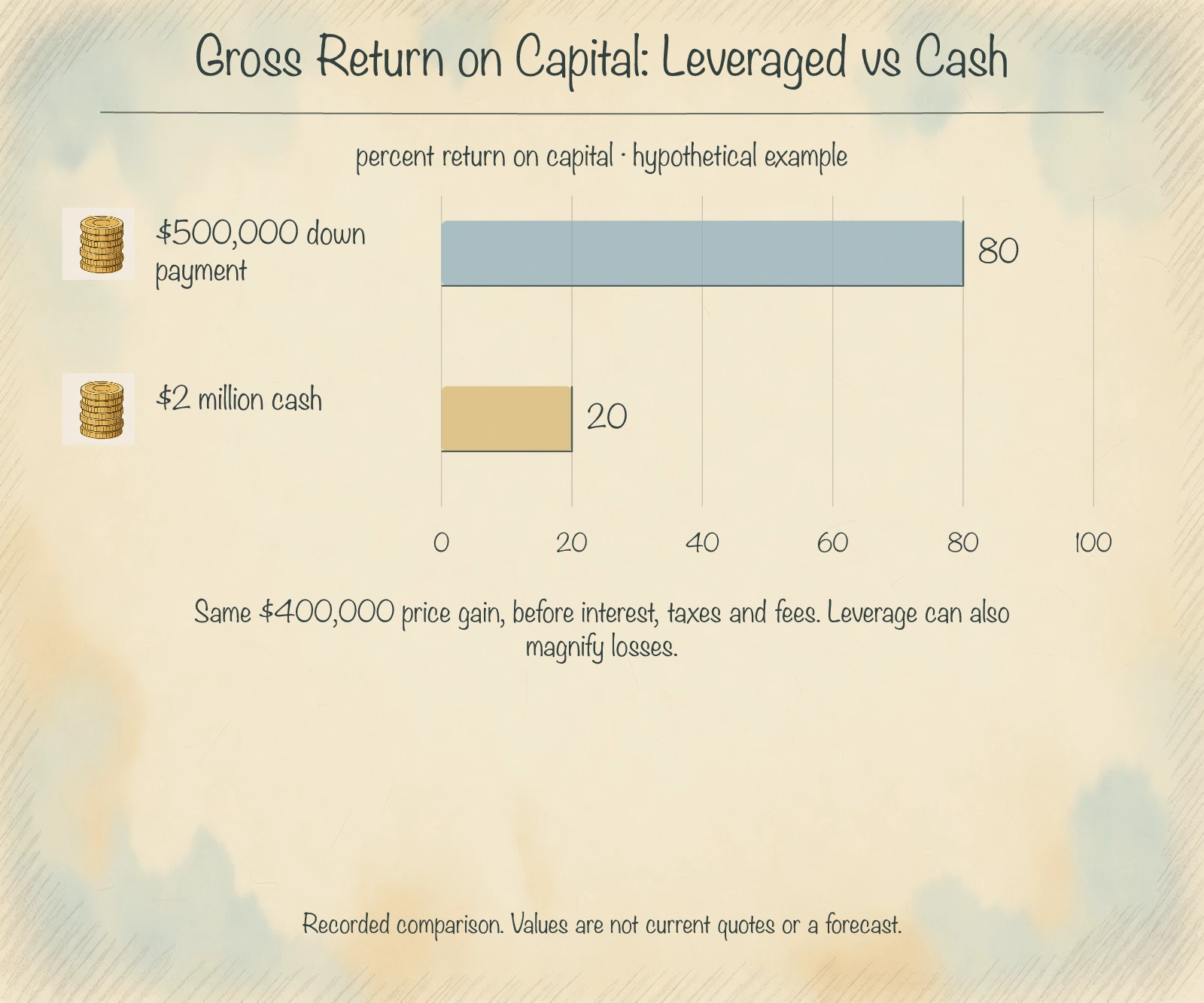
Read chart values
hypothetical example · percent return on capital
| Comparison | percent return on capital |
|---|---|
| $500,000 down payment | 80 |
| $2 million cash | 20 |
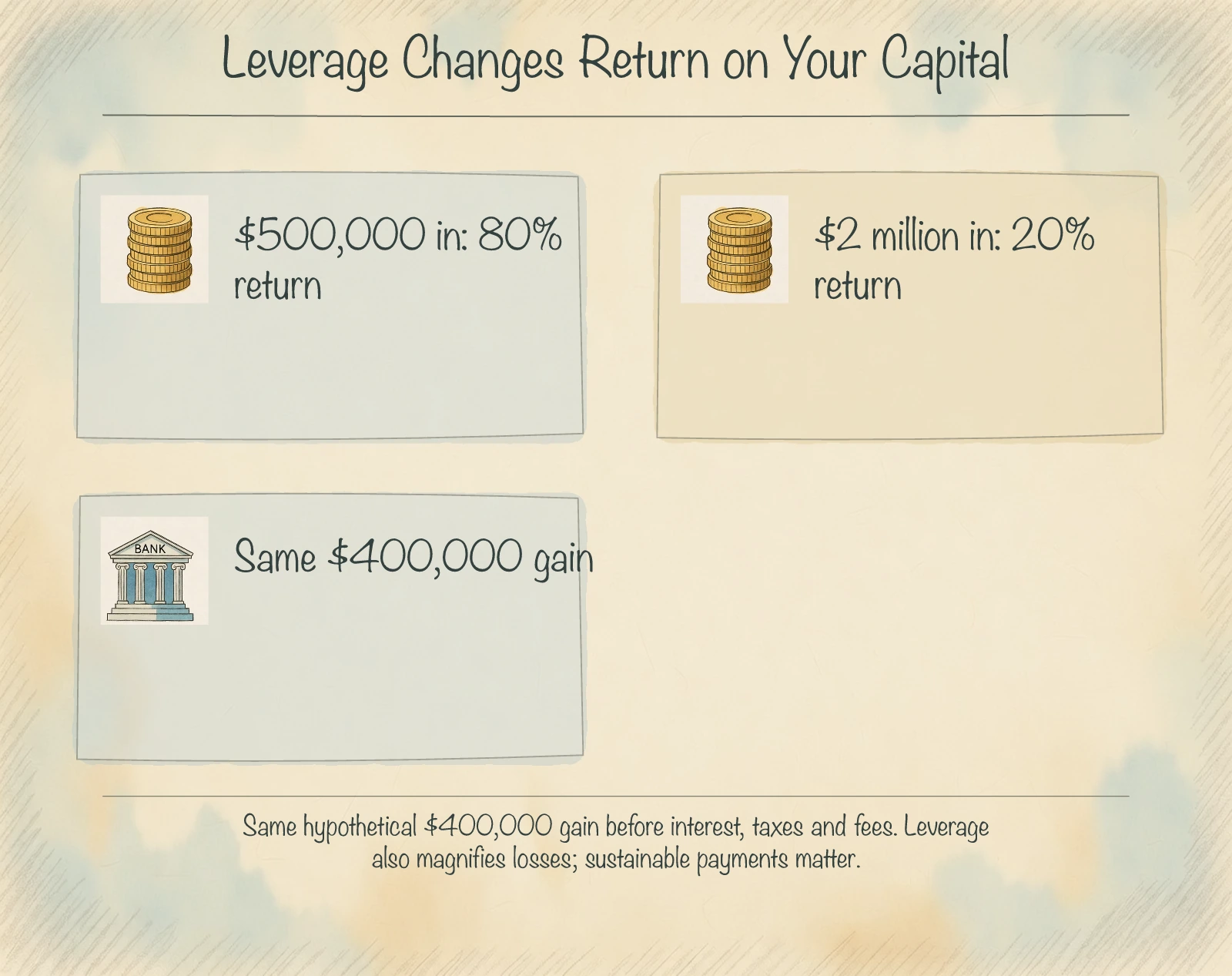
Just by this difference, you have the same amount of money at the start, but your profit in terms of return of your capital is very different. This is $1.6 million.
This is $400,000. So thereby, we see the difference in terms of leveraging versus non-leveraging approach.
Now of course there are various mechanics, it depends on ABSD and stuff, but let's say in the country with no ABSD, this is how people usually invest in multiple properties.
But the kicker is this: you must be able to sustain the money installment. If not what's going to happen is that the bank can take back because your asset is collateralized.
So you must be able to make sure that your cash flow is good to sustain, and there are periods of vacancy. Let's say you want to rent them out, and what if the property depreciates?
You need to take into consideration all these
Four Quadrants and the Tenant as Second Investor
risk on factors. So just a recap on a previous episode we had, I talked about the four quadrants on analyzing real estate investment.
We look at the first one is capital preservation to make sure that this asset doesn't depreciate. So you need to do your numbers analysis data to make sure that this zone, this particular asset has a very low chance of depreciation but has a high chance of growth.
Second portion will be your tax efficiency. Third one will be your cash flow portion.
And the last one is that everybody wants to hunt for real estate that can appreciate because any real estate that stagnates in value basically consumes your time and opportunity cost.
Today's topic is about the two investors. So the first investor will be the bank.
This is your first investor. The bank is your investor, your co-investor because they co-invest 75% in the property and the beauty is that the bank do not need to share your profit.
So banks are not interested in your 400k.
They are only interested to make sure you can return me the money that you loan at a point that you sell the place or at the end of your tenure or they are also very interested in the monthly interest that is gained from here because there's a P plus I component.
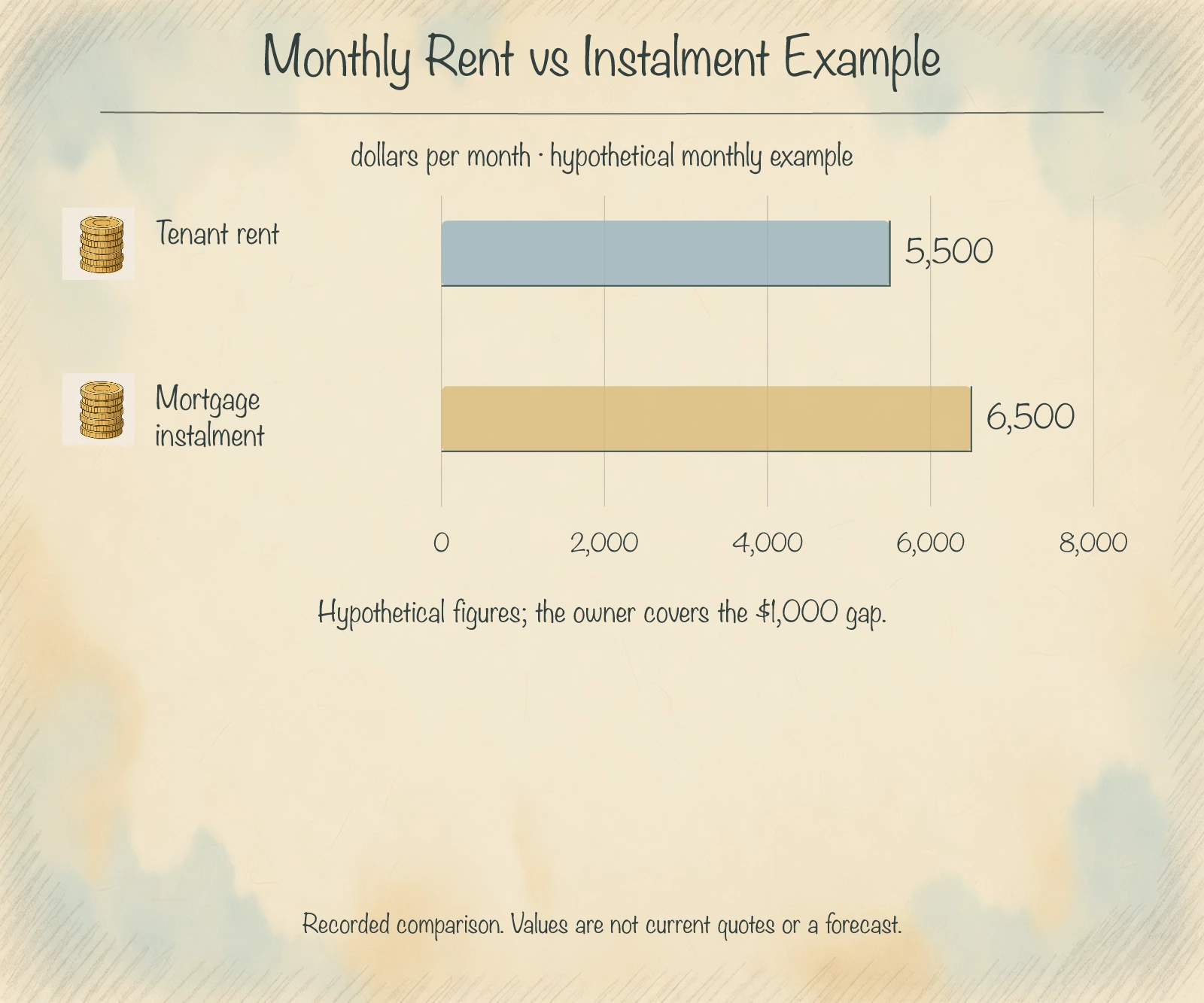
So coming back to the screen here, let's say for example I invest in a property $2 million, I put in 25% down payment, 75% is from my co-investor which is the bank. They are only interested in the interest payment because when I load 75%, I need to pay a money installment of let's say for example $6,500.
Now within this $6,500, it depends on the spread versus your SORA rates, there's a principal component and there's an interest component. So just a hypothetical example, out of $6,000, your principal could be $4,000, your interest $2,000 a month.
All right, so the bank is only interested in this. Why?
Because when they co-invest, refute in this property by giving you 75%, they earn $2,000 a month.
So they are very interested in this and they are very interested to take back their money in terms of the balance amount that is due to them at the point of selling your property.
Let's say you sell your property within five years, they earn five years of interest and they want to take back the balance amount that they loan to you. So naturally after five years, you pay down the interest and principal, the amount that you owe them will not be 1.5 million.
Maybe by then it will be 1.35 million. Example.
All right, So they are only interested in the money interest and the amount that they will take back from you now They are not interested in the profit that you make.
Which is why real estate investors love to invest in real estate is because this is unlike so-called like Investing in the company together that when you sell The company all the shareholders will be distributed accordingly based on the sale price, based on their percentage.
But take note of this, when you come back to this screen, even though the property has appreciated the $2.4 million, the bank do not want your $400,000 appreciation. They are just keen on the original amount, the balance amount due to them, and the money interest.
And the moment you can pay a money interest, your consistent, your cash flow, they will not touch your property because the collateral recovery is not activated.
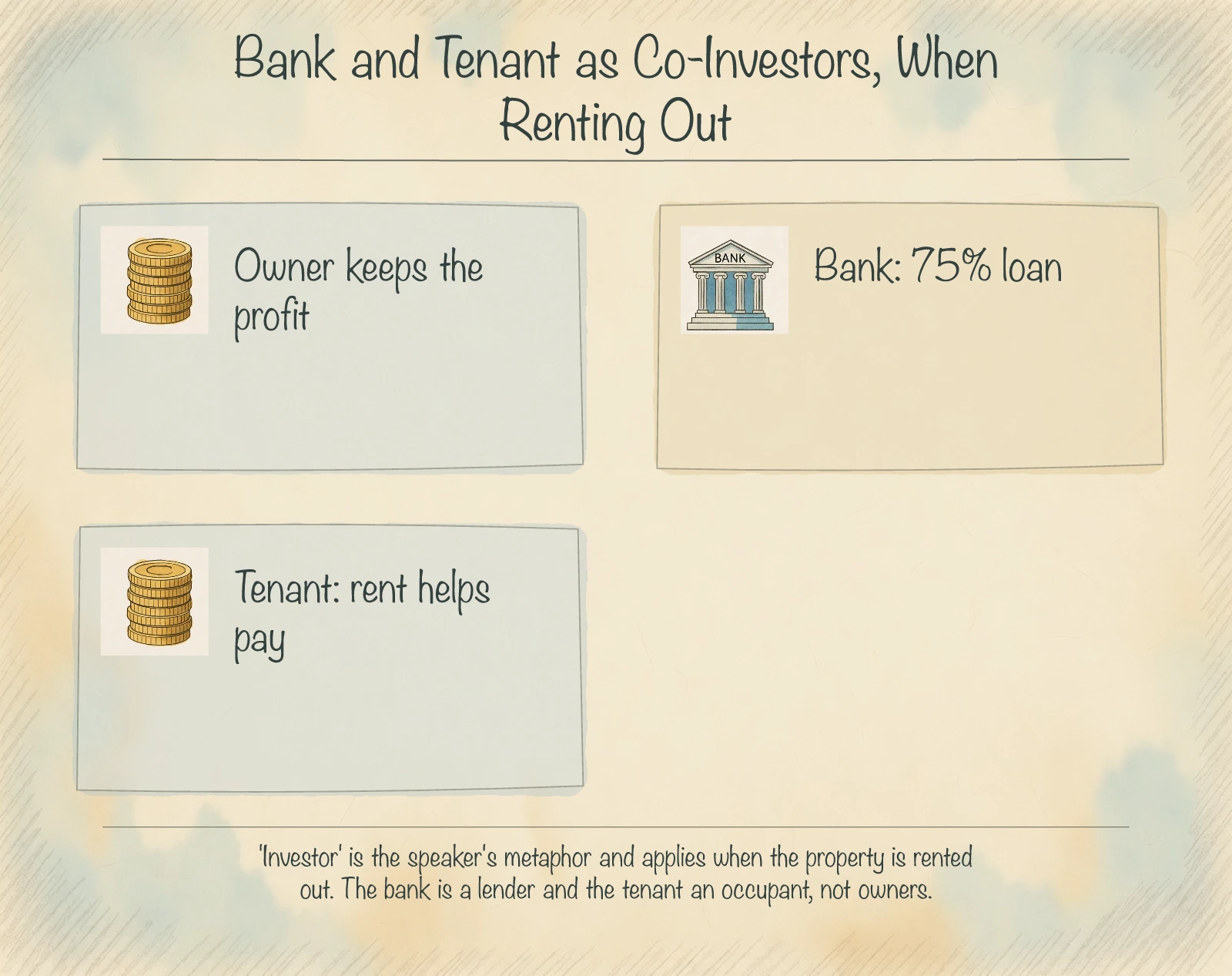
Now, Now, if I talk about this P plus I portion, then I want to introduce to you your second investor. So who is your second investor?
Your second investor is your tenant. All right.
So a lot of us don't realize that when you buy a property to rent out, you buy investment property, rent out, you invest in this property, your tenant is your core investor as well. Why?
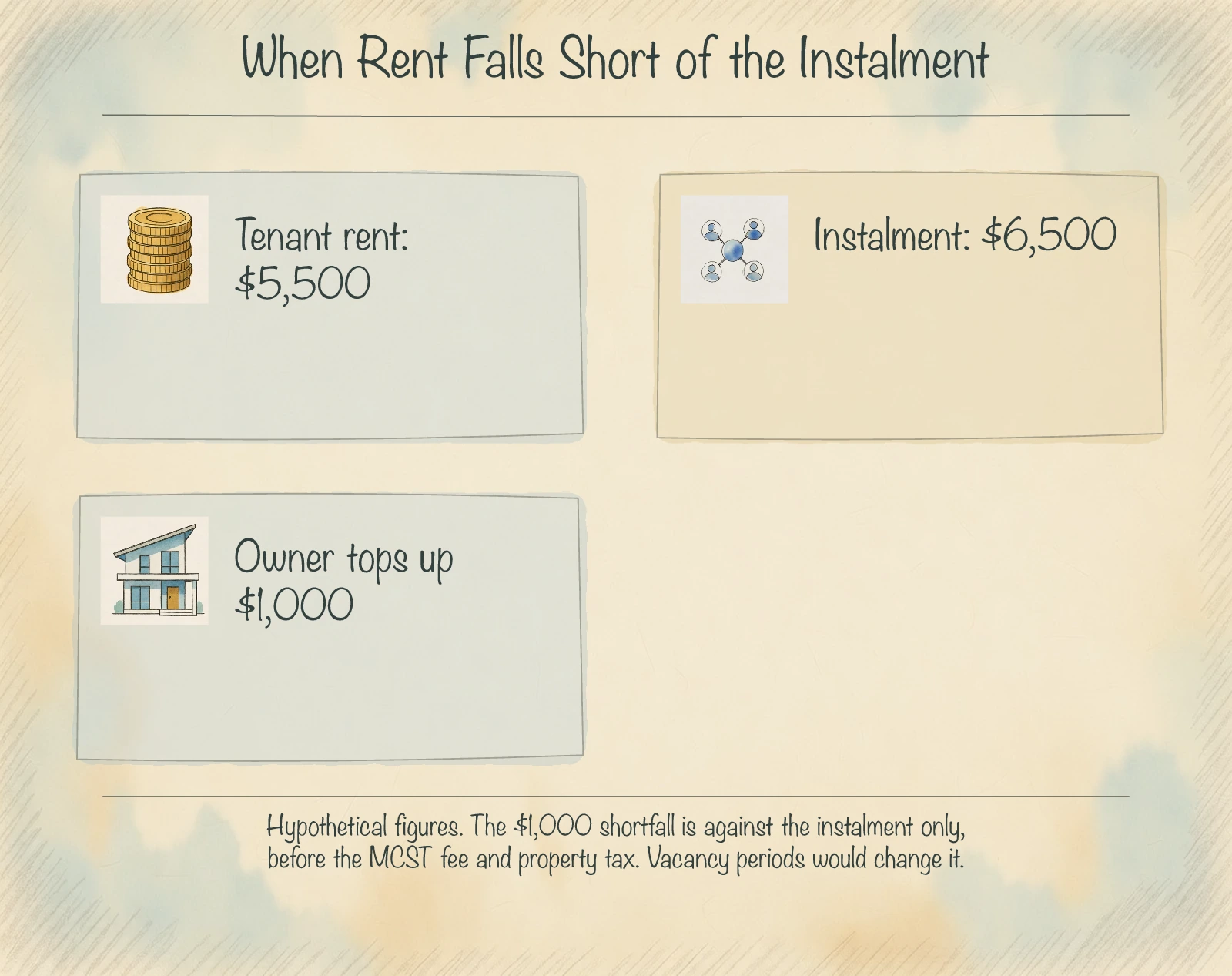
Let's say you ran out of this property and the rental cannot fully cover $6,500 and there's also MCST fee involved. Let's say $400.
Your outgoing is $6,900 a month. Of course, there's still an annual property tax but it's only fair that as the owner, I pay the property tax.
Whoever is the owner pay the property tax. Alright?
The tenant, let's say, pays you $5,500 a month for this 3 beta that you invested in. It cannot cover the $6,500 that's a short fall of $1,000 and this comes from you as the owner, as the original investor.
But this is your second core investor.
Your first core investor will be the bank that supplies you with the initial investment 75%. Your second core investor is the person that core invests with you on a money basis to take care of the P plus I portion principle and interest so that you can pay back to your first investor.
So this is the concept that a lot of people, they don't realize that actually they have two investors together. One is for the initial investment, one is for the sustainability of the investment, which is what makes real estate beautiful.
Because your second co-investor, the moment you
Read chart values
hypothetical monthly example · dollars per month
| Comparison | dollars per month |
|---|---|
| Tenant rent | 5,500 |
| Mortgage instalment | 6,500 |
How Rental Income Pays Down the Loan
Ran out your property, let's say for two years for 24 months, of course, sometimes there's vacant see period and stuff like that. But then once you ran it out, majority of this 5.5 is used to pay your principal fully and to pay your interest.
All right. So you can look at another way is to pay your interest fully and the balance is for your principal.
Both ways work. All right.
You only need to sustain $1,000 into the principal and then it is taken care of on a monthly basis. So you as the main owner, you come out with 25%.
You come out with $1,000 on a money basis.
You come out basically with the MCST, the property tax and your buyer stamp duty because you own the property and because your two investors are not interested or they don't have the rights to your profit if you were to make a profit for eight, ten years later, is only fair.
You pay the MCST fee, you pay the property tax, you pay the BSD and the exit cost. Let's say you want to sell the property, you pay 2% to a realtor to sell because you have all the rights.
By paying all this, you own the rights to the full profit. That's how it works.
And everybody benefits.
Your second co-investor is a tenant. They get to enjoy the utility of the property.
They stay in the property. Your first investor enjoy the interest, but the beauty is that by exchanging this utility, I let the tenant enjoy the space.
The tenant pays the interest to the bank and the tenant also pays the principle that will be unlocked when I sell the place. Because take note, how it works is like this.
Today, 2025, I put in 500K to this property. I loan 1.5 million from the bank.
2029 when I sell, my balance is 1.35 million. Why is it that my balance dropped?
It's because for the last 48 months, I paid off the principal plus the interest. But the interest of 2005 is being paid for by my tenant that pays $5,005 and my tenant also pay another $3,000 to my principal which reduces my loan balance.
And I pay another $1,000 to reduce my loan balance as well.
So on a hypothetical basis, let's come to the screen. If I were to load up basically our property limb brothers calculator, let's say I'm 45 years old, I invest in a restate $2 million, 1.55 interest rate 25 years because the bank takes 65 minus 40, it gives you 25 years.
Of course after one year you can refinance and stretch to 75 years, that's a separate topic. Loan 75%, 1.5 million loan amount, monthly installment $6034.
What is going to happen is that when I look at my armotization table, it looks like this. So every month, $4000 goes to the principal, about $109 goes to the interest that the bank is interested in.
But what happens on a month-to-month basis, let's say I read up $5,500. About $2K is used to pay their interest, I left $3,500 to pay the principal.
I myself as the owner come out with $500.
Basically, what is going to happen is that because the tenant is taking care of the bank's interest, the tenant as a second-core investor pays the first investor.
Alright and the tenant also contributes to my principal to pay down my loan because my loan is going to reduce on month-to-month basis and by the end of let's say four years when I hold a property what is going to happen is it will look like this at month number 48.
So month number 48 my loan balance is going to be $1.297 million. $1.29 million.
Originally my loan was 1.5 mil and there's a reduction of 210,000 and this is being contributed by my tenon and myself and my tenon is taking the bow of it because I pay 500 my tenon pays 3,005 another 2,000 that my tenon pay is basically to pay back my first investor all right this is the P portion, this is the I portion.
This whole portion is paid by my tenant.
So now that you have a good visualization of actually there are two people investing with you and the second co-investor is actually helping you to pay the first investor and the second co-investor is helping you to pay down your loan in exchange for the second investor to have the chance to stay at property.
This is a win-win-win scenario. So everybody wins.
The property owner wins, the bank wins, the tenant also wins. And the beauty is that when you unlock this property, if I were to sell, because originally I put in $500,000 as the original owner, but how do the tenant benefit?
The tenant get to stay in the place without coming up with $500,000 and all the risks involved as the owner. Because as the owner, I still had to pay MCSE property tax and BSD and exit fee.
But the tenant gets to stay in the place immediately, which is why people want to rent. They don't have to come up with the initial investment.
They don't have to qualify for the loan. So it's a very fair game.
Everybody has its
Selling the Property: What the Owner Gets Back
contribution and has their own wins. As a property owner, the moment I get the appreciation of 400,000, this comes to me and not to them.
So the beauty is also that the tenant is contributing another 210,000 cash flow, and I get the profit. I get back my 500,000.
So when I sell my property, I get back three things: I get back my original investment 500,000, the tenant contribute and store into my property the principal that they have helped to pay over the last 48 months, I store another 210,000, I profit because the property I selected very wisely as an investor and it appreciates like 400,000.
All in, when I sell, I unlocked 900k plus 210k. I unlock a total of 1.1 million dollars with my initial $500,000 in my profit of $400K and earn another profit of $210K over for the AMRs.
But of course you need to store this. If you span it, then you can't see it, right?
So usually how do people span it is that they use it to pay for the installment, alright?
So of course you don't get to see this. This is like hidden, this is hidden because your monthly cash flow is only $500.
Of course, another way to think about it is that if my monthly installment is $6,034, some people like to play this mental game. They have two bank accounts.
So they have a collection account from the Tenancy. So every month they collect $5,005, they leave it there.
And then they use their own account. They pay $6,034.
They just keep paying it and at the end of 48 months, they see this as one lump sum. All right, but of course what a lot of people do is that they don't do it, they improve their money cash flow, they just take this collection, pay the money installment and they themselves top out another $500.
All right, so your money cash flow is only $500. So technically you don't see this 200 and 10K being unlocked.
Why? The rationale is because you already use it to pay for your money.
installment. But what do you get at the back end is that when I sell my property at $2.4 million, I less off my outstanding loan of 1.9.
So let me run to 1.3. I get back a total of $1.1 million because there's this storing function that I just mentioned is that this reduction of loan, yes, every month you are using the money to pay for installment, you don't really see that money, but that is unlocked at the end when you sell the property.
So in totality, you take this 1.1 million, but originally you only come out with 500k, but you see this at one go because your loan has also been paid down. All right, so when that happens, usually people refunnel this into the next property as the next set of bail payment.
Then you can buy something in the $3 million range or $3.5 million range. So that's how property investment work and that's the beauty of it.
So if you want to learn more about real estate investment concept,
But also just to share a view on some key developments that we have is that if you're in an event of really analyzing new launch investments, we have this Balloting Day Playbook. So let's cut to this short little sharing on our Balloting Day Playbook and then we'll see you on next episode together.
So what is the Balloting Day Analysis Kit?
All our consultants at KW Singapore and PLB, they are armed with the disparity effect analysis toolkit, stack ranking toolkit, appreciation, simulation, analytics, cross launch comparison across all the new launches in Singapore and a SnickQ Live Pricing Analysis Tool.
Now the rationale, we come with this six-step process because a lot of years of experience, we realize that most of the time, if I'm somebody that's investing in the new development, I managed to get a balloting on that day, most of my entire day is spent at the SnickQ.
All right, so once my turn is called, I show up at the appointed joint marketing agency's office. And the moment that I queue, most of the time is that I do not have live pricing updates on what's available.
So most of the time, maybe I will only get based on my stack what is the pricing that's available, the floor level that is left, and by the time I kill that maybe I'm left with level 7, 8, 11 and 12
Balloting Day Playbook for New Launches
And importantly is that I want to take my emotions out of this because I want to have a holistic view of what's available Our realtors and our consultants on the ground Whenever they help our clients to go for new project balloting They already have armed themselves with pre-research.
They'll sit down on the tabletop strategy session with our clients. This is ready to look at the target investment property, vis-a-vis, or the resale competition in that district.
Because what's important is in four years' time, my investment is competitive in the whole district's resale market landscape. And thus, we have the master disparity effect analysis.
We also have the stack analysis on the entry price and quantum strategy by looking on a stack out stack basis. What is the quantum?
We have the pros and cons and the strength of each stack and of course we all know no properties and stack-facing is perfect.
And just understand what will be the potential advantage and disadvantages of each stack and how to balance the entry price. Most importantly, we also want to have a simulation of our exit PSF and exit quantum in four years time to see if this particular stack makes sense.
And we have this newly coded toolkit. it basically it have all the entry quantum and entry PSF of all the launches based on bedroom tasks in entire Singapore so if you want to compare this together with our consultants on the tabletop discussion that's available as well.
And most importantly we have the SnakeQ Live pricing stack disparity analysis because this allows us to update our clients while we are queuing up on what are the units sold and available. So that we can know the differentiation for example if I'm doing a particular stack by my turn I'm left with only the high quantum units.
If I have an opportunity to see what's available in the next bedroom type on the next bigger size or smaller size, I can make an informed decision on whether should I go for the other stack because there's still units available.
We call this basically the potential to save a certain quantum by shifting to a bigger size opportunity. And this is basically workable because we have our live research team deployed on site on launch day.
Let's see... oops I need to sign in.
Let me sign in. Oh shucks I forgot my password.
This part let me cut it off a little bit. Please.