Buying and upgrading
When to Switch to Your Next Stronger Asset
Published 2026-11-06. Adapted from the episode published 2025-08-29.
Reading Market Trends Before Switching Assets
Today we're going to talk about this particular question that recently I've been seeing. Some of the audiences are asking, when do they know whether this is the right season to switch to what we call a next stronger asset.
Now, if you've been following us, we always talk about this term called NSA, next stronger asset. So when is the key question.
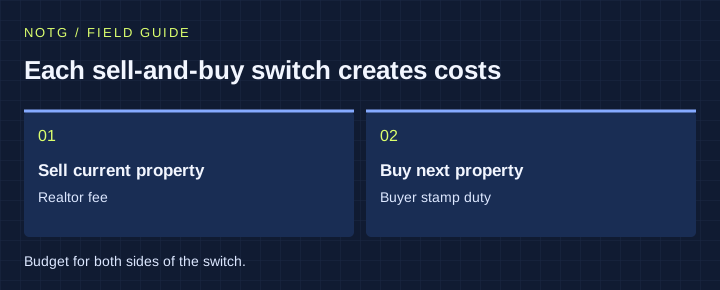
And it's even worth it, because we always talk about the fact that if you have one property now, or maybe two properties, every switch of your asset class, meaning let's say a sell and buy action, each action creates a cost.
What is the cost involved? On re-entry you have Buyer’s Stamp Duty.
When you sell, there may be a professional fee that you pay to a realtor. There can also be legal fees on both sides.
Buyer’s Stamp Duty is tiered, so the total depends on the property and the transaction. Work out the actual costs of your exit and re-entry before you ask whether the switch is worth it.
The when is the main driving force here.
So let's have a look at this framework. Now when we should do it, I will want to introduce you to this formula.
So this is a very good formula because why? This formula will allow you to think about whether you should even start this action or not, because we talk about the fact that the entry and exit induces costs.
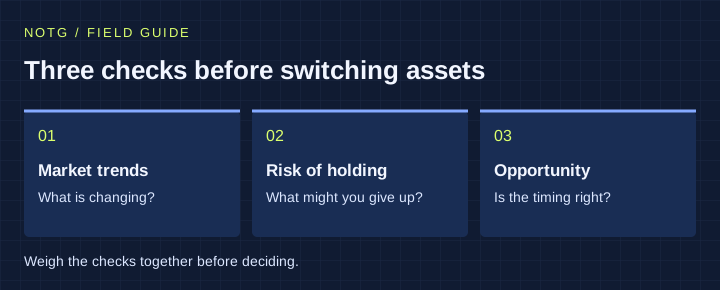
So this formula basically is to look at what is the first point here, which is the trends. So let's have a look at the trends first, because why?
Trends matter. Why do trends matter?
Because a trend will allow us to see whether the current state of the market is a state whereby we can sort of find opportunities. For example, is it a seller's market now?
Is it a buyer's market now?
In a previous episode I talked about the difference between a seller’s and a buyer’s market. In this August 2025 episode, my view was that we were moving towards a seller’s market in the second half of 2025.
One reason was the expectation of US rate cuts. I was watching whether lower borrowing costs would bring buyers back.
In a seller’s market, the people with inventory have more room to set terms. Sellers and developers may try for higher prices, and you may see more buyers at show flats.
In the episode I used a launch as an example of buyers returning. So what is the trend on the ground?
Number two is to look at the risk of holding on to your current property.
Holding Risk: Volume, Density, and Balance Lease
If you are holding for the long term, you may feel that hey, it doesn't matter, I'm buying for own stay, I’m very happy where I am, I don't want to move, I want to stay put, and to me the experience of staying put, having a stability, is more important than making profits from my property, and I would categorise that as your personal investment kind of horizon and methodology, which has...
that's not a 100% linkage to this approach, because this is more of a very investment kind of centric approach.
So for those of you who are very clear — because let's say you want to separate and segregate your own lifestyle, your own home, separating basically from whatever ways that you can build your wealth — then this is a very different approach.
But for majority of the people, they would want to have a combination, or maybe they want to have a pure investment kind of outlook. For example, some couples rent a property, while each spouse buys and sells at different times in their working lives.
As you get older, you may have a shorter investment horizon and a shorter loan tenure. What you can borrow also depends on your income and existing debt.
So some people, they want a combination. They want to have like, okay, while I stay in this property that I like, I enjoy, is near my kids' school, near my parents' home, and they also want to wake up one day, five years later, to know that their property value has appreciated.
So they want what we call a dual approach. So some people, they want a dual approach.
And a dual approach is that while I enjoy this as my primary home, but I want to have some investment element. Because I want to wake up one day and feel that my property has already appreciated in terms of bank valuation.
Some people are very clear. They are very clear.
They can make their wealth elsewhere, whether it's the stock market, equity market, investment, and stuff like that. They're doing businesses.
They have professional jobs. They are earning very well.
So they want to keep it very separated. A home means a home.
Don't need to keep selling and buying. It's a lot of mental energy and hassle.
Some people have already settled where they want to live and assess any additional purchase as an investment.
So what I'm going to share on this triangle, it relates to these two categories of investment methodology. All right, so let's come back to this investment methodology.
The first one has to look at trends; number two is to look at the risk of holding on to your current property. Why is there a risk of holding onto your current property if you want a dual approach or pure investment approach?
The rationale is this. When it comes to the risk element, we're talking about the risk of your age of your property.
So for those of you who hold on to 99-year property, you want to take note of the balance lease. And you also want to take note in terms of the potential of this property.
Is there still a potential for growth, or has it reached a season of potential stagnation.
Now of course, I compare 99-year leaseholds with 999-year leaseholds and freeholds, and then we also talk about the fact that there are other factors that involves this, because the volume and density of a project is now a very big thing in Singapore, because we go by the transaction volume to see if there's a chance for valuation appreciation.
So you can refer back to my previous NOTG episode where I explained this in depth on why valuation appreciation is closely linked to transaction volume. Now the third thing that you want to look at is that firstly you look at the age of the property.
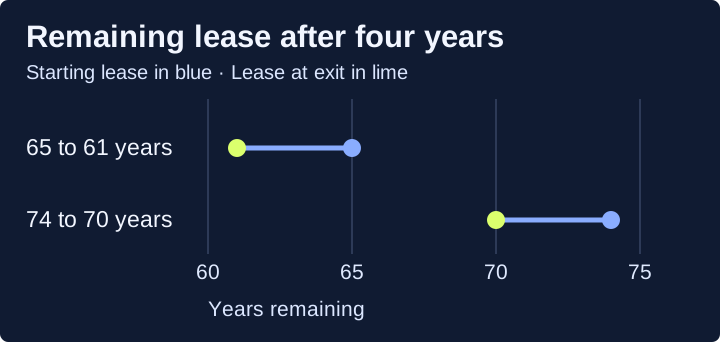
Is there a remaining-lease issue? Because for example, if you want to put a property in the market, will you get a lot of objections from potential buyers that come and view a property that they are worried about the balance lease?
Like hey, the balance is 65. If I buy and hold for four years, it will be 61.
Balance Lease Appeal and Avoiding Stagnating Capital
Or now the property is 74. 5 years later, it will be 69.
Or 4 years later, it will be 70. So buyers will always think about the balance lease.
Of course, balance lease will also translate into what is the quantum that I'm buying this resale property, what is the PSF I'm entering, does it measure against some of the new launches, the newer products or maybe a nearby freehold similar property.
So buyers will look at the balance lease and this is something that you have to calibrate because properties with so-called smaller balance lease, they will attract an older group of buyers. Why older group of buyers?
Some buyers maybe they are 55 years old. The lease doesn't really matter to them.
They might have already sold off their landed property or a condo and made substantial gains and they want to just pay off a lower quantum, older property to retire and keep the rest of the funds more liquid in stocks, equities and dividends.
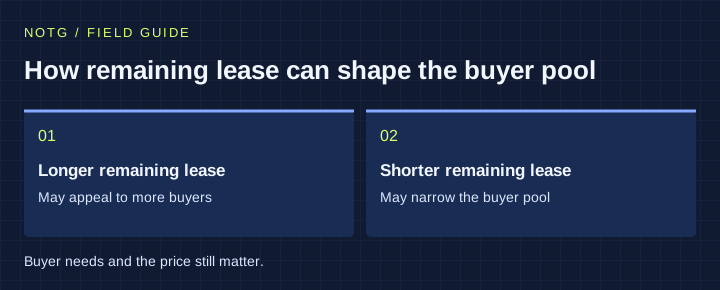
If you own a property with a shorter remaining lease, think about what I call the audience triangle. And this audience triangle means that in my framework, a shorter remaining lease can narrow your buyer audience, while a longer remaining lease may appeal to more buyers.
So this is for younger properties, this for older properties. And the audience matters a lot.
Why? Because when you have a smaller audience, you may need more time to find a buyer.
When you have a younger lease, that means you have more years to go, you attract more buyers from all categories. So this is extremely important.
And of course, the risk number three is to look at yourself as the investor. So it's my investment season.
Alright, so we look at your investment season as an investor. Okay, what is your season?
What is your personal age? What is your own age?
What is your buying power? Meaning what is your income and your age relates to your tenure?
Your buying power depends on your salary and business income. The lender considers your income alongside your existing debts when assessing what you can borrow.
So we want to look at what is the season that you are in right now and of course what is your overall plan because for example are you in the spring summer Autumn or winter season. Winter season is that you are entering towards like 55, 60, 65.
You need to plan for your winter season because my personal methodology is I wish that my clients do not hold your property all the way. You should always enjoy the fruits of your labor.
You should divest it and change it into a lower quantum property, put your funds into dividend stocks or whatever have more liquid cash towards the winter season, you should enjoy the fruits of the labor.
Now, if it's your autumn season, then you need to invest with care as well because you need to make sure that the property that you enter is a strong asset. Similarly, for summer season, you should multiply your portfolio.
In the spring season, my framework starts with the first property. Coming back to the holding-risk part of the triangle, look at the age of the property and its potential.
Maybe the property you’re holding appreciated sharply after completion. Now you notice prices are levelling off or fewer units are changing hands.
Is it stagnation, or is it still growing at a slower pace? Sometimes it can be linked to the remaining lease.
The remaining lease may be part of it. Sometimes it could also be based on the trend that a lot of people now are focusing on landed properties or new launches and stuff like that.
So growth in terms of what is potential growth, can it still go up further? Because why?
When we talk about investment-centric approach, the main methodology is that you want to build your wealth through assets. And you want to build healthy, very disciplined kind of wealth in the sense that when you park your capital into a real estate asset, which is illiquid.
You need time to find a buyer and you may owe Seller’s Stamp Duty depending on when you bought and when you sell. So for example, if you qualify to borrow 75% of the purchase price and fund the remaining 25% yourself, you want to make sure that this works hard for you.
And you don't want to park in an asset that is stagnating.
Holding Costs, Growth Potential, and Market Opportunity
Imagine you buy at $2.5 million and it is still worth $2.5 million five years later. Why?
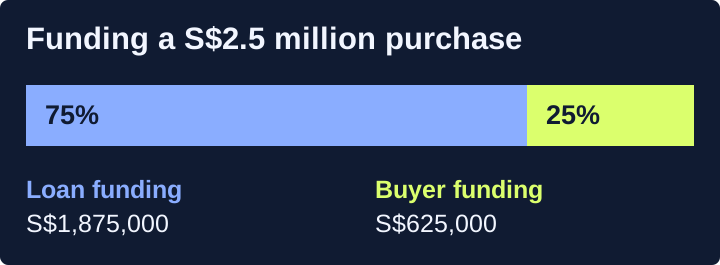
Because there are costs of holding onto an asset. You have property tax, you have MCST, you have running costs to maintain the rental or maybe to take care of the property and stuff like that.
So you want to make sure that this grows in terms of its value, let's say to $3 million after a couple of years. And you want to make sure that this is something that has potential to grow, to make sure that you can cover the cost and then see gains and ROI on your 25%.
So this 25% must make sense that you put in this asset to generate this profit over here. All right.
So you are leveraging to own this quantum to enjoy the ROI or cash on cash return.
In this framework, spring is your 20s, summer your 30s, autumn your 40s, and winter your 50s to 60s. You should make sure that this is the season that you let your capital work hard for you.
Why? Because you're building towards your winter season.
And that's the time that you wanna enjoy the fruits of the labor. You've worked so hard for so many years, you want to enjoy the fruits of labor, you should enter into the winter season with a high valuation asset.
So something that is very strong that you can divest and then you can switch to multiple portfolios, maybe buy one property pay off for own stay, no more mortgages and then another property fully pay off for rental and then maybe a pot which is like a cash reserve and then maybe another pot is just to buy some very good dividend stocks.
The idea is to spread your resources across several pots, including a cash reserve, so you can enter into the winter season with flexibility and freedom. So what is the third part of the triangle?
We talk about the first one, which is trends. Second one is risk.
Then how about the third portion here? Now, third portion is extremely important because firstly, we want to look at the trends in the market, the trends relating to the risk of our own age, our own buying power, our own holding property, the potential of our own holding property.
And of course the third one is we want to look at the overall opportunity in the market. What is the opportunity now?
In my framework, different types of property can present opportunities at different times. For example, at one point I was looking at resale freeholds.
There was also a season that we identify in this district for landed. I was looking specifically at semi-detached houses in that district.
Maybe there's a season whereby it is for new projects. New projects, we're sharing that.
Go for this big group type below this quantum above this size in this zone, in this area of growth. There are different calibrations for different seasons of opportunity.
So we call this the season of opportunity. So is there an opportunity now in this season?
And if there is, how does it coincide basically with the trend and the risk? In my experience, what looks like an opportunity can change within a couple of quarters or over a year.
I use that as a reason to revisit the comparison as conditions change. And this is very much relating also to the trends.
But I will say trends, it can be on its own because trends relate much to, let's say, how well the equity market is doing. Why is it tied to equity market?
I was also thinking about the crypto market. Some buyers take profits from volatile investments and put some of those gains into real estate.
And then of course, they will invest the rest back into market and stuff like that. But they want to see that, oh, I own this property purely from the gains of what I made in the stock market.
So sometimes there's this kind of behavior. So we want to look at the general trends, the borrowing power, the interest rates.
But at the same time, this is the opportunity on the real estate level. So on this real estate level, I want to see what is the opportunity now.
For example, one market may have moved up quickly. Now this type of property seems to be very, very cheap or it seems to have an opportunity for me to enter and make a gain.
The AB Approach and the Disparity Effect
I usually look at a three- to five-year horizon. Is there room for the second property to close some of the gap over that time?
I call this the A–B approach, part of the disparity effect. If A has moved up quickly and B has lagged, compare them against the relationship they used to have.
In the episode I used semi-detached homes in Districts 15 and 16 as an example. I was looking at whether a widening price gap could make District 16 more attractive to buyers who had also been considering District 15.
For me, the gap was a reason to do the homework and see what was available on the ground. I had discussed that example about three to four months before this episode.
By the time of the recording, I was already seeing more interest in District 16, so the earlier comparison may no longer have held.
That’s an example of looking for an opportunity using the disparity effect. Bring it back to the triangle.
You have the trend, the risk of holding your current property, and the opportunity you’re considering. Most importantly, can you create a liquidity event?
| Check | Keep your current property | Switch to the next property |
|---|---|---|
| Market timing | Consider what could change while you hold. | Check whether the opportunity is still there when you can buy. |
| Lease and exit | Consider the remaining lease and who may buy later. | Check how long a sale could take and when your capital would be available. |
| Costs | Allow for ongoing holding costs. | Work out the costs of selling and buying, including any applicable duties. |
| Fit | Check whether the current home still suits your plans. | Check whether the next home improves what matters to you. |
By that I mean an exit that frees up the capital tied up in your current property. I also talk about your name as a kind of currency.
Who already owns the property and who has an outstanding loan can affect the options you have for your next purchase. Check what a sale would change before you commit.
If the exit takes six to twelve months, opportunities you’ve identified can pass while you’re still waiting. Plan the exit alongside the purchase.
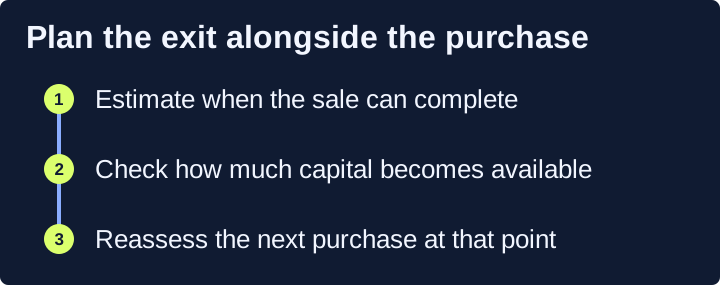
The whole point of looking for a next stronger asset is to ask whether your capital could work harder after you account for the cost of the switch.