Market and policy
What Happened When I Timed The Market - My Mistakes and Lessons In Real Estate
Published 2026-11-29. Adapted from the episode published 2024-02-16. Figures, illustrations and data reflect the episode’s original publication date.
What Happened When I Timed The Market
Let's wish all the dancers a wonderful Lunar New Year! I hope it's a great first.
Wish everyone a healthy health! Every year, there's a...
Long year's day! Hey, don't give me that!
Wishing everybody all the wonderful memories and wishes for 2024 and thank you for supporting N.O.T.G. channel!
Hoorah! One, two, three!
D.O.S. D.O.S.
D.O.S. D.O.S.
D.O.S. D.O.S.
D.O.S. D.O.S.
D.O.S. D.O.S.
D.O.S. D.O.S.
D.O.S. D.O.S.
Alright, welcome back to NOTG. Before we start, we just want to thank all our supporters and audiences that have signed up for our NOTG free telegram channel.
So if you have not seen some of our ads on our new telegram channel, please click on the link below. This telegram channel basically is for our NOTG community.
You can just enter, you gotta see all the other members right inside the NOTG group. Basically it's for us to chit chat a little bit.
And of course all our NOTG call teammates will be there as well. We'll do our best to of course just to chat with you whenever we can.
But of course you guys are free to chat among yourself just to discuss about anything related to real estate as well as our content on NOTG channel. So just want to thank everybody for the support for Nuggets On The Go.
Over the years today, we're going to talk a little bit about one part of my painful journey. If you have not seen this episode previously, it was an episode that I talked about my entire journey all the way when I started when I got married in 2004.
Back then I looked really like an out-being. Please help to flash the picture a little bit.
After I got married, I was transformed by my wife. So, and then of course subsequently we have children, four kids now.
My first home was a HDB 4 room with just three months of pay slip. I went to buy a resale flat.
My wife just started working as well. I started working as a prison officer which just three months pay slip and
of course thankfully with the government HDB CPF grant, we got our first home with almost zero down payment because everything was paid off by the grant for the first set of down payment and we took a HDB loan.
If you have not seen that episode, just click on the link below. That'll bring you back to the episode couple of rounds back.
Now, I want to focus on this part because there was an audience that has asked me about this question. That was the portion also that I left out previously during that episode because it will be too long to talk about that.
So I want to touch on this portion right here. The most painful part of my journey actually was here when I bought the HDB jumbo flat.
This home during a previous episode, there were no regrets on doing that. In terms of happiness level, I would like to talk about two main frameworks.
Number one framework is that when we buy a property for our own stay, the first fundamental base framework,
maybe let me just draw a triangle. Can you all see the triangle?
Okay. The base fundamental framework is that we should not time the market because we're in Singapore.
If we're in overseas, where by 50% of the demographics usually are renting properties. For example, let's say you go to Bangkok.
Bangkok, a lot of citizens from all over Thailand, they come into Bangkok and then of course they rent because they want to work there. There's a lot of existing localized tenant demand.
And that's when you buy a property there, of course, it's very easy to rent out. But of course, it's a very different demographic because supply is of a different level compared to Singapore with very fixed land and scarce land.
So when you look at Singapore with 90% whole ownership rate, the way that we look at the residential market is very different because nine out of 10 people own properties here and if you do not own a property basically it's very easy to be priced out.
So do not time the market.
I made a mistake right here. I time the market and of course I suffered a loss here because the market actually shot up after six months of Lehman brothers that happened in 2008 October.
2008 October, the market actually crashed. And of course, when the market crashed, by 2009, around March to April, the market picked up on an accelerated phase.
And of course, back then, I thought that the market will start to go down again, but actually it didn't. And I tried to time the market.
Back then, I also shared that because I was very focused in doing sales in the real estate business as a one-man realtor. I didn't really spend time to understand, to read up, to learn about property investment framework.
The main mistake was here in the sense that the second thing is on your happiness index. What is the happiness index when it comes to buy a property?
Happiness index is the index that you and your family in terms of a preference level priority will feel happy or not happy
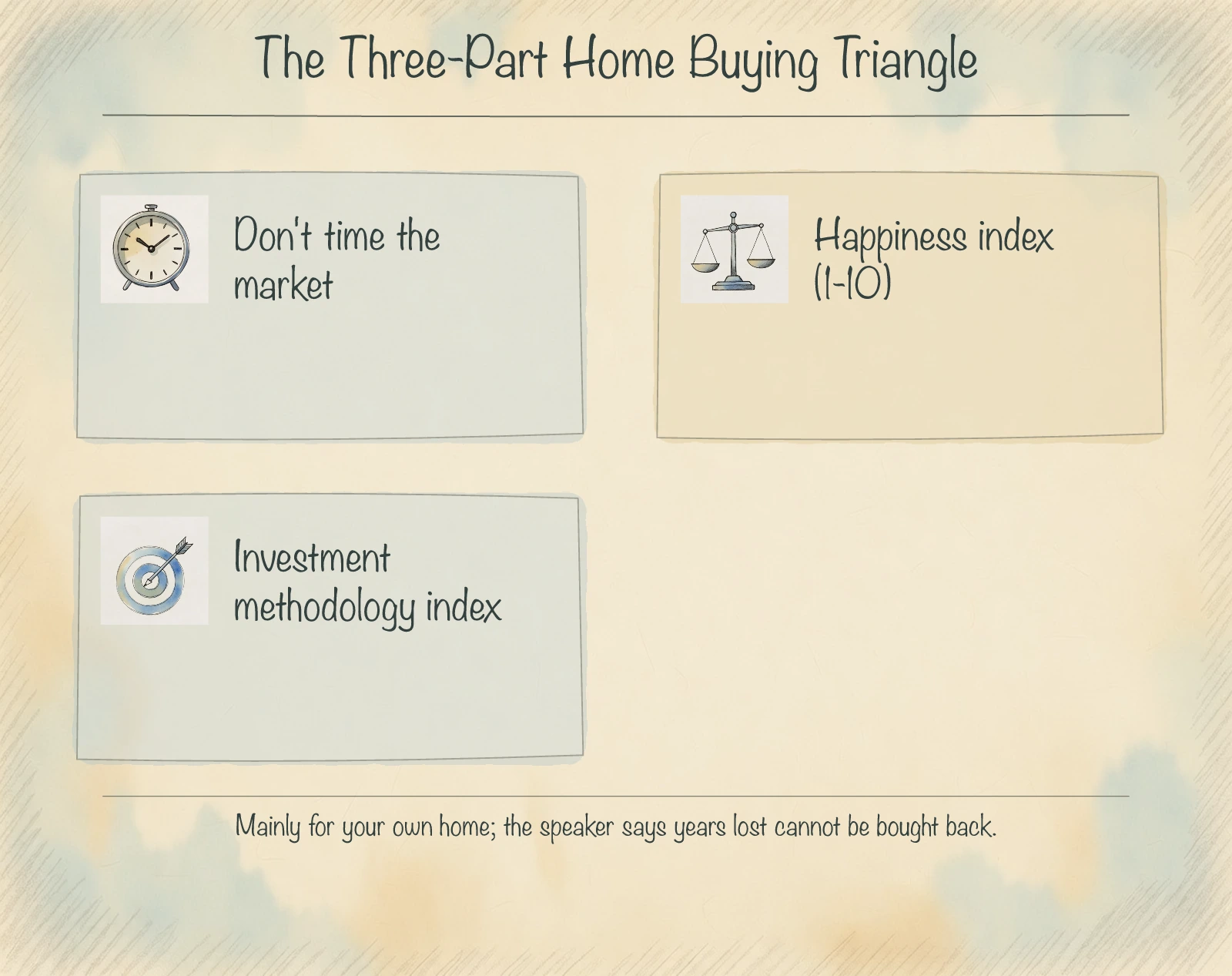
On a scale of 1 to 10, so your happiness index is from 1 to 10, what is the happiness index of buying this property?
I feel very happy buying this jumbo flat because there are 4 bathrooms, 4 good-sized bedrooms and of course my family is on a single level, my kids grew up there, we enjoyed the entire time all the way from 2011 until 2019 for a full about 8 years.
That decision back then didn't factor in the third part of the triangle, which was the investment methodology index. Now, the rationale is because of this: if you do not factor in this, of course, naturally, you can't enjoy the property.
But sometimes, if you didn't take this into consideration, this might be a property that you live in, but you defer the opportunity for your property that you're living in to see capital appreciation. And time is something that we cannot buy back, which is why we don't time the market.
Now, these eight years, I can't buy back already.
Of course, during this eight years journey, I co-invested with some friends in residential investment property. There was also another question to ask me what this property is about.
I'll make this in another episode. I also made a mistake with buying an overseas property, invested in a commercial property, which until today I can't sell because there's just no exit demand.
Then of course, subsequently I'm not going to sell this property because this was a very good property. I made some gains here.
But though I exited in 2019, there was an eight years period that technically I cannot buy back anymore. This eight years also were the period whereby I have some of the increasing buying power as a home buyer, in the sense that my income level was increasing.
I was still young. Loan tenure was still long.
Of course, I'm not very old. I still have quite a long loan tenure period to go.
But compared to back then, this eight years, I cannot buy back.
Now why is it so? This theory, let me share with you using one of the case studies that we did in one of our webinars.
This was one of the 18 webinars that we did last year. We did 20 in total, 18 were webinars, two were live debates that were done in our PLB office.
So this year round, just a quick sneak preview, is that we're also going to have webinars every month. We're also going to have live debates as well.
So do click on this link, go to proptimeras.com. So there's a webinar tab.
You're going to see this webinar tab. Click on it.
You'll be updated of the webinar dates. So there's also a replay on 29th Feb on our expansion strategy as well.
But I'm going to give you a quick preview on what we talk about during one of the case studies in the expansion strategy. So this was a case study that I shared.
It's called the power of investment, leveraging your first property for future expansion.
Now this was a case study of a homeowner that we successfully have helped. So this couple, they bought this DBSS direct from HDB.
Of course DBSS is still launched by HDB but just that it was constructed by a private developer, but this scheme was scrapped off already. That was in 2010.
They bought a 735 [sq ft?], after 4 years of construction that was 2014, plus 5 years of MOP 2019, as you can see here. When they sold it and they sold through PLB, we sold for them at $928,000.
At the year of 2022, we went back to review the price. Average price of the property was about $960,000 but of course now it has crossed a million.
This is 2024 already. Why is this important?
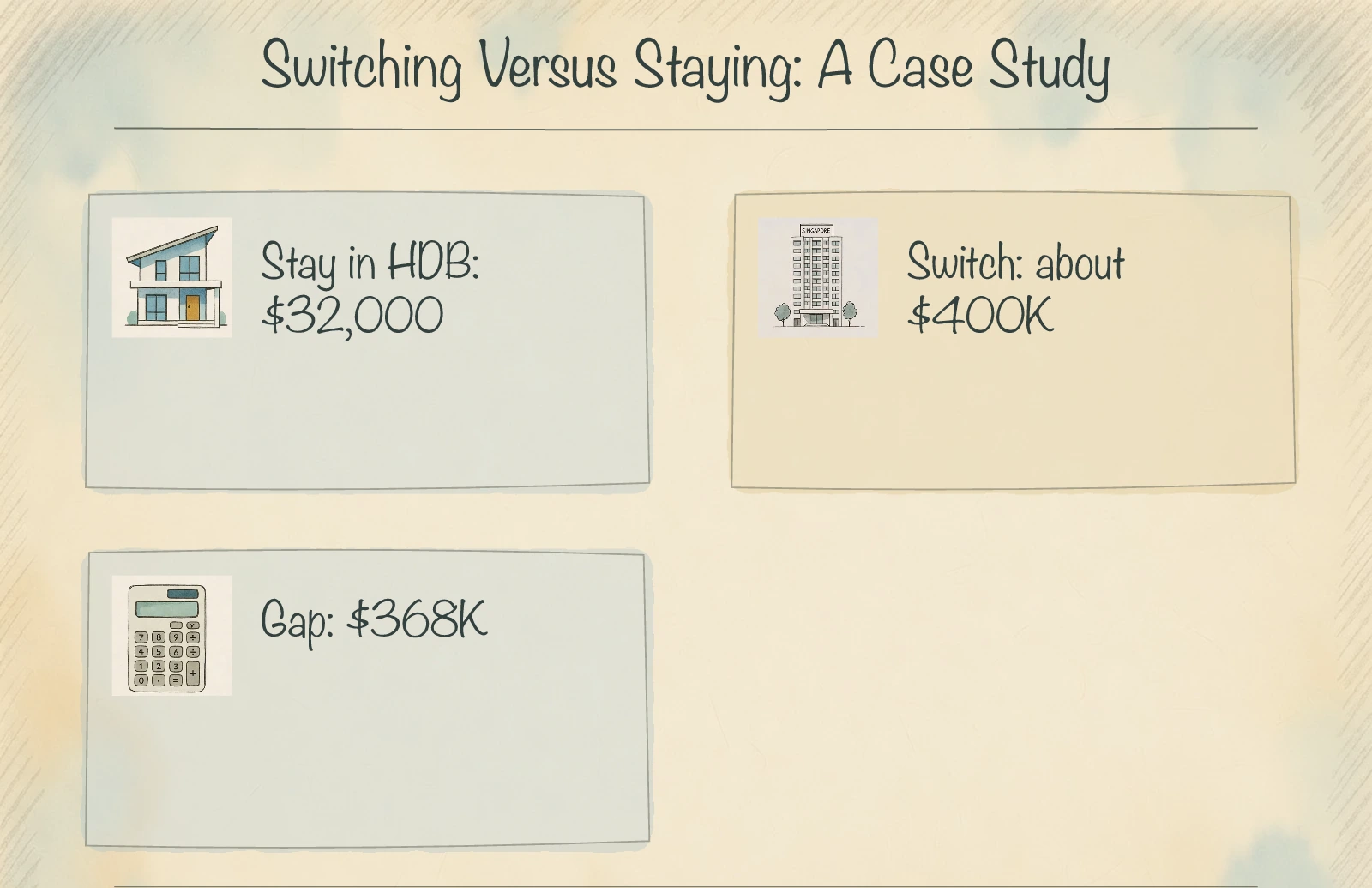
It's because if they had not done the switch, they would have lost $368,000. Now why is that so?
Because when they did the switch in 2019 to the new property, and this was Sterling Residences back then. Sterling Residences back then, it was
about $1,006 plus PSF where it was launched. People were also saying that wow, at the year 2019, $1,006 PSF is like a new benchmark as well because it was like quite a high PSF level back then.
People were a little bit concerned but of course the sales still went on and eventually it was sold out. It's now of course a very successful project.
They bought a 3-bedder compact at 1.735 million and at the year 2022 when we reviewed back the price when the TOP was 2.135 million. And of course today we already helped them to sell off this property, they have already cashed out and of course went to buy a bigger property already.
Now if they have stayed on with the initial HDB in year 2022, basically they will have seen an appreciation in the HDB at $32,000 more. But they will have lost out on $368K because this switch technically made them $400K in terms of capital appreciation.
So that is what we mean in the fact that when they made a decision back then to exit, they
Actually, they would have had a higher capital gain back then by reinvesting and leveraging the first property's capital profits for dual expansion. So of course, eventually, this was what happened.
For us, we also showcase some of the key statistics on the unit that had been exited. Now when we look at this, this was their sequence, their portfolio flow.
So they bought in 2010; they were a young couple back then, their earning power was not that much. In 2019, their earning power had increased.
So after that, they went to buy a new project, TOP, rented out for a year, sold after they rented out for a year, re-bought a new resale at a bigger unit. So this was their portfolio.
And of course we're consistently helping our clients to plan their journey as well, depending on the market trend and market cycle. So back to basically my story, why is it related is because of this.
If I were to just share with you, during this portion when I bought it,
I bought at 567,000. So this was like a jumbo HDB, but back then I was contemplating this or, I still remember it's about 600 over 1000 later, I'll just go into the price.
I was thinking about buying a D19 condo, 600 over 1000 back then, because I didn't do my homework. I didn't understand the fundamentals of real estate investment frameworks.
I didn't invest time to learn. I didn't have that confidence.
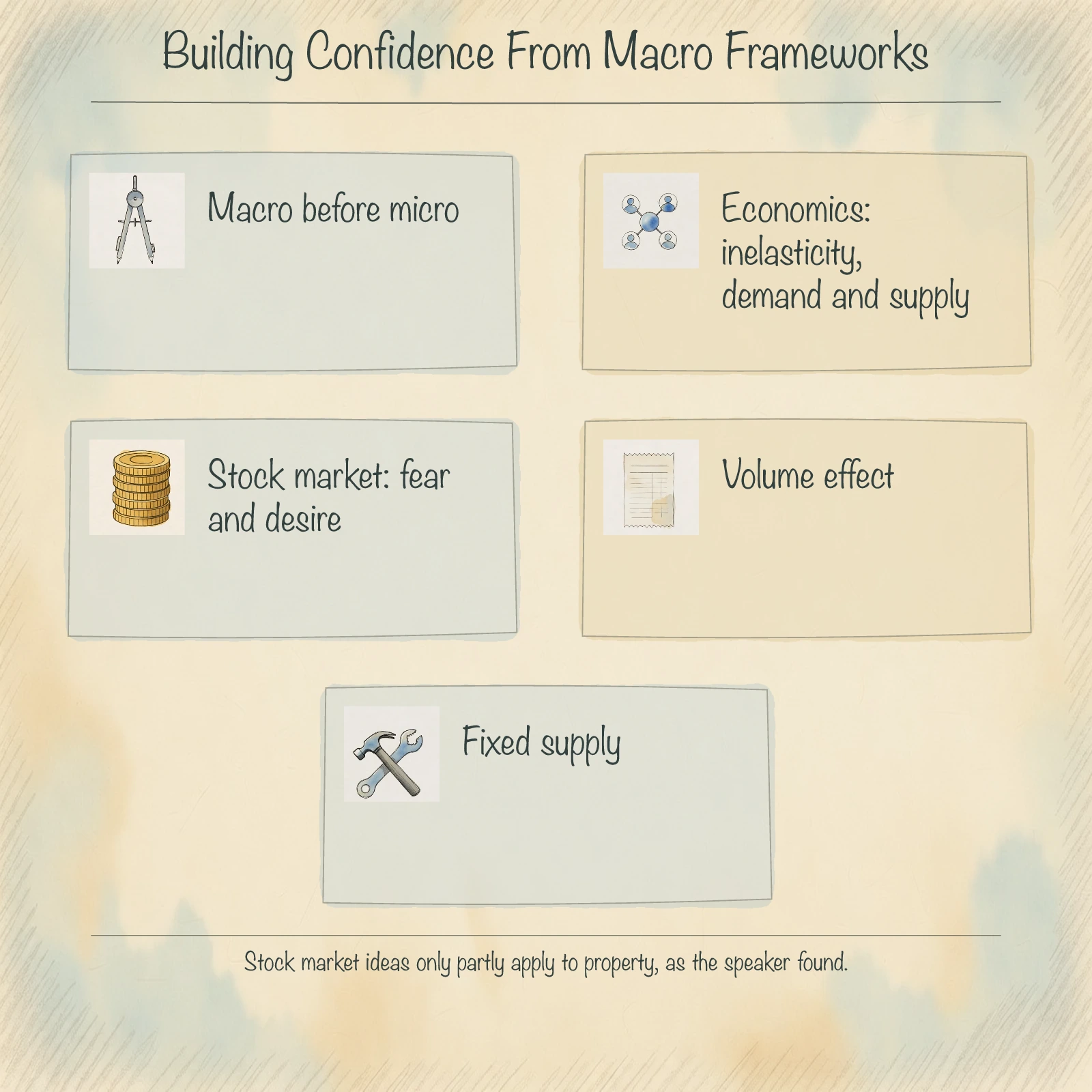
I don't know about macro, I don't know about micro investment framework, which is why every time you end up teaching, you talk about macro first, then we talk about micro. Because if you don't understand macro frameworks, you don't have the confidence to invest based on micro frameworks.
Because if you don't understand the entire demand and supply situation in Singapore, you naturally don't have the confidence to go into any private residential properties. If you talk about landed property investment or just condo investment, you will already begin with a fearful kind of mentality.
So eventually, once I surpassed that stage, why is it that here now, after I started PLB — and that was in 2018-2019 — I started to really chart out my entire personal property portfolio journey, and I bought residential property in 2019, bought another investment property in 2022.
And of course, in 2022 and 2023, we bought four industrial properties plus one overseas property. My goal now of course is that every year I want to look at some level of investments.
But most importantly is that I started to understand and I started to combine certain frameworks that have already existed in the market. For example, I started to go very deep into certain economics books just to understand more deeply about inelasticity, demand and supply.
I started to take certain frameworks from the stock market as well, just to understand what is the fear and desire kind of mindset and index, and can we really apply whatever happens in the stock market to real estate, and I realised that we can't do that.
But of course, there will also be learning
points on dividend play, how certain frameworks can actually be applied to a rental play kind of concept as well. Volume effect in terms of certain transactions of certain stocks, why is it that when popularity happens, certain stocks behave differently.
And similarly, why is it that certain condos, even though it's 99 years, when popularity happens, they tend to outperform even smaller freehold projects with low volumes. And that's how we started to craft out volume effect.
And of course, I also combine another framework, which is on the fixed supply framework ratio from certain kinds of alternative assets. Using that framework of Bitcoin, why is it that Bitcoin having a 21 million fixed supply ratio, how does it affect the popularity and the demand level towards that fixed supply?
And if you look at, of course, Singapore, landed properties, 73,000, it has almost been fixed for the last 5 to 10 years. When you look at condos, now we are at about 360K.
We add on about 10,000 every year of new launch
through government land sales. Even for 2024, you look at the government land sales, first half plus second half add up is also about 10,000 units plus minus.
And then when you look at HDB properties, now we have 1.2 million HDB, but we are adding on supply through BTOs. So how does that supply index affect the overall investment for you from a macro standpoint?
So once you understand that, then we combine everything together, then it allows us to invest with confidence. So this basically — when I was selling my jumbo, I sold at about $650,000, though that was a gain of about $90K.
But actually, you cannot see the $90K because of course, like stamp duty, you already invested for renovation over here, I spent about $100,000 doing renovation. So technically, it's a loss-making property.
But I'm very happy that in terms of happiness index, my kids grew up there. I'm happy there.
But if I would have learned property investment frameworks at the start, I would definitely have went here, because with this
My Own Market-Timing Mistake, and the Frameworks That Would Have Changed It
A 3-bedder, or maybe I would have bought like a 4-bedder back then. A 4-bedder was only about 800 over 1,000 in this condo.
If I were to sell that 8 years later in 2019, the appreciation would be very different. Let me just show you what condo is that.
Back then I was looking at this particular condo, which is Rivervista, all right. So back then, when I started looking at the 3-bedder in that particular condo in 2010, I didn't make the decision to go for it in 2011 because in the early part of 2011 I went to the HDB jumbo already.
So back then in 2010, when I was looking at it, a 3-bedder cost, you can easily get something — oh, okay, it was actually 700 to 800 over 1,000. Sorry, I made a mistake here.
It's about 700 plus K. Of course, nowadays you cannot see this kind of pricing anymore.
Okay, so a 3-bedder was 700 plus, 800 plus. I think a 4-bedder
back then should be about 900 plus over 1,000. Okay, so let's just take that range.
If I move forward all the way to 2019, that was the capital gain of 90K for this HDB. And of course, when you look at that, this could easily exceed about a million.
So the capital gain was about 200 over 1,000 compared to 90,000. So back then, in the whole real estate cycle in Singapore, this period was actually on a very, very, very slow growth, because there were a couple of things that happened in between.
In 2013, it was the switch towards smaller-size units after TDSR. And of course, 2013 and 2016, the entire market was in the peaking stage.
Only after 2016, after QE happened in the States, after the subprime crisis, then prices started to move up globally in terms of solid assets like real estate. So of course, if you see the difference from 90,000 compared to like a 200 over 1,000 gain, that is a huge difference technically already.
And of course, take note that when we sell off this property back then, if I would have sold that condo at a million, by that time when I sold it, probably, for example, maybe the outstanding loan is about $400,000, $600,000 cash out from cash and CPF of course, then in terms of the next property quantum, it would be very different already.
That's just an example of my own personal painful journey. It's quite similar to the case study I showed just now on travellers, is that they have taken action, I didn't take action.
And of course, why am I sharing with you this? And why is it that we love to share case studies, even my own case study, is that we are all learning through the journey.
And I don't want you to walk in my shoes in the sense that if you still have a long bandwidth to go, and let's say you are in your early 30s or maybe mid 30s, or even now if, let's say,
you are in your early 40s like me, or maybe you are in your late 40s or maybe early 50s, there's still time to make certain correct decisions by using property frameworks. We just came out with a new syllabus.
Now first, this syllabus is what I call the property investment framework syllabus. What we're going to do is that this is also to be launched in conjunction with our PLB assembly.
So PLB assembly, we are going to launch in 2024 one of, I think, the first very important masterclasses that we're going to launch. And of course, let me just show you.
So these are the first few sets of masterclasses that we have crafted, because they are core series for realtors, they are also core series for property investors. And how we're going to do it is that this will all be launched in masterclass format.
This is going to be like the school of real estate. We were very excited for this launch of this new school under the PLB brand.
The first two things that, of course,
I would love to share with our audiences is that if you would sign up for the masterclass, I think the first thing that we want to really share with the market is really about investment frameworks. So it's going to look like this.
Let me just share with you a little bit about how this will look like.
Basically, these are going to be all the different kinds of investment frameworks, macro and micro, how to select properties, how to look at certain properties with a higher level of capital appreciation factors and characteristics, how to utilise our PWA model analysis, trifactor frameworks and of course a lot of different things to look at.
And this is going to help you with your journey as a property investor in Singapore. And we're also going to have one of the masterclass workshops on property expansion strategy.
Some of the masterclasses will be catered towards realtors in Singapore, some of the masterclasses will be catered towards property investors in Singapore. We hope to see you on some of our masterclasses very soon.
Wait for the details. The new website is under construction now.
It's going to come up very soon. We'll release more details.
So thank you for supporting PRB on our journey as well to add more value through education through evidence, through masterclasses, into the real estate industry in Singapore. Alright, so back to today's episode.
I think the key takeaway from today's episode is that here is that based on that framework of the happiness index, the investment methodology index as well as the core fundamental characteristic of not timing your property, especially if it's like your main residential property.
I think with that, it will be easier to make decisions if you combine macro and micro understanding of frameworks as well. So that's for today's episode.
Just using my illustration of my own case to share with you some of the key pain points. And I hope that you can avoid that as well.
Because even from moving from 2024 onwards, sometimes as we look back, we just need to understand the level of supply versus the level of demand in Singapore.
Population is still increasing. We're still on track to 6.9 million by 2030.
And I was looking at all the URA master plan, expansion plans, a dose of our transportation transportation network, a more expert tricks coming to Singapore, a more naturalized citizens coming to Singapore as well, and a more liquidity coming to Singapore as the main global financial centre in the world.
When we look back 5 years later, let's say by 2030, 2029, we look back, I think we'll realise that actually some of the PSF level of certain condos, apartments, leather properties today, when we look back, we'll be thinking, hey, I should have taken action in 2024.
Of course, I'm not saying that you should buy anything. You need to, of course understand that not every property will see capital appreciation.
We shared that a lot of times during our NOTG, during our webinars, you don't just go in blindly.
So once you understand that, you're ready to go in, do your homework, understand the framework, select the correctile properties because certain new launches, see appreciation, certain new launches stagnate, certain resale condos see appreciation, certain resale condos stagnate even for landed properties if you don't buy the right one at the right time.
When you want to exit, you'll find that is very painful to exit because there's too many disadvantage inherent factors. Watch this particular episode, the one that we walk through, reject our builder on how to select a property if you want to plan for rebuild.
Then of course last but not least sign up for our NOTG telegram channel. We hope to see you there.
Meantime, take care. Okay, why can't I screw it with Miran?
Because if you don't understand macro, you don't have the confidence to go macro. Sorry.
So that's for today. So that's for today's