Buying and upgrading
What Does It Take to Grow From HDB to $6.5M In Value?
Published 2026-11-17. Adapted from the episode published 2025-11-14. Figures, illustrations and data reflect the episode’s original publication date.
On this page
Diversification, Discipline and Avoiding Stagnant Assets
Diversification depends on the amount of time and knowledge that you want to invest in a particular asset class. We need to understand the psychology of investing, which is which one will allow us a disciplined approach not to touch the investment too many times.
Real estate is a very disciplined approach. So it's very suitable for people that wants to have a disciplined approach of not touching and trading on your asset based on the price movement on a very rapid fashion because sometimes you can make wrong decisions.
Today we're going to talk specifically about this topic which is how to turn our portfolio from a starting point in real estate and predominantly 80% of us in Singapore all starts from the BTO route or the resale HDB route.
Of course another 20% they start directly from the private property route, be it from various kind of seasons — maybe you started off with a condominium, you started off with an EC, you started off with a landed property, you started off with some inherited properties from your family.
But be it whether you are starting from which point, we want to start from the most fundamental rock first, which is from the BTO slash HDB resale route, which is why today's webinar topic is how do we transform an $800,000 portfolio in real estate to a $6.5 million portfolio now.
Very briefly, I want to share with you this terminology called the equity triangle. In the last three to five videos, I talked a lot about this concept called equity triangle.
I shall not spend too much time on today's webinar because we only have about an hour review.
We're going to really deep dive a little bit more into the concept of how to expand our valuation of the properties that we're holding in our portfolio or how do we structure this asset class and a backdrop is that let's come to this screen.
Now I will talk about the fact about diversification.
Diversification depends on the amount of time and knowledge that you want to invest in a particular asset class. For some people they want to be multi-diversified, they want to have a rested portfolio, they want to have a dividend portfolio, they want to have an equity portfolio, they want to have bonds and fix D and stuff.
Some people like multi-dimensional diversification. Some people just want to focus on their professional and business and then depend on real estate itself.
Some people don't even want to touch real estate. But I think the very important thing is that you should only diversify into various asset class based on what you have knowledge in.
Because most of the time, if you are too diversified, for example, if you want to diversify into property, maybe this is for your own stay. And then you want to have like an investment property.
And then you decided to go into, for example, cryptocurrency, right? You want to go into, let's say, equities, S&P 500.
Now, sometimes we need to understand the psychology of investing, which is which one will allow us a disciplined approach not to touch the investment too many times.
Because sometimes when we are in a season of looking at the pricing on a day-to-day basis, for example, let's say if it's equity, it's a very liquid kind of investment because you can enter and exit very, very easily.
Once the market is open, cryptocurrency is trading 24-7. You can enter in and out very, very quickly.
But real estate is a very disciplined approach.
So it's very suitable for people that wants to have a disciplined approach of not touching trading and trading on your asset based on the price movement on a very rapid fashion because sometimes you can make wrong decisions to exit when the market is still going up and you enter when the market is still going down.
So this is really not talking about very liquid investment. This is more suitable if you want a very, very disciplined approach.
And sometimes the disciplined approach can help us who are very busy professionals or busy business owners because you just want to set your investment and we call it the set and forget principle.
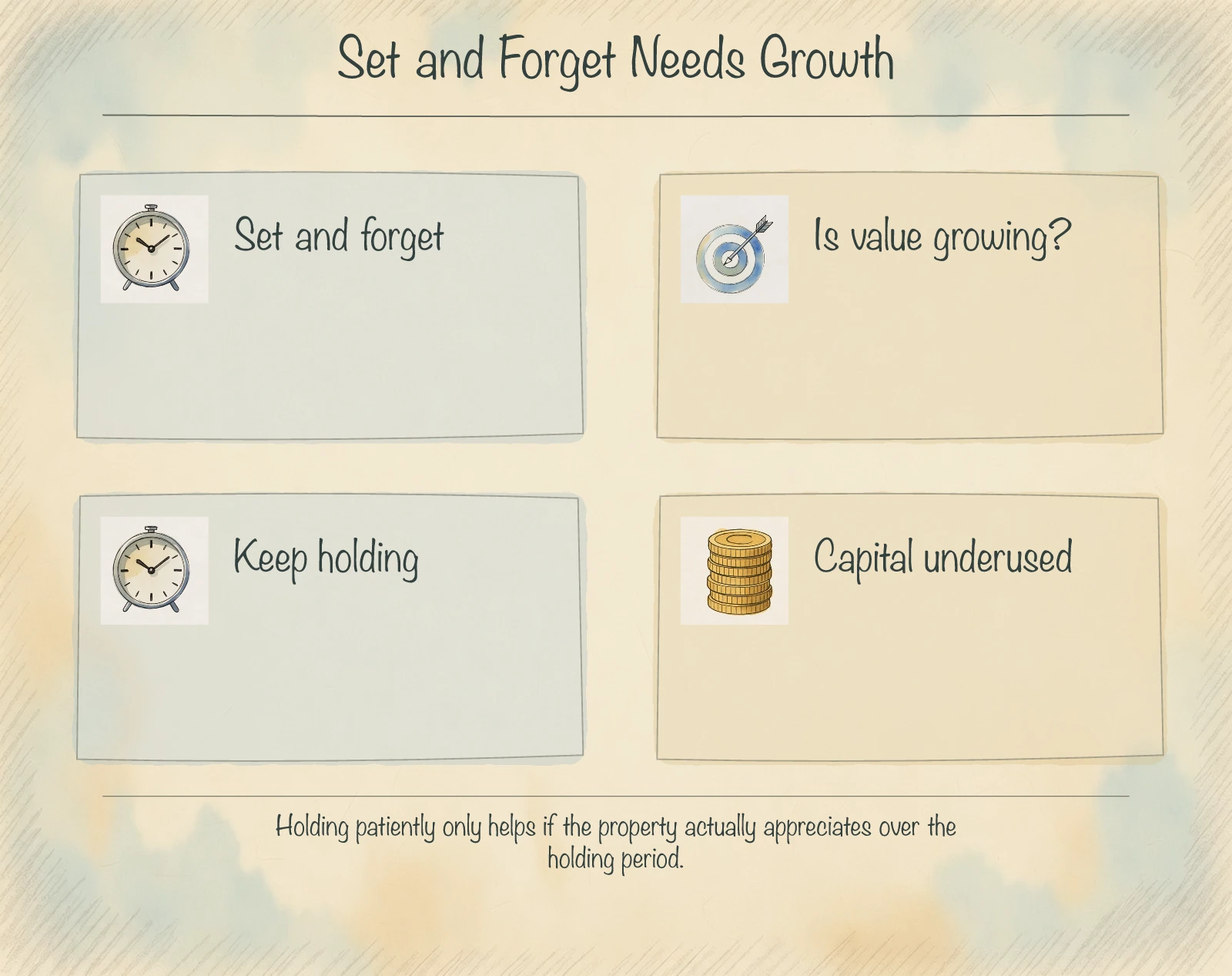
Set and forget but then the kicker is that for set and forget kind of terminology, this is a principle when it comes to investing in real estate.
But the kicker is that you have to go through what is a real estate investment that is not stagnating because the moment you invest in the stagnated assets that let's say in the next 4 to 6 or 8 years is stagnates in terms of its valuation it does not appreciate or it appreciates very very slowly.
Then technically speaking this investment is not working well for you because you are wasting your opportunity cost, you're not letting your capital work hard enough for you. That means your capital is not working hard enough for you.
And this can be deployed into other stuff like dividend stock in order to gain a better you. So the most important fundamental principle is that
Set-and-Forget Real Estate and Equity Growth Targets
When you want to invest in real estate, you want a set-and-forget kind of instrument so that you don't touch it too many times. And then four to six years later, when you wake up, your investment has appreciated and you want to build your portfolio valuation, and you should hunt for properties with appreciation potential.
I talked a lot about this concept, but for today, let's come back to this screen here. So how do we then calibrate our portfolio so that we can grow it?
So let's have a look at this example. For example, this family started from an asset value of $670,000.
And then in fact, when they went through this entire route, there was an in-between route over here. Now, this in-between route basically allows them two condos, and then subsequently they went to one landed property.
Of course, this landed property's plan for this family is that they want to hold it all
the way until it hits about $5.8 to $6.9 million. And the rationale for doing that is because they are after the very disciplined approach of living in the property, because property gives you a utility value to stay in the asset.
You enjoy the asset, your kids grow up with the asset, and you enjoy the space of the landed property. They want to enjoy that while the asset grows in value based on just a 2% growth non-compounding.
All right. So we're just talking about asset inflation, just based on 2% per year, hold it from age 39 all the way to 55 or 65 to expand this equity triangle.
Now the reason this triangle can expand is because of a few reasons. Number one, because of 2% inflation.
And if we look at property price indexes, property prices increase between 2% to 6% per annum, be it a landed property, HDB property or condo property. But of course, because HDB and condo property, if it's a 99-year property, you need to take out of this
concept called balasker, but that's a whole topic together. But let's say for example, this is a landed property.
The main ideation is that this can expand to an equity triangle that allows your mortgage to decrease in terms of its outstanding loan and allowing your equity to build up. Now this equity is built up firstly by the inflation.
Number two is by your contribution to the principal amount based on the money installment on a month-to-month basis. Now this will look very differently if you have two properties and you're renting out one and you're living in one.
So let me just very quickly talk about all this concept, because at the start it might seem a little bit complicated, but once I break it down to you in numbers, then it will start to make a lot of sense.
But maybe let me just share with you a few case studies first. All right, so firstly the framework that we always deploy is that we have a multitude of frameworks.
The most important thing is really to go for freedom and choice once you are 55 years old onwards, because once we are 55 onwards, we perhaps want to do and pursue things that give us a bit more freedom, or to travel a bit more, spend time with our kids, our grandchildren.
We want to travel the world, we want to do maybe volunteer work. You want to really spend a little bit more time pursuing other passions and interests.
Of course, the key fundamental ideation is that if you don't have passive income that comes from a very strong asset income, sometimes it's a little bit hard to have freedom and choice, because that means that you still have to depend a lot on active income.
And we use this 11th or 12th investment methodologies. Of course, our investment methodologies, they grow on a year-to-year basis.
But the main ideation is that we want to really deploy our active income on the very disciplined approach to enlarge this asset income to be a bigger and bigger asset class.
And that is what we mean by increasing and improving your valuation portfolio of the properties that you're holding. So rather than me holding — let's come to the screen — rather than me holding onto my $800,000, $1,000 HDB, I want to see if I can, during 25 to 55, expand it to let's say like a six-and-a-half-million-dollar portfolio.
All right, why six and a half million? It doesn't need to be six and a half million.
It can be five and a half million, it can be four and a half million dollars. It really depends on various mechanisms.
For example, your earning power, how much good debt leverage that you can take in terms of a mortgage, what is the down payment that you have, but there's a step-by-step process to hit there once you're approaching towards maybe your 40s or even into your 50s.
But the key ideation is that by this, can I achieve this by age 55 to 65 so that I
Daniel and Sherry's 17-Year Property Journey
Can then have some choices and come back to the screen here to really not depend so much on my active income, because my active income sometimes can be unpredictable. And once I'm 55 to 85, once this active income disappears, I want to be able to enjoy the equity inside my asset portfolio.
And so, for example, Daniel and Sherry, this family, we journeyed with them for the last 17 years. Started off with their HDB.
I was the one to help them to purchase their HDB in the first place, and then after the MOP period, they took a HDB resale ground and then they exited for around the range of 500 over 1,000. Now they went through a secondary route in order to build their valuation first.
They didn't go straight into landed property. They actually went into a two-condo approach, and later let me show you why this approach is actually very powerful, it's a very good stepping stone.
And once they go into a penthouse for their own stay, because they needed the space with themselves and the kids,
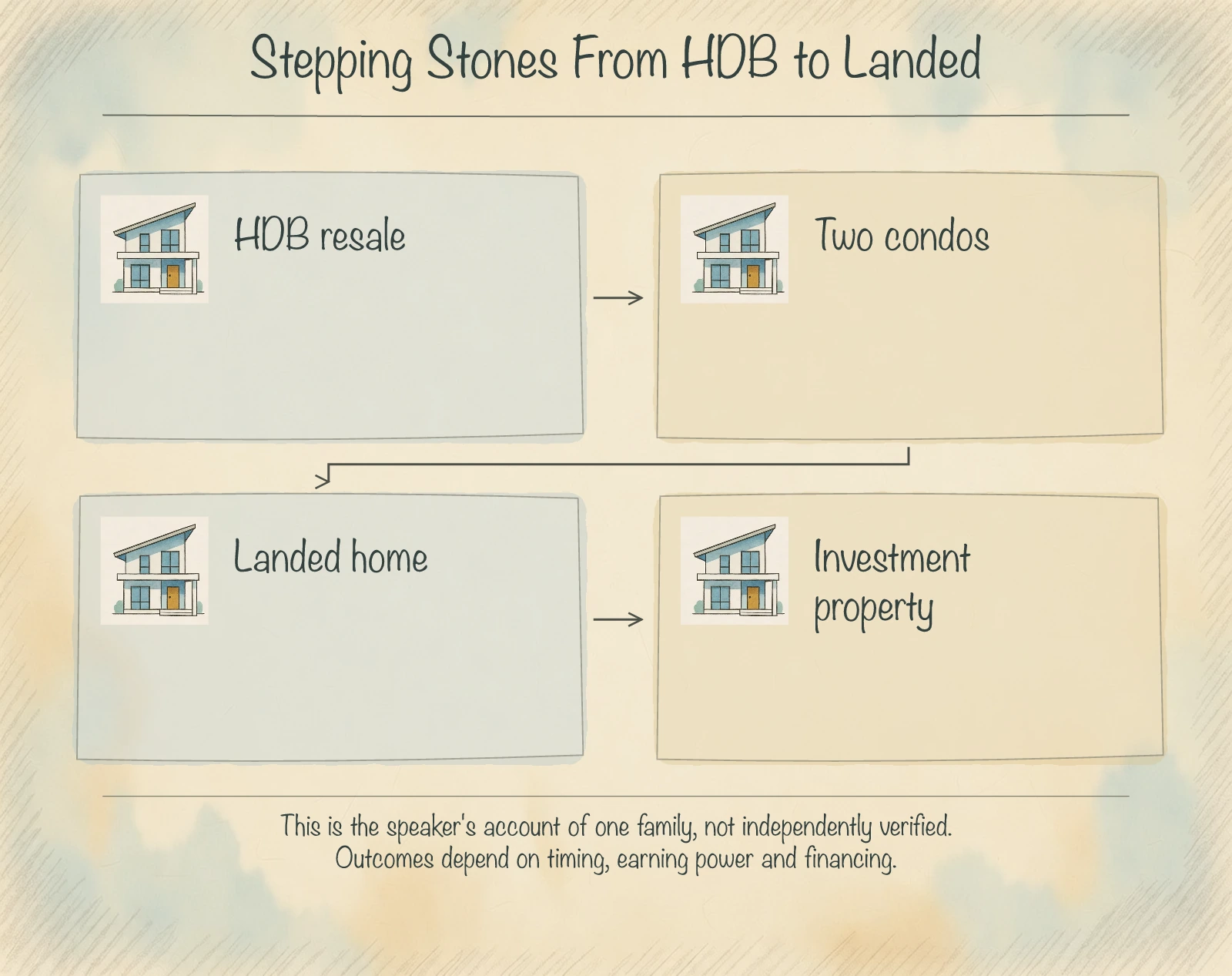
they also purchased another 3-bedder resale for rental, and in combination they then shifted from a $500,000 HDB and improved it to a valuation point of $2.3 million. They held on to these two properties for a couple of years.
Once it settles the seller's stamp duty period, they managed to exit it in totality at about $3.2 million. So these two properties started at 1.3, appreciated to 1.65; they bought a $1 million condo, appreciated to 1.55, and then they exited at $3 over million.
That allowed them the capability to shift into a landed, and they entered into a landed at 2.85 million back then, pre-COVID, and then now it's worth about $4.8 million. And subsequently, after they stabilised, they invested in an investment property and now their total portfolio size is $6.5 million.
Now once they have achieved this, actually their methodology is following our PLB framework in the sense that they're hunting for high growth, high rental yield either in the condo space. Landed space is high growth, low rental yield, but this has very good capital
appreciation. So basically what they are trying to build is to shift into this zone here.
So now they are around the age of about 40-40 odd. The total valuation just based on the landed property is about $4.8 million already.
If I were to add on to their condo purchase, they already have achieved a $6.5 million portfolio at this point in time.
Now once they go into their winter season in the 55 to 65 years old range, now if assuming the property they invested at 1.7 becomes $2 million or $2 over million, then they will have formed maybe about $8 over million in terms of total portfolio size.
So what are they going to do with it? Once they hit into their winter season, is that they can deploy into four different buckets of income that generates passive income.
So I believe that we should divest the property once we are in our winter season. There's no real need to hold on to your properties unless you have a lot of
properties. But if you want to really enjoy the fruits of the labour from the two properties that you have, you should divest it into properties that are lower quantum, older properties.
You can pay off an HDB, you can pay off an older property and stay and enjoy the space. You don't have to invest in very high quantum new properties.
Because at the end of the day, what you want is go in low quantum, enjoy good rental yield, one for own stay, one for investment, no more instalments, pay them off, and then enter into dividend kind of gameplay, just to enjoy very consistent dividend stocks.
And with this plus your rental property, you can still keep a good sizeable amount of liquid cash. So when you enter into this kind of season, even if let's say they want to press the button at age of 55, they can still deploy it into this four different buckets approach.
Alright, so with that as an introduction, let me just kick
start with the first case study. Now, I just screenshotted this from PropGuru.
These are not my listings. They are not my team's listings.
Basically, I just want to share like on a very generic asking price approach, what is this very popular condo commanding. So this is Parti Star, very good performance condo right beside Eunos MRT station, very beautiful project as well, and a lot of the owners they have made gains from investing at the first-hand owner when it was launched.
Now, currently the 3-bed 2-bath version for this listing, this is 958 sqft, there's a listing here asking for $2.37 million. The rental for a similar size 926 sqft is asking for $6,500.
So of course, these are the asking prices. Usually owners will ask for higher compared to the last done, but we still need to check the last done.
And let's say if I go to check the last transaction, there was a unit over here in September contracted date, it was done at 2.3 million 926 square feet
Checking Last-Done Prices and the Fair Game
3-bed 2-bath. Alright, so 2.3 million just now that listing was asking for 2.37.
Maybe if you were to make an offer for this listing, you can lend yourself at about 2.35. I'm not sure.
Alright, it depends on negotiation with the seller and the seller agent. And of course, there was also a big unit, 1,000 square feet odd 3-bedder, rented at 6,005.
And then if we look at this listing, this is a smaller 3-bedder asking for 6,5. Maybe after negotiation, you can get it rented out at 6,2.
So just for today's case study, let's assume you are looking at these two sets of numbers to think about investing. And you want to invest in this property to secure it with the purpose of renting it out.
And this is at $2.35 million. And then once you completed the purchase, you get your hands on the keys, you rented it out for $6,200.
All right, let's come to the screen a little bit now. So I wanna share with you Daniel's journey again.
So Daniel started with a HDB resale. And the reason he started with HDB resale is because he didn't want to go to the BTO route, because sometimes the BTO route needs to let you wait for 8 to 9 years including balloting, including waiting for construction to be ready plus your MOP.
Alright, so BTO, usually one year balloting, then maybe 3 to 4 years of construction, then you wait 5 years. Total sometimes people don't want to spend 9 years because for example, if I started at the age of 30 years, ROM, by the time I can sell, I'm already 39.
So what Daniel and the family wanted was that they just want a five years. All right.
That's why they went for HDB resale. They also took a HDB grant.
All right. They took a resale grant and then they managed to exit this property back then.
If I can remember correctly, it was about 500 over 1000. All right.
So this was in the past.
Let's just take for example, this is 500,000. All right.
Now they didn't immediately expand their portfolio to six and a half million dollars. They actually went for a one property for stay and then one property for rental.
So this is called an investment asset. They went for a one name each approach and then they went for a utility asset, that means this is for really their family.
So this is the family asset, this is for stay. Now take note, fundamental principle in terms of real estate is that real estate for it to make sense you have to leverage and this is called a good debt.
Why is it called a good debt? It's because it's not like a personal unsecured loan.
A good debt means that there's a collateral. So you invest 25% plus buyer stamp duty and then the bank loans you 75% and why the bank is really willing to loan you 75% is because in the event if you're going to pay your instalment for three months, they are
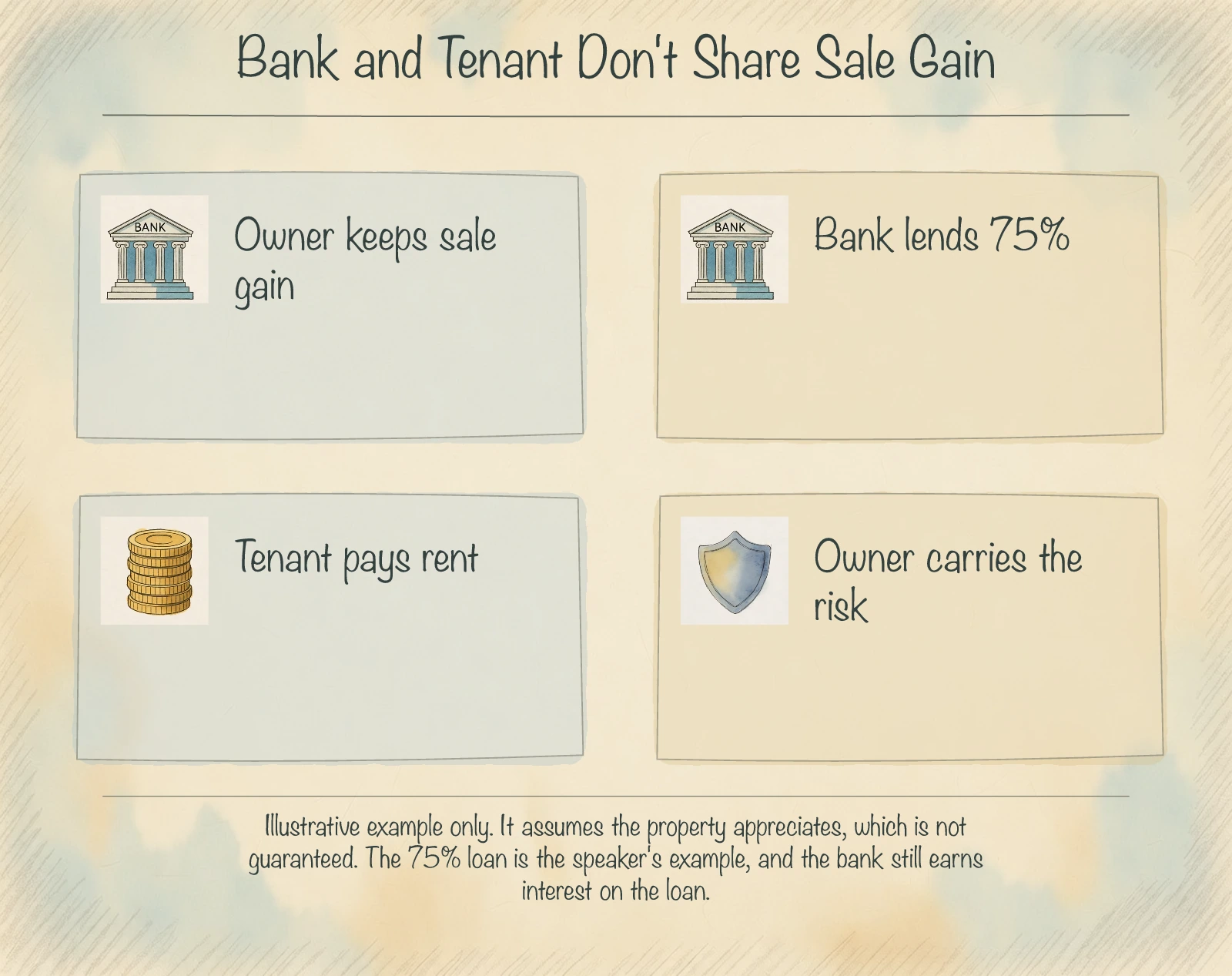
going to take back your property. Your property is an asset collateral for the bank as a secured lending.
So they feel that it's very secure and they are very happy to loan it to you because with your monthly payment, they are earning interest for your monthly installment. Take note, when you own a property to stay, you consume the property.
That means you are technically like the tenant that is servicing the money installment. Now, when you go for investment assets, you have another investor.
Your first investor is actually the bank. The bank is your first investor.
The tenant is your second investor. The beauty is that these two investors, they deploy money together with you as the owner.
So this is me, I'm the owner, this 3% deploy money together, this 2% deploy money at the start to own the asset. This person comes in later part to stay in the asset and contribute to the money installment.
But the beauty is that this 2% do not own the property.
You are the ultimate owner, which means that let's say 4 years later, if you were to sell the property, you are the one that gets the profit. So this one gets the profit.
This 2% does not get the profit. All right, they have no partake in the profit at all.
If the property appreciates, I'm saying if the property appreciates. So for example, if you go for this asset at $2.35 million and then you exited at $2.75 million in 4 years time.
The gain, the paper gain is $400,000 profit. This $400,000 belongs to the owner and it does not belong to the bank and the tenant, which is why real estate investment is so beautiful because you firstly have co-investors, but the co-investors has no right to your profit.
Why? It's because this is a very fair game.
So let's get this out of the picture first. What is it a fair game?
You as the owner, you inherit the risk. You inherit the risk of managing the entire property.
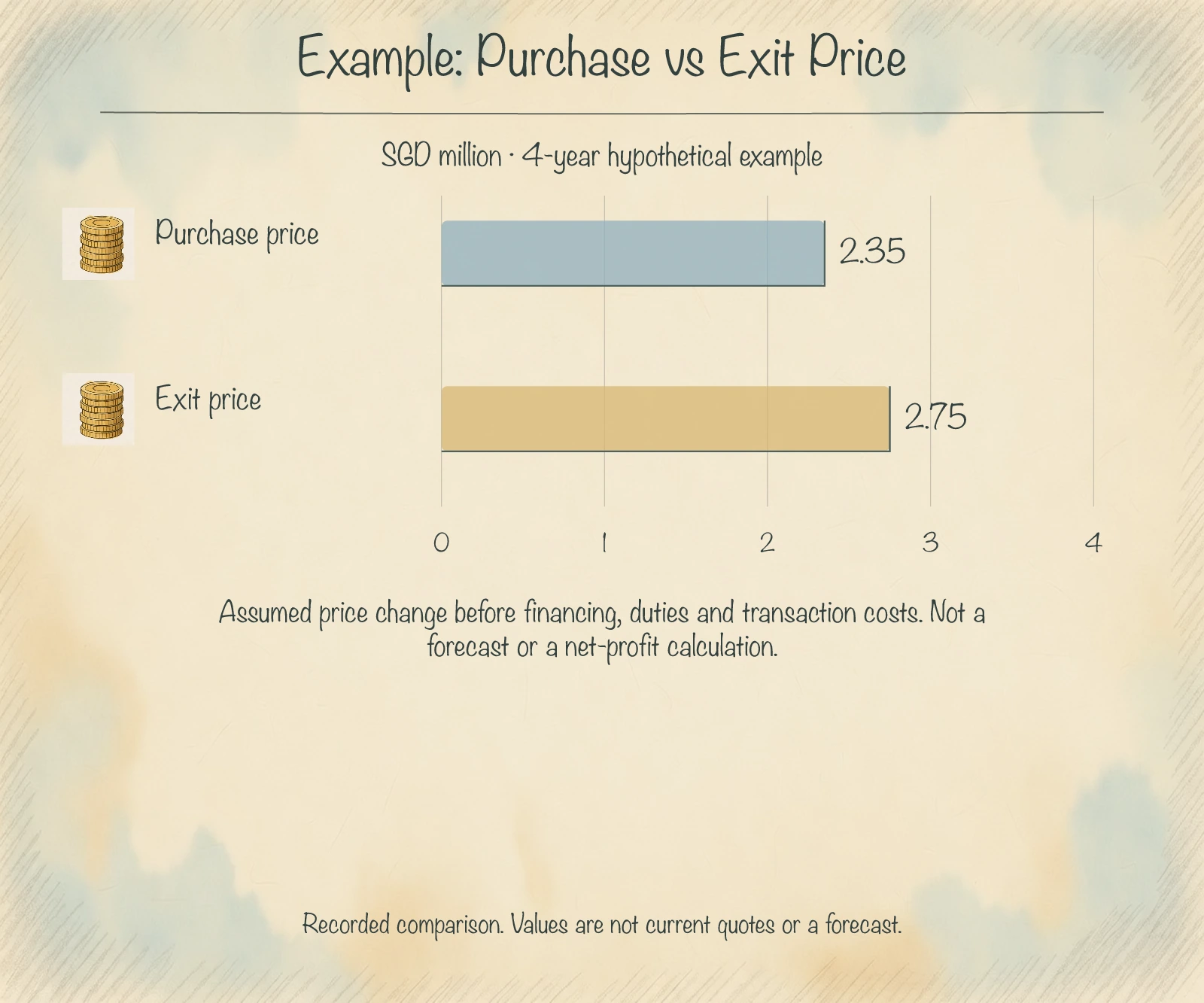
Read chart values
4-year hypothetical example · SGD million
| Comparison | SGD million |
|---|---|
| Purchase price | 2.35 |
| Exit price | 2.75 |
Owner Risks, Bank Leverage and Seeing the Numbers
You are responsible for the property tax, the MCST, the maintenance of the property, and you need to get the property rented out to a second investor once every two years. You need to find a new tenant.
You need to tahan the vacancy period if you cannot get it rented out for one to two months. You need to pay agency fees when you rent out and when you sell the property.
Alright, so it's a fair game. But then the beauty is you only need to invest 25% plus buyer's stamp duty, plus all the miscellaneous, alright, of maintaining the property.
The bank puts in 75%, which is actually three times the amount that you put in, but then they have the rights to take back the property if you cannot pay installment for three months. Alright, so they are also covered in terms of risk and they earn interest off the money invested.
The tenant gets to stay in the property, so that's a win for the tenant.
The tenant gets to use the property in terms of utility value, but the tenant has to pay rent. But the tenant don't need to maintain the property based on the tenancy agreement.
Maybe they need to have responsibility in the quarterly account servicing and stuff like that and minor repairs. But then by and large, most of the maintenance is done by the landlord.
They pay the rent and then they enjoy the property. So how does all this work out?
And why is it a very powerful mechanism that allows families like Daniel to leverage on these two approach first? Because once they have done these two approach and the property appreciated, they then went into a combination convergence investment into one landed property.
So they, after they go into one landed property, they enter into this landed property. And once this property appreciated in terms of value, they then kept the landed property.
So they still hold on to the same landed. Of course, they want to switch the can,
and then they start to expand back into another investment property. Why did they do that is because when they went to this approach, they actually divested their family asset first and they held on to this investment property until it appreciates to 1.5 million, exited it and then they went into this approach.
Alright, so there's various mechanisms depending on the appreciation speed of the asset that you're holding. It doesn't mean you have to divest both at the same time.
We plan it strategically so that it makes sense to really expand the portfolio on a bigger level. The most important thing is that once they are here already, now this asset is already worth 1.7.
This is worth about 4.8 million total, they have already achieved 6.5 at the age of 40 plus. So by then, maybe it could be $7.5, it could be $8.5 million by the time they are 55 to 65, I'm not sure, but at this point in time, they already have achieved a portfolio size of this.
Now when they are at this portfolio size, naturally speaking, they are equity sitting inside their property. So for example, this could have an outstanding, I'm not sure about the actual number, maybe the outstanding loan is about $2 million.
Maybe this one, outstanding loan is about $1.2 million. Of course, if you want to press a button and sell everything today, they can extract $2.8 million from here, they can extract $500,000 from here.
And then of course, they have $3.3 million cash and CPF. This is what we call the equity inside your equity triangle.
So this is still very early.
There's no real need for them to press the button to sell everything because they still need a home to stay, they are still working, they are still having earning power, they are still so-called in the season that once this property TOP, they can rent it out as well, and they can still service the property based on their monthly salary and income.
So there's no
real need to press the button, but let's come back to this. Now, once we look at this, then it's time to come to the mechanics because why?
The moment we start to understand that there are co-investors with us if I deploy some of my funds into an investment asset. So for example, let's say now I have a HDB property, I already achieved my MOP.
And I'm thinking, should I go into investing into one property for my family stay, one property for my investment? That's the number makes sense.
And sometimes we are not motivated to intentionally plan for this. It's because we can't see the numbers clearly.
And, Taz, I want to share with you the numbers on a deeper level. And once you have seen the numbers clearly, then you will realize that it makes sense to deploy effort intentionally to make this work.
All right? So let's have a look at the numbers first.
All right? And I will show you more case study.
Working Through a $1.2 Million Starting Position
All right. So I come back to this.
So when I look at, let's say, for example, just on a very simple approach. Sorry.
Let's come to this screen again. So let's say for example I have $800,000 property.
This is a HDB that hits this MOP already. And maybe my outstanding loan is only $200,000.
And I can extract out $600,000. Plus I also have some level of savings.
So for example, I have another $500,000 or maybe $600,000 of savings. So in total, I have about $1.2 million.
And both me and my partner, we are both working. We are in the season of 30 over years old.
We are able to actually own a property that is $2.35 million. And maybe another property that is of a lower quantum.
Let's say this is like $1.8 million. All right.
Now, a simple calculation is to just use your calculator. And of course, there's many ways to do it.
It's just to use a divisible approach. So for example, let's say $2.35 million.
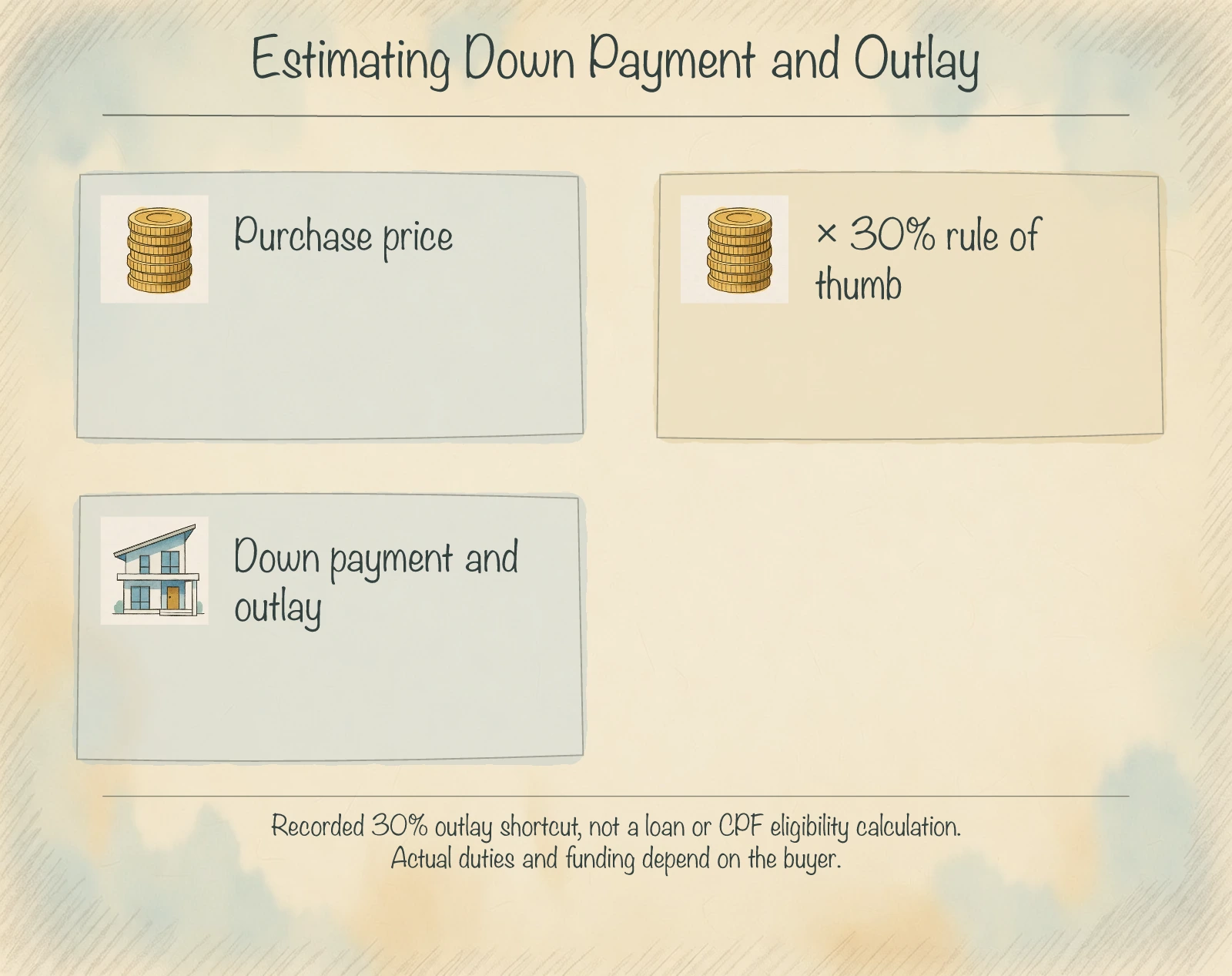
How much do I need? Basically, I just need to multiply by 30%.
It's about $700,000. So why is it 30%?
25% is your down payment, 5% cash, 20% CPF, and of course the BSD is 4% to 6%, but BSD is not so much. But then on a simple approach, usually we just take 30%.
If I want to buy a $1.8M property, I times 30% that will come up to about $540,000. So basically, once I have so-called really back calculated how much down payment in terms of initial investment that is needed.
Alright, so this one I need about 500 over 1000. This one I need about 700,000.
All right, all in. There's about $1.2 million here.
And then from that, I want to see if I can actually go into two properties. Now, sometimes maybe I don't have my own savings.
All right, then that's fine. I can don't go for this property first.
Because I can actually deploy into one property and stay first, and provided I did the right
investment, if it appreciates, then from that next point four years later, then I can split into two properties, family stay as well as investment. So it depends on your current season in terms of your professional earning power, your TDSR, your capability to loan, and of course the set of down payment that you have.
Sometimes we need to go with an interim approach in order to deploy into two properties because we do not have enough capital to go into the down payment in the first place. All right, sometimes we can straight away go into another property, let's say $1.8 million.
dollars this is for stay. Now personally I prefer that my own stay property is of a lower quantum because I want to drive down my monthly costing.
All right so that's basically depending on your needs. Sometimes you'll find a good buy and let's say the quantum is about a sale as my investment property then I can go bigger on this this one I can go lower all right or sometimes I really love
the project because they are just needs by the kids and your family, schools and all that kind of stuff. So it really depends what kind of calibration that you want.
But based on this approach, just looking at this, let's have a sense of the numbers on the deeper fashions. you