Landed property
Understanding the Demand and Supply Dynamics in Singapore’s Landed Market and Core Districts
Published 2026-11-29. Adapted from the episode published 2024-11-04. Figures, illustrations and data reflect the episode’s original publication date.

Thank you, Chuck, for organizing this. Thank you for the introduction as well.
Good to see you, everybody. Good morning.
And today's key focus that I'll be talking about will be mainly talking about two main markets in Singapore, primarily the landed property market as well as the core central district market, which is CCR in nature, 9, 10, 11, as well as 1 and 2.
Maybe just a show of hands on how many of you are interested more about the landed market for 2024, maybe just a quick show of hands. Okay, some landed lovers.
How about core central region, or maybe you are looking primarily not bounded by CCR, OCR or RCR but really looking at opportunities. Anybody.
Okay, great. What we have done for today's sharing basically is to talk about demand and supply.
And what our research team has done was that instead of just looking at transaction figures, which is the primary source of information in the real estate market in the whole Singapore,
but we also tabulated active listings in the market. So what we have done was that we have cropped up close to about 9,800 landed listings that have been listed on one of the major portals in Singapore as of 31st October, as well as 13,000 CCR condominium listings.
And then for today's sharing, I will make sense of the data for everybody so that you can look towards the next 12 to 18 months to make some decisions. Now this will be the key framework that we'll be talking about.
So we'll be introducing this framework that we use in our PRB team, which is called the absorption ratio. Now absorption ratio basically will mean these two kinds of analysis.
But of course, this is just one of the frameworks. It shouldn't be the primary framework for you to make a decision.
But later as we move on, we will start to see that there are certain bedroom types in CCR condominiums with a higher, or I would say a shorter, absorption rate.
And when you see a shorter absorption ratio, it would mean that probably in the next three, five or eight years when you want to exit from that property that you have invested in, it might be easier to exit.
Similarly for landed, there are some opportunities as well in the next 12 to 18 months. Now, these are some of the data that has allowed us a little bit of luxury to look at.
Maybe let's just have a show of hands, or maybe you can just try to visualize in your mind. There are currently about 3,177 listings of a particular landed property type as of 31st October 2023.
And of course, there's about 416 listings of a particular landed type. Now why is this important is because as we look at transaction data, we also want to know what are some of the types of landed that have an enormous amount of supply in the market.
Because if let's say we would look at this range right here.
So for example, semi-Ds, there are currently about 3,177 listings available in the market. Corner terraces, 1,176.
Strata houses, 478. And of course, when you see this data, it will also be good to take a shave off of about 20% because on portals, sometimes certain property owners, they will appoint about four to five realtors to help them to market their listings.
So just as a safeguard, we'll shave off about 20%. But by and large, later, it allows us to create more insights.
This will be the CCR condominium properties available in the market for sale right now. And based on this data, you can also see that two-bedders and three-bedders, there's an average of about 3,000 over listings available.
So, 2023 is very conflicting. In fact, actually, every year in Singapore is conflicting because we see all kinds of news.
You see positive news, you see negative news. You see news like this at the start of this year where a couple of banks in the US collapse and close
because of the Fed's interest rates movement all the way from 2022 to this year. And in Singapore, on a local fashion, we also have a couple of new cooling measures.
Right now, we're already at 16 rounds of cooling measures ever since 2009 Lehman Brothers Crisis. And a couple of negative news as well in the last quarter.
A little bit of dip in the landed Q3 flash estimate. And also, the conflicting part will be every time when there's negative news, there are also positive news.
This just happened yesterday about 80% of Jaden and Jurong sold during the first launch day. And of course, maybe one key highlight is to note the amount of PSF that has been done averagely.
And this is an OCR district for new launch. This is where we are right now.
We are technically at the 16 cooling measure. The latest round of cooling measure will be the 60% ABSD created for foreigners purchasing residential property.
And the conflicting point is that why is it that with so many rounds of cooling
Understanding the Demand and Supply Dynamics in Singapore’s Landed Market and Core Districts
Measures, with negative news happening overseas and perhaps in Singapore, why is it that our price index is too high? So this season, one of our core methodology across every singular year for our investors is that we want to look at which particular type of asset class in the real estate segment is starting to wake up.
So we believe that we shouldn't time the market in a sense, we shouldn't time the real estate market as a whole, but in every season there should be certain types of real estate classes across the residential segment that are prime for movement.
So these are a couple of positive news and of course latest report from UBS Credit Swiss was that in terms of household wealth, Singapore has done well. Across the latest research in 2022, Singapore in terms of household income also topped the charts across global cities.
So this is all the key highlights in terms of interest rates.
And of course our friends from UOB recently just released their projected federal funds rate and of course in US if you look at all the news right now, a lot of people are projecting the Fed pivoting as well as interest rates likely to come down in the next one to two years.
So these two parts will be something that I'll be talking about today and just a quick introduction if we have not met before. My name is Melvin Lim.
I'm the co-founder and CEO of PropNex Lim Brothers and PropNex Lim Brothers Realty. I've been in the real estate industry for 16 years and of course you have seen a lot of our videos.
These are some of the home tour videos that we have done across our channels. And we run two different teams.
So PRB Media is a creative agency. We specialize in in-house creative, realistic content.
We have our own 3D team. And of course, in our Realty team, these are all full-time consultants.
We only take in full-timers, and we have 65 of them. They are mainly research and analysis-based, strong marketers as well when selling homes for our clients.
And in the landed segment, we do believe in having a very focused team. So we have our own landed unit that focuses on landed properties.
And these are the three channels that we currently have in terms of realistic content.
So we just ended our two largest events. One was the landed convention that took place in Panpack in May this year.
We had about 370 landed lovers that came to look at 100 landed properties. We also just ended our 580 packs event just last Saturday at Timber.
So maybe just a quick video, one and a half minutes just to let everybody know in a nutshell what we are doing.
Got a slime, got a slime, Smokey in the air, it's a lot of time Pocket's running over with the dollar sign, Try and take it from me, yeah Oh I got a lot of fun running up the numbers.
That's a lot of fun.
Try and take it from me. Must be at your mind.
I got a lot of fun running up the numbers. That's a lot of fun.
Try and take it from me. Must be at your mind.
Let me talk about the landed market first. Landed forecast has been pretty interesting and this year will likely end quite similar to 2019 in terms of transaction volume.
In fact, I will call this year as the year of a continuous black swan. Last year was a black swan event.
This, I mean, up to this year we have two wars going on. US market is still not doing well and of course interest rates.
Thankfully, inflation came down in the latest result under US Fed announcement. And of course, if we look at locally, we have reached a new price point.
So I think it is very crucial. If let's say you are thinking about entering or investing in a second property or maybe switching properties, it is crucial to find out which particular type of land that or condominium has a more advantage price movement.
Because you don't want to get stuck in a price point that will take perhaps another eight years to start moving. You want to get something that can move in the next three to five years.
So at the new price point, but volume wise is pretty low compared to 2019 is quite similar. The highest volume will of course be post COVID after all the pent up demand from COVID.
And this is basically the landed price index, followed on by the non-landed price index. And of course, overall, there was like a deep in Q3 landed.
So we need to investigate what happened to landed properties. And this was the news article that came out.
So officially it has dipped 4.9%. And basically what we have done is that we then deep dive into all the transactions from real list and we try to dig up what has caused the dip.
So basically the dip was let on by detached homes.
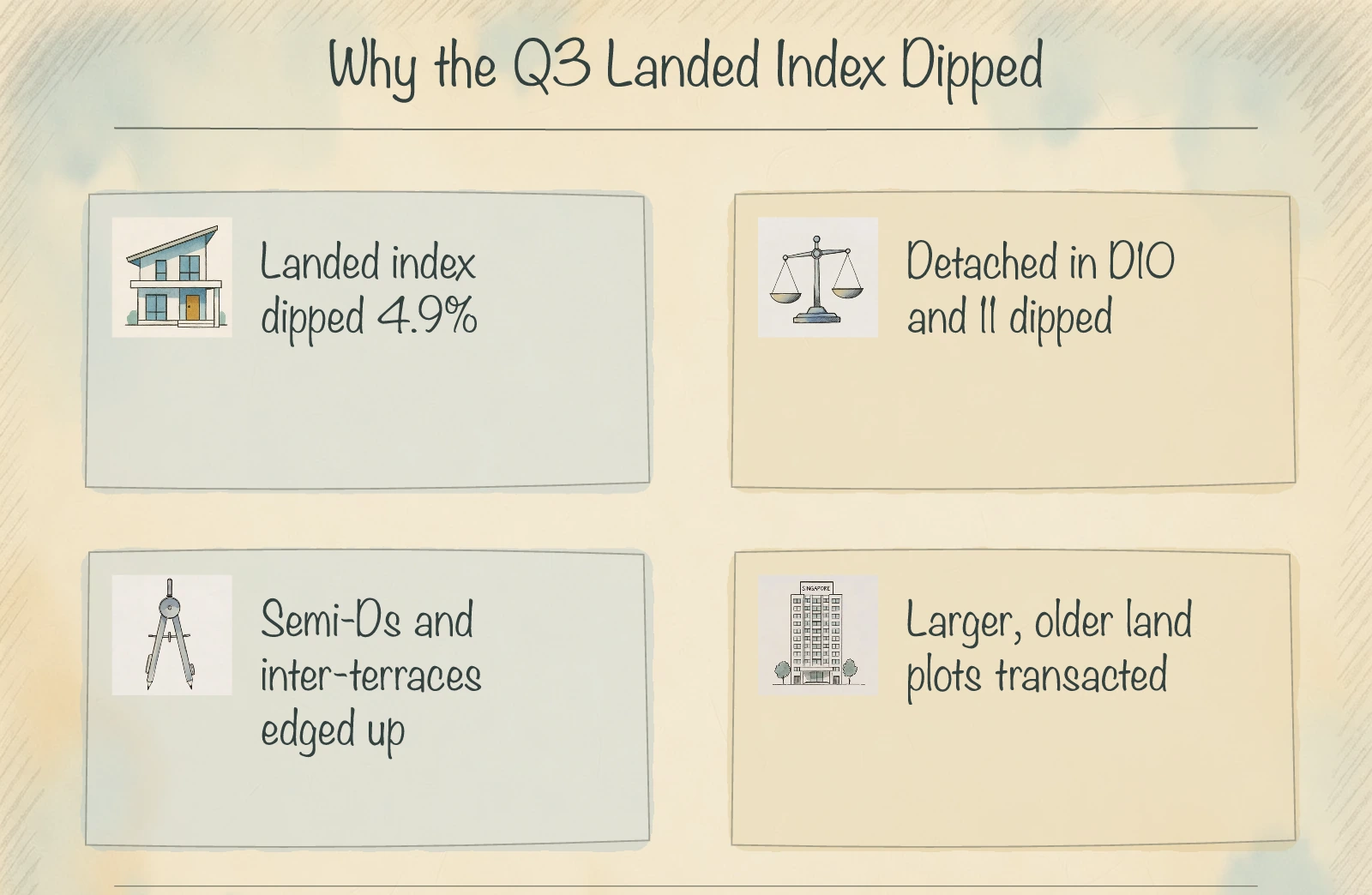
Detached homes particularly in D10 and 11. So semi-D and inter-terraces, there actually was still a marginal increase.
But detached in 10 and 11, they saw a dip primarily because some of the transactions that happen in Q3 belong to larger land and older land. So Q1 and Q2, we had a lot of land plots that was transacted above $2,000 and $3,000 per square foot.
And this was Q2 as well above $2,000 plus. And then in Q3, there was a lack of transactions, but primarily older land plots were done because bigger land plots, lower PSF.
So lower PSF and because of the quantum size and the way our price index being calculated, because what happened is that the detached home carries a very significant kind of quantum in the whole index.
So I think it will be good to look at what will happen in the next two quarters as well if you're hunting for a detached home.
Now, so what we usually do on the ground is that we also work very closely with our architects and builders. These are the things that are happening on the ground, very useful for you if you are planning to rebuild or A&A.
I call this the things that you need to have in your landed home to future-proof your landed home. Landed properties as the quantum goes higher when you want to sell in the secondary market, your buyer that is coming to build your property becomes very, very stringent in terms of their selection criteria.
Sometimes when we sell landed homes, 10, 15 million, short of this thing, short of that part, short of this helper's room, the buyer walk away. The buyer would then think that, hey, I'm as well just rebuild my own landed property.
So things like this, future-proofs your landed property. Thankfully, in terms of costing wise, it has stabilized.
Costing post-COVID was much higher, delay in construction because of shortage of manpower and construction costs. This has stabilized in the last two quarters.
And of course, if you look at the range, the range is because of the materials that you're planning to go for. So, landed properties, of course, over the last two years or three years, it has been very well received as a wealth preservation asset class.
I think in terms of this particular rationale, we would term it as a hard or softer asset in Singapore. So, in Singapore, it's pretty unique.
A lot of property owners in Singapore, when they look at the current market, sometimes when we look at the price point, we think that it's a little bit too high, but if we dig down deeper into numbers, then we will get to see a clearer picture of why is it that in Singapore, if you own a couple of properties or you own a few properties, you sometimes feel a little bit fearful, but why is it that foreign investors from overseas they want to really bring their liquidity into the market and really invest in couple of assets plus the rest.
The rationale is because our land of course is very scarce, but also because our private properties are really scarce.
So in terms of everything that people can buy for residential homes, there are currently 1.2 million HDB properties. In all, we have 360,000 condo and apartments combined.
We only have 73,000 landed property, which makes up 4% of residential stock. So the supply ever since 1994 has plateaued all the way from 67,000 until today.
For the last six years since 2018, it has remained at 73,000. Rationale is because there's no more GLS land plot for landed homes.
All GLS are reserved for high-rise. So plot ratio needs to be high.
We have not enough land. The government cannot release land for landed properties.
You will only see very marginal increase every year is because landed developers buy old land, tear down, subdivide into two or three. So that's the only movement but the land plots are the same.
So where we are going in the next seven years is important because then we will understand whatever we buy today if we want to exit and I think it's always good to plan for exit because you don't want to be stuck with something that you might need to sell or want to sell, but it takes very long to find a buyer.
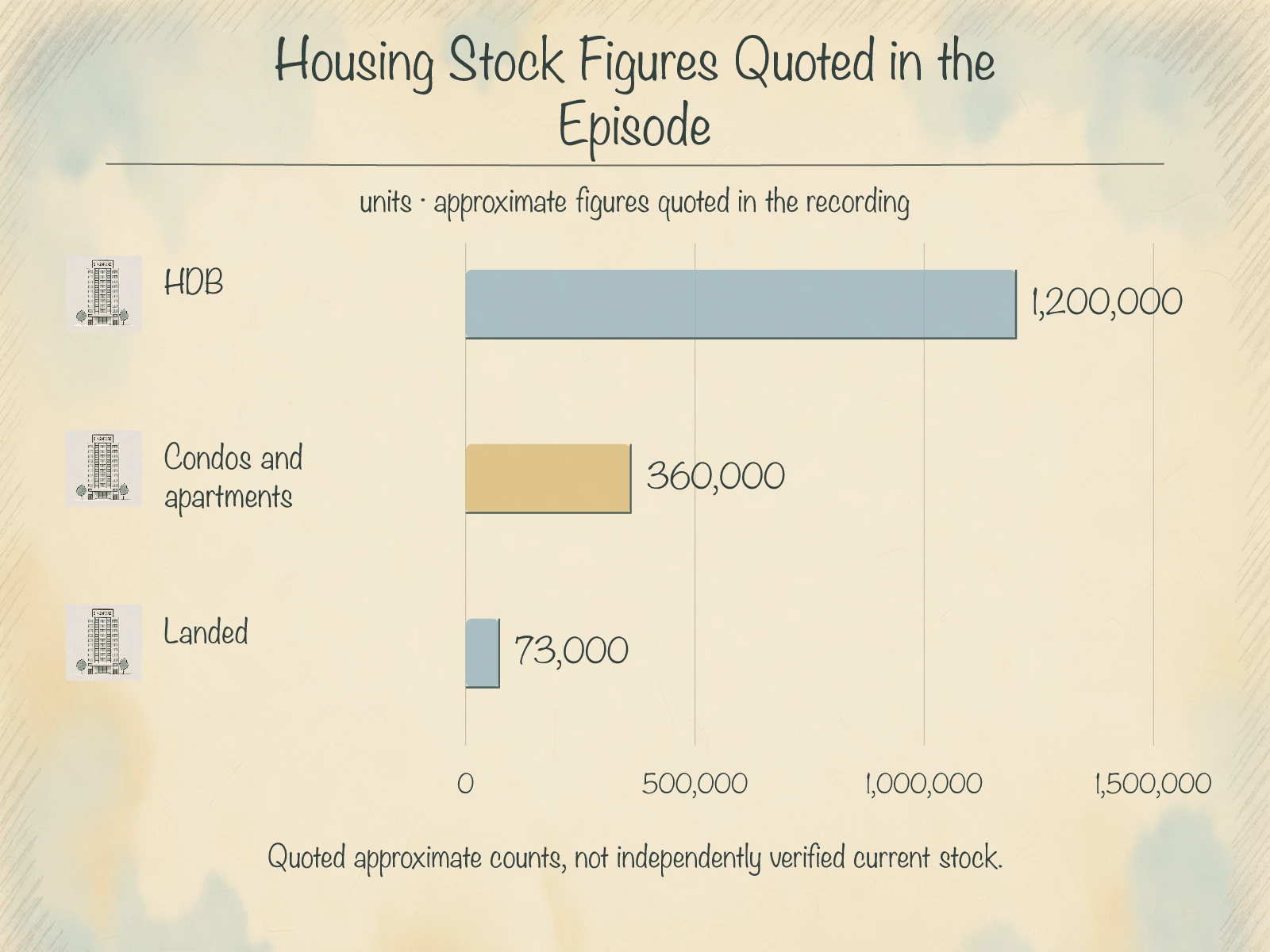
Read chart values
approximate figures quoted in the recording · units
| Comparison | units |
|---|---|
| HDB | 1,200,000 |
| Condos and apartments | 360,000 |
| Landed | 73,000 |
So we always share with our clients that whatever you buy today, in five, ten years time, it could be a product you need to put in the resale market. So importantly, we need to understand a little bit about demographics.
So seven years time, we're going to have 50% Singaporeans, 50% of our foreign friends in Singapore. And when we list down all types of properties starting from HDB, condos, LANDED, STRATA, Sentosa landed, GCB, shophouses, Sentosa, cove landed.
These are the total quantity available. So it is also important to note the citizen classes at the top.
So we have one more citizen class that is not seen in demographics data, which are foreigners that wants to buy our property, but they are not living here. So, landed property, of course, it belongs to the class
Absorption Rates: Finding the Right Price Range for Your Landed Home
That caters to the entire Singapore kind of citizenship. Of course not everybody can afford a landed home, but in terms of quantity, I think the plus point is that the supply is stuck.
So this brings us to our terminology about inelasticity and elasticity. By this we mean that if you have a set of capital or an existing portfolio, it could be a season that you can start playing forward a little bit, shift your capital into harder and harder asset classes.
So harder asset classes would definitely mean the condominium market as well as the landed market. Of course the landed market is the hardest.
Hardest meaning that when prices increase, you have no new policies coming in. Policies come in because they want to curb demand or to increase supply.
So naturally when HDB properties' prices increase, our government gets very concerned because it's public housing, policies come in to restrict demand, increase supply. Even for condominiums, because condominiums is an aspiration class as well.
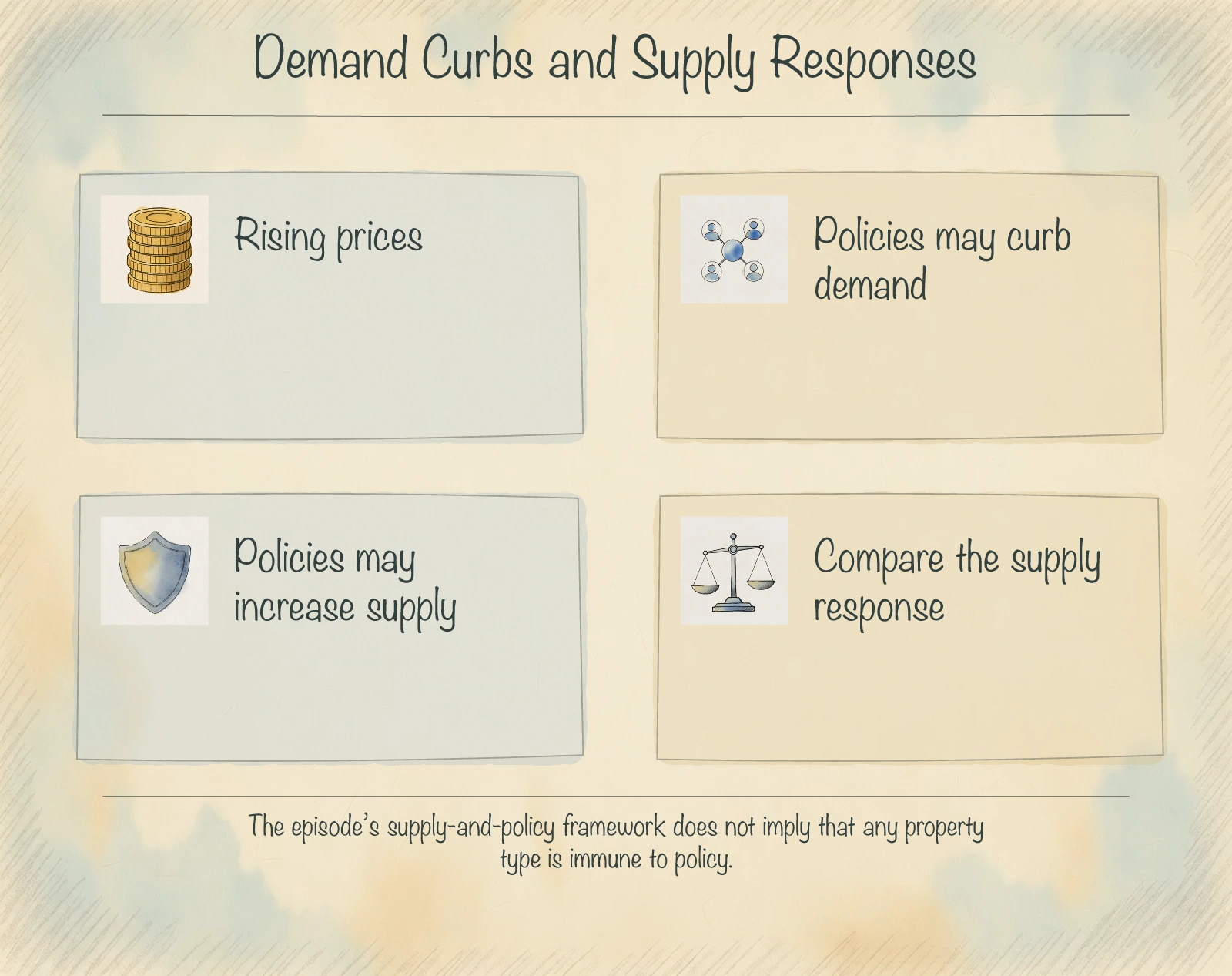
So every year we have about 10,000 new condo units introduced through GLS and en bloc. So now we have about 360,000.
In seven years' time, we will add 70,000. That should be about 430,000 units.
Still not enough. Later, let me show you why.
But there will be of course measures coming in because it's an aspiration product that Singaporeans love to own. So to sum it up for this portion right here about hard and soft asset is to identify quadrant 1 and 2 asset classes.
So if there is an ability or existing capital, it could be beneficial in this next season to start to look at landed homes category Q1.
If not Q2 homes that have these characteristics that will allow a good rental coverage on your mortgage as well as growth on the condo category because there are a couple of properties even across all districts that fall into Q3 and Q4.
That means there have always been condominiums that have not appreciated for 10 years even though
they are freehold near good schools 9, 10, 11 later I'll show some examples. So let's look at this portion here and I always believe that historical data is good to about market behaviors but past performance sometimes cannot allow us to forecast things.
So let me show you a few landed homes first nine months. So first nine months what we have done is that we have segregated across different types of landed and the 28 different districts.
Of course in Singapore the top two volume districts, top three sorry will be 10, 15 and 19.
So 10, 15, 19, very large landed enclave, a lot of volume, and these are the landed listings for sale in all the landed districts in Singapore and we have segregated them even up to corner terraces so that it allows us to see the current supply in the market.
Okay and then of course we pair them and we come to some conclusion so let me allow me to share with you. So let's come back to absorption rates.
Now
Now, absorption rate allows us to analyze every district and the type of landed.
So for example, if you're hunting for a semi-D, you want to go into a district that has strong demand for semi-D, as little competition as possible, because you don't want to face a situation that eight years later you want to sell your semi-D, but it just takes two years to find a buyer, and you don't want to be stuck.
So let me, okay, so I have 87 charts, but I cannot show everybody all the districts, and these are like the tabulation. Red color means for sale, blue color means transacted.
So let's just look at five districts. And in totality in the whole Singapore, this is the current listings available.
However, the red color kind of like quadrant is where competition intensifies if you want to sell in the future. So for example, if you're looking for inter-terrace, competition will start to intensify if you go for certain ranges circled over here,
which are the 5 to 6 million, 6 to 7 million, 7 to 7 million onwards. Why is that so?
It's because the price point you enter today determines the price point that you want to exit later. So for example, if you want to buy an inter-terrace right now at $6 million, naturally after five years, you hope to exit at least $7.5 or $8 million.
But if the price point that you're entering now has a high amount of supply in the market, it also takes a longer time for this current listing to be absorbed first. Because later on when you sell about 3-5 years later, this group of people will be on new competition level.
So usually what we are looking at is that we want to find the kind of price ranges for the type of landed that has not really woken up or we call this the disparity effect. So these are the ranges that could be absorbed faster in the market in the next 12 to 18 months.
Once this is being absorbed, then we will move to a new status. These are the corner terraces.
Also in terms of the amount of listings available, it starts to intensify towards the higher tier ranges. It is also important to take note of crossover effect.
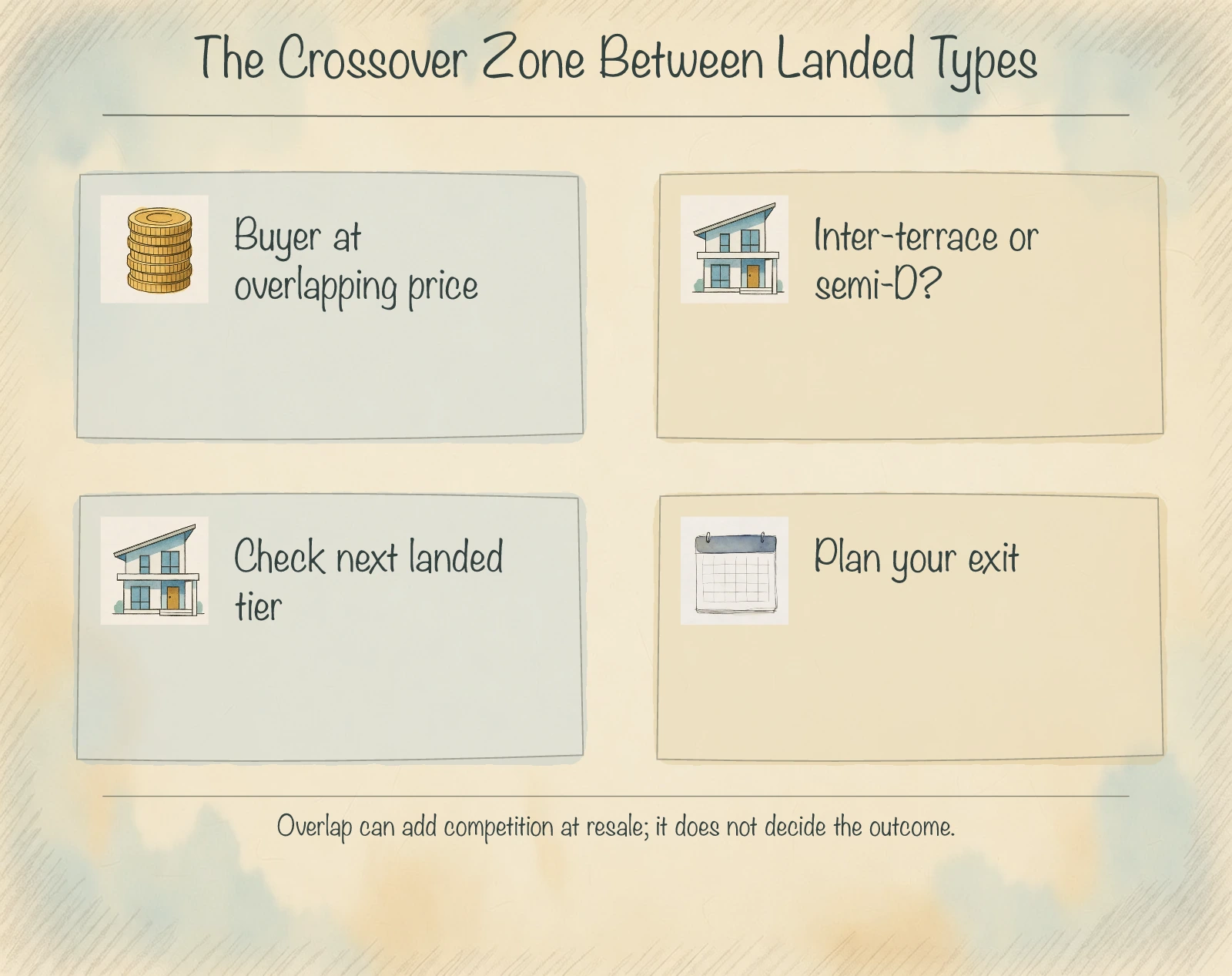
For example, somebody that is going for an inter-terrace of maybe 7 million. In future when they want to sell, they might face buyers coming to view their properties having a dilemma of whether should they go for a 7 or 8 million dollars inter-terrace or should they go for a semi-D that is 8 million dollars.
So try to take note of the crossover disparity gap as well.
So this is the semi-D market across board. So once you look at semi-Ds above 8 million, the competition intensified because this is the current supply that has not been absorbed yet in the market.
And of course, there's opportunities right here as well for ranges that is below $6 million. So detached homes, and just for research purposes, we only see FALT-3, Hoh and Tripen 9.
So we have excluded all 9 in 9 years. So detached homes, above 15, there are currently 790 listings, cost 10 to 12, also a substantial amount of listings, that could be opportunity in the lower quantum ranges as well.
So strata houses are pretty interesting because strata houses, anything below 5 mil, have been absorbed very quickly in the last two years. This is a hybrid class that some owners love to have.
Couple of facilities, no need to worry about maintenance, just pay MCST, but living in the community and yet having the space and the more generous as it landed.
So to sum it up, some of the palatable price range opportunities are available now. And I believe in the next 24 months, this listings amount will start to dwindle because these are the entry classes for different segments.
So inter-terraces 3.5 to 4 is very palatable, but the amount of listings will start to dwindle. And for semi-Ds 5 to 5.5, very palatable as well in the market, but it will start to dwindle as well.
So D15, so far so good, is it very heavy? Okay, right, okay.
Now D15, to sum it up, in terms of absorption rates, naturally for more palatable landed, you can sell off faster. Now what do we mean by absorption rate?
It means that for example, if let's say you are a landed king or queen in D15 and you own all 464 terraces in D15. And one day you come to us and say, hey Melvin, can you help me to sell off all my 464 corner and inter-terraces in District 15?
I own everything. How long do you take to sell off everything?
The answer is 59.7 months. Because based on the transaction rates for the first nine months of this year, and this year being a very conservative year, and we always want to take data for conservative year, not bull markets.
This will be basically the theory of absorption rate. So it takes 59.7 months for all the buyers to absorb everything.
So when we look at this, it will then give us a new sense about which particular type of landed in which districts has a faster movement rate.
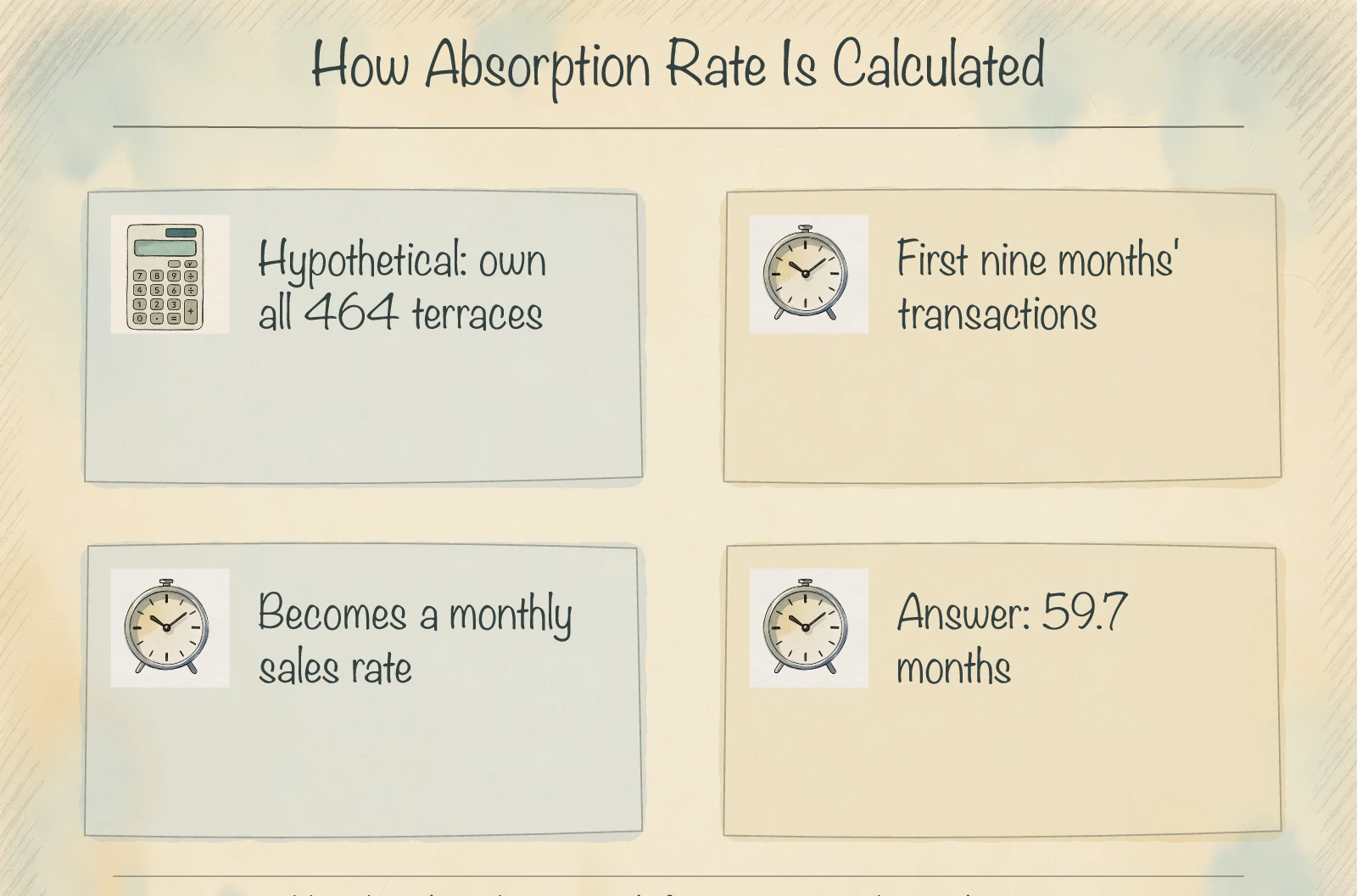
So calculation method, very simple. We take transactions in the first nine months, make it into a monthly sales rate.
It means that every month there are 7.77 buyers buying inter and corner terraces in D15. So sometimes we look at this, it's not a lot and that then brings us to two summaries.
Number one, if you want to market your property, you really have to stand out from the crowd. Number two is that you have to buy the right type that can be absorbed faster.
So D10, D10 surprisingly, semi-D performs very well. This is district 10.
So absorption rate for D10 is semi-Ds are fast. D19 terraces and D5 surprisingly in the Pasir Panjang region, the Wanof region, semi-Ds are doing very well.
Detached has so far no absorption rate in the first nine months of the year and this D28 Salita region terraces are doing good. Detached homes absorption rate is much slower.
So all in all we tabulated we've listed all 28 districts across this. We highlighted the red color bars.
These are the ones that has fast absorption rates.
So what does this mean for you is that if you are buying a semi-D, sometimes it doesn't really mean that you can just depend on one framework. It's that, oh, I must die, die, go for one district.
We can look across districts and see which districts absorb semi-D the fastest. So to sum up for the landed segment, basically this is my personal opinion and forecast for the next 24 months.
This will take advantage of semi-Ds below 8, terraces below 5, and hunt for the absorption rate that's below 60 months.
Okay, so let me move on to CCR. So CCR very importantly, this is a very interesting cooling measure that will tweak our decisions.
So this cooling measure is important and yet very interesting. Why is that so?
This is the first time our government has doubled up ABSD.
First time our government has doubled up ABSD. First instinct when we look at the news, we will think that hey, now foreigners are not buying, then I think we shouldn't buy.
So what does this mean? All in, we have close to five rounds of ABSD already.
And first step is to understand why is it that our government needs to come up with such a strong measure. And then we also need to understand, hey, will this cause certain markets to start to dip because foreigners are not buying Singapore properties?
60% is very high, plus the normal BSD 4 to 6 percent, that will amount to 65% in total. So first step is to look at what is the percentage of transactions that foreigners dominate in Singapore.
Basically, when we look at it, it's quite low. Residential properties 4 to 6% for the past five years.
Primarily Singaporeans and PR. And when we look at the volume, these are the volume of non-landed transactions by nationality.
And when we look at this, naturally we see that Singaporeans dominate close to 78% of all transactions.
PRs as well, 17%, very little percentage, mainly by foreigners and companies. Five main countries buying Singapore properties: China, Malaysia, India, USA and Indonesia.
The interesting takeaway from this cooling measure is like this. There are currently only 360,000 condos.
So we might think that, wow, there's so many new launches, 47 new launches this year. It seems that there's going to be an oversupply.
But when you look at this, sometimes it can create a little bit of fear as well. Why is that so?
It's because currently, in terms of the total supply, we have close to 87,000 units in total being owned by foreigners and companies. All this unit, and we're talking about singular condo and apartment units.
That means foreigners plus PR own 67,000 condo apartments. Companies own 19,000, or in 80,000 or 90,000 units.
What does this mean? This means that all these units are stuck because they will never sell.
When you double up the ABSD, you create this kind of effect. Why would they never sell?
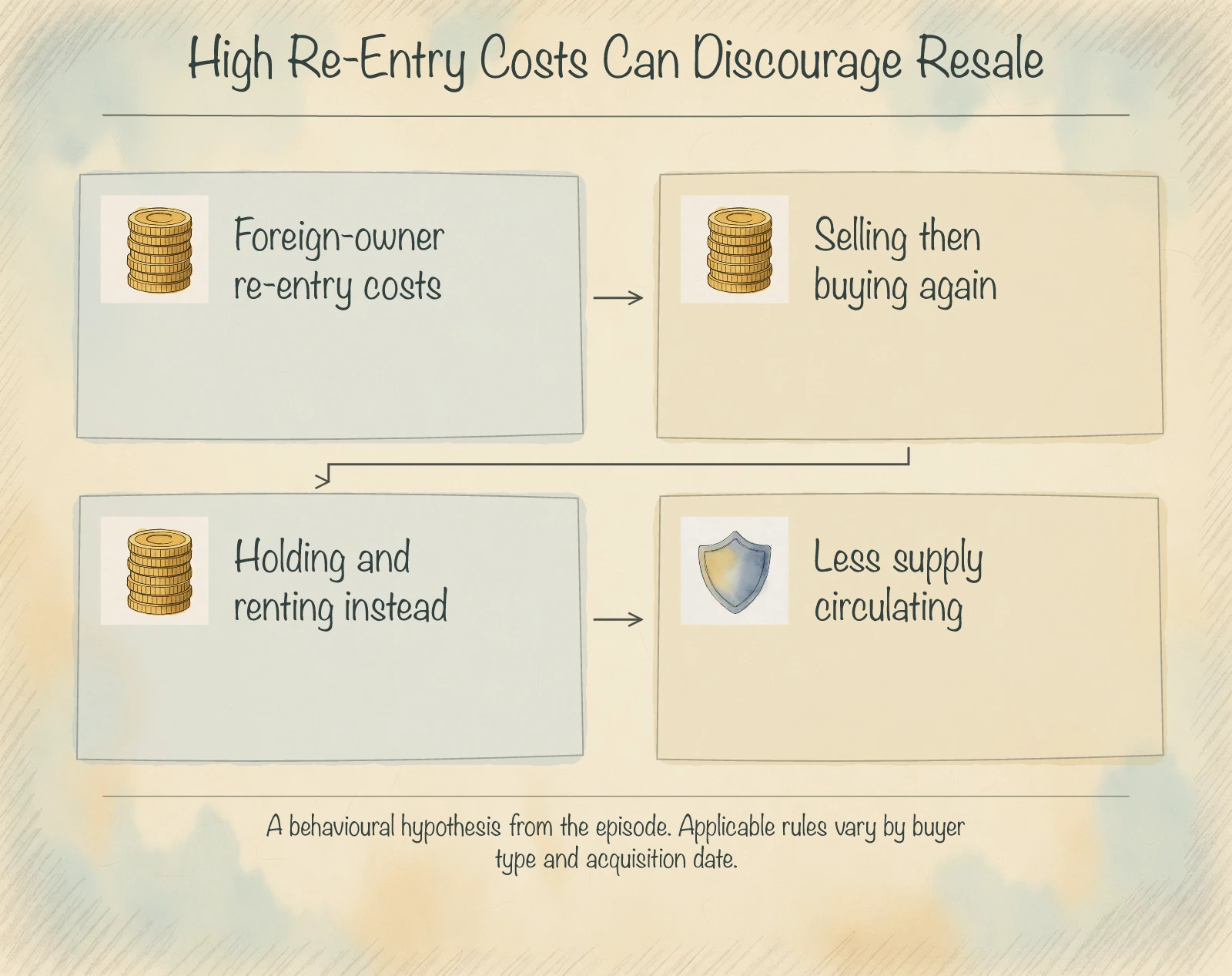
Because they all purchase before the 60% ABSD. So if they sell now, they have to buy back at 60%.
So they will never do that. They will just rent it and our rental is so good.
So they will just hold it, rent it, leave it blank. So we are stuck with a circulating supply of only like this.
So this is the picture when we look at numbers. So technically the holding power will increase, it stabilizes the market but we have lesser roving supply.
And the rationale was also because in the last few quarters there was an increase in foreigners buying mass market condos. So our government has to step in with the 60%.
If not, the OCR condos will start to be stepped up by foreign buyers. Of course, Singaporean buyers, these are the rangers.
Okay, but the key takeaway is like this. If you intend to buy CCR condominiums or high quantum condos, you have to take note of the demographics in that district.
If that district has always been popular with foreigner buyers, you need to take note that right now, foreigners, in terms of foreign investors or foreign family, setting up family offices and they want to buy Singapore residential properties, their technical budget has reduced quite drastically.
So somebody that used to have a $6 million budget, pre-ABSD, when it was the older version, they can buy something at $4.47 million. But now they can only buy something at $3.6 million.
Somebody with a 15 million budget can not only buy nine because they have to pay 60 over percent ABSD.
So what does this mean is that if you are buying yourself as a Singaporean or PR or even if you are a foreigner that is buying, you have to take note that the ranges that you are getting in must be something that you can exit also because it's quite likely that our government will not release the cooling measures, any cooling measures that they remove now, the floodgate is gonna open again.
So we should have that kind of like assumption that they will hold it for long.
So it means that if let's say you are going into a CCR condo and you are going into like something that is like seven or nine million dollars, you must take note that the audience has shrunk. Yeah, and quantum play is very important.
Okay? Some data about CCR, 9, 10, 11 absorption rate is still healthy compared to 1, 2, 4.
9 and 10 has a large amount of competition for 2 and 3 bedders. Currently, people are selling.
And there are slower absorption rates in the CBD region. So this is a very true fact.
You just look at the amount of listings available, the amount of transactions. It is harder to absorb in the CBD areas for certain types of properties.
So it might be safer to stick to 9, 10, 11 for 1-4 bedders. Now, the average medium PSF of CCR-3 bedders is at about $2,300 now.
And there is a closing up gap of CCR and OCR condos. So what does this mean?
This means that if you're hunting for CCR, it might be a good season
Because if you remember the first news that we saw, the new launch OCR was done at about $2,400 plus average, but the average PSF in CCR is about $2,003. So these are the CCR one-bedders now.
And similarly I've highlighted the price range where competition intensifies. So meaning if you're buying one-bedders in CCR, take note that you will face more competition for price ranges in this region, which is the $1.25 to $2 million range.
Two-bedders, intensive competition in the $2 to $2.5 million range. And three-bedders, $3.5 to $5 million intensive competition, because these price ranges are still waiting to be cleared in the market.
So these are the four-bedders, five-bedders. Okay, and to sum up, there are actually options between $2.5 to $4 million in D9, $2.5 to $4 million in D10 as well for three-bedders.
So the disparity occurs because of the yellow-coloured ones. So the yellow-coloured ones are the opportunities in the next 12 to 18 months, which are the OCR and CCR resale condos.
CCR certain new launches are also at a very, I would say, palatable PSF range, if you can hunt for them, because they are quite close to the OCR new launch PSF already. So my forecast is that the yellow-coloured ones will start to move in the next 12 to 24 months.
They will reach a new level. Then the new launch balance units will start to move faster.
So try to limit your ABSD risk by selecting the type of properties that Singaporeans can buy and take advantage of this PSF range. Try to keep the quantum within $7 million, below $7 million I would say if you are going for CCR condominiums, and try to keep within $2,000 to $3,000 PSF if possible.
But three to four bedders because these are the hot-favourite kind of bedroom range. Okay, so last but not least, before I hand back over to our host today, basically the summary is that every season there are things to invest in, but do not buy using emotions.
Buy with the exit in mind, because one day the property you buy, even the new launch you buy, the moment you walk out it becomes a resale property. So you have to think about that.
We use several different frameworks. This is our landed framework.
We have 21 factors to hunt for. These are things that we look for so that it doesn't let us get stuck three to eight years later when we want to sell.
Also take note, for landed the higher the quantum you go, the more stringent your next buyer is. So it's very important to future-proof your property.
We use several different frameworks, for example these are the four frameworks we categorise pricing cat one, two, three and four. We also use disparity effect across the time concept just to give you an illustration.
So for example, this is D19 Serangoon Gardens inter-terraces. This is the price right now in 2023: $4 million for old land, $6 million for brand new from developer.
Two years ago, if you missed the market, of course we cannot go back already. You will not go back to this price as well.
But if you look at the percentage increase, now it might be a bit more worthwhile to go for brand new, because the quantum increases only 20%, but if you go for old land you're helping the owner make 33% more, but you still have to top up $1.5 to $2 million to build yourself and spend 24 months.
Sometimes we also look at disparity across types. So also need to be careful if you are planning to buy a brand new inter-terrace at about $5.8 million or $6 million, try to explore the next highest status landed which is semi-D, because there are still deals that are around the five-over-million range.
Why? This is what we call the crossover zone.
So if you go for this in future, if you want to sell, your next buyer also will be confused. "Hey, should I go for inter-terrace or semi-D?" So we call this the disparity effect, and we have some future-proofing kind of things to look for.
Usually we will share this with our landed clients through our consult sessions. So if you're keen, later there's a QR code you can scan as well.
These are not things that you must take off everything because there's no perfect land in Singapore. There are inherent factors, there are also things that you can change.
So these are things that our buyers over the last 60 years have taught us over the ground because these are the things that they look for. We have this episode on our YouTube channel.
We walk through with a builder. We talk about everything that builders don't like to talk about.
So we talk about things to avoid when you're building your home, ingress of bad thoughts and things like that. And of course in today's, I mean like marketing and as well as the number of listings in the market, it's very important not to market hastily.
If you're putting your property in the market, make sure that your unit stands up for the
Crowd because buyers have no time. In Singapore we are very busy.
You need to gain the attention of your potential buyers. So what we do at the back end in PLB is that we like to create visualizations when we market things like this; these are usually done in our home tours.
We create what we call solutions to obstacles so that buyers can visualize better. And of course things like this are what potentially they can do with the land.
These are landed reports that we always do for our home buyers and sellers. We try to create options and costing on how much it costs to A&A, rebuild and things like that.
Okay, last but not least, before I hand back for condos, just take note that every season there are winners. So this is a clear winner, clear winner because you look at the amount of paper gain that they make from launch to TOP.
Most of the three and four bidders get half a million winners as well.
But the myth is that sometimes we think that we have to get freehold, we have to get 9, 10, 11, but there are also a lot of properties that have not recovered. So properties like this have not recovered until today.
These are all near good schools as well. Even in OCR, there are certain properties that have not recovered.
They are still sitting on paper losses as well. So in Singapore, it can sometimes be a little bit confusing because it doesn't mean that you go for a condo, it's a sure appreciation.
No, there are 2,330 projects in Singapore; there's a set of criteria that we need to adhere to hunt for the right one. So freeholds D23 across all districts I will say they are winners and losers.
Okay, so I will end this with this QR code that y'all can scan. This is a list of 11 factors for you to hunt your condominium.
Okay, this is a free report that we just came out with. It ranks the condos within 500 meters from the
East-West MRT line. So if you want to go for something in the East-West MRT line, this is a free report that you can go for.
It gives you the scoring for different projects. Okay, last but not least, this QR code is to stay in touch with us.
Thank you very much!