Buying and upgrading
Time Preference & The 4 Key Factors To Real Estate Decision-making in Singapore
Published 2026-11-23. Adapted from the episode published 2023-10-13. Figures, illustrations and data reflect the episode’s original publication date.

Time Preference and Planning Ahead
You will have a lower time preference based on this knowledge. You will start to think, hey, I better take some action today.
I better start strategising my portfolio, my income, my savings to qualify for the down payment, my TDSR and the loan, and I need to start to plan. Because if I don't plan now, three years later, I might be priced out.
The reason is because if you have the knowledge of the upcoming supply and the upcoming demand projection — of course, we do not have the crystal ball, but if you look at facts and figures and statistics, politics, and you see in terms of policies and the way things are going in Singapore, then that will help you to make a decision based on time preference, economic perspectives.
Alright, hi everyone, welcome back to our next episode of Nuggets on the Go. Today is a solo episode.
So I'm going to talk about this concept called time preference. What is time preference?
Time preference is an economic term used in certain kinds of a school of thoughts of economics theory. So of course, there's different school of thoughts on economics theories over the years, but it really depends on what you subscribe to.
But this time preference concept is timeless, is very useful, especially if you are thinking about the perspective of real estate. And even if you are not thinking about the perspective of real estate, you can apply to many parts of your life to make economic decisions or life decisions.
Let me just give you an example. I'm going to use three different examples to share with you in terms of what is the definition of time preference.
But let me first define time preference for everybody's understanding because this would be very helpful if you're thinking of whether should you buy a property now or buy a property three years down the road or five years down the road or maybe next year.
It will also help you make a decision if you are in the midst of renting and you're thinking of when should you stop renting if let's say you have decided to settle down in Singapore for the long run, assuming you are working in Singapore as an expat.
Or maybe you are somebody that has already moved out of your parents' home or your main family's home and then you are out in the market renting for a couple of years already.
Or maybe you are in a season of your life that you're still accumulating your down payment to buy your first home but you're not living together with your parents.
But you are on your own and you are renting or maybe doing co-living and you are in this mind space that hey when should I stop renting, when should I continue?
So let me define time preference. Time preference basically has two kind of classification.
One is what we call a low time preference, one is called a high time preference. Low time preference means that you prioritize the future compared to now.
Not saying that now is not important, but in the now present moment, you feel more secure, which is why you are able to prioritize the future. So this is called prioritizing the future and you are planning for your future.
And you can then practice delayed gratification, but usually, in order for this to happen, your present needs to be secure. And later I'll come to more definition of what this means.
So for now, just bear with me a little bit. So basically for somebody that's low time preference, their present situation is they feel more secure, which is why they start to plan for their future and they can then practice delayed gratification.
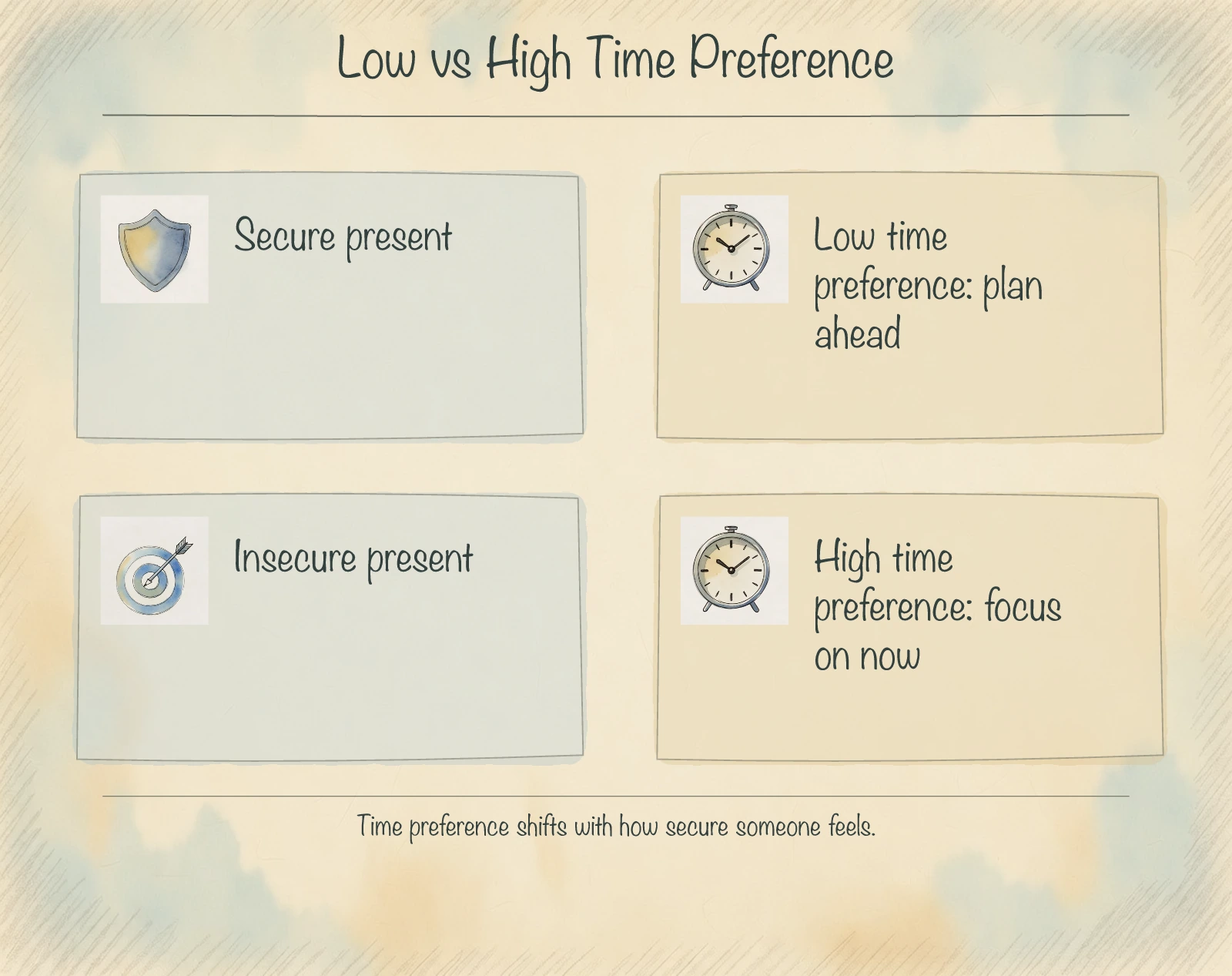
Now, when it comes to somebody that's more high time preference, it means that they actually prioritize today or maybe next week or next one month or this year more than their future. That means right now, the present moment is more important.
Survival is more important. They feel that now maybe times are bad, their job is not secure, their business is not secure.
Now is more important. So they prioritize the present more than the future.
And because the present is not that secure, they will tend to put off planning for the future. Alright, so they usually put off planning for the future.
Now, this has a little bit to do with also like, you know, the hierarchy of needs by Maslow, right? So, for those of you who have studied economics a little bit, the Maslow hierarchy of needs, usually a person will start to feel more secure when they satisfy their lower levels of need.
And usually it starts with physical needs, basically your shelter, your day-to-day food, your health, and basically you need definitely a home to live in every night.
You need to make sure that monthly in terms of your income wise is pretty consistent and then also your health is in a good shape and once you're satisfied basically all your physical needs then you move on to higher tier kind of needs like relationships and then of course the final one will be your self actualization right you want to do philanthropy you want to help people that in poorer condition and things like that and you want to actualize your self purpose in life so
Maslow's Hierarchy and Time Preference
So usually when we look at these three components, they are all somehow inter-co-related, but it also correlates to our decision-making process and relates to also real estate. So let me share with you why this is important by sharing with you one to two very simple examples.
First example, out of real estate context, but you will have to understand a little bit better. All right, and then later we can have a very fruitful conversation.
Let's just imagine you are somebody that wants to set up a chicken rice store. So maybe you have aspiration to start the most delicious chicken rice in Singapore, and you decided to start a chicken rice store.
Chicken rice. Sorry, I don't know how to draw well.
Even my words are, I cannot, I mean every time I want to say that you have like doctor's handwriting. Okay.
So chicken rice store, you decided to start. But you have some, can maybe like 100,000 for your store's renovation or maybe you rented a mini shop.
You are putting the deposit for like a two, three year rental. Monthly, you are paying a rent of like maybe $5,000 for small store, and then maybe you need to hire people.
Maybe you need to hire two assistants that you are paying them about $3,000 times two, so that is about $6,000, and of course you also need to pay for all your raw materials and miscellaneous, and you have already also invested a couple of amount into renovation.
So if the chicken rice store business owner is not doing well, so for example, they are unsure about the sales for next month, November, they are not sure, and they're also not sure about December, and they're also not sure about January, because why, maybe the sales are fluctuating.
They have inconsistent revenue and they feel that a month to month it don't seem very stable. Naturally, this will increase their time preference to a high time preference format for this season, because they will be thinking about how to calibrate their business well so that on a month to month basis they feel more consistent and more secure.
Now if they are in a high time preference like this, they are not sure about their sales for the following month. What's going to happen is that they will not think about the future that much.
They wouldn't keep investing their time and energy during this period to think about, hey you know, I want to open 10 stores. Where is my next store going to be?
How is the renovation for my next store going to be? How is the concept for the next store going to be?
Because they will be worrying about this first store first. And because of this insecurity in the short term, they become high time preference and they will not plan for the future.
Now let's have another example.
If this chicken rice stall owner is doing well and the sales are fantastic on a month to month basis, sometimes up and down but every month they are profitable, and they have been consistent for one year or coming to two years, and they have had revenue savings, savings in the business, naturally this time preference will be lowered.
Meaning that the chicken rice store business owner would have a lower time preference because they have revenue savings, they are able to reinvest back into the business to improve the business, and they can even take out additional savings to invest in a second store.
So in order to be low time preference, the first criteria is that there must be security. That means the feeling of anxiousness must be removed.
And when you have feelings of security, you can plan for the future and you are then willing to plan for the future. That is what we call low time preference.
Now, let me give you an example as well. Let me come to the context of real estate salespersons.
All right, because I understand how salespersons function. I've been doing real estate since 2006.
So if you are a real estate salesperson looking at this episode, because we know that a lot of our colleagues and all that also look at our episodes, this time preference can also be applied to not just salespersons, but all types of self-employed professionals.
And so a low time preference versus a high time preference salesperson, so basically whether you are a realtor consultant or you are a financial FAA consultant, or you're doing sales or doing any form of self-employed professional work, this totally applies to professionals as well.
Because somebody that is high time preference as let's say a sales person functioning out in the market, if let's say their month to month sales is not consistent and they are not even sure whether next month will they have revenue, will they have closings, and let's say every month they are investing, costing into their business, doing marketing,
Inconsistent Income and Rising Time Preference
So that applies to prospecting and things like that, and their sales is not consistent. What is going to happen is that their time preference will start to rise, and we call it high time preference, and then they will start to de-prioritise the future.
They won't even think about, you know, two years later, what I'm going to do with my real estate business, or my insurance business, or whatever professional you are in, because they will start to calibrate their mindset that, hey, how should I strategise for next month?
How should I strategise for the next quarter? They are high time preference and they start to think more short-term.
Now, somebody that is low time preference will be somebody that is consistently doing very well in their business. And similarly, because they are doing well, they have higher security and certainty, and they are lowering their time preference; they start to plan for the future.
They start to plan, hey, you know, maybe next year I want to get an office space.
Maybe two years later, I'm going to invest in this app for my business. I'm going to invest in this technology.
I'm going to do this, do that. I'm going to build my team and all kinds of stuff.
So time preference also applies not just to businesses, to professionals as well.
Now let's come to the third one, which is the one that you guys are very interested in. This is the time preference to make a decision as a property buyer or a property investor.
So how does this apply? Basically, if let's say you are low time preference versus high time preference, your decisions will be different.
Now, when will you start to plan for your property or real estate? Basically, you need to make sure that in terms of you and your spouse's income, it is consistent and stable.
Because buying a property is a decision that you have to make with prudency. If there's no prudency involved, what is going to happen is that you're going to suffer, because if you loan from the bank and you cannot pay the mortgage for a consistent three months, they have the right to repossess back your home.
Of course, if it's with HGB, similarly, if you're going to pay the money in stockman, HGB has a right to repossess your home. But of course, for HGB, you can work with HGB to work out a plan and things like that.
But definitely with financial institutions, the rule when you sign the letter offer to take a mortgage loan is that after 3 months, if you really cannot have a plan to repay the money installment, they have the right to repossess your home and force sale it.
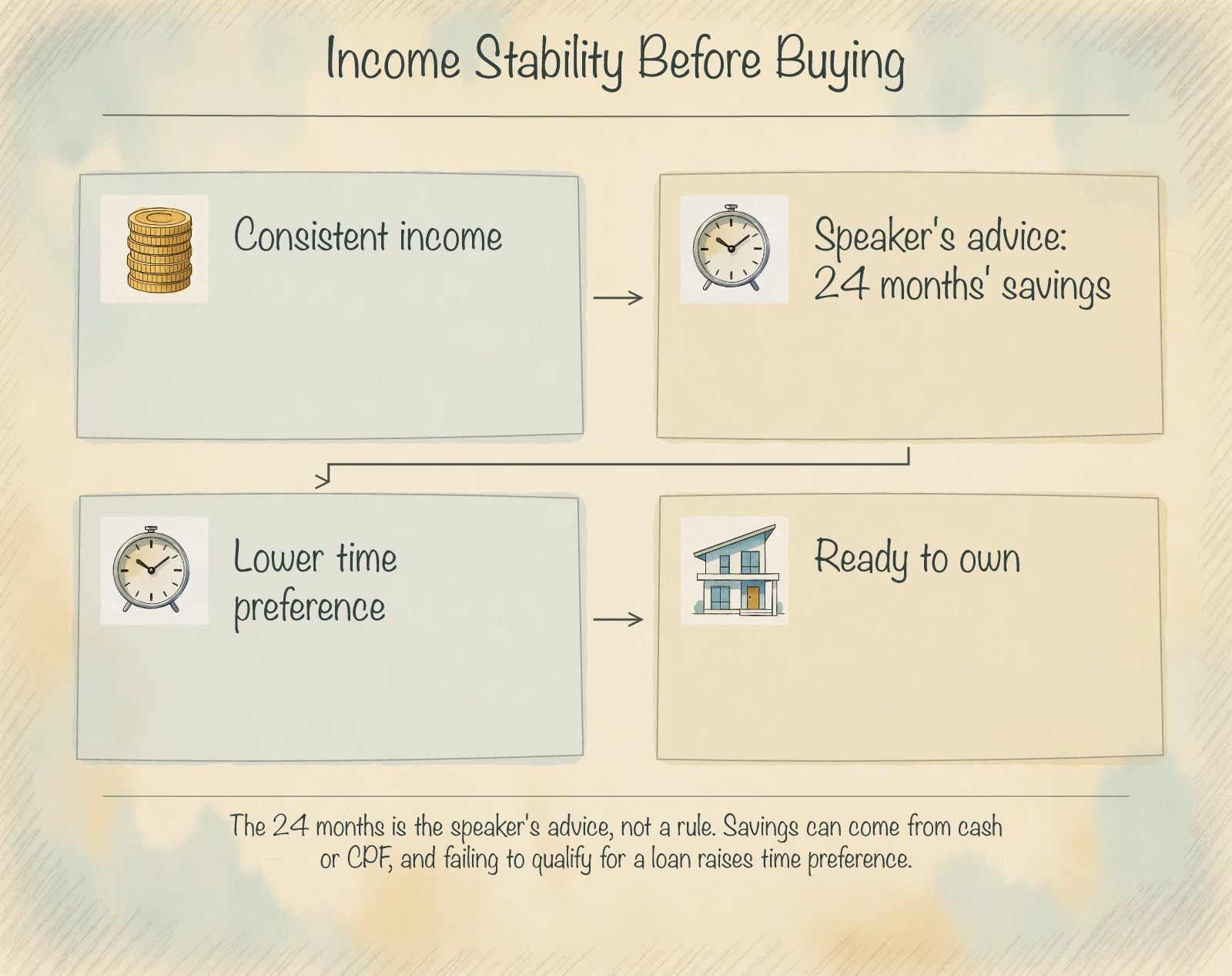
Usually we advise home buyers like yourself is that if you want to commit to a property, you have to ensure that you have the confidence and the necessary savings to sustain your money installments for a minimum period of 24 months, whether by way of your cash savings or your CPF.
And of course, in order to attain that, you first must have a consistent income through your work, through your job, through your business with your spouse, and to ensure that you can sustain the installment the moment you buy it.
So money installment stability plays out into a form of time preference. The moment you have this, you definitely lower your time preference.
You then start to think, hey, because my income is sustainable, it's something that is consistent, I think now I'm ready to own my property.
Now, second thing is that once you have saved up your down payment through your cash savings, through your CPS savings in your OE account, think that you... you cannot use your essay for your money installment and the down payment.
And let's say if you're buying a public housing, a HDB, BTL or resale, then of course with Grunts or Entance Housing Grunt, if you have not watched the previous episode on Standard, Plus and Prime Flats, please click on the link.
That was the episode that we talked about a lot of things, whether it is the strategy of One HDB and Condo, how do you strategize your owner occupier scheme and stuff like that. Please watch the episode if you're into public housing.
And once you start to see better chances of building up your down payment, you then also lower your time preference, and the chances of owning your property increases. Your time preference will start to heighten the moment you lose the job, or you find that you cannot qualify for a loan.
Naturally, this will affect your time preference, and you will definitely delay your decision to go into a property.
Now, that is for the income portion. However, time preference also relates to your decision based on your knowledge of the market.
Now, what do I mean by this?
Naturally, if you know, because you have read up a lot, studied the market, studied Singapore, and you know that Singapore is very different from other countries in terms of demand and supply, that will affect your decision-making for time preference, decision, or whether to go and buy a property today or delay your decision a few years later.
Four Key Factors Behind Property Prices
whether to go and buy a property today or delay your decision a few years later. Why?
Because if let's say, for example, you know that what is going to happen in three years down the road is that the very same property that you are eyeing for right now — whether it is a condo, whether it is a landed, or whether it is a HDB property, these are three different types of residential products, and today we just talk about residential properties.
So assuming your intent is that you want to buy a condominium to stay. However, based on your knowledge, you know that the price of the condominium is going in this direction in three years' time; this will affect your time preference decision.
Because you know that for the same property, this has the same square footage, in the same location, is the same exact property, is going to cost, for example, from 1.5 million and it's going to be very likely inching to 1.8 or maybe 2 million in 3 years' time.
How does that affect your time preference decision? Naturally, you will have a lower time preference based on this knowledge.
You will start to think, hey, I better take some action today. I better start strategizing my portfolio, my income, my savings to qualify for the down payment, my TDSR and the loan.
And I need to start to plan because if I don't plan now, three years later, I might be priced out. So knowledge plays a part in time preference decision.
The reason is because if you have the knowledge of the upcoming supply and the upcoming demand projection — of course we do not have the crystal ball, but if you look at facts and figures and statistics and you see in terms of policies and the way things are going in Singapore — then that will help you to make a decision based on time preference.
So if you have knowledge that prices are going to go up, and we all need to understand a few key factors when it comes to a real estate economic perspective. And most of the time,
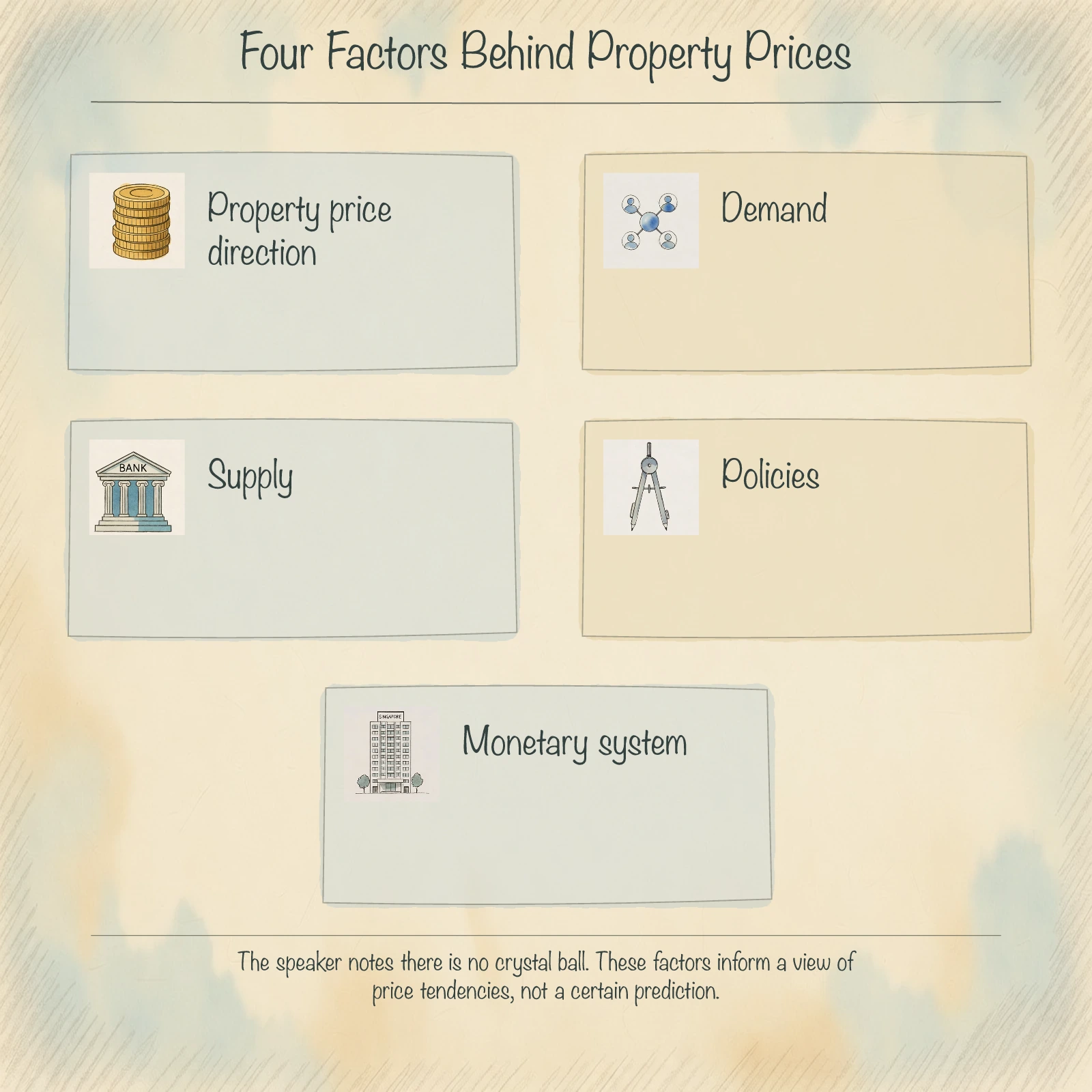
whether the price will start to inflate or go up, it relates to a few key factors. Number one, demand.
Demand based on the population and the demographics of the people in Singapore that wants to buy a property. Supply of the types of residential supply that's coming up, whether it is HDB supply, condo supply or landed supply.
Policies that are shaping and limiting demand and supply; most policies are either limiting demand or limiting supply. If the government wants to let the price ease off, they will increase the supply and they will limit the demand.
If government wants to let prices accelerate, they will relax demand policies and allow more demand to come in.
For example, they can relax ABSD for foreigners, relax second property ABSD, and they can restrict supply; that means they don't want to release so much land and keep land even more scarce for, let's say, condos at HDB — they can naturally tweak the market behavior using policies.
And of course we also
have to think about that we have already 16 rounds of cooling measures that is inbuilt in the price system today. And of course last but not least is the monetary system.
Why? Because we have to take note that our monetary system based on after the gold standard since 1970s, monetary supply in the entire global market including Singapore is always in expansionary mode.
Why is it in expansionary mode? The moment somebody takes a loan from the bank, money supply expands.
And if you go into just some of the charts, money supply always constantly expands and it expands based on both ways. One is based on loans and leveraging.
The other way is through policies as well. And of course, every time you see this keyword called QE or QT, it's whether there's quantitative tightening or quantitative easing.
These are of course a little bit of a deeper kind of economic terms and perspective we have covered that in our NOTG previous episodes as well. We can refer to that.
But importantly is that when you understand through knowledge on this few key things — one, two, three, four: demand, supply, policies and monetary system — it then gives you a better position to know whether prices has a tendency to move up and inflate, or it will start to be stagnant, or it will start to go down.
Let me give you another example. If let's say I'm not talking about Singapore, I'm talking about another country, and let's say you start to deep dive into this country.
The first thing you have to look at it is that, let's say you look at country B. Number one, how is the supply of the properties in that country?
Is the government always allowing new plots of land to be developed? Because if there's no control of the supply and the country is huge and there's developers as free will to buy upland and build, then you know that you need to fight against the increasing supply.
So when you buy something, sometimes for those of you who have
Overseas Supply Risks and Final Takeaways
Purchased like overseas property in certain countries, if you don't do deeper analysis at home work — I'm not saying that overseas properties cannot buy, I'm saying that you have to do deep analysis at home work in the sense that if let's say supply is expanding faster than demand, then you have to be very careful in the sense that you must know what are you buying this home for.
Is this for a holiday home? Is this for investing or is this for exit?
That means you want to see capital appreciation in the shorter frame of time, because a lot of countries, when you buy certain kinds of properties, if you want to exit, it might be difficult if you're buying the wrong place or in the wrong country or in the wrong city of a particular country.
So you have to take note of these two things, and of course look at the policies. What are the taxes involved as a foreign property owner, and of course look at the monetary system as well in terms of the interest rates as well as the loan leveraging ratio and stuff like that.
If I were to refer back to Singapore, and I think we have already talked about this for a couple of times, basically one of the key elements is to look at the demographics, in terms of the number of units of condominiums, landed and HDB.
So HDB we now have around 1.2 million in totality. Of course in the next five years, there's going to be about 150 BTOs that will be built.
Landed is hovering at about 73 over 1000, and then we have condominiums hovering at about 360,000 plus minus now. And when we look at that, it's very important to also understand — then when it comes to condominiums, you need to go in for a deeper breakdown.
So existingly about 360,000 including the latest new launches, about 75% are owned by Singaporeans, 20% by foreigners and PR, 5% by companies. And we also have to understand from the perspectives of foreign investors that already own properties in Singapore, either under company or foreigners or PR, is that the tendency for them to exit it is very low.
Because why? The moment they exit, if they want to repurchase back, they will be taxed with the later 60% ABSD.
Because most of them have very bottomed before the 60% ABSD that was being implemented in April this year.
So when you look at this aspect, a deeper aspect is to understand also the policies of who is allowed to buy what kind of properties. And we technically segregated the demographics in the four portions.
Singaporeans, about 3.5 million by 2030. PRs, we have about 600,000 by 2030 based on the white paper projection.
Foreigners in Singapore working in Singapore — but of course there are various tiers of foreigners working in Singapore. There are foreigners that are in the service sector, construction sector and stuff like that.
It's about 2.9 million. Foreigners not in Singapore is an unknown figure.
We also look at what kind of residential properties are allowed to be purchased by what kind of citizenship status. And all this actually plays a huge part in managing your time preference ideation.
Because the last part will be then landed homes, which has plenty — 73,000 units. Of course, that's one of the reasons why landed homes has continued to go up in notches in every quarter in terms of its price index.
And so to finalize, this is of course a very huge topic and it also relates to whether do you want to continue renting or purchasing. But we already covered the rental decision on a previous episode because rental has a lot of intangible pros and cons as well.
Some people love flexibility, some people love to change homes every couple of years, some people just are still in the phase of saving up for their down payment and things like that. And I think most importantly is that if you are in a season of deciding whether to time or not to time the market.
Then base your decision based on time preference and try to come from a perspective of knowledge. By investing a little bit more time to understand about the four key factors that we talk about: demand in Singapore, supply in Singapore, policies in Singapore, last but not least is the monetary system globally and of course in Singapore.
And with that, it will also kickstart for us for the next few episodes into cracking the code. We'll talk deeper about how we analyse condos, landed and other kinds of properties.
And we hope that you enjoyed this series with us. We'll see you on the next NOTG.
And meantime, take care.