Landed property
The Investor’s Guide to Landed Properties: Rebuild or A&A?
Published 2026-11-23. Adapted from the episode published 2025-01-24. Figures, illustrations and data reflect the episode’s original publication date.
On this page
- Understanding Your Landed Property Options
- Four Pillars and Landed Home Categories
- Landed Homes in Growth–Rental Yield Quadrants
- Singaporean Demand and Global Market Backdrop
- Stamp Duty Impact and Scarce Landed Supply
- Condo Ownership Versus Landed Supply Inelasticity
- Recycled Landed Supply and Buying Criteria
- Higher Quantum and Detached Resale Difficulty
- Cat 1 Versus Cat 4 Price Quiz
- District 5 Analysis and Inter-Terrace Appreciation
- Second Quiz and Inter-Terrace Leading Upward Ripple
- Holding Power, Ease of Exit, Buyer Wishlist
- Avoidance List and Value of Expert Guidance
- Rebuild, A&A or New: Journey Maker
- Historical Rebuild Costs and Planning Factors
Understanding Your Landed Property Options
So for today's topic, we're going to talk about the landed property market and in specification, we're going to talk about on this particular question of should we rebuild A&A or buy a brand new landed home in the year 2023.
So these are the three things that we will dive into. Now of course we have a lot of things to talk about pertaining to the landed market as well as landed property investment but just for today's webinar context we're going to dive into some of the costly mistakes that some buyers might make when buying a landed property.
Some of the key factors to consider when you're selecting your next landed home purchase as well as this main theme of today or whether should you rebuild, do an A&A or should you buy a brand new from a developer.
Recently our team over the past 12 months, we have deep dive into a lot of different kinds of visualization and that has helped a lot of our landed home sellers to better position their homes.
It has also helped our landed home buyers as well to visualize some of the possible things that they can do for their landed home after they purchase a landed property. So these are just some examples of how we have used architectural visualization within our home tour videos.
In order to showcase that where is the right position to put it a lift, where are some of the right positions to actually enhance your layout in your landed home having to do a little bit of A&A or maybe if you were to rebuild what are some possible layouts that you can actually do for your brand new home.
This is an example of existing home having that split level concept and how can you build actually a RAM in order to solve some of the wheelchair friendly issues as well.
Now of course for existing homes like this with the visualization it also helps our buyers to better enhance their imagination of what they can do after they buy. One of the recent homes that we have sold at the Jalan Bambong and this was sold at about $8 over million dollars, it has a blank roof at the top.
Of course this is just an example of how we help our home buyers to better visualize what they can do after they purchase. And recently we have also helped our clients to sell this home at Loran Asu and this home actually has been a market for quite a fair bit of time.
and the key reaction now is because this home has a very long driveway and of course for long driveway not every buyers will love this kind of home because most of the time a lot of buyers do not know how to utilize the long driveway.
And this is a fantastic for homeowners with a lot of cars
And of course, these are just some examples of what our architecture visualization team has done for the home tour itself. And Taz, let's come back to today's webinar.
Who is this webinar for?
Four Pillars and Landed Home Categories
And in terms of landed property, we usually like to talk about four different main pillars in the landed property market.
If you have been following a lot of our PLB landed home tour content, we also include a lot of different educational elements for home buyers to understand a little bit better what are some of the key categorizations of different types of landed homes.
As well as the key factors that you need to look out for when purchasing a landed property.
Because landed property is a huge quantum purchase and you need to take note of certain differences when it comes to comparison in terms of pricing, when it comes to comparison in terms of different types of homes as well as different locations of the landed property.
And when we look at these four topics, this is the main thing that we will deep dive into for today's webinar. This year, we're also going to talk about another two to three rounds of landed webinars and I will do my best to deep dive into the different types of topics later on
throughout the year. We want to talk about selection of landed today, particularly for home owners who are buying a landed home for their own family stay with a perspective of price appreciation.
So today's topic is deep diving into this particular segment. We're not going to dive very deep into basics of landed properties because if, let's say, you are very new to the landed scene, Look at the landed playlist.
You will be able to probably have a very good sense of the landed market just by looking at maybe about three to four home tour videos, and of course some of the webinars this year, maybe in the next few months, we'll talk about basics of landed properties if you're very new to the landed market.
But for today, we presume that you already know a little bit more about the landed market and we want to deep dive into this particular topic. So it's still important for me to share
some key fundamental concepts with everybody so that the discussion later on will be more fruitful for you. So first thing, in PLB, we have four different categorizations of landed home and this is how we help our buyers to ascertain some of the value points and price comparison metrics when it comes to selecting homes.
So when we say category one, two, three and four, we're actually trying to put the landed homes in four different segments so that we can have a very clear understanding of the state of condition of each landed home.
So to simplify for everybody, category one homes are homes that are 30 years old and above and these are homes that are meant for rebuild. And category 2 homes are homes that are maybe about 20-odd years old and they are meant for A&A.
And category 3 homes are usually homes that are below 15 years old or maybe below 20 years old but they're still in very good condition and you just need to do internal renovation. Of course, category 4
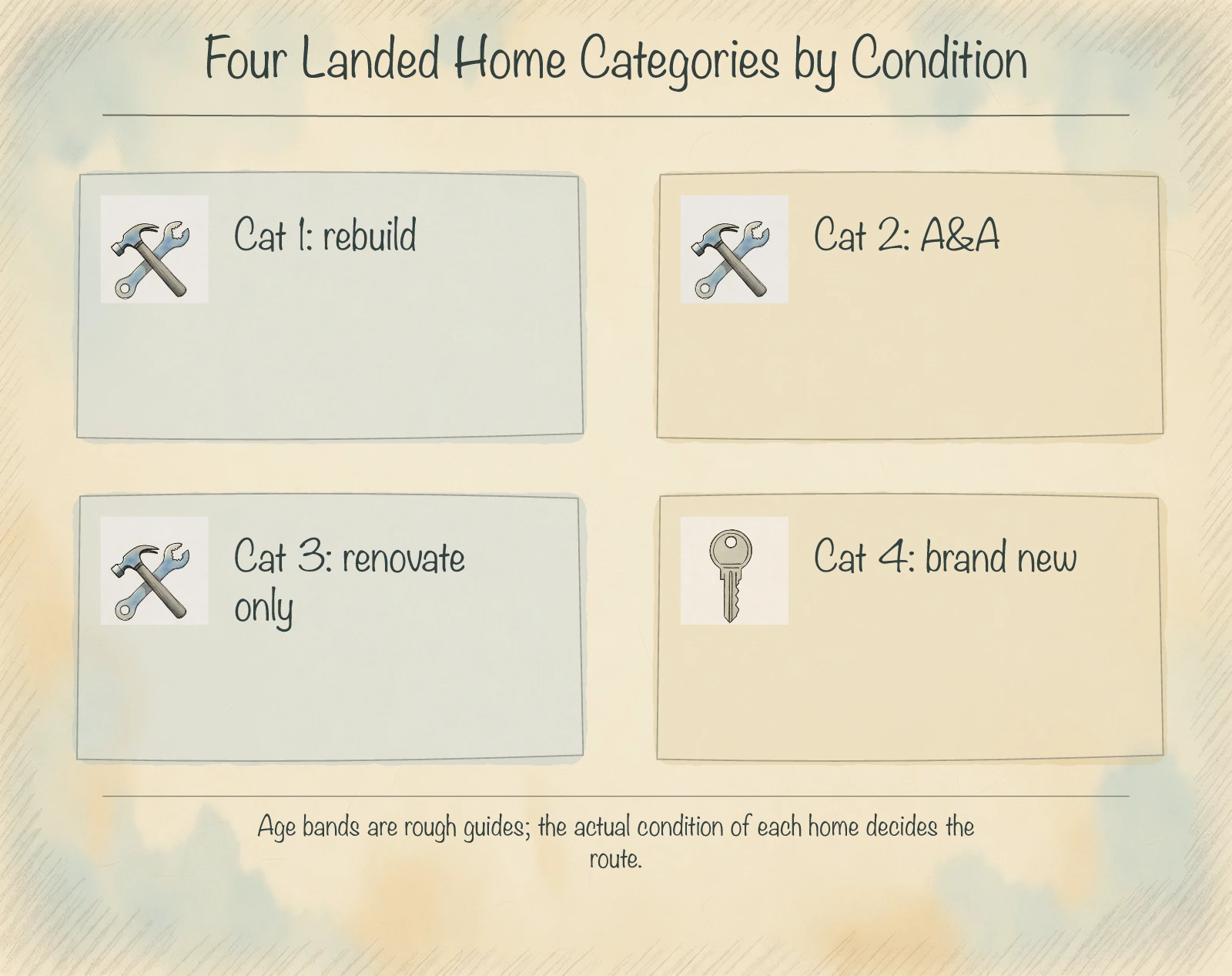
are brand new homes directly from developers. Now this is of course the categorization of inter and corner terraces.
Inter terraces means that you are in between homes, and of course these two are inter terraces, these two are corner terraces, and semi-detached homes are homes like this with setback at the side, very similar to corner terraces, but of course when it comes to tiering in terms of the status level, inter terrace is the start point of a landed home, followed by corner terraces, followed by semi-ds, and then detached homes.
So semi-ds will be like this and of course detached homes will be like the red one over here.
So some of the key regulations when it comes to subdivision of land: for example, if a developer would purchase an old land that is having an old house sitting on top of the land and it's a huge piece of land and they want to subdivide it, they'll have to follow this guideline, having that plot width minimally for certain statuses of homes.
So for example, if they want to build
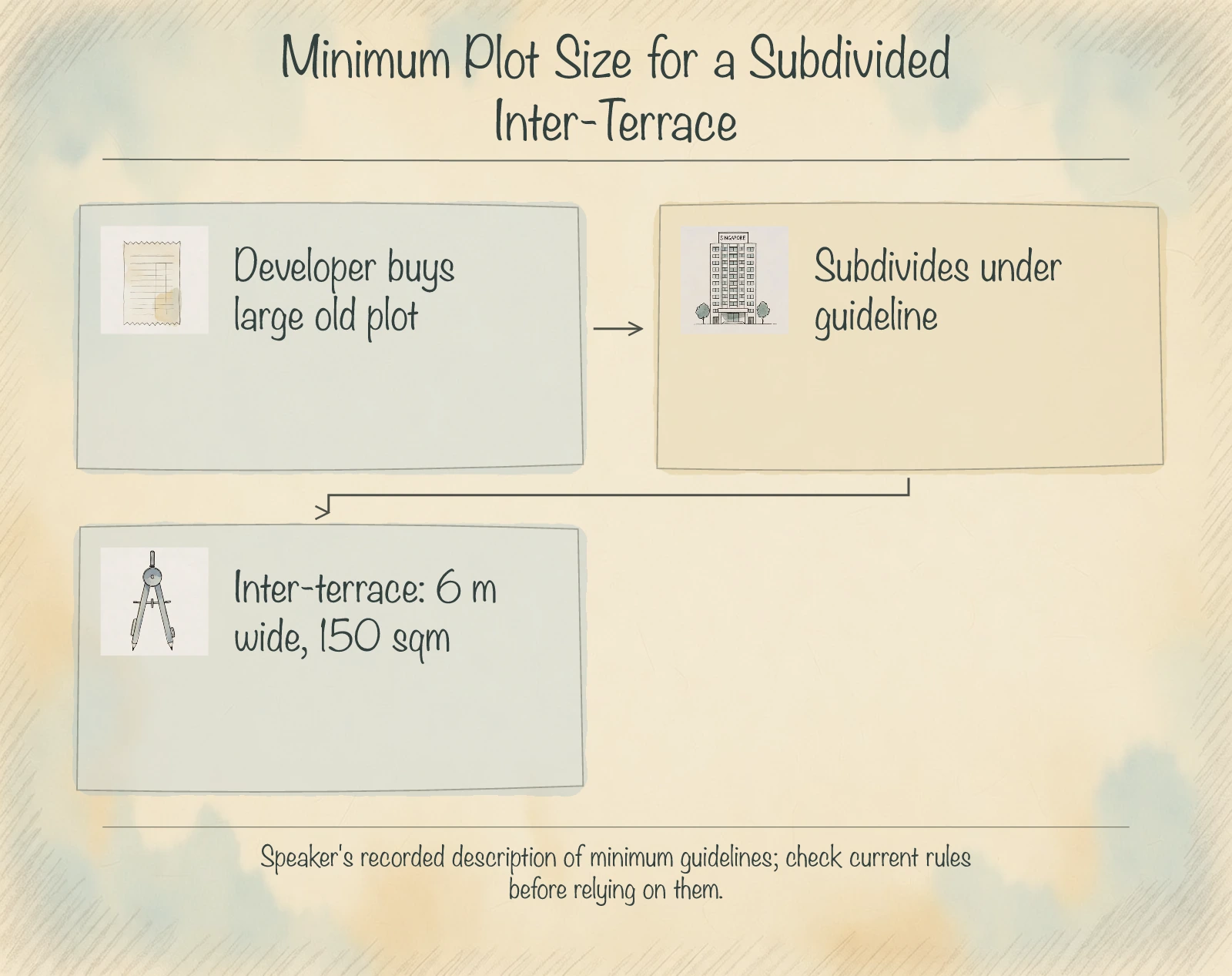
maybe from a huge piece of land, they want to build two corner terraces and one inter terrace, the inter terrace at minimum will have to be six meters in width and total plot area has to be 1614 square feet, which is 150 square meters.
And if they want to build two semi-ds on this plot of land, let's say they purchase a detached and want to subdivide into two semi-ds.
By minimum standard both semi-ds must have at least eight meters of width in terms of its plot width size and total size must be 200 square meters, which then translates to 2152 square feet.
Which is why you see some brand new homes having that 2152 square feet or maybe 2002 square feet status, is because they have been subdivided and there's a bare minimum requirement needed. So landed home also has another four different categories and I want to introduce that to you today.
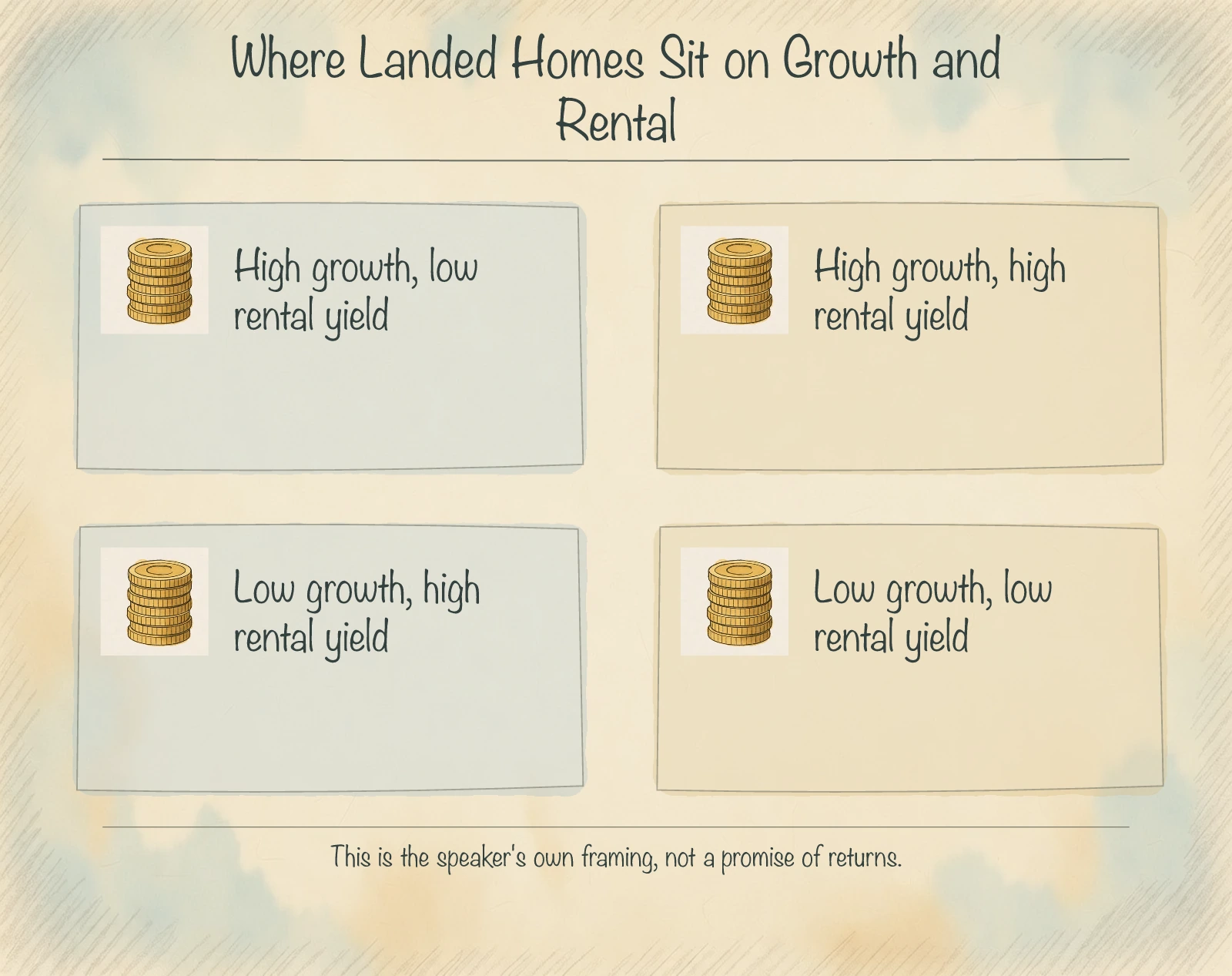
So for Quadrant Number One, homes that have high growth and low rental yield belong to Quadrant
Landed Homes in Growth–Rental Yield Quadrants
Number one. So quadrant number two are actually homes that belong to high growth, high rental yield.
And then quadrant 3 belongs to homes that are low growth, high rental yield. And then quadrant 4 would be homes that are low growth, low rental yield.
So just to bring this quadrant up to the whole entire residential market, if let's say you are looking at both landed properties as well as condominiums for investment point of view, where do we put a landed property? Now, landed homes, they belong to quadrant 1 predominantly.
The reason is because a landed home quantum is larger and landed homes are for growth. They are like high growth stocks, they are like high growth equities and then in terms of rental yield, they're actually not as fantastic as private condominiums.
Condominiums of course fall into many different spectrum because if you look at small properties like one-bedders or maybe a studio apartment, these kind of homes they actually have low growth but high rental yield and high rental speed as well.
Their vacancy period is very low
because if you buy a one-bedder, very easy to rent out. But when you talk about growth, then a penthouse will have a better growth but a lower rent.
Because your entry quantum is bigger, but your rent in comparison with a total rental collected is lower. So I will categorize landed property as a quadrant one kind of hope.
But of course, when you look at then landed properties by itself, let's say I evolve to categorize an inter-terrace, semi-D, corner-terrace, and a detached home, then I will place the inter-terrace in the categorization of high growth, high rental yield as well.
Because inter-terraces have a lower quantum, but their rental can be compared to corner-terraces as well as semi-detached homes if the amount of bedrooms is about the same, if the build-up is about the same.
Because for tenants' point of view, in the terrace and the corner-terrace, not too much of a difference as long as there are enough bedrooms, if the look at view is about the same, the build up is
about the same, from a tenant's point of view, it's not too much of a difference. So for inter-terraces, they belong to sort of like the Q2 quadrant.
And very quickly, for some of our friends who are newer to the landed market, and let's say if you are considering to enter into the landed property market, some of the key reasons why landed properties are so popular is as follows.
And one very very important rationale on why landed homes are popular in Singapore is because of the fact that you are buying two items at one shot. So what are the two items?
Compared to buying a condominium, you are buying the strata space. That means you are buying the strata space that is in the air.
And let's say for example, you buy the 2,000 square feet four-bedroom apartment, you're owning the strata space in the entire condominium complex. However, when you buy a landed home, you're owning two items at one go.
Firstly, you own the build-up area of the structure.
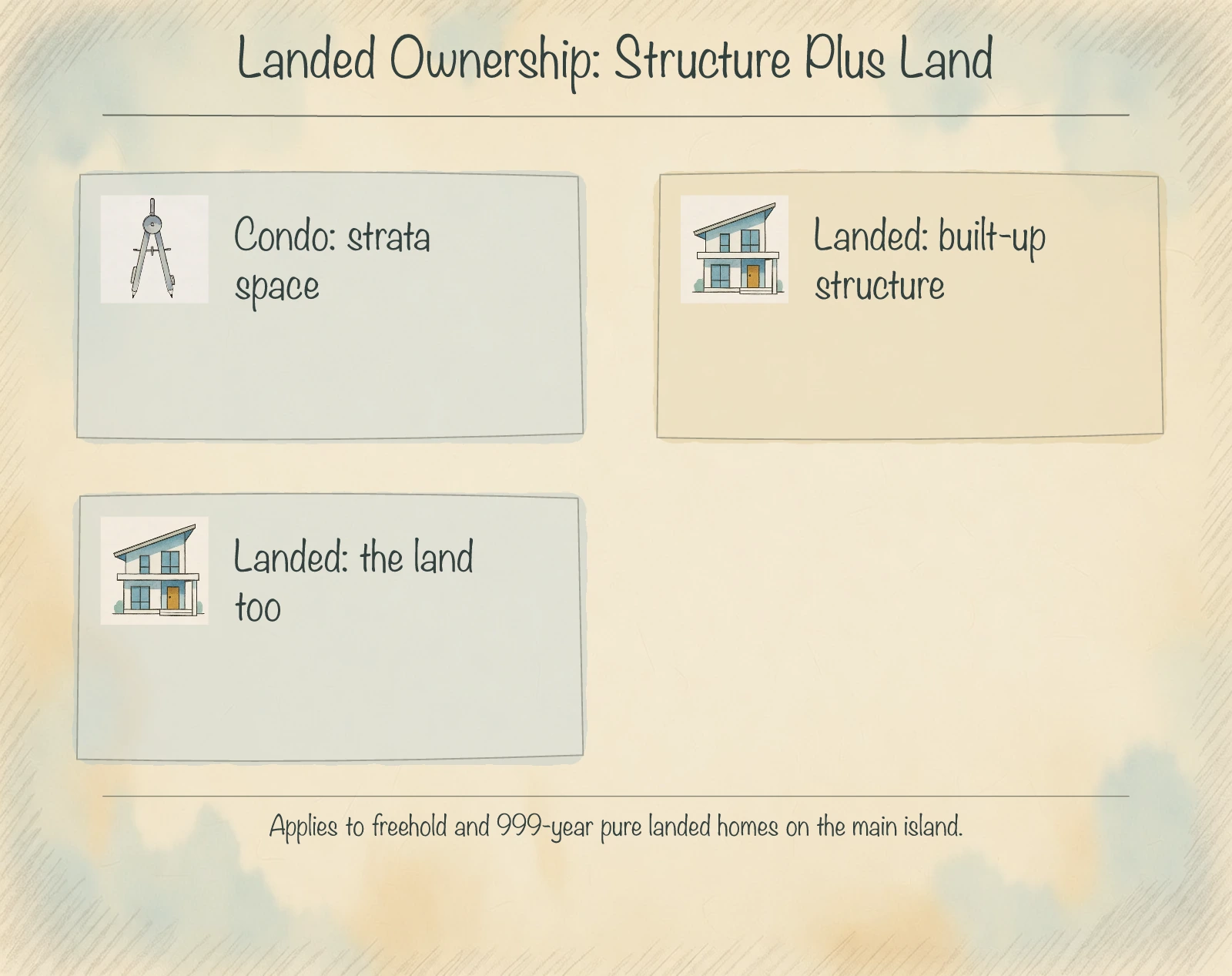
So for example, if this is a three and a half story home and has a total built-up of 5,000 two, you own the structure and you own the build-up area. Number two is that you also own the land that the structure is sitting on and this is what landed home owners are after.
Because you own the land and this land belongs to you and for today's context as well. We want to put it another consumption is that we are only focusing on freehold and triple nine years pure landed homes.
So we're not going to talk about cluster properties, we're not going to talk about strata homes, we're not going to talk about Sentosa homes, we're also not going to talk about 99 years properties and at the same time we are also not going to talk about GCBs.
So we are largely talking about pure landed homes, freehold, triple nines on the main Singapore Island. Now landed is also becoming a class of its own, is a great store of value and later with
deep dive and of course you've seen a lot of news about the GCB market but of because GCB market is a prestige property in the class of its own. So for today's context, we'll largely talk about the main predominant landed properties on the main island.
And in the last 24 months, there has been a lot of articles talking about the fact that landed homes are now really becoming a wealth preservation status, and we're gonna deep dive later into it.
One of the key reasons is also because of the fact that if you look at the total residential inventory in Singapore, 74% of the residential properties belongs to HDB apartments, which has about 1.2 million units.
And then if you talk about the total size of non-landed residential properties, meaning condo apartments and ECs, they comprise of about 340,000 units. Private, landed, pure landed, they comprise of about 73,000 units.
And it's of course extremely rare. Of course some of you might asked me, hey Melvin, there's 73, 74,000 landed properties but landed
Singaporean Demand and Global Market Backdrop
These properties can only be owned by Singaporeans. Of course, that's a very good question, and let's have a look at how many Singaporeans there are right now.
So of course in the next six to seven years, once we hit towards 2030, we're going to attain close to about three and a half million Singaporeans in terms of total population.
Now just by effect of five percent, if let's say there are five percent of Singaporeans that are interested to own a landed property, 3.5 million, 5% is close to about 175,000 Singaporeans that might be interested for this private landed property, and of course that is close to about double or maybe at least two and a half times the amount of demand.
But later we're going to deep dive a lot into the population figures as well, and most importantly this number is not growing. There are only 73,000 landed homes in Singapore.
The supply is pretty stagnant already, and any asset that has a higher demand than supply, you will see a faster value and price appreciation on its asset value.
And of course one of the appeals of landed homes is that the landed home allows you to configure it. You can A&A it.
Let's say after you live in it for 20 years you pass down to your children, they can tear it down and rebuild. It has flexibility to change, and the reason is because you own the land and you can of course amend the structure as long as it coincides with BCA and URA regulations.
So last but not least is that it also allows homeowners to actually configure design and architecture to their own liking, as well as configure internally the amount of bedrooms that you want, whether you want to lift, whether you want a hanging garden, whether you want a pond, you want to build a pool, there's a lot of flexibility in landed homes.
And of course that is also one of the key ways to enjoy very high ceiling heights, especially with the envelope architecture in today's market.
Now we are not going to talk about Sentosa homes, but I just want to show this chart so as you can see in terms of the 99-years landed properties in Sentosa, of course Sentosa homes are a very small population.
And Sentosa homes are the category of landed homes that allows international — so any buyers from the world, they can buy landed homes in Sentosa — and you saw this dip in the average transacted pricing. The key reason was because of the introduction of additional buyer's stamp duty for foreigners.
At first right now, it has picked up steam again back into 2022-23, but we're going to leave this for one of the webinars in this year on the behaviour of Sentosa homes. Now, a quick run-through of the recent happenings in the real estate scene as well as in the global scene.
So, Sing Dollar is still very strong in terms of Asia's resilient currency. And recently, we have a lot of distress from some of the banks in America.
And this has of course populated into a lot of different topics.
A lot of people are actually speculating, or maybe they are of this theory, that though the word 'bailout' is not used, but it's technically like a stealth bailout in terms of the deposits that the government, in terms of the Fed's reserves, they want to make good for some of these banks like Silicon Valley Bank as well as some issues with Credit Suisse.
And of course what is happening are mainly for the four banks that have been in the news for the last two weeks. And what might happen, in my own opinion, is that over the next few months, there's going to be a lot of pressure on the Federal Reserve.
And what the Fed is going to do is that in terms of their rate hikes program, they will definitely have to slow down because it's going to add a lot of pressure to the banks. Because what has happened over the last two years is that from 2022, there are seven rounds of rate hikes.
This year, there's already two rounds, and if the rate hikes were to continue too aggressively, it's going to create a lot of distress to the banks, because in terms of arbitrage, they are going to face a lot of issues.
And then what might happen is that if rates have stopped and the Fed will start reducing its further reserve rate to rate cuts, then mortgage interest rates throughout the world, in the US as well as in Singapore, are going to take a downward pressure.
And what might happen when mortgage interest rates start to drop is that buyers will then become more confident and they might come in back to the market, perhaps at the end of this year or maybe next year.
Stamp Duty Impact and Scarce Landed Supply
Now these are home prices in terms of the overall private property market and of course there's been a lot of articles about the wealth preservation status, buyer stamp duty, does it really add an impact.
And of course when you look at the latest round of buyers, stamp duty increment, the impact comes largely once you buy properties above the $5 million range, then you will see a little bit more significant impact. But of course for home buyers they are into landed homes.
This impact is a little bit more like a wealth tax and I think for serious home buyers they are really into buying landed homes as a wealth preservation status. This does not have a very huge impact on the ground based on what we've seen so far over the past one month.
Now we're going to dive straight into some of the key things about the overall red state scene and of course if we look at the latest red state bubble risk index from UBS, Singapore ranks very low.
In fact it's actually just touching the undervalued graph and compared to a lot of countries where the bubble index is a little bit higher, Singapore is still deemed to be a pretty undervalued country overall compared to the rest of the world.
And our rounds of cooling measures has also made our red state seem a little bit differently. As you can see, we have turned into 14 rounds of cooling measures, but similarly, our red state prices are still rising pretty gradually.
And these are the rounds of cooling measures which we think the government could not remove any more cooling measures. At this point in time, in fact, they can only add on should our property price continue to rise aggressively.
A quick disclaimer is that the things that we're sharing in our webinars are definitely for sharing purposes and knowledge sharing purposes.
A lot of things are from our own research and opinions and of course do your own market research, do consult your consultants and if you want to make any serious decision, do make sure that you exercise financial prudency as well.
Our start of webinars has no products pushed. If they've been with us for a few webinars, you probably will understand that we do not push any particular products for any developers.
If we do collaborate with any developers, will say upfront in our webinar title saying that you know we are collaborating with this developer talking about this product or talking about this new launch, so we will be very upfront how we conduct our webinars.
I myself am a property investor as well. I'm very passionate about real estate space and personally over the past six years I have filmed a lot of real estate content
Now why do property buyers and investors aim for landed homes? Now the key reason is because of supply and we need to talk about supply because once we understand macro, it allows us to understand micro as well as selection factors.
So I'm of this school of thought that is very important to understand about the macro landscape because once you understand the macro landscape, you can make very good and wise decisions when it comes to property investment. So by understanding the macro landscape, it gives you more confidence.
It also helps you to avoid risky investments and it helps you to make wise decisions on good investments. Now this was a white paper that was published in 2013 and this of course is now the trajectory of where our government wants to go in terms of population size.
So by 2030 we're gonna hit close to 7 million and in terms of the overall inventory in the residential market we need to understand this why, it's because when our population now from 5.9 million scales to 6.9 million, everybody in Singapore needs a home.
Whether they're going to rent, whether they're going to buy, everybody needs a home. And we can see from the COVID pandemic period, homes are even more essential and that have gave rise to a lot of behaviour.
People want to buy bigger homes because they work from home, exercise from home. People now want to rent homes because they want their own space.
There's also been a lot of behaviour change as well. Understanding the amount of available stock helps us to understand the demographics of Singapore because our land is very scarce and this is basically the amount of stock that we have.
Although our government still have balanced land available under their land bank, but take note this are to be released as government land sales and GLS are largely 99 years, they are largely meant for private apartments as well as HDB apartments and thus when you look at land property it becomes a very very scarce asset.
Condo Ownership Versus Landed Supply Inelasticity
Well, as well as HDB apartments, and thus when you look at land property it becomes a very, very scarce asset. And this is basically what is happening in the total amount of our population that is owning private condos and apartments.
And later I'll share with you why I need to share with you about this particular segment is because if you look at this segment, this is the only segment that is open to the international market. And out of the 340,000 condos and apartments, about 68,000 are owned by foreigners and PRs, 262,000 owned by Singaporeans.
The foreigners and PRs, they are not really selling their homes because the moment they sell and they buy back a private property they have to pay the new ABSD. And thus when we look at this, even for the condos and apartments market the supply elasticity is becoming more and more sticky.
And let's have a look at this and later I'll come up for you very quickly. In seven years' time, what's going to happen is that
we're going to see a 50-50 concept. Every two persons that I meet on the street, one is a Singaporean, one is a foreign citizen.
And of course with that, it increases the economy GDP, dynamic of our labour force. These are of course great growth plans.
But what we need to understand is that this is basically the 50% of population that will be eligible to buy landed homes if they want to. And thus, when we compare HDB apartments in terms of stock, we look at non-landed in terms of stock and you look at landed homes, now what do you see here?
Maybe let's do a little bit of Q&A. When you look at these two charts, so maybe I can give you a little bit of hint.
You look at this, and of course you look at this. What do you see?
Let's have a 5 second quiz time for you to key in.
And of course, the key observation here is that in terms of supply growth, it is stagnating. And the reason is because there are no more, or technically speaking, there are no vast amount of land that government will introduce to build landed properties.
Because landed properties take up a lot of space, you can build 2.5 or 3.5 level; it will make more sense for our government to release the government land as a land to build high-rise condominiums or apartments. So it makes more sense for our land-scarce Singapore.
But even at 340,000 and of course every year there are going to be new launches and of course every new launch, every government land sale can build an average of about maybe four to five hundred units.
But this is already at an under-supply situation in my own opinion and I think it is definitely at an under-supply situation because we just need to look at the take-up rate in terms of the new launches even for this year it shows
that there's a lot of underlying demand and private properties are open to international demand as well and of course this space will still continue to do well but in my opinion I think this of course will be the largest driver if you're hunting for an asset type that has the fastest level of growth and this is definitely one of the key components which are landed properties.
The reason is because landed properties in Singapore has the most inelastic price versus supply relationship. What do I mean by that?
Basically in economics, when price of a product or asset or a commodity goes up, it attracts more people to come in to create the supply. Let me give you an example.
Just look at, although gold is not a very good illustration because it's very hard to mine gold, but as price of gold increased in the past, a lot of gold miners want to come in to mine more gold because they want to take part in this trade.
They want to take part to own gold and mine gold
so that they can also enjoy the price status of this particular commodity. But what we're trying to ascertain here is this.
If let's say I want to compare private condos versus landed property in Singapore.
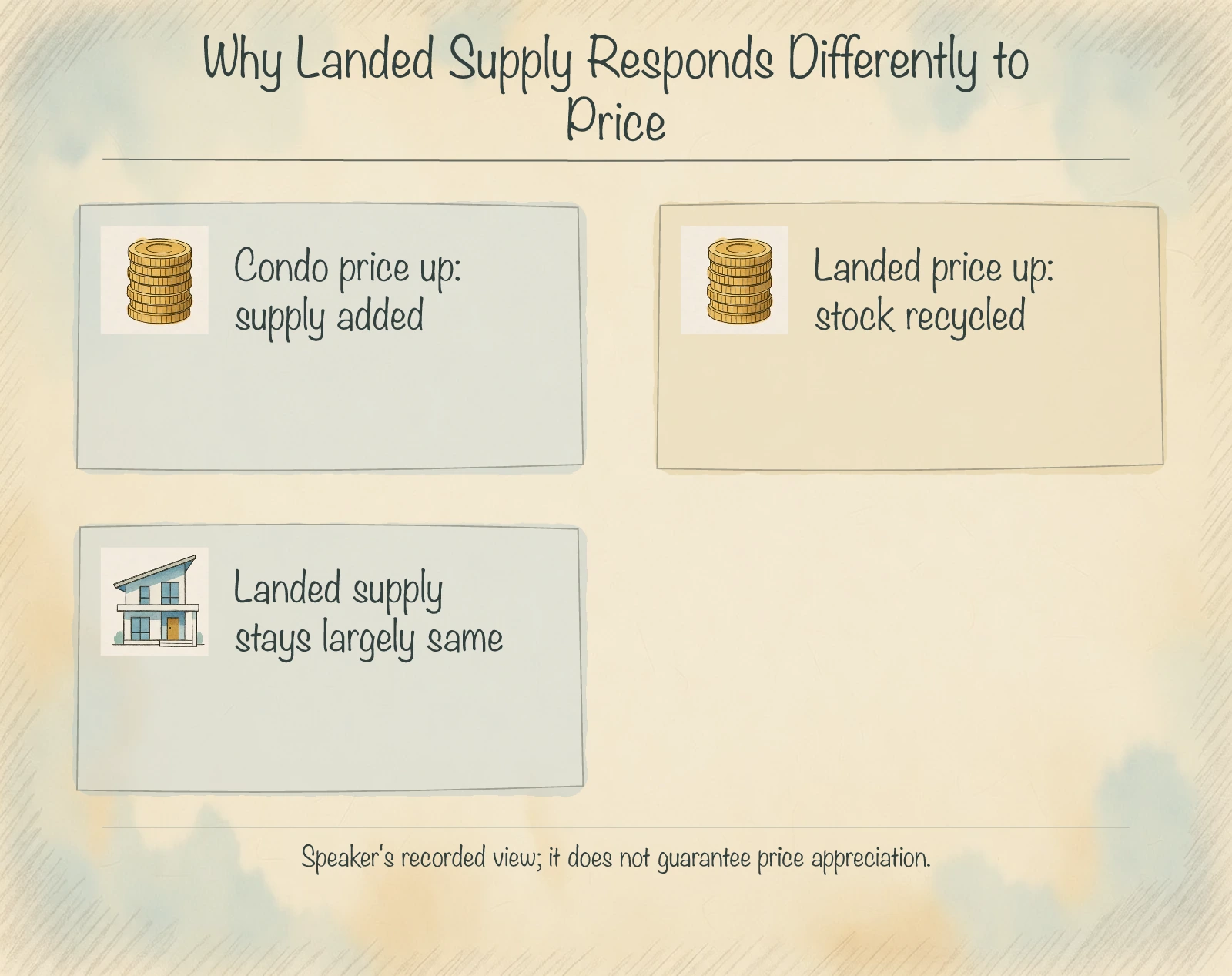
When the price of condominiums goes up, more supply comes in because our government wants to make sure that the price doesn't escalate further, thus they introduce more government land sales for developers to bid in order to satisfy the demand for developers to create more homes.
And thus this relates back to this fundamental term in economics is that when a price of this asset type goes up in the terms of condominiums, supply comes in and supply gets increased in the sense.
But for landed property it's very different in Singapore because even though when a price goes up, supply technically finds it very hard to be increased because there's just this limited amount of landed homes in Singapore that's always being re...
maybe I shouldn't use the word recycle but I would say that it's always been recycled in the sense that
Recycled Landed Supply and Buying Criteria
Developers will buy up old land, they will either subdivide it and build new ones to be sold in the retail market, but you are always hovering with the same amount of landed homes in Singapore. So it has a very inelastic kind of relationship between price and supply.
What this means is that because supply is the most restricted, when price goes up, landed home supply remains largely the same.
Thus when you own a landed home, you're sitting on an asset that appreciates by itself as you own it through the years, and this is a fantastic asset to own if you are after something that has very strong growth and high appreciation.
Now, the last chart to showcase to everybody, and then we'll head on to the main segment, is that yes I would definitely advise our clients to move towards the private property scene in terms of whether owning a condominium or owning a landed home.
But if you have the capability and ability, do of course dive very deep into owning a landed property as a form of longevity and as a form of price growth appreciation asset.
And take note that three and a half million Singaporeans — as long as let's say there's five percent that's coming in landed homes that's already close to about 175,000 Singaporeans that are eligible to buy landed homes.
I mean most importantly is that a lot of the landed buyers when they get into a landed market they actually upgrade and downgrade within the landed structure.
For example they get into interterrace, after a few years they move up to semi-D, move to the detached and then they move back into interterrace, or they pass on the homes to their kids.
And of course a lot of demand comes from the existing landed home owners as well, as well as from condo owners that want to upgrade for more space. We do see some HDB upgraded families as well that upgrade directly into the landed market.
And not forgetting this portion here is that a key disclaimer and observation is that landed real estate, because of the fact that it's high quantum, when you want to exit next time, also take note that because of the fact that you're owning a high quantum asset, you need to spend more time to find the next buyer.
So when it comes to selling a landed home, it is both an art and a science.
And because of this particular fact, it's very important that when you enter into a landed home, you need to take off a list of checklists to ensure that you're buying something that gives you an easier ease of exit in 5, 8, 10 years' time.
And in PRB we have this — Prof. Tillin Brothers Landed Mode Analysis.
Mode Analysis has three key apexes. First one are seven factors of IBA.
That means these are the seven factors that will help you to increase your buyer audiences in future when you wanna exit. Now, of course some of you might be saying that, you know, Melvin, I wanna own a landed home forever.
Yes, that is possible. We have seen some clients that own it forever.
They buy a freehold and they pass on to their children as legacy. And of course, their children might choose to sell it, they might choose to keep it depending on the next generation.
However, it is always important in my opinion to have a possible exit plan. Because maybe in 5, 7, 10 years' time you might want to relocate.
You might be having a plan to move on to a condominium that is a single level for retirement years. You always want to have at least a possibility of an exit.
And because of this idea and because of this possible exit plan, it's important that you buy something that allows you to increase your buyer audiences in future. Because you don't want to hold a landed property that in future you find that it's very hard to exit, very hard to sell, and maybe you want to realize your gain.
Maybe you have bought a landed home for $3 million, after about 15 years you can exit at $8 million but you find that oh my goodness it's very hard for me to exit because I bought something that there's a very restricted buyer audience.
Now secondly is that you want to buy something that has an increased amount of price acceptability, and we have seven factors here. Of course the third thing is that you want to buy something that your home has a key component that it doesn't have many unexpected outcomes.
And for today's webinar, I'm not able to share all 21 kind of factors with you because that's going to take maybe about, I don't know, 8 hours or 9 hours. But what I'm going to do is that I'm going to share with you some quick components within this spectrum right here.
I hope that this will add value to you in your journey.
Higher Quantum and Detached Resale Difficulty
Because we will definitely try our best to cover all. Now one more key component statement is that the higher the quantum, you also need to note that in future when you want to sell your landed home, landed buyers have very specific requirements, especially when the landed property is a higher quantum.
So when you want to sell your inter-terrace, compared to when you want to sell a detached, you will find that when selling your inter-terrace is actually much easier compared to selling a detached. Now the rationale is because your buyer audience is different.
And why is that so? Let's say you own two properties.
You own an inter-terrace that is currently valued at, let's say, $5 million. You own a detached that is valued at $9 million.
You put them both in the market. You'll realise that you have more buyer audience for the $5 million property because an inter-terrace is an entry-level landed property for many aspiring landed home buyers.
And you're gonna have more audience because at a lower value right here, which is at $5 million, there are more people that can afford a $5 million home compared to buyer audiences that can afford a $9 million home.
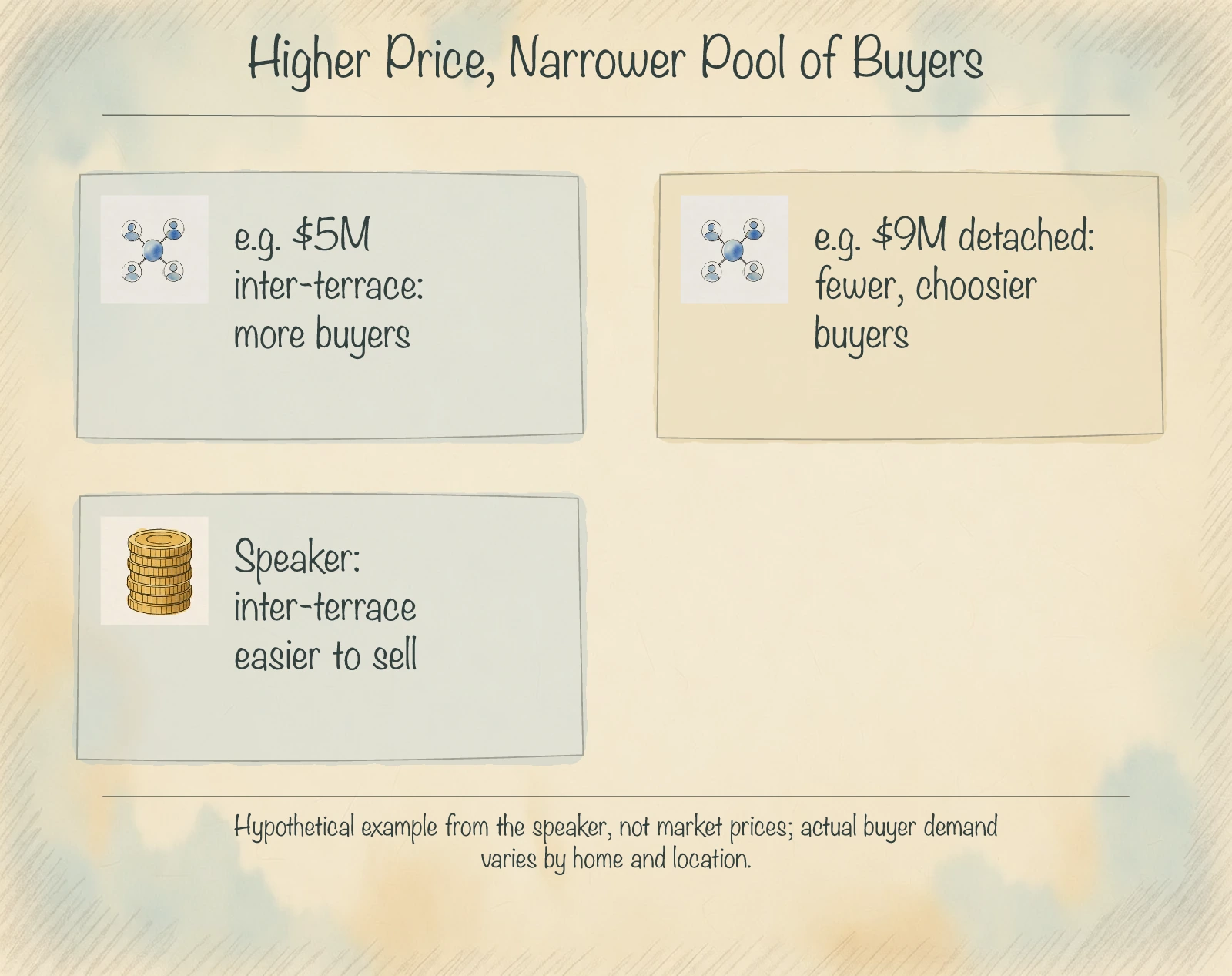
And a $9 million buyer is going to have more stringent requirements because the $9 million buyer has options. They can buy an old land that is in Cat 1 to rebuild.
They can choose from Cat 3 homes, they can go for Cat 4 homes, and they're going to have a lot of specific requirements.
And of course we have seen many homes that, sometimes because of a little bit of layout issue, land plot issue, facing direction issue, or maybe a lack of one to two bedrooms, or the inability to have a lift provision, then the buyer simply walks away.
And this is very important, to learn about what are some of these 21 factors, because these are the success factors that will allow you to have an easier exit. And when you have large audiences waiting to buy your landed home, you actually have a price position.
And that allows you the advantage or ability to enjoy more offers, more competing offers, and a faster exit.
Okay, now let's dive in. And what this helps is that it serves two objectives.
Number one, the mode analysis serves the objectives of increasing the speed of exit. Number two, it increases the price of exit.
And let's talk about the first key point. First fundamental is about increasing price acceptability.
Second one is increasing buy audiences. Third is to reduce your unexpected outcome.
And let's talk about the first thing that we want to talk about today, which is disparity effect on time. And this is under the category of increasing price acceptability.
So what is this disparity in terms of time? Now this is an example of how we always help our clients to ascertain some of the key success factors when selecting a landed home.
Now firstly is that we want to look at, let's say, if somebody has a budget of $6 million —
and take note that when you're buying a landed home, we definitely need to start with the overall investment range at the key start point. Now the rationale is because of this.
If you have $5 million to enter into a landed market, compared to a $7 million budget to enter into a landed market, compared to a $10 million budget to enter into a landed market, the strategies differ because why?
Your choices increase as your quantum investment range increases. With $10 million, you can explore places like Upper Bukit Timah, you can explore places like District 10, and of course you have a wide array of choices.
You can go for a semi-D in D10, or you can buy a mega DETACHED home in District 19. So because of your quantum investment entry range, you have a lot more choices if you have a higher quantum.
The investment strategy differs, even whether you should do an A&A, rebuild, or should you buy brand new. And this is an example if, let's say, somebody having a $6 million
dollars entry range. What we do is that with that six million dollars, we try to see what districts are suitable for entry purchase.
And within that district, what are some of the key enclaves right here. And within that few enclaves, what are some of the behaviour pricing in terms of the state of condition of those particular landed homes.
And this is an example of how we categorize. And in terms of categorisation, we use this particular technique that we've developed, and this is called disparity effect.
But disparity effect has a lot of sub-components, and one sub-component is time. Let me just show you one example.
This is an example of how we help our client to decide on what landed home and what particular type of landed home should they go for if, let's say, they have a $6 million range. And when you look at this, maybe let me pose you a question.
If, let's say, for example, you have a choice to make between a Cat 1 home,
Cat 1 Versus Cat 4 Price Quiz
Compared to a Cat 4 home, which will you go for? And that brings us to a quick quiz.
So maybe you can participate in the comment section in the chat box below. And let me maybe share this scenario.
If let's say you get to see a price movement over the last two years, and let's say you have been trying to stay out of the market because you have been trying to observe the London market, and maybe after two years of waiting you've decided hey I don't want to wait anymore, I want to come into the market.
Two years ago an inter-terrace in this particular district for Cat 1 homes that are meant for rebuild is at $3 million.
A brand new from developer is at $5 million and of course Cat 2 is at $3.5 million, $4.5 million and then 24 months later, two years later because you've waited for two years, the price appreciated to this category.
So you could actually have bought a landed home two years ago at $3 million for an old landed, but now if you want to buy an old landed, it's at $4 million.
And now if you want to buy a brand new landed, it's at $6 million, but two years ago, you can buy a brand new inter-terrace for $5 million. So now because we cannot go back in time, we cannot go back to the year 2021, we are already at 2023, maybe just put in your own opinion.
What will you buy? Will you buy the $4 million home now?
Will you buy the $4.5 million home now? Will you buy the $5.5 million home or will you buy this?
So take note that we are not talking about this because you cannot go back to this already, this is in 2021, this is 2023. Which type of inter-terrace will you buy in this particular district?
maybe let's take about five to ten seconds for you to answer. Well I enjoy a little bit of our coffee in the office.
Alright so I hope that you have a keen thought of your comments and your opinions. And one of the ways that we use disparity effect on time is to look at the percentage gain.
So for this particular scenario, in this particular district with this particular budget, for this particular client of ours, we actually recommended them to go for a brand new home directly from the developer. And when we talk about developers brand new homes, we're not talking about the mega kind of launch.
We are talking about homes that are available in the market because there are a lot of boutique developers that like to buy old land, tear down, subdivide, rebuild in the brand new homes. Sometimes they have one home for sale, sometimes they have three, sometimes they have five.
So these are the homes that we are talking about. We categorize as cat 4 homes.
So why is it that we recommend this client to go for the Cat 4 home is because if we look at the past 24 months of appreciation, the Cat 4 Category home appreciated the lease and it has the most bang for the buck value meaning that it has the most gain in terms from a biased perspective because you are only paying technically 20% more.
So compared to a Cat 1 home, it actually appreciated 33% and take note that when you buy a cat one home you are only buying the land because you're going to tear down the house most of them are single story or one and a half story.
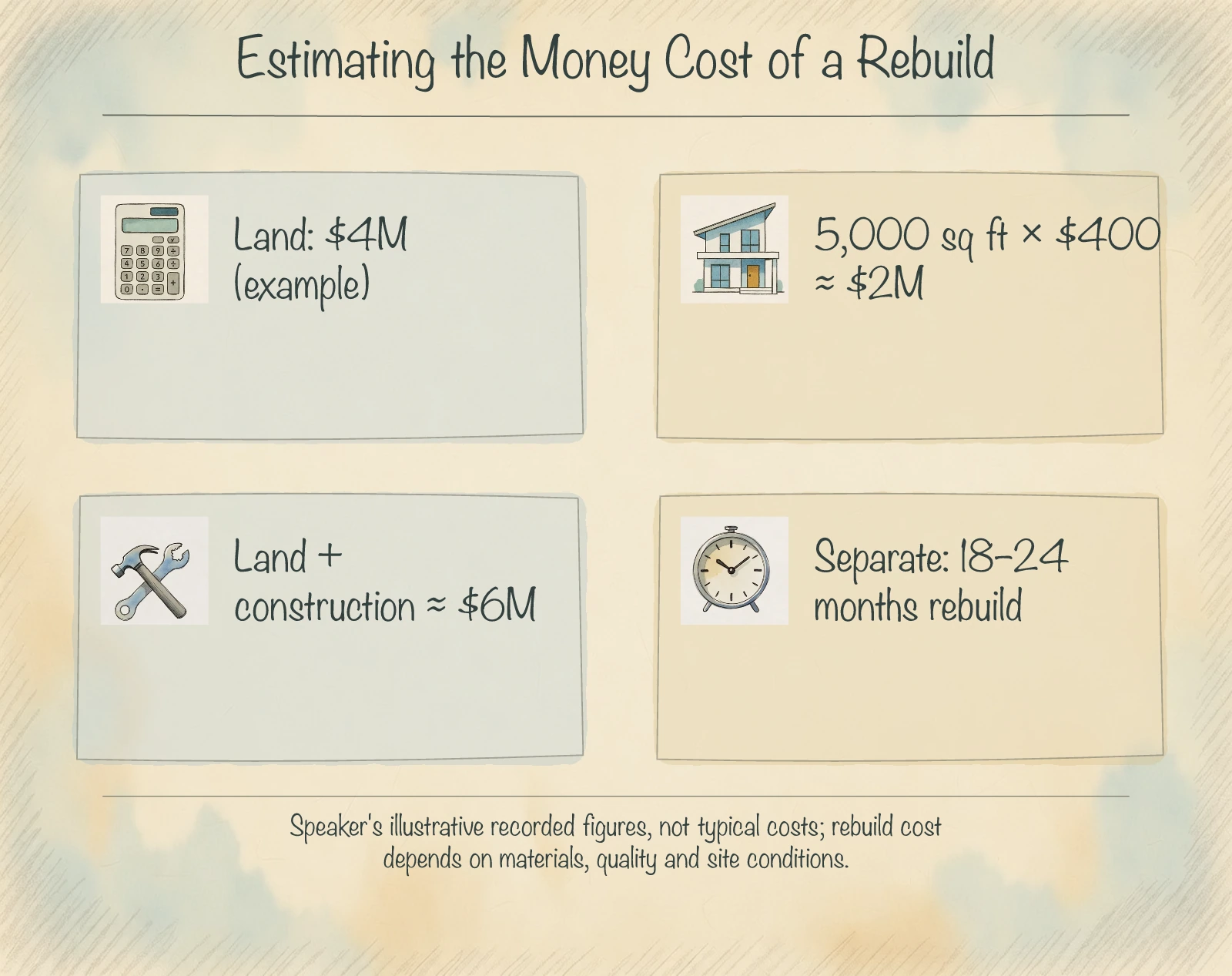
So you actually paying 33% more for cat one home and take note once you buy a cat one home you still have to spend the rebuild cost on the land itself. And right now rebuild cost is about $400 plus minus depending on the quality and material that you want to have.
Unless you want to build a 4,000 or 5,000 square built-out area take 5,000 multiplied by 400 is about $2 million of construction and that will then add on to your land cost of four mil. So four plus two million is six million and then you still have to spend about 18 to 24 months for rebuild.
And task for this particular scenario we recommend our client to go for this. They can immediately move in.
They are only having a 20% uptake from the past because they have chose to wait and not enter the market.
But of course if they have entered the market it would be fantastic for them but it's okay, I mean time has passed, we cannot go back to the past and thus this is just an example of how we share with our clients to take advantage of this disparity effect time selection kind of technique.
Now this is the disparity effect that we have developed in Propzilin Brothers and another example of how we have helped a client that was hunting for a D5 home was that whenever we start our analysis, we always go by firstly understanding what is available in the particular enclave in District 5 for this example, and then we estimate the
District 5 Analysis and Inter-Terrace Appreciation
We then estimate their build-out cost in terms of rebuilding. We then estimate their rental if they need to rent, and then we calculate the total cost.
And then from there, we try to ascertain what is a suitable choice for them and for this particular scenario. Because of the particular requirements of this client, we actually recommended them to go for the inter-terrace of this quantum, and that is actually based on their requirement, and we actually recommend them to rebuild on their own.
Because at that particular point in time, in the year 2021, it was better to go for a rebuild of their own because the disparity towards the brand new was actually pretty far apart, so it actually makes more savings from the buyer's potential point of view in order to rebuild on their own to save more cost.
Now the second factor under the IPA model in our mode analysis is disparity effect based on the types of landed home. And let me show you what it is about.
So when we talk about disparity effect in the types of landed home, this is a very good example because we were using this to help a D19 client in Q3 of 2022.
So in D19 Q3 of 2022, what is available in the market is that for inter-terraces you can get into an inter-terrace market at about 3.2 to 3.5 million dollars.
And of course right now the market has shifted; right now if you want to get into an inter-terrace in D19 at least you must have about 3.6 to 4 million dollars, and the choices are dwindling.
So in probably about six to eight months' time, my own personal forecast is that to get a D19 inter-terrace unit you'd have at least four million dollars, so that is what the price range for inter-terrace has been to.
So let's go back to Q3 2022, just about two quarters ago. So we're actually helping our client to look at whether should they go for an inter-terrace or semi-D.
So if you were this client, which will you go for?
And of course this is quiz time again. So if you have a budget of 4 to 4.5 million dollars, which type of landed home should you go to?
If you have this objective which is similar to our client, is that they want to see a maximum ROI in five years' time because in five years they might want to move, so they have a five years kind of investment horizon.
Of course it's not a hard and fast rule, they can exit in eight years, that's fine. But they hope to be able to buy the correct type of landed home to be able to exit in five years for a maximum ROI.
So if you were them, which one will you go for? Would you go for inter-terraces at 3.2 to 3.5 million but you have to rebuild on your own?
A $4 million inter-terrace that's meant for A&A, a 4.5 million which is the max of the budget where you still have to find maybe
$300,000 to $500,000 for renovation at the later stage? Of course this is out of your budget range because you only have 4 to 4.5 million, or will you go for a cat 1 semi-D at this range because the rest of the semi-D you cannot afford.
So assuming you have 4 to 4.5 million, which one will you go for? Maybe just take the next 10 seconds to keep your answer in the comment box below, and it'd be very interesting to look at some of your perspectives as well.
So also, just a recap, if you have just joined us halfway, we're very open to any questions that you have about the landed market.
So our research team has compiled a PDF pack of median quantum as well as median PSF pricing of landed homes in the latest months, and this is going to help you in hunting for landed homes in different districts in Singapore.
So which one will you choose? And based on our analysis, we actually have shared with our client that this will be one of the best choices that they can make.
The reason is because we noticed a shift in Q3 of last year that the inter-terrace market in this particular district, in this particular enclave, has already appreciated by a high percentage margin. And now it's time for the semi-D market to have an upward momentum at a faster rate than
Second Quiz and Inter-Terrace Leading Upward Ripple
Now of course, now quiz 2. And assuming right now that your budget has increased to five to six million dollars, which one should you buy?
And of course the objective again is in five years' time, and this is the same table. So if you have five to six million dollars budget, we show you go, and take note — if you have five to six million dollars, you can buy all four categories in the inter-terrace.
You can buy a brand new one from the developer, which is very beautiful. Some of the inter-terraces, they have even an air well, beautiful light coming into the centre core of the home, six bedrooms and very large build-ups, perfect.
They can even park two to three cars. The design is of course evolving over the years and is really fantastic for the landed buyer.
You can also go for brand new semi-Ds as well because there are some brand new semi-Ds at 2,152 square feet or 2,002 square feet or 2,003 square feet. There's about $6 million in this particular district.
Which one will you choose then if you have $5 to $6 million? So just take about 5 to 10 seconds to key in and take note — you can go for any type because you can go for all the spectrum.
Of course, you couldn't go for the higher quantum ones, where the land might be bigger, let's say 3,000 square feet land, and the developer calls for a bigger quantum.
And for this particular scenario, we advise our clients to go for this, in particularly the $6 million type. Now the rationale is because of this: the disparity between the brand new inter-terraces and the semi-D inter-terraces is too close.
When the disparity is too close, it means that in future, if you were to buy a brand new inter-terrace in this particular district and enclave, you're going to face steeper competition five years down the road when you want to sell the inter-terrace, because take note that once you buy it, in future it becomes a resale property.
And once you buy this home at $5 million or maybe even $5.5 million, you're going to face steeper competition from the semi-Ds as well, because your future buyer is going to be in a dilemma because they can just top up about a million dollars to own a semi-D — and a semi-D is two jumps in terms of status categorisation.
Inter-terrace, corner terrace, and semi-D is actually a two jump in terms of status.
And sometimes when you talk about the status, whether you go for a corner or a semi-D is also very important, because if your corner is very close to the price of a semi-D, that closeness in terms of disparity can also cause confusion to your future buyers, because a semi-D is always seen as the highest status compared to a corner terrace.
So these are just some aspects of example to share with you.
Now in September 2021, this was exactly the advice in this particular episode. We talk about the micro trends in the landed market, we talk about this disparity forming up in a lot of districts.
But make sure that you have already done your homework. Of course, if you have any questions, you can always comment and then we'll try to help you as much as we can.
Now, in 2021, we actually advised a lot of clients to start looking at the entry level of semi-D homes because inter-terraces had risen too much.
So this was just one example, and another example of a disparity effect happening is that you always have this up and down ripple effect. So inter-terrace is always the predominant movement.
When a market moves up, inter-terrace is always the first to go up, because if you have a lot of upward pressure from upgraders from condominiums or from the HDB market that want to enter into the landed market —.
And take note, because this is basically the Singaporean demand, and landed homes are only available for Singaporeans — they will usually enter into the inter-terrace market first because in terms of entry level, the price quantum is more palatable.
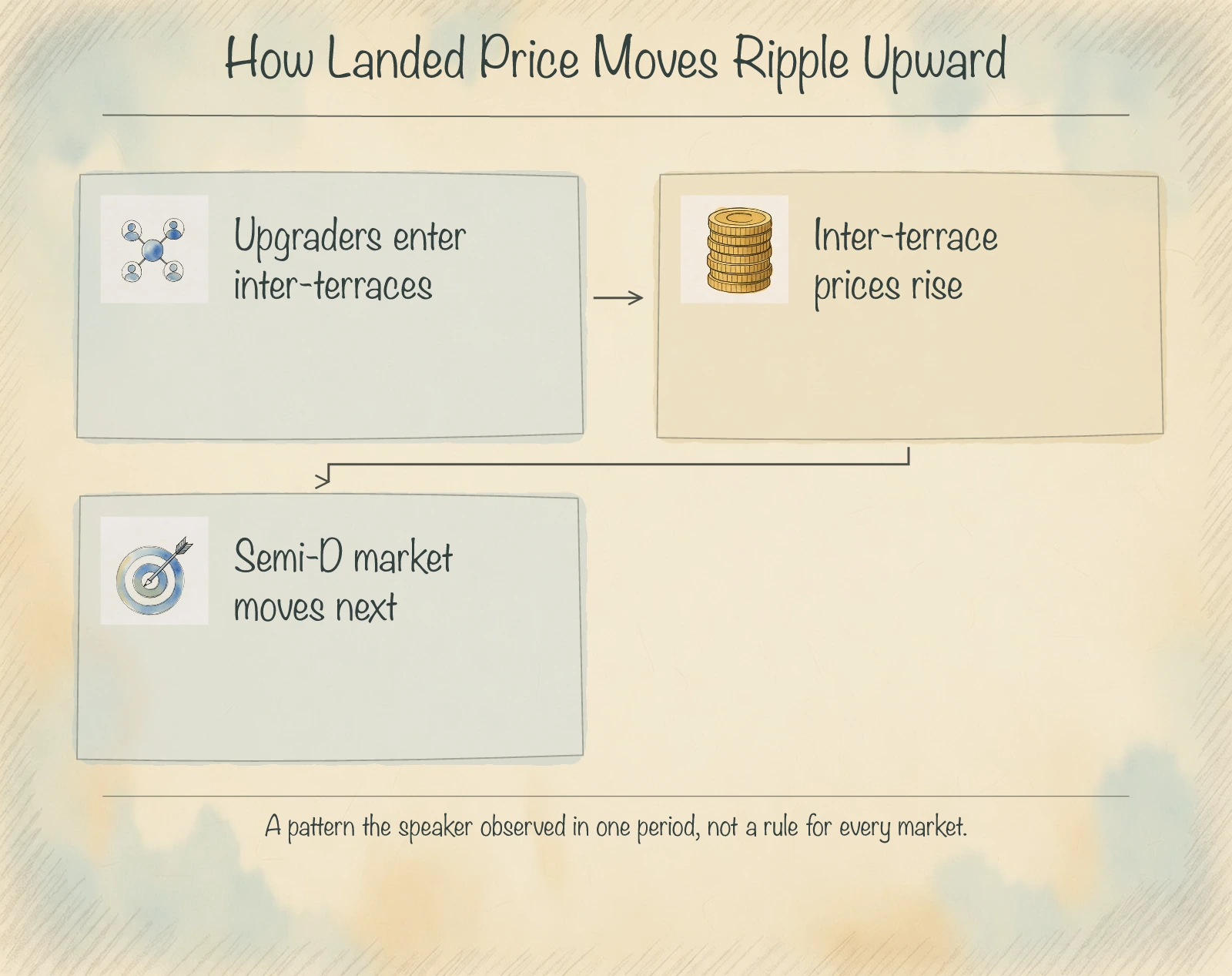
And once you see inter-terrace starts to move up very aggressively in terms of pricing, the next to move will be the semi-D homes. And that was exactly what happened in 2021 until today.
And let's have a quick look also at some of the performance of landed homes. We talk about this in some of our episodes.
There is a chasm gap that has happened over the last 11 years, and this chasm gap increases the very fact that landed properties now is a wealth preservation asset.
The reason is because firstly, you are buying an asset with only $73,000 of supply, but as price increases, supply remains stagnant, and that is good news for people that own this asset.
Holding Power, Ease of Exit, Buyer Wishlist
Asset because your asset value is not diluted away because of the fixed amount of supply. Secondly is that the holding power of the people here increases because as their value increase, the holding power of the lender owners increases in the sense that they find it less motivating to fire sale their property.
There's no need to fire sale their property because their value has increased. They can take equity arrangement on the value appreciation of their home.
When they sell it, they take their profit gain and buy another landed home, or maybe they buy two landed homes using one name each, or maybe they buy a bigger landed home. And thus, this has created a landed market in a spectrum that announced becomes like a well-preservation safe haven status.
This gap was formed because of the introduction of the ABSD, TDSR, and of course, a lot of cooling measures, and thus the split of pricing performance started. And this is showing a very good opportunity for home buyers that have the capability to enter into a landed market scene.
We have also seen appreciation in terms of landed, this is the blue line, of course non-landed. So of course in the last three years, both properties has appreciated and when you see this, this is actually the chasm gap that we have been talking about since 2010 and both lines are not touching one another.
Homes also have a growth rate, these are all landed residential home, 62% growth rate from 2012 to now. In terms of apartments, apartments also have a growth rate of 73% and then landed homes just in the last two over years, 31% growth rate, condominium in the last two years, 24% growth rate in terms of price PSF.
And I'm going to skip over to this portion here, which is the IBA segment. So this are the seven factors that will help you to increase your buy audience in the event if you are trying to buy a landed home.
That is easier to exit next time. So of course we have seven factors.
We are not going to cover them all and coming back to this main statement is that you have to ensure that you buy something that takes off more checkboxes so that it's easier to exit in future.
And we want to introduce you this new concept and this is called the seasons of change. So what is this?
This is also a subset of our disparity effect methodology in PLB and basically this is of the methodology that we always want to invest in the landed that gives you the ease of exit.
So that you can swap to another landed home that has a better performance in another season because take note that in every season different landed enclaves and different types of landed home they perform differently. Just refer back to the example that I was sharing back then of what we have talked about in 2020-21.
2022 is that the interterraces have moved up too rapidly and their growth is a little bit more platoon now and thus this is the season for semi-B to start moving starting from 2021-2022 onwards even until today.
We have actually segregated the annual medium quantum of terrace houses by district level, detached homes as well as semi-D. That's going to help you to ascertain the seasons of change methodology and under the IBA model, the first thing that we're going to share with you today is the future proving base of configuration.
So we have 12 future proving configuration under this first factor is that if you can pick off as many checkboxes here, the ease of exit in future increases and the first six basically is basically having a lift.
The minimum amount of bedrooms that a lot of buyers on the ground looking for is at least five to six on-suit bedrooms because of the multi-gen concept. People to buy homes with more bedrooms and let's say you have three children, three children who are already occupying three rooms.
You yourself is in the master room, there's four bedrooms, your parents is one room, of course you want to have one spare bedroom for a study room or maybe as a work from home office.
And on top of that we're also referring to this pure legitimate bedrooms meaning that it's not including the helper's room so make sure that there is also a helper's room as well. At point number four, two cars minimum and wet and gourmet kitchen, external yard bath in terms of the yard WC at level one laundry zone.
These are some of the things that a lot of buyers are asking for in today's market based on countless viewings that were conducted over the past 36 months.
Of course, there are also another 12 factors that we will only talk about in the later web next throughout the year. Now second thing is that I think this will be a very high interest list that you want to have is basically the avoidance list.
These are the things
Avoidance List and Value of Expert Guidance
That you want to avoid when hunting for a landed home, and of course this is just half the avoidance list.
So we have a 24 avoidance list right here, and of course I need to put in a disclaimer, is that these are collective feedback that myself and our team has collected over the years, and the very fact that we have so many landed homes over the past years allows us to gain ground feedback from buyers directly on the ground.
And these are not hearsay; these are actual obstacles that we look at, these are actual obstacles that buyers look at. For example, the number cannot be changed.
If you are facing the main road, it cannot be changed. If you are facing the expressway, it cannot be changed.
But what are some of the pros
and cons of this home? And most importantly is that we have to understand the fact that in Singapore, there's no perfect home.
It's impossible to tick off this entire list. And what we're trying to ascertain is that the more you can tick off, the easier it is to exit.
Because if you buy a home with lesser obstacles from your future buyer, you are going to face lesser obstacles in future. It means that it increases the speed of exit, increases the price of exit.
So this is just an example of the avoidance list that we always have our clients tick off. And of course we always share with our clients: you cannot find a home that has full 24.
There's no full marks here. If you have like at least 50 to 60 percent, it's already a very good bonus.
Last but not least, the R.U.O. hexagon.
So these are the R.U.O. hexagon, and of course this list belongs to the category of the costly mistakes that buyers make when buying a landed land.
So some example is like this: if you buy a land with road reserve cut lines and you didn't do your homework initially, this might come as a shock, because when you're trying to exercise your option, your lawyer might warn you, hey, do you know that there's a road reserve line, stuff like that.
So it's very important to do your homework at the start. And take note that when you're facing a main category of roads, there is a deeper setback requirement for your landed home as well.
And that's when you intend to rebuild, you will have to allocate a setback portion to cut back into your land, and then that means that you can rebuild lesser.
So some of the key things to take note: a road reserve line, of course sewer line that cuts across the land as well, soil condition is something that you need to take note of, non-approved renovation and of course, roofing issues, water leakages or unsafe renovation as well as some of the
telltale signs of water leakages as well.
So when we talk about purchasing a landed home for some of our clients, our main practice is that whenever there's a purchase, what we do is that we share with our clients that there's an option to engage one of our key partners who also have the experience of a chartered surveyor to come and have a look at the potential home that you want to put in the offer.
Just to look at the home in a sense that you want to reduce unexpected outcomes, because sometimes with the naked eye it's very hard to look at a lot of things. But with an expert's lens it's then easier to look at what are some of the plus and minuses of this home.
So that as a buyer you can make a decisive decision on, let's say, if there are very serious water leakage issues, at least you are pre-empted in the sense that you know how much you need to invest to solve the water
leakages, or let's say if there is some problems with this particular soil condition of this land that you intend to buy and rebuild, what are some of the additional costs that you need to put in when you are rebuilding the home.
So having an expert eye to look at a home before you put in the down payment is extremely important, and that's what the value-added service that our PIV consultants do for our clients on the ground. And when you have an expert following you, you can make a decisive and wise decision.
This gives you the power to walk away from unfavorable deals or be in a better negotiation position if you are buying a landed home. Alright, so now is the golden moment, because this is the main topic of today's webinar: should I rebuild, A&A, or buy a brand new landed home this year?
And of course I don't want to disappoint you, but I need to share with you this PLB journey maker, because there's no clear-cut cookie
Rebuild, A&A or New: Journey Maker
cuter answer to that particular question. So of course this is not a trick question, but the main truth is that there's no pure cookie cutter answer to this.
Because if you've been with me from the start of this webinar till now for the past almost one hour, you'll start to realize that it really depends on a lot of functional factors and a lot of it is dependent on this key factor called the disparity effect.
And this journey maker is basically how we have our clients to ascertain what action to take. So basically, if you are somebody that is entering or re-entering into the landed market or maybe purchasing another landed home, the key fundamental thing is here.
These are the five main points that we have for our clients. Firstly, is to understand, if let's say you're brand new to the landed market, is to understand why landed is a very different asset investment class.
And this is a perfect home if you want space, you want to own the land,
you want to own a freehold of triple nine years title, you want more big rooms, but at the same time, you want to own an asset that has very inelastic relationship to supply and price. And you are sitting on a strong price growth asset in a very limited supply kind of asset volume.
Now, once you understand that, then we definitely have to look at this key component in part B.
What are landed homes should I buy with this particular range that I have and this is adopting a concept of seasons of change and this is an extremely important concept because everybody has different quantum range that they can enter into a landed home in the particular season of their journey.
So assuming right now you have investment range of about $7 million then we'll have to reverse engineer for you to look at this $7 million in the particular district of your choice because if this is going to be a home that you and your kids are
going to enjoy living in, the district preference will also be of utmost importance. And from that district level, we deep dive into certain enclaves and then we have a look at disparity effect over time.
Disparity effect over cat one, two, three, and four, on what type of home should you go for and disparity effect of the types of land at home that you should go for.
And going back to cat Cat 1 & 4, that is the way that we can then determine whether should you rebuild A&A, renovate or buy brand new in Cat 1, 2, 3 & 4.
And that is a combination of applying techniques in C&D for us to ascertain using the Landermote Analysis on reducing unexpected outcomes, on increasing price acceptability for your future buyers, increasing buyer audiences for your future exit as well so that in five to ten years time, if let's say you want to switch from your interterrorist to a semi-D, you want to switch from your semi-D to a detached home, you can do
that easily without having to put your property in the market for let's say 12 to 18 months and you still couldn't find a buyer because of the fact that there's a lot of key components that is blocking the sale.
And task importantly To answer this question, it has to follow an A to E concept right here so that we can reverse engineer and see whether should you rebuild A&A or buy brand new based on the ratio you have, based on the season that you are in, based on the district that you are after, and based on the particular enclave that you are looking at.
And that is how PLB reverse engineer for our clients using the PLB Landermote Analysis method. And of course a recap of cat one two three and four is basically at this table and maybe just a quick glimpse of one of the homes that we have already sold.
This is an example of a cat one home that's suitable for rebuild at
Wasco. You can head back to the video on our prop 10 bus YouTube channel to have look at the video in depth.
There's this particular home right here very suitable for rebuild. That's an example of cat one home.
Of course when you rebuild you have the choice to go up to two and a half or three and a half story. Of course most of time when people buy two and a half storey kind of potential homes, they will consider to build a basement for additional build-up area.
And this is an example in Chelsea Village of an inter-territorial that is very suitable for renovation or a light ANA.
Historical Rebuild Costs and Planning Factors
Now, a quick update from some of our partners. Basically the observation for our first quarter to 2023 in terms of landed pricing is that for the A&A category right now is at about $250 to $300 per square foot, and take note when we calculate this kind of pricing we're talking about the built-up area.
So for example if let's say your A&A is for an area estimated at about 2,000 square feet, then you take that and multiply by the cost, and reconstruction is at about 320 to 375. Brand new, tear down rebuild is about 375 to $400 upwards depending on the type of materials.
Of course all these are subjected to site condition and soil topography. And when we look at landed pricing, we always talk about the land PSF, but when we talk about doing work on the built-up, we always talk about the built-up area.
So this is just a quick sharing on the categorization.
Also there are six observations of what is happening on the ground. This is very useful for you if you're planning to rebuild a home.
So NetLink Trust, of course, it has increased lead time, now is about five months for fresh application. SP Power upgrade right now is about four months backlog.
There's also a lot of interest for EV provision and do remember to consult with your electrician, LEW consultant. Sanitary fittings, of course, take note that not all online purchases will be allowed for submission and they have to be approved by a licensed plumber.
Imported sanitary as well can take up to four months for international shipping. And of course there's also a lot of safety provision, hand high-ten, kind of protection, site supervision and compliance documentation needed due to recent spate of construction incident and death incidents as well during the construction of homes.
So these are the latest observation, the market on the ground. Hope that that will help you.