Buying and upgrading
The Core Is No Longer Just Orchard or Newton
Published 2026-11-11. Adapted from the episode published 2025-10-10. Figures, illustrations and data reflect the episode’s original publication date.
On this page
- Introducing Aurea and the CCR zoning
- District 7's appeal as a CCR location
- Region disparity effect and CCR pricing
- Rejuvenation plans and tax efficiency for owners
- Wealth growth and Aurea's mixed-use design
- Aurea's unit mix and the surrounding D7 belt
- Limited D7 supply and competing projects
- Comparing Aurea with other CCR launches
- Exit PSF and the mixed-use premium
Introducing Aurea and the CCR zoning
Welcome back to NOTG. So today we're going to deep dive into District 7, in particular on this particular new launch, a development project called Aurea, which came from the previous Golden Mile development, and of course after it has been en bloc, now the entire new project seems pretty interesting.
Of course a lot of you are asking: is this project investable? Is it great for you to own and stay?
So we're going to deep dive into sort of the potential of this and also what's happening in the downtown called Regent. Let's go.
So CCR is the central core region. So if you look at the map itself, I call this the foreigners' playground.
Why do you want to talk about this region? Because internationally in all countries, everybody looks at the central city.
For example, if you go to KL, Malaysia, you look at KLCC region, and if let's say for example if you go to China, you look at Shanghai, right, you go to Shanghai, you look at where is the central core.
If you go to KL you also want to find out where is the central core.
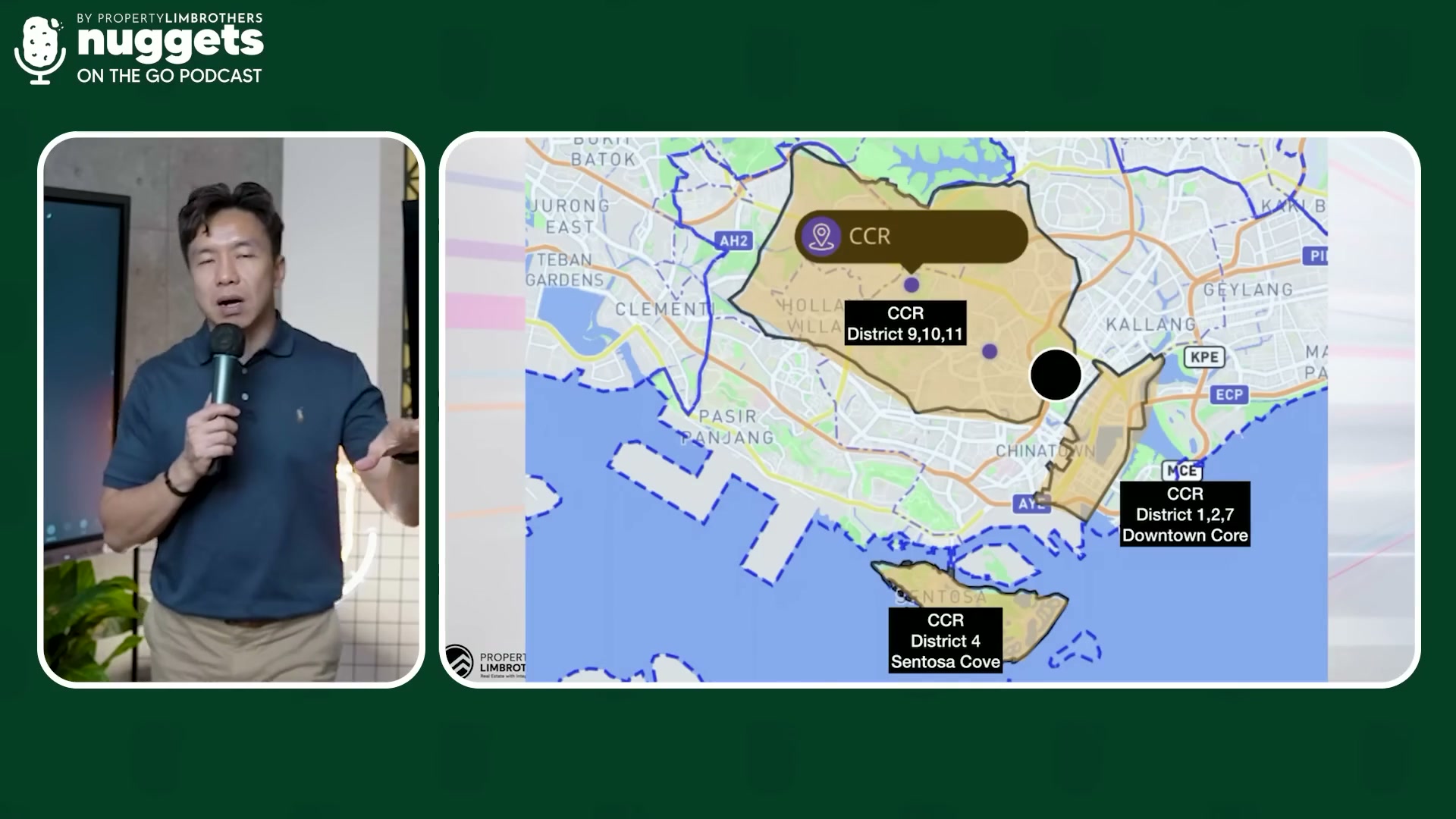
But then when we look at the expansion of central core, we need to look at this particular slide. So when you look at CCR, CCR is a central portion of Singapore.
It comprises of District 9, 10, 11, which is Orchard, River Valley, Bukit Timah, Newton, Novena, and it also includes District 1, 2, and 7.
Now District 7 is the entire precinct, all the way starting from the downtown region where you see like South Beach, Bugis, towards Kampong Bugis, Jalan Besar area, all the way now stretching towards where Aurea is being located.
The latest master plan by our Minister that was being launched in the year 2025 — if you have not visited URA, you should go and have a look, because it's almost, I would say that it's awesome and impressive, the amount of forward planning our government have for Singapore.
And I think in Singapore, if you have already invested in Singapore for the last 20 years, you know that a lot of progress are happening,
which is also why for a straight, I think like 20 years will be named globally as one of the top most livable cities in the world. And of course, our real estate prices are not low because real estate prices coincide with also the most livable city, because if it's not most livable, it wouldn't be popular.
And because it is popular, there's a lot of demand. International audiences, people migrating in, high-net-worth individuals and millionaires coming in — just have a look at the latest Henley and Partners report.
We are now in the number three ranking status in terms of the amount of high-net-worth individuals that's coming in to Singapore on a year-to-year basis.
So the amount of wealth and liquidity flowing into our country and a lot of people that's wanting to apply PR as well as national as well as our nationalized citizenship is actually going on a very consistent basis.
So I would say that in terms of our country's growth is now on our 60th year, very, very, I think, promising in the years to come.
But most importantly CCR also includes District 4, Sentosa Cove, and today we want to deep dive into District 7 to have a look at the potential of this district, because when we talk about District 1 and 2, that's largely Marina Bay CBD zoning.
But District 7 is a little bit different because it consists of heritage. If you have travelled to a couple of countries, you'll notice that in every country that is very well developed, that's usually the very prime zone.
So for example, if you go to Malaysia KL, you will see KLCC. But then with the development of KL, you will also notice that there seems to be new kind of like luxury districts popping out, and that's very similar to a lot of countries as well.
So let's have a look at this call relationship first and then we can deep dive into some of the potential that's upcoming. So CCR comprised of 9, 10, 11, and then you have another CCR which is here,
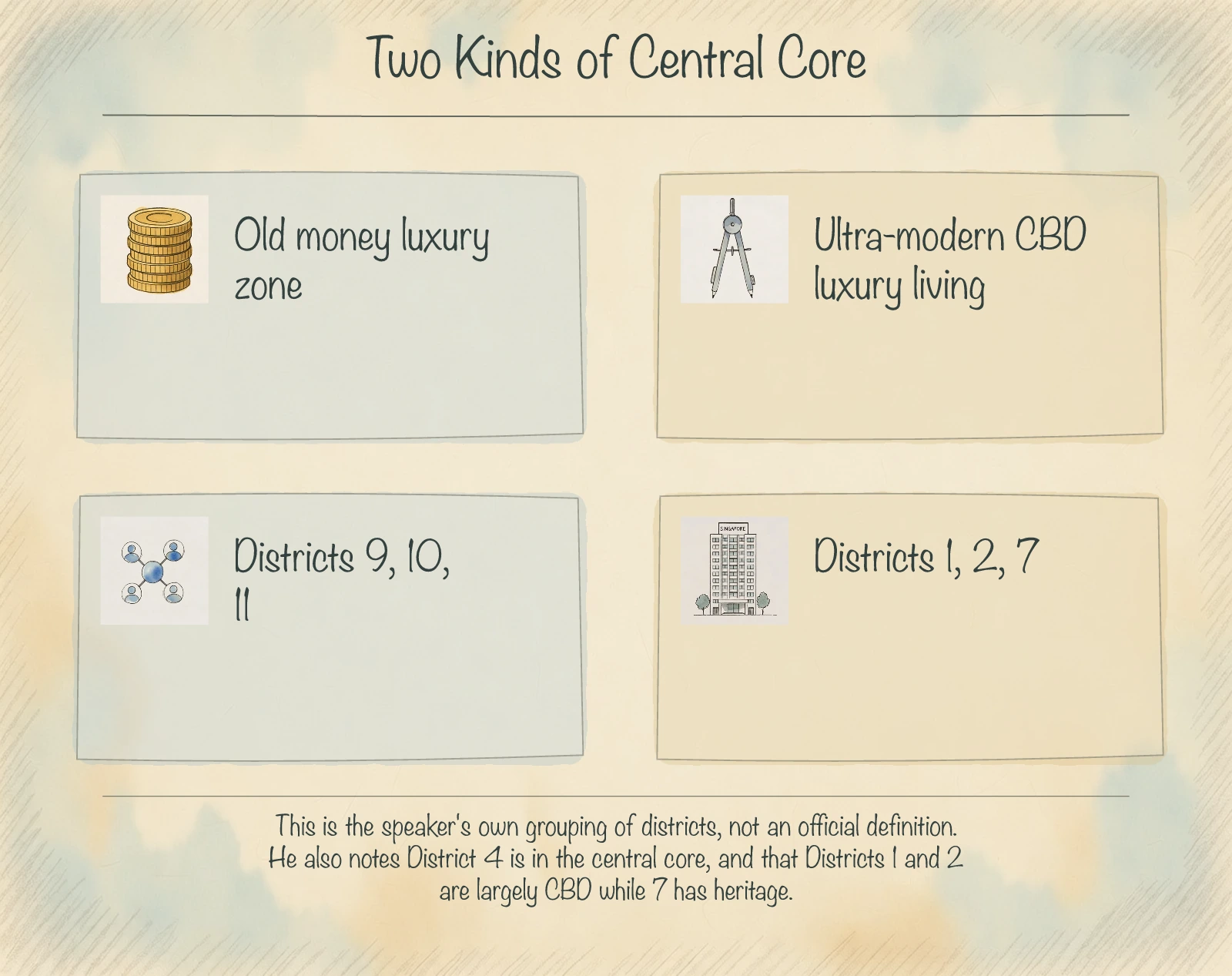
District 1, 2, 7. So traditional CCR I will call them the 9, 10, 11, so I call them the old money luxury zone, and the new version of CCR.
Why is it important that a government must so-called like develop a new CCR? Because of their hybrid mix, younger generation, Gen Z, there's an ultra-modern concept, CBD financial hub concept plus heritage kind of zoning.
So I'll call this the ultra-modern CBD-centric luxury living which is in District 1, 2, 7. And if you go to Shanghai, you will see the old money luxury zone, you'll also see the ultra-modern luxury zone.
If you go to different countries, for example, in Tokyo, Taipei, Hong Kong, Sydney, New York, Shanghai, this is also very prominent. They have this traditional CCR as well as downtown CCR.
So we are talking about District 7 as being enjoying one of the best of both worlds, because CCR is being known as a central zone in Singapore whereby, for example, if you own a property
District 7's appeal as a CCR location
To invest, even the own property that is easily rentable, you want very high rental speed. Then most of the time, a lot of international audiences expect tenants when they come in, they will first ask, where is the CCR zoning?
What kind of CCR zoning are there? Am I talking about the traditional luxury, old money zone, or can I enjoy a bit of heritage?
Can I enjoy a bit of fast-paced movement, shopping near to the financial hub? And I think this is where District 7 is being located.
And right now in this current season, the year 2025, moving towards 2026, it seems that the disparity gap and the equilibrium has like a very strange kind of relationship. Just track back to what these two charts are showing.
Alright, so basically let's say if you look at RCR versus CCR, you can find some of the pricing of RCR very, very similar to CCR.
And sometimes even in OCR is pretty similar to CCR in terms of overall quantum because one of the key things that has happened over the last few years ever since COVID is that if you look at RCR versus CCR pricing gap pre-COVID, RCR was cheaper by CCR by 31% but post-COVID until today, RCR is technically more expensive by CCR by 3.08%.
Just have a look at this graph and the growth of pricing and catch up in terms of PSF levels.
So in terms of PSF, I think when we look at some of the new launches as well as some of the properties that's happening in CCR, you'll find that, why is it that CCR PSF is about the same as RCR PSF?
And why is it that OCR PSF, because they are doing in the range of 2250 to 25PSF, is also like just one, two, or $300 difference from a CCR pricing. And when we look at OCR, this is the current price gap.
Pre-COVID, 71% price differential in terms of PSF, post-COVID just a short five years later, OCR versus CCR is only 7%.
So when I was putting in some of the data point between some developments over here, and just trying to look at what has been the past transacted in terms of new launch comparables, some of the balance units in some launches in the RCR zone.
And of course, whenever we look at this kind of price gap, we're not saying that this project is better than that project. We're not saying that.
We're just saying that when you as an investor or let's say somebody is buying your next property to stay or invest, if you can find the disparity gap movement when it's out of equilibrium, you can have a potential advantage to enter into a project to take advantage of this opportunity because this opportunity doesn't happen all the time.
Let's come back to this screen for a little while. This is what I call the disparity gap.
Just an example. Let's say if you're comparing between Aurea, which is a CCR project, and let's say this 2 beta that you're hunting for at the base entry level, for example, sort of the level 456 units, they are starting from 2007 plus PSF, quantum wise, maybe about $1.8 million.
Just an example, all right. 2007 plus PSF, Aurea.
And you happen to be looking at a balanced launch in a RCR project for example at Grand Dunmond and that is at 667 square feet. There's a unit available now at this point of filming and that is at $2 million.
PSF at $3,200,000. One bath and this is two baths.
All right. So versus a RCR two-bath one bath $2 million and this is at $3,000.
$1.00, PSF. Of course, this is high floor, very high floor.
This is of course low floor. And we can't really compare high versus low floor.
But then we should definitely compare the strength of the region because one is a CCR development, one is a RCR development. And when we compare the strength of a region, we call it region disparity.
And this region disparity occurs when I put A and B together because by right, A and B should have a very healthy equilibrium gap between a CCR pricing and a RCR pricing.
But why is it that now if you go for a high floor here, this is 3000 PSF, you go for a lower floor, this is 2007 plus PSF.
And even if I want to go higher floor here for this particular project, and if I'm paying 3000 $1000 PSF, it will still be around $2 million for a 2-bit 2-buff compared to a 2-bit 1-buff over here.
And if you can take advantage of this equilibrium gap between region, then you have an advantage because simply say it, 4 years later or 3 years later when this project hits its TOP status, the person that would have paid $3,000 would want to sell at about $3,003.
They want to sell maybe $2.25 million. You, being in the CCR era, even if you have entered at the same price at $3,000,000, you want to sell $2.25 million, $3,003,000, but you have a CCR product versus a RCR competitor.
It's a and basically you can sell and exit at the same price and let's say for example you go for
Region disparity effect and CCR pricing
High floor, you can take advantage of that as well. This is a high floor, this is a high floor, or you enter at about the same price but you are in a different region, you're in a different district, you're in a different region strength.
And that's what I call region disparity effect. So if you look at this example on screen, basically for example if I take a 2-bed, even if let's say I go high floor for a large unit at already at 710 square feet.
This basically, 2-bed 2-bath, 1.99 or just take as $2 million, $2,800 PSF, comparable to some of the balance units available in the RCR region. I think this is something that you can look at.
And of course, if you were to look at some of the balance units at Tron Park, and that's of course OCR region, of course that Tron Park location is fantastic as well. Serangoon, Tron MRT station going into RCR region, but it's still considered OCR.
The balance unit is now 1.9 plus.
Of course, developers have done very well. They're not urgent to sell for that project.
But if you're considering like balance unit, then you should definitely look at in different stronger district or region. Can I get something that is about the same price as a less stronger district, less stronger region?
I can take advantage of this gap right now because there's always a season, forget, and this kind of gap doesn't exist all the time. And that's the reason why we want to deep dive into this particular district to talk about CCR region strength.
There's always what I call a correct equilibrium kind of thing. So in the past, a healthy region disparity is that for example, I have X amount of dollars.
If let's say this X amount of dollars only allowed me to buy a 1-bed in CCR, then I can buy a 2-bed in RCR and I can buy like a 3-bed in OCR. If I can buy a 2-bed in CCR, theoretically
I can only buy a 2-plus-study or 3-bed in RCR region and a 4-bed in OCR region. However, what is happening now is that sometimes we see this kind of occurrence whereby OCR, RCR and CCR 1-bed are around the same quantum price.
And when that occurs, this is not a healthy region disparity. And the reason is because of the two charts I showed you is that pre-COVID, post-COVID now in the last five years.
The pricing caught up by RCR and OCR has went up so much that now I think there's a lot of opportunity in the CCR zone.
Because pricing for a lot of the launches now, and especially when you look at D7 Aurea, it starts from about $2,700 PSF all the way, of course, to $3,000 for some of the very high-floor units.
And you can get it something at a PSF range that is quite comparable to OCR-RCR launches and at the same time the quantum entry range
is also pretty palatable. So now of course it seems that a 2-bed in RCR is the same as a 2-bed in CCR and sometimes it might be even the same as a 2-plus study in the OCR region.
So when we spot this kind of stuff we want to see if there is any opportunity in terms of entry that we go in and we call this the region disparity.
Now let's talk a little bit about this particular development itself because in terms of transformation wise, I think there's quite a fair bit of upcoming transformation including of course the conservation areas and buildings, the identity corridors, you also have the entire urban design areas, you also have the Kampong Bugis evolution as well as the Kallang Alive project.
So these are some master plans that we should not overlook because whenever our government says that they are putting effort and if you go to URA, the physical gallery to have a look at what's happening, the entire plan is already mapped out.
And of course, sometimes it might take five years, eight years, 10 years to develop. Certain master plan will come up faster.
Certain master plan will take a little bit longer basically for government to do study. But I think as long as they already have announced, I think our government is committed to make it happen.
And also when you look at some of the very interesting rejuvenation point, there's a lot of makeover that's happening in the entire Beach Road, Bugis region in terms of rejuvenation.
Of course that includes like the Shaw Tower, includes the entire Nicoll, Marina East, Southern Coastline, new homes that are being planned, the National Day Rally that has been talking about the Kallang Alive project. You have Marina South, the new mixed-use urban neighbourhood.
You also have the new investment to expand the integrated resort and Marina Bay Sands, the mooring of the float at Marina Bay, all this, the future NS Square, Kampong Bugis Kallang rejuvenation, new sports facilities for a lively, pristine Kampong Bugis and the
Rejuvenation plans and tax efficiency for owners
Plan to go car-like residential. So the identity corridors includes the very exciting zone where we're talking about which is the Golden Mound region.
So the Masterland 2025 I think is very interesting, and wherever you see all these yellow plots here, of course, maybe you'll be saying that, hey, in future, will the plot in front of Aurea because there is a yellow plot in front of Aurea.
We don't know what that's going to be. It's a reserve site.
It could be a high rise, it could be a mid-rise, it could be a low-rise. It depends on the plan of the government thinking about the waterline region over here.
But in any case, there's going to be tons and tons of new developments in the next 20 to 40 years as our population keeps gradually growing. So no matter what project you buy in today's market, unless you're really sitting at the brim of the seafront facing, there's no perpetual view.
But the important thing is that any new projects that come up right across the street, right in future, is going to be a new PSF level that will potentially help your PSF entry price today.
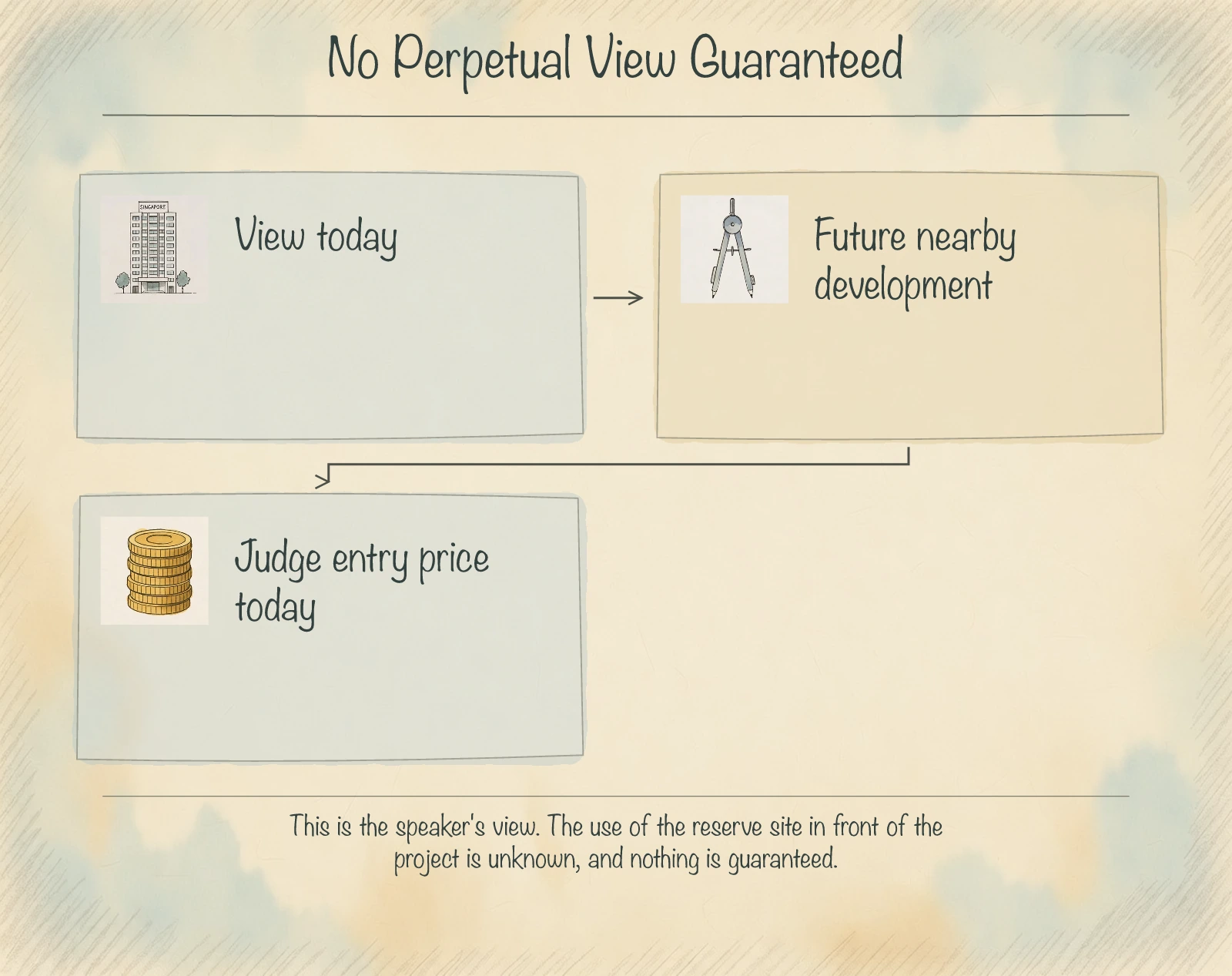
Just an example, just look at East Coast. Everybody thought that the moment I buy a seafront facing East Coast condo development, I have perpetual unblocked view.
But then last year, the another long island technically will mean that potentially a lot of all these condos, sea view is going to be blocked. So there's no perpetuity because plans and trends and requirements of the country changes along the years.
What's important is that we don't wait for 20 years later to invest in development. We invest in something that makes sense today in terms of entry quantum as well as PSF level.
Let's talk a little bit about some of the catalysts that potentially has not been fully priced in yet that is relating to the precinct. Of course, Gordemau complex is 700 million dollars acquisition by Faiz as well as Perano.
Know, this is like a conservation lab makes you develop with a new tower or and of course, the whole development is centered around like a signature heritage, modern kind of vibe, as well as a luxury component that is all weave into one.
There's some projects that will be completed very soon. I mean, let's have a look at just down the street short Tower is a 200 meters away grade A building.
It's later to complete Meet 2026. There's already like pre-committed premium operators.
For example, the Great Room, they are taking a 36,000 square feet hub within that project itself. Of course, that's going to really enhance the corporate kind of like tenancy debt and the day population and day traffic around the entire Bukis, Kampong Bukis region.
Now Guakko Midtown, the whole ecosystem phase has already created like a network hub. There's almost like more than 10,000 data executives, residents, visitors as expected of the district.
This is like one of the key driver for the region for rents, amenities, office use. Of course, the planning backdrop as well for the URI Central Area, Beach Road, Street Block Plans, as well as CBD fringe intensification.
This is going to bring a lot developers' attention to take advantage of URI's focus on CBD's sort of like rejuvenation process.
So let's further break down in terms of what will happen in terms of transformation. I think the important thing is to pair transformation together with the existing kind of competition around the era because as an investor, I want to look at a few key things.
So today, for example, let's say I I want to invest in a property and I want to go in at about $2.5 million. I have to put in 750K.
Why 750K? Because 25% down payment plus bias time duty plus minus 750K.
This is my capital. This is the total property price because I'm going to leverage 75% on my loan as well.
I want to know is my capital going to have a potential to be preserved? That means I do not want to lose money.
That is basically the number one top process of an investor is that the amount I put in, I don't want to lose money. What is the possibility of this property making me lose my capital?
Because there are of course people who lost money and which is why when you look at certain kind of projects, there's profitable transactions as well as unprofitable transactions. All right.
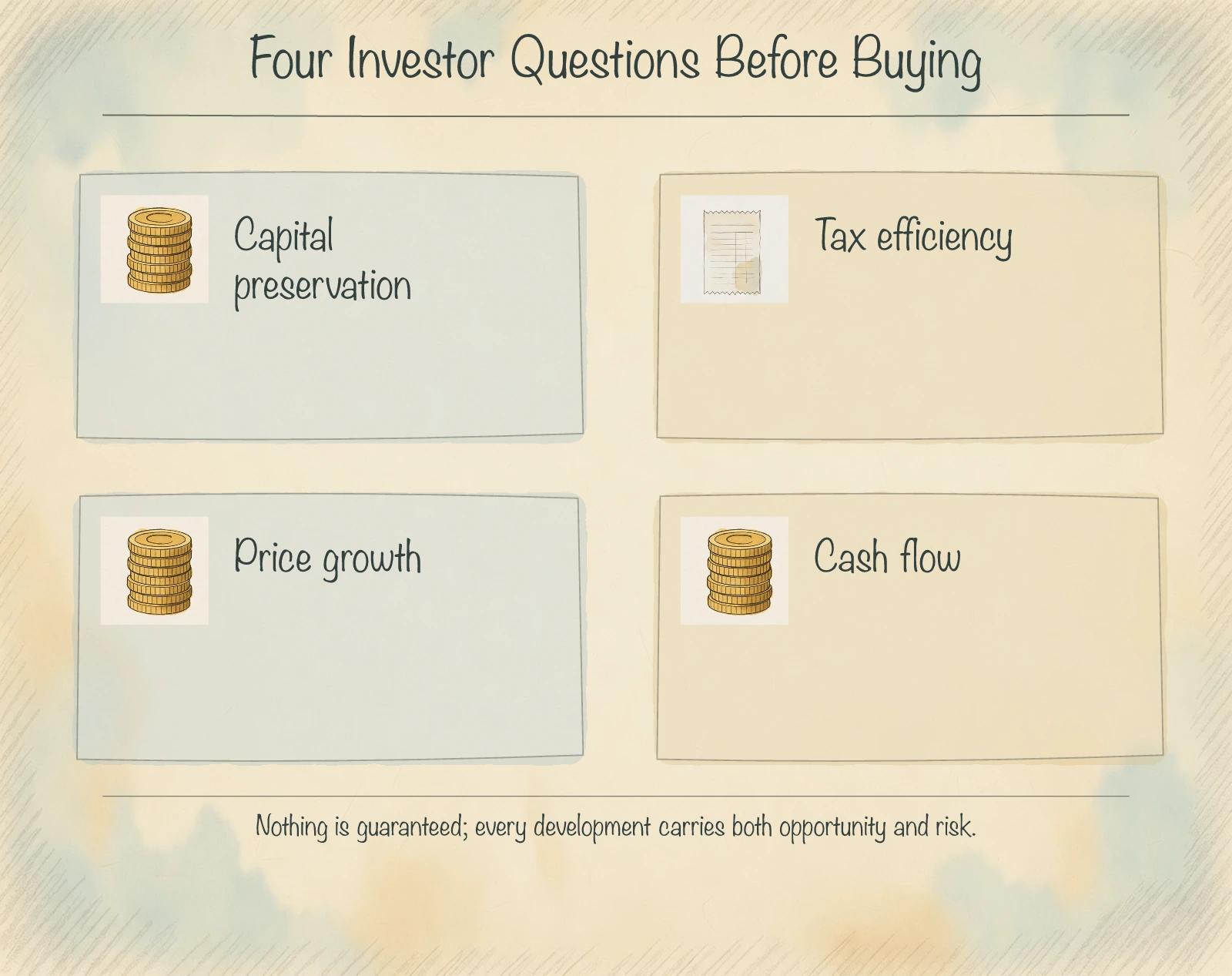
Second thing is that I want to look at my tax efficiency, which is why, for example, if let's say you have two names in a property, why a lot of families they decouple their name out of the property.
And of course, by doing refinancing, decoupling, they're freeing up their name to buy. Another property is for tax efficiency so that they don't really have to pay the ABSD unnecessarily.
Because for example if you pay an ABC as a Singaporean 20% technically if you buy any property at $2.5 million 20% is not a small sum that's 500k of tax all right so they always look at tax efficiency and the third thing they look at of course is the growth
Wealth growth and Aurea's mixed-use design
Is there a potential for growth of my wealth? That means if I want to invest $150,000, can I grow my wealth?
And I want to know, is there price appreciation?
So for example, if I were to invest in Aurea, is there a chance that — of course nothing is guaranteed in this world, every development comes with opportunity and risk, which is why investors always look at these four quadrants, because they want to know, is there a potential for price appreciation to grow my initial capital?
We call it cash on cash return or return on capital.
So this 750K — okay, when I enter and when I exit, is there a chance for this 750K to grow into a bigger sum after paying off all the legal fees, agency fees and all sorts of so-called costs of holding on the property, including interest costs and so on and so forth?
And this is of course my cash flow. So importantly, when you want to invest in a property, especially if it's a new project,
cash flow is usually related to the progressive payment, which usually is a very attractive point for a lot of investors, because this is progressive payment. Cash flow also relates to the holding cost of the property.
Some people want to buy a resale property because they want immediate rental cash flow. However, also to note that immediate rental cash flow doesn't mean that it fully covers the mortgage.
So you need to calculate whether your rental for the resale property can cover the mortgage, or whether you still have to top up MCST fees and part of the mortgage, etc etc.
And of course your MCST fee kicks in for resale properties at the start point of you owning the property, and your instalment model kicks in immediately for progressive payment. They follow a tiering system based on the construction of the project, and this is sometimes very favourable to investors.
There is a more hassle-free kind of concept — that they don't want to manage a tenant, they don't want to have the MCST fee kickstarted,
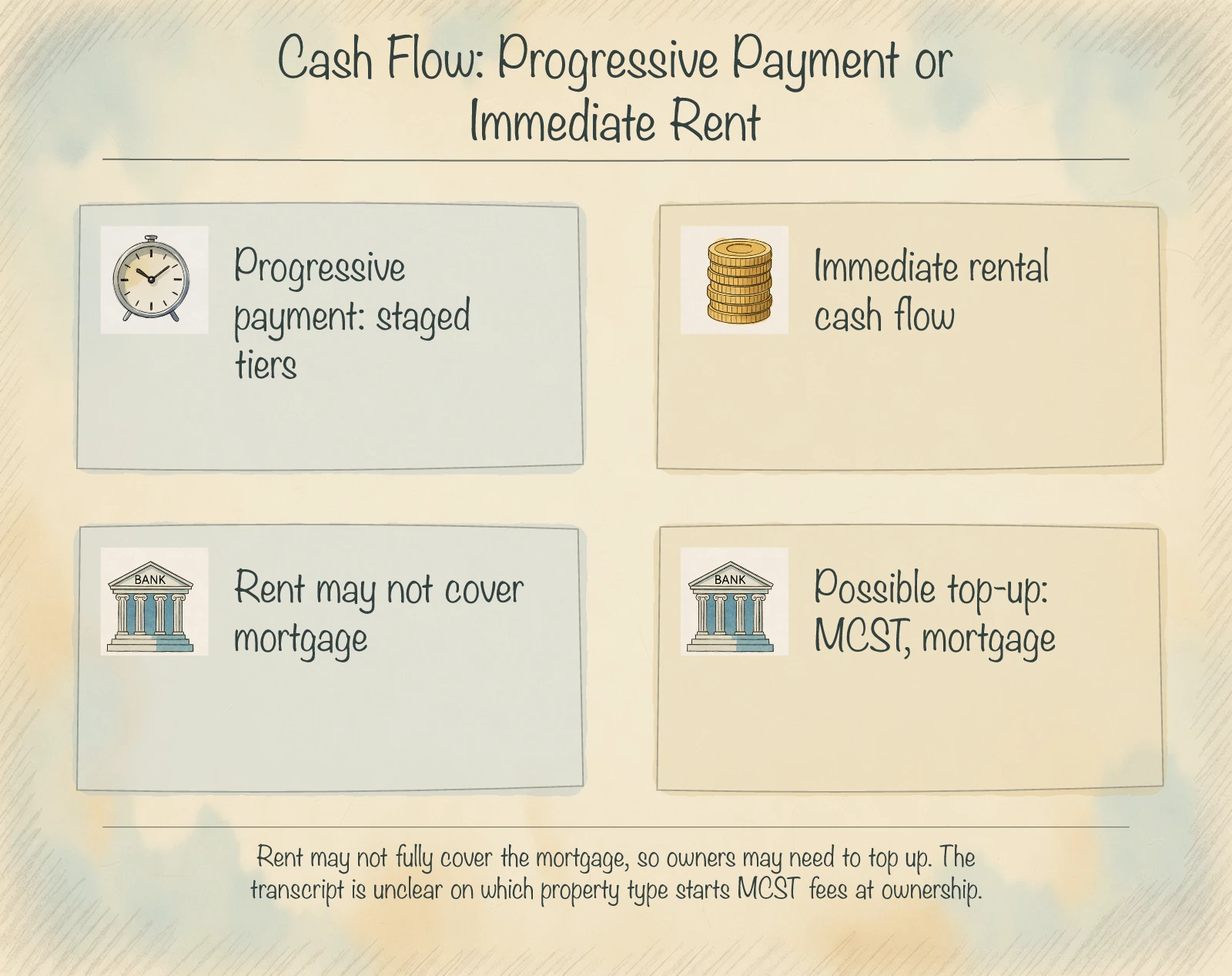
they want to have a brand new development, they want something that they can really manage their cash flow just by using the progressive payment format to own a new development. And last but not least is the growth.
Is there a chance based on my entry price towards my exit when it's TOP, maybe four years later?
And should I decide to sell on this day, when I collect my keys, six to 12 months after I collect my keys — if let's say I want to sell or want to rent out, what is my rental yield, as well as my possible exit price?
Now, to know the possible exit price, we usually want to come in and go back to the original point and treat first, because from an investor's point of view, your entry price is actually the most important.
And to determine the entry price, we usually look at what other competitors are there in the resale market as well as the other new launches. Because we want to know, from an entry perspective,
this price that I'm entering — for example, let's say if I'm considering Aurea, because I want a heritage factor, I want the fact that it's so interesting. I mean, like the original concept you look at — you look at this new futuristic mockup, they have to preserve the original concept in the sense that there's some modification.
But when I was looking at it, I think it's very, very interesting in the sense that firstly you have 42 stories — sorry, you have 45 stories for Aurea, Golden Mile is 22 stories. When you look at this site model, what's going to potentially happen is that firstly, the retail shops are not for sale.
I think that's a very good move, because the retail shops are not for sale, it's going to be managed retail F&B.
The moment retail shops are for sale to strata owners, individual owners, what's going to happen is that usually when you're at TOP, you'll see a lot of blank shops, because there's no centralised management to get in the anchor
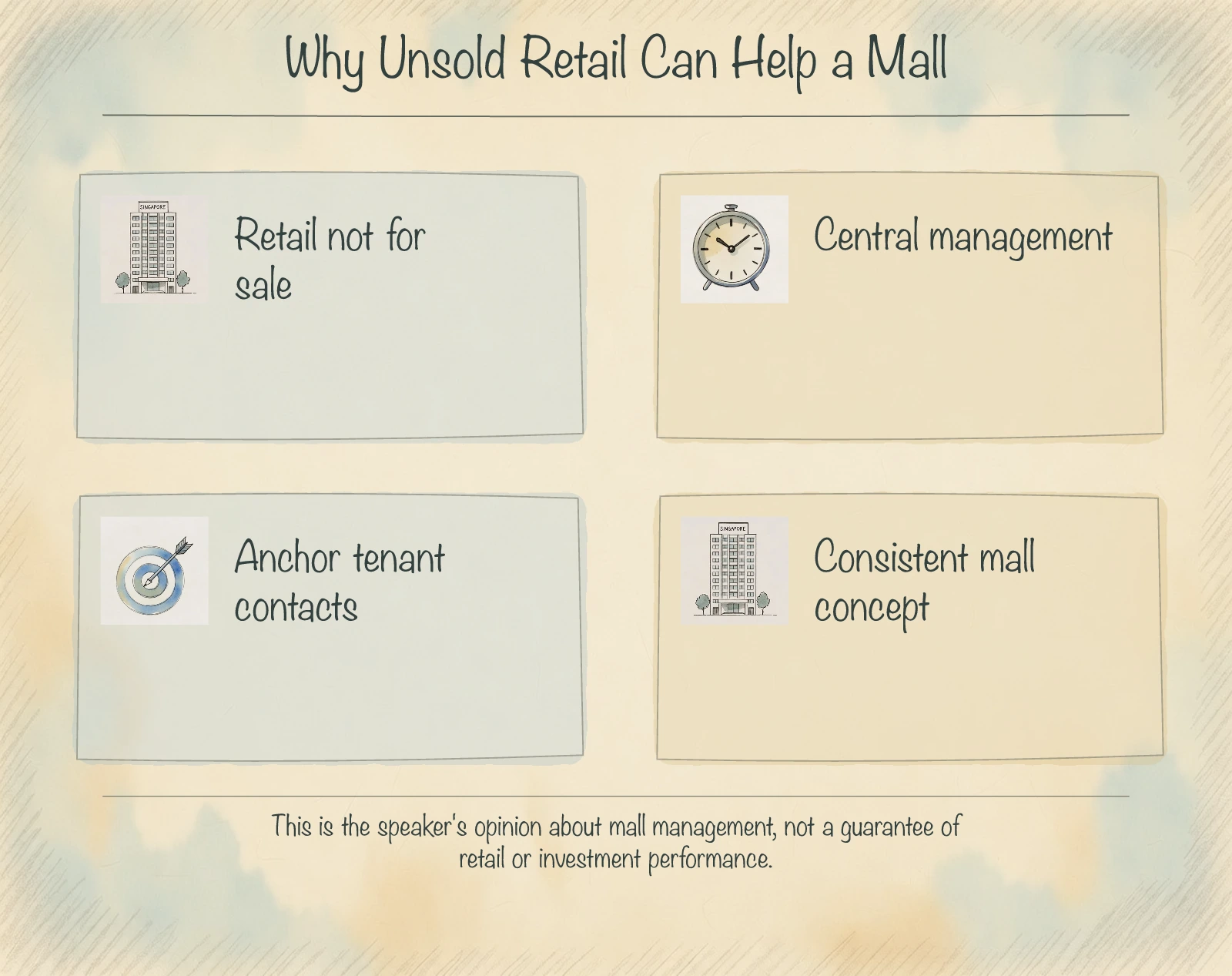
tenants. Every owner is like, you're free for yourself to get your own tenant.
And usually, out of interest, you just easily rent out to anybody. And then the whole mall has no concept.
And usually the best malls that perform the best are the malls that are being centrally managed by REITs. They have a management team.
They have contacts for different anchor tenants, get in the brands like McDonald's, Starbucks and all that, make the mall have a consistent theme — like F&B are all at which level, how do we segregate the clothing, how do we segregate the electronics, how do they segregate different kinds of concepts for the brands to be at different levels, and the traffic flow as well.
So mall calibration is very, very different, and the moment the developer decides not to sell, I think it's a very good thing. So basically retail and F&B are not for sale.
Madagascar suites, very interesting concept, and of course all your offices, enterprise office at the top as well, plus a flagship office
Aurea's unit mix and the surrounding D7 belt
So there are a couple of concepts that is of course on the commercial side and the important thing is that when you look at this whole combined concept together you have two, three, four, five bedders.
Majority of the units, eighty-four units are two bedders, 3 bedders are at about 28 units and 4 bedders 56 units, 5 bedders 80 units, you have 2 penthouses. And of course I think the entry point for the 2 and 3 bedders is something that I think is pretty interesting.
The moment you want 4-5 bedders, that's considered the luxury zone and I think if you want something that's sea front facing, 4-5 bedders are fantastic. There's also a very interesting concept that recently I talked about is regarding the 60% ABSD that has been taxed on foreign buyers.
Of course, over the last many years, foreign buyers' contribution to the amount of residential transaction is insignificant, meaning that Singaporeans and PR, they lead almost 90% of all the residential transaction, and that's shown in our strength in our real estate pricing.
Now, the important thing is that in future, if there's ever a chance for government to reduce the ABSD or maybe if that's it they were to really like down here the ABSD from 60 maybe back to 30 or back to 24 for foreigners.
I think this is also another for our first mover advantage because by the time you already own a CCR project and most foreigners they love to buy CCR projects. They love to buy projects with a story, the transformation story with a heritage story, with a luxury story.
If you already own a CCR project and if foreigners will really come back with liquidity to buy Singapore developments, residential properties, then I think that is considered like a first mover kind of advantage as well. Beyond the Golden Mile, the wider Beach Road corridor has been identified under URA's draft Masterplan 2025 as an urban corridor.
Golden Mile Tower, which is currently undergoing a collective sale process, has been offered redevelopment incentives if its iconic cinema block is conserved. Paving the way for a potential mixed-use landmark that will further elevate the district.
While Golden Mile Tower eventually undergoes rejuvenation, it could unlock close to half a million square feet of gross floor area, bring fresh residential and commercial supply to that zone. Directly beside Aurea, a site has already been year-marked for future residential use with a plot ratio of 6.9.
This could support the development of more than 36 stories. So together, these moves in this zone occupy a very prominent stretch along Beach Road.
So for Aurea homeowners and investors, this underscores its positioning as the first luxury residence anchoring beach road, securing early entry ahead of further catalysts. Adding to this transformation is the historic St John Ambulance Headquarters nearby, a long-standing civic institution that enriches the cultural texture of the area.
And with heritage, civic character and new high rise development converging, Aurea benefits from a layered transformational effect. In today's River New, Golden Mile Tower, Shaw Tower and Guoco Midtown as well as tomorrow's wave of intense vacation.
That's what makes District 7 such a unique first mover opportunity.
But let's come back of course to maybe to have a look at the market overview first. All right, so it does a market overview.
There's this very interesting article that Propdigro has written is that there's a potential by this writer there that Bugis might overtake. In fact, they didn't even use the word might.
They said he will overtake or as a Singapore's new prime residential district. I think what the main thing that they talk about is that District 7 is entering an uncharted territory and of course in my unseat District 9 as the country's most prime residential area.
So basically the PSF growth in Bugis has been very, very healthy. It's changing to like a historic history rich and of course like very cheap and vibrant kind of civic district.
And of course, other promising districts is like District 3, District 19, but basically it's really talking about District 7 that might really overtake as a new prime resonance.
So the address, I think is gaining a lot of popularity. This of course, the prestigious mixed use development already existing in the area.
So we have Concourse Skyline, you have City Gate, you have South Beach, Duo, Guoco, Midtown, Midtown, Modern, the M. Let's have a look at the map because I think it's very interesting when you look at this.
Now the very first project, if I shift back a little bit to Lavender is City Lights. And then you have South Bank and then you have of course like the Concourse Skyline, you have City Gate.
You have then dual residences and then the whole Guoco Midtown Bay came out, the M came out, Guoco Midtown 2 came out.
So if you look at this entire belt here, technically speaking, the whole D7, if I were to eliminate all the older small boutique developments, which is not a lot as well, because this is technically like the arts zone.
That's also where SMU is being located.
Limited D7 supply and competing projects
You have SOTA, you have LaSalle, you have, of course, all the shopping and shophouses as well.
And the existing project, there's not a lot of government land sales for sale, because that will really depend on the future reserve side, which is why if you want to find a project here, sometimes it has to go through an en block, which is what happened to Golden Mile.
Now, if you look at Citygate, it was also en bloc from a previous development. So it's not easy to find a new project, a government land plot.
And when you want to hunt for projects here, technically speaking, we can go by a handful, just within your two hands, in terms of competition, in terms of tenants' choices in future; they can only choose from these few projects.
Either you want to stay at Duo Residences, you want to stay at the M, you want to stay at City Gate, you want to stay at Concourse Skyline, you want to stay at The Aurea, or you want to shift towards the Lavender zone for City Lights and South Beach.
All right, but I would say the Lavender zone is a very different vibe compared to the vibe here near to Nicoll Highway as well as Bugis, because Nicoll Highway to Bugis, this is basically a different MRT line and, most importantly, money.
You have the entire belt of Kampong Bugis as well, very near to where Aurea is being located. So I would say the vibe is very different, because you can also oversee towards Kallang Basin.
And I think, in terms of competition level, there's not a lot of competition for the existing projects. Some buyers, they were asking about the HDBs that are opposite, basically the Beach Road Garden; some of the HDBs over here, the very famous army market over here as well.
My son is an army now, he always needs to go there and buy some stuff. And of course some of the units that are back facing from Aurea, lower-floor units, are looking towards the HDB zone.
Now, of course, what's going to happen in future, these HDBs are now very, very old already. There's a concentrated area over here, right across, called HDB Crawford Court.
Now these are what we call the heritage HDBs. If you look downwards towards Bras Basah as well, they also have a cluster of HDBs over at this zone here called Waterloo.
Bras Basah Complex on top is HDB flats as well. And I think these are really like heritage kind of HDBs, which in future, my opinion and personal take, is that because these are very, very rare plots, and of course there's a new HDB Crawford Heights that's under construction here, there will definitely be rejuvenation.
It could be a new township of HDB which will definitely be under the prime housing scheme, and this is going to be a million-dollar HDB flat. It could be redeveloped into something else when the lease runs out.
It could be redeveloped into, for example, private properties as well. We are unsure.
But of course, I think in future, whatever plot that is upcoming over here, whatever kind of plans that the government might have, this is going to be a very prime kind of housing, because it sits within walking distance of Golden Mile, of Aurea, towards South Bank, towards Lavender, and this is a very, very rare plot that also faces towards, maybe, the Kallang Riverside region.
So there's a lot of sea view, river view over here. So I think it's a very precious plot for the government, and I think they might have already plans for that.
All right. So I think, most importantly, is to look at the entry price as well, because, as mentioned, I think entry price vis-a-vis view.
Yes, views are important. The best views here belong to the 4 and 5 bedders, because they have a good view of the CBD and Marina Bay, a breathtaking view, and of course it is being reserved for the large-format units.
But from an investment point of view, for, let's say, 2 and 3 bedders, I think as long as the entry price makes sense, then in terms of rentability, in terms of regional disparity advantage point of view.
If you were to come and have a look at some of the comparable pricing, after we look at all these launches over here, Aurea is also like part of the mixed-use comparatives.
So mixed-use development, exclusive 180 units project; technically speaking, if we look at comparison with the rest, you get a mixed-use within the CCR zone, downtown, core region, and in a sense, pre-array. And this is what I meant.
Basically, District 7 is parked right side by side with District 9. So, them enjoying the same status as CCR region, I think Aurea is parked in a very good, strategic location.
So let's have a look at some of the comparables in terms of resale versus Aurea as well. So we already talked about the price trends of OCR, RCR, CCR; we won't deep dive into that.
We want to look at, really, in terms of comparing other new launches. So of course, like—
Comparing Aurea with other CCR launches
D3 RCR Promenade Pig now has been trading at a range of about 2006 plus all the way to 2005. River Green is about basically from 2009 to about 2006.
You also have Upper House of course that is like prime Archer Boulevard location, the highest achieved is about 3008, One Marina Garden 3003, Orrea Tropayo 3000 PSF already in Arsia region, Trum Park highest is 2007 and of course Union Square 3007 as a highest PSF, Canning Hill Pierce of course the average range is about 2009 to 3000 plus but the highest PSF 5000 plus.
One Sophia highest is also 2009, Midtown CCR, you can see some pricing at about 3000 plus PSF, Midtown Bay also 3000 plus, the M is about 3000 plus. And of course, when we look at the comparison of resale, Citygate 2-bedder now is about $1.6 million, 710 square feet 2253 PSF.
If I put them through our PRB lease reset calculator, I reset it back to 99 years. Technically, it's at about $1.8 million at about $2,500 PSF.
So at a recent market for something with a balance of 88 years, it's still doing very well at about $1.6 million. And this is basically Citygate.
And if you look at dual residences, they are built for larger sizes. The 4-bedders are about 4,000, 4.7mm, 2,000, 4 PSF, 1,000, 9 square feet.
If I reset them back to the full 99, it's about $5.5 million at 2.8 PSF. And Concord Skyline, 4-bedders is at 5.567 asking price.
PSF is about 2005. South Beach, 3.7 million for 2-bedders, large luxury 3000 PSF.
So prices over here are holding strong. And when you look at Aurea, basically if let's say you can get let's say like a low floor at 2007 compared to all the price that we mentioned just on the resale market, resale market is holding strong in terms of pricing.
But now there's a brand new product in the market. If you can enter at about 1.7, 1.8 million for 2-bedder, 2,7, 2,8 PSF.
Or even if you get a larger version of a 2-bedder at 1.9, 2,8 PSF. I think entry, based on what we've shared just now on the screen over here is that the important thing is to look at the entry.
Is this like a safe entry price comparing to the resale comparables as well as the new launch comparables? So based on this, it seems that the entry is pretty palatable.
If you were to compare the 3-bedroom as well. The entry for a three-bedroom at low floor area for the thousand and one square feet one is at about 2.6 plus 2.7 PSF about 2006 2007 PSF.
So some of the projects has been done. Let's say Park Town level two is already at 2.618 million dollars.
So there's always opportunities when you compare OCR versus CCR, RCR versus CCR and this is what we call sometimes as a potential first mover advantage into taking part of this region disparity that happened when certain regions outside of CCR they moved too fast over the last few years and this is a time that CCR can play catch up already because people will be starting to see.
AY is the CCR entry PSF and quantum PSF the same as some of the projects outside of CCR and maybe this is a time to really look at CCR and this will then propel in the next four years.
Because in the next four years what's going to happen when you look back at the screen is that somebody that bought CCR, somebody that bought RCR, somebody that bought OCR.
If they enter at 2005 PSF, this person entered at about 2007 PSF and and a time horizon perspective, in the year 2029, naturally as a human being, we all do not want to lose money. Because remember, just now I shared about the first quadrant that investor is looking at is capital preservation.
And I don't want to lose money. I want to try and test the market to see if I can make money or not.
And that's relating capital preservation to growth. If I cannot attain this price, I can rent out.
Doesn't matter. I can move in.
I want to see if I can test the market to see if the market can absorb a price that I want to sell. For example, if I buy an OCR at 2005 PSF, I want to sell at 2008 PSF and I see if the market bites or not.
If I buy an RCR project at 2007, I want to see if I can sell at 3000 PSF.
If I buy a OCR project at, sorry, if I buy a CCR project, for example, at Aurea at 2007 plus PSF, I also want to see if I can sell at 3000 PSF and take notes in the year 2029, all these three projects will be completed.
They are called TOP projects. And if let's say I want to put my property in the market, I put it at 3000, somebody in the RCR put at 3000, somebody in the OCR market put at 2008, I think by then the resale buyers in the market.
They will also look back at the same thing is that, hey, if I can get

Exit PSF and the mixed-use premium
CCR at 3000, then I will strongly consider if this location is the right fit for me provided, of course, after I look at my preferences, rental, school needs and stuff, so on and so forth. But if it's an investment point of view, then this will also be very highly visible.
So I will call this a very highly visible opportunity because I know that in four years' time I can still fight the market in terms of being very attractive of my exit PSF.
Because I enter at a PSF that allows me to take advantage of this region disparity, and this is what we call like the first-mover entry advantage as well into the CCR. So because I think 2025 to 2026 there's a lot of opportunities piece in the CCR region.
Some interesting portion as well is that I think Faiz has also designed the fact that for 2 and 3 bedders there's no balcony. Now this kind of layout I think it makes it very practical in the sense that you give more bang for your buck and you're going to have more maximized usable space.
The balconies are being reserved for the 5 and 4 bedders because this is a large-format unit, but if you look at the floor plan of 2 and 3 bedders there's no balcony, very practical layout that really optimizes efficiency, whether it is the bigger version of 2B, with the big room walkway layout or the dumbbell layout.
But we look at 3B, I'm pretty fascinated with 3B as well because it has very little kind of walkway space that gives more space into the living and the dining area. So I think layout wise is also pretty optimized.
Last but not least, I think mixed-use and integrated developments are very different from normal residential projects. This is a mixed-use development.
They tend to confirm based on multiple studies that mixed-use developments, they can often come on maybe about 15 to 20 or even 25%.
Thanks to the proximity of MRT plus effect that there's retail office linkages, medical suites as well as I think a lot of industrial analysts, they tend to track that mixed-use developments and integrated projects, they tend to do better in terms of premium wise, because firstly, I think rental yield is great.
There's more audiences, there's more kind of like amenities note and the fact that it's like a project, an ecosystem all in one, it tends to attract a better kind of exit as well when it comes to exiting the property.
So I think for mixed-use, you can also take a bit more kind of like highlight into certain kind of projects like Aurea. If you want to find a little bit more, you can click on the link right down below.
I'll be very happy to review to understand a little bit more about CCR market as well as your property journey and portfolio. And this is the episode at NOTG that today we deep dive into D7 especially on this project called Aurea.
We'll see you on the next episode. Take care.
Rolling, which is the main cam. Is it too close to me?
Ready? One, two.
Along the portion. We start.
We start, we start.