Evaluating property
The 6 Steps to Making Smart Property Investments
Published 2026-11-07. Adapted from the episode published 2025-12-12.
On this page
- Six Steps to Create a Liquidity Event
- Capital Preservation in the Investment Quadrant Matrix
- Opportunity Cost and Avoiding Tax Inefficiency
- Melvin's Background and Fear of Cooling Measures
- Sellers' Market and the Cost of Waiting
- Switching Assets and the Buying Power Triangle
- Cash flow then and now
- Where to look at different budgets
- Seller's Stamp Duty and holding periods
- Trends: macro season and liquidity
- Seller's market versus buyer's market
- Upgrading: switch when you are ready
- Downsizing: let the market heat up first
- Buying power and the closing thought
Six Steps to Create a Liquidity Event
In this episode, Melvin previews the framework he uses to think through a purchase and its eventual sale. He starts with the risk of buying at the wrong price or waiting too long for a buyer.
Melvin describes buying as the easier part. A buyer can visit a show flat or go for a few viewings before deciding.
Selling is the difficult part. When you exit, you have to run an entire marketing campaign, host multiple viewings and negotiate offers.
It is not easy to compete in the resale marketplace when you are the one who needs to leave.
Melvin calls the future buyer pool the exit audience. He looks for a property with enough potential buyers to improve the chances of finding someone who can transact when the owner wants to sell.
Capital Preservation in the Investment Quadrant Matrix
The right property comes from the right entry mechanisms: the right price, the right price per square foot, the right location, and a look at growth and the factors behind capital appreciation. That is how you work out which type of asset, in this season or over the next several years, has the bigger exit audience.
Nobody wants a property that stagnates, gets stuck, or whose valuation simply does not go up. From an investment point of view that is very detrimental, because your capital is not being used.
If you put S$500,000 as a down payment into a S$2 million property and eventually sell at the same price, that S$500,000 has not worked hard for you at all.
Opportunity Cost and Avoiding Tax Inefficiency
The episode previews six steps grouped under trends, risk and opportunity. Most of the discussion here is on market trends.
The closing slide signals that the framework continues in a later instalment.
The steps are applied differently depending on your situation. Take John, who wants to buy a new property and sell at TOP.
Another buyer might want to buy new, stay a couple of years after TOP, and then buy bigger. Kevin and Felicia want to buy now, live there until their children have settled their schooling needs, and then upgrade to landed.
Each situation shows how the steps apply to a different holding plan.
Melvin uses this version for new condos and a similar version for resale condos. He has a separate set of frameworks for landed properties.
Consultants also use stack and site-plan simulations to compare specific units within a project.
Melvin said a lower mortgage rate could lower the monthly instalment and put a Total Debt Servicing Ratio check first. MAS explains separately that existing monthly debts count towards that calculation.
Melvin's Background and Fear of Cooling Measures
Melvin uses four questions to assess a property investment: capital preservation, tax efficiency, cash flow and growth. He introduces growth as the fourth question and spends more time on the other three.
On the whiteboard, Melvin set aside S$500,000 for a S$2 million purchase and S$750,000 for a S$2.5 million purchase. That represents 25% and 30% of the respective purchase prices.
Melvin’s first test is whether the investment can preserve capital. He would reconsider a purchase that failed that test.
Melvin used a S$2 million purchase sold four years later at the same price. A flat sale price still leaves costs to account for, including stamp duty, agent and legal fees, maintenance charges, property tax and bank interest.
Sellers' Market and the Cost of Waiting
In the recording, Melvin used roughly 4% of the price as an allowance for Buyer’s Stamp Duty and another 3% for exit costs. That was his rough 7% estimate.
He discussed other costs in the same example without breaking down what was included in the 3%.
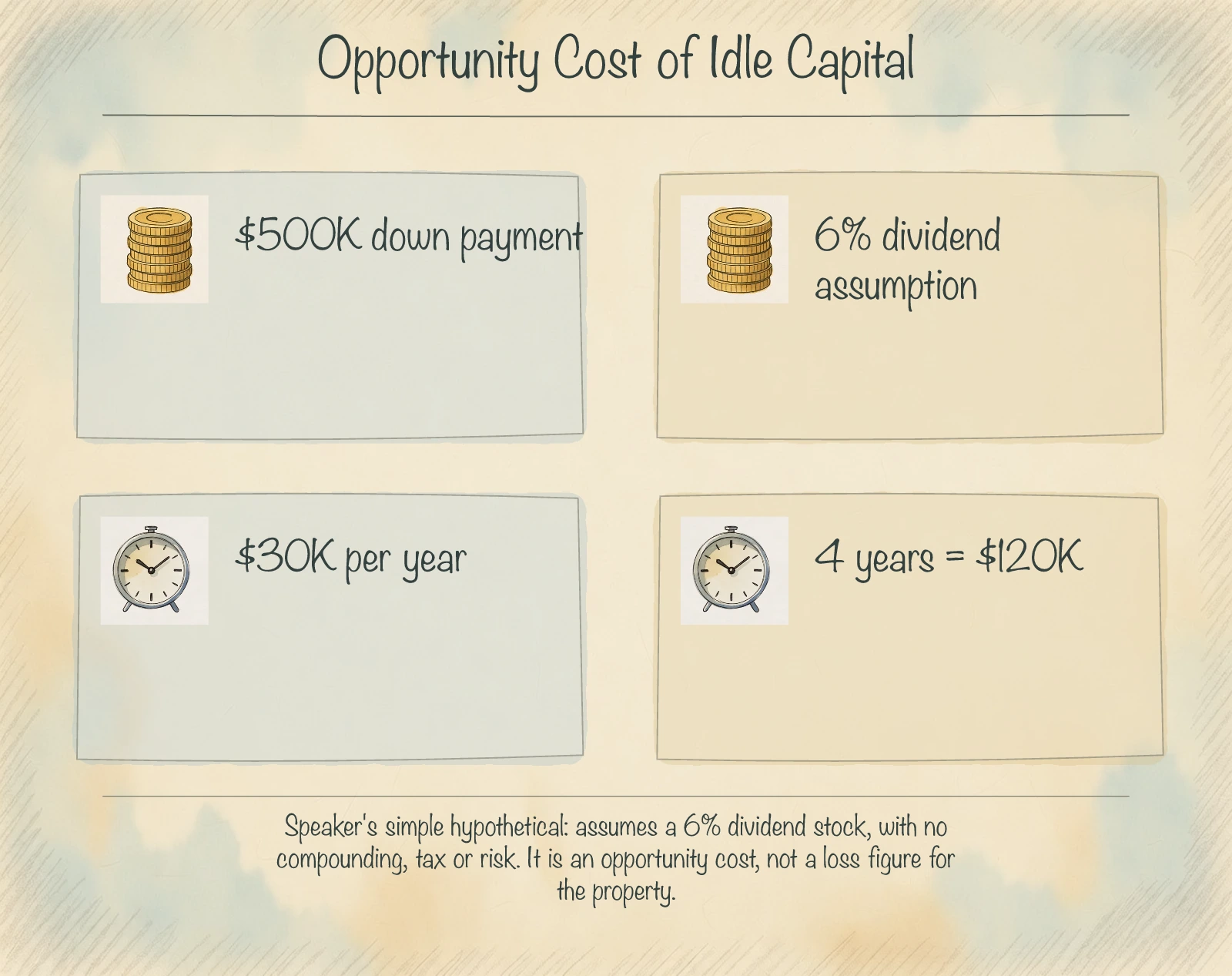
To illustrate opportunity cost, Melvin assumed S$500,000 earned a 6% annual distribution. At that assumed rate, it would produce S$30,000 a year or S$120,000 over four years before tax and fees, without reinvestment or changes in capital value.
For Melvin, the example illustrates why preserving the purchase price is only the starting point when capital is tied up for several years.
Switching Assets and the Buying Power Triangle
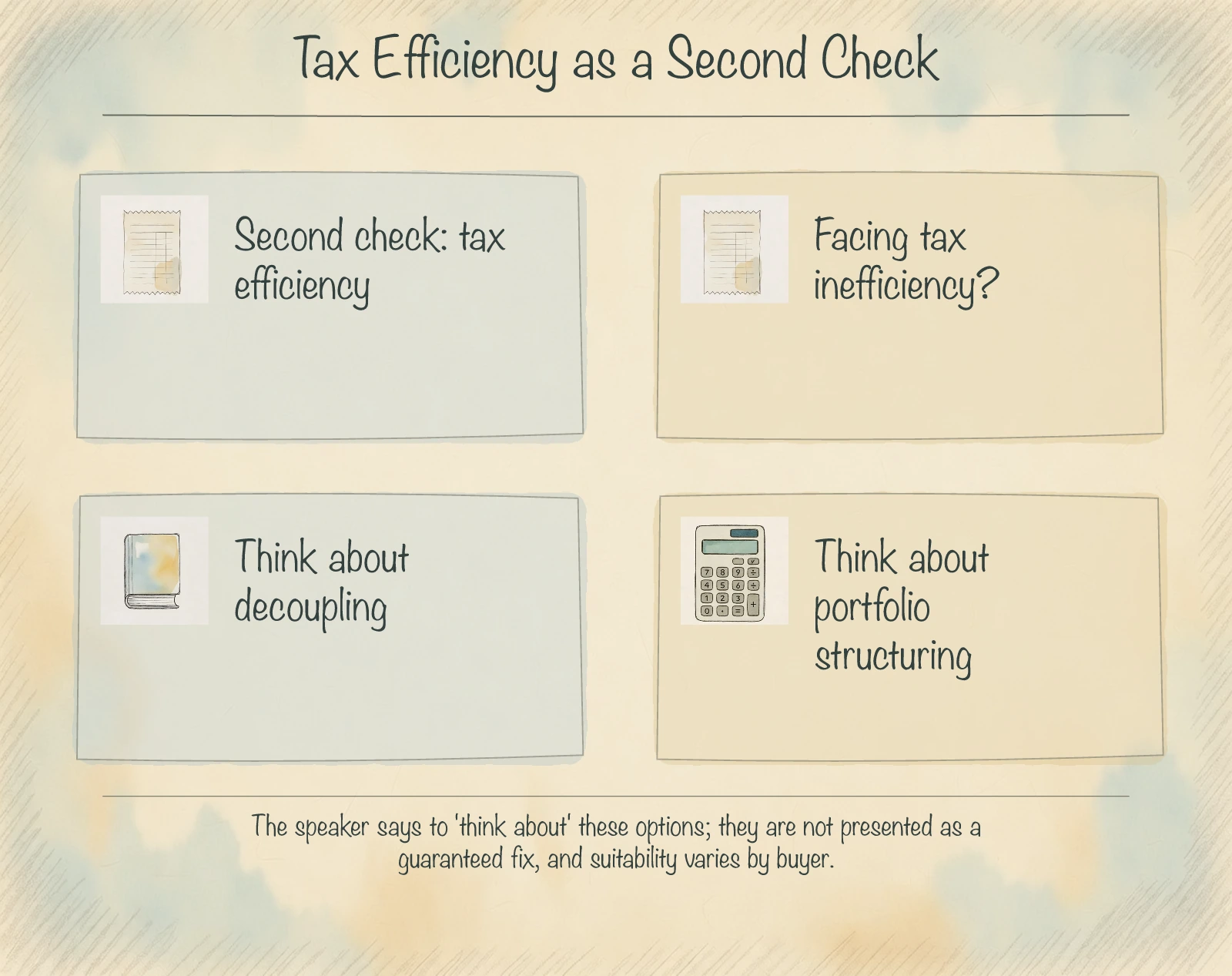
The second point is tax efficiency. Any additional duty you pay raises the amount you need to recover on sale.
To work out break-even, calculate it together with your other costs.
Under the IRAS residential Buyer’s Stamp Duty schedule effective from 15 February 2023, the duty on a S$2 million purchase is S$69,600, or 3.48%, if the dutiable value is S$2 million. Any Additional Buyer’s Stamp Duty or Seller’s Stamp Duty is calculated separately.
The standard ABSD rates include 20% for a Singapore citizen buying a second residential property and 60% for a foreign individual, subject to applicable reliefs.
Melvin used a duty equal to 20% of the purchase price to illustrate the hurdle. A 20% rise in the price would cover that duty alone in a simplified comparison.
A full break-even calculation includes the other costs and cash flows. He noted that some buyers with more capital choose to pay the duty, and discussed ownership structure and decoupling as considerations.
Cash flow then and now
Melvin said the investors he learned from checked whether rent covered the mortgage instalment and maintenance charges with cash left over.
In one historical example Melvin recalled, S$3,500 in rent less S$2,000 for the mortgage and S$400 in other charges leaves S$1,100 before other expenses. He rounded that to about S$1,000 in the talk.
In the 2025 talk, Melvin said positive cash flow was hard to find. The two possibilities he pointed to were an older property with a lower total purchase price and co-living.
Where to look at different budgets
In the recording, Melvin expected a narrower buyer pool as the price rose. He considered how the duty faced by foreign buyers could affect the pool for a higher-priced central condo.
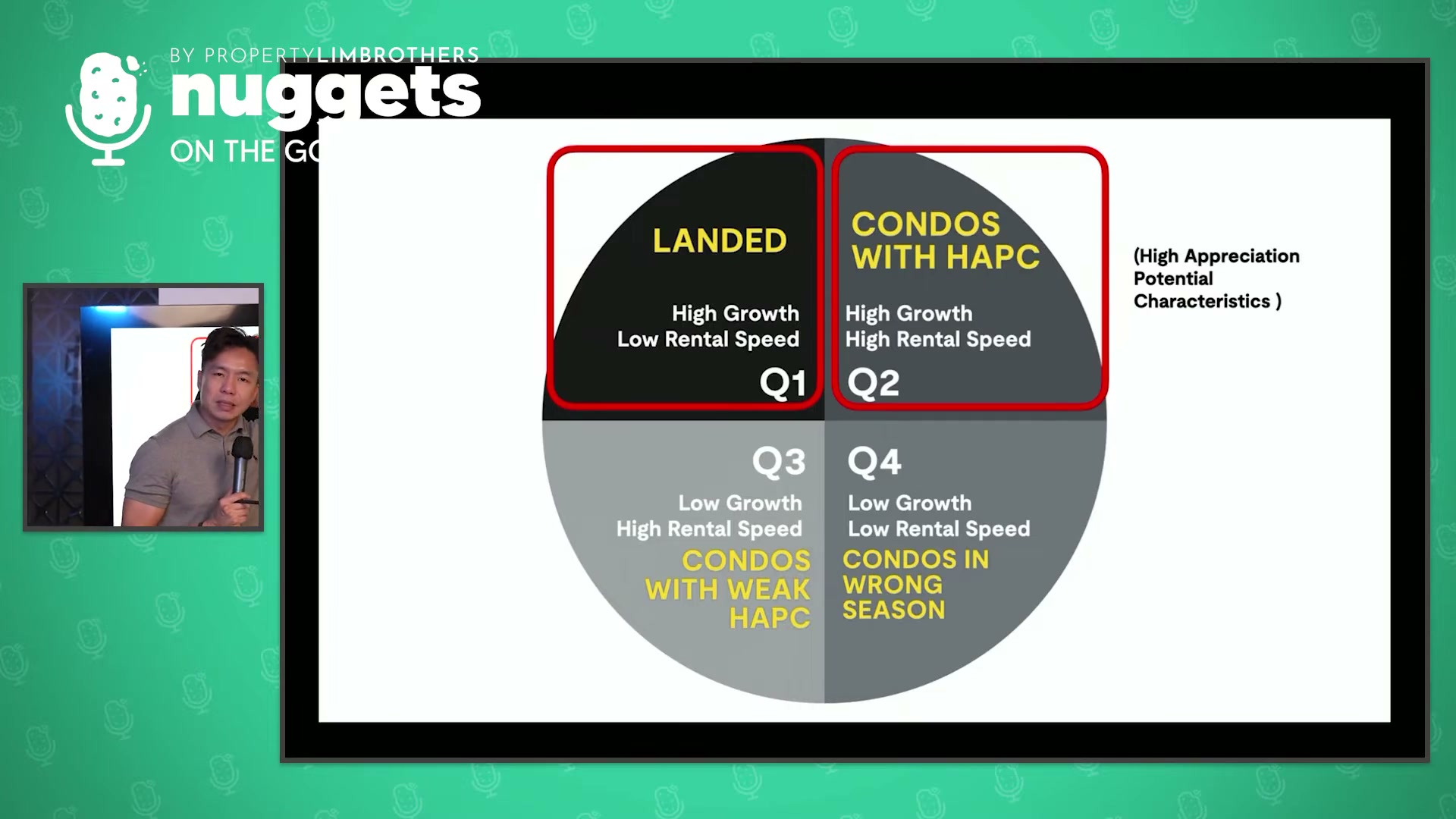
Melvin’s examples in the 2025 talk put landed property on his shortlist at around S$4.5 million or above. At S$4 million or less, he looked for condos with growth potential and the ability to rent quickly.
His point was that a higher-priced central condo competes for some of the same buyers as a landed home. The figures were his examples of how to sort the choices at that time.
Seller's Stamp Duty and holding periods
In the 2025 recording, Melvin said he expected little market impact from the four-year duty window. He reasoned that many buyers were already familiar with a four-year schedule, bought with the intention to hold, and might spend several years waiting for a new launch to be built.
The acquisition date determines which duty schedule applies. Compare the intended sale date with the holding period for that schedule.
For residential property acquired from 11 March 2017 through 3 July 2025, IRAS lists Seller’s Stamp Duty at 12%, 8% and 4% in the first, second and third years respectively. No SSD is due under this schedule after three years.
For residential property acquired on or after 4 July 2025, IRAS lists Seller’s Stamp Duty at 16%, 12%, 8% and 4% in the first through fourth years respectively. No SSD is due under this schedule after four years.
The rate applies to the higher of the selling price and market value at disposal.
Trends: macro season and liquidity
Melvin starts the market-trends discussion by asking whether buyers or sellers are gaining bargaining power.
He watches mortgage rates alongside market sentiment. The closing slide places interest-rate movement and FOMO side by side.
In the 2025 recording, Melvin considered whether central-bank actions such as bond purchases could add liquidity and whether easier rates might coincide with growth in broad money, or M2. His scenario was that stronger equity prices could lead investors to take profits and move some of those gains into property.
Melvin recalled two historical periods in the 2025 recording. He said he saw developers offer smaller homes after the 2013 measures as they adjusted to what buyers could borrow.
He also recalled property prices rising during a later period of rate increases. He used those observations to explain why he looked beyond interest-rate direction alone.
MAS records two separate steps in 2013. In January, the authorities tightened loan-to-value limits for some borrowers, raised Additional Buyer’s Stamp Duty rates and capped the Mortgage Servicing Ratio on public-housing loans from financial institutions at 30% of gross monthly income.
In June, MAS introduced the Total Debt Servicing Ratio framework, which assessed total monthly debt obligations against gross monthly income. Its headline threshold at introduction was 60%.
In the 2025 discussion, Melvin was concerned that rapid price growth could prompt further cooling measures. He mentioned loan-to-value limits, ABSD, TDSR and Buyer’s Stamp Duty.
At the time, he suggested using the next month or two to study available homes if capital was ready.
Seller's market versus buyer's market
Melvin described the pandemic-period market as favouring sellers. He pointed to the launch take-up, news and financing conditions he remembered from that period.
Melvin described 2024 differently in the recording. In his reading, activity slowed while prices held.
He recalled buyers having more time to compare and negotiate.
In the 2025 recording, Melvin expected easing rates to give sellers more bargaining power.
Upgrading: switch when you are ready
Melvin’s advice in the upgrade example was to switch when ready instead of trying to time the market.
Say you own a three-bedroom of about 1,000 sq ft in a condo you love. Your spouse suggests moving to a four-bedroom of about 1,500 sq ft in the same condo.
Your unit could fetch around S$2 million, and you want to wait for S$2.2 million.
There is nothing wrong with a target if you are not urgent to sell. But the decision should be made against the target property.
If the market cannot absorb your price, because buyers have several similar choices at S$2 million with similar renovations, your hope for more may not be met. A better view or a better stack or a heavier renovation might support a higher price, but if your competition is about the same, the market rate sets the price.
Now assume the four-bedroom costs S$3 million, also at S$2,000 psf, and prices rise by S$100 psf. Your unit gains about S$100,000, but the larger one gains about S$150,000.
At S$200 psf, you gain S$200,000, but the target rises by S$300,000. The gap between what you sell for and what you pay widens by S$100,000.
This excludes duties, fees, financing and timing, and it assumes both units move by the same amount per square foot.
With an equal S$200 psf rise, the price gap increases from S$1 million to S$1.1 million before costs. With flat prices, the gap stays at S$1 million.
If both prices fall by S$200 psf, the larger home falls by more in dollars and the gap narrows to S$900,000. These are three cases for the same comparison.
Downsizing: let the market heat up first
In Melvin’s 2025 downsizing example, the owner starts with a S$2 million condo and considers an S$800,000 HDB flat. He suggested waiting for a stronger selling market.
That choice depends on the condo gaining more in dollars than the replacement home.
Melvin assumed the total stock of condos was smaller than the stock of HDB flats and that condo owners in his example had more capacity to wait before selling. He used those premises to explain why he expected the condo price to hold up better.
They are assumptions of the example.
In the illustration, waiting works if the home you sell gains more in dollars than the one you buy. You can test the same comparison with flat prices or with the replacement gaining more, because either would change the benefit of waiting.
His rule in the example was to avoid selling first when the seller’s market was still developing. He illustrated a condo moving from S$2 million to S$2.2 million or S$2.3 million.
Whether waiting helps depends on how much the replacement flat’s price changes over the same period. Those numbers were the assumptions in his 2025 example.
Buying power and the closing thought
The closing slide shows a buying-power triangle with five price tiers from S$2 million to S$5 million. It contains no buyer counts.
Melvin’s point in the recording was to pay attention to what the eventual buyer can afford.
Melvin called summer and autumn the stronger market seasons in his framework. His closing point was that waiting through those seasons can leave less time to build equity.