Market and policy
The 5-year Cycle. Market Stability & Timing Your Investment
Published 2026-11-18. Adapted from the episode published 2024-07-19. Figures, illustrations and data reflect the episode’s original publication date.

Whiteboard Intro: Seasons and Five-Year Cycle
How do I annotate? Can I annotate?
Can I annotate one? It just so I remember I can draw.
How do I draw? Okay, got it.
You gotta go on track now. Alright.
So welcome back to our NOTG whiteboard session number 2. We just changed a new whiteboard, by the way.
This is a different brand. Bigger screen.
Because the previous one really has retired already. We've been using that for I don't know how many years, then 4 years already, he has sort of retired.
This one can change colours a lot. Because it's whiteboard, let me make sure that the background is white.
Alright, great. This session is a continuation from the first session that we had.
So the first session we talked about the 11 points, why new launch buyers like to buy new launch, and with that in relation to the key benefits of how new launch buyers are thinking. Why do they want to go into new launch with certain key benefits?
Because there are 11 benefits that we talk about. So if you have missed that particular session, head back to the previous round of NOTG, our first whiteboard session where we talk about that particular segment.
Today we're going to move into a continuation and this is also related to new projects.
Why is this session important is because after today's whiteboard session number two, what you will walk away with is that you will know the four different seasons of how developers think about land acquisition as well as how it coincides with what we call the five-year cycle.
So I just want to introduce this circle first. Wow, okay.
Sorry. Right.
So let me... Oh, it's white colour.
Wait, hang on. Erase.
Let me change the colour to black. So I want to introduce you to this four seasons first.
What are these four seasons and how does it relate to our decision on when to go into new launch development investment? So whether it's for own stay or investment, there are 4 different seasons that you can consider.
I'm not saying that in certain seasons that you cannot buy, but there are definitely certain seasons that are more visible in terms of benefits when it comes to certain price points.
Alright, so there are 4 seasons. It's very similar to the 4 seasons of weather: spring, summer, autumn and winter.
Wow, this whiteboard feels better than the previous ones. Okay, so spring, summer, autumn, winter, these are the four seasons, but it is the action of this four seasons in relation to a little bit like when we talk about harvest, when we talk about sowing seeds and harvesting.
Typically from let's say a point of view where let's say you are harvesting this land and we come from maybe like a plantation point of view. The spring season is usually planting and sowing.
The summer season is usually reaping and harvesting. The beginning of summer, that will still be harvesting in voth but it's also in preparation for summer already.
And summer is really basically for recovery of the land and also in prep for spring.
So this is in relation to the four seasons of weather and also how does plantation work? How does that relate to basically new launches in term of fire cycle?
This has a very interesting correlation to what we call it 5 year cycle. So let me just bring on the chart very quickly.
Of course, hold this image in your mind when you talk about spring, summer, autumn, winter because this is a pricing strategy. As certain seasons, certain price movements of new launches behave very differently because it correlates to the 5 year cycle in terms of new benchmark PSF pricing.
Number 2, it correlates to the supply. And this supply has 2 elements.
One element is the speed of absorption of the existing launches that the developers are holding on. So they launch and then how is the performance of all this basically inventory that are on their hands.
The speed of absorption number two is this speed of absorption affects their decision on how much land they want to bid for the next GLS as well as on block.
Allowing to share some new data with everybody and then we come back to that main framework for today. So basically this is the latest what we call the medium PSF of non-landed private news, so basically new launch sales that has been transacted by region.
So we're separated by yellow color CCR, RCR is a red line, OCR is basically the blue line. So if we look at it, everything is above $2,000 per square foot.
The median transaction based on URA data, this correct is our first June 2024. So basically OCR has already surpassed the PSF of $2,000 and we look at RCR that surpassed $2,000, CCR has surpassed $3,000.
So this is basically the new benchmark that we are talking about. And everything today, we are talking about $2,000 PSF upwards.
I think if you have monitored the property market for a couple of years now, you have probably remembered there was an era back then. And I was just talking about a few years back ago that there was this wave of HUDC on-block projects.
HUDC En Blocs and Controlled Land Supply
About a few years back ago there was this wave of HUDC en bloc projects, which has now translated today to Riverfront Residences in D19. It has translated to Florence Residences and some of the existing projects, for example like Jadescape, it also used to be a HUDC.
So a lot of these older HUDCs back then they are depleting in lease.
They are occupying huge, very good land plots and the en bloc happened, and that was during the year I remember, I think about 17, 18, and then all these launches started to happen in the season of about 18, 19 all the way to about 2020 and then before they eventually get sold out maybe in the year 2021.
We were talking the range of about maybe about like $1,500, $1,600, $1,700 per square foot. Back then, a 3-bedder was still in a very affordable range, perhaps in range of about like $1.3 to $1.6 million.
So now of course when we talk about this number, it seems like hey, did that happen?
It was just a short period of time ago. That is in relation to what we are going to talk about today.
If you look at this, back in the season of 18, 19, 20, we were still in the range at about $1,005 PSF for OCR. And then RCR was not even touching $2,000 per square foot.
Why is it that in this new season, everything has surged by about $400 PSF upwards towards this new benchmark range? And partially the reason is because of the timing of this sort of, like, I wouldn't call it like a boom or bust cycle if compared to let's say the stock market or maybe like the business cycle.
But I would say that is largely due to an inventory cycle and also for the very fact that Singapore has many stabilizing effects as a base layer. So we'll come back to that later.
So let's have a look at the overall supply first, because sometimes when we look at supply we'll be thinking hey, are we in an oversupply situation, but actually if we look at the overall supply,
if I take in all the ECs as well as all the condos and apartments, we are currently at the range over here which is largely at about 360 to 370 thousand, so every year we have like an increment of close to 10,000 units, so every year we're increasing by about 10,000, 10,000, 10,000.
Of course we will hit 400,000 maybe in a few years' time, but in overall totality if we were to look at the overall supply situation, we always talk about the fact that landed has about 74,000. We talk about condos, apartments, ECs.
And anyway, ECs after 10 years they'll be fully privatized. After 5 years, PRs can buy, Singaporeans can buy if they hit their MOP 5 years.
So this 74,000, this is currently at about 360,000. We are moving to 370K.
HDBs, we have about 1.2 million. So in totality when we look at the ratio, we always talk about the fact that condos and apartments, they have international audience, they have Singaporeans, PRs as well as foreigners.
This is
the only type of assets that the international market can buy, because landed property is restricted to only Singaporeans, except for Sentosa that foreigners can buy. So HDB is only basically Singaporeans and PRs that met their criteria.
So this is still in a very niche situation in of the overall supply of all residential housing. Because if you do have a look at this, this is basically about 5% of all the total inventory.
This is about 20%. This is about 75% of all total inventory.
So let's come back. When we look at supply, I think our supply is still healthy because firstly, our land is in a very controlled fashion.
Every half of the year you will see new release of land basically by our government, but the land that are being released or that are being tender activated is in a very controlled fashion. It's really controlled to an extent that our government will take very close gauge on the appreciation index of our property prices.
So
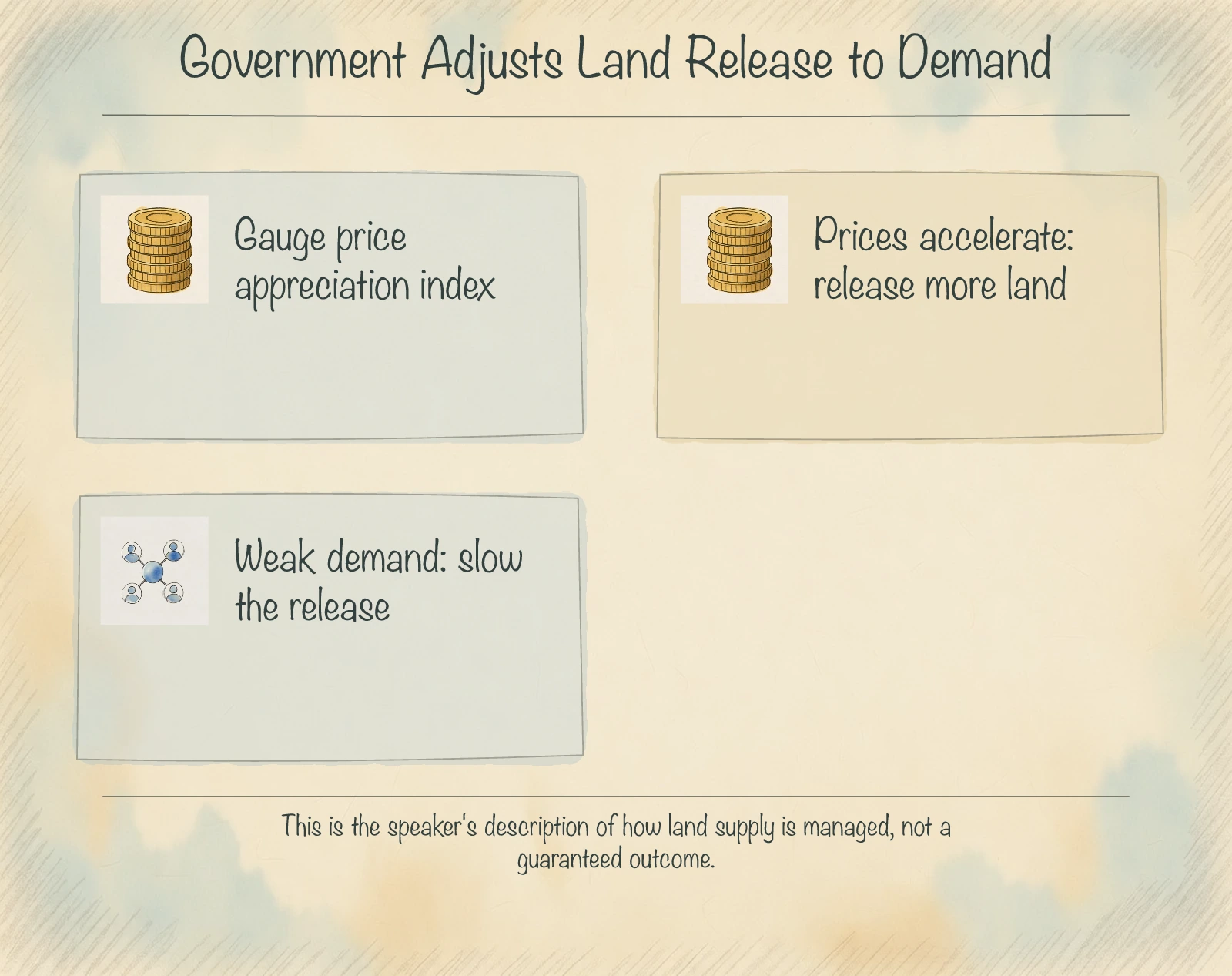
if it accelerates too fast then they will know that okay, there's perhaps a shortage of land, they will start to introduce more land for developers to bid.
Because they don't want the bidding of the limited amount of GLS land plots to be in such a fierce competition that there are so many bids and it bids up the base land price to such a high extent that it would then be transferred to the consumers at the launch setting.
So basically if there's a lot of demand, they will release more land. If there's not enough demand, then they will actually slow down the release of land.
So I think it's in a very controlled fashion. Let's come back to this again.
So when you look at the overall ownership distribution of private properties, which is at about 360,000 to 370,000 — now, this is something that we can also take in some information to know that, okay, now companies occupy this level of the entire bar chart for the 370,000 units, per PR and basic foreigners,
Ownership Distribution and Developer Land Bidding
They occupy this level. Majority are still owned by Singaporeans.
And of course, this level here, if they have bought in before the ABSD of 60%, or they bought in at 30% ABSD, 15%, 20% ABSD, very unlikely is that people will sell. They will hold on to this asset that they have accumulated before the 60% ABSDs.
So I will say that this inventory here, they are very sticky. There's no reason for the people that have held it, whether they're PR foreigners or companies, there's no reason for them to sell it, and he has created like a more sticky situation.
If we look at the next chart as well, this is basically the supply change on a year-to-year basis. So you can see that the total supply of all non-landed proper residential properties is increasing at a very slow pace.
It's very well controlled. You don't get like a huge surge like a super oversupply situation.
Every year is really based on demand. There's only trickles of supplies that's coming up.
So I think it's very well controlled by our local government.
This is a new trend to take note, is that en blocs are at an all-time low. So compared to the past, this was a season I was talking about that there were a lot of en bloc, and then that spirals a whole effect of en bloc situations that happen.
But this time round, en blocs are very few, partly because there's new sort of like DC charges, and then of course a lot of en bloc projects they are maybe asking for a price that developers are not attracted to in terms of like their tender minimum bid pricing, reserve pricing.
And of course, going for GLS, maybe developers will feel that it's a cleaner route. They feel that there's lesser kind of like gestation period, because for en blocs, we see after tender, you still have to tear down, the period that you have to pay the existing owners and all that.
That could be one of the reasons why en blocs are at an all-time low now.
Before I show you basically the five-year cycle chart again, I just want to share that the holding period, because of seller stamp duty, this particular cooling measure, it is already working. In the sense that if you look at this, now our average holding period of private properties is around 10 years.
It's about 9 to 10 years. That started after the introduction of seller stamp duty in 2013 and TDSR.
Basically the people that have been selling within the first 3 years is down to a bare minimum, which is less than 5% of owners are selling within 3 years of purchase.
So these owners, if they are selling within 3 years of purchase, it could be maybe because of reasons like, for example, they want to change ownership, that's number 1; number 2, maybe they really need to sell.
Number 3, maybe because after they bought then they realised that oh, they made the wrong choice, or maybe they just think that maybe they couldn't afford it, and they bite the bullet and then they sell it and pay the seller's stamp duty.
But all in, you look at this, more than 95% of owners are holding for a minimum period of 9 to 10 years, and that has created a whole new level of stability in the property market in totality.
Alright, so with all the backdrop, we now understand that in terms of supply level for new launches, it seems to be quite stable. In terms of overall supply, it seems to be pretty healthy.
So that helps us to understand a little bit about whether we are in an oversupply situation, and that will then help us to see whether does this sort of help us to know which particular season will we have an advantage going into a new launch development, whether it's for own stay or investment.
So with this statement, why is it that it seems that every five years, there is like a $400 PSF increment in our Singapore new launch space, and will that happen at the end of this five-year cycle?
So let's do a quick recap. We talked about the fact that in 2017-2018 there was like an en bloc fever over here, and a lot of developers were actually acquiring land.
Now if you see this line, this line and all these bar charts are basically the expected year of completion of units. It's not the total supply.
It is basically how many units are going to be completed in this particular year. So 2017 there were these 16,000 units that will be completed.
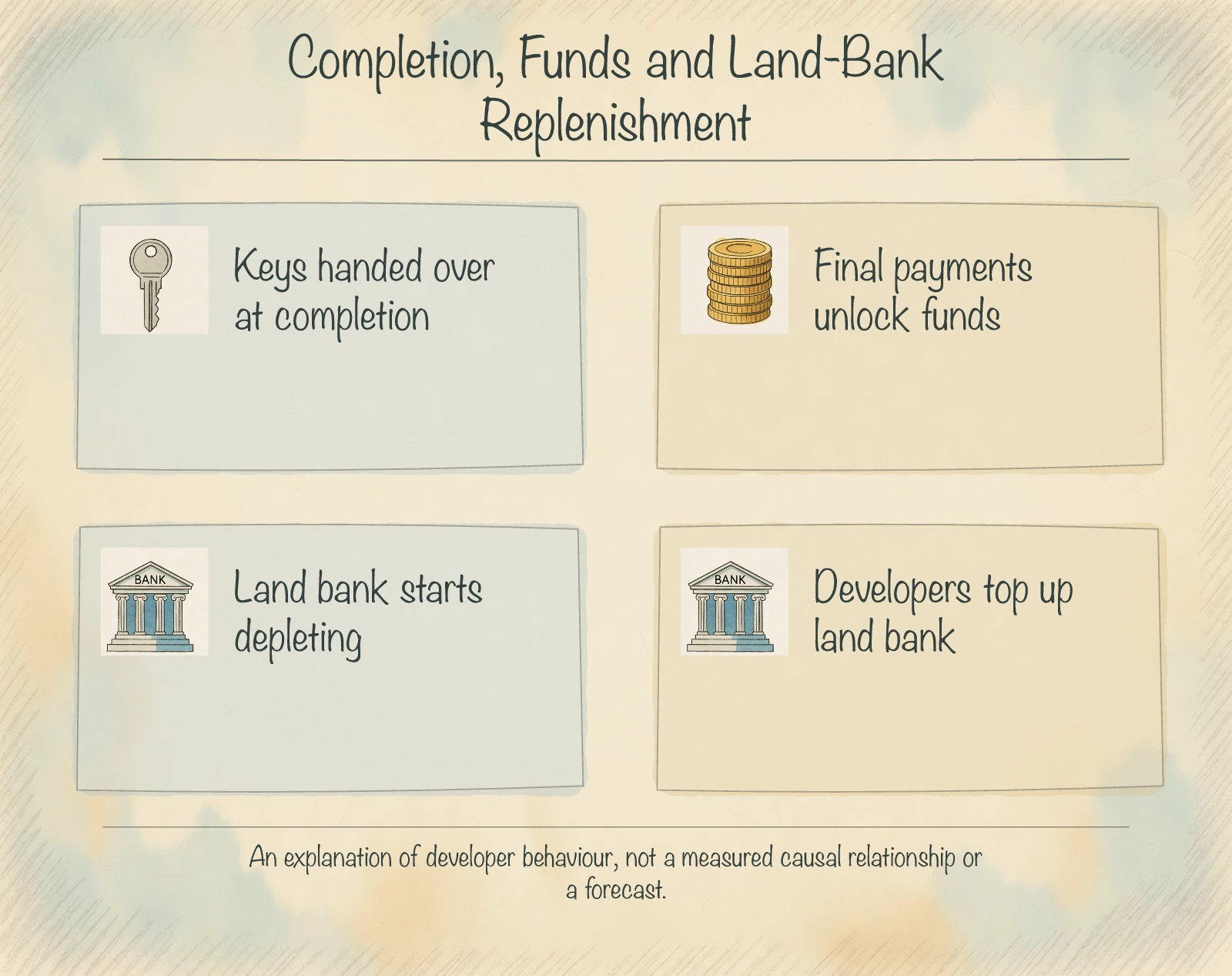
2018 there were 15,000 units that will be completed. Completed means the keys will be handed over to the buyers that have bought during the show flat season, the balloting season.
And it also means that when we see this higher amount of completion, it means that developers are actually handing over the projects to the buyers towards the tail end of the progressive payment.
And that is where most of their funds will be unlocked, they will then need to bid for new land because their land will start to be depleted, in conjunction of handing over their projects that they have accomplished for the buyers that they sold to.
Completions, Land Bank Topping and 2027 Benchmark
Their land will start to be depleted with the conjunction of handing over their projects that they have accomplished for the buyers that they sold to. So this is really from a point of view to see how many units will basically change hands based on completion year.
So 15,000 units, 16,000 units will be completed, handed over to the buyers, and the developers will need to start to top up their land bank, which is why during these two years, or even these three years, there were a lot of en bloc and GLS happening because the developers were rapidly topping up their land bank.
That then spilled over into the season of selling where they were taking 18 all the way to 2022 to sell out the projects.
Basically we're talking about all the en blocs that has happened in 2022 and 2023 because when they start to sell out their projects they also need to start to top up their land bank as well, which is why we see that these two years,
there were a lot of new launches that were happening. So, 2023, 2024, these are the two years of new launches.
So, back then, we will share with everybody: if you are in a season that you have sold off your existing property or you were ready in 2021, 2022, go and hunt for those balance units that came from the previous five-year cycle because this is a five-year cycle on its own all the way for this entire period.
This was a five-year cycle of its own. Their pricing belonged to the previous era.
So they are pricing basically to the previous era pricing right here. So if I zoom in here for you, if you are ready during 2022, go for all those balance units that were still calling at around this price.
Of course, they might have increased their pricing because how projects works is basically, if they are at the tail end, they are like perhaps the last 20%, developers have already holding power, they have cleared off 80%, they will
mostly also increase price gradually towards the tail end of the cycle. So basically what happened was there was one episode in 2022 that we're talking about the fact that if you are in the right season, go for the balance units that belongs to the previous 5-year cycle.
Now that phase has already been over because now we are in 2024 and that will bring us to this new chart. So as you can see, spring, summer, autumn, winter.
2021, 2022 was the season of spring where the developers were accumulating GLS. That was why in 2023 and 2024, there were a lot of launches because summer and autumn is the stage of harvesting.
So developers has really bidded for the land. They made up the architects.
They made up with basically the landscape artists, the builders and all that. Plan for the project, plan for launch.
The marketing teams are launching. And then in summer, they start to launch the developments.
So in 2023 till end of 2022,
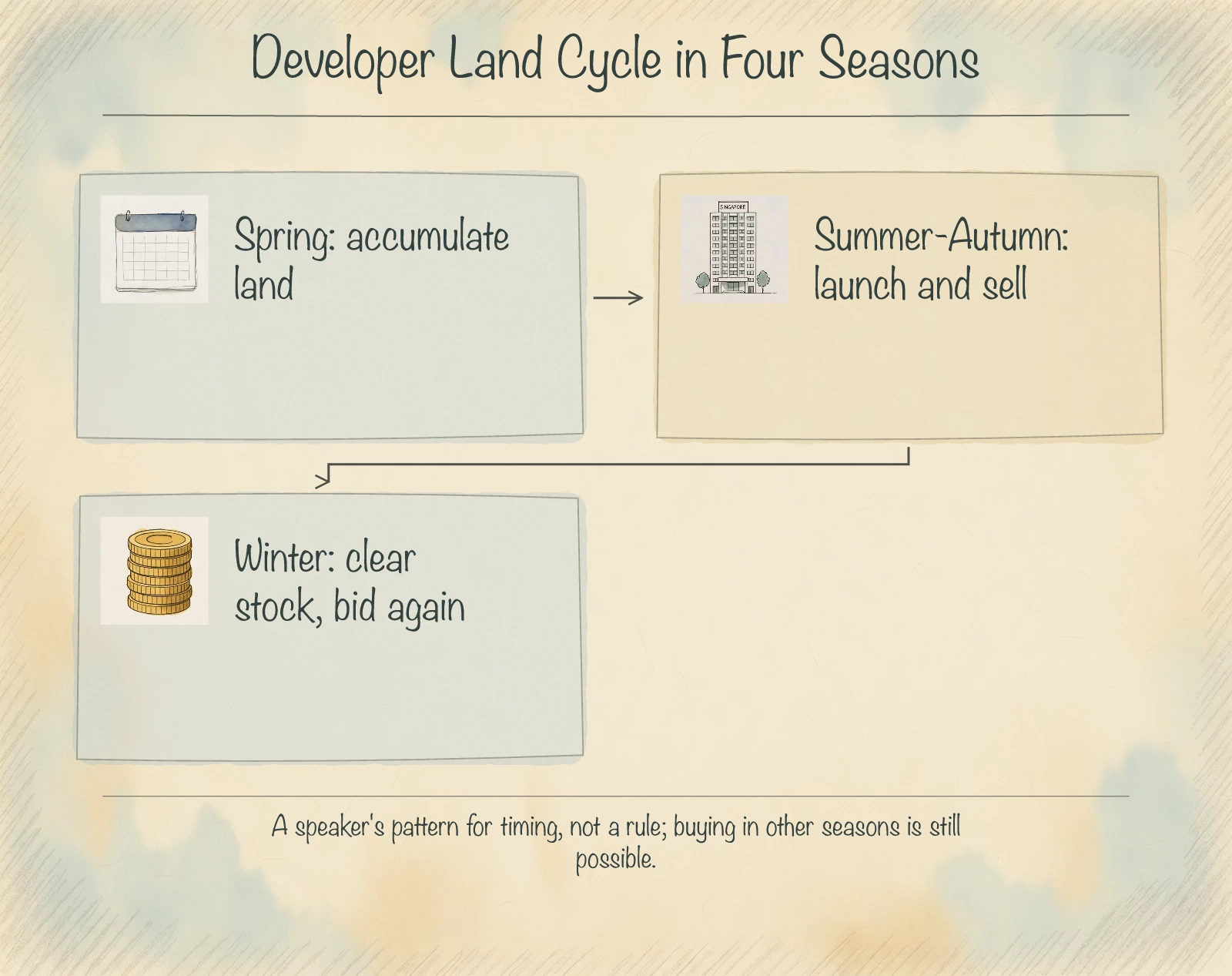
you see a lot of launches, 2024 also a lot of launches. And then summer and autumn is the time that they need to sell out their products.
So once they go into winter, which is expected to begin basically next year or the end of this year, depending on how fast the current inventory are being cleared, what will happen is that usually at winter phase as they start to clear out their projects, they will start to accumulate again.
And when they start to accumulate and bid for new land, what is going to happen is that towards 2026, 2027, when they start to launch their new products, we will then go into a brand new PSF level.
And this is something that you need to take note because this is the season that we will start to hit perhaps a new benchmark again and things will likely go up by about another $400 per square foot. Of course now we are in 2024, we still have time because the current projects that are being launched in
2023-2022 at this price range. This is still available.
We still have another 3 years to play around with. Maybe by 2026, if you are ready to go into the new launch market, you are still buying products that are being launched at the current 5-year cycle.
And that will still be around this price range. But once we move past towards 2027 into the new phase of launch, so 2027 will be the new phase of launch, we will likely see a surge of a new benchmark again.
So this is really something for everybody to take note because once you have understood this cycle and then it will start to coincide with you trying to see based on like what has been reported on the news.
Why is it that you know like maybe in 2020, so when we look at the new launches, why is like an OCR project being launched at about $2,800 per square foot and then you will think, hey, is it overpriced again but sometimes when we look back at the overall macro picture is really
Inventory Clearance and the $400 PSF Pattern
About the fact that there is this clearance of inventory, new batches of GLS, and with every new bit of GLS, because land price is increasing, construction costs, inflation, a lot of things are increasing at a pace that coincides with the fact that it increased by about $400 per square foot every 5 years.
So once you have done that, basically then you will know that, okay, maybe for me the cutoff time is around here.
If I really want to go into a new launch, then now is 2020, I have some time to prep for my existing property, structuring a little bit of my ownership status, maybe planning about decoupling or things like that.
But you have like a nice timeframe for you to plan a little bit now. But once you move into that season, then you need to take note, a lot of the new ones that are being launched is going to be at the new benchmark.
There could be some balance inventory of the old ones in this current phase, but it will definitely clear out towards the round of our 2020 to 2027.
Now this is of course not in and of itself one distinct method. It's correlated to interest rates, it's correlated to any kind of economic condition, any kind of economic crisis.
Those are global factors and of course it also coincides with like overall policy changes and things like that.
But all in all, this has happened for two rounds and the previous round we don't think the consideration why, because the previous round there were a lot of new cooling measures, especially TDSR that was introduced in 2013, ABSD and other kinds of stuff.
So the behavior is a little bit more erratic, but these two cycles has been pretty consistent. We hope that with this, this is like whiteboard session number two.
You help us to understand a little bit about the spring, summer, autumn, winter season plus the five-year cycle, and then as we move to episode number three, we'll talk a little bit more about using very specific micro methods to select a correct new launch.
I will see you on whiteboard session 3. Me time to take care.