Ownership and financing
The 3-Investor Strategy Behind High-Yield Property Returns
Published 2026-11-17. Adapted from the episode published 2025-11-21. Figures, illustrations and data reflect the episode’s original publication date.
Exit Loan Planning and the Bank as Investor
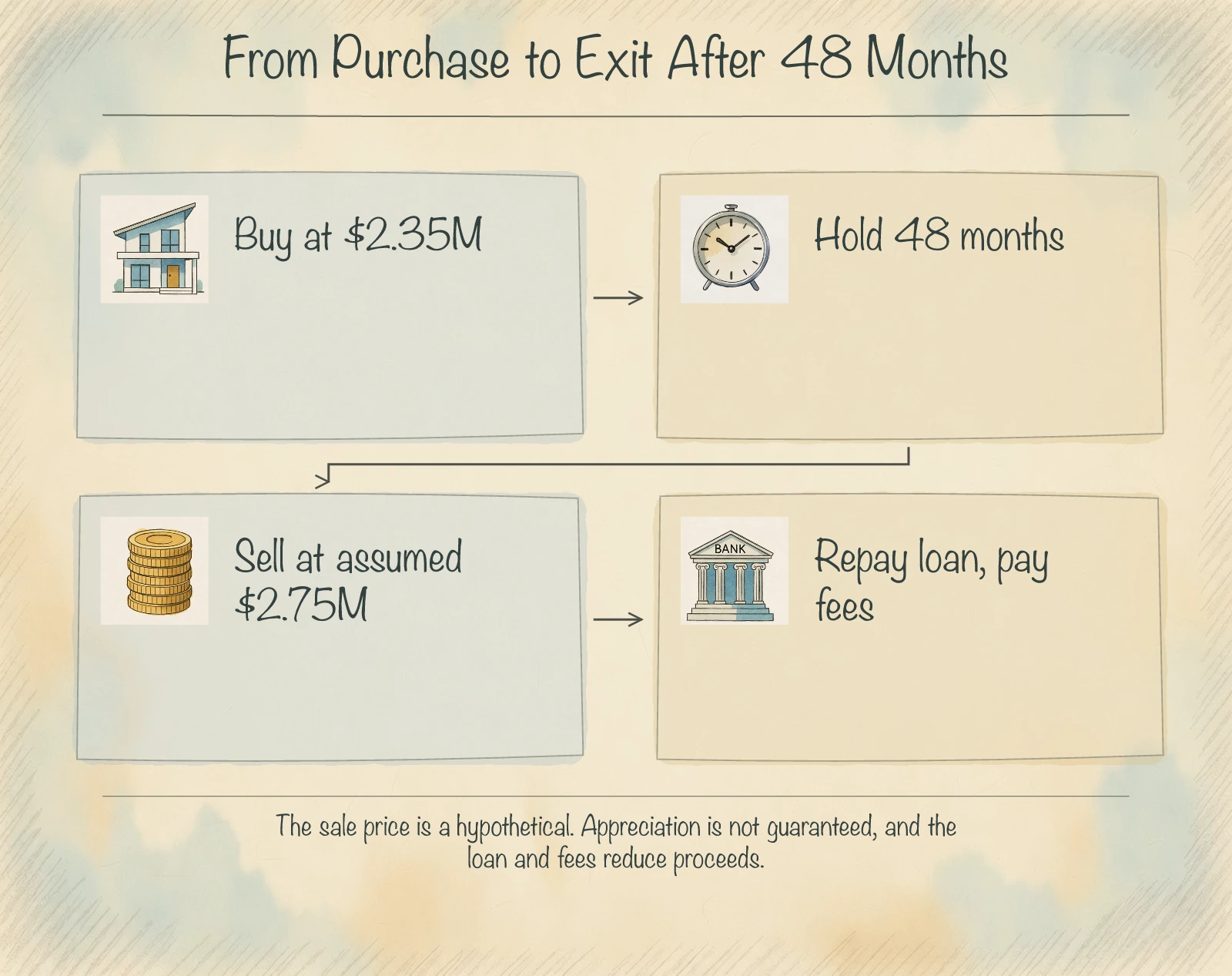
Let's say if I want to hold on to this investment property for 48 months, what is going to happen after 48 months to my outstanding loan if I want to exit from the property? For those of you who are refinancing, do not refinance first.
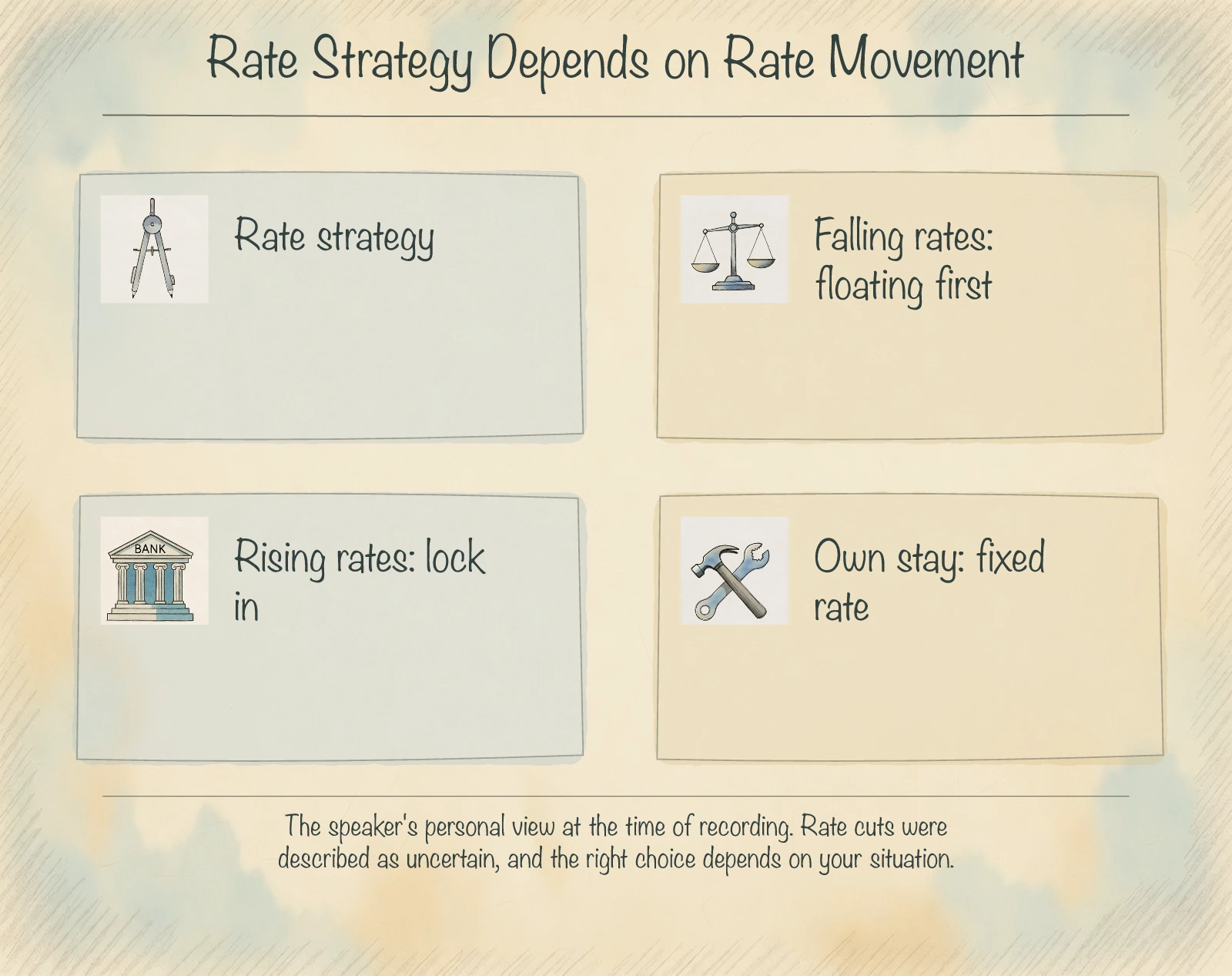
My personal advice, standard interest rates are going down. We want to go floating first so that we can pay lesser and lesser interest and take advantage of the interest rate movement.
So let's say the investment property that I'm hunting for is $2.35 million and I can rent out for $6,200. I already look at the numbers.
It can be done at Part S star. They're going to break down into numbers.
So let's say it's $2.35 million. Now I can get a mortgage at about 1.5%.
For those of you who are refinancing, do not refinance first. My personal advice is that interest rates might still come down because we still have two more rounds of rate cuts that might come in November and December.
I'm not sure whether you will 100% happen,
but if it happens, maybe you will start to see a slightly lower interest rate. I'm not sure.
Maybe 1.203%. Now, assuming you're 40 years old, because maybe you went for the BTO route, you got married at 30, now you waited for 1 plus 4 years, and 5 years MOP, you're 40 years old, and you are doing this exercise, and you can loan 25 years.
Of course, you can stretch your loan after you pay your loan for one year, you can go for repricing, refinance, and stretch it to 75. That's another topic.
But at the start, you can take 25 years based on your TDSR. And your TDSR allows you a loan of 1.762.
So assuming you qualify for this, your monthly installment is $7,049. And this is a resale property.
You are looking at these numbers over here. So basically, your monthly installment, 7049, is broken down into principal at interest, which is principal 5,875, 1,174 to the bank.
Now take note, when you look at this, this principal means that the amount is in your
property until the day you sell it. It's equity that is locked in your property.
It belongs to the owner. It belongs to you.
This interest belongs to the bank. The bank takes this interest because the bank loans you 75%.
So everything is very fair. And take note, these two calibrations will change with interest rate movement.
So it's advisable if it's your own stay property, we try to go for fixed rate so that you don't need to worry about fluctuations on a month-to-month basis, but it really depends on the interest rate movement because the interest rates are going down.
We want to go floating first so that we can pay lesser and lesser interest and take advantage of the interest rate movement. I'm sure if it's going up they'd want to lock in the rates.
Alright, so it really depends on the rate strategy. Based on this, my down payment is $587,500 because that's consuming 5% cash, 25% CPF.
So in total, that is 25%.
So if I look deeper, basically, I also have to take into account the total buyer stamp duty, which is $87,000. So my total deployment is actually $677,600.
So basically, down payment $587,000. And then I just put in legal fee $3,000.
The buyer's stamp duty is about $87,000 or in $90,100 total I need to deploy $677,600. So once we look at this, then I want to go on another secondary level.
So what is that level over here is that I want to know, let's say if I want to hold on to this investment property for 48 months, what is going to happen after 48 months to my outstanding loan if I want to exit from the property.
So basically at the first month, my outstanding loan is going to start of course from the full amount of 75% which is at $1.762 million $500 but then at the end of 48 months, what's going to happen is that at month 48, if I decide to exit and divest from this property,
my outstanding loan is going to drop to $1.522 million. So the beauty is in the centre over here because why?
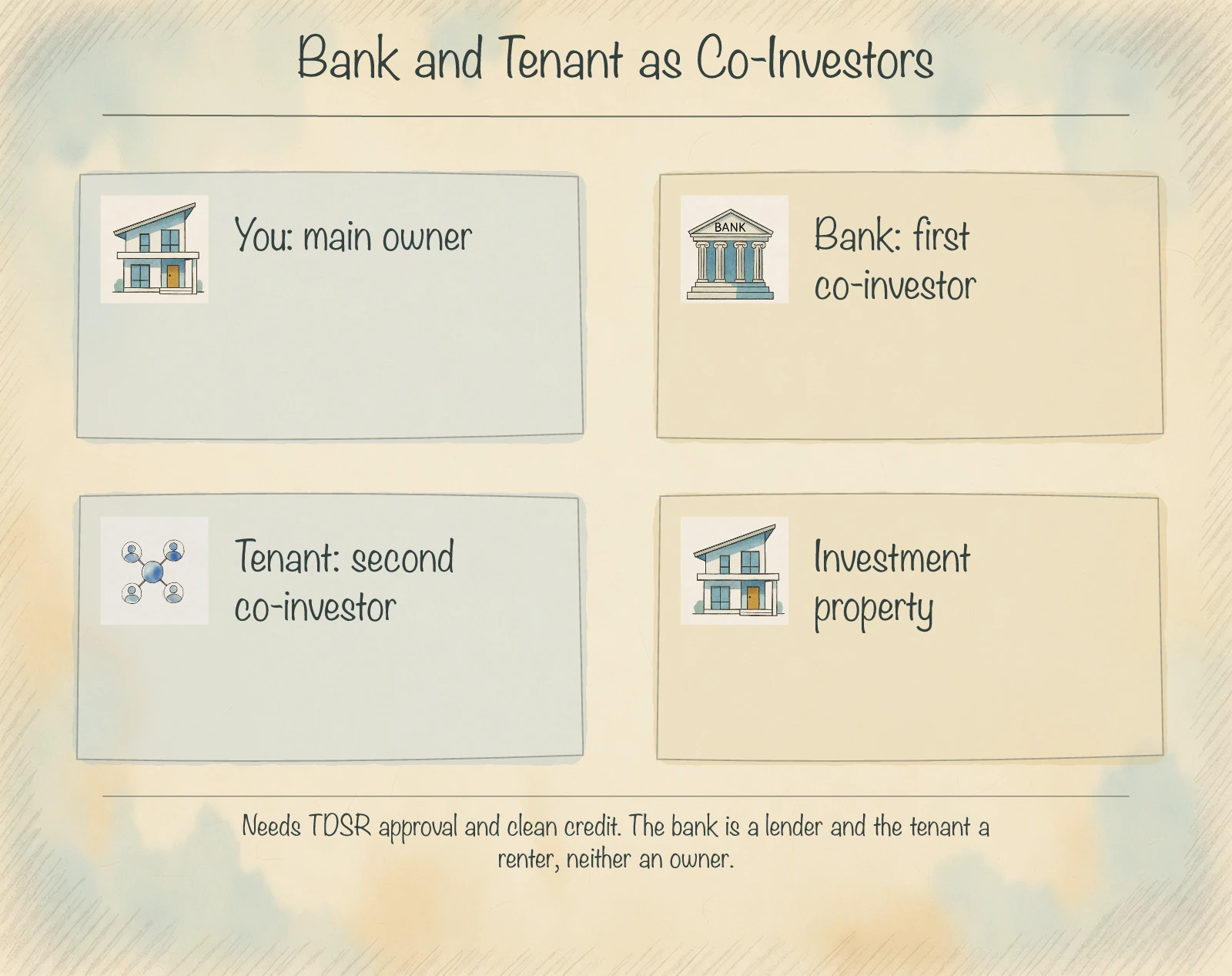
Remember the first approach that we talked about, the fact that you always have two core investors in your property. So who are your core investors?
Let's have a look. So first part over here is that when you look at the numbers from this point, the investment started at $2.35 million.
And then when you look at this, the main investor is who? The main investor is you.
You are the main investor. You are the main owner of this property.
You started off with $677,000 initial investment that includes your buyer's stamp duty. Now where is the other amount coming from?
The other amount is coming from your first core investor, which is the bank. So if you qualify for TDSR, your credit is clean, the bank loans you 75%.
So they come in as your first core investor and that forms your total investment. And then you deploy it into the market, you rent it out to a tenant.
Tenant as Second Co-Investor and Monthly Breakdown
And the tenant is technically your second core investor. Why?
Because the tenant gets to enjoy the utility of your property. They stay in your property.
So the tenant pays you $6,200 per month. Your monthly installment is $7,000.
So let's have a look at the breakdown. The breakdown works like this.
$7,100 is the amount you need to fulfill on a month-to-month basis. If you decide to hold for the next 48 months, you need to make sure it's paid to the bank.
If not, the bank can actually collateralize your property back. And this is split into two portions.
All right, so let's have a look at this example, this breakdown first. Because take note, there are simple calibrations along the way.
Usually at the starting point of your monthly installment, the interest is higher at the front. We call it the front interest loading.
The bank must earn a bit more interest at the start. All right, and then as you pay down the loan, the interest usually depletes towards the end of the tenor.
All right, so you will see a little bit of a high interest at the start portion first.
So I'll just take this into consideration and then look at these two numbers. So the money is $7,001, principal is $4,800, interest is $2,300.
So once we are here and then we look at how the rental income makes sense. So the rental income starts at $6,200 and I call your tenant the second co-investor.
All right, so the moment you go for investment property, you have two investors that is with you, all right, the bank and the tenant. So the tenant is the second co-investor.
Basically the 6,200 is deployed based on this approach. Firstly, the co-investor settles the interest to your first investor.
So your first investor is after the money interest because they loan you the 1.762 million. They want to earn this 2,300 every month.
So the tenant settles that to the first investor. So they settle the interest to the bank.
All right. They deployed another 3,009 into your equity.
All right. So into your equity triangle.
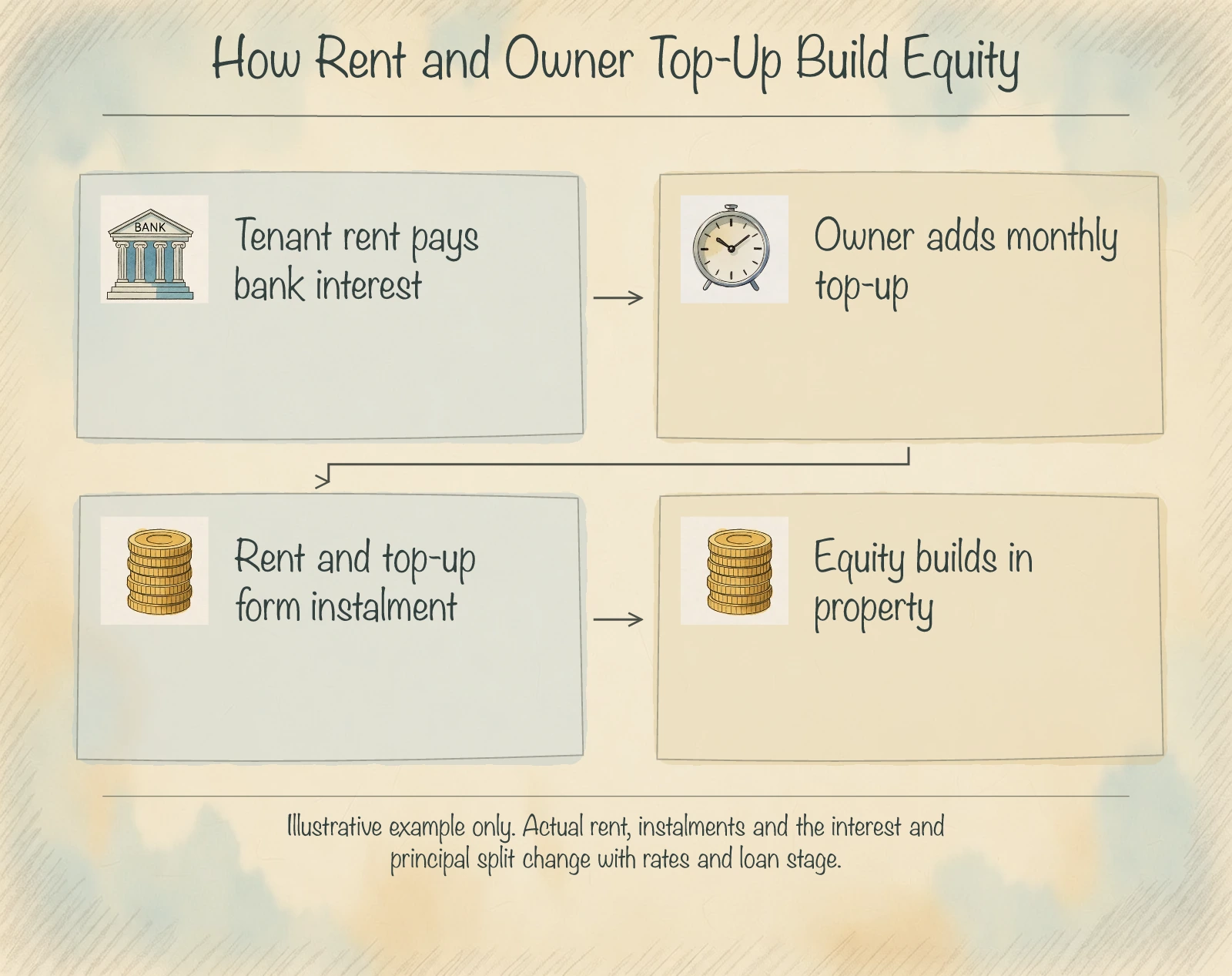
So if I were to illustrate over this triangle over here, 3,009 is being deployed into your property every single month. All right.
And another 900 is deployed by you every single month as the main owner. So this is by the tenant and the tenant pays another 2,300 to the bank.
So in total, the tenant pays 6,200, you pay 900 and this whole thing forms up 7,001. All right, so now that we are at here, let's come back to the screen here.
So 2,300, 3,009, 900 is by you. We form up 7,001, we settle the monthly installment into this investment property.
So this is how the complete picture works. Now take note, that means me as the owner, I come out with $600 over $1,000 at the start.
All right? Down payment by a stamp duty.
And every month, I put in $900 into the property as a form of discipline, as a form of savings, discipline. I just treat it as I set aside $900 into my piggy bank.
I put it inside. All right, my second core investor, which is a tenant,
will put in $6,200, pay my first investor and pay me $3,000. This belongs to me as the owner.
So my tenant is building up my savings, my tenant is building up my piggy bank. So this total amount goes into the piggy bank which is the property and the property is the big piggy bank that you are trying to build up the equity.
So the piggy bank can grow into the huge equity triangle through time. So let's go to the next slide once you are clear with this.
So basically in terms of logic is that I put in $900 a month, I get back $4,800 in total. Why is it $4,800?
It is because the tenant pays $3,000, I pay $900, I get back a total of $4,800. But then it also means I put in $900, my $900 earns me another $3,900 per month.
This is equivalent to 433% gain per month, which is a fantastic deal. It's like I put in $900, I get $3,900.
And this is building up the equity property inside my property. And that is the reason why real estate investment once it is rented out is extremely powerful because my return on my monthly deployment is extremely good.
So once I'm clear with this, this is the amount of returns I earn from my second co-investor on a month-to-month basis.
Let's go on to the next slide. So come four years later in the year 2029 or 2030.
And let's say I decide to exit my property. How will the numbers look like?
So to recap, the numbers is very important because once we are clear of the numbers, we will take action. Why a lot of people don't take action in property investments is because they are not clear of the numbers.
They are always comparing, hey, it's more worth for me to invest in other instruments, invest in this, invest in other forms of asset class, which is nothing wrong. But the rationale that a lot of people don't take action is because they are unsure
Projecting Four-Year Gains on a $2.35M Property
of the actual returns generated by investment property. So let's have a look at this.
In order to complicate you, just follow me on this portion first. I invest in a property that is worth $2.35 million.
And in four years' time, let's say I invested in the right property and it goes up to $2.75 million, $400k paper gain. My outstanding loan in four years' time is going to be $1.523 million because I share with you over here at this portion, $1.523 million.
What is going to happen is that if I can sell at 2.75, I less off 1.523, I can extract 1.227. Then you will be wondering, hey, I only put in 677,000.
Why did it become 1.227? Later, let's go through the numbers.
However, I like to be very, very transparent with every fees because I'm also an investor myself. I want to calculate the actual amount.
On paper, I extracted 1.227 but there will be fees involved, there will be exit fees, what are the fees involved?
Now take note, when I enter, this amount already includes my buyer stamp duty which is about 4% to 5%, alright, because the down payment is 580,000, that's about 90k buyer stamp duty plus legal fees.
When I exit, there's also exit fees, let's say I pay a broker 2% to sell and plus legal fee, 2% plus GST is about $58,000 based on this sale price over here plus GST.
Or let's say the brokerage charges GST on their fees, all right, then legal fees 2 to 3,000, let's round it up to about 60,000, all right. Plus minus 1.227 less or 60,000, I net gain 1.167, and this 1.167 includes my original investment.
Alright, take note you already deployed 582,025%, your BST is gone already, that's considered fees, alright, but it includes my down payment at the start. My net gain is 490K.
I take 1167-677. My net gain is 490.
So I deployed 677, I net gain 490, my return is 72% over 4 years, per year is 18%. So question here is that will another
sell investment give me 18% per year? Because if I can hunt for property that has the potential, of course nobody has the magic so-called crystal ball.
But if I can do that, it can generate me 18% per year.
That is the beauty of real estate investment if you hunt for the correct property with the right characteristics, which is why in PWA we use this thing called mode analysis, 10-point checklist to go for high scoring properties so that it's easy to run out very low vacancy period, high chance of capital appreciation.
But of course, these are all bearing economic situations. But by and large, we are in Singapore, we're already fully developed.
If you have been following my podcast, my web and all that, there's a lot of fundamental reason why REST Instacompile is very stable growth. It will not shoot up very quickly, but it will grow very gradually.
Once we are clear about this number, then it will start to give us some approach like, if really I want to take an intentional approach, the investment property
can actually give me this. Now let me go deeper into the number for you.
And then allowing us to understand a little bit more. Why is it that there is an 18% gain?
The rationale that there's an 18% gain is because of these mechanics behind the scenes. So what is this mechanics?
I put in 677,000. The bank as my second investor give you $1.762 million.
When I sell the property, I pay off the bank already because I pay off $1.5 over million. My second investor actually is contributing this on the second level.
Alright, so for the last 48 months, my tenant has been giving me $187,200 into my property because he is contributing or she is contributing $3,000 a month from the monthly rental of $6,200. I am contributing $900 per month, so I contributed another $43,000 inside.
I call it me to me. And the tenant is contributing to the bank, 2003 for the last 48 months, 110,000.
And the market is contributing to me because of asset inflation. And because I did my homework
as an investor, I hunted for the right property, another 400,000. So everything is clean and very fair.
And this is how the numbers look like. So take note, I put in 677, I still need to put in 900,000 over the last 48 months, total I put in another 43,200.
Because of this 900 dollars, I also need to account for this additional investment over the last 4 years. So let me just plonk it over here.
In totality, actually I invested 730,200, 677 at the start, 25% down payment, buyer stamp duty, and then another 43,000 over the last 4 years total, 720,000, my net net gain. Then after cost, it's actually 490 over the total amount of 720,000.
That means that my returns is actually net net 17% instead of 18%. So after I account for this, of course, some of you might be asking, then what about the MCST, property tax and let's say any repair, water heater, all that kind of stuff.
Sure, let's reduce another 2% from here.
Net Returns Compared with Dividends and Discipline
Let's make it just 15%. It's 15% good.
If 15% is good, why is it good? Does it outperform your dividend?
6%, 7%? Does it give you a very disciplined approach that you don't have to keep entering in and out of the market?
Let's say if you do equity. So take note, I do cryptocurrency, I do equities as well.
But what I'm trying to share is that this is very suitable if you want a very disciplined set-and-forget approach to real estate investment, provided you hand for the correct property.
Alright, now if you come to this and let's reduce by another 2% because there are costs involved of holding a property, property tax, MCST all this. So let's take it as 15%.
Then when we look at this, things will start to click. Why?
Why for the next 30 years and maybe it just go to a million dollars? Then basically I'm letting a lot of my equity, let's say I have an outstanding loan of 200k and I have an equity of 600k, I'm not helpfully deploying my funds to grow my portfolio because it's a very, very different ball game.
And let's say at the end of 30 years, let's say now I'm 40. By the time I just say another 25 years, I'm 65.
My HDB, let's say is worth $1 million, example. But take note, my HDB by then, it will be maybe having a balance of 60 over years.
And let's say this 4-room flat, now it's 800 is $1 million. Okay, or maybe I say it's $1.2 million, for example, with a balance of 60 over years.
Alright, let's just be a bit more optimistic.
Okay, but take note, there are one over million HDB in Singapore and our government wants HDB to be bread and butter really for own state. It's not for speculation.
It's not a lottery effect. Their direction is very clear, which is why they are very focused to really create supply, to make sure that Singaporeans can really own their first home healthily.
Alright, so naturally all the policies are curated in a way to not let HDB be too speculative.
Alright, so let's for example, this is $1.2 million and you're fully paid and you are left with $1.2 million if you were to sell at the age of 65. And my question is, what is your next step?
Naturally, your next step is that you have to pay for a replacement home. Maybe you pay for a three-room flat.
By then, you go into an old estate. It could be a three-room flat at $600,000.
You are left with $600,000 retirement fund to last you from age 65 all the way to 90, 20, 25 years, 600,000. Of course, you might have other falls of investment, insurance, and all that.
But what I'm trying to say is that you can still have other instruments. You can still have your insurance.
You can still have your equities. You can still have your fixed D.
You can still have your whatever bonds or whatever it is.
But this should be treated as a separate investment because this in and of itself can be calibrated into another thing while you still have all this.
You can still have your insurance, equities, investment dividend or whatever, but this can have another picture, which is, is that a way that now my property is worth 800, I have 200,000 outstanding, I have 600,000 of equities, sorry, of basically cash and CPF that is trapped inside my HDB.
Can I deploy this into two property or maybe I start with one property first? And one of this is the investment property that I talk about, which I can have another two investors.
One is the bank, one is the tenant that can help me build my portfolio because I talk about the fact that you enter at 2.35, you exit at 2.75, you extract $1.1 AUD million after 4 years. You started with $677,000 and because of a very disciplined approach to have your first and second investor co-investing review.
And after extracting this $1.1 million, let's come back to the screen. This $1.167 million, I just reverse engineered it back by 30%.
You can own a property that is worth $3.89 million, provided you qualify for the loan, provided your TDSR is good. But this is down payment plus BSD for a property that is $3.89 million.
And this is the power of expanding, leveraging good debt, having these two core investors with you and being very intentional in your property investment.
Now this can be a very simple property example. You go to the North.
All right. Now I've been telling people the four betas in north is the cheapest in Singapore.
You can still find properties below $1.7 million. Let's say you take $1.6 million, you get a 4 beta in the north.
And you just stay. Four years later, you can just continue to stay.
Maybe this will be $1.8 million in four years' time. Just a hypothetical example.
You can stay, it doesn't matter. And of course, this has to come from another set of down payment, maybe from your own savings or whatever.
Two-Property Plan: HDB Value and Cash Flow
Or whatever it is, but $1.6 million, 25% or 30%, you need about $480,000 here for down payment. And of course, provided both you and your spouse can each take a loan.
Now, assuming this is like this, by that time, basically over here, just based on the two valuation, is already worth $3.45 million. $1,000.
This is in contrast in four years' time on what your HDB will be worth. Maybe in four years' time your HDB will be worth, I don't know, $850K, $900K maybe?
All right. Your equity inside the property is $700K because you have an outstanding, let's say $200K example, all right, maybe drop to $180K.
But then this is a different story. The equity sitting inside your property is $1.1 million.
Just by one investment property is already larger than the equity in your original HDB. All right.
Because the tenant is building the equity as well. This is your own stay property.
You started at $1.6 million. Your loan is maybe $1.12 million.
By then maybe your loan is $1 million. Your equity is about $800,000.
So your total equity here in four years' time is going to be $1.9 million, is already bigger than your $700,000 or $700 over $1,000 example. And this is the power of really expanding your portfolio.
And that's a rationale why if you take an intentional approach, you can build it up gradually because from here, the next step is that you don't have to invest in such a big quantum if you don't want to.
The next one, maybe after you exit at $2.75, you can go for let's say a $3.2 million dollars or $3.5 million dollars property. All right.
Or you want to divest both, take out the A-HRK, take out the $1.1 million dollars, then you combine into a lender. Because by then, if you have $1.9 million dollars, how do the numbers look like?
$1.9 million dollars divided by .3, you can own something at about $6-plus million dollars. You can go for a landed property at about $6 million dollars.
And from there, the jump for landed property tends to be stronger, potentially, provided also you invest in the right landed, because we go through that a lot in our webinars, our landed clinics at NOTG and all that as well.
You can also connect with us in various ways. Everything is over there.
Let you know when is our next event. Join our PRB landed clinics that we do once every month at different districts and different bistros.
So once you're at $6 million, then you can see how you want to calibrate this further because maybe if you appreciate to $7.5 million, you might want to further divest it. You might want to extract equity out from it.
You might want
to maybe own another one. Or you want to start going into alternative investment like commercial, industrial property, but that's a whole other topic.
But the main thing is that get the engine moving first. From the first route, once you get this engine moving, you stay in one, you run out of one, you get the momentum going.
And this is the classic example that I have always been showing: the most important thing is to make sure that in your strong season you build your equity triangle.
So I've always been sharing about Andrew and Zi Yi, is that they took a very intentional approach and started with their first HDB, they weren't able to own two properties immediately.
So they went to own a resale for beta first, make gains from this property first, and then after that, once they sold off, then they went into two properties. So they also took a separate route.
They didn't go straight from selling HDB to two properties because they were building their income. All right.
They are still growing in their professional work, their salary and all that. So once they're comfortable, they went into two names first, and once they're comfortable, they sold off this, then they went into two properties, all right.
So the moment they went into two, there are two properties, their portfolio increased to $4.3 million dollars. And this is a classic example because if they would have stayed on with their HDB at $670K, maybe now it's worth $800 compared to five years back, but now their portfolio is $4.3 million dollars.
And the approach is basically like this: own stay $2.83, 4 beta, money is somewhere $800, principle $3.9, interest $4.4. Now this was an old example because back then interest rate was higher.
Now if they have refinanced, it's much lower already. They are CPF, they have cash.
This is your own consumption because you are using the property for you and your family. This is rented, paid by the tenant.
All right. And combined with the CPF, the total cash flow per month is $5,007 per month to own two properties.
Property as Protected Savings and Next Steps
But importantly, this has a very strong engine because it's rented out. This engine comes from you yourself as the utility consumer.
That means you are like the tenant, putting a lot more for savings, and you need to pay the bank interest, but because you're enjoying the property, net net for both is that it takes them $5,700 cash per month to own two properties.
Now, so they view property as a protected savings. It gives them peace of mind.
They don't have to worry too much about other forms of investment because they know that four or five, six years later they own two properties with a certain amount of valuation. And one is being paid down gradually by the tenant, one is paid down by them.
And then basically it allows them not to go for the traditional approach whereby by the time 65 you have to downgrade to a smaller HDB and you're left with very little for retirement. And they're really after this approach just by a very simple methodology to hit towards a higher quantum intensive portfolio.
So all right, I hope that I have given you that breakdown that allows you more clarity for you to take action. Most importantly is that you have to do the first step, is to understand that the numbers must make sense.
It generates about 15% per annum for that example at $2.35 million for the $6,200 rental property at Park X-Star. If you were to rent it out, of course, if you were to stay in it, the return on investment is lower.
Why? Because you become the tenant.
So it's a fair thing. Now, there are some couples that go for a very creative approach.
Some of them, because they still have young kids, they stay with their parents and then they invested in two properties while staying with their parents. So while staying with the parents, they have family support, they also can give their parents a bit more in terms of money allowance, but they have two investment properties working hard for them.
Because if you have two investment properties, most of it are paid by your tenant as the second investor, and they are living together with parents, and then they want to go through this season of four to five years, then they will divest both investment properties and go into a lender.
So some couples are utilizing this approach as well. Of course, every family is different.
It really depends on what works for you in terms of personal space, personal comfort, your parents' comfortability and all that kind of stuff. But these are just some things that we see on the ground.
My consult is at $150 per consult for one hour at PRB office, where I will dedicate my time together with my consultant to look through your portfolio, give you advice, opinion, and give you insights and perspective. And of course, work out some numbers for you to see if it makes sense.
And of course, sometimes it's just about clarity. That means you come in for an hour, consult fee for our time, and of course our professional advice at $150.
In the event after that, if you want to work with our PRB consultants, then of course, they can help you with the sale and of course the purchase of your property or investment in your property as well. But importantly, if you just want to come in, have a chat with me.
And of course, you want to make your own plans. Now, of course, that's all fine as well.
Most importantly is that I hope to be able to give you value in exchange, of course, for your time, my time. Of course, come in, have a coffee at our office.