Buying and upgrading
The 3 Hidden Forces Behind Real Estate Wealth, and How to Ride Them
Published 2026-11-11. Adapted from the episode published 2025-09-12. Figures, illustrations and data reflect the episode’s original publication date.
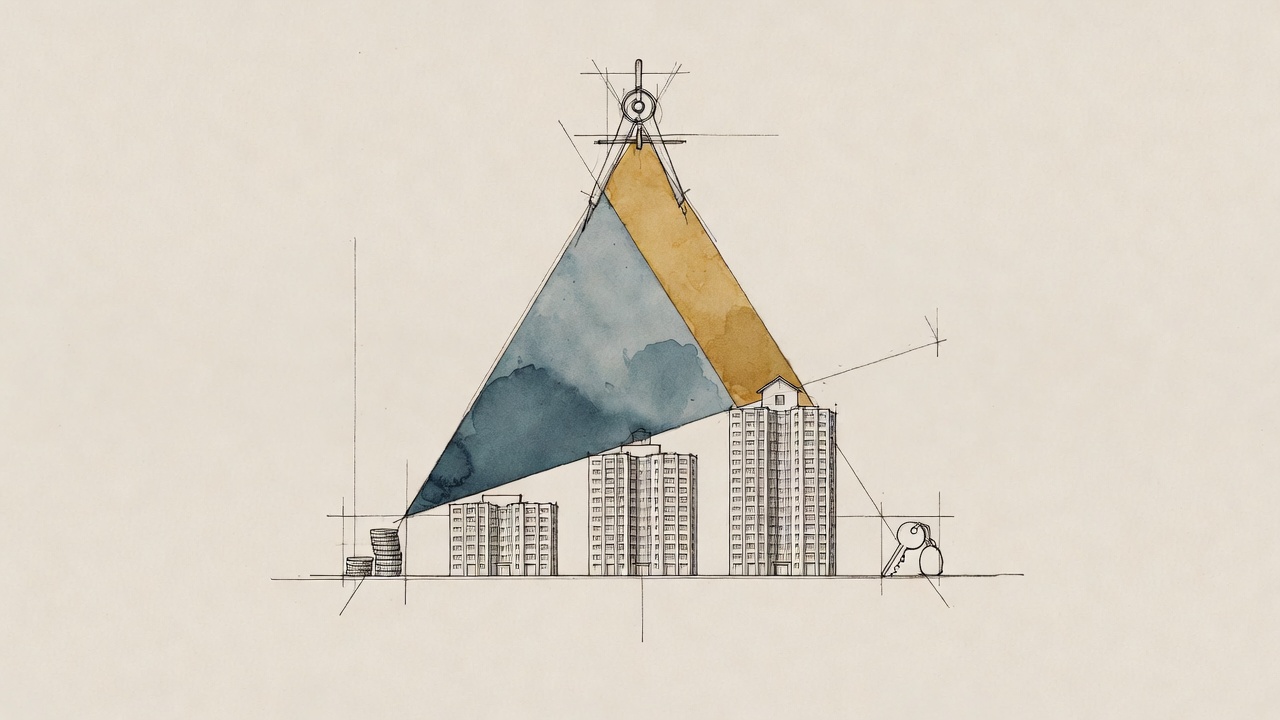
Three Forces Behind Real Estate Equity Growth
I'm going to share with you how to build this equity triangle and how to view it in a very conservative step-by-step gradual growth with inflation now. $2 in the past can buy you more things than $2 today.
It's because of this inflation that's happening and things get more expensive, but underlying the mechanism is because by then just based on 2% flat inflation without calculating for other kinds of asset inflation, this portfolio would have already been $6.96 billion, and then they can then build what I call...
Alright, so the previous episode at NOTG, we talked about this triangle of decision making, alright? So I'll call it a triangle of decision making — trans risk opportunity.
Let me touch on this episode on one key aspect of risk, and we talked about the seasons of the investing cycle.
And of course, it's very important to identify which season you are, because the most important thing is that once you identify your strong season and you make the right choices, this is basically building towards your equity triangle.
So for today's episode, we're gonna talk about the equity triangle. Let's go.
Alright, so equity triangle — I'm going to share with you how to build this equity triangle, how to view it in a very conservative step-by-step gradual growth with inflation now. Let me come this screen for a little while.
Take note, real estate has a triple movement. All right, what is the triple movement?
I'll call it the real estate appreciation triple movement. Now the moment you understand this triple movement, you will understand why all the wealthiest people in the world invest in real estate and they sleep while their real estate grows in value.
You invest in the right country, right location, right kind of macro, micro factors, and you look at different frameworks on understanding and identifying the right kind of real estate asset to invest in. Now, of course, in PRB, we always share that different assets move in different seasons.
We call that disparity effect.
There will be a season, maybe let's say a certain quarter of a year, that this type of property will move faster than the other type of property.
And in the long run, if you're in the right country and you invest in the right kind of assets — and of course in Singapore, we always share that there are different strength of hardness of asset, landed property being the apex property, the hardest, because there's no more new landed property, 73,000, and demand is still growing; condominium, 380 over thousand units; and of course HDB is 1.3 million.
So largely residential properties in Singapore is the main play for a lot of Singapore property investors, and of course once they have maxed out their names they go for commercial, industrial, overseas property. Now when it comes to residential property, which is the topic of today, there is this hidden mechanism called a triple movement.
Because firstly, you have the inflation that happens on a broad base level. So we call this the real estate inflation.
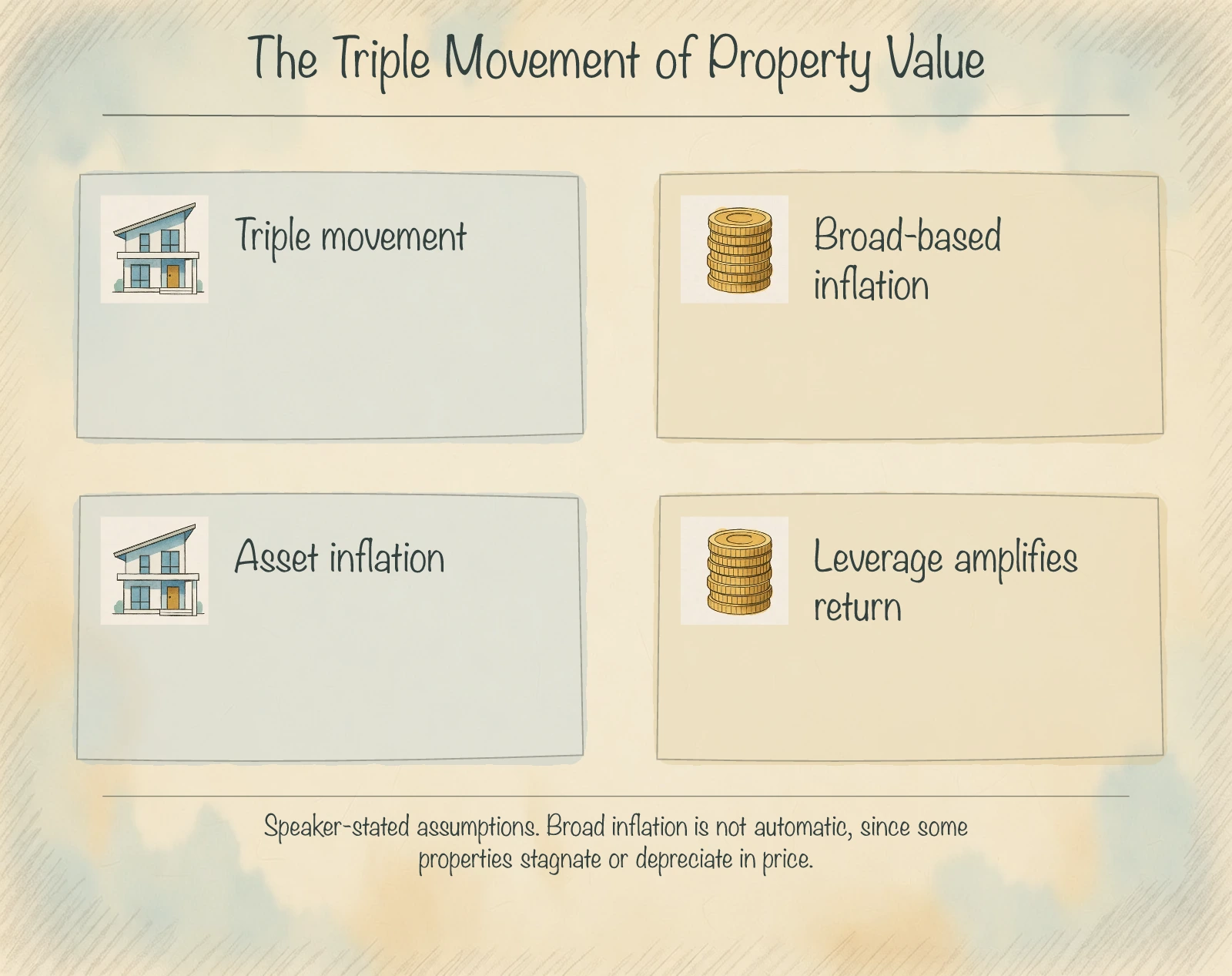
And inflation, of course, on a surface level, it looks like it's only growing at about 2% per annum based on goods and services, pricing of products that is going up by about 2% on a national level. So we call this the broad-based inflation.
However, there is this thing called the inflation based on assets and we call it asset inflation.
And this is what a lot of people are talking about, which is the capital appreciation, because the capital appreciation happens when there are macro, micro reasons, or maybe there's a catalyst that happens in a particular enclave that really boosts up the prices of the surrounding properties, or there are certain reasons — maybe because of a launch of a master plan.
Suddenly you buy this property, you got a jackpot: there's an insertion of an integrated mall or MRT station or whatever it is, or a very famous school comes and plonks into the area and it increases the demand.
And there is a situation whereby the supply is pretty restricted of that type of asset property, and it beats up the demand and popularity and tasks with the ongoing transactions and the demand; it boosts up the valuation, and we call it asset inflation.
And this is due to reasons on the ground, alright? So you can call them — I wouldn't want to call it artificial; I want to call it that it's being propelled by macro and micro factors.
Now, of course, the third one is that you have something that is underlying and is happening because — why? You usually will put in a 25% down payment plus BSD, and then most people will leverage 75% from the bank.
Now, take note why real estate investors leverage on the bank is because of a few key reasons which I explained before. One of the key reasons is because firstly, the return on capital is very different when you leverage, because you put in 1x — this is like a 4x leverage.
So you put in 1x, you own 100% of the property because you only put in 25%, and the...
Return on Capital, Inflation and a Client Example
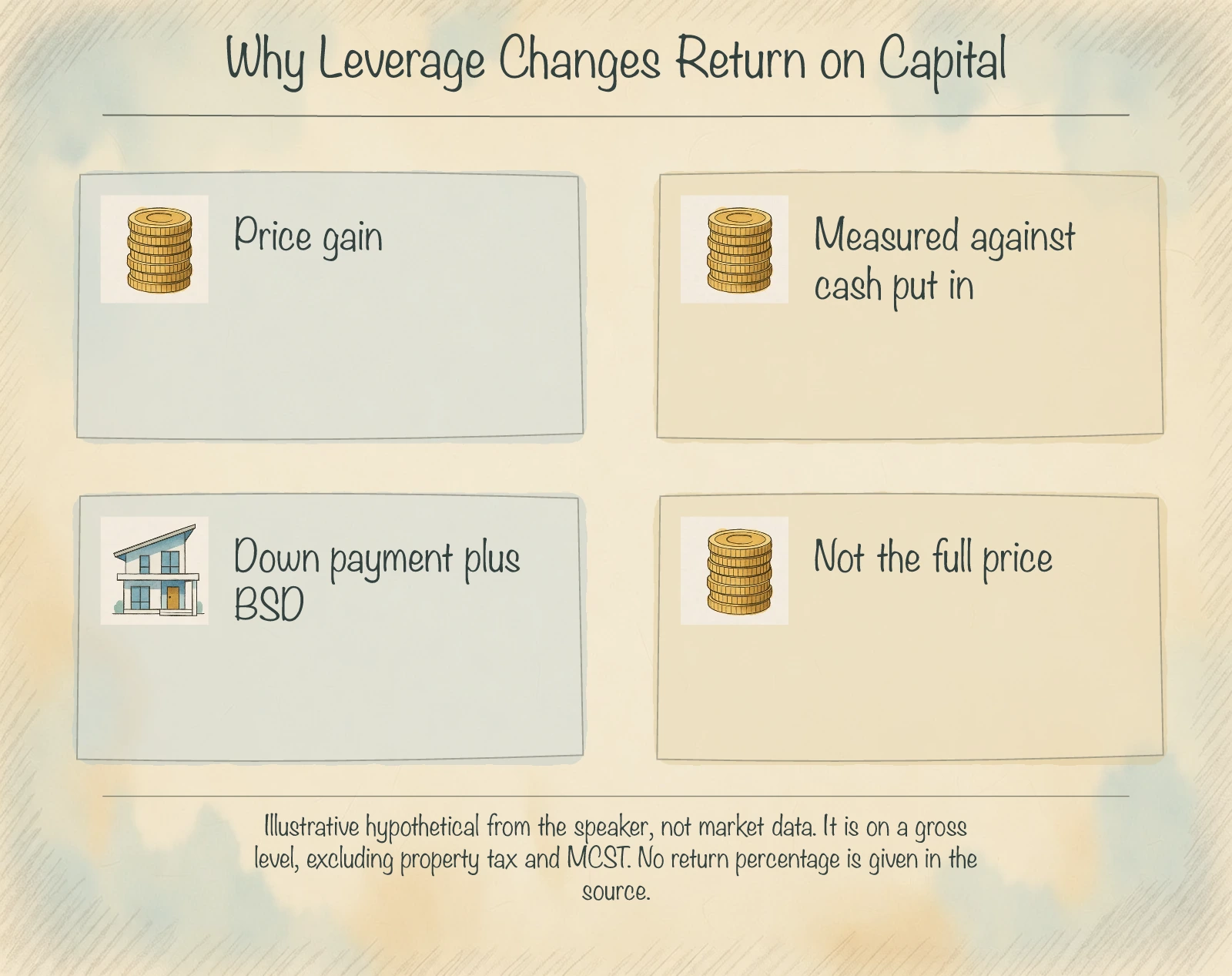
The moment this property appreciates in profits, for example, you're appreciated by $400,000 — let's say you bought this property at $2 million, and then four years later it becomes $2.4 million.
Take note that this $400k, you measure it against your down payment here, which is a different number, because you don't measure against the full $2 million unless you're paying in full, but you measure against this 500,000 plus your BSD.
On a gross level — we don't want to call the property tax and MCST and all that kind of stuff — and over five years, the ROI, return on capital, is different.
Some people call it cash on cash return, some people call it return on capital, so it's very different, and because you enjoy leverage and the banks don't need to share your profit, you just need to pay the interest based on this.
And Singapore is one of the most blessed countries now — interest is so low, 1.4% is going to get even lower once the Fed rate cuts kick in in September and October.
Now, so we call this the triple movement. And just for this example, we just want to take a base level inflation that happens.
And of course this kind of inflation sometimes is not automatic. Why?
Because even though goods and services increase in prices, certain properties stagnate, certain properties depreciate in price. So I want to remove this portion here.
I don't want to base it on this, but I will just base it on the fact that because of asset inflation and there is this either mechanism here — that your purchasing power actually decreases over the years, the purchasing power of your cash decreases with this inflation in the marketplace.
So which is why two dollars in the past can buy you more things than two dollars today. Maybe a cup of coffee cost like 50 cents 10 years ago, now it costs $1.80.
It's because of this inflation that's happening
and things get more expensive. But underlying the mechanism is because our cash is eroding in power because of the printing of money, and we don't really see it as a physical printing of money — it's just an increase in money supply by central banks all over the world.
And because of this, your cash loses strength, and when your cash loses strength you will feel that why is it that last time $600 per square feet I can buy a 3-bedder condo maybe in the OCR or RCR region, but now everything is a thousand six, thousand seven, thousand eight, and for resale, new launches is $2,000 over dollars?
And why is it so? Is because there's also this erosion of purchasing power through inflation, because construction cost increases, money becomes weaker, land needs to be stronger, everything increases in price, everything goes up in terms of cost.
So when I combine all these factors, what it means is that even your loan is decreasing in strength. So if you were to buy this property, you put in $500,000 but you loan $1.5 million
dollars from the bank. The loan of $1.5 million today in the year 2025 is weakening in power 25 years later, which is why when your parents bought a property in the past and they feel that wow, my money in the sum seems so high —.
You know, last time when my parents bought their first HDB property, they said that their money in the sum is $600 over dollars, they feel this very high, but if you look at today's context, $600 if they are still paying the loan is very low.
And one of the reasons is because our perception of the weakening of money based on reducing purchasing power is very real and very subtle. So what I'm trying to say is that this triple movement is a very important understanding, because even your debt is reducing in purchasing power, which is why it makes all sense to leverage healthily.
And even though you got $2 million, you shouldn't put $2 million into your property, you should take $1.5 million to go
invest in, let's say, a dividend stock or REITs, get 6% yield and generate higher interest than your mortgage of 1.75%. So as long as your cash can generate a better return than your 1.75% mortgage rate — in two days, right now, 2025 Q3 — then you shouldn't utilize your cash.
Alright, so basically this is the triple movement, the triple movement of real estate inflation. Let's come back to this.
Just for this example, I'm going to base this equity triangle based on a 2% flat inflation. I haven't taken into account catalysts or maybe certain factors that cause the property price to rise much faster.
Just imagine, let's say you buy a property at $4.3 million dollars — now you have a total portfolio of two properties at $4.3 million. What is going to happen in the next maybe 20, 25 years?
And let's have an example of a real customer and why is it that they want to build an equity triangle. So we have this client and this client basically is Andrew and Zi Yi.
Andrew and Zi Yi's Property Journey and Life Seasons
So basically they were very gracious to come for an interview, allow our team to tour their new home. Of course we are very happy to help them over the years.
So they went through phase one where we help them to sell their HDB once they hit MOP, that was a DBSS HDB. Phase two, we help them to purchase the resale property and then we sold it off.
Phase three, we help them to invest in two properties. In fact, if you go to our PwT YouTube channel, you'll be able to see the full length 8-minute video on their interview where we actually help them with more properties because after we sold off the HDB, it also helped their parents to sell off.
We purchased two parry for them so their parents landed, helped their brother to buy a home and then sell the two perry and now we invested in two properties, one for stay one for investment. So why do they go through such a hassle and sometimes you know when we own our first property we became very emotionally attached.
I still remember when I first bought my HDB at the age of 24 years old, when I first got married I bought it with zero cash because there's a grant of 40,000 and of course back then you can take the higher HDB loan.
It was our first matrimony home. I still talk about what maybe we'll stay in here for life until we die, right?
But as you progress with your journey in terms of your work business career, once you have higher earning power, you start to understand a little bit more about real estate investment.
If you take time to study some of the investment methodology and framework, then you realize that actually real estate can be a hidden mechanism while you focus on your work and use it to build your wealth.
Now in the event, if let's say we were to go back in time and Andrew and he didn't take action, what's going to happen is that if they have held on to their HGP, actually they could have made more.
Their HGP has technically appreciated for 600 over 1000 to 800,000. They could have made 130,000 more.
Now this 130,000 of course in hindsight, it looks like there's additional appreciation over the last five years.
However, today they own a total portfolio of $4.3 million by owning two properties intentionally, because if they didn't take action, their total portfolio value is only $800,000, but because they have taken action now, they have improved their total portfolio value from $670,000 to $4.3 million, which is close to a 7x improvement in terms of value, 6 to 7x.
Now, why is that important is because we want to focus on expanding your portfolio valuation that you own in terms of asset valuation, whether it's a combination of your capital and your debt, it doesn't matter, because in Singapore, we're already protected very healthily by TDSR.
It's very hard to speculate on properties. You need to be very prudent.
TDSR check, 25% down payment by a stamp duty.
Make sure that you can afford a monthly installment. You can hold for four years to sell a stamp duty.
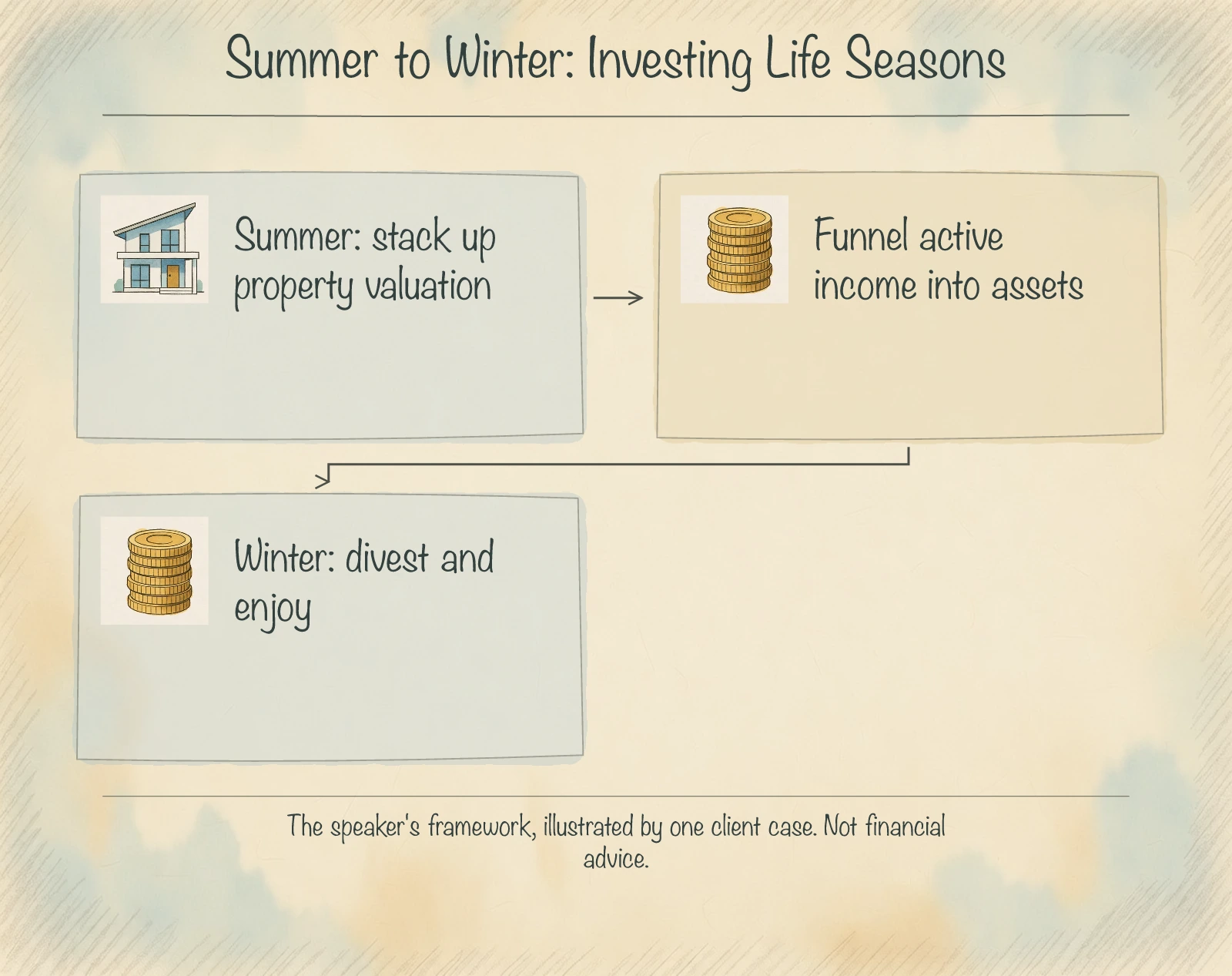
And of course, the reason why they do it is because they identify they are in the summer season and they should stack up on their property valuation. And both of them are working professionals.
And after doing the numbers and the risk-free manner, basically they're owning a freehold four beta that they purchased through PLB in the year 2024 at $2.383 million. Early part of 2005 is already $3 million now.
I believe it's about $3.2 million, $3.3 million already. And then after that they invested in a rental property through PRB again.
Now I think it's worth about $1.4 million. So total I think their portfolio size is already 4.5, 4.6.
And in totality, because one property is being rented out with a combination of their CPI contribution, it takes them $5,700 per month of cash flow to sustain two properties, which in totality per year is about $70,000 additional,
which they can set aside their bonuses. And they look at it as a way of safeguarding their future by investing in the rental property so that they are viewing property as a protected saving.
So rather than just spending it on a new car, not saying that cars are not necessary, but they look at chances of them forming a very disciplined approach to funnel $5,700 per month into two of their properties so that it becomes an equity triangle building kind of project, because they want to funnel their active income $5,700 a month into the asset income.
And they identify that this 30 years, 25 to 55 is the most risky year because anything can happen to our jobs, anything can happen to your active income. Active income means we are trading our time and skill set for money.
And once we hit 55 to 85, I call this the winter season. This is the time that you should divest your assets.
You shouldn't hold on to your big portfolio all the way until you die.
Retirement Stage Targets and Equity Extraction Strategies
You should enjoy the fruits of a labour. But if you don't have a big valuation or a sizable valuation, most of the time, the route that a lot of Singaporeans will take is that they will downsize their HDB and pay off like a smaller HDB.
Alright? And then they will not be having a sufficient amount for retirement.
So basically for Andrew and Zi Yi, based on their portfolio size now of about $4.5, $4.6 million, they are working towards $45, $55, and $65 to determine at that season what will be the life stages, what will be some of the decisions they can make for themselves and the kids based on health, freedom, choices, and they can press the button anytime.
So if they decide to press the button when they are 65 years old, by then, just based on 2% flat inflation without calculating for other kinds of asset inflation, this portfolio will have already been $6.96 million. Now, this $6.96 million by then, there's no mortgage,
full equity, CPF withdrawal already past the age, they can take out everything, and then they can then build what I call a funnel of passive income because they would be able to funnel into four different types of income, which I think is a very wise move if they do it.
So at the age of 65, they can just pay off like an old condo at $2 million. Just pay off something with balance 50 over years or 60 years, 99, it doesn't matter because why?
It's just for your own stay and no loan, no mortgage. Pay off another property, low quantum, $2 million, pay off, rent it out, all right, just an estimation.
Put it in a dividend stock portfolio. Generate these two as your passive income that gives you about $13,000 a month to sustain your lifestyle throughout your next 20, 30 years.
And then you keep cash. Now, total liquid cash, we still have $2.5 million because this is equity, full flexibility to exit any time based on the stock market.
And then of course, you have a set income of $4 million. Of course, this is not financial advice, so I have to put in a disclaimer.
But importantly, we just want to share usually this is how we structure and we think for our clients, and we share then the methodology, that this will make sense because I don't believe in holding on to the same portfolio.
We should enjoy the fruits of our labor. So basically you still can pass on two properties to your kids.
You keep cash, you generate passive income. Now this forms a very beautiful four kind of circle of income buckets for you.
Now, if you feel that 65 years old is a little bit too old to enjoy life and you want to enjoy at the age of 55, you can also press a button, sell off your assets, pay off your loan, extract $4.4 million out, and then you can still generate three buckets.
And you can just pay off a large
HDB, a four-room, E-A-E-M, buy a jumbo flat, doesn't matter, renovate beautifully, keep cash, generate passive, you can keep a portfolio cash of $2.4 million, and then generate dividend, and then of course you can still add one property.
Alright, so basically that is the reason why we advocate building your green color zone equity triangle, because the importance is that this is building towards freedom and choice. While you just set your valuation, right, invest in the assets already, let's say yourself, your spouse, once it's done, you don't even have to do anything.
You just need to let time take its course. Of course, over the years, if let's say these are 99-year properties and it's starting to get old, you can track the performance and see if you want to do switches along the way, provided it's wise and proven to do it.
If you have freehold properties, you can just hold it. You don't have to do much changes as well.
Of course, along the years, some clients are a little bit more aggressive.
They want to switch wherever they feel that the performance has stagnated. So they love to switch properties once every four to five years, which is fine.
So different people have different strategy and comfortable level, but some people, they just set two properties right already. They focus on their work, build their family, spend time with the kids, travel, do their own things, and then as time goes by, they extract the equity once the triangle is big enough.
However, if I were to go back and just set this at $800,000, what is likely going to happen is that the HDB property — it can still appreciate, but for $800,000, maybe you would just go to $900 plus, a million dollars, and depending on the age as well, the appreciation will not be that fast than a harder asset, which is why when people go for landed properties or condominiums, the hardness of the asset accelerates much faster and bigger, and I'm not even counting the 2%, I'm not even counting for additional kind of
Why Larger Portfolios Build Equity Triangles Faster
Appreciation on top of the 2%, but the moment you have a very small portfolio, let's say 800,000, the appreciation of the value of your asset is actually much slower because you are starting off with a lower quantum in the first place, and you are not funneling additional funds inside to build equity.
And of course, maybe the other school of thought is that, okay, let me just own a HDB and build my dividend. You can do that as well.
The only thing, of course, is that you must be so disciplined not to touch your dividend so that it can activate, it can activate what we call compound interest building. And that is also a very powerful concept because compound interest building is very true and real, and a lot of investors also use that as well.
They don't, or maybe they don't have time to study in real estate kind of investment. They want to use compound interest building.
The only thing is that compound interest building is almost exactly the same as real estate building.
Of course, the tail end part of compound interest building explodes in terms of exponential value, but the thing is that you have to be very disciplined to funnel in your funds on a month-to-month, year-to-year basis, and you have to make sure the performance of whatever funds or stock or whatever that you invest in brings him back a consistent yield on a year-to-year basis.
So that's a different methodology, which I think there's no right or wrong; it just depends on what you want. End of the day, why some families do this is because at the same time while they do this, they get to enjoy a different type of asset.
They get to enjoy a condo asset with facilities for their kids, they can enjoy a landed property because life is not just about money. At the same time, while you do this, you can also enjoy the asset.
You can rent out the asset as well. You can use the asset to generate income.
And of course, I would categorize equities and real estate as two very different kind of asset investment class.
So this is what a lot of real estate investors do, and I'm not even accounting for the fact that, for example, maybe at this stage instead of $4.9 million, it could already be $6 million because the property has appreciated much faster.
In fact, at this point of recording, both their properties combined, I believe, is already $4.6 to $4.7 million, much faster than their trajectory of 45 years old, because the freehold property especially that they own now is worth at least 3.3 to 3.4, and the two-brother is about 1.4 million, so 3.3, 3.4 plus 1.4 is very close to 4.8, 4.7 million dollars.
So it actually has moved up much faster. So the faster it grows because of other macro, micro factors, actually your triangle actually builds up much faster because there's a profit zone within that, the equity triangle.
All right, so I hope that today's episode will help you. I'll see you in the next NOTG episode.
In the meantime, take care.