Evaluating property
Resale vs. New Launch: Navigating the 2025–2028 Shift
Published 2026-11-24. Adapted from the episode published 2026-01-23. Figures, illustrations and data reflect the episode’s original publication date.
Quantum Limits and Exit Audience Strategy
Just follow the quantum based on the exit audience availability, and the strategy is to go for at least a 3-bed, a 4-bed, because there will always be HDB upgraders that can only have 450K, 500K of down payment in their CPF and cash.
Developers are also sellers. When the quantum is too high, the amount of audience will shrink because people are still limited by the amount of down payment and the loan that they can take.
But the important thing is to note this: they're going to buy $40 billion of T-bills. They already started buying.
At this point you're watching, they are buying already. What does this mean by actual fact?
It is money printing. We need to just look at a few things.
All right, is money supply increasing? Behaviour of developers, interest rate movement, and are developers land hungry?
Now, so 2025, I forecast developers will launch aggressively new launch in high supply. So you might look at certain news articles that a lot of properties are stamped up, but there are balance inventory, which I think is a good strategy to go for balance inventory.
So tip number one: next year, look at the balance inventory because these are the OPSF. If you want something that will complete sooner, maybe TOP in two years' time, one year's time, look at the balance inventory.
These are the properties that will launch at the OPSF. That's tip number one.
Moving to 2026, the balance new launch units will start to clear. That means developers will focus to clear their balance launches that they launched in '24 and '25.
And for this year, 2025, resale catches on PSF and quantum demand shifts back to TOP and new launches. All right.
So 2025 is a bad year for resale properties. It is a good year for new launches.
Now come 2026, what might happen? My own forecast is that resale will come back in focus, provided they are priced correctly, priced aggressively.
Freehold resale will come back in focus. Balance launches will come back in focus.
The new launches are going to be launched at 3000 PSF and above. We're going to see a new benchmark coming Q3 2026.
So let's come to this screen. My old forecast in 2026 quarter three is that this is the quarter that we're going to see new benchmark pricing, whereby you will get to see OCR coming very close to 8 [hundred]; it might even touch 3000 for some RCR, needless to say 3000 CCR 35 and maybe coming to 4.
Okay, so based on some of the land bid pricing, I think this is going to be the new trend for Q3, which means that in the year 2026, a lot of people are going to look at the balance launches.
Of course, there are some launches that a lot of people are waiting for, but they are not going to be cheap. All right.
And the only way moving forward that developers have is they have to make the units even smaller. All right, so they have to reduce the size.
Perhaps we will start to see
3-beds being at 700 plus square feet, being a norm, or 800 plus square feet. They have to reduce the size even more if they want to keep the quantum palatable because why?
The amount of people that can afford a certain range of quantum is the same. There will always be people that can only buy properties at $1.5 million.
There will always be people that can only buy properties at $2 million. There will always be people that can only buy at $2.5, at $3 million.
Of course, we can say that they can take the existing profit from their current property, lump it in, increase more, but they are still restricted by loan. They are still restricted about TDSR.
And what I'm trying to say is this, and this is tip number two. All right, tip number two is that do not be anxious if, let's say, your overall quantum range that you can enter now is only at $1.5 million.
Maybe you'll say that, hey, I only got $1.5 million. I can only buy
a property that is in the resale market or new launch. Maybe this new launch, you can only buy one bed, or maybe at max a two-bed small one.
This is new launch. And then you say that all these are my only choices.
But what I'm trying to say is that there are tons of choices still in the resale market now by next year. And I'm not sure.
All right, because prices are also moving. Resale sellers are also increasing their pricing.
You can still get $1.5 million for 3-bed; it's just that it's older. It's just that it is about 25 years old.
It's about 30 years old, balance at least 60 over your 70 years. In fact, I think this will be the new trend moving forward because there are always people with $1.5 million affordability.
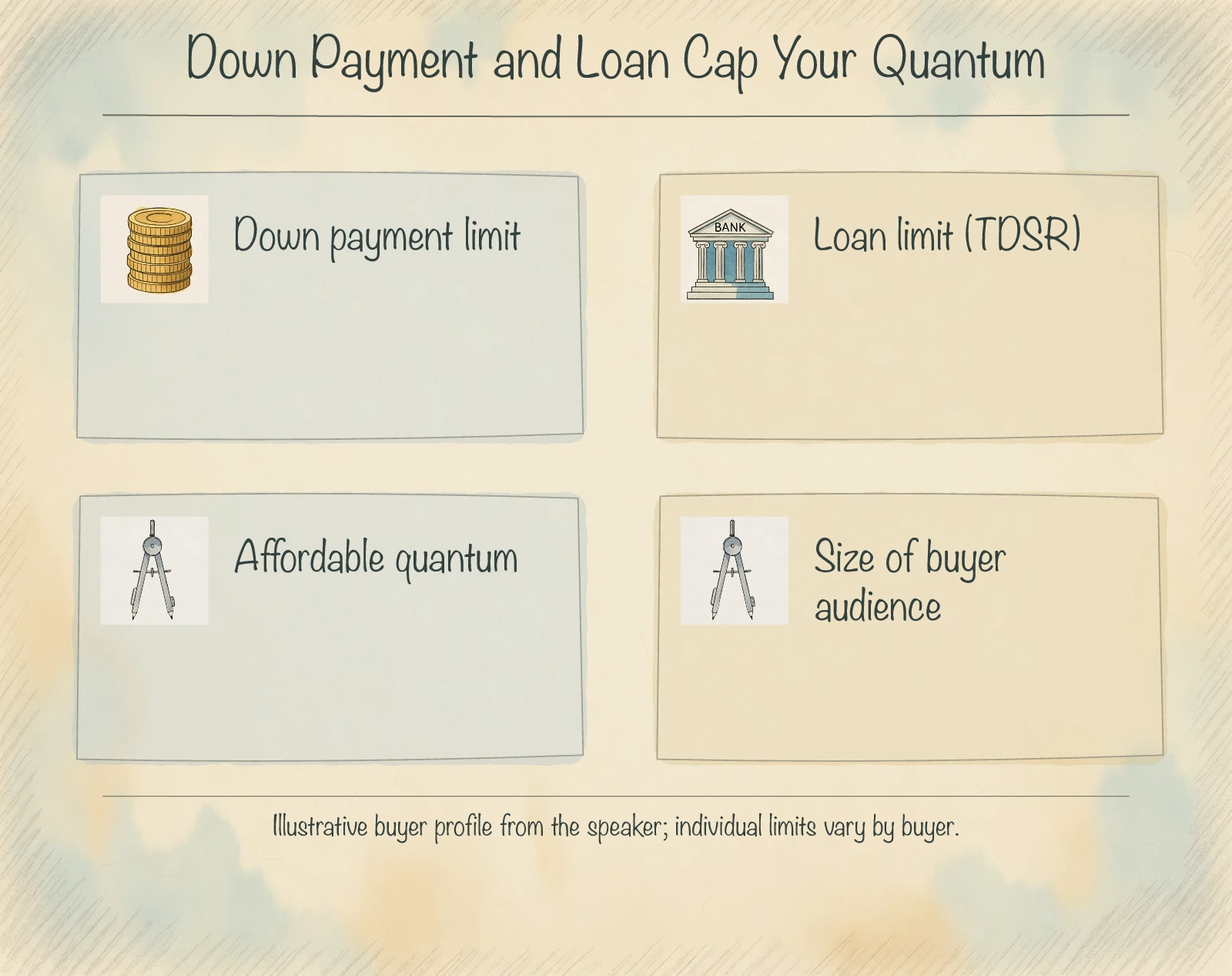
Why? Because the TDSR, based on loan, they can only take up to a loan to support $1.5 million per chase.
They can only get a loan
Buying More Bedrooms Within Budget
of about $1.1 million, $1.2 million. They only have a down payment of, let's say, $400,000 or $450,000.
And because of the limitation of their down payment, limitation of their loan, they can only afford up to 1.5. In fact, they can only afford up to 1.4, 1.3.
And the strategy is to go as many bedder as possible. That means if I get a 3-bedder, I go for 3-bedder.
If I have 1.6 million, I can still go for a 4-bedder. Yes, by all means go for a 4-bedder.
Just follow the quantum based on the exit audience availability. And the strategy is go for at least a 3-bedder, a 4-bedder, because there will always be HDB upgraders that can only have 450K, 500K of down payment in their CPF and cash.
And you want to, let's say, look at this from a perspective that five, 10 years later, yes, even though this property is going to become 35 years old, going to be 40 years old, in about 10 years' time, there will also still be people with 450K to 500K.
And this is actually a good strategy. Let's just hold the thought for a while.
Later, I'm gonna show you some old properties that in the last four years, they still make two to 300,000 because it was about a million dollars for a 3-bedder. Now it's about 1.35.
It was about 950K for 3-bedder in the outskirt in the OCR area. Now it's about 1.2 or a million dollars.
They still make the same two, 300,000. The reason is because they play by quantum and they play by the mass audience.
But of course, maybe in five years' time, this whole thing will be eroded away. We will start to go up to about 2 million.
Now you want to find 3-bedders at 1 million, you cannot find at all. But you can still find that four years ago.
So four years ago, I can still find 1 million dollars for 3-bedders in the year 2021 after COVID. 3-bedders.
But now this is gone already. In about four years' time, this whole thing will be gone as well.
And then we will start to move up. And HDB price has also moved up.
So there are still opportunities at the base. So tip number 2, look for opportunities at the base, and go for the one with the largest quantum for a 3-bedder and a 4-bedder.
Sorry, the largest audience. I'm talking about the largest audience at the lowest quantum.
And of course, there are other mechanics. Look at our example of mode analysis.
We have to see whether there's enough volume. There's facilities, it's near to the MRT station.
We try our best not to go for boutique developments unless you really like the lifestyle of having privacy, very little density. But then we try to cater as much as what will future HDB upgraders want.
So for those of you who have limited quantum, go for the one with the largest audience, lowest quantum, the most bedrooms.
Okay, most bedrooms. Let me just sum it up for you over here.
All right. So number of bedrooms, most beds, lowest quantum, largest audience.
All right, so you can still do that now at $1.5 million because once money supply increases, there's going to be an issue. We're going to move up to the next leg in about four years' time.
I then asked the research team to look at 2027 onwards. So going to be developers that will need to hand over units that they launched previously in the year 2023–2024, which over here, I think they will start to bid for more land in the year 2028.
But these two years, 2026–2027, they will focus to sell because 2024, they have bidded a lot of land. Sorry, 2025 this year, they have bidded quite a fair bit.
2026, they will start to bid more as well. And then they will focus to clear their balance launches in the year of 2026, 2027, they will also focus to sell
so there's going to be a lot of inventory and choices in the new launch market. And I think 2028, once they finish clearing, they will start to bid for more land and then we will enter into the new face.
Now, so I think the new benchmark price that I talked about that will happen in Q3, 2026, it will last all the way until 2028. So that is going to be a norm.
People will start to get used to $3,000 PSF and the impact is like this. I talked about the new pricing, right?
So for example, you look at 3000. Now 3000, if I look at the typical 3-bedder, there's only a few things that can happen.
If I'm a developer, I continue to put it at 900 square feet. Okay.
Or developers usually—lie, it's about 926 square feet. Okay.
3-bed, they call it 3-bed premium. This is going to be $2.8 million.
And if this is going to be starting from, that means it's going to be level 2 or 3-bedder. Okay.
If they're going to launch a
Developer Unit Sizes and Quantum
Three plus study, a thousand square feet, it's going to be $3 million. Now, one strategy that they have is that they have a large or smaller.
If they can make it 800 square feet, it will be 2.4 mil. If they can make it 750 square feet, it can be 2.3 mil.
If they can make it 700 square feet, it can be 2.1 mil. So one way is for them to go small because developers are also sellers.
They will know that when the quantum is too high, the amount of audience will shrink because people are still limited by the amount of down payment and the loan that they can take.
So naturally speaking, I believe the trend from 2026 to 2028 is going to be a very interesting two years that developers are going to challenge the size. And we're also very excited to see how they're going to do it.
All right. What kind of creative solutions?
Perhaps we will no longer see walkway bedrooms. A lot of the units will be dumbbell layouts.
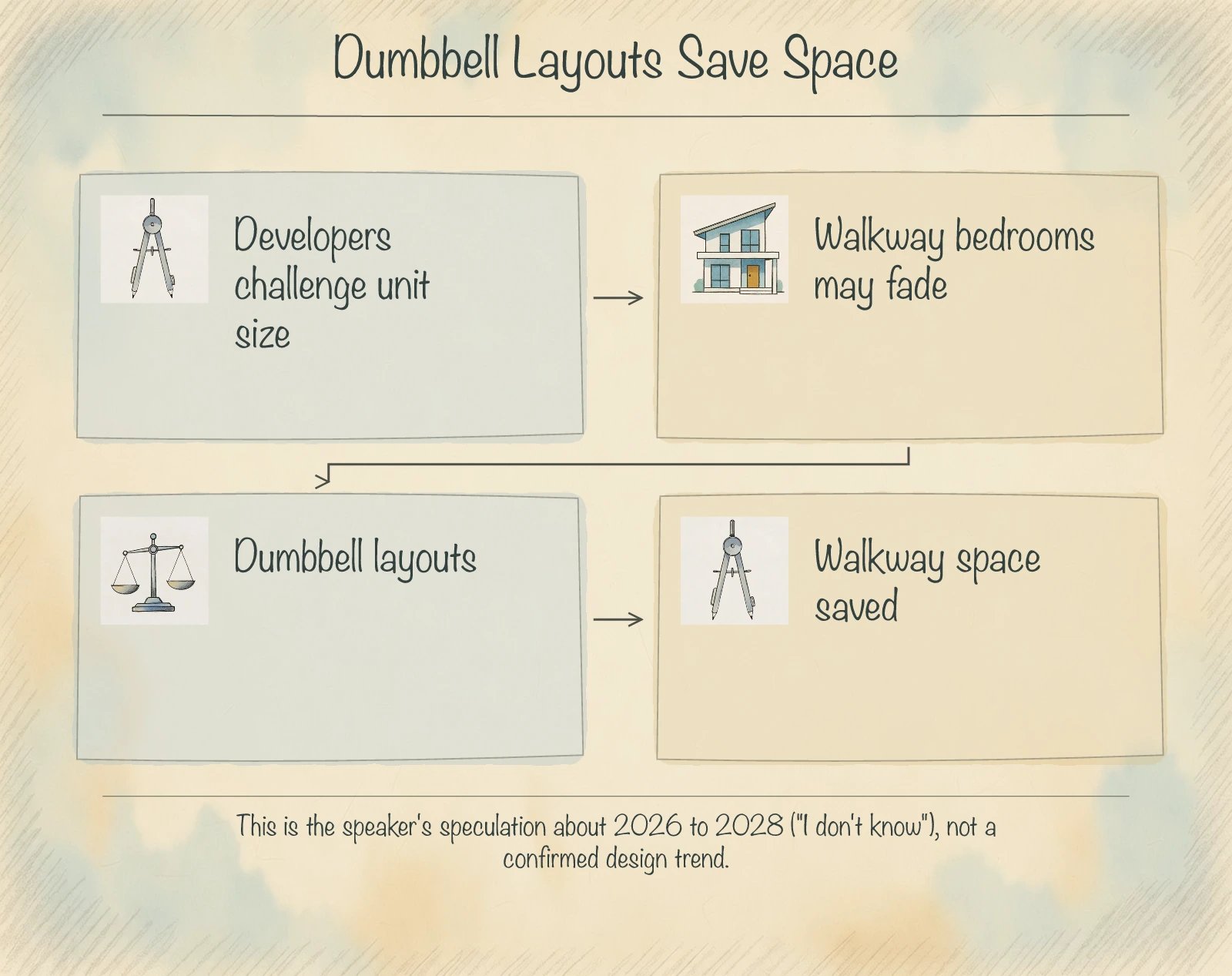
Maybe three bedders will all be dumbbell. All right.
I don't know. Maybe we'll start to see four bedders dumbbell layouts as well.
All right. Because dumbbells, you save some space from walking into the walkway.
Of course, you have to calibrate the whole architecture and everything. Okay, a GFA and all that, but we'll see what happens next.
This is a very, very important news that we have to understand because this is the third Fed rate interest rate cut for 2025. It's the last cut for this year.
They have cut two rounds of interest rate in November. Now they have just cut one more round in December.
So I talked about interest rate three months ago. So if you have not seen my NOTG webinar, I shared with you that if you are refinancing, don't refinance because I forecast that interest rate is going to drop to 1.25%.
That's my own forecast. Now, so next year, maybe there's another one to two rounds, but the important thing is to note this.
They're going to buy $40 billion of T bills. They already started buying at this point you're watching, they are buying already.
Okay. What does this mean?
They don't want to call it QE. This is a stealth QE.
So take note, they're very sensitive of the word money printing. By actual fact, it is money printing.
It is an increase in money supply. Just take note when central banks want to print money, they don't need to print physical paper.
They just need to go to the central bank account and increase the numbers of the currency in the market. That's it.
In the past, there's two key events, a bit of history. 1930s, there was this main thing that happened, that all countries came together and then peg themselves to USD and gold.
All right, so everybody peg themselves to USD and gold. But in 1970s, US announced that they wanted to delink USD from gold.
And that was the whole era of money printing. All right, because now USD being the most dominant currency can print at will and it's going to affect everybody in the world.
So basically, when you look at this, they're going to launch $40 billion of debt buying scheme. This are all news that happened the last week.
And what is the Fed buying? What are bonds?
Alright, so Fed says that you buy treasury bonds, treasury bills, T bills. When Fed buys T bills, read a defined print.
It creates new money. They will use the new money to purchase the bills.
It will inject that cash directly into the banking system. And this money has to go somewhere.
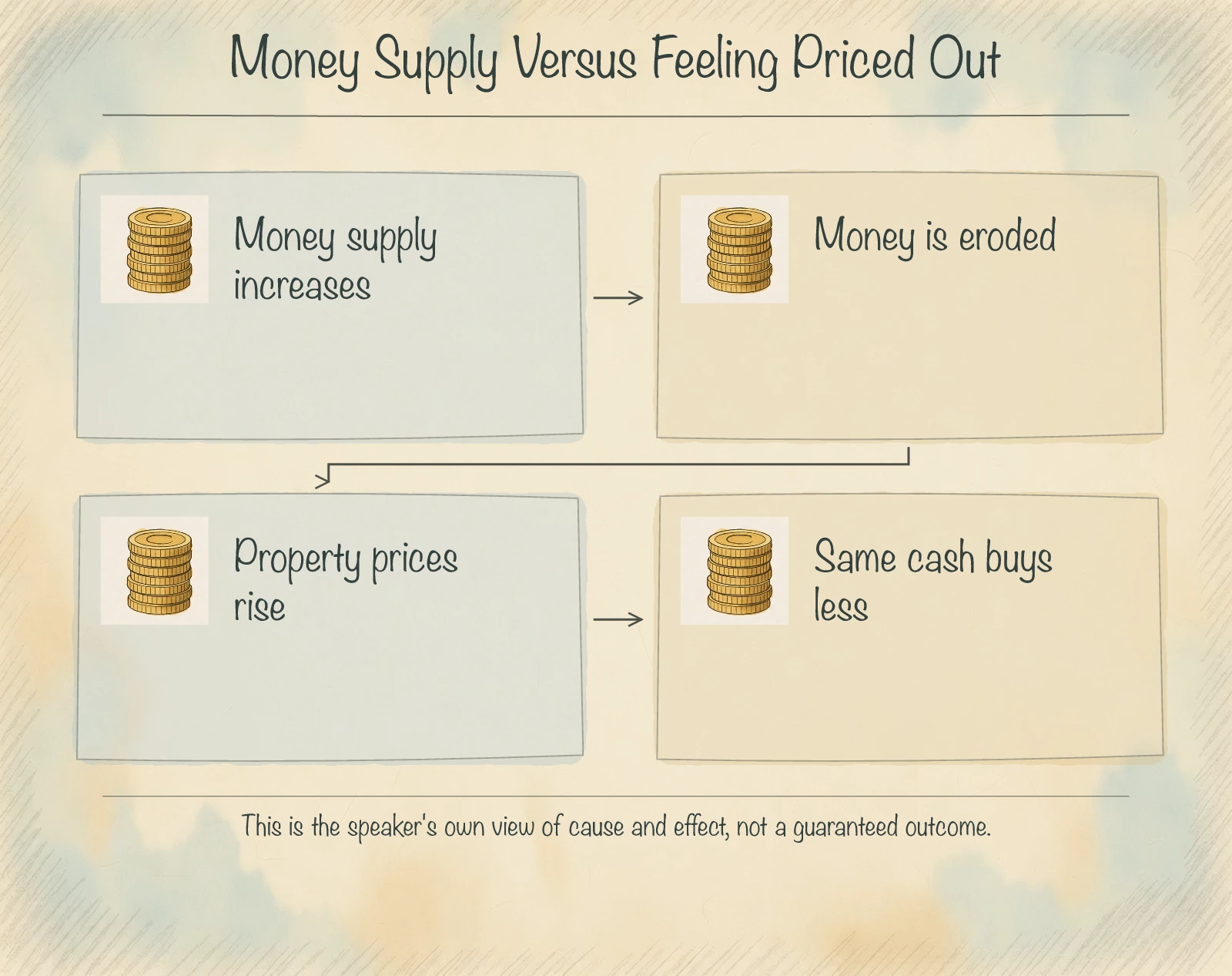
Now when you have, let's say $100,000 in your bank and when money supply increases, your 100,000 would drop in value. So that's why in the inflated economics world, you don't keep cash.
The moment you keep cash, you realize that your cash can buy lesser and lesser things as the year goes by. I give a simple example.
Last time, you want to buy a car. I just talked about a normal car, Japanese car Toyota Altis.
You can walk into the you can walk into and that was just like a short 10 years back. Alright, probably it costs you about $50 over $1,000.
Now you need to pay at least close to $200,000. I don't know how much it's a car.
Toyota Altis cost, maybe $180,000 or $200,000. So imagine you were to keep your 50,000 in the bank.
It could have bought you a car 10 years ago, but now it can buy you nothing. It can only buy one quarter of the car.
So the same theory is this. Previously, if I have 500,000 ready down payment, all right, I can buy a property that is 1.6 million.
And this in the year 2025, $1.6 million is very powerful. Sorry, in the year 2020.
All right, just talk about five years back after COVID. $1.6 million back then can buy me quite a fair bit of things.
All right, it can buy me maybe like a four bedder. But then now, what can it buy me?
2025? You type in 1.6 million dollars on property grow, you have nothing to buy.
It can buy me something maybe in the RCR region. But
Eroding Money and Rising Property Prices
Now I have to go to OCR and maybe I can only get a three- or four-bedder. So you see, the same amount of money is buying me lesser and weaker or further because my money is eroded.
So every time we say a property price increase, actually it is, yes, on the surface property price increase, but underneath is because your money is being eroded by the central bank printing money. So your money is worth lesser and lesser and lesser and lesser as the years go by.
That means if you don't do anything strategically, intentionally, what is going to happen is that you're going to price out. So every time we say price out, price out is because the money supply is increasing.
It is not because the property price is increasing. The property price increase because money supply increase.
That is the main issue. So basically, the Fed is going to inject cash into the financial system.
And of course, we always hear things like this: "I invested in the landed $2.8 million in the year 2020, now it's $4.3 million. The reason is because money supply increase.
I invested in a new launch, made some money, invested in resale, made some money." And of course some people also invested for four years nearly broke even, didn't make any money. All right, some people bought landed also cannot sell, okay.
And how price is going to be like in 2020.