Buying and upgrading
Refinancing in 2025: Strategic Move or Missed Opportunity?
Published 2026-11-16. Adapted from the episode published 2025-12-05. Figures, illustrations and data reflect the episode’s original publication date.

Refinancing, Interest Rates and Progressive Payments
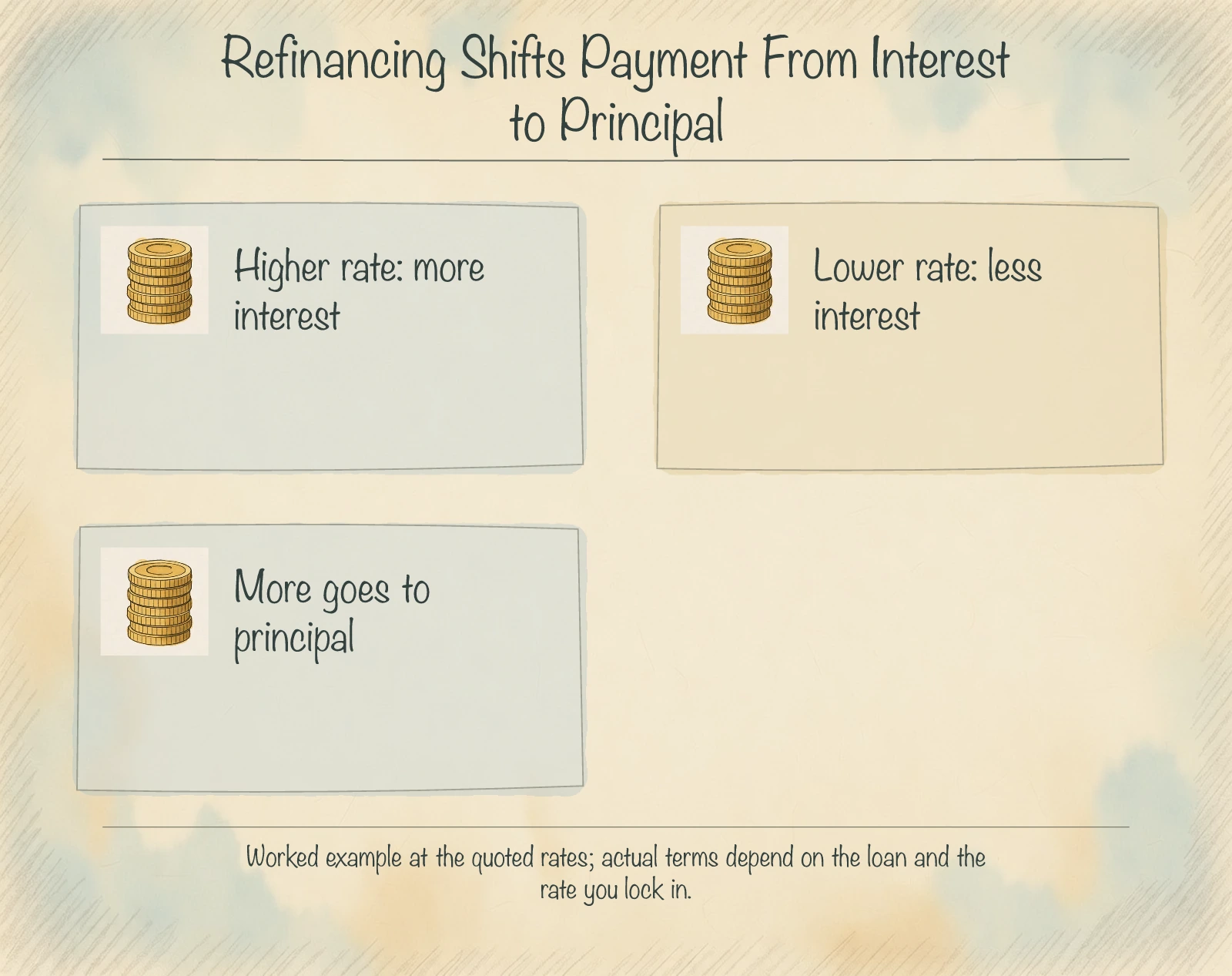
Take advantage of the interest rates. The key fundamental proportion now is that there is a swap in terms of P and I.
For those of you who are looking at new developments, you want to take advantage of two things. A lot of people want to take advantage of basically the progressive payment so that they don't have to manage the tendency.
So as we move into part 2 of this NOTG, let's talk about where we left off. We talked about a few key points; refer back to the first part 1 on our own forecast of the 2026 real estate market.
Today is NOTG part 2.
Now the very first point I want to share is the real estate interest rate for mortgage residential properties. Of course, commercial properties is the same, although the price points in terms of percentage is slightly different between RSI and commercial.
But if you have any property now, you should take advantage and refinance or reprice now. Of course, whether it's fixed or floating, it depends on your own forecast.
My own personal forecast is that it's already low enough to just lock in the rates, 2 to 3 years. My own forecast is that it might drop to 1.25%.
But now it's about 1.45% upon recording in November. So take advantage of the interest rates because just 12 months back, let's say if you were to invest in a $2 million property at 2.5%, 30 years, 75% loan, 1.5 million, your monthly installment is about $5,927.
What is going to happen is that when you look at this $5,927 breakdown, you have to break it down on a month-to-month basis. Out of $5,927, interest you're paying to the bank is $3,125 per month.
Principal, you are paying $2,008 per month to pay down, draw down your mortgage. But the bank is taking $3,125 at 2.5% interest rate.
Now, if you refinance to, let's say 1.5%, the monthly amount drops to $5,177. So $5,177 from $5,927 — the interest portion that you are paying to the bank is $1,875, principal is $3,003.
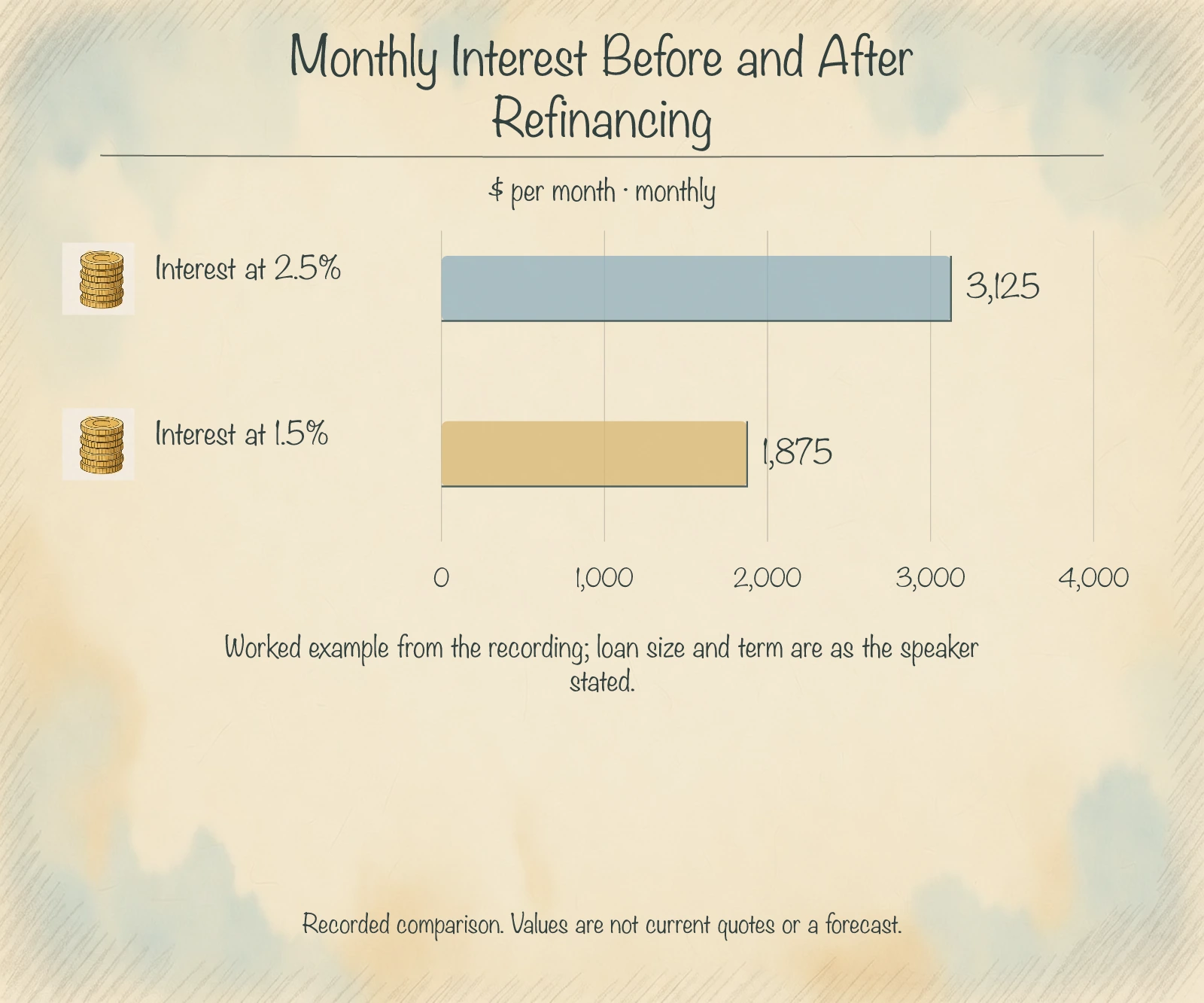
Read chart values
monthly · $ per month
| Comparison | $ per month |
|---|---|
| Interest at 2.5% | 3,125 |
| Interest at 1.5% | 1,875 |
Now, when you look at this, actually there's deeper mechanics. From $5,900 to $5,100, even though it's like an $800 drop, you're saving about $1,300 per month in terms of interest saving, because the key fundamental proportion now is that there's a swap in terms of P and I — you are actually paying down more loan faster.
All right, so you're depositing more into the principal portion, you're paying lesser interest, so you're putting more bang for your buck into the principal portion. At 3.3 [1.875], interest has dropped to 1.875.
So you should definitely take advantage of the interest rate drop.
Let's talk a little bit about the set and forget principal investment rule. So for those of you who are now experiencing like volatility in the stock market and all that, of course, we talk a lot about diversified portfolio.
You shouldn't, of course, put everything in real estate, but of course, this is if you just want to focus on a professional — what your business is — you want to use real estate as a form of a very fixed, disciplined kind of investment.
This reduces temptation to touch the investment. So the first seller's time duty — another way to look at it is that for those of you who are looking at new developments, you want to take advantage of two things.
One is that you're getting a bonus buyer audience, because there's a group of buyer audiences that only want to buy properties that are brand new, and they want to buy from people who just collected the keys because it's still defect warranty period, and they don't want to wait for the new launch construction period.
And they also don't want to buy properties that people stayed in before. So these are the bonus group that you will have if you invest in a new project.
And just to share some of the reasons why people love new developments — and of course, we have a full-blown debate between new launch and resale.
It's a one-hour debate that I did against myself.
A lot of people want to take advantage of basically the progressive payment so that they don't have to manage the tendency, and they want to just progressively pay until TOP, and upon TOP they're still not paying the full installment, because the full installment is supposed to be $5,699 upon statutory completion which happens 6 to 12 months after TOP.
But they want to take advantage of this because at TOP they can collect the keys, they can rent out, they can sell. So this is the fundamental mindset of the set and forget principle.
And of course, when we look at this in terms of resale versus new launch, the amount of interest paid for a new launch investment is slightly lesser than a resale in terms of interest portion. So some people, they like this approach because the loan is not fully disbursed.
They pay a small amount of interest based on the progressive payment and the loan that's being disbursed by the bank. So end of the day, the interest portion is a little bit different.
Rental Properties and the Tenant as Third Investor
...by the bank. So end of the day, the interest portion is a little bit different, but of course the disadvantage is that you cannot rent out the property because if you rent out the property and if this is a rental investment property, it's not your own stay property.
If you rent out a property, there is a third component that will actually pay down your loan faster, which is the component that is paid by the tenant. And we're going to visit that thing here, because if you invest in a resale property, the plus side is that you have this third investor called the tenant.
So there are always three investors in a property investment. The first investor is yourself.
The second investor is the bank. Third investor is the tenant.
All right? How does this work?
So this is basically the fundamental rights to each investor. You yourself as the main investor, you have the rights to the full profit and loss.
And because you have the full rights to the profit, if there's a profit, you have the full responsibility if it's lost, then basically you as the ownership rights, you need to take care of the property tax, MCST, and maintenance of the property.
That's only fair.
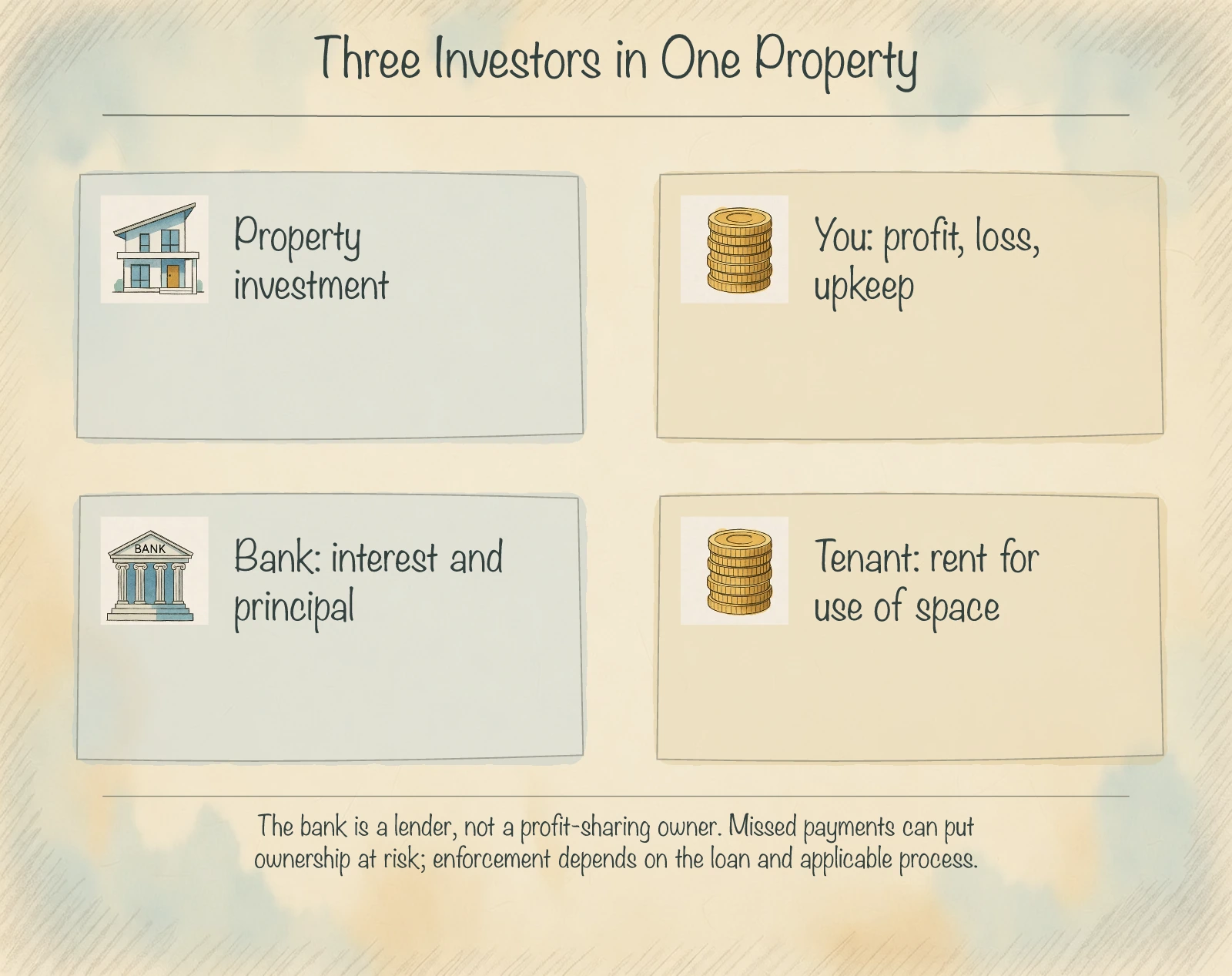
The bank loans you 75%. In fact, the bank is a bigger shareholder than you, and all they want is the bank interest, or they will take back the property if you cannot pay the money in store for three months.
But they have no rights to your profit. They will have rights to your property if you cannot pay the money in store, but they have no rights to your profit.
If you fulfil your responsibility and are covenant with them, then you pay the bank interest and the principal on a monthly basis.
Tenant, because the tenant has the rights to use your space if you sign the tenancy agreement, they pay you a rent. All right, so these three are the three investors.
Let's have a look at this investment property: 2.35 million, 6,200 dollars.
Example I'll take part as an example: 2.35, 6,200 as the final figure. All right.
And let's say you would invest in a 2.35 just to illustrate what does this three investor do in this relationship. All right, so 2.35.
This is a very important example because sometimes once we know the numbers we become very intentional and know what we're going in for and what's the key beauty of a real estate investment, right? 2.35, 1.5%, 25 years.
Loan amount is 1.762. Money is 7,049 dollars.
And behind the scenes what happened is that your stamp duty is 87,000. All right.
And then your deployment is basically $587,000. So all in, you have to put $587,000 and $87,000 into a buyer's stamp duty.
So what's going to happen is that this is a four-year investment projection. After four years, based on this, money is almost $7,049.
Interest is $2,002. Principal is $4,008 at the start.
But you'll realize that after the four years or the 48-month, interest drops, principal increases, provided interest rates are the same.
The reason is because there's a front-load period by the banks. The first two years usually they want to claw back more interest.
The balance loan will be 1.757. It will drop to 1.522 after 48 months.
So how does the figure look like? Your total investment will be $677,000 because I factor in 25% down payment which is 5% cash, 20% CPF, legal fees plus the 87,000 buyer stamp duty, total capital to deploy 677,600.
So how do the numbers look like? You as an investor, you put in 677,600, 2.35 million dollar asset target.
Your second investor, I call it the first core investor, which is the bank, put in 1.7625. And you need to make sure you pay them interest.
Third investor will pay you $6,200 a month. And the fulfilment to the bank is that I must pay the monthly $7,100, out of which $4,800 is principal back to me if I sell the property.
$2,300 is for the bank, which is a second investor. So now the relationship is clear.
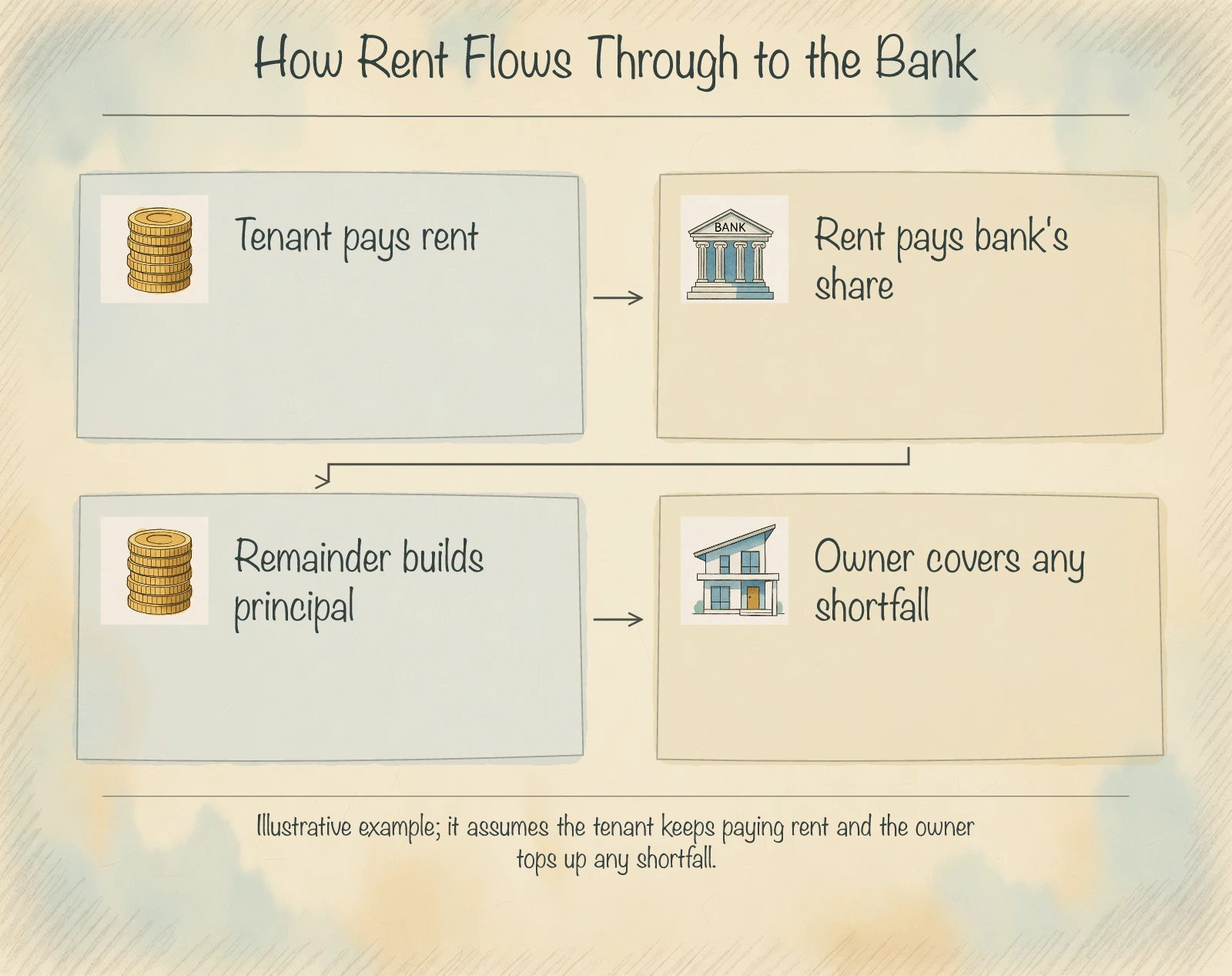
Let's have a look at how the numbers flow. So my tenant is going to pay $6,200 to me every month, out of which I will use 2,003 here to pay my second investor because my second investor requires 2,003.
So I'll take the tenant's money to pay to the bank. So technically my third investor is paying the second investor.
They self-sustain by itself. Balance 2,009 will be towards my principal payment, but think that there's a short: 4.4 minus 3.9 is 900.
I have to put in 900 per month.
But this is magical relationship that a lot of people don't understand, is that I put in $900 a month, I get back $4,800 in total principal, because my $900 is $3,000... because there's a relationship happening here.
I put in $900, the tenant put in $3,900. This whole thing will be unlocked when I sell the property, but just by this relationship itself is already 433% per month.
That's the beauty of every rental property investment, is that you put in a small amount of principal, you earn back a bigger amount of principal.
Return on Capital and Closing Framework
A bigger amount of principal. The return on capital is no small figure, because in the event if you were to invest in the correct property and it appreciates by 400,000 in 4 years — I'm not saying that you will definitely happen.
Some properties don't do that.
But if your property appreciates by 400,000 in 4 years' time, you extract 1.227 after clearing your outstanding loan, you sell 2.75, 1.5 minus 1.5, 2, 3, you extract this amount, your exit fees, your closing costs to your brokerage, whatever agent that you appoint to sell your property, your net, and then your initial investment 677, you take 1.167 minus 677, your net gain is 490.
You take 490 over your initial investment, the return over 4 is 72%, per year is 18% gross return. Basically, if I were to minus off the amount that I deployed in myself, my net gain is still about 17%.
Alright, so this is behind the scenes what happened, because there's another component that's the true benefit. Number one is if the market does me right, or invest in the right property with correct demand and supply, it appreciates.
My tenant is also building my wealth because I let the tenant use the utility of the space, the tenant pays the rental. The tenant is deploying 3,009 principal into my property for the last 48 months, about $187,200.
I deploy $900 per month and I have $3,200. The tenant pays to the bank.
So it's an automated beautiful relationship, which is why I can see a net gain of $490 using the deployment of my 677K. And in totality, this whole thing will be released to me — once I released this 1.167, I started off with 677, now it becomes 1.167, I then redeploy this entire thing for a bigger property.
Alright, that's how people grow their wealth in real estate investment.
Now, with that, of course, we come to the end of part two, and these are just some key frameworks as well as forecasts for the next season, and once we get a sense of all these numbers, it'll be easier for us to make a decision, and of course, I'll see you on the next NLTG episode.
Me time to take care.
For the very first time, I've never run meant to be—