Buying and upgrading
What the 2023 Property Market Taught Me About Holding Power
Published 2026-11-08. Adapted from the episode published 2025-04-11.

On this page
- Three themes in the recorded discussion
- Should You Time the Property Market
- Our approach to property decisions
- Volume Dips While Prices Still Rise
- Interest rates and the local property market
- Real Estate and Inflation
- Would Owners Fire-Sell in a Recession
- Ownership, entry costs and holding power
- Rental movements in the recorded period
- Low Unsold Stock and the TDSR Changes
- Comparing smaller and larger homes
- A Family Torn Between Their Properties
- Restructuring Into Landed and Rental
- What the Portfolio Switch Gained
- Upcoming TOPs, Rentals and Owner Liquidity
- Bigger Quantum and Pricing Disparity
Three themes in the recorded discussion
Melvin opens by naming three topics. First, whether a shift may be coming in the Singapore real estate market.
Second, the recession risk in the United States and whether it could also reach Singapore. Third, what the recent run of US interest rate hikes, together with Singapore mortgage rates, has done to local property prices.
He also asks whether these conditions create opportunities for real estate investors. He adds a disclaimer: real estate is a major decision for a family and its financial portfolio, so readers should seek advice from their own brokers, consultants and bankers.
The series is for educational purposes and should be weighed alongside other investing factors.
Melvin lists the news themes that people have been following. They include rising mortgage rates in Singapore, China's reopening and what it may mean for the global economy, the return of travel, and ongoing concerns about inflation and recession.
He notes that Singapore private property prices held up even in a year he describes as turbulent.
Melvin calls the previous year a "Black Swan" year. He cites the war in Ukraine, the crash in cryptocurrency, the sell-off in US stocks, and central banks around the world moving into quantitative tightening.
Against that backdrop, he asks where the demand for Singapore property is coming from and why buyers are still crowding show flats.
Melvin says US interest rates are at a high, and that many people are talking about a possible "Fed pivot". He asks what this means for a Singapore buyer, seller or investor, and why he is bringing in the US stock market at all.
He says he will connect the two later in the session.
Should You Time the Property Market
Melvin addresses two groups: investors who are invested in equities and also waiting on the sidelines, and people who sold Singapore property in 2021 or 2022. Some of them are fearful and wonder whether 2023 is the right time to buy back in, or whether to wait for 2024.
They are watching recession risk and interest rate movements, hoping prices will fall so they can re-enter at a better price. He raises the related question of whether US mortgage rates will come down.
Melvin says every property buyer hopes to time the market, because buying low and selling high gives a better return. The question for this session is whether the market-timing techniques many people use in the stock market can also be applied to Singapore real estate.
Our approach to property decisions
Melvin says it matters to understand what may happen over the next 12 to 24 months. It bears on an investor's existing portfolio and on whether to time the market, wait and watch, or act, and he frames that as the right move for one's family.
Melvin adds that this is also important for people who already own one, two or three properties, because better knowledge and analysis lead to better decisions. He plans to cover macro shifts first, then micro shifts, and to close with the types of property to look out for in 2023.
In his view, the type of property chosen affects the appreciation an investor can expect over the next few years. He notes that everyone who invests in property wants appreciation.
For Melvin, appreciation is a key objective of investing in an asset. Many investors also want steady rental growth, treating a property like a dividend stock, and he says he will touch on that approach as well.
Melvin presents a chart of resale non-landed private home prices per square foot, quarter by quarter. He points to a slight dip in transaction volume and suggests comparing the whole of 2022 with 2021.
He then asks why prices still rose even as volume dipped. Here, non-landed means condos and apartments, with landed homes excluded.
In Melvin's view, buyers became fearful as interest rates rose, which is why volume and pricing need to be read together. A second chart shows new launch prices also rising while new launch volume dipped.
Volume Dips While Prices Still Rise
Melvin explains that new launch volume differs from resale volume. It depends on how much stock developers have left to sell and how many new projects they are developing.
If their land banks run low, there is naturally less volume in the market. He says that even though volume dipped, prices kept rising, and he wants to understand why.
Another chart compares the S&P 500 with the HDB, private non-landed and landed markets. Melvin asks why all three kinds of residential property rose in price while the S&P 500 fell, and says this is the question he wants to discuss.
Melvin then shows a chart of US interest rates against Singapore mortgage rates. In his view, Singapore rates are "sticky" and follow the US Fed rate very closely.
So if US rates start to fall, he expects Singapore mortgage rates to follow.
Melvin asks what would happen to Singapore mortgage rates if the Fed's terminal rate comes down. He notes that the news from the US is conflicting.
Some people say the US is already in recession. Others point out that a recession needs two quarters of negative growth, so technically it is not there yet but may be heading that way.
Some expect a prolonged recession and others a shallow one. He says this is confusing for Singapore investors, because the US dollar is the dominant world currency and US movements correlate with Singapore interest rates.
Melvin points to a news statement that inflation is likely to pick up again in response to government stimulus. He describes such stimulus as quantitative easing, which he characterizes as putting more money into the money supply, and he says the Fed would have to lower rates to do it.
He argues that this would echo the earlier flood of liquidity, which he believes pushed up asset prices around the world, including Singapore property. He asks what would happen to Singapore property prices if something similar happened in 2024, and whether buyers are prepared for another stimulus-driven move.
Interest rates and the local property market
Melvin notes that some US analysts expect stocks to rebound while others predict a recession. He explains a Fed pivot as the Fed stopping its rate hikes and possibly adjusting rates downward.
He asks what that would do to the stock market and then to Singapore property prices. He says past behaviour may offer hints for preparing over the next 12 to 24 months.
He frames the core question with three choices: over that period, prices may move up, stay stagnant or go down.
Melvin observes that Singapore property prices rose in both 2021 and 2022, while US stocks rose earlier and then fell over the past year. He asks what happens if US stocks recover: will property prices rise together with them, rise further and faster, or come down?
He says the answer would help buyers decide whether to buy more now or wait for a price adjustment, since everyone wants to buy at a reasonable price.
Melvin stresses that stocks and real estate are two different asset classes that behave very differently. In his view, the stock market is more liquid and more volatile, which leaves more room to time it.
He invests in both, keeping a smaller allocation in stocks and the majority in real estate, which is more illiquid. He explains that illiquid means it takes time to enter and to exit, and that transaction costs are higher.
Melvin says buying a property is easy: a buyer can walk into a show flat, put down a payment and buy immediately. Exiting takes longer, because the property has to be prepared, marketed and sold, and buying and selling both carry transaction costs, including marketing costs.
Stock investing is more liquid, with lower transaction costs, and an investor can enter and exit on the same day. His view is that liquid assets lend themselves to timing, while for illiquid assets like real estate, trying to time the market may not be the best decision.
As a second foundation for the session, Melvin introduces the idea that real estate "eats inflation for breakfast".
Real Estate and Inflation
Melvin observes that many wealthy people hold real estate for the long term and treat it as a store of value rather than something to sell. They let inflation lift the price of the asset over time.
He adds that real estate investors tend to use leverage sensibly. In his view a mortgage is a good form of debt, because inflation erodes it through the years.
Inflation therefore lifts the asset's value while shrinking the real weight of the debt. From this, Melvin argues that Singapore real estate is no longer a speculative market and now works more as a store of value.
Melvin then sets out the structure of the session: the macro picture, the micro picture, and how to select property types. His main macro point is that investors should not use a stock-market-timing strategy on Singapore real estate.
The first micro factor he raises is the mindset and holding power of current owners and investors. This bears on whether recession risk or interest-rate risk should make a buyer wait and try to time the market.
To test this, Melvin says one has to ask whether higher interest rates have changed the behavior of existing owners. These include families with a single home, owners who have rented out additional properties for years, and recent buyers of a second property who plan to rent it out.
Melvin explains that rising mortgage rates normally push property prices down. Monthly installments grow, buying power shrinks, demand dips, and prices follow.
He says this is happening in some US states, though not all. He argues Singapore behaves differently from this usual pattern, and he points to the holding power of existing owners as a key reason.
Would Owners Fire-Sell in a Recession
Melvin uses a deliberately fictional, light-hearted example. Suppose a property owner opens the news tomorrow and learns that rates have dropped sharply.
He says the natural reaction is to raise the asking price, because buyers are expected to flock back to the market with more purchasing power. A buyer waiting on the sidelines would want to enter the market, because monthly installments would fall.
A developer would raise launch prices, since a developer is also a seller.
Melvin then reverses the scenario to the actual high-rate environment and asks whether anyone is fire-selling. He considers a recent own-stay buyer who locked in a lower fixed rate, paid a substantial down payment, and has children enjoying the home.
In his view, that owner has no reason to sell in a hurry. The same goes for someone who bought a second property for rental investment last year.
That owner put in a large share of their own capital and borrowed relatively little, so higher rates do not force a sale.
Melvin also describes owners who stay in one property and rent out another. Even if one person lost a job in a recession, he thinks they would keep holding.
His reasoning is that people tend to divest liquid assets before illiquid ones.
Ownership, entry costs and holding power
Melvin says foreign investor clients have told him they plan to keep holding. Some would keep renting out what they own, and some would keep buying.
They would not sell, because they do not want to buy back under the current, stricter additional-buyer's-stamp-duty regime. Many clients bought under earlier, lower rates and are content to keep collecting rent.
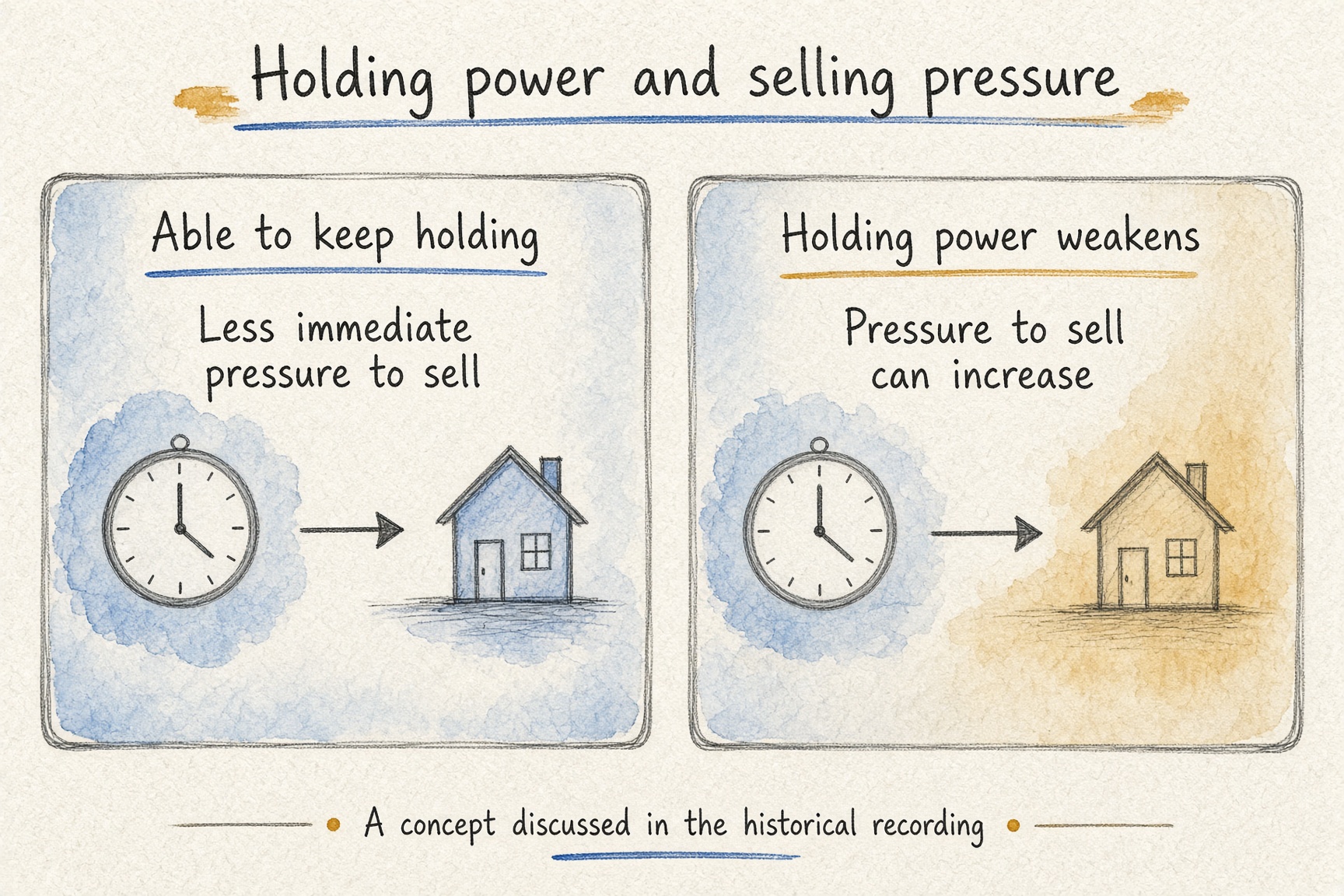
This leads him to holding power: in his view, fire sales happen only when holding power drops.
Melvin argues there is currently no fire-sale pressure in Singapore residential property. He credits cooling measures, including the minimum holding period imposed by the seller's stamp duty, with strengthening owners' holding power and lengthening the time they hold.
Melvin says many people assume Singapore needs foreign money to support prices. He argues that the share of foreign buyers has fallen, and the largest group of buyers is now Singaporeans and PRs.
In his view the market no longer needs foreign buyers to support price appreciation and transaction volume, which he says move together. He adds that prices kept rising even after additional-buyer's-stamp-duty increases, because local buyers make up the main bulk of demand.
Foreign owners who already hold property are not selling either.
Melvin also notes that only part of the residential stock is open to foreign buyers. Because existing foreign and PR owners are holding on and renting out, he argues the stock circulating in the market depends mostly on Singaporeans who want to switch properties.
He considers this important for understanding existing owners' holding power.
Rental movements in the recorded period
Melvin points to a sharp rise in rents over the past year. He gives a four-bedroom unit in a central-region project as an example, saying that owners there kept asking for more as rents rose.
He says the surge is not limited to the core central areas. It also shows up in the rest-of-central and outside-central regions, with smaller units now renting at levels once seen only in the core central market.
Melvin then returns to the macro question he opened with: what would happen to property prices if the US Fed pivoted and Singapore mortgage rates began to dip. He moves on from holding power to how policy over the past decade has shaped the behavior of owners and buyers, and then to which type of property to select.
Melvin states the investing fundamental simply: buy the asset type with the most restricted supply and the highest demand. When many people chase few goods, prices tend to rise, which he describes as Economics 101.
Melvin notes that the government has introduced many rounds of cooling measures over the years, yet prices have still risen. To make sense of this, he says one must ask whether Singapore has an oversupply problem, because the answer helps settle the supply and demand picture.
Low Unsold Stock and the TDSR Changes
Melvin says the government is monitoring demand and supply closely. In his telling, developers had depleted their land banks after many launches and were bidding for land aggressively.
The government then released more land to meet demand, because otherwise the market could heat up further. He also mentions what he calls the "I only have one property syndrome" and says he will tie it together with the supply and demand discussion in the summary.
Melvin then turns to what he calls the combined TDSR effect. Before the total debt servicing ratio was introduced, he says, the common strategy was simply to buy more properties.
Since then, he sees upgraders shifting from HDB to private homes, and from private to more expensive private homes. He says this is partly because one buyer's name is increasingly insufficient to afford a higher-priced property under the combined TDSR limits.
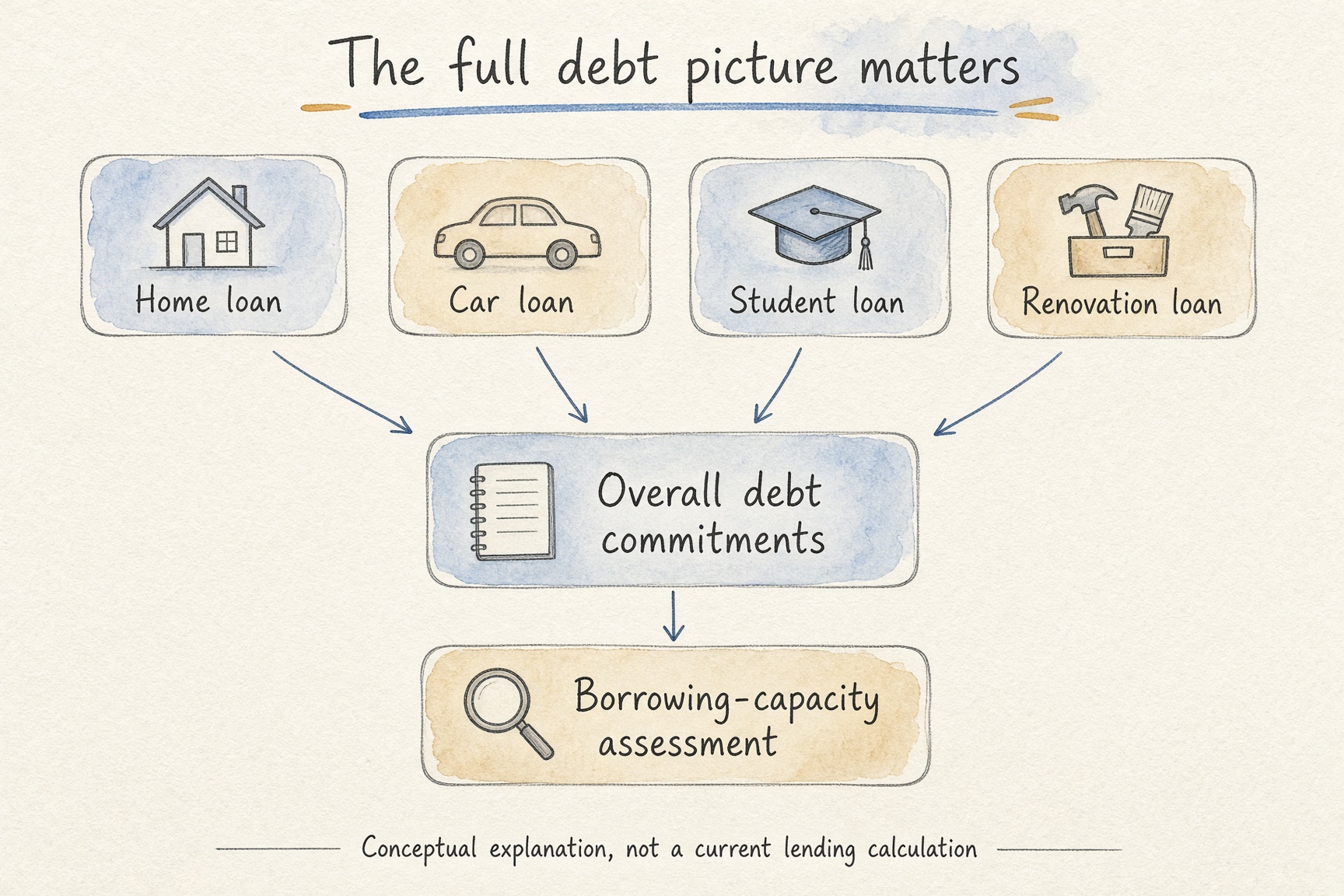
Melvin calls TDSR a structural cooling measure, meaning the government is unlikely to remove it. He considers it healthy because it promotes financial prudence and takes into account existing obligations such as car loans, student loans, and renovation loans.
In his view, this lengthens the longevity of real estate pricing and removes speculation from the market. He notes that later tightenings reduced the share of income lenders count and cut borrowing capacity further.
Comparing smaller and larger homes
Melvin observes that buyers who want a bigger quantum property now often choose one larger property over decoupling into two small ones, because in his view smaller properties have underperformed larger ones in quantum appreciation. He links part of this to TDSR.
In his view, developers began building smaller unit layouts so that the total price of each unit would stay palatable for the average buyer.
The arithmetic behind the comparison is simple. If a project's average appreciation is, say, $200 per square foot across both small and large units, a bigger unit will naturally see a bigger quantum gain because it has more square footage.
Melvin says many owners who held small properties for years have found that they behave a bit like dividend stocks. They are easy to rent out, rental collection is steady and vacancy between tenants is low, which makes them fantastic for rental.
But their quantum appreciation is low.
Melvin adds that a modest gain can disappear once costs are counted. As an illustration, if a small unit gained $100,000 over several years, the owner would still need to deduct bank interest, buyer's stamp duty and selling fees, and might see little real gain.
He says this is one reason investors are switching to bigger properties.
To illustrate the difference, he compares a 2,174 sq ft three-bedroom penthouse with a roughly 1,000 sq ft three-bedroom in the same project. If both rise by the same amount per square foot, the larger unit's quantum gain is much bigger and arrives faster.
A Family Torn Between Their Properties
Melvin describes a couple, both 45 and working, with three children studying. They live in an HDB flat that has been their matrimonial home since the beginning.
They bought a one-bedroom unit of 452 sq ft in an OCR district in 2014. In 2016 they bought a one-plus-study for $800,000, which Melvin says has appreciated by about $150,000.
Melvin says the small 452 sq ft unit has appreciated only modestly. Both investment units are held for rental.
Both rented units largely pay for themselves. The first produces some positive cash flow to cover the management corporation (MCST) fees, and the rental from the second covers its mortgage and a little of the MCST fees.
The couple plan to keep living in the HDB flat and pay off all three properties by 65, which Melvin says would give them roughly $3 million in assets.
Even so, they feel torn. In Melvin's account, they told him they felt like property managers for their two tenants.
They said they own two condos but do not get to enjoy them, and they wondered whether their investments could also benefit the family. Their hope is to move to a bigger home, such as a penthouse with more rooms or a landed home.
Melvin asked what they would do at 65, once all three properties are paid off and the children have moved out. They had no firm answer.
They guessed they might sell everything and buy a condo to live in. Melvin's concern is that the cost of a replacement home could take up a large share of the sale proceeds and leave limited funds for a long retirement.
It would also not meet their wish to enjoy their assets as a family during the next 20 years.
Restructuring Into Landed and Rental
Melvin says the couple joined the wave of buying but did not structure their strategy properly. His advice is to plan now, with proper leveraging and reallocation of funds.
That could mean divesting the three properties and shifting into fewer, larger assets that he believes have lower supply and higher demand, such as a penthouse for own stay plus one investment property, or landed property.
Melvin argues that even consolidating into a single larger asset, such as a landed home, would give a better chance of appreciation over the next 20 years than holding two small properties and an HDB flat. The figures he sketched for these scenarios were unclear, so they are not reproduced here.
His point is to move capital into an asset he expects to perform better, one with less abundant supply and more demand.
Melvin then introduces a client, Daniel, and his family, who moved with real estate trends over the years. According to Melvin, the family stayed in step with his portfolio restructuring advice.
He says such planning should also reflect financial prudence, including TDSR, current savings and the family's stage of life, so that the right option can be identified.
Melvin says he does not always recommend action. When a family's current portfolio is good, he tells them to keep it as it is, rather than change for the sake of changing.
When capital locked in their assets could perform better, he recommends alternatives. For Daniel's family, he moved them from their first property to a penthouse for their own stay and a condo for rental investment.
In 2015 he advised them to keep the condo untouched because it was performing well as a rental. In 2020 he advised them to restructure into a landed home.
What the Portfolio Switch Gained
Melvin says he advised Daniel's family not to touch the investment condo, and it has also appreciated. By contrast, he says their penthouse did not appreciate much, from about $1.6 million in 2015 to about $1.8 million at the time of the talk.
They bought the landed home for $2.55 million in 2020. According to Melvin, a neighbouring unit a few doors down transacted at $3.46 million about 12 months earlier, and his latest 2023 valuation check put the home at about $3.8 million.
He presents this as an example of how knowing where the market is moving can improve a portfolio.
Melvin's broader view is that doing something with a portfolio is healthier than doing nothing. Busy professionals and business owners often do not take time to sit down and think through their property journey.
He notes that the investing journey is limited, running from the day one starts working to roughly age 65, and he believes mistiming the market can work against investors.
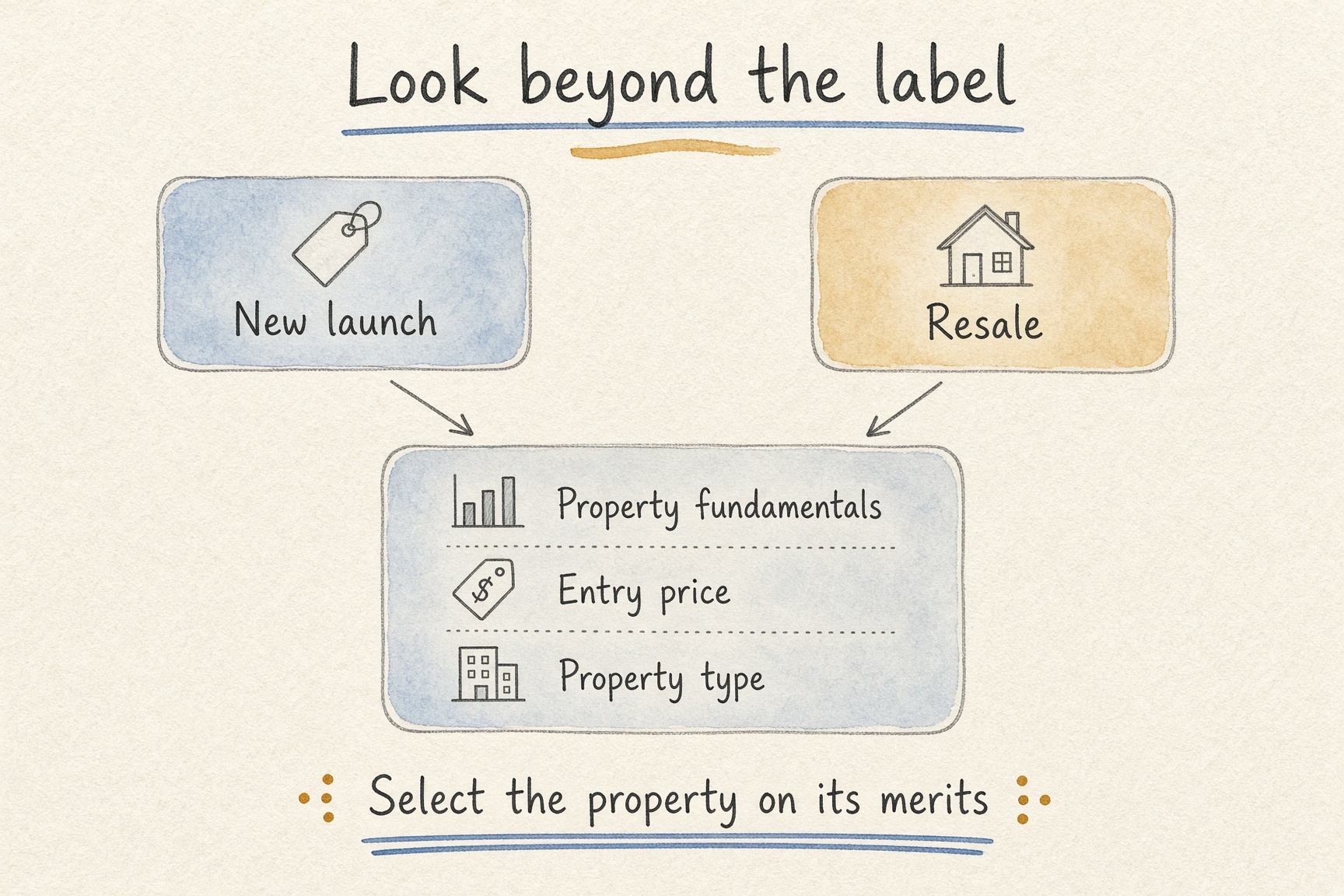
On what to buy, Melvin says the question is not new launch versus resale. What matters is choosing the right property with sound fundamentals and the correct entry price.
He calls the advice to buy now and buy only new launches one-sided. He says he personally owns both new launch and resale properties and is not against either.
Some new launches will appreciate and others will stagnate, and the same is true of resale properties.
Upcoming TOPs, Rentals and Owner Liquidity
Melvin expects that more completed projects reaching TOP (temporary occupation permit) may soften rental rates a little, since more new units become available. He also expects some owners of recently completed projects to ask for prices well above what they paid years earlier, which he sees as part of a new pricing trend.
Melvin sees a gap between new launch and resale prices per square foot across market segments. His forecast for 2023 was that buyers would start snapping up lower-quantum three- and four-bedroom resale properties in the OCR, especially those under $2 million.
For anyone hunting in that segment, he cautions that such units may be taken up quickly.
Melvin urges investors to avoid trying to time the market. In his illustration, the older a buyer is when entering the market, the more the loan tenure shrinks, which changes the monthly repayment drastically even at the same purchase price.
He argues that the question should be what to invest in rather than when. In his view, staying in the market means not being priced out when it moves.
To sum up, Melvin says buyers now prefer bigger quantum properties because he believes they perform better. Anyone holding small properties may therefore need to make some adjustments to their portfolio.
Bigger Quantum and Pricing Disparity
Melvin suggests that owners pause and strategize. In his view, bigger properties and landed properties appreciate faster because of their larger square footage.
He then turns to the last element of the new pricing movement: a disparity in the market this year. He says a few things might happen.
Low-quantum resale homes might be snapped up quickly, and developers are pricing in a new PSF range that buyers will have to get used to. He also advises against trying to time the market, because "you're playing with time, playing with fire." Instead, he suggests identifying which type of property suits each season.
Melvin says his approach to selling is to market a property with intent, so that its potential is brought out fully. He does not believe in a passive, hasty approach.
In his view, an owner typically has one chance to exit, and that exit should do justice to the property by selling it at its best potential to a buyer who appreciates it, so the owner can move on to the next investment.
This is why he believes in selling properties as a team.
Melvin describes how this works in practice. When a seller comes on board, team members from customer experience, listings, inside sales and media production, along with a team lead, join together to guide the client through the process.
He argues that a strong sale price needs analysis and numbers inside the home tour. A tour that covers only the interior is what he calls a renovation home tour.
He therefore stresses investment analysis, location analysis and pricing disparity, backed by a strong marketing campaign built on digital and content marketing.
Melvin also says a home tour should show the possibilities of the home, including ways to solve layout issues. He adds that a home should not be shown empty, because physical experience and emotion still matter, as many buyers are buying for their own stay.
For clients who are exiting and investing, or buyers who are purely investing, he describes doing a comprehensive investment analysis so that the numbers and factors support a decisive choice. For landed properties, he says the type recommended to each family changes from season to season, depending on the family's current investment horizon.