Landed property
Priced Out of D15? Why D14 Is The Next Landed Hotspot
Published 2026-11-24. Adapted from the episode published 2025-10-23. Figures, illustrations and data reflect the episode’s original publication date.
On this page
- Landed Clinic Welcome, D14 and Entry Budgets
- Freehold Landed Priority and Rate Hike Cycle
- Return to Sellers' Market and D14 Listings
- Avoiding Corner Terraces and Condo Price Pressure
- Landed Counts by District and Home Categories
- Landed Categories and Big Brother Catch-Up
- Inherent Plot Characteristics and Asset Income Framework
- Equity Triangle Portfolio and Case Study Handover
Landed Clinic Welcome, D14 and Entry Budgets
Thank you for being here. Good to see everybody.
Maybe give us a round of applause for being here at our Landed Clinic. Welcome.
This is I think our sixth or seventh round of Landed Clinics. So every round when we do Landed Clinics, I always like, was thinking, every month is like harder and harder to look at the numbers because the prices of Landed keep increasing.
So it seems like it's harder and harder to find good deals.
So today we are in D14 based on our trending as well as our framework — we call this a small brother district. So we want to talk a little bit about this district and also if there are any opportunities in the next six months.
And of course at the end of today's segment, please of course have a chat with some of our consultants at the back because they have on hand this latest D14 research report.
We have put together this report — basically inside the charts there's also a lot of different kind of opinions about what is happening in the D14 market.
And especially if you are thinking about investing in the next three to six months in a landed home yourself, whether it is for your stay or investment, I think this report is going to help you a lot.
So I'm going to kickstart this with what we call our absorption ratio. So we came up with this framework about two years back and we realized that there's a certain kind of trending for different landed districts.
Different districts, they behave a little bit differently. Because in Singapore landed property there's only 73,000 units, but certain types of landed within each different district, their absorption rate is a little bit different, meaning some districts the semi-Ds get absorbed faster, some districts the semi-Ds get absorbed in a sense like they take a longer time to sell.
Why is it important to understand absorption rate? Because for example, if I want to invest in something today with a horizon of eight years later and I want to sell, I want to make sure that I buy something that is not difficult to be exited.
Because end of the day our capital is trapped in the real estate as an asset class, but I also want to make sure that when I want to create a liquidity event — that means if I need to sell, I need to press the button — I can find an audience to take over my landed pretty easily.
Alright, so this is the latest absorption ratio. So as you can see, Terrace Homes remains the most liquid, meaning that on average if you have a Terrace Home in D14, it only takes you an average of four months to find a buyer.
And of course, semi-Ds — why is it that it takes 11 months? Perhaps because of the amount of listings that's available in this last couple of months and maybe a lot more semi-D owners are putting out their semi-Ds in the market.
Now take note, for all our Landed Clinic, we come from a perspective as an investor.
So I also want to put this disclaimer first. If you happen to own certain types of homes that I mentioned, because I'm going to share with you some homes to avoid, but if you happen to own these type of homes, please do not get offended, because I come from a perspective of investing.
That means I want to help you to think about certain frameworks to buy your next property correctly. Of course, there's no right or wrong.
I always share with my clients, in the horizon of 10 years, everything appreciates because of inflation. But with a perspective of, let's say, four to five years later, we want to hunt for the one with the fastest ROI.
If you don't need to sell any properties, of course, we are experts in selling homes. We will definitely find a position to position your property.
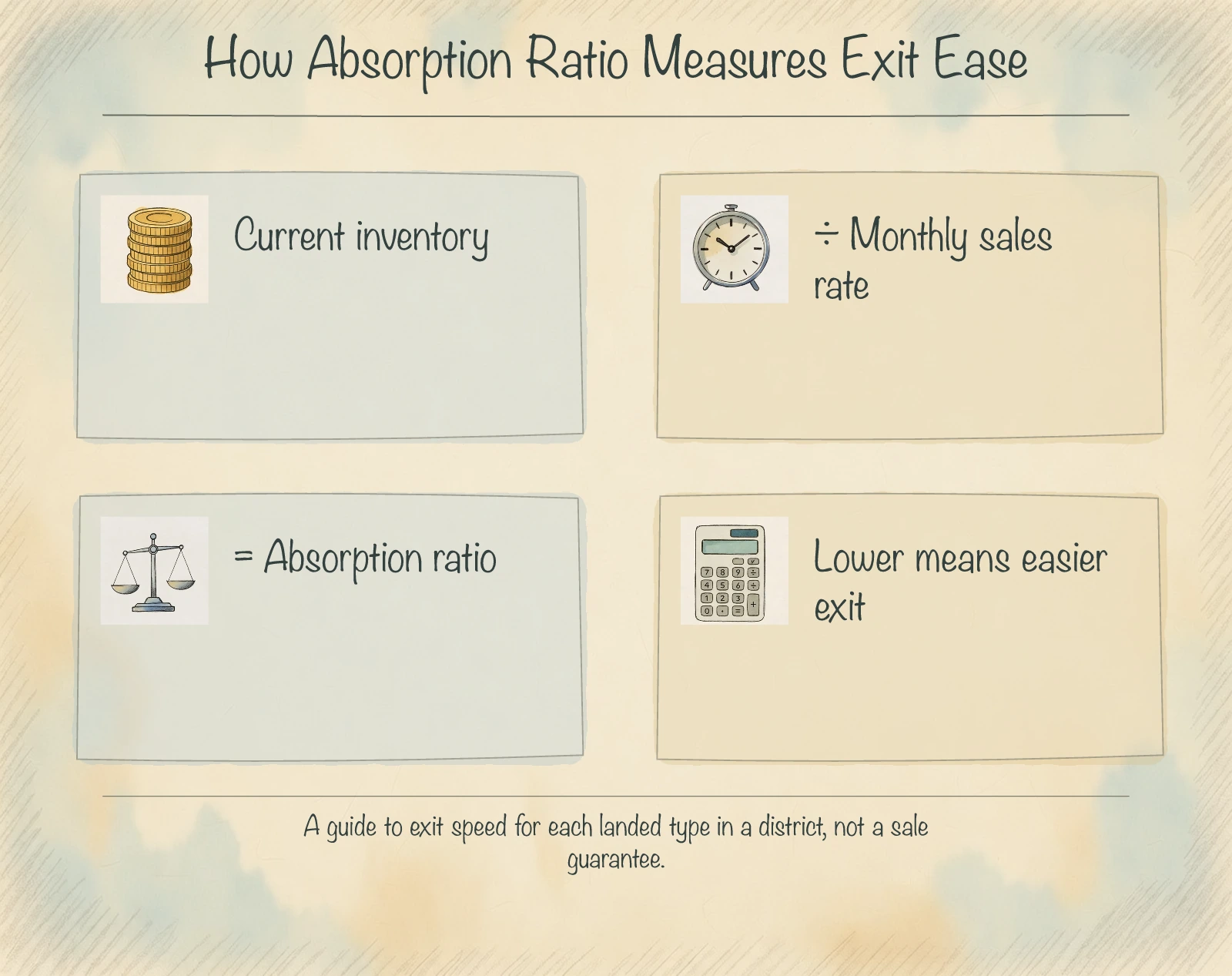
Absorption ratio, we take the current inventory in a singular 12 months or a certain period of time divided by the monthly sales rate. And then that gives us the absorption rate.
And of course, the higher the absorption ratio, the longer it takes you to exit. Now, why is that important?
Because if it takes you long to exit, you will miss your potential next opportunity. So a faster absorption ratio will have a lower number.
Okay, so we always firstly want to go for the property with a future ease of exit because we don't want our capital and profit to be trapped.
So when we look at some things to avoid, especially when it comes to properties, nowadays, whenever clients come for consult, I advise them these two numbers — this two magic numbers.
If you have anything below three and a half million dollars as your quantum entry kind of investment range, then naturally your choices will fall towards like freehold properties, apartments, condos, maybe resale or new launches.
All right, maybe below three and a half you will start to think about should I go for 99 years or should I go for strata homes. Nothing wrong with that.
All right, so nothing wrong with that — fantastic for stay. There are different strategies.
Freehold Landed Priority and Rate Hike Cycle
I have certain clients that go for 99s landed but then they have multiple other forms of investment dividend play, they invest in another property, there's nothing wrong but for the context of investing in landed the best ROI will belong to the freehold ones.
So nowadays if you have anything that is four and a half million dollars upwards try to go for freehold or triple nine years landed properties. If you are stuck in between that four million dollars try to think about certain advanced creative financing to show funds or pledge to stretch a little bit.
Okay now whether you are John Charmaine who has like different horizons maybe now you are Kevin and Felicia who is thinking about getting into a landed property.
Basically what we have is that we have certain frameworks that can help our clients but most importantly when you meet our consultants later they are going to help you to chart your journey. Alright and in terms of where we are right now there's no way that we can go back in time.
There's 16 rounds of cooling measures.
Recently the seller's time duty increased to four years. Naturally a lot of people are thinking whether there is any impact but what we are seeing on the ground is that there's almost no impact.
All right so basically I think we already had a four-year time duty before. We reverted to three years.
Now we are going back to four years but it seems that buyers feel that it's quite okay. And where we are right now is that even with 16 rounds of cooling measures our growth rate is averagely about 3 to 5 per cent per year.
And naturally, it's very hard for the government to remove any cooling measures, so we just need to see how do we hunt for the best investment.
Now, PLB is of the opinion that we try to hunt for either condos with high growth or high rental speed or landed with high growth, but naturally if you go for landed, the rental yield is going to be very low.
Okay, this is a norm. Landed property owners, they want to enjoy the space,
they want to enjoy the land and the structure and of course they are hunting for faster capital appreciation while they enjoy the space. So we recommend what we call quadrant one and two types of properties.
Naturally, you want very high rental U properties nowadays for condos, you have to go for older properties with lower quantum. That is the natural but most properties in Singapore, very hard for the money installment to be covered by rental now because we are already one of the most expensive cities in the world.
Latest kind of outlook by some stock market firms, what's going to happen likely is that September, October, there might be two rounds of rate cuts.
And latest news, I think couple of days back is that they are also saying maybe the rate cuts might not happen or might be delayed in October so we need to wait and see but Now our mortgage is already 1.99%.
If we had two rounds of rate cards, we might be seeing 1.5% mortgage interest rates,
which worries me a little bit because every time when we see low interest rates, a lot of formal will kick in and the faster acceleration usually belongs to the APEX property. The APEX property means the best property of all the residential assets, which is landed homes.
Alright, so if QE does happen because of red cards, then I get a little bit worried whether price go up too fast Because price go up too fast cooling measures might come back more. Okay, so So this is all the news about FAD.
I mean this struggle between Trump and and and Jerome Powell And of course a lot of research papers already predict In two years time, there will be a lot more graduate red cards until the end of Trump's term.
Alright, so So this is something that we have to take note because every time when let's say there's too much liquidity, what we see is that S&P 500 tend to increase quite a fair bit. The MAC 7 stocks tend to increase quite a fair bit.
Crypto increase as well. Of course, now this one week is a bloodbath.
But of course, I believe maybe in October, the stock market will recover if there's an actual record that's happening. But when that happens and if a lot of people start to take profit, they will usually try to lock their profit in a safer asset, which usually will funnel back into real estate.
So that has been the QE behavior we have seen over the years. We have also escaped what we call the natural behavior of interest rates.
So sometimes we worry if rate cuts will result in price increase, but what about rate hike? So the last round was 11 rounds of rate hikes, but our price still went up.
if you look at the green color arrow, that was during Biscay Biden's season. And of course, now we are entering into the face of red cards again.
And this is what I call a sellers market reintroduction. Because we had been inside a buyers market for the last two years.
Return to Sellers' Market and D14 Listings
Now we are shifting back into a sellers' market. So sellers' market coincides with interest rate cuts and it creates a lot of formal positive news in the market.
When there's positive news, people tend to be able to exit their current properties and then they will hunt for the next better one. So this next two years I believe we are going back into the sellers' market.
Now take note, when this kind of news does happen eventually, and when we ship back to the sellers' market, there's two key strategies to take note.
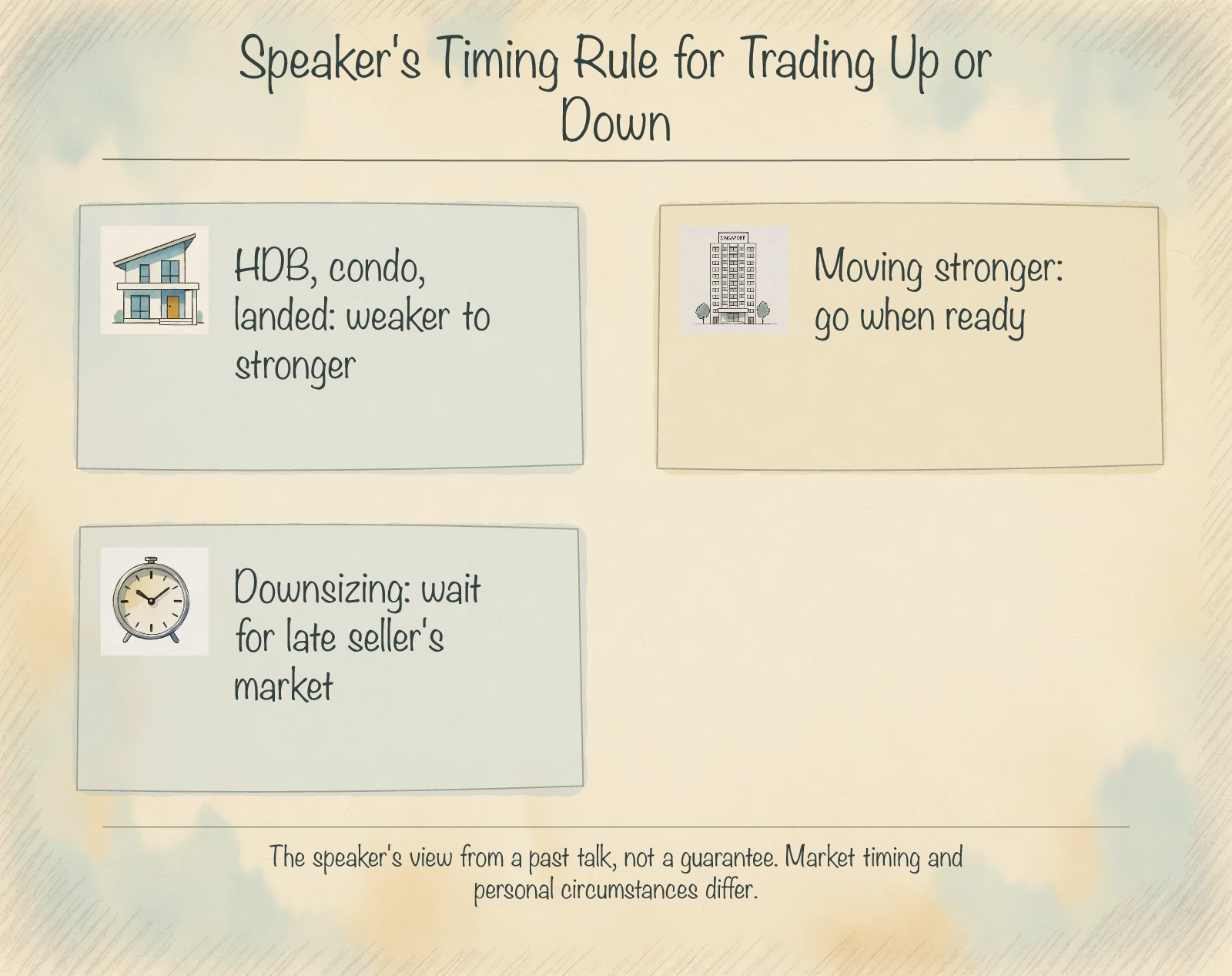
Meaning, if you are downsizing to a weaker asset — and weaker asset I mean I will calibrate from HDB to condos to landed, being the strongest — if you are downsizing from a strong to a weak asset, please do not do it now.
That means don't sell your property now because the price is too good. You should only sell when we are moving into the last phase of the sellers' market, which is in 2026.
So wait for the interest rate to drop first, price to accelerate, then you sell before you downgrade to a smaller property to retire. But if you are in a season that you can actually move to a stronger asset, you should always do it whenever you are ready, because a stronger asset will move faster than a weaker asset.
Give an example: if you own a condominium at $3 mil, but you're thinking of getting a landed, naturally speaking you might want to wait for your condo to appreciate by $200,000, but by that time your landed already appreciated by $500,000, so you need to take note of that key difference.
So quick disclaimer: all the charts I'm going to show basically is based on our research team and my team's experience on the ground. So do your consultant's advice before making a decision.
So let's have a look at D14. So average price, last 12 months, they grossed at $5.23 million for average landed property in D14.
60 transactions, not a lot of transactions. 60 transactions belong to Freehold 399 landed homes.
So this is the median range — you're looking about five million dollars. These are some of the transactions that have been done.
For the purpose of today, I will just focus on a core enclave in D14, which in my own opinion is a better choice than the rest of the D14. So averagely, you get to see terraced homes.
Overall quantum is about $7.15 billion, and then of course, that means $3.84 billion.
Why is there so much value in the terraces? Because the volume of transactions is very high for terraced properties.
In fact some developers now, they are also very cautious, they keep buying bigger land to subdivide and make that into corner terraces and inter terraces to sell because it's easier to sell, it's more palatable. So some developers keep going back that cycle: they buy big land, sell terraces, buy big land, sell terraces, alright.
So this is suitable for people — if you want very liquid kind of landed property, then you can focus on terraces, but of course if you want more space, then by all means semi-D and including detached as well.
Buyer profile very typical, a lot of people buy for ownership in D14, and of course this is the entire D14 enclave, but for the purpose of today my own kind of personal recommendation is this entire enclave that is right across the Liew Lian — right, this is a very favorable enclave.
In fact I think there is disparity kind of opportunities right here, because if you cross the street maybe slightly newer interterraces can get you a semi-D over here. Alright, this is the big and small brother effect that we're talking about today.
Alright, so I'm going to focus on this particular enclave over here. In fact, my most favourable enclave will be after this road line, that means from Vegan Burger inwards all the way.
Alright, so this entire enclave pretty favorable.
Okay, now the rationale is because D14 is actually quite strategically located. If you look at the kind of proximity to town area, actually it doesn't lose to D15.
It's just that D15 has always been a very popular name and brand. People like to tell their friends they stay in the East: I own something in D15.
It's like a prestige kind of thing. It's a little bit like I stay in Bukit Timah kind of thing.
But when buying landed homes we are also very cautious about cultural aspects because branding does matter for landed homes. But then when you look at the Kembangan area, I think there are value buys there because let's say if the disparity is too big, you have a chance for a salary growth in the next two to three years.
So let's have a look at the number of listings for sale now, D14. So number of listings for sale, you have quite a fair bit of semi-D at about 118 listings.
We have already minus off all the duplicated listings — my tech team and research team has done that. You have about 77 interterraces, 29 detached, corner terraces 47.
Now, in a typical season, I usually share with my clients to avoid the
Avoiding Corner Terraces and Condo Price Pressure
Now, in a typical season, I usually share with my clients to avoid the sandwich class, which means we try to avoid corner terraces because it creates a dilemma when you want to sell.
When you want to sell, a corner terrace in terms of the plot requirement is about the same as a semi-D, but the status is fundamentally very different. So some buyers on the ground, when they come and look at your property, they will be in a dilemma between your corner versus a semi-D that's for sale.
So unless you see very, very good value, then if not, you try to switch up here to a semi-D.
Okay, now freehold inter-terraces are still available at four to five million. But $4 million is almost non-existent.
It could be fake listings, I'm not sure, but I will say that to be safe it will have to be four and a half million dollars upwards. All right, but there's still a couple of listings for inter-terraces available.
Corner terraces, about five to six mil, still can be found. And then if you can see semi-D also at five to six mil.
So naturally I look at corner five to six mil, semi-D five to six mil, the natural choice should be a semi-D. All right
So semi-Ds, a couple of choices here, and of course detached, if it is below 9 mil, provided it is not a micro-detach. Micro-detach, I mean by 400 square meters for 305 square feet micro-detach.
All right, later I'll show you some examples, but if you can find at least 5,000 square feet upwards, 9 mil and below, there's still some value there, okay?
Now, when we compare the inventory from 16th September 2024 to today — oh sorry, that is National Day. National Day, after that, my research team, pa-kang already.
Because in PRB Media, we have this thing called REST Week. So every year, we have two sets of REST Week for all the media team to go for a free holiday.
So after that, they're pa-kang now.
Okay, so basically what happens is, inter-terraces, the amount of sellers that has asked in the four to five million dollars range increased by about 40%. Last year there were 36 listings over here, but now you can see more and more sellers are putting their listing in the market in this price range.
Before that, below four you can still find, but below four already deep. All right, so basically now this is quite the norm, $4–5 million.
And then of course for semi-D, the amount of people asking $5–6 million has increased in the last 12 months. And then when you look at the detached, amount of listings below $9 million, it has deep pretty drastically as well.
That means it could have been absorbed, or maybe sellers pulled off the market. They want to wait for an opportunity to put it back in the market.
All these charts are available with our consultants. They are also in our research report.
So not to worry if you can't snap the photo in time.
Okay, so terrace house volume still remains very strong. Predominantly most of the transactions in the last 12 months belongs to terrace house, 38 transactions.
Then semi-D, 18; detached, 5. The rationale is because for detached, it crosses a certain price benchmark, people tend to use that price benchmark to hunt for a stronger district, or more branded district, like D15.
So quick introduction, if this is the first time we're meeting, my name is Melvin, I've been in the market for 18 years, and of course this has been some of the events that we've done.
This was at Suntec last year, this was a landed convention at Shangri-La, and we have been going around different districts just to meet different audiences in the market.
All right, and let's talk about, basically the first thing that we just need to have a high level view, all right, which is landed residential remains the smallest quantity in the whole of Singapore residential properties. HDB is going to increase very drastically to 1.3 million.
Private plus EC now is about 378,000. And landed property basically has been stagnating in terms of supply, which is a very good thing.
That means if I put my capital in landed, I'm not worried about new supply coming in to dilute my price. All these micro increments are due to subdivision.
There's no more new land. Condo is growing at about 10,000 units per year, but it still remains favorable.
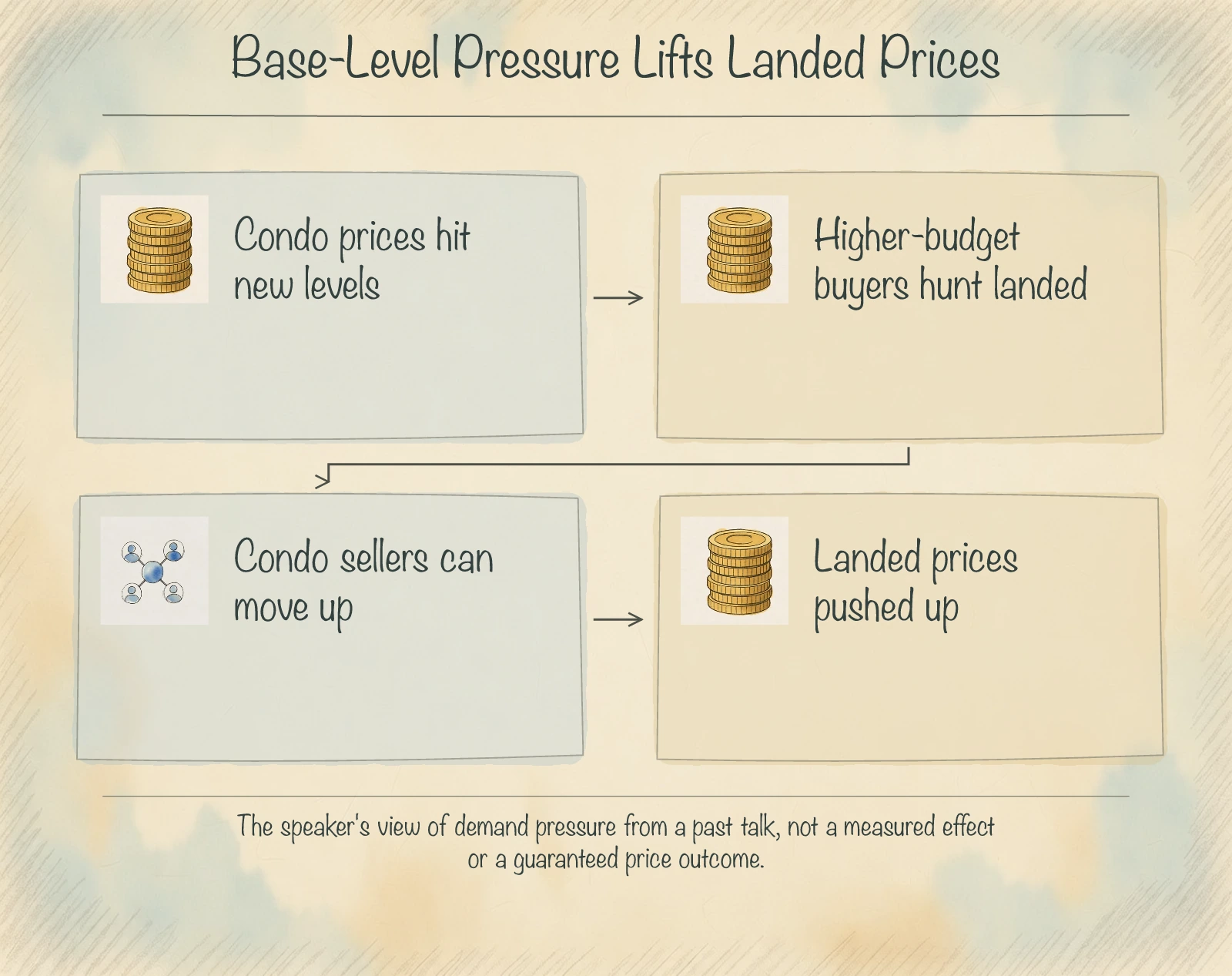
And of course the beauty is that because now condo prices for new launch and even resale, most of them are capping towards the three and a half million dollars. So it is fantastic for landed investors and landed owners, because why?
People that have four million upwards, they will tend to hunt for a landed. And we call this the base level pushing up pressure.
That means when condos hit a new quantum, it pushes up the landed property price. So from the base layer it's pushing up the landed pricing.
It's also good news for landed owners. Why?
If an existing condo owner can sell at a higher price, naturally they earn more profit and they can funnel into a landed home. So the base level
Landed Counts by District and Home Categories
Kind of pressure is there. We believe that the harder the asset the better preservation of wealth, because I want to put my money in the hardest assets.
It is econ's name, we call it inelasticity. That means there's no new supply coming in to basically dilute my pricing.
So let's have a look at the number of landed in every district. D14, take note, detached homes about 210.
Semi-D you have about 800. And then terrace house about 1,688.
And this is the other district. I highlighted D15, which is the big brother.
So usually D14 and D16 will move after D15 move up very quickly. So when D15 move up very quickly, people get priced up, they will tend to buy D14 and D16.
Nothing wrong, it's just a behaviour of disparity. Okay, it's a little bit like if you buy Bitcoin and it went up too high, then you want to buy Ethereum, all right, something like that.
All right, it's a big and small brother kind of thing.
So 73,000 landed homes in total, 73,356. If I were to put D14 and D15 side by side, this is the comparison by default.
Now some of the pricing for terrace houses in D15 can let you buy a semi-D in D14. So if you want to buy something in D14, you should go for that cross disparity.
That means if I can take 6 million to buy a terrace house there, why don't I take 6 million to buy a semi-D? It should be across that kind of disparity.
And if I were to buy a terrace at 4.5, before you commit to D14, try to look very hard into D15 first. Until you are very sure you cannot find, then you go for the small brother.
So later I'll touch more about the small and big brother effect. But before that, just take note, try your very best not to buy into a slow growth landed enclave.
That means we are very cautious whenever we see that that particular enclave or street
has very little transaction because some streets the owners there just don't want to sell.
So if the owners don't want to sell and there's very, very little transaction, like ever since 206, no transaction, sometimes I get a little bit worried because if all the owners don't want to sell there's no transformation, and banks, they like to have somebody broke a record for PSF or quantum in a particular street.
So we love to hunt for very bullish transactions. We like to hunt for varying kind of landed properties with like rebuilt kind of properties.
People have done rebuilt beside you and all that. So don't worry about construction.
It is a good thing because when they build and sell, it creates a new valuation for your street. Alright, so we try to hunt for varying kind of movement within that enclave.
This is something for you to take note so that you don't become a catalyst to help other people, because it might take longer. Let the catalyst happen, then you buy into, let's say, an older landed home over there.
Now D14 landed volume is not very high. It's quite similar to D21.
So we just came from D21 last month. D21 is also a small brother.
It's from income onwards. D21, people always compare it with D11 and D10.
When D10, D11 gets too expensive, they will go towards D21. Similarly, when D15 gets too expensive, they will go for D14 and D16.
Two and a half months back, we were at D16. From two and a half months back until today, D16's volume has already shot up pretty tremendously.
A lot of people are already snapping up some of the semi-Ds over there because back then when we did the Lander Clinic, $5 million, $4.8 million can still get you a semi-D. Now getting a little bit harder.
So let's have a look at the median PSF. In terms of PSF, D14 and 15 DT, there's still a gap of $500 PSF.
We only compare freehold and triple net leasehold semi-Ds. The gap is about $360 per square feet, and then terraces is about $390 per square feet,
D14 versus D15. And second framework we want to look at, which Josh will touch on later on in greater detail.
So Josh is going to come in later at the second segment to share a lot of case studies of actual landed homes and how do you look at good and maybe not so good landed properties.
But before that, if you were to work with our landed consultants, they will usually come out with this format to help you make decision. That means we...
our lingo is like this, if you were to work with us. That means when...
let's say you want to look at a landed property, we will talk about, okay, are you looking for a Cat 1 home or Cat 4 home? Alright, so category one means all landed, single storey, one and a half storey.
Cat 2 means a landed that is very typical with a pitch roof. The pitch roof, orange colour, dark red colour, usually two-storey, three-bedroom upstairs, one-bedroom downstairs.
But those are very good
Landed Categories and Big Brother Catch-Up
structure. Cat 3 homes are maybe now it should be about 20 years old already.
Modern design, and then Cat 4 will be by developers. So 1, 2, 3, 4, easy for us to make decisions.
Now a typical Cat 1 home might look like this. Alright, take note, it's very important when you go for a Katwan home because Katwan home sometimes if you want to do A&A and renovation, you have to take off a lot more things.
Okay, later you can check my consultants' video we did for a west coast corner terrace because Katwan homes usually they have the best source kind of material within the ceiling. So when you do A&A, you have to be very careful.
Make sure you get somebody qualified that knows their stuff. And then of course this is Cat 2 home, usually two and two and a half story.
And then Cat 3 will be like a couple of glass. There usually will be a live-in or without live-in.
And then Cat 4 will be from developers.
Okay, so some observations on the ground. There are more and more buyers that are adopting this strategy because of the price acceleration.
That means they are trying to see, is it even worth it to rebuild my home? Because maybe if I don't rebuild, I might still enjoy the same amount of margin.
Alright, so some buyers now they are buying older landed, just do very minimal renovation $200,000. Alright, and then they hold the land, but of course now you have to hold for four years, no longer three years, and then they do nothing.
Alright, either they rent out or they stay, and they let the land price grow by itself because if you were to sink in that rebuild, maybe after you can sell at a higher price the margin might look pretty similar.
So some buyers are thinking about this approach on the ground. Alright, okay, so when we observe D14-15-16, the sizes of the houses seem pretty similar.
Alright, so basically we just want to note is that a variation.
Now if you go to D13-McPherson, you will find mini landed properties which we usually try to avoid. So that thousand square feet, thousand two, nine hundred square feet, we try to avoid.
You usually can find this in McPherson or Jalan Hari Raya, Upper Thomson area. We try to avoid those if possible.
They do appreciate, it's just that they take a longer time to appreciate. So this is the big and small brother district comparison.
You might want to take a photo of this. Why is this important?
Because this year is the year for small brother to rise, but once we enter Q1 next year we might shift back to the big brother. Okay, my own forecast is that in the next six months, in fact actually starting from January this year is the small brother district season.
Alright, so you'll continue to accelerate in terms of transaction volume, people will step up the lower quantum ones, and then we'll hit a new price point next year quarter one.
We might enter back into a big brother, whereby the big and small brother will go back to equilibrium, then it will make sense to go back for the big brother.
So if you are going to pull the trigger now, then try to hunt for small brother. But next year, if your timeline is next year, then you can maybe shift back to look at whether there are good deals in the big brother district.
So this is basically how it functions because these districts here have very high volume transactions and they usually are the top favourite district first, okay, before buyers look at the other district. And what do I mean by equilibrium?
It is that sometimes if we lay down all the listings side by side, let's say I'm looking for a landed now, a semi-D, I compare the big brother which is the purple colour one and the small brother, maybe the equilibrium should be like this.
But then sometimes the big brother accelerated too quickly, and maybe if, let's say example, I have a $7 million kind of range but I can afford maybe like a Category 3 home, but with the $7 million if I were to come to a small brother I can get a brand new home.
Alright, so this is what we mean by this priority. So as long as there's one category gap, then it might be worth it, or a terrace in a big brother can afford a semi-D in a small brother, then it might be worth it.
Okay? So once we wait for the small brother to catch up, then it might make sense to go back to get a stronger district which is the big brother district.
All right? So later Josh is going to share with you how we look at DNA because the DNA will result in you being able to sell faster or sell slower.
All right? So we call them basically the DNA of the houses and we call them the inherent characteristics
Inherent Plot Characteristics and Asset Income Framework
of the land plot because every land property has a plot that you cannot change. So if it's facing a cross junction expressway, it has let's say a Chong law or whatever it is, you cannot change the plot orientation and the position but you can enhance the structure on top of your land.
So importantly, we must know what can be changed and what can be improved. There's various poorer inherent characteristics which we have summarized.
Also later on, Josh is going to share with you some of these things that we have picked up over the last 18 years by bias. So all these are bias feedback on the ground that resulted in properties taking a longer time to sell.
Okay, now you also have good inherent characteristics. Some of them for example single loading, facing a park, some buyers prefer a three-story enclave rather than a two-story enclave because you don't have to dig a basement.
So things like this and of course what you can value add
basically to your property. But the more you value add, the more capital you sink into your property.
So we have also summarized into these two tables over here. Later you can run through for consultants on what to future proof, what to avoid as well.
Okay, now so let's have a look at the compound annual growth rate for D14. Now sometimes when we look at the compound annual growth rate, we think like, ah not very fantastic, eh, like buy dividend stocks better, alright, it's only 4 over percent.
But on the ground, this is not what is happening at what I call the base layer, very palatable size landed properties. Rational is because usually what is available on the data is an overall generic kind of compound growth rate across different types of landed homes but we want to note the quantum of entry.
So basically 2020 until today, this has been the movement that means during COVID, two and a half million dollars easily you can buy something in
Bangan, Interterrest. But now I need at least close to a $4.5 million.
So actually if you look at the compound growth rate over the past five years, it's close to at least 80% growth in terms of pricing from $2.5 million. It's shot out by $2 million to $4.5 million.
Semi D price growth is around this range. And of course, it has growth of about $3.5 million entry to about $5.5 million and $3 million.
So this is the dilemma zones. So take note, small brother district, you have to be very careful.
You cross $8 million, you will face resistance to exit. Why?
Because you buy $8 million, you want to sell at $10 million four years later, for example, the $10 million buyer will be very, very picky. They will have more choices.
So you want to note the quantum unless you are very sure you're not going to sell then by all means please buy a detached enjoy life all right but I'm talking from a
perspective that if you want to exit okay my forecast for next year is that this district will become like that all right in the next 12 months lightly a minimum entry for interterrest old version will hit towards the five million dollars and we will not see this price again.
I've shown these charts over the last five years and every time lender property tends to accelerate by 500,000 in terms of a 500k chunk. So just take note as I mentioned if you want to go for stronger asset if you can then try to move faster.
By 2029 I believe at the rate that we are going because now based on the clients we are serving a lot more younger people are buying landed already. Okay, so it seems that everybody very clear what they want to have I believe by 2029 we should be looking at around that quantum for the base layer for interterraces.
Okay So maybe just to share a little bit about our methodology
Our main methodology is that to invest we try to put our capital in something with appreciation potential and easy to exit Alright, because why we want to always have that liberty to create a liquidity event that we can sell our existing home so that we can go for a next stronger asset and we couple of frameworks over here.
So we have 11 frameworks, 12 methodologies and we believe in this approach whereby in your strongest, most income producing years try our very best to funnel our active income into asset income.
So that once we hit past the winter season which is 55 to 85 we have a pot of passive income alright because active income is the most risky, involves job loss, business changes and stuff like that.
And of course once we are 55 to 85 once we don't have active income at least we have a very strong asset income that we can start to plan further. Alright so for example let's say when we look at a
Equity Triangle Portfolio and Case Study Handover
Portfolio, if let's say we are going for multiple portfolio — a landed plus condo, or just purely looking at landed — somebody that has maybe invested in the 2.8 million landed in the past, or maybe even if they start now at a four and a half million dollars landed, just by 2% inflation growth towards the 6.5 million by age 65 in 25 years' time, you are building your equity triangle in the middle while you're staying in the property or you're renting it out.
So most importantly, the equity triangle is like a disciplined approach to put money into your assets. And let's say if I want to divest it at 65 years old, at least I can form what I call a four pocket box.
All right, so I can keep cash for 500k, I can buy dividend stocks at 5% that generates me 83 a month with my $2 million cash. In total, I will have liquid cash of $2.5 million.
I can pay off a condo.
It doesn't matter if it has a balance lease of 50 years. I can pay off a 2-mil condo.
I can buy a rental property fully paid, collect rental income, no mortgage, and it creates a passive income that is strong. I still have two properties.
We believe that you should enjoy the fruits of your labour to create like a passive income engine to serve your winter season.
And then even if you want to go and press the button a little bit earlier at 55 years old, you still have a very healthy equity in the middle that allows you to funnel into four pots with a smaller kind of quantum as well.
All right, so do speak with our consultants if you want to chart your journey and I move on to my last part. So basically this trend is very suitable if you have a bigger quantum budget and you want to hunt for something maybe in the 8 to 10 mil range which is getting increasingly difficult as well.
Maybe you have maybe 10 to 12, then you have the liberty to look for land that is able to allow you for subdivision. Subdivision is a strategy because you can buy the land without subdividing it now.
You can wait for four years later and you will have a new group of buyers that will hunt for your land. And these are the developers.
They are always hunting for this kind of land. And they want to buy your land for subdivision.
So George and Tabitha sold this last year to a developer. Basically it was done at about 12, 13, 12 plus.
The developer bought it, they just did their groundbreaking so they are subdividing it into two corner terraces. So if you were to own this kind of land, you have two sets of buyers in future, you can sell to developers, very very kind of popular with developers nowadays.
Also take note that those of you who wants to hunt for entry level detach, what I mentioned
is 400 square meters is the entry level for detached qualification. Semi-D to qualify as a semi-D is 2152 square feet is 200 square meters, okay, but my most favourable semi-D size will be about 3005, okay, because 2152 is too small, it feels exactly like an interterrace.
Why? Because 2152 means that your width is 8 meters, your depth is 25, but after you have a side setback of 2 meters, your internal livable space is still 6 meters.
It is the same as an interterrace. So if you can try to hunt for something 3000 plus square feet, it will be very comfortable with a 10 meters width.
But for those of you who are hunting on the right hand side, take note that if you were to buy entry-level detach, it will feel exactly like a semi-D. Okay?
Because you have two setbacks to cater to. So sometimes it might be wise to go for a semi-D at a low quantum because it feels about the same.
It's just that you can tell people you have a detach but you can save $2 million. So this is a research report that our consultants will give it to you later.
Of course do have a chat with them. Stay on, we would love to interact with you.
I'm going to pass on to George who's going to share with us some very deeper case study. Thank you very much.