Evaluating property
Overseas Property Investment, HDB Owner Occupiers, New Launch vs Resale
Published 2026-11-21. Adapted from the episode published 2024-01-12. Figures, illustrations and data reflect the episode’s original publication date.
Mortgage Packages, Pairing and Overseas Property Risks
Are you at a live stage that you have more earning ability that allows you to buy an asset that can move faster? What is pairing strategy?
So basically in every season, there are different pairings. How do we compare between two mortgage packages?
Firstly, look at whether it is fixed or floating. So I think comparing mortgage packages have to be dependent on season.
Let me record for the Solonel boom. Alright Solonel just cut away the front part.
Solonel I'll send you this link as well. Sorry, why not take a coffee?
Ah! Solonel I'm sorry!
Can you cut it off please? What is the future with rental yields?
Consider that JB is much cheaper and people are renting there instead of in Singapore. If the train from Singapore reached KL, would Singapore rent be below-in-demand?
I still remember probably about 10 years back there was like a super hype for Iskandar properties. Okay so I also own Malaysia properties.
Recently I just bought one but it's really for like a holiday home about like a brand new landed is a holiday home. It's really for that, just that mindset.
So I have no hope and dream to see the property appreciate. I have no hope and dream to rent out the property.
I don't intend to rent it out. So my purpose is very clear.
So me and my wife just want to own like a holiday home. So if you travel, bring the kids for a road trip to Malaysia and of course we like Malaysia, then we have a place to stay without always depending on Airbnb and hotels and stuff like that.
We can also bring our family, my parents and all that. If you want to stay there for a week, then you can just take the keys.
And of course, I can also hold retreat for PRB people. So we can go there, have fun, stay in the lender for 2-3 days.
Probably also because this year we did a lot of hackathons in Malaysia. We rented an Airbnb corner terrace and then we just stayed there for 3-2 nights.
Come with all the plans and all that.
Okay, so my purpose is clear. What is your purpose?
Is your purpose to see your Malaysia property appreciate in price and you want to sell and make a profit? If that is so, let me just show you two perspectives.
Number one, let's say you buy a property at $1 million. Five years later, you manage to sell at $1.2 million.
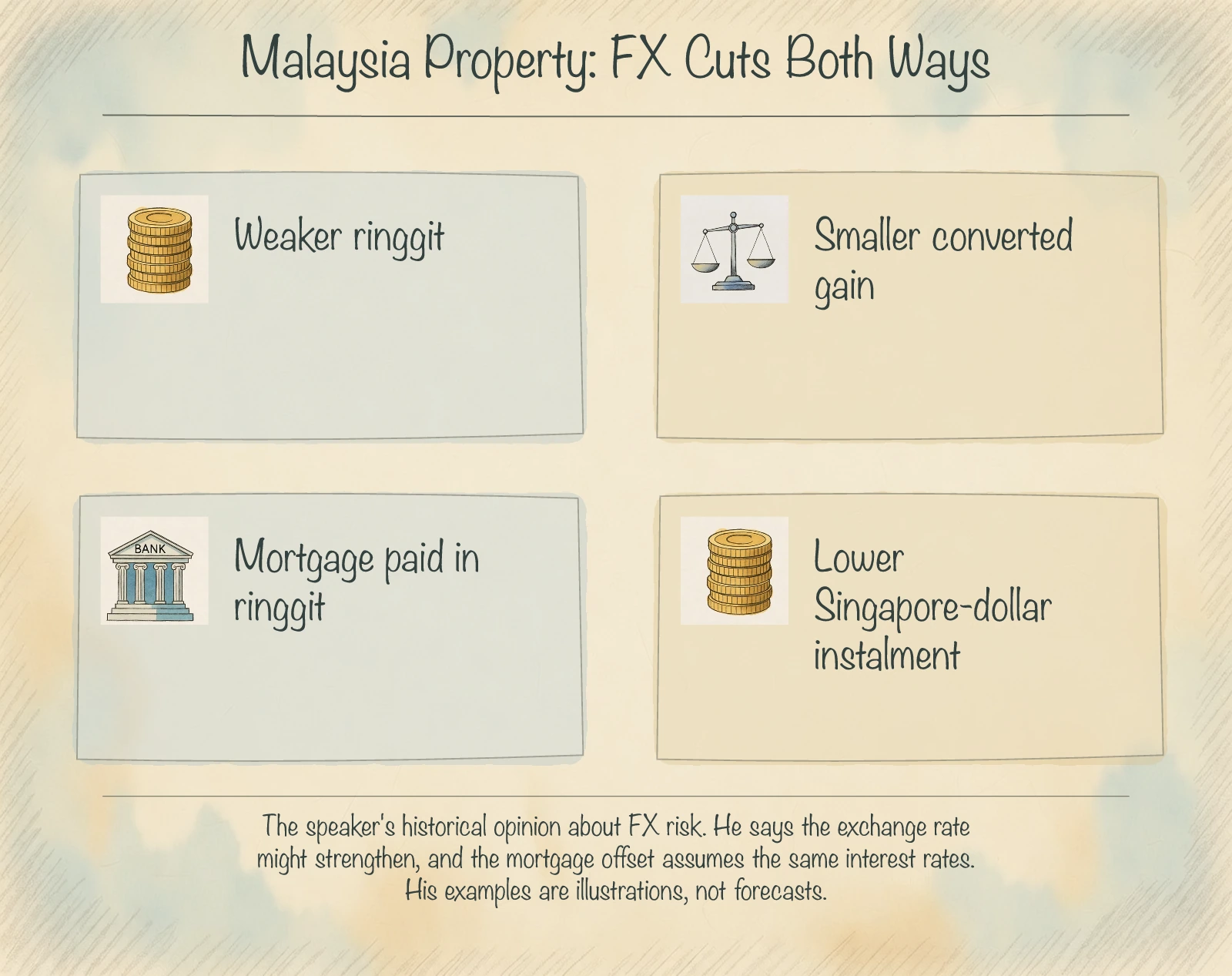
So my first question is that you need to consider the exchange rate because you are investing in a country where the currency is weaker than your currency. So what is going to happen is that that $200,000 in five years time is going to be way lesser factor because the exchange rate keeps depreciating.
Now it's about 3.49. In future, I don't know remember 3.67, 8, 9, 4.
I'm not sure. It might strengthen.
But based on the trending, I think Singapore currency is always getting stronger. So take note of the currency exchange risk.
It's called the FX risk. Right?
Number two, if the FX is present, and if you're taking a mortgage, then it might also be a counter effect, which might be a positive thing. Why?
Because if you are paying a monthly installment, you are paying the monthly installment with weaker and weaker money because let's say the monthly installment is 6000 ringgit per month.
Over the next 10 years, if you continue to pay 6000 ringgit per month, assuming the interest rates are the same, you are paying with your strongest Singapore currency, which technically will mean that if the currency rate for ringgit depreciates, you're paying with stronger and stronger money in lesser absolute amount.
So maybe at 6000 ringgit, you only need to pay $1700 dollars. But maybe as your currency strengthened, in accordance to the FX risk, in 5 years later, you only need $1300 dollars.
That's an example. So that's number one.
Number two, if you're buying with an intent to see an appreciation, I would think that this might not be a good intent because if your hope and dream is ready to see the property appreciate, take note that in different countries that have different demographics in terms of demand and supply.
Singapore works very differently. 15 rounds of cooling measures, land is scarce and population keeps increasing.
Just by these three things, it is different already. Malaysia has technically a lot of supply.
A lot of times if you would have purchased a property brand new, by the time you want to sell, you're competing with a lot of other brand new properties also. There's a lot of new launches by developers.
There's too much lambang in my opinion. So I think it's perfect for a holiday home.
It's perfect for maybe you're doing an Airbnb business, buying a couple of rental properties and doing Airbnb if you want to operate there. You work with a local partner or things like that.
But I think if you have the hope and dream to see appreciation, I think it might not be a very good hope and dream in my opinion.
Iskandar Supply Lessons and Realtor Responsibilities
There was a hype in Iskandar properties ago; a lot of people buy properties at Iskandar, Medinia. I think there are still holding on to all those properties now, and just by the very fact that there are so many new launches, the supply is always matching up and superseding demand.
And also take note, the policy that if you are a foreigner, you had to buy at least $1 million dollars. This disfavors the property holding as a capital of precision as set class.
Why? If you are a Malaysia citizen, you have plenty full of choices.
You can buy condos at 350,000, 400,000, plenty full of choices. That means if you're buying one million dollars, you're technically just paying that difference to own a property.
And technically speaking, if you compare to what Malaysian citizens can buy in terms of price choices, you already lose out as a foreigner. So I think if your concept is ready to hold it as a foreign property just for enjoyment, then I think by all means, but do not put in the hope and dream to see appreciation.
If you appreciate, that's good; if you don't appreciate, then you must be ready to hold it. So just take note of that.
Now to answer your question, we will Singapore Renter below in demand. I don't think so because I think based on population figures, the expert trades pool coming in is still strong.
I think people will still value the time difference to travel. Of course, if the trade is there, I think it would be a great arbitrage for Singaporeans.
Singaporeans can own properties there for rental, speed is fast. I think it's going to be fabulous.
I also look forward to the trade. So I think if the trade happens, then maybe our rental prices will not be too heated up by that time.
But let's just hope it happens because policy can change, inter-country policies change all the time. I also do want to put the washroom and drink in the train kind of like movement between the two countries.
So I rather put my energy and focus on local properties.
All right, next. Would you advise to buy a new launch condo or a resale condo?
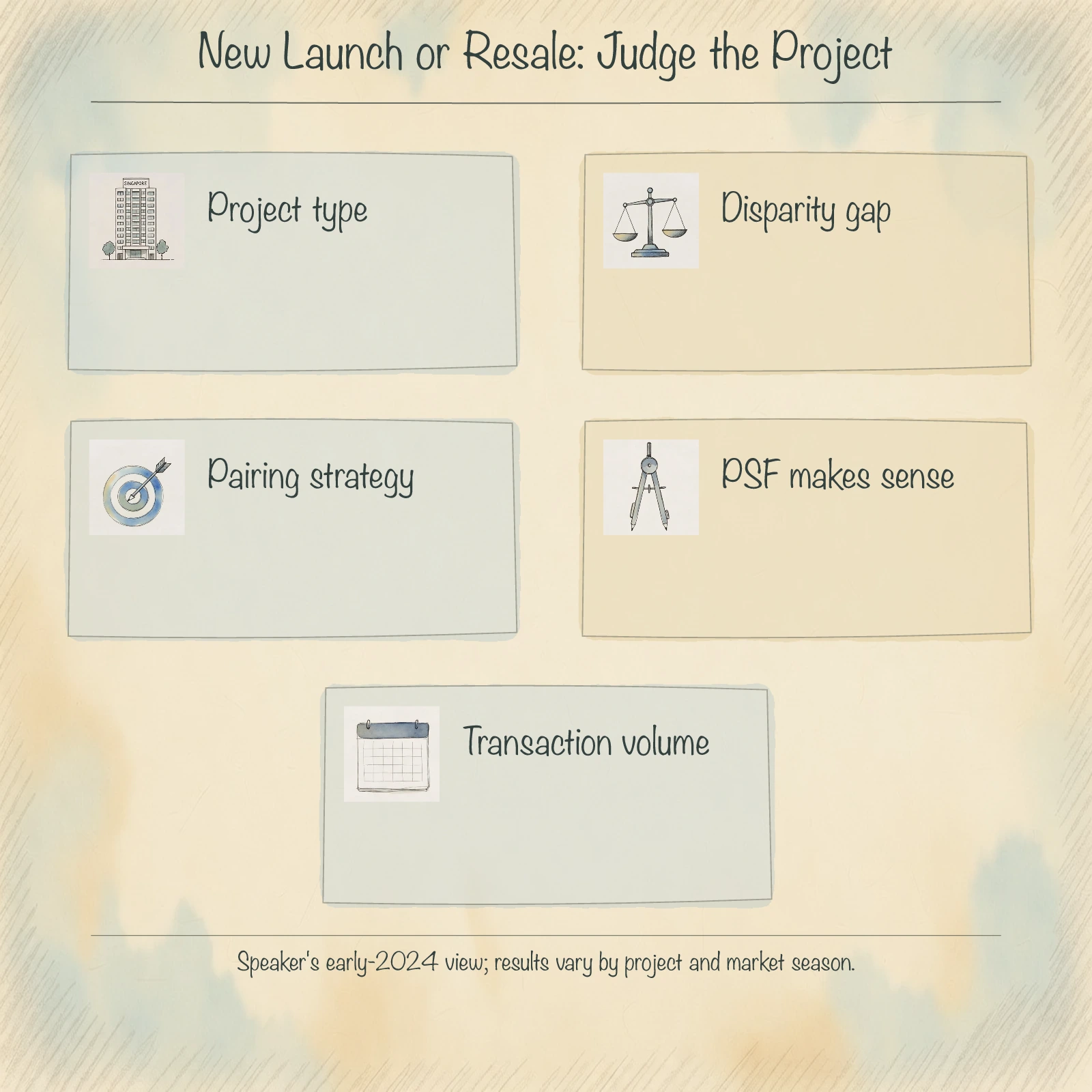
So I'll watch that two episodes because the fundamental is that it's not about new launch resale; it's about the project type. Some new launches c-profit, some new launches stagnate.
Some resale c-profit, some resale stagnate. So it's not really about new or resale.
It's about firstly, disparity gap. Secondly, the pairing strategy.
And in this season, which PSF makes sense to see that opportunity arbitrage. So my opinion is that if you're talking about now, now towards 2024, resale might be something that you can look at seriously.
I'm not saying that new launch is no good. But I think new launch will start to clear out towards third and fourth quarter of 2024 because there's very little new launches in 2024.
There's quite a fair bit of balanced units, good projects, new launches from 2023 that will actually move forward into the balance inventory of 2024. People might start to look at them because the PSF will start to make sense once resale catch up.
Resale needs to catch up in terms of PSF and quantum. TUP project is already in terms of PSF very close to new launches.
So I think new launches will start to clear out in the last 2 quarters of 2024 and by 2025 most of the balance units will clear out and then 2026 will have a new high.
So I think you can look at both, but importantly hunt for the one that has best popularity, best volume effect, potential of good transaction volume by a TOP because you want the valuation appreciation to move up based on healthy transaction volume.
Fundamentals using our mode analysis near the MRT, parent's attraction effect, rental demand and of course preferably high rise, good project size and things like that.
Alright. Start mid-late 20s young couple with a few years of working, both median income ready to settle down.
Option A, save up 4-5 more years to buy a condo or buy HDB as owner-occupier or B. Buy HDB next year, co-own and qualify for grants, but must pay AB-SD if get second property next time.
Which would you choose? Now, based on your scenario, late 20s assuming 28-29, I think option A to save 4-5 more years to buy a condo might not be a good option.
Okay, a rational is like this. Buying a property is not just investment centric, own stay centric, it is also psychology centric.
When you own an asset, it trains you to save because now you have a responsibility. Similarly example, I always tell my salespeople, the criteria is that within the first year, once you start to close some deals, you need to get a second hand car.
Any car, Japanese car, wine. You need to own a responsibility for your clients to fetch them for viewings and to reach different listings to open the properties to show bias for your sellers.
Because if you take grab, take bus, take public transport all the time, you are not responsible as a salesperson, right?
Home Ownership, Responsibility and Closing Remarks
And owning a car creates a responsibility that you must do well certain month every month to pay for the car, because a car is a tool for a realtor. A home has also psychological factors.
Because the moment you start to own a home, you need to maintain it. You know, pay property tax, monthly conservancy or MCST, electrical bills, internet bills and stuff like that.
That will give you like an internal healthy motivation to be hardworking. Because you now have a responsibility.
Similarly, when you get married, you also want to be a responsible spouse. When you start to have children, your level of responsibility increases.
So I think sometimes owning a property or maybe owning 2-3 investment property is a psychological game.
So coming back to this, if you wait 4-5 more years to save out the bar, by the time the price will already escalate, my preference is that go for the option to buy a resale HDB near to MRT station, owner occupier scheme, but read the disclaimer.
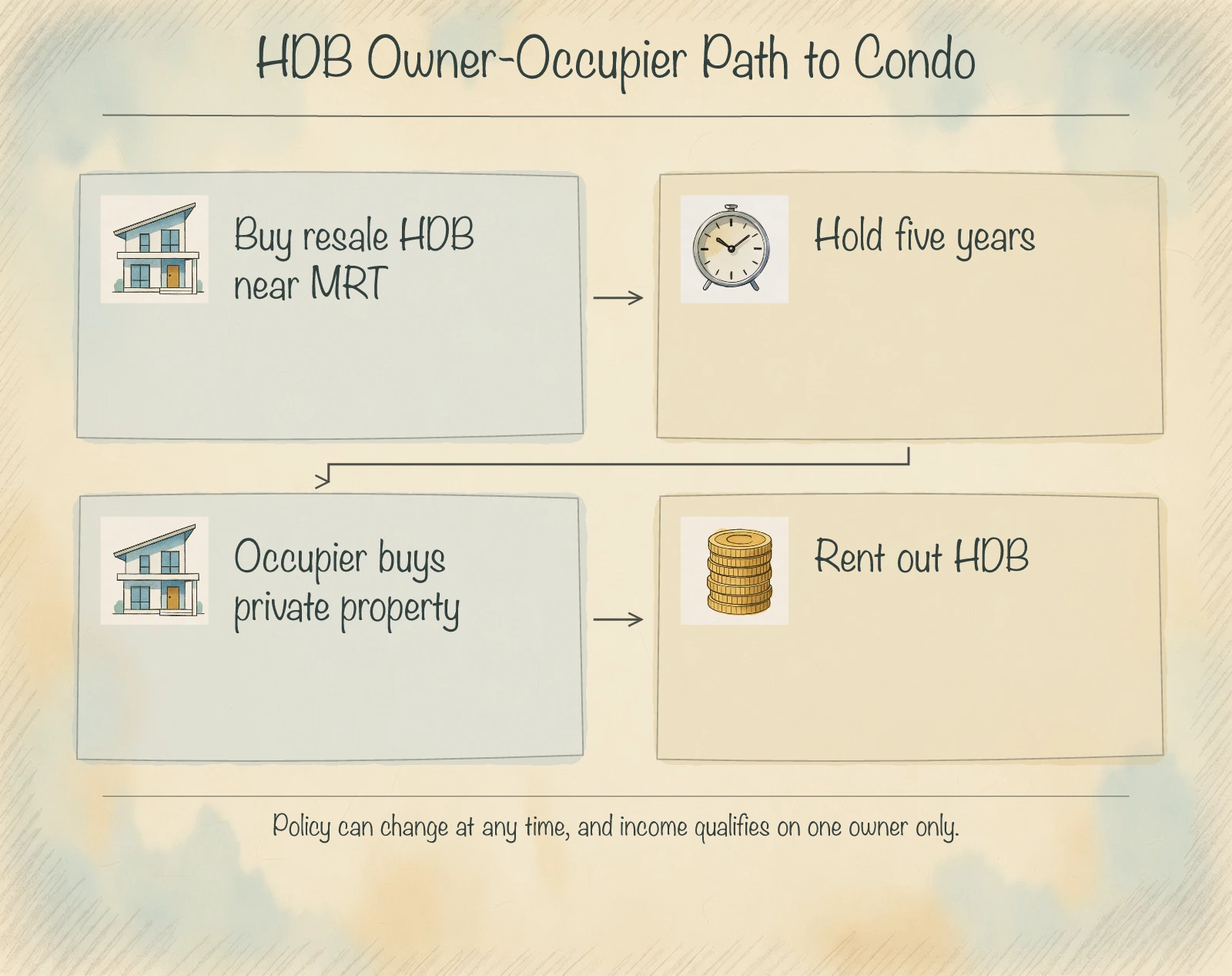
Our episode previously on Standard Plus Prime and the impact on the resale properties is that we talk about the fact that HDB has the right to change the owner-occupier scheme anytime. So take note, even if you buy now with one owner name, one occupier, midway, if they change the policy, then this will not work.
So take note of this disclaimer, I'm going to put it here a lot and clear for you. For now, if you go in one owner-occupier scheme, the disadvantage is that the income will only be based on one owner.
That means the income that you qualify to loan from HDB or the banks is worth a 1 owner because technically there is only 1 owner. But the benefit is that after 5 years, should both of you do well in your mid 30s, the occupier is not subjected to ABSD when you come out and buy a private property.
I think this is the best moving for now based on your scenario.
Because 5 years later, your resale HDB near to MRT will be very easy to rent out. Go for a minimum 4 room flat or 5 room.
Very easy to rent out. It's going to create income for you to pay for the mortgage for the HDB plus some extra spare cash to pay for the MCST and contribute to instal more of a condo.
You can move to the condo. Rent out your HDB.
You can have one HDB, one condo. I think that's the best approach.
Alright, so watch the episode. I have explained in-depth for you over there.
Last question. Is now a buyer or seller's market?
Now is definitely a buyer's market. Why is it a buyer's market?
A buyer's market has slower transaction volume. Transaction volume for the entire 2023 is the same as 2019.
This is a buyer's market because there's more listings, lesser buyers taking immediate action. I'm not saying there's no buyers.
I'm saying that buyers are taking time to take action. However, a seller's market will happen when you start to see headlines,
all every launches you start to see resale volume shooting up, condo resale, HDB resale, landed resale, you start to see brand new condo launches 80% 80% 90% sell out for every launch. Why is this a buyer's market now is because not all new launches perform very well.
Some are 20% 40% 50%, some are 80%, but not everything is sell out. So now it's a buyer's market but what's going to happen next year is that 2020-20 if interest rates come down it's going to swap back into a seller's market.
Why? Interest rates always affects and impacts the mindset of buyers.
When interest rates are low, buyers flat back because of FOMO. When interest rates are high, buyers are a bit more cautious, they want to take their time.
And thus I would say that the biggest proponent of whether it's the seller or buyer's market is based on the interest rate. Alright, so I've come to the end of episode two of AMA.
We hope that you had a great start to 2024.
Leave your questions below in the comment section. We're gonna tabulate then we'll do more AMAs for 2024.
And we're gonna come up with new series. If you have certain ideas on what kind of topics we can talk about in our NOTG channel, please leave a comment.
We'll look forward to your comments and we appreciate all your support over the years. My name is Melvin Lim.
Take care.