Landed property
Outlook for Shoebox Units, Early Investments & Condo and Landed Appreciation Power
Published 2026-11-18. Adapted from the episode published 2024-03-15. Figures, illustrations and data reflect the episode’s original publication date.
On this page
- Starting Early and Cooling Measures' Combined Effect
- Shift Toward Bigger Homes and New-Launch One-Bedders
- First-Owner Appeal for Singles and Starting Early
- Defensive Strategy After 55 and a Cluster Question
- Cluster Landed vs Pure Landed vs Freehold Condo
- Substitution, Disparity Effect and Appreciation Ranking
Starting Early and Cooling Measures' Combined Effect
Will shoebox units start to gain more demand in future? Today we have another episode on Ask Me Anything.
Your earning power is there, you're single, and you want to go for your first property. Would you go for a new project or a resale unit?
Sorry, my handwriting is very terrible. Okay, please do not wait until you are 55, then you want to start buying your property.
Of course I'm not saying that if you are 55, you cannot buy a property, you can. But of course once you are into 55, this is of course the start point of what we call a defensive strategy.
Alright, welcome back to Nuggets on the Go. Today we have an episode on Ask Me Anything.
So we're going to tackle a couple of questions. Thank you for sending the questions throughout the past weeks.
Okay, so there's this question for Chris. In recent years, there are more and more younger Singaporeans buying their first property within 25-35 years.
So most of the time, they are targeting shoebox units.
So perhaps referring to like studio one bedder due to budget constraints. Two questions for Chris.
Currently, three bedrooms and above are more popular. Yes, which is true.
We talked about that in a lot of our episodes because of the COVID effect plus a lot of the cooling measures plus of course rising prices that requires a lot of couples now to combine names instead of splitting their names due to TDSR constraints and stuff like that.
But of course couples that have dual earning power, of course with pledging, unpledging kind of facilities they are still able to do like one property each. But beyond that, ABSD of course is pretty hefty, which is why a lot of couples tend to go for bigger units nowadays.
Property investing strategy also bigger units and bigger units a bigger square footage area and thus when a hundred dollars PSF increase. Let me just illustrate so that based on this question everybody can be very clear what we're talking about.
So for example,
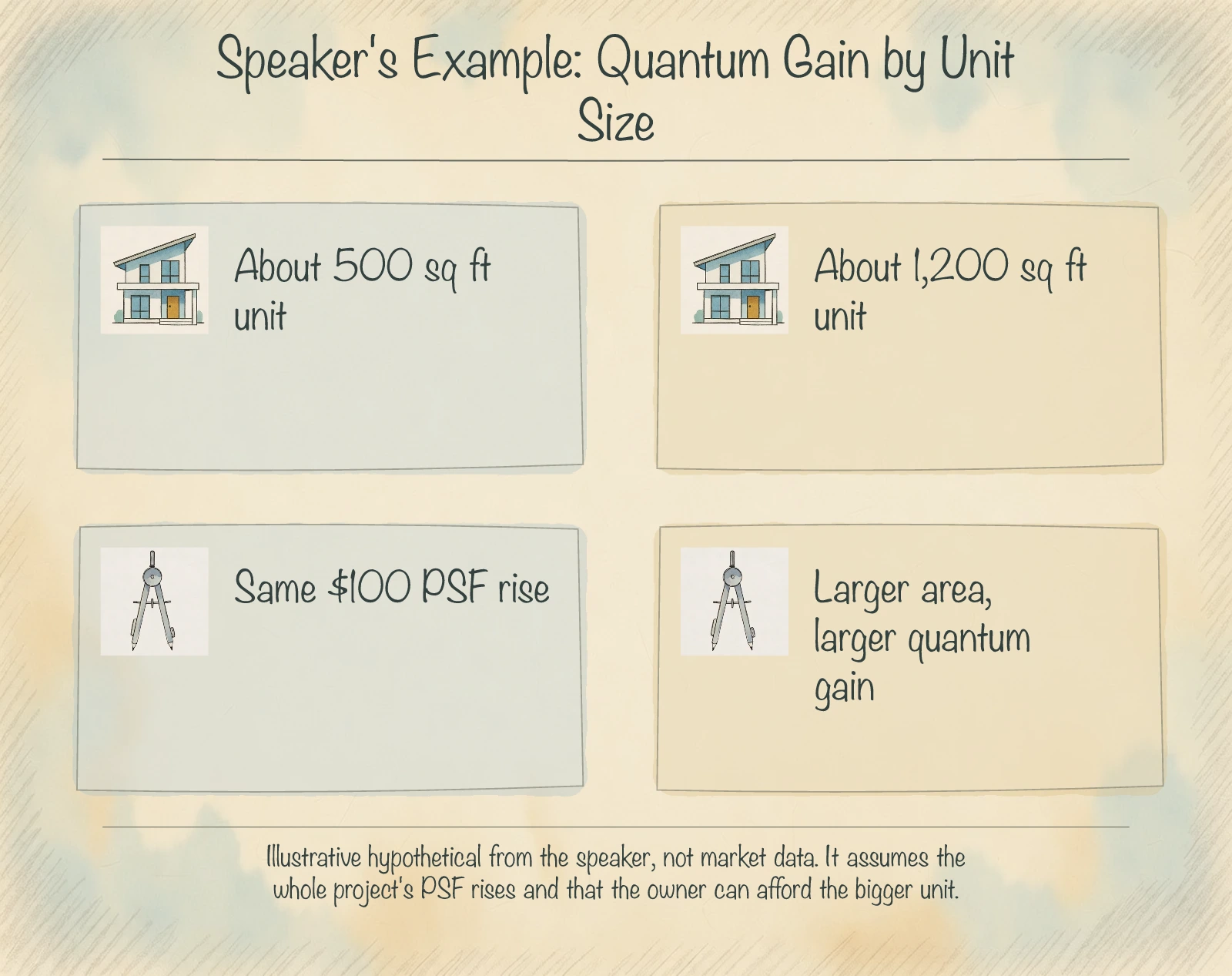
let's say you compare a one bedroom versus a three room unit. If let's say you buy something at about 500 square feet compared to something at 1200 square feet, if the PSF of this entire project would increase by $100 PSF, basically what's going to happen in terms of quantum.
This is PSF. This is quantum.
Quantum means the total price. So for example, $100 PSF increment, this will increase by $50,000.
But $100 PSF over here, this will increase by $120,000. So this is what we mean by a bigger quantum increase because of the fact that you are owning a larger square footage.
If this increased by $200 per square foot, basically this will be 100k increment. This will be a $240,000 increment.
And thus, when you look at quantum gains, when you own a bigger unit, if the PSF for the entire project would increase, you will definitely see a bigger quantum gain. But of course, this will all depend on whether in the first place,
does this property owner have the ability to go for this bigger appetite compared to a smaller appetite, which is pertaining to this particular question. The first question from Chris is that, currently because of the fact that this is more popular after COVID, after rounds of cooling measures, why is that so?
It's because of a few key factors. So why are bigger units more popular, bigger units, right?
It's because after COVID, with the combination of effects of COVID plus cooling measures, and take note that cooling measures, we have about 15 rounds of cooling measures. And this cooling measures is powerful in the sense that it has ABSD on local residents, meaning that the second property now you are taxed with a very hefty ABSD.
It also has TDSR, which means that after the rounds and rounds of TDSR ever since 2013, we already had like three to four different rounds of revision. And now TDSR is even more stringent.
And also LTV issues in the sense that we can only
load 75% on the first property, 45% on the second property. This three things in combination created a new effect.
In the sense that now in order to buy let's say a three-bedroom unit just for your own stay plus prices are increasing, this resulted in the sense that a lot of couples instead of going for like in the past they tend to go for maybe you know I will go for like a one bedroom to rent out maybe I'll go for two bedroom to stay but now after all this combination of effect with COVID and cooling measures and all these kinds of different types of cooling measures this created a new impact in the sense that the couple will think that hey you know let's just go for a bigger place and let's enjoy the space while we stay in the private property why don't we just combine it maybe get a four room unit or maybe get a bigger type of three room unit so that we can also enjoy the space in terms of
Shift Toward Bigger Homes and New-Launch One-Bedders
This kind of mindset — this has been the new shift ever since 2020. We saw that burst in terms of three, four bedrooms, ground floor, penthouses getting very popular, and a lot of people started to restructure into this approach.
Of course, just as I mentioned, if let's say both couples still have very good earning abilities, maybe this person will get a three room, this person will also get a three room, and then they will rent it out.
Or maybe this person will get a four room and then this person will get a three room and then they will rent out one of it. So this is like the new trending.
And couples that maybe one person stays at home, or maybe one person has a lower income level, one person has a higher earning ability, then they might combine names and then just get like a big unit, or maybe get a penthouse, or maybe get a landed.
So this is the current trend that we're seeing.
And let's come back to the first question.
So the first question is that with such a trend of younger Singaporeans in their 25 to 35 years old, let's say they are single, they're not getting married, they're not going for BTO, they're not going for HDB, and they don't want to wait until 35 years to get their first resale HDB —.
Because if you are single and you want to get your first resale HDB, you have to wait until you are 35 years old. The question then pertains to: will shoebox units start to gain more demand in future?
Shoebox units, let us define. We are talking about studio units, we are talking about one room.
So maybe let's just classify them as less than like maybe 550 square feet. Okay, of course there are variations.
One plus study, studio unit, open concept. There's a one bedroom unit, you know, we have an enclosed bedroom.
One plus study has become very popular nowadays as well. But this of course caters to a lot of, I think, like a demand from young professionals that are doing well.
They don't have to wait under 35 to get a HDB. They can well afford a property in the range of maybe about $1 million all the way to $1.5 million.
And we can see from the uptake in terms of deals that has been transacted from new launches throughout the past 10 years for these type of properties. Of course, in 2023 and 2024, a one-bedroom is no longer like in the past, where you can get below $1 million.
Now one-bedrooms, they are all above $1 million. $1.1, $1.2, $1.3, $1.4, $5 million.
A two-bedroom is in a range of about $1.7, $1.8 million. A three-bedroom is already about $2 to $2.5 million for a lot of OCR districts.
So what is going to happen to the one-bedroom kind of trending? Now our observation and research based on data that is seen, it seems to us that when we look at this particular category, studio plus one bedder, we have to look at them from the eyes of a resale type and a new launch type.
Okay, what is this trending? This trend is very unique and it's only unique towards this particular category.
So what is this trend? This trend based on our observation is that buyers tend to favour this a lot and we're going to circle this for you.
Compared to this, why is that so? It is because let's just imagine, let's say now you're a single professional, you are 25 years old, 26, maybe you're 29, you're 33, you're 35 years old, your earning power is there, they're single, doing very well, and you want to go for your first private property.
Would you go for a new project or resale unit? Now of course you might say, hey yeah, you know, they might go for a resale unit because they maybe just want to buy and live in it.
Yes, there are two transactions, strong healthy transactions for resale one bedroom and studio units in the market and you can get good deals. You can even get one bedder that's below a million dollars or maybe at a million dollars at many, many different districts.
However, the trending that we see is that the new launch 1-bedder tend to be the hot favourite ones among this particular group of demographics of buyers. Why?
I think it's like a combination of factors. Number one, because of the fact that when you go for a new launch, this particular group of buyers probably are now staying with their parents.
They probably don't have the strong need to move out immediately. And they probably want to buy something that is new because maybe when you go for gatherings, you know, you tell your friend that you invested in my first property and then they say, hey, what property did you invest in?
Oh, I just bought a new launch. You know, the feeling is very different compared to telling your friends that you just bought a resale that is being transacted at the same time.
So I think there's like a difference in this sense, in the sense that the first owner effect among single professionals for their first property —
First-Owner Appeal for Singles and Starting Early
Especially for a student—and one-bidder is very different compared to the statistics for two-bidder, three-bidder and four-bidder. I think coupled with the fact that they are studying with parents, there's no need for them to move out immediately.
They prefer new. There's progressive payment which is good because they are single.
They want to finance this property on a progressive payment approach. It might be better.
The feeling of going for a first property that's brand new and nobody living before, with most renovation being done, you can just collect the keys in three years' time.
Take your time to pay progressive payment and then collect the keys, go for defect check, and then by the time if you want to rent out or you want to sell, it is a choice that they have.
So I think single professionals based on our ground information feedback plus statistics, it seems to us that new launches tend to be the hot favourite.
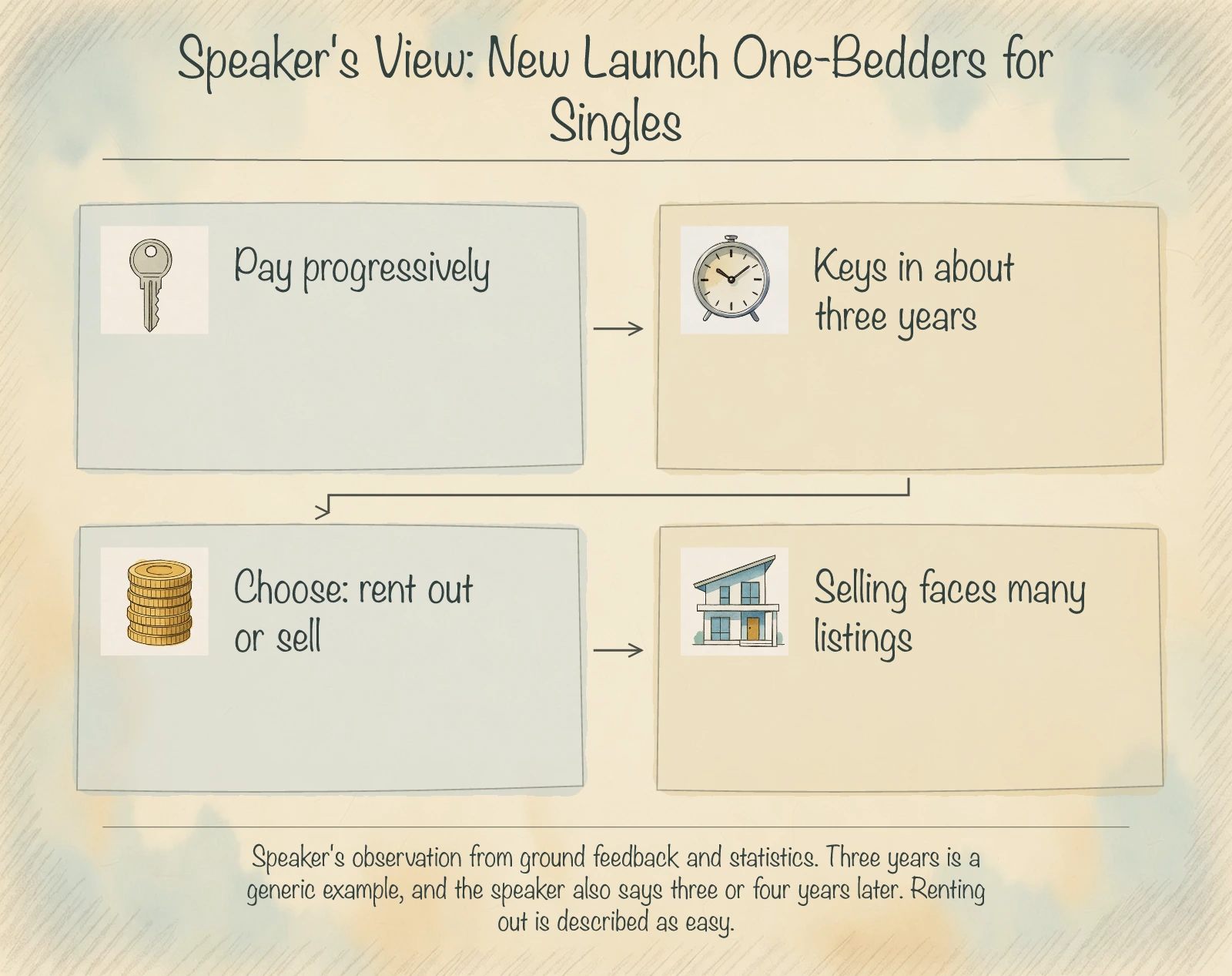
Then it brings us to the second part, is that what about after 3 years when the first-hand buyers that bought the 1B, when they want to exit, then will there be enough buyers to absorb this from the resale market?
So that is the key question. It seems to us that based on the amount of listings available, we just need to go to PropertyGuru and look at the amount of one-bidder available in the entire market.
It is a lot in the sense that there is strong competition in terms of the amount of supply in the market.
So that has been the hot topic that we've always been talking about in the BENTUS series is that if you want to buy, it's easy, but you need to be prepared that when you want to sell, you need time to find a buyer to absorb your one-bidder from a retail market.
If you want to rent out, I think one-bidders are easy to rent out. Which is why we always advocate that one-bidders is a rental play.
But if you want to exit, you need to be prepared as a buyer.
That bought the new launch in the first place—that three years later or four years later when you collect your keys and you want to sell, it's going to take a bit of time. Because you are competing with a lot of the one-bidders in the entire market.
I'm also going to give everybody a bonus link to the absorption ratio webinar that we did. So if you click on this link in the description box, I talk about absorption ratio for condominiums and 1-bidders have the longest gestation period to find a next buyer.
So this is something you need to be prepared about because in the very first place, if you look at the small size that is over here for the 1-bidder, the increment of $100 is not even enough to cover your stamp duty and your interest payments and your property tax and your MCST.
So you need to wait for it to go up by $200–$300 which might take time. So this is all this combination of effects, I think you have to take note of it.
Especially if that's it, this is your first property, you need to take note whether should you go for a new launch 1-bidder or maybe go for a resale market to hunt for a 2-bidder. Something of this approach, but of course that one we can discuss further and I'm not against 1-bidder.
1-bidder new launches—this is perfect for staying in, brand new; you want to rent out, I think it's hot favourite, it's a rental play; but in terms of capital growth, if you can stretch a little then go for something bigger.
But if not, I think it's a good start. It's just that when you want to exit, you need to take note of some of the things that I just mentioned about.
Now, so question number two. Do you think it makes more sense to start earlier on a small unit than, say, five years later on a two-bidder?
Now, it will always make sense to start earlier even though it's a one-bidder. So of course you might be saying, hey, Mel, it's because you know you want us to buy property.
That's why you want to start earlier. Now, no, it's not that.
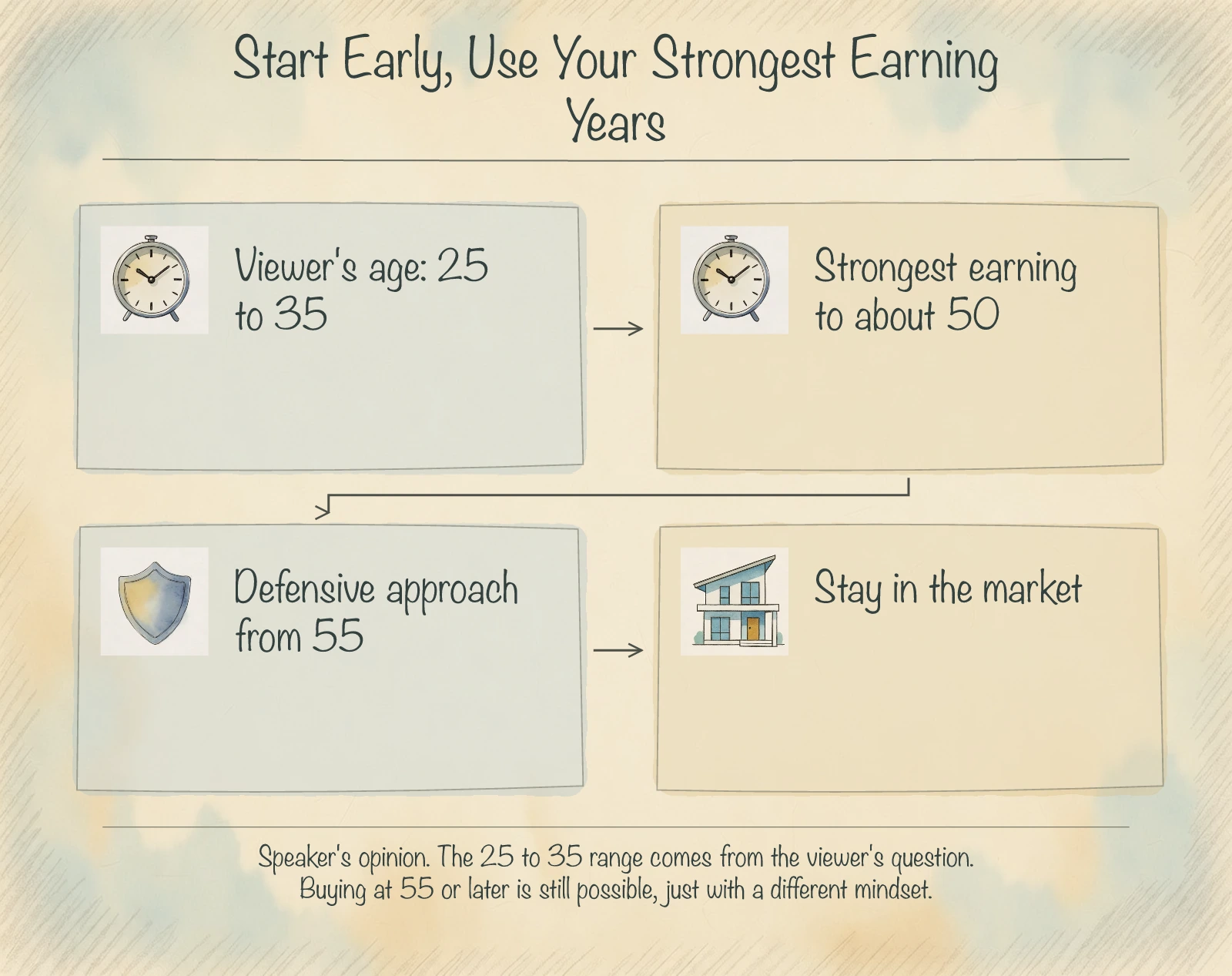
If you look at the amount of time that we have, please do not wait until you are 55 then you want to start buying your property.
Of course I'm not saying that if you're 55 you cannot buy a property, you can, but of course once you are into 55 this is of course the start point of what we call a defensive strategy. Now by the time you are 55 I think in terms of approach is less aggressive.
Of course we still have clients that in their 50s even 60s they are still buying properties, but it is of a different kind of mindset really. It's more for capital preservation.
Maybe they are moving to a landed, or maybe they have already diversified from a big landed or multiple properties, and then they are anchoring certain funding into a space that
Defensive Strategy After 55 and a Cluster Question
They can stay all the way until 90 years old, or they are cashing out some of the properties and then buying a big plot to rebuild for legacy planning. And there's a lot of different kinds of strategies to do that.
But what I mean is that if you are talking about this particular scenario that Chris asked, if you are 25 to 35 years old, you just need to calculate the amount of cycles that you can go in and out based on your strongest earning capability.
And I call it your strongest earning capability is up to about 50 years old because after that, I mean, there's things that maybe you want to do, right?
You want to travel, you want to retire a little bit, you want to not have so much anxiousness, reduce your mortgage, and maybe you have different kind of planning for your finances, your kids are of a uni-age and then maybe they are not at home anymore, you have a little bit of emptiness syndrome, you might want to travel a little bit, you might want to enjoy the fruits of your labour.
Because their whole life is not about accumulating so many properties that you cannot bring with you to your grave, and we all have to be very honest about that, right? We cannot bring the properties with us into the coffin.
I mean, you can of course create a legacy that you know you have 10 properties to live for your future generations. But of course, sometimes we all know that the more you live for your future generations, the sometimes you reduce your motivation in life as well.
So I think this is about legacy planning, which we can have another topic about it. But what I'm trying to say is that life is also about enjoying certain fruits of a labour as you accumulate and invest in properties.
You might want to divert some of it along the way, enjoy the fruits of labour, turn it into more liquid kind of holding so that you can enjoy it as well while you're still strong and young at 50–55.
So what I'm trying to say is that actually our investment points are very little. And these are your strongest period in terms of TDSR, whether you're an average investor, a beginner investor or maybe a seasoned investor.
But these are your strongest earning power. I call it the best years of your life, the best years of your investing life.
And if you spend 5 years to wait because now you can only afford one bedder but you spend five years to accumulate your additional amount of, let's say for example one bedder here, 1.3 million example.
Your down payment you need 25%, which maybe about 300 over 1000 plus 10% duty right, but because you want to buy a 2 bedder at maybe 1.8 million you need 400 over 1000 to 500 thousand and to accumulate the extra 100 over 1000, you wait for 5 years to save up to get a 2 bedder while you are 40 years old.
Take note that these 5 years, the price of the 2 bedder would have already increased because year on year we are still seeing a single digit growth in terms of the PSF level of private properties. And take note that maybe in 5 years time you cannot even afford back the 1 bedder anymore.
So it is always important to be in the market rather than time the market. So even though you can only go for a smaller one, maybe you can open your horizon a little bit.
Ask your consultant. I'll speak to some of our PIP consultants.
The link is right down below. 1.3 million instead of going for a new one bedder, new launch.
Maybe look at the resale market. See what's out there.
Maybe you can move out a little bit to RCR or OCR. OCR, you can still get a three bedder, but of course this amount, it's dwindling already.
So expand your horizon, get into the market first.
Expand the product category that you can. Try to get into the private property market first so that you can enjoy the best years of your investing life, where you have strongest earning power to get into the market.
And of course, five years later, should there be a capital appreciation, then you can divest it and go into something else. But it's always important to stay in the market, right?
Now, I hope that answered your question. Let's move to the next one now.
So I received this recently from my Facebook. Let me just share this particular question, okay, from BK.
Thanks for sending in. And this question says that hello Melvin, I've been watching your videos, I have a question.
I own and stay in the Freehold cluster landed semi-D in district 11. I held it for more than two years now.
What is your take on cluster landed on the capital growth as compared to a pure landed or freehold condo? Thanks for sending your question.
Cluster Landed vs Pure Landed vs Freehold Condo
Sorry, I think instead of me replying to you over my Facebook, I think it's better for me to just illustrate it, put it on this episode so that everybody can also share. Of course, with illustration, I think it's a little bit easier as well.
Okay, so this is a freehold cluster. Sorry, my handwriting is very thorough.
Okay, this is D11, all right, D11 freehold cluster landed. Okay, we're talking about cluster landed versus a pure landed versus a freehold condo.
All right, so pure landed, of course, I will presume is freehold triple 9. This is a freehold triple 9.
Okay, so this one, let's just categorize them, let's just align in the sense that freehold and triple nine is belonging to the same category. Okay.
And so we're not talking about 99s properties. I think perhaps BK, you are talking about this particular question because you are heading towards your three years SSD already, and maybe you're thinking about, hey you know, should I continue to hold this, what should be strategy in the next one year as I reach towards my SSD.
This is a very good scenario to talk about disparity effect.
Now, based on our observation of study of data and transactions and of, because, appreciation power. Fortunately and unfortunately, of course, for cluster properties, they fall into a hybrid kind of distinction.
So of course, if you talk about the Apex property, let's just introduce this term called Apex property. Apex property is something in the sense that it has limited supply.
It has the A star performance. It has good absorption from the market.
That means there's a good ongoing healthy demand, and it has very little kind of like challenge in the sense that the demand is still ongoing even though the price is still increasing.
And at the same time, when the price increase, the elasticity is not very high, in the sense that when price increase, I don't see so PX is price, when price increase, I do not see an increase in supply.
So I don't see this. Now, why is this important is because when a property is so elastic that the moment we see price rise, government reacts.
For example, HDB properties. Price rise for consecutive quarters, government reacts by building more BTOs, coming out with cooling measures for HDB properties, trying to bring down the speed of acceleration of HDB properties.
Now the rationale is of course, HDB properties, we mentioned many time, is not for speculation, it's really for having a roof over our heads, it's a kickstart to your real estate ownership journey in Singapore where government is doing a great job, all right, and it cannot appreciate so fast.
Now, condos at the same time, even though our government wants to have a little bit more free play, but they also have to make sure that it doesn't go into like a bubble cycle.
Just like what happened in the past, in maybe 1997 when there was no cooling measures at all to make sure that we keep speculation in check. Which is why we have ABSD for second properties, we have ABSD for foreign investors.
But if price would go up too fast, you will also realise that there are supply measures. Government might release more land in order to curb the aggressiveness of bidding of land by developers.
When we look at the Apex property, I'm talking about pure landed. So pure landed belongs to Apex property category because there's only 73,000 in terms of supply.
It has not increased ever since 2009 until today. The supply has remained the same.
You might see a little bit of changes. The reason is because people are buying up a single unit of landed and then chopping it up, or they are buying a bigger land plot, chopping up into two units or three units, we call it subdivision.
But there's no new GLS for landed properties. The new launches you see are what we call the old money.
That means certain developers has owned certain plots for a long period of time and now they decided they want to apply to SLA and launch it as a new launch landed properties. Now, it is a A star property in the sense that price performance has been great year-on-year basis.
Good absorption, meaning that when you put it in the market, if you price it correctly, people will absorb it. And of course this is a Apex property because you can value add to it.
You buy the land and then you can build something on top of it. Or it comes with two products, because with the land PSF, it also comes with your GFA.
So, and most importantly is that when price increase, you don't see government increasing the supply to bring down the increase in price. So for pure landed, it belongs to the Apex property.
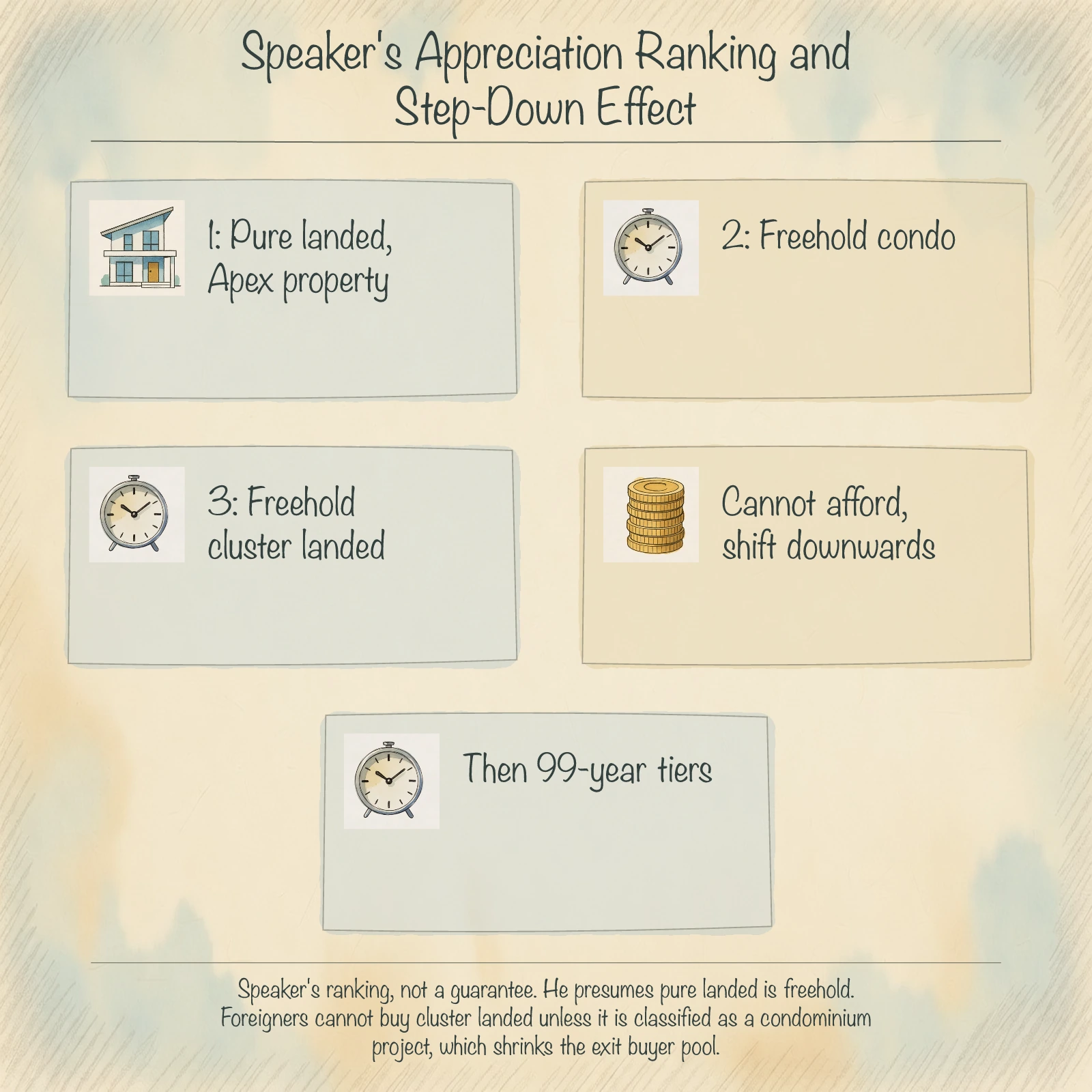
So I'll put it as number one. So disparity effect basically is to see when this becomes a new high in terms of pricing, which is now, it has appreciated since 2020.
When we look at a pure landed, in the sense that let's say for example somebody wants to buy an interterrace.
Substitution, Disparity Effect and Appreciation Ranking
An interterrest used to be able to allow you to enter about three million dollars for a decent land 106 square feet or 1080 square feet, but now, minimally you need like 3.5 million to 4 million dollars and you cannot go for this anymore.
So what is your next best alternative? You will then shift downwards and we call this a substitution effect.
So this is like in economics, we call it a substitution effect in the sense that because I cannot go for this, what is my next best alternative? And then in PRB, we call it a disparity effect because there's a disparity now in the sense that I cannot afford this, I will go for the next category.
And what is my next category? My next category would then be a freehold because let's say this is a freehold, triple nine.
And I want to go for a landed living so I might hunt for a cluster house and let's say if I don't like a cluster house maybe because I don't like to climb staircase.
Then I maybe will then go for a freehold condo that is like a 4 beta or 5 beta or maybe I'll go for a penthouse. Because maybe I want more facilities I don't mind the staircase but I want more facilities, I want tennis court and stuff like that.
And thus this will then sprout on even further, it will then go on even more.
Maybe if I cannot afford a freehold, pure landed, a freehold cluster house, a freehold condo, I might start to look for 99 years pure landed and then I will go for 99 years example cluster house and then maybe I'll go for 99 years condo and that's this what we call the disparity effect.
There's always this cycle based on affordability.
So coming back to your question, what do I think about the appreciation power of this type? Of course then I will rank it for you in this way.
Is the number one, this will be the highest appreciation power. Number two, actually, even though somebody might go for this, but I will still rank the freehold condo as a higher appreciation power.
Why? Because in terms of acceptability and demand audience is bigger.
This will be ranked as number three.
So why is it that a cluster landed has a lower amount of audiences compared to a condo is because of acceptability? And take note that cluster house also have restrictions in terms of foreigners restriction.
Foreigners cannot buy any cluster house. They have to buy a cluster house that has been classified as a condominium project.
If not, they are not allowed to buy cluster landed properties. So take note that this will then further shrink your buyer audience, your exit audience because you can only sell to Singaporeans or maybe PRs or foreigners with special LDA approval.
So on top of that, maybe some people might also think that hey, instead of going for a cluster house that technically I'm not buying the land, I'm just buying the build up, why don't I just go for a freehold condo for example?
So these are just some of the mindset thinking in terms of what I have experienced over the last 16 years seeing things on the ground. So I will rank the appreciation power base on number one, two and three.
So that's how I will look at things like this. All right, I hope that answered your question.
All right, so we'll come to the end of this particular episode. These are two solid questions.
Thank you for writing in. We'll answer more questions in future NOTG episodes.
You can go in there, meet our community, feel free to ask any questions. Of course, that channel was formed with an ideation that you know we just want to give back support of community and of course be there with you.
And of course sometimes we might not respond as much as we can but our team of banter presenters will also be inside there so feel free to just chat among yourself. And then of course we want to keep all the conversations healthy and positive as well just to learn from one another.
So thank you for supporting NOTG over the years. We hope that this will continue to allow us to do more good content for everybody and meantime take care.