Market and policy
New BTO Classifications and the possible ripple effect in the property market
Published 2026-11-10. Adapted from the episode published 2023-09-08. Figures, illustrations and data reflect the episode’s original publication date.
Introducing Standard, Plus and Prime BTO flats
Why is it important to understand this? Because on the surface it looks very clear cut but underneath there's going to be some ripple effects, in a sense, on the mindset of buyers, so let's go in depth from here.
Definitely there's no free lunch. Right?
So, plus, I think everybody has already heard the news about Standard, Plus and Prime new BTO flats that will be introduced from 2024 onwards, and of course we just want to break down what will be the possible impact to the current market.
If this were to be introduced in 2024, what is going to happen truly is that we will only see the real impact coming into about 14 years later, which is 2038 or 2037 thereabouts, and we're gonna break down for you in a simplified fashion what we think might happen.
Alright, so of course the first one will be the new classification of HDB towns. So in the past, BTO flats were being allocated based on mature and non-mature estates.
Of course, according to our PM, this framework does not work anymore because a lot of the towns have actually been developed into very beautiful townships. For example, just take Punggol.
It looks beautiful now. In fact, a lot of, if you go on the ground, a lot of our retirees, not only young people, love to stay in Punggol.
If you love the northeast part, a lot of retirees actually are coming from all parts of Singapore, even from Jurong, to sell their property and then going to Punggol to retire. And Punggol has become one of the hotspots for a lot of families, retirees, young couples as well because of the rate of development.
And I think it's also because of that very beautiful connector park that links all the way towards the entire Punggol waterway that makes it so interesting. Now, it will then of course be classified without this classification.
Also this will be removed and they will classify it just purely based on the type of flats
which is Plus, Prime or Standard kind of properties. So as you notice, what is going to happen is like this.
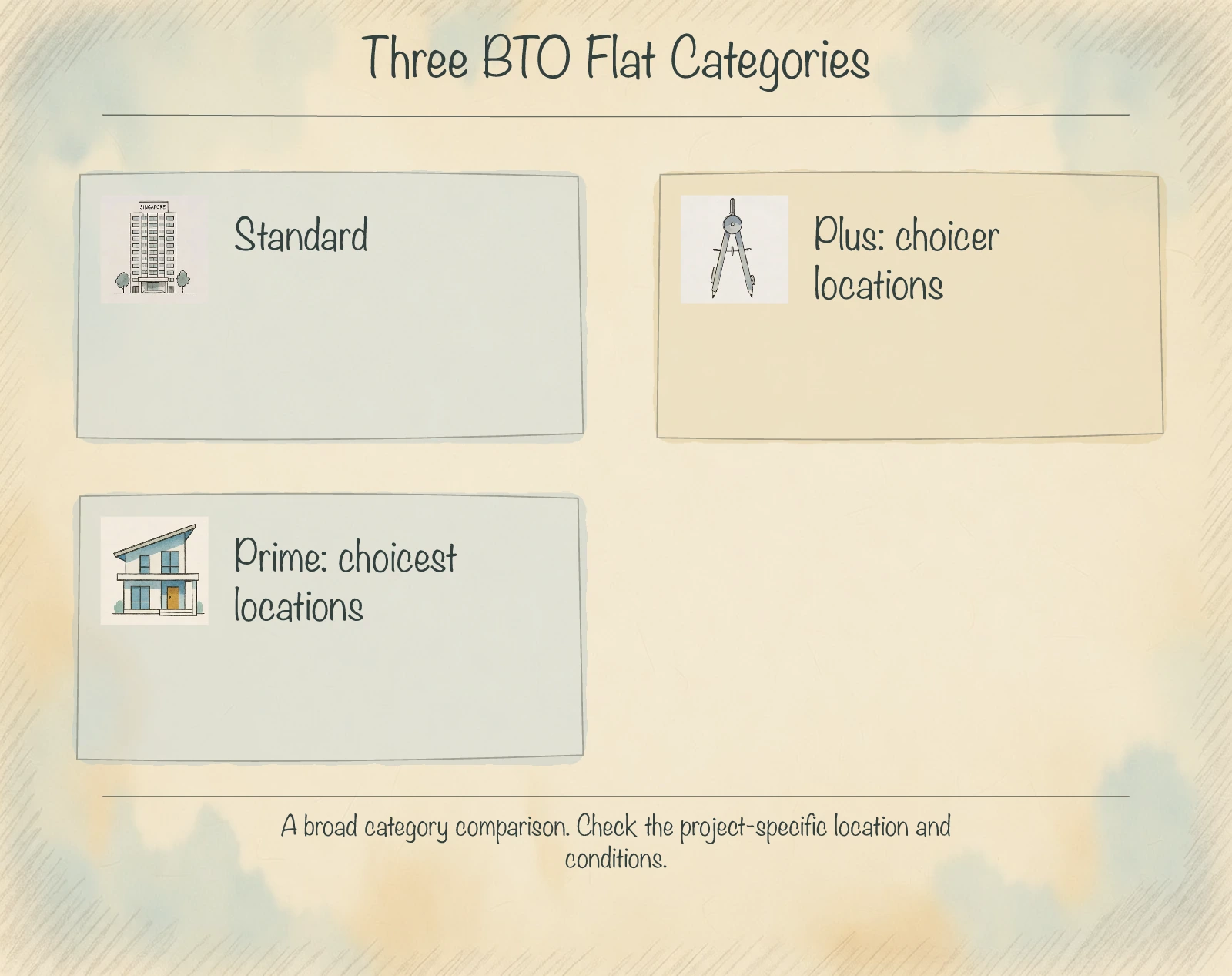
So if we were to look at the map and the classification, basically Standard kind of BTOs will be the main supply across entire Singapore.
In the sense that if we look at the next categorization, Plus, this is a new model, the description is that it's going to be choice locations within the regions and it could be near transport node or town center.
So very clear cut, I think all the near MRT plots in all townships will be Plus property. So for example, even if you talk about Punggol or Sengkang, as long as it's near to the MRT station, is near to transport node or even near to a very major shopping mall, it might most likely be a Plus model.
Anything that probably needs to take a feeder bus away from an MRT station, they will be classified as Standard. And the key jargon we want to focus on today for
today's episode is that Plus will be near MRT. Standard might not be near MRT.
Okay. And then, and okay, so coming back to this, I think it's also very clear because PM brought out the example of Central with the one that's over-subscribed, 17 applicants to one property, the Amo Kio latest BTO that's a very good location near the MRT station, super over-subscribed.
So I think from that hint, we're going to see that Plus will definitely be near the MRT station. Now Prime will be properties that are in the Central region.
So if you notice this map that's being published, there's no mention of Prime in other parts of Singapore, basically it will be the central region and you will be in the GSW, Great Southern Waterfront; it will so-called be renamed from the prime housing scheme, which is a PLH model.
So previously we have been so used to PLH, PLH, right, housing scheme. Now it will just be called Prime.
Now based on this, why is it important to understand this? Because on the surface, it looks
very clear cut but underneath there's going to be some ripple effects, in a sense, on the mindset of buyers, so let's go in depth from here. A few key things I just mentioned: that Plus, just do you remember, it's going to be near MRT station; Prime is central; Standard is not near MRT station.
Now I'm going to bring up my points and then we're going to look at some of the key very interesting features here. So whatever we see, this kind of news, what we want to understand firstly is that definitely there's no free lunch, right?
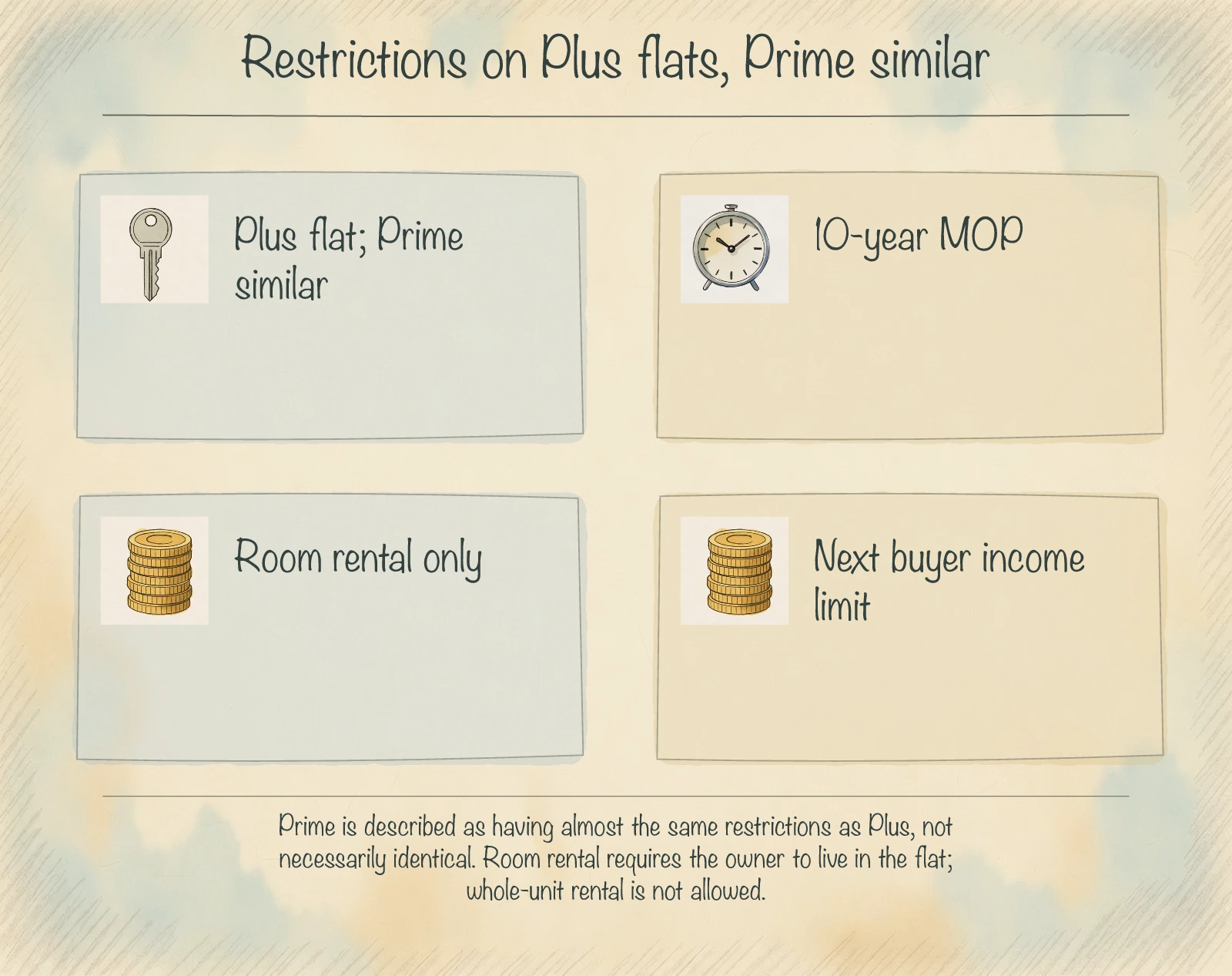
So Plus — you want to go near MRT station: firstly 10 years MOP, alright. Second thing that is the most important one is that you cannot rent out the entire flat anymore even after you fulfil MOP, alright.
Third is that when you want to exit from your Plus property, similarly to Prime, this too has almost the same kind of restrictions after you hit MOP, after 10 years
Plus flat restrictions and likely mindset shifts
The stay restriction is that your next buyer, in terms of their combined income as a family, cannot exceed 14,000. So this is the restriction.
There are three major restrictions. Number one, 10 years MOP.
Number two, you cannot rent out the entire flat; you can only rent out the rooms. But take note, when it comes to HDB properties, if you want to rent out the rooms as room rental, you must stay in the property itself.
If you don't stay in the property and there's an inspection, you're flouting HDB rules; HDB has the right to repossess your home. Now take note, room rental means that you are occupying the place as a primary residence but rent out the rooms.
Whole unit rental can be done after you hit the MOP period for all types of resale HDB now and standard HDB BTO, but no longer allowed for the new Prime and Plus. You cannot rent the entire place now.
With these three restrictions, let us look at some of the possible mindset shifts on the ground that might happen next year.
Okay, so we'll summarize it for you over here. But then we are going to look at a possible impact.
So with this, I'm going to draw out some key things. Number one, let's look at, let's say if I'm a young couple, okay, let's say me and my spouse, me and my fiance, we are planning, let's say, example to buy a BTO.
With this right now, what's going to happen next year is that when we look at the choices in the market, you only have Standard, so you have Standard BTO. And very likely this would not be near MRT.
Okay, so let's say you want to go for Jurong. These locations would not be near MRT.
You want the Jurong near MRT version, it has to be Plus. Okay, so this MRT.
However, take note that this will be four years if the construction goes well. Of course, during COVID, there were people that have waited for six to seven years, but now the government has of course done their best and they want to really put out the construction period to be around four years.
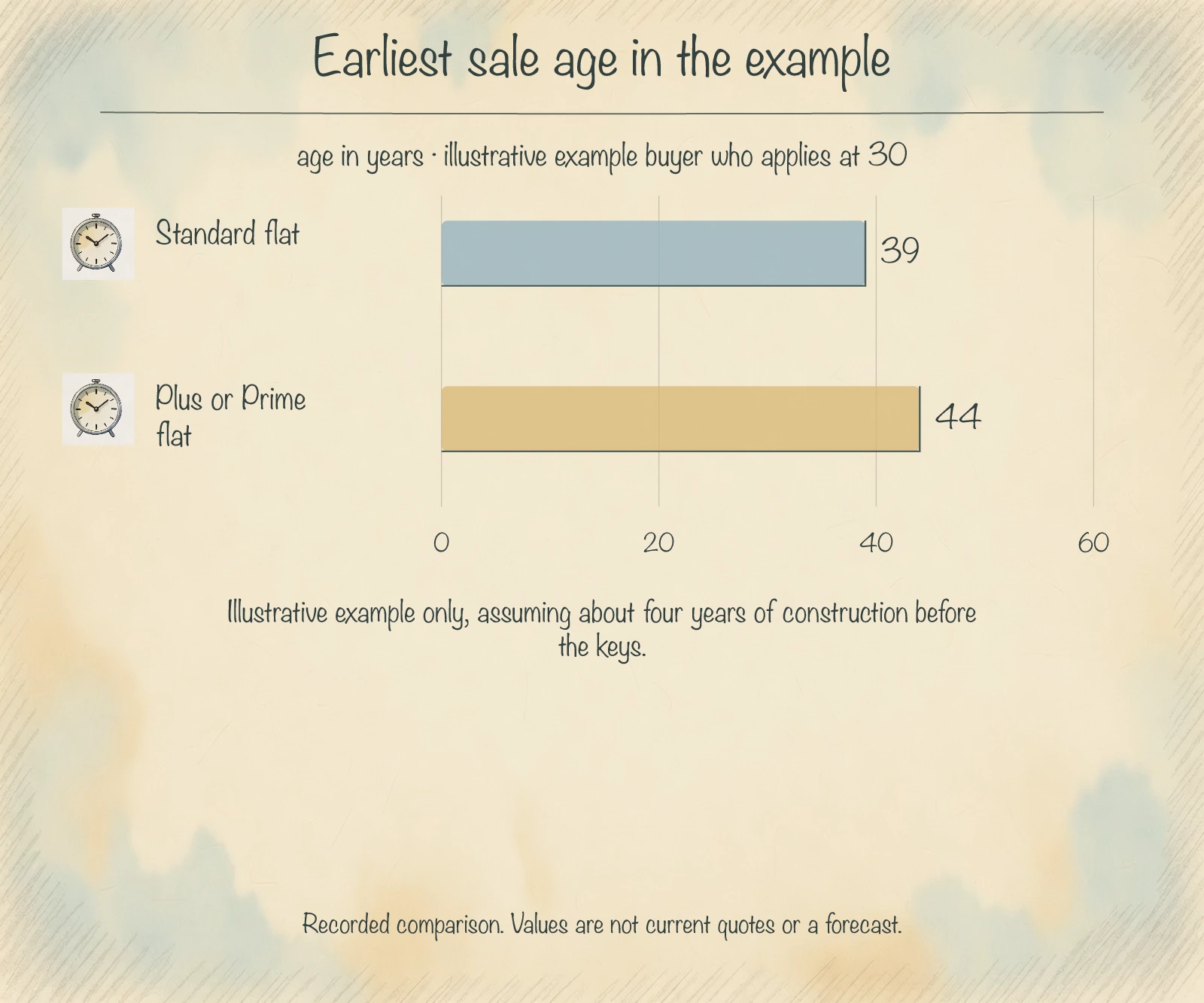
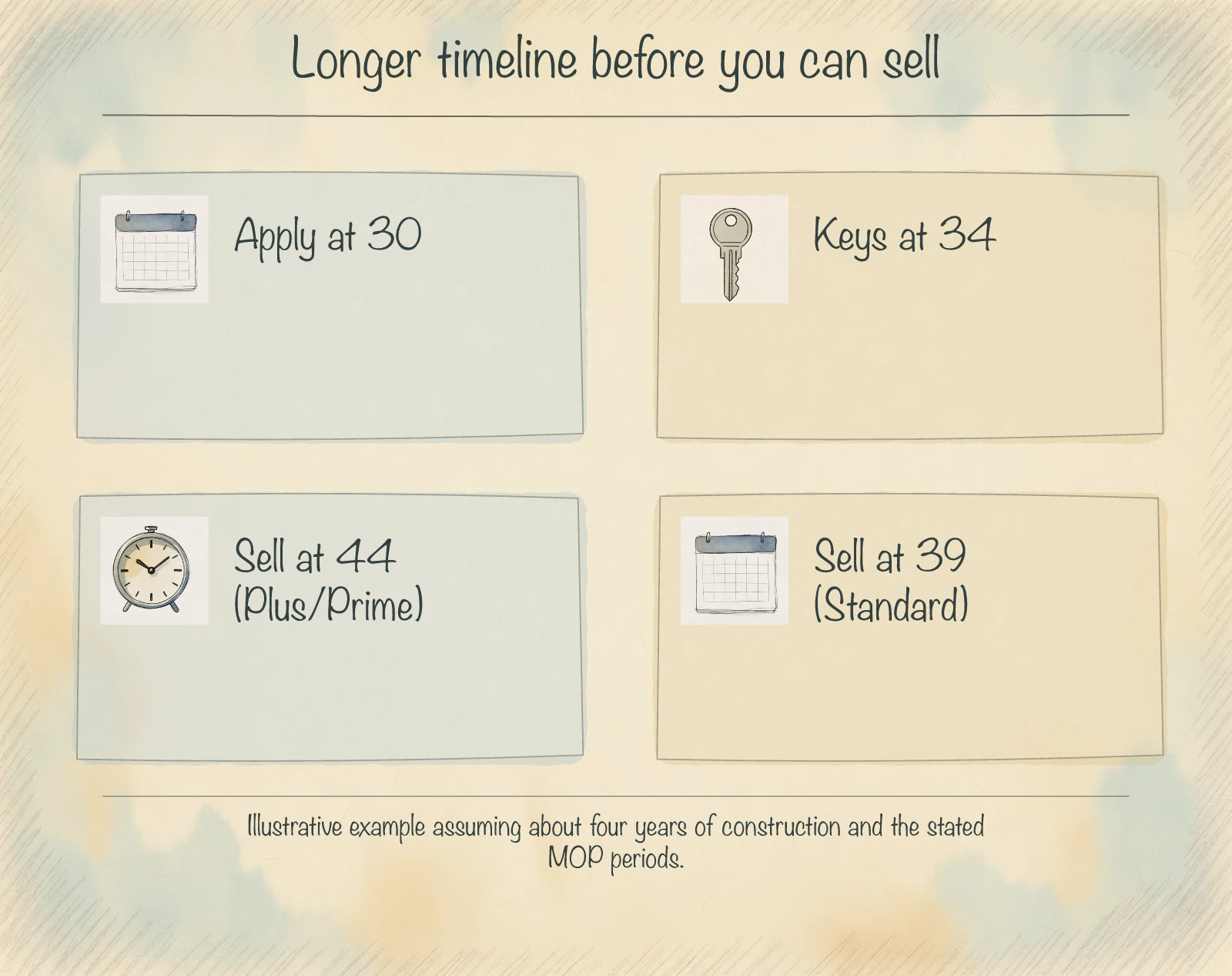
And you need to stay for 10 years. Now what is going to happen is that, for example, if let's say you are 30 years old now, 30, you apply, once you get your keys you are 34, by the time you can exit and sell you are 44 years old.
So you have completed a 14-year cycle, alright. Now for Standard it will be the same four years construction and then five years, you hear MOP, and let's say if your plan when you first purchase a BTO is that you have early 30s, this is going to be the next 15-20 years going to be our highest earning power.
And we're going to build our family, have kids, but we're going to accelerate on our career, want to do well. And then maybe you have a plan that, okay, by the age that you hit, maybe 55, you want to slow down, right?
Most people, they will start to plan for retirement, kind of strategy for their real estate asset at about 50 years old,
Read chart values
illustrative example buyer who applies at 30 · age in years
| Comparison | age in years |
|---|---|
| Standard flat | 39 |
| Plus or Prime flat | 44 |
because if you turn 55 and you only do your final move after 55, what's going to happen is that there's going to be a certain amount that will be locked up in your retirement account in your CPF and you cannot utilize the full amount for an OA into your next property.
So most people, they will do the move around 54 for their final primary residence. Now that is just a slight information but let's come back to this approach.
So let's say you're a young couple that has a plan that in future after your first BTO because now maybe you're building out your income, you don't have much down payment for private property and you don't want to go to resale because you want something that's brand new and maybe you're thinking that okay BTO, there's a higher chance to see appreciation.
So what's going to happen is you also have this plan that your next property is going to be a private property. So if that's the plan, plan A, if you
go for a Standard kind of property, you're 30 years old, get your keys 34, by the time you sell is 39, you move into your new, let's say you upgraded to a condominium or maybe a landed property, you got to be 40.
Here by the time you are be 45.
First impact is your tenor for your next home because loan is based on 65 so here is 25 years of loan tenure, of course you can do refinance stretch up to 75 that is another topic altogether but here the key impact is that by the time you enter into your property you're 45 your loan tenure for your L.O.
is about 20 years so your money is definitely going to stretch up higher, alright. Take note that that's point number two is that your loan tenure will be affected, but point number three is that take note that you're losing this 5 years here and these are opportunity costs because if this is an uptrend market,
Opportunity costs and the HDB-plus-condo route
You could have entered into a private property market or a landed market at age 40, in which year. Let's say now it's 2023.
9 years later, you move in in 2022, 2023, 9 years later, it's going to be 2032, 10 years later it's going to be 2033. So by the time you move in 2033, this is the part that if you went for route A, you can go into a property market in 2033.
Just imagine if in the next five years from 2032 to 2038, the private market went into a bull run. Example, you're going to be priced out in the sense that you lost these five because you are in plan B.
Okay, so that is the second or the third impact. Okay, now let's come to plan C.
C is prime. So prime and plus is the same.
Alright, so we'll just stretch out to 14 years. And what is the next level of thinking that might go through a young couple's mind is that first.
My first so-called like assumption is that if this young couple is a couple that wants to get into a BTO first because they want to build an income.
They cannot get into a condo right now, they cannot get into a land right now because they're still young and all that, building out their down payment and that's all I'm fine. And they want to build a home to get married and settle down, have kids and all that.
But they have a plan to go into a second property next time.
So by the way, if you have not seen that episode that we have interviewed Javina and Joanne, And basically, there's a lot of families that have already had a very clear plan at the start phase, similar to Joanne and Javin just at the point of buying.
They already planned next time when they hit LOP, they want to buy a prior property because they want to have like a multiple property investment. And they have already planned out that either they will have one HDB and one condo or they will sell off the HDB and have two condos.
Now, is it possible to have one HDB and one condo? Yes.
The only way to own one HGP and one condo, despite all the myths in the market, is that you have to go through this route first. You have to go through the HDB route, complete your MOP, then you buy your condo.
How do you do it? Let me come to the second page for you.
So I just start track a little bit and then I'll come back to plan A, plan B and plan C again. First, you must fulfill your MOP.
So the only way to own a HDB and condo is to go HDB route first. So you must go HDB route, fulfill MOP first.
After that you have two ways. Okay?
One way is you pay ABSD. One way is you don't need to pay ABSD.
Now let me just talk about the ABSD first. So firstly to buy another prior property and continue to hold on to this HDB, this is what we call a rental play because you want to accomplish one HDB plus one condo and why do you want to do that because HDB has the highest rental yield.
You purchase a HDB let's say a BTO 600 over 1000, your yield is going to be fantastic and the rental yield is the highest, you will be able to use a rental to pay for the money installment here or let's say some people they actually plan to fully pay off their HDB once it reaches that movie because maybe you have a lot of CPF and force saving and stuff like that.
And you can then use this rental to sustain your condo's installment as well. That's how people plan for one HGP and one condo because the cost of maintenance of this HGP is very low, rental is very high, money is always lower.
Yield is definitely better than a condo or a lender. So HGP has the best yield.
That's why a lot of people love to use HGP for rental play situation. Now, the usual route is that people, if you put in two names here as owners, you have to pay the ABSD for second property.
So you pay ABSD, you buy the bullet. But their mindset is that I will use my rental for the next X number of years for my HDB to pay off myself the ABSD that I have paid for the second property condo.
That is their strategy. And of course with that, you have to take on the next point is that your loan to value for your condo loan.
Because if you have not pay off your HDB, you cannot take 75% loan. You can only take your 45% loan.
So you need to take note of that. So most people, when they go for this HDB and condo plan, they usually pay off their HDB, then go for this.
Now, there's a second way is that at the point of purchase of a HDB, you go for owner plus
Owner-occupier route and a young couple's options
occupier route. Now, owner plus occupier route, of course, if you do that, take note that in terms of the income eligibility and loan repayment, CPF payment usage, only the owner can use.
So that is a disadvantage in the sense that if you don't have enough income and you want to sustain this payment for the mortgage, you can always use one person income.
But the advantage is that after five years of MOP, what's going to happen is that this occupier is treated as not owning the HDB because there is just an occupier and when this occupier go and buy a condo there's no ABSD and that's how you accomplish the one HDB and bond one condo kind of concept as well.
So there's pros and cons for both methods but take note that this ownership plus occupier rock can only be done at the start point of the purchase of the BTO of the resale HDB.
Also, a labour on advertisements of what's going to happen on the 15th of September is that we're going to have a live debate right here. Come to our PRB office.
It's got PRB ascent. We're located near to Thaising M.R.T.
Parleba region. Just come here.
We have a lovely office. 3 Starbucks coffee on the house.
We're going to have some small bikes and stuff like that. But you're going to come here.
we're going to have our live debate first round. We're going to have two teams that would debate HDB, BTO versus HDB resale.
And then the following two weeks later on the 20th plus September, what's going to happen is that we're going to have a live debate with another team as well. And these are all my PRB consultants.
They are going to take the position of condo versus lender. So if you're very keen to watch our live debate, join us on this first time live debate.
So we've got a live cast that for you. So I think it's going to be very fun.
I'm going to be the moderator. We're going to have fun together.
All right. So coming back to this, this plan basically is for you to accomplish that one HDP plus one condo kind of concept.
Whether you want to pay a BSD or don't pay a BSD, remember to plan right from the start because a lot of people don't know this.
Once you have put in your names, take note that let's say if you have purchased your HDB with two owners name there's no more changes you cannot change to occupy it anymore alright let me come back so where's my whiteboard boom alright okay nice love this screen man okay ABC what will happen in the mind of a young couple that is contemplating A, B or C kind of BTO next year.
Is that firstly, if they don't want to buy a car, they want to be a near MRT station, they only have one choice left which is plus. But that's going to jeopardize their plan because this couple wants to have one HB and one condo.
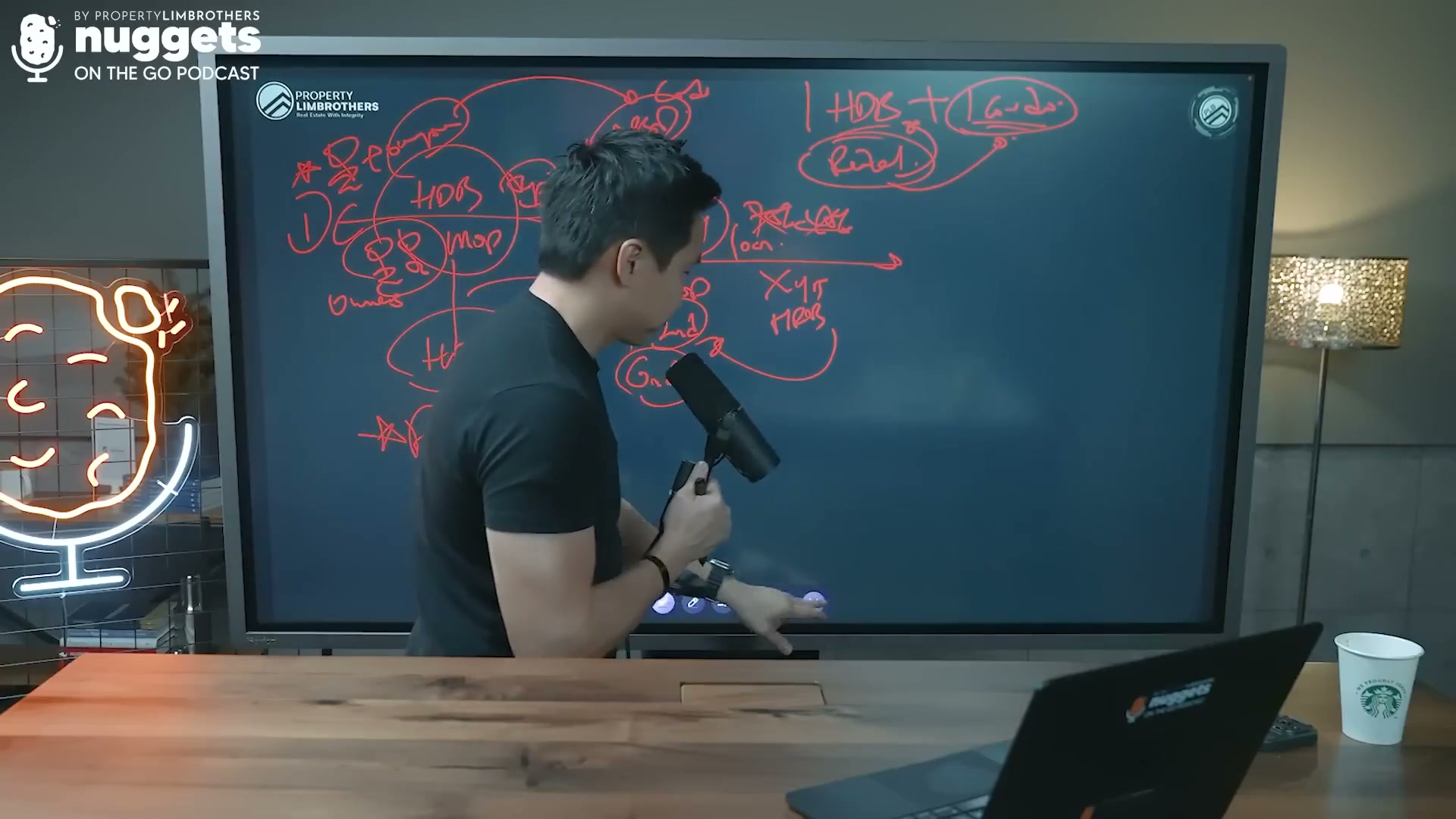
They want to use the HB as a rental play but now techno they can't use this as a rental play anymore.
So plus and prime, you cannot accomplish the plan of one HB and one condo in the sense that even if you buy the buller and pay absd for your condo or you don't pay absd for your condo you can't rent out the whole unit anymore.
And please don't risk this by sort of like illegally renting out a unit because if you are being discovered by hgb the consequences are very very dire all right so please just follow the hgb rulings all right.
So basically you can only do room rental so there's no point that you go for plus or prime flat if your intent is for like a an expansionary route to own two properties.
Of course, if you love the prime location, central location, you love the MRT location near to your parents place in the same township and you are not going to sell, you are very clear, then all good and fine.
You can go for plus and prime. But if you are on an expansionary kind of plan and you want flexibility in future, then it will make sense to go for standard.
However, because it's not near to MRT, you might be thinking, hey, for the next five years here, it's going to be quite painful taking the feeder bus and taking grab and stuff. Then this young couple might start to explore D, which is resell HDBY.
And they will go for near MRT. So my own forecast is that from now towards the next 14 years, because take note, we're only going to see the impact of plus and prime
Resale HDB near MRT and levy considerations
Time in 2038, 2037 because Prime started last year, 2022. I add about 14, 15 is about 2037.
This started 2023. I add about 14, 15 is about 2038.
So we're going to go to see the impact later on. That's very far away.
But what's going to happen now until the next 14 years is that couples that are thinking in this mindset, that they might then think about the resale HDB near to the MRT currently in the town that they like.
Let's say they want Jurong, they want Punggol, they want Sengkang, they want Woodlands, they will hunt for those near MRT stations because that is their main criteria to have an MRT version.
And they will just buy, they just wait 5 years and they can go ahead and get another condo once they are ready, of course they can take 5, 6, 7, 8 years to save up the down payment for the next condo and stuff like that, or they can sell and move to the condo, or they can use the 1 HDB
and 1 condo kind of strategy whether to pay ABSD and LTV kind of stuff that I just talked about just now. So this will then work.
Why? Because this model, since the mindset is that you are going to rent out the whole unit anyway as a rental play, then whether is it a brand new BTO or a resale, it doesn't matter anymore because you're not going to sell.
So this category of owners, they have this few key mindsets. Let me share again what is that key mindset.
Firstly, the first mindset is that they are not going to sell the HDB. Why?
Because they are using it as a dividend rental play. Secondly, they want to accomplish one HDB at one condo.
And since they want to accomplish this and use this for rental play, even if they go for a resale that has the balance of 85 or 75 years, it doesn't matter because it still has 75 years, 85 years to go, they can just go and rent it out.
Why? Because it's near to the MRT.
So this is the type of demographics that I think will spill over into the resale HDB route hunting for properties near to MRT station. And I think this would then create a fresh demand for properties right now, they are near to MRT station.
And of course, the grants are created in the sense to be different. So what do I mean by this?
Basically, why are the grants different? Just have a look at the BTO grants versus the resale grants.
Resale grants easily 100,000, 100,000, I think 20,000. And I'm not even talking about the enhanced.
I'm just talking about family grant, near family grant first-timer. Easily you can get 100 to 120 if you go for a 4 room, if you go for 5 room, slightly lesser but it's also a substantial amount.
And the mindset is that because of the grant, if you go for a HDB resale, you pay something at about 650,000. Example, you go for fresh MOP, 4 room, near MRT.
Example in Sengkang.
Alright 650,000 you get 100,000 grant technically your price is only 550,000 and of course all these MOP properties you have not watched our Work Nuggets on a good discussion. There was an episode with Rihong and Linda we talked about this fact that a lot of the MOP just five years their renovation is only five years old.
You're going to get renovation that adds five years so that is very new modern renovation and you don't have to worry about investing cash onto renovations. You can just take the property as it is.
Maybe just spend $2-3,000 dollars to paint, bring your furniture, maybe spend $10-20k on furniture and then you're good to go. So your total cost maybe just plus another $25k, $5-75k you're good to go.
Now the logic is that five years later, since you are not going to sell, you just need to rent it out. And let's say the rental right now is I mean easily people are asking for about 4000 I mean just a
hypothetical example but that's around the rough rate right now then of course if you just divide in terms of gross you how do you calculate gross you 4 times 12 48k just divided by your flat price 5 5 0 you want to even divide by 575 is up to you no problem.
Because why this 100k is given to you as a grant and once it's given to you, the misconception on the ground is that you have to return it. You don't have to return it.
It's inserted into your OA account, you and your spouse. You don't have to return it.
You only need to return what we call the levy. And that is called the resale levy.
If you go for a second property, but you want to buy another subsidized property, let's say you want to go for like a BTO, but you have taken grant here. You need to return the levy based on the flat type that you have here.
But if you're not going to go for a subsidized
Keeping the HDB as a rental strategy
One, you're forever going to a resale HDB all the way, or after owning this, you just go for add on one more condo. This is yours to keep.
And the rental is fantastic. You keep this HDB, it's a defense strategy, we call it rental play strategy.
And this kind of strategy is very, very prudent because you keep a HDB, you own a condo, you move it to a condo. So you ran out this, let your kids enjoy the facilities, enjoy the appreciation of the condo as well.
This one whether you appreciate or don't appreciate, it doesn't matter. You're just keeping it as like a defense mechanism.
So that's for today's topic. And with that, I hope that you enjoy this session where we take standard plus and prime and look at some of the possible repos in the retail market.
And of course, through this, it's basically to share with you like this key strategy about one HDB plus one condo. So I hope that you enjoyed this episode with me and Duggars on the go.
I'll class do and draw a banter series. And if you have any comments, anything that you want to answer, anything you want to learn about real estate, just palm in the comments below.
I'll be very happy to answer. If you're my ex Valvelin, we'll see you on the next episode.
For example, HOMBO has in recent years been a very popular place for... I'll go to sleep.
Okay, let's do it.