Buying and upgrading
Navigating The New Era of Singapore Real Estate: Insights You Must Know!
Published 2026-11-11. Adapted from the episode published 2024-05-24. Figures, illustrations and data reflect the episode’s original publication date.
On this page
- Introduction and Agenda for Today's Session
- Upgraders Moving Toward Bigger Homes
- Small-Unit Returns and Inflation Eroding Debt
- Leverage, Inflation and Interest Rate Flexibility
- SORA Transition and Foreign Buyer ABSD
- Foreign Buyers, ABSD and Life-Stage Planning
- Retirement Needs and Landed Segment Shifts
- Future Population and Resale Condo Outlook
- Resale Forecast and Closing Remarks
Introduction and Agenda for Today's Session
Hi, good afternoon everybody. I don't know whether you guys had your lunch, but I have about 35 minutes with you.
So let us kick start. Thank you, Etiqa and Singtel for inviting PLB for today's session.
I didn't know that it's a master class, but what I'll do is I'll do my best. So this is our topic for today, and of course I think that everybody in Singapore is very interested in the real estate market especially for this year, and of course we are coming to year end.
What I've decided to do is that because 2023 has been so interesting, in the fashion that I think this year has one of the most real estate news that is hovering through our media space almost every week, and of course because at the start of the year, we saw a couple of US banks collapse.
What they termed as the banking crisis, we also have news like this, where we had a fresh introduction of ABSD. In fact, this round of ABSD, which was on the 27th April, 2023, was one of the biggest hikes in terms of ABSD for foreigners.
We also had that new policy whereby if anybody were to downgrade from private property to HDB apartment, they will have to wait a 15-month cooling period unless they are above 55 years old in their retirement stage or they are buying a four-room and below.
So this news are not new. In fact, Q2 we saw the first dip in the non-landed residential, meaning condos and apartments, specifically the RCR segment.
We also had that recent money laundering cases that has happened over the past one month, and of course this has been the hot topic since then.
So what is happening in the real estate market? This is already the 16th round of cooling measures.
If you see that all these dots over there, and it seems that the more cooling measures we have, the higher the prices went up, and it's like we're stuck.
So technically what is happening is that whether you're looking at the yellow colour line which is the landed property segment, if you're looking at the red colour line that is the condo segment, the blue line will be the HDB apartment segment.
So it seems that though we have 16 rounds, but our government and policymakers they cannot remove any cooling measures. The moment they remove, what is going to happen is that the demand will rush back into the market and that will propel the prices even higher.
So what should we do?
I mean like is the market overpriced, and if let's say you are currently a property owner and let's say you have aspirations to move to a new place, or you have aspirations to buy a bigger home, or you are planning to get a second property, or if this is your foundation years that you are planning for your first home, what should be the next steps?
So this just came about two days back. The Q3 flash estimate registered a slight dip in the CCR market.
We call it the core central region which are where all the prime properties are.
We also registered a 4.0% drop in the landed market and later we'll talk about that. But at the same time we also have positive news that Singapore is one of the rare countries that our household wealth rose compared to the rest of the world.
In fact, our household wealth actually rose quite a fair bit. In this Urban Affordability Index report, we also came out first in terms of the median household income compared to a lot of global cities.
So what I'm going to talk about today is we're going to talk about three things and I will do as much as I can. But what I've done is that I've broken down the key insights for you to hopefully make an informed decision over the next 18 to 24 months.
I broke down into seven insights that we have discovered by our research team. I will also touch a little bit about the high interest rates environment and of course if you're hunting for a property, what can you do using some methodologies that we have always been using for our clients.
So quick disclaimer, this is of course a masterclass so it's for education purposes, and a quick introduction: if you have not met before, online, digitally, my name is Melvin Lim. I've been doing real estate sales for 10 years.
At the start of my career, I used to be a prison officer for three years. And after 10 years, I started a company called PropNex Brothers Media.
Today it is a creative agency. And last year, I started a realty company.
So my aspiration has always been to marry media and real estate together.
We have a couple of different channels talking about different things. Recently, of course, we also interviewed a couple of entrepreneurs.
We had a live debate session. And this is our team.
So it comprised of the creative agency on the left-hand side, as well as the real estate consultants on the right-hand side. And they work hand-in-hand together to serve our clients.
Upgraders Moving Toward Bigger Homes
So in short, let me share with you a quick one-minute video just to share what we do on a daily basis. Time.
Big power. Big power.
Big power. Big power.
Big power. Big power.
Big power. Big power.
Big power. Big power.
Big power. Big power.
I We must be out of your mind All I need is love Love is love I'm walking in that air Love is love I just wanna know Love is love I'm trying to take it from you Take it from you Take it from you Take it from you Take it from you Take it from you analysis and aspects of homes into the home tour video.
So let me kick start to talk about the seven PRP insights that we have. Maybe a show of hands.
How many of you here are renting homes right now?
Maybe just a quick show of hands so that I know who are our audiences. OK, great.
How many of you own properties in Singapore? OK, great.
So almost about 90%. And then we have about 10% of our friends who are renting currently.
OK. I think whether you are renting or you're owning homes or you're planning to switch the seven insights that we have will more or less be able to help you with the trends in the next 18 or 24 months.
So the first insight that we have is that we have discovered that in this new season, ever since that we have exited from the COVID period from 2020 onwards, going bigger tends to be a wiser choice. Why is that so?
It's because it will prime you for an easier exit. Now why is this syndrome happening?
It's because of various cooling measures policy. So in fact we thought that the cooling measures policy will actually curb demand but it sort of created and directed a new kind of demand towards bigger homes.
So these two years what we have noticed on the ground and through data and research is that a lot of families they start to have this new mindset is that I only have one chance kind of syndrome and of course they would choose to buy as big as they can.
Why is it that there's this new syndrome is because of the TDSR impact. So this impact is actually huge in the sense that because of the stress test and it's harder to get a larger loan and And of course, the threshold has a higher kind of qualification limit.
What has happened is that a lot of people find that in the past, the old kind of, not say the old, the previous kind of strategy was actually to own more properties.
So we have clients coming to us with two one-bedders, one two-bedders, and maybe they are living in a HDB apartment. So they own three different condominiums for rental.
They live in a HDB apartment. or they are also client with portfolios like maybe they are living in a three beta condo, but they own another two units of one beta.
So what is happening is that that was the strategy in the past is to own as many as you can, rent them out, and then of course, as they are being fully paid towards your tail end of your tenure, then that becomes like a retirement property that you can cash out.
However, because of the TDSR measure, what is happening is that the name is insufficient to purchase a property just for their own stay as well.
So the strategy has sort of shifted from buying more in the past to strategizing how to buy a bigger place. And this of course has added on to a lot of our syndrome because the name is insubstantial.
So if we look at what has happened over the last three rounds of TDSR impact, technically a household, husband and wife, even if they are both working, They are loan quantum, if I add on ever since 2013 until today, there's a total reduction of close to 20% in terms of loan quantum.
And thus, that has resulted in this thing happening in the market, which is that smaller properties has failed to perform over the last nine years ever since TDSR has implemented.
The rationale is because when 2013 has that new TDSR measure, demand shifted to bigger properties and tasks a lot of families at HBG Upgraders, they are moving towards the bigger homes, three, four-beders, penthouses, ground floors, the landed properties.
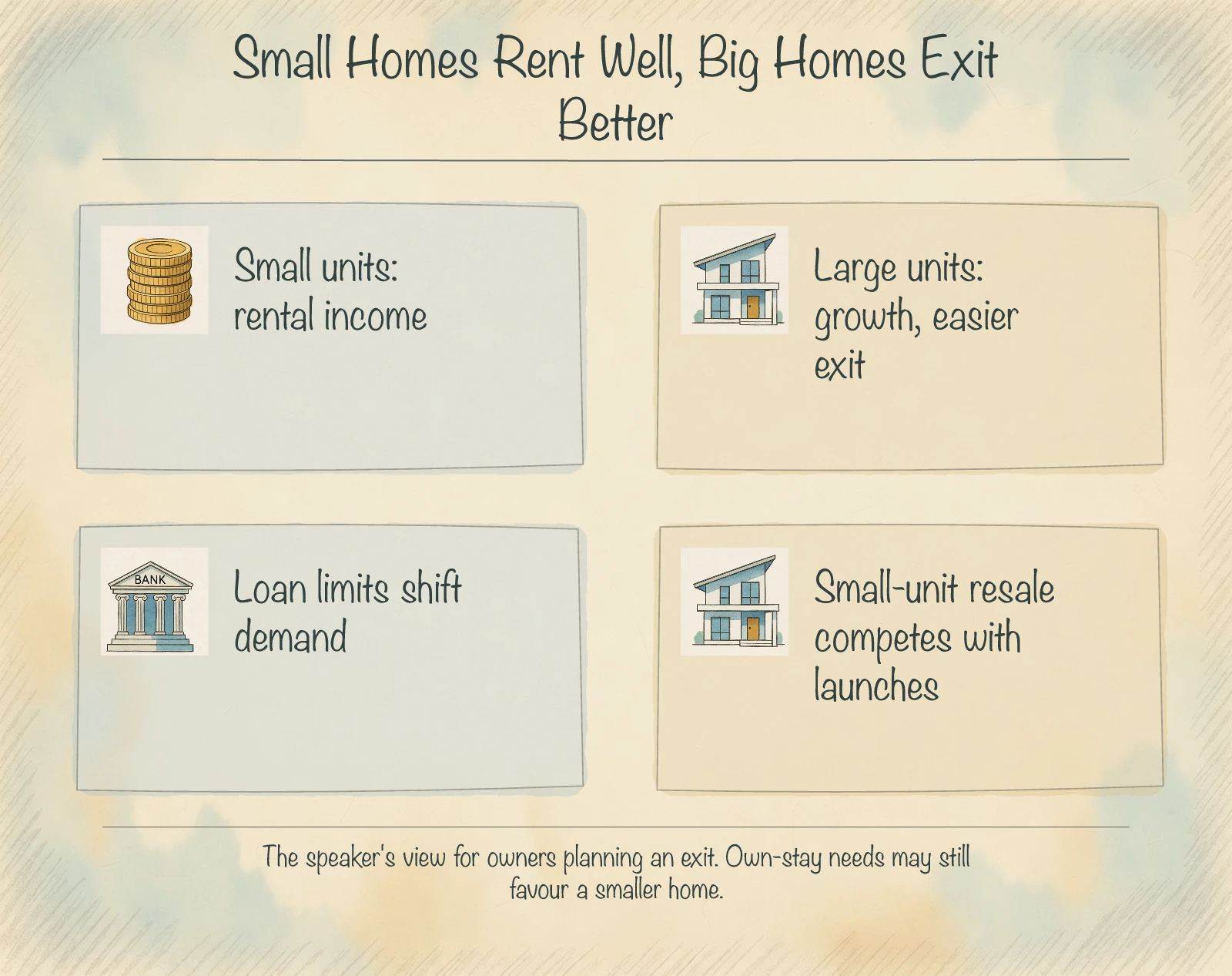
And if we look at the performance of smaller properties over the years, you will tend to see that the larger homes in the same development, even though PSF level increases, but because of two things happening at the same time, developers are building smaller and smaller one and two betas.
And if we were to compare light for light, sometimes if let's say somebody would own like a one beta, they can hold it all the way from 2014 until today, sorry, 2014 until over the eight years period, but their paper gain is only probably not even enough to cover
Small-Unit Returns and Inflation Eroding Debt
Their interest costing, their stamp duty as well. And of course, if I were to add like property tax, agency fee, sometimes it cannot even cover.
So even though the PSF level has increased, but if you multiply back by the size that you're owning, that means the square footage that you're owning, your paper gain doesn't make sense. Unless this one BTO or two BTO is for your own stay and there are no other options, then that's fine.
But if this is going to be like an investment or hybrid property that you want to own, stay, and invest at the same time, then of course, the aspiration in a wiser fashion is that try to own a bigger square footage as much as you can.
Because in future, when you want to sell, you are going to face the same problem. So the new norm is that the smaller properties now we classify them as like a dividend stock.
So if you were to invest in equities, small properties are great for rental. Speed of rental
is very high. But the moment you want to sell, so you just need to go to like some of the most popular portals like PropertyGuru, take a look at the number of one BTOs for sale in the resale market versus the three or four BTOs, you will see the stark difference.
And most of the time when you want to exit from your one BTO, you will find that the buyers in the market tend to like to go for new launches. So you are technically also competing with developers in a sense.
So bigger properties have sort of become the growth stocks category. And so that is the first thing that everybody can take note of.
Now, coming back, before I move on to the second part, so what if, let's say now you own a three-bedroom condominium plus maybe a one BTO, because your names are so precious, because your second property will be taxed with the additional buyer's stamp duty.
What is going to happen is that it might make sense for you
to restrategize that the one BTO that you're holding, you can actually prime it to like a bigger square footage kind of home. Now let me talk about the second part.
So second part, of course, has been a hot topic because interest rates are reasoned to about 4% over. We have been so used to 1%, 2% over so many years.
And then suddenly, when you see your existing mortgage balloon up to a bigger level, a lot of people start to think, hey, should I start to pay down my existing loan, whether a partial repayment or full repayment? So I'm going to go through seven things that we have observed.
And of course, we firstly recognize is the key difference between a good and a bad debt. So a good debt, of course, falls under the category of home mortgages because you have a very strong collateral.
And a real estate debt is very different from a credit card debt. Now, leveraging on real estate has been one of the key vehicles that people over the world
will use in terms of leveraging their wealth. Why is that so?
So very simply, if let's say we look at a $1 million property, the first kind of perspective that you can look at is that even though you have $1 million in the bank, but if you were to leverage 75% loan for the bank, you put in $250,000 from your own savings.
Technically your growth is very different if you look across the both spectrum because you only have $250,000 from your own savings inside the property compared to putting a full $1 million. And the $750,000 comes from the bank.
So technically, you're leveraging about four times. And of course, how does leverage work?
This is an example of a $2 million property, 25% of your own money, 75% from the bank. And of course, if it were to appreciate why is it that property investors love the leveraging concept is because of the very fact that if there's a 20% appreciation, just looking at paper without reducing any other costing,
the $400,000 appreciation is based on your $500,000 initial investment, excluding your stamp duties. And that percentage is much larger than if you were not to leverage.
So when your property appreciates, the other beauty is that the bank don't have to share your profit. And they won't come to you and say, that, hey, you make $400,000.
Give me 75% of your profit. There's no need for that.
All they are interested is your interest that you need to pay them through your monthly installment every month. Next concept, of course, is that inflation erodes debt.
So what is this inflation eroding debt? So of course, we always see on papers inflation 3% to 4%.
And this is a term that we came up within our team, is that real estate eats inflation for breakfast. Why is that so?
It's because when your asset price is being inflated through inflation over the years, your mortgage that you owe the bank is also being deflated. Why?
It's because you're paying down your money
Leverage, Inflation and Interest Rate Flexibility
In summary, over the next 25 to 30 years, with weaker money, inflation has two actions at the same time. If you leave your money in the bank, it erodes your cash.
If you leverage from the bank to let the 75% be inside your property, that 75% is also eroded at the same time. And of course, on the surface, we might be looking at inflation of 3%.
But inflation does not include the cost of vehicles and the price of property. So if you look at the baskets across the world, even in Singapore, inflation of 3% does not comprise the inflation in real estate.
In fact, if we look at some Austrian economists, basically what is happening is that because of the fractional banking system in the whole world, if you leave your money in the bank, your currency is being depreciated by 14% annually.
You cannot feel it now, but you feel it through the property prices every year. You feel it through the car prices every year.
So the strange thing about Singapore is that even though we can still get good hawker, low-cost food. I'm not saying that they have not increased in price, but the increase is marginal compared to the very important things in our life, like real estate and cars and things like that.
So this is the example of paying down the monthly installment with weaker money. So my mom used to tell me, hey, she used to, of course, now she has fully paid her HDB, but she will tell me today that, hey, my nickname is called Avida.
She'd like to call me Avin, Melvin, Avin. So you would say that, hey, Avin, you know, actually my money installment until the end is only $600.
Last time, I should have bought the maisonette. And because the maisonette installment was $850.
So every time she would look across the street, across his maisonette, but she's staying in a four-room flat. But if I were to bring her back 30 years back, $600 was very big.
But she's still paying the same $600 until recently when she fully paid her property. And of course, in 2047, when we are paying a monthly installment like this, maybe in that period 20 over years later, you might think that hey, $4,400 seems to be very small already because of inflation.
So it makes sense to pay your monthly installment through a long longevity period because you're paying down with weaker money. Now, third concept when it comes to interest rates, whether you are thinking about paying down your mortgage, is that technically, your net worth is still the same.
Because if, let's say, you choose to pay down as much as you can, or you choose to leverage, your cash in the bank is either left in the bank or is going into basically your property. But your net worth at the end of the day is the same.
Of course, the other school of thought whereby you want to pay it down is because you want to reduce the interest as much as you can.
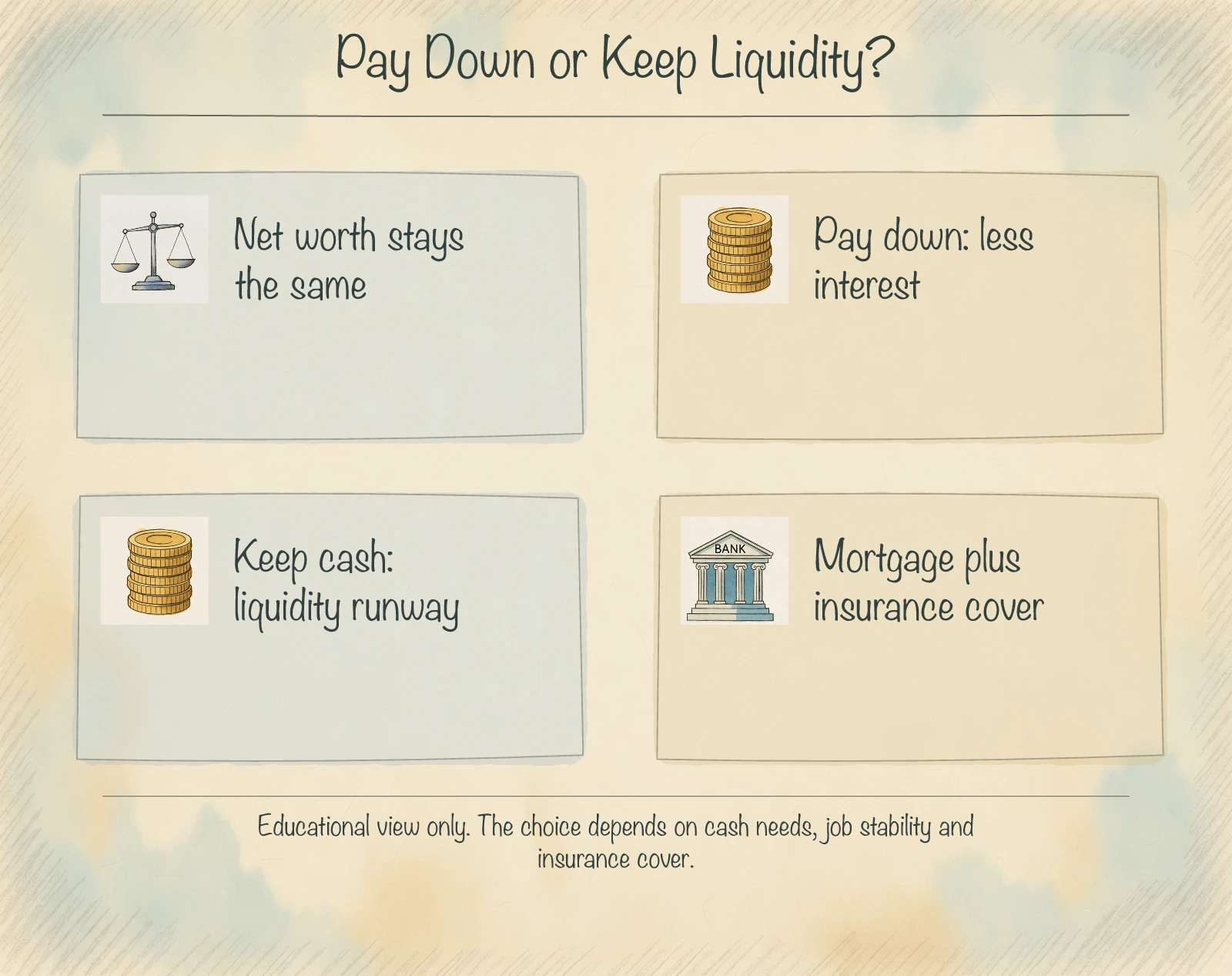
But later as we look through, sometimes maybe the benefits might outweigh that action. And of course, liquidity is important as well rather than paying down into a trap equity.
So this is liquidity. Of course, some of our property clients, and of course a lot of all these insights also also comes from our property clients over the years, which I've learned over the years.
So liquidity is important in the sense that if there's going to be any kind of like job change, any kind of situation whereby you need to take a break, there is also a runway for you to have if you keep some liquidity with you in cash.
This is the concept that I always share with my consultants is that it will make sense if, let's say, you leverage your mortgage with a double protector. That means the mortgage should pair either with a term insurance or mortgage insurance.
And I do that personally for myself, and I learn this from my clients as well.
So a lot of my clients, they actually have full cash to pay off everything. But their mindset is that the moment they pay off, they are not living close to double the amount for their children.
If, let's say, something would happen to them tomorrow. Because it makes sense to look at the key difference of $1.25 million versus $500,000.
So second version is to leverage with insurance, leave the money in the bank.
First version is to be your own insurer, which if, let's say, it touches tomorrow's, if something would happen to the first scenario person, the balance as stated for the family will only be $500,000 and sometimes the family might have to sell off the property to get some liquidity.
Number six that I've thought of is that this might not be forever. So Singapore is quite flexible; you have fixed, you have floating interest rates.
And of course, right now where we're at is that the Fed Reserve is already close to the peak though there are no signs
SORA Transition and Foreign Buyer ABSD
That they'll reduce the interest rates next year, but what is happening is that there's already been a lot of forecasts that through 2024-2025, they might start to taper off a little bit, to switch away from the QT kind of format.
I think our local government is also very smart because they started planning since 2021. What is going to happen next year in 2024 is that we will eradicate SIBOR rates.
Everybody will start using SORA rates. SORA rates does not depend on international interest rates.
That is also one of the reasons why you start to see interest rates coming down this year. For a 4 over percent for fixed package, now we're at about 3.2%.
So I think our government is really smart. They already planned in advance of what is going to happen and they start to introduce the SORA rates that will take full effect next year.
So in fact, now if you take a fixed mortgage, if you are taking a floating package, it might still be at about 4.2%.
But if you refinance to a fixed package, you'll be at about 3% or 3%, which is quite stable already.
And of course, the last thing is that, let's say, if let's say I've sold all my property last year or two years ago and let's say I'm renting, I'm trying to time the market because I'm hoping for market correction, for example.
We also have to take note of the behavior of existing property owners and developers first using interest rates as a decision tool. So let's say I'm waiting on the sideline.
Now my mindset as a buyer is that, hey, interest rate is very high. I don't want to buy.
I don't want to wait for price to come down. But as we can see, even though we had close to six rounds of interest rates high over the last 20 years, the only time that our property prices in Singapore dropped was in 1996.
The rest of the season prices didn't drop. But what is going to happen is that if we flip over the papers tomorrow and interest rates, let's say, is being reported at 3% over now, it drops to 1.5% tomorrow.
Do you think that the existing developers with stock or the resale property owners, they will start to sell cheaper or more expensive?
I think naturally, people holding on to properties, if they want to dispose their properties, once they read that news, in their perspective, they will raise their price. But in your perspective, it's that, OK, I want to come in and buy now.
But I end up I have to buy at an escalation kind of scenario. So our perspective is always different as a buyer and seller.
So we also have to look at the other perspective. What would they potentially do?
And sometimes in a more stagnated market, which now is quite a stagnated market, in the sense that some buyers are waiting, some sellers only want to sell when the market is very good. This might sometimes be the best time to hunt for a home as well.
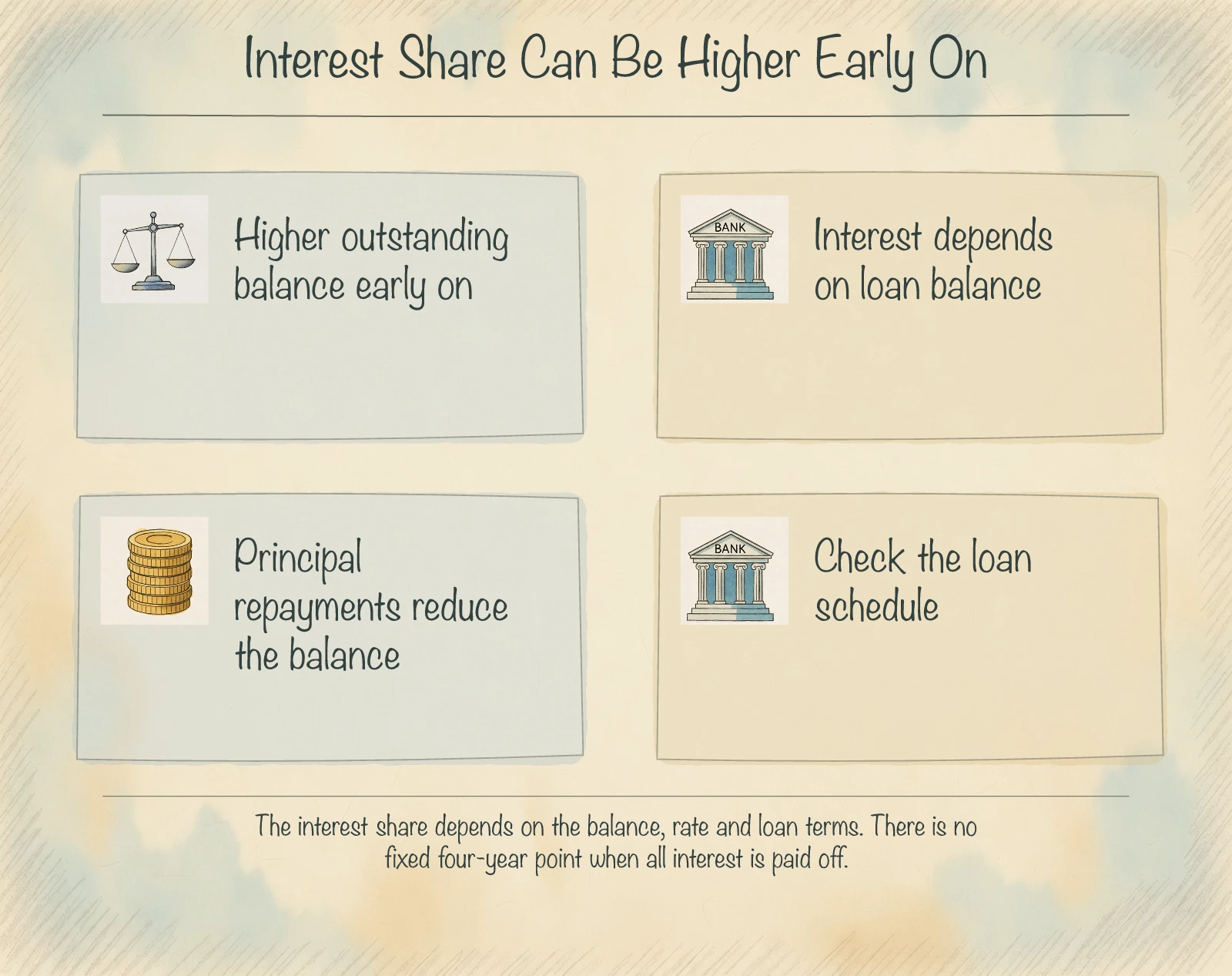
Okay, now this concept basically is that the loading period for your mortgage loan is usually the first four years. So if you look at the amortization table all the way for 25 to 30 years, usually the first four years is the period that the banks wants to make the most for your interest.
So you also have to try to calibrate. Have you been paying your mortgage for four years already?
Because if you have been doing that, then it might not make sense to pay down. Because you have already fulfilled that front loading period.
And also, let's say if this is not a forever home, you only want to stay here for five to six years. Then the moment when you sell at a six year, technically the interest stops.
It's not like buying a vehicle, where you pay a lot of interest at the front. So mortgage interest is a little bit different.
You cut off at a point of sale. And banks has also been very creative.
They have interest offset packages to offset your interest for your mortgage. So you can also talk to your banker on that.
All right, so far so good on interest rates. OK, so there's the eight things that we talk about interest rates.
Let me come to number three. So number three, basically, this is a hatch over your decision.
So if you're planning to buy a next home, a next property, this strategy is basically to buy homes that Singaporeans love and care. Let me show you why.
On the surface, this just looks like Singapore government trying to prevent foreigners to continue buying our condominiums and apartments because even at 30%, it seems that they are still very aggressive in purchasing. But we need to look a little bit deeper through the next layer.
So what is the next layer? Why is it that they want to raise it to 60%?
And this is the first time they double up the ABSD. So we already have five rounds of ABSD.
This is the fifth round, ABSD number five. And this is the only round that there's a doubling effect for foreigners.
Foreign Buyers, ABSD and Life-Stage Planning
So in the past, it's always been an increment of 5%, 5%, 10%, and suddenly plus 30%. And of course, Singaporeans' second home has now been raised to 20%.
So sometimes it's good for us to dig deeper and see where our foreign investors buying. So across the board, actually we don't have to be too concerned because they hover at about 5% of overall condos and apartment transaction.
Singaporeans own about 80%, PRs about 15% to 20%, but what is alarming is that in the last close to seven quarters, foreigners are buying mass market condos. There's a huge increment in foreigners buying OCR condominiums.
That means condominiums in Punggol, in Sengkang, in Woodlands. There's been a sharp rise in foreigners buying mass market condos.
And thus, that was the reason why the government had to step in. Because just imagine next time an HDB upgraded family was to buy and they are competing with foreign investors.
And that's not very good news for our government. But one thing that we need to note
is that we then went deeper to calculate the budget that now foreign investors have. And that is a sharp impact.
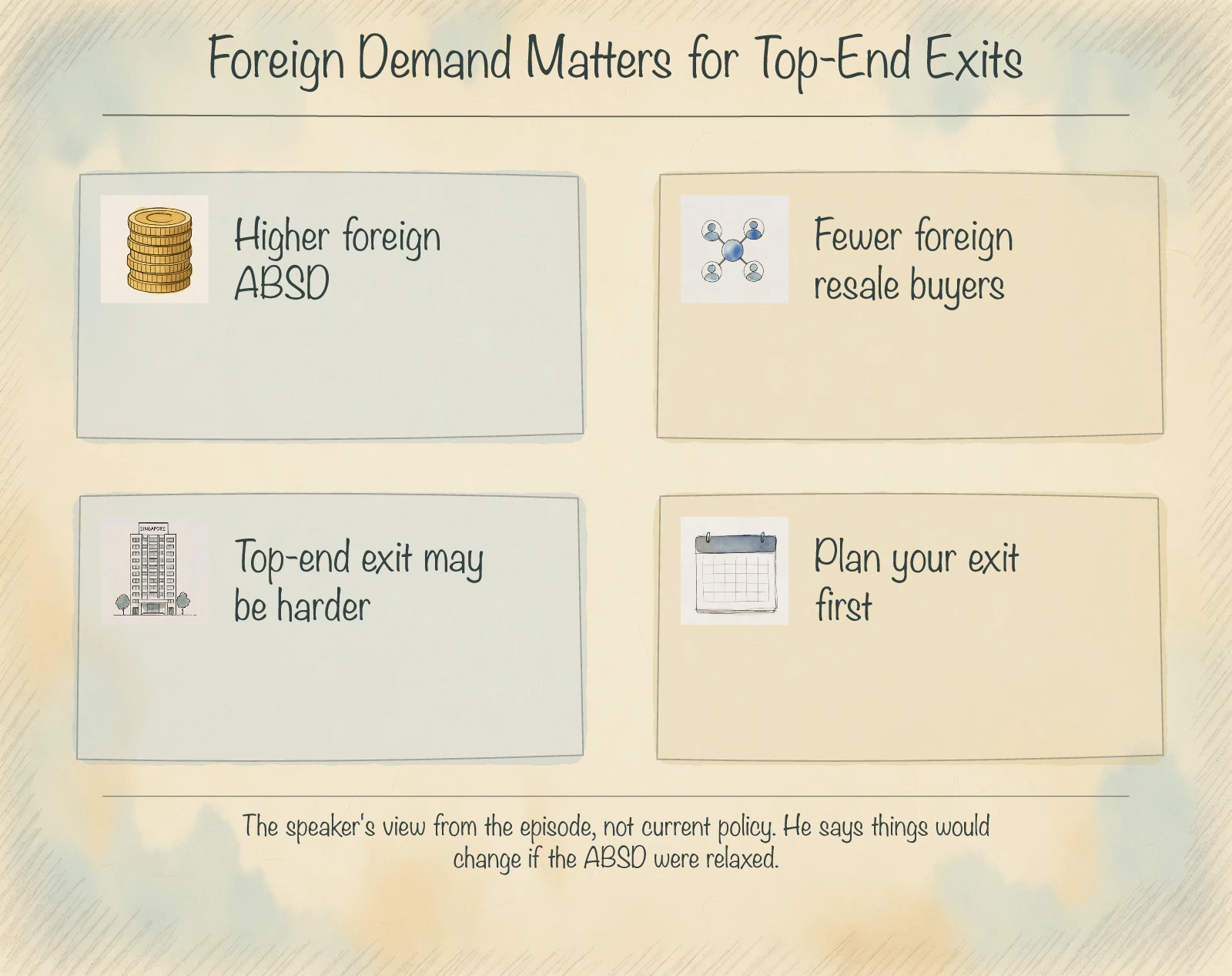
That impact will shift what will be sellable next time. That means now, if you want to go into a D10 bucket team, a condominium that is like $6 million, you need to think twice.
Why? Why?
Because last time, we depend on foreign audience to take over all this property. So let's say I go into Bukit Timah, I buy a $6 million, $7 million, $4 billion free hold.
My aspiration is that maybe I stay for 10 years after my kids finish ACS and I want to exit, but in future there might be no people to buy over my properties.
Not saying that completely there's no people, but there's going to be a drop in the amount of foreigners that can absorb these properties from the resale market. So the shift has been from this actual budget.
So for example, somebody that used to have maybe
like a $9 million budget as a foreigner, in the past, they can buy something at $6.7 million with the 30% ABSD. But now with the new ABSD, they can only buy something at $5.4 million.
So their quantum is affected. That means what they can absorb from the market is also affected.
So as you plan your next decision in the CCR region, this is something that you have to take note in order not to be trapped in the situation that you cannot exit in future. So we call this limiting of risk unless there is a relaxation of ABSD, then things will change.
But if we are staying put at 60% all the way, then this is the new strategy. Now move to number four.
Three more to go. OK.
Everybody doing good? All right?
OK, great. Now, OCR will be the new king.
What is OCR? OCR means out of central region.
We're talking about mass market condominiums. Why would this be the new king is because there's
been a lot of research that mass market condo segment is the most stable segment? Because it's also the largest land space that occupies Singapore.
It has the largest amount of HDB upgraders audience. So it is safe in the sense that if let's say you want to own a 3-4 bedroom or a penthouse for your family, you want to exit in five to eight years time, there will always be a ready buyer waiting to take over your property.
And if you look at the trends, what is it that overseas family school that used to be a river valley just down the road beside horizon towers? What is it being moved to Pasir Ris?
It's very strange. What is it that there's now going to be two global Indian schools in Punggol?
I think our government is strategizing to ensure that the mass market segments is self-sufficient through the URA master plan. So there's hospitals, digital districts, and they're all populating in the northeast east and the west part of Singapore.
So all these are not new news, but I think it affects our decision because when it comes to real estate, sometimes if it's our first property as a very young person, my young clients will always say, I am helping, it's okay, I will just stay in this house forever one.
It's not possible, I've never seen my client do that. I mean, even though when they are young, 25 or 30 years old, they get married, usually the first home is the most emotional and they will say that I will stay in this home forever.
But after five years, they will surely call me, hey, I think it's time to change because our life stage and season changes, you start to do well in a professional life, you start to save a bit more, you want also to plan for your retirement, and you just want a bit more protection.
So just imagine, it's perfectly fine to stay, of course, in a property all the way until maybe 65 years old.
Retirement Needs and Landed Segment Shifts
But assuming that you decided to take a step back from work at 55, 60, or 65, and averagely, let's say, if we live until 80, 85. That 20 years is very important for planning.
Because if you and your spouse, minimum needs at least 50 to 80,000 to sustain for per year, then if you multiply that by 20, sometimes if you take your best years during your 20s, 30s, and 40s to invest in a real estate that you can stay, but you can also appreciate that can be a vehicle to sustain the final stages of our life.
So that's what a lot of our clients have been doing.
And mass market condos, of course, is not just popular with foreigners over the last seven quarters. In fact, it has also been very popular with PR buyers.
Singaporeans nonetheless, this has always been one of the key segments that Singaporeans love to have.
I think it's also of the stickiness effect because a lot of families, they grew up in, let's say, example, if you grew up in Woodlands, you bought your first HDB near your parents, your kid starts to go to school there, childcare and all that.
Sometimes the first instinct is to hunt for a private property in the same district as well. So that's one of the rationale why transaction violence has remained high.
Number five, all right, landed, if let's say you are in a season that you can consider landed properties, this is still the best across all the residential classes. Let me show you why.
So this is the first time we registered a deep. And of course when this news came out about two days back, I asked my research team to go in depth and find out why is there a deep.
And this is the rationale.
So it's a very interesting observation to see that the semi D segment across the entire Singapore in the last quarter is it went up interterror segment went up so for those of you who are keen in landed properties is something to take note.
But the detached segment has a drop now why was there a drop and where was the drop so let's have a look. Now the the deep register was primarily through the central region and the east region But the Northeast region and the North region is still registered a sharp rise through the detached houses.
And we're only talking about detached houses. So basically, this 4.7% drop in the landed price index was led on by the detached segment and not by the interterrest or the semi-D segment.
And later I'll give you my summary observation. So this was the average PSF of District 10 and 11.
If you notice, in just one quarter, it came now pretty much in 10 and 11.
The summary, of course, at this point in time is that the landed market might be consolidating the quantum play. That means some of this landed in 10 and 11, which is what we call the king of the landed region, whether it's being dominated by GCVs or big detached homes, 10, 15, 20 million dollars.
this deep basically happens in that region itself. What do I mean by going back to quantum play is that because of this season of maybe interest rates or uncertainty in the economy.
A lot of people are starting maybe to favor the landed market but they want to focus on the lower quantum ones, the interterraces or the corner terraces of the semi-dies. Things that are in the range of about five, six, seven or eight million dollars and it might be consolidating back into quantum play.
And if we look across board of what happened from 2020 to 2023, this was a comparison heat map that we've done for landed CCR condos, RCR and OCR condos, versus Bitcoin equities as well as S&P 500 in NASDAQ.
So basically, this is of course predominantly green over the last three years. On top, some segments were green, some segments were yellow.
So what does this tell us? Basically, I think sometimes when it comes to a decision matrix of, hey, should I put my money in the equity market versus the real estate market, these are two very different products.
Real estate is considered a very hard asset, is E-liquid. And equities is very liquid.
But of course, the more liquidity there is, the more volatile sometimes it can be. So it's just to differentiate between the two different investment vehicles.
So when we look at what is going to happen, in the next seven years, this will also affect our decision. Because in the next seven years, every two percent on the street, one will be Singaporean, one will be a friend from a foreign country working in Singapore, or it will be a friend that has already attained PR.
This is important in terms of what kind of property we should go for because if we don't plan ahead then we might be left behind through that movement. The condos market remains the true blue kind of a set that international audience can buy and that is a very important thing that we have to take note.
Future Population and Resale Condo Outlook
So what is going to happen in seven years' time is that there's going to be about 3.5 million Singaporeans. PR, we have 600,000 foreigners working in Singapore, 2.9 million.
There are also foreign investors not in Singapore. But the condo market remains the true blue international audience market.
So it might be good if, let's say, at this whatever stage of your life, you can start to plan forward a little bit on what kind of residential assets you want to own.
And Singaporeans, whether they are Singaporeans, PR or foreigners, if you're in Singapore, because our rent rates are so high, the DNA that we all have is that we want to own homes. And our land is scarce.
It's not like we're in another country whereby they can keep building and building. Our land is scarce.
We have the highest home ownership rates. In fact, if you look at that 89.3%, this is us across all global cities.
We have very high ownership rates. And thus, most homes are purchased for stay.
It also translates to stability in price. It also translates to a little bit like a competition kind of stuff in the sense that if let's say a family don't work towards owning a real estate for their own usage, the inflation and the escalation in prices might cause this family to be priced out.
So this is an important aspect to understand because of the DNA that Singaporeans have.
And when we look at the supply segment, HDB apartments is about 1.2 million. This is condominiums.
They are at about 360,000 in supply now. Landed is at about 73,000.
And it's also good to note that this 350 to 360,000 if we break them down, actually is very little because on the whole island, there are 1.2 million HDB flats, but there are only 25% compared to HDB apartments.
That means 1.2 million HDB, 360,000 condos, 73,000 landed. So when we look at the supply matrix and bearing the fact that our land is scarce, and we further break down who are owning all the condos now.
This is of course something for us to think about as well because foreigners and companies they own about 25% and they are not going to sell. Why?
Because if they sell now, they cannot buy back already. They have to pay 60% ABSD to buy back.
So I would say that this 25% of inventory is stuck. So we are only looking at about 75% of the inventory.
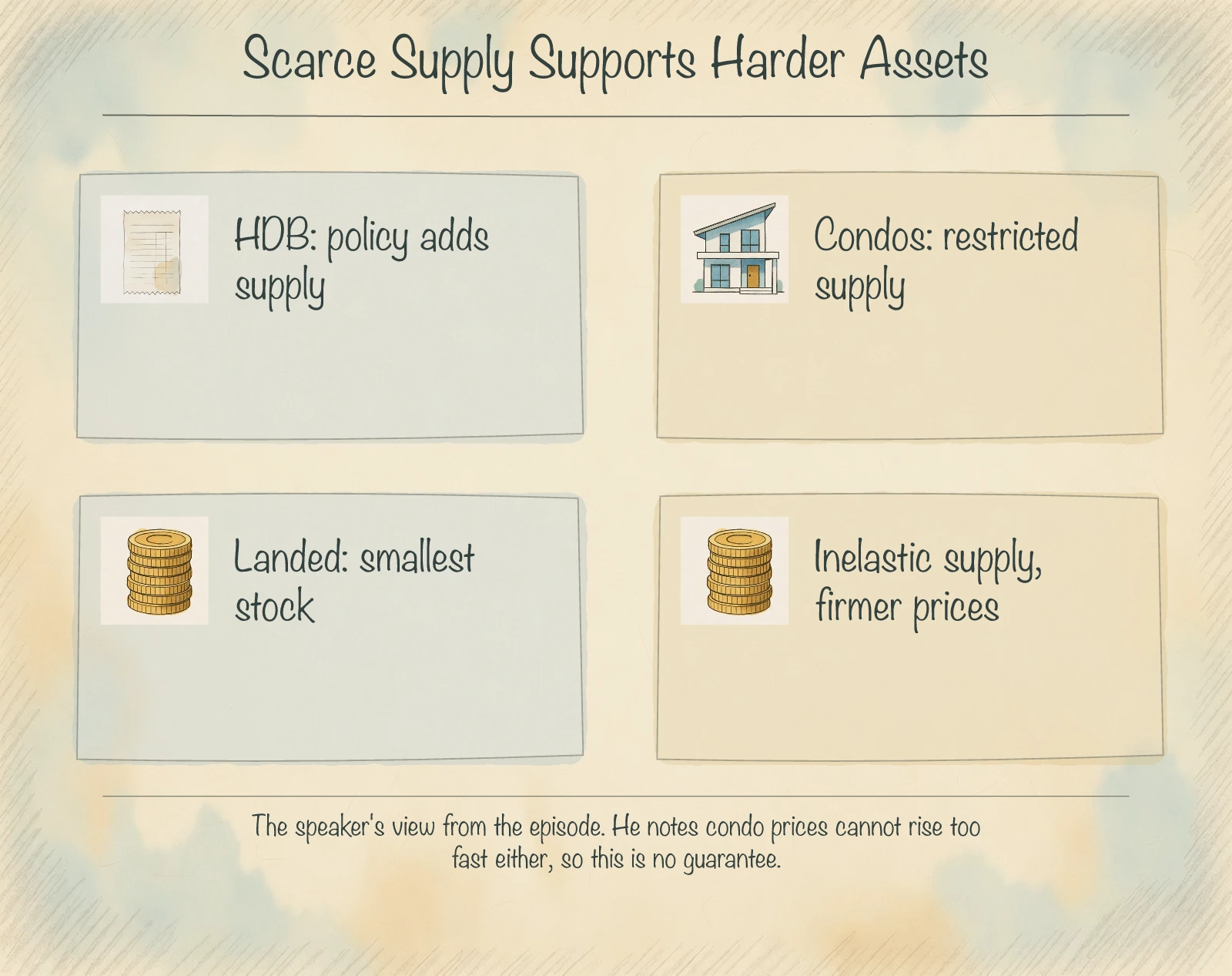
And Taz, if let's say you are deciding on your next move, should you look at this, this, or this, then we can look using what we learned during our economics lecture last time. It's to look at which one has a more inelastic effect to price.
What do I mean by this is that I can classify them through elasticity in terms of when the price of this type of home rises will there be more homes built to stifle the price growth. Very clearly, if it is inelastic, the better it is.
So what do I mean by this?
This is of course why HDB apartments are more elastic, because HDB apartments are not meant to make money. They are meant for own stay.
And the moving price rises, it attracts policy to increase the supply. So it is very elastic.
And thus, when it's too elastic, the price growth is stifled. If it's very inelastic, the price growth is more certain.
And of course, you will always see things like this, even for condominiums, because condominiums also remains as an aspiration for Singaporeans. So they also cannot let it go up too fast, right?
But it's still harder than a HDB apartment because of its restricted supply. And this is the result of rise in HDB prices.
And Taz I think is very important to plan ahead is that the moment, let's say you start to think about your next move, you can look at the harder asset. Even condominiums they belong to a harder asset because of the supply quantity that I was showing you.
And every year condominiums only increase by about 10,000. There's only 10,000 brand new GLS being released approximately.
But HDB BTOs are increasing at a rapid rate. So we are building about 150,000 homes in the next three years.
So that's the key difference between elasticity.
Last two, for those of you who are keen in buying a new launch, based on my research is that resale condos will remain dominant for the next 12 to 24 months. Why is that so?
Because the gap is too close. So there's three types of products, new launch, TOP projects means that those owners that have bought new launch, they collected keys, they're selling them now.
These are the resale condos. So this year, 47 launches, 38 TOP projects, and then of course you have a resale options.
So based on our own methodology called disparity effect, my own opinion is that for the next 12 to 24 months, resale will be the main dominant category that has the sharpest rise in price. The rationale is because it takes a little while for buyers to get
Resale Forecast and Closing Remarks
Used to the new pricing for new launches. They might adopt a little bit of a wait-and-see approach.
TOP prices is also very close to the new launch prices and this is the most lagged category. So in the next two years, my forecast is that resale condos will start to rise up at a steeper rate until it becomes a little bit too close to the TOP versions.
Then it will take a stagnation period for about two to three years, and then these two categories will start to move. So that's my forecast.
And let me just move forward because of time constraint. I'll also pass it on to the team later.
So if you want to scan, you can scan now. This will explain to you in depth on disparity effects.
Sorry, how much time do I have left? OK, OK.
All right. Now, last part.
If you really, really want to buy a new launch,
we have four frameworks. So if you really want to buy a new launch, because maybe so I also have our clients that say, hey, I just want to buy a property that people was there before.
I just want to buy a new launch. Can.
But you have to see if it's overpriced. It will let you watch a full video on how to use a four-step process to analyze if the new launch is overpriced.
So this is just the last thing that I want to share with you. Final.
This is the number seven rub. Is that after 14 years, because of the new National Day measure, what is going to happen is that we might face a diminishing amount of HDB upgraders, but that's in 14 years time.
And the rationale is because the lottery effect has technically been removed. So this is going to cause a shift, but it will not happen so fast.
I've also explained that in depth in one of my videos. But the move very quickly is that most people that might be able to own private properties, 14 years later, are people who own private properties now.
So this might be the new thing that will happen in 14 years time because of the shift in our BTO policies. Now, I want to move very quickly to the final slide so that maybe Nicolae can help me move to the final one.
So everyone can scan the last slide. Yeah, we can move to the final slide.
Okay, so these are the seven things. Yeah, so the seven insights that we have.
But our first things will change. These are for the next 12 to 24 months and our research always move along with what's happening in the market.
Final slide please, thanks Nicola.
The things that I mentioned, I hope they add values to you. And in the meantime, have a great, today is what day, Thursday.
Friday, have a great weekend ahead. All right, thank you, cheers.
Thank you. Thank you.
Thank you.