Thinking and decisions
Mastering Your Craft: The Key to Reshaping Real Estate Marketing
Published 2026-11-21. Adapted from the episode published 2024-06-14. Figures, illustrations and data reflect the episode’s original publication date.
Thanking the Team and Stages of Competence
Hi everyone, Malaysia team is here. Give yourself a round of applause for being here.
Okay, so we are going to have like how many hours is today? Barry, is that you?
Seven, right? Under seven.
Okay, then after that, you all will go into, we're all going to like setting up mode for tomorrow. So I just want to thank everybody for putting in an effort for these two days.
Give a round of applause. Just now as I was seeing the teams selecting your vote cards, right, or your grouping cards, the purpose of today is really to have fun.
Yeah, I know that it's like a survival mode that you are having to compete with each other or to fight each other, right, but it's really for the purpose of having fun and working as a team.
So see it as an opportunity to meet new teammates and then to do things very differently, because this time round what the committee has planned is that we want to just randomize, not based on your current skill sets as well as your own department.
So the important thing is ready to have fun as a team and then we try different and new concepts. Okay, I want to just have a very short segment before we kickstart, because we selected four main things that we want to focus for 2024.
One of the groups of course will be focusing on building the school, which is PRB assembly. Another group will be innovating in terms of breaking out of our more of our signature home tours.
The other group will be doing media and prop tech, right, which is what are some things that consumers will want to have, and of course the instructions are on the scroll that your facilitators have. And of course, last but not least, one of the other teams will be building PRB social, which is the events.
And these are four very exciting things that we want to do in 2024. Now I want to ask everybody just take a moment to ponder on which point do you think you are in your mastery journey in your own craft.
Because all of you sit down here, you're all very different from the other industry. In fact, sometimes some of you like to maybe compare yourself to the sales team, right?
Like, you know, what are the sales team doing? What are we doing?
These are all very different skill sets and they are all very different, I would say, models of using your craft in the marketplace. So each of you have a craft.
For example, Dil, what is your craft? Digital marketing.
Okay, what is another way of putting it? Performance marketing.
Okay, actually Dil, he's working his way to what we call a funnel expert. Alright, similarly as Zen, he's working his way into what we call a funnel expert.
Pehli, what is your craft? All very scared that you see your face here from here, right?
It looks like, reminds me of like when I was a primary school kid sitting down there, then hopefully the teacher don't call me.
What is your craft, Pehli? Website.
Yeah, so what is another way of saying it? Like what are you aspiring to become?
I don't know. Okay, so whether you think that your current role is working towards something, you're all in different stages.
Pili might think that now she's like a website builder, but one day she might be able to master a whole realm of understanding the psychology of how website works and what does it take for a website to work so well that it draws customers in and it gets absorbed into the funnel so that the products and services that this business provides can really add value.
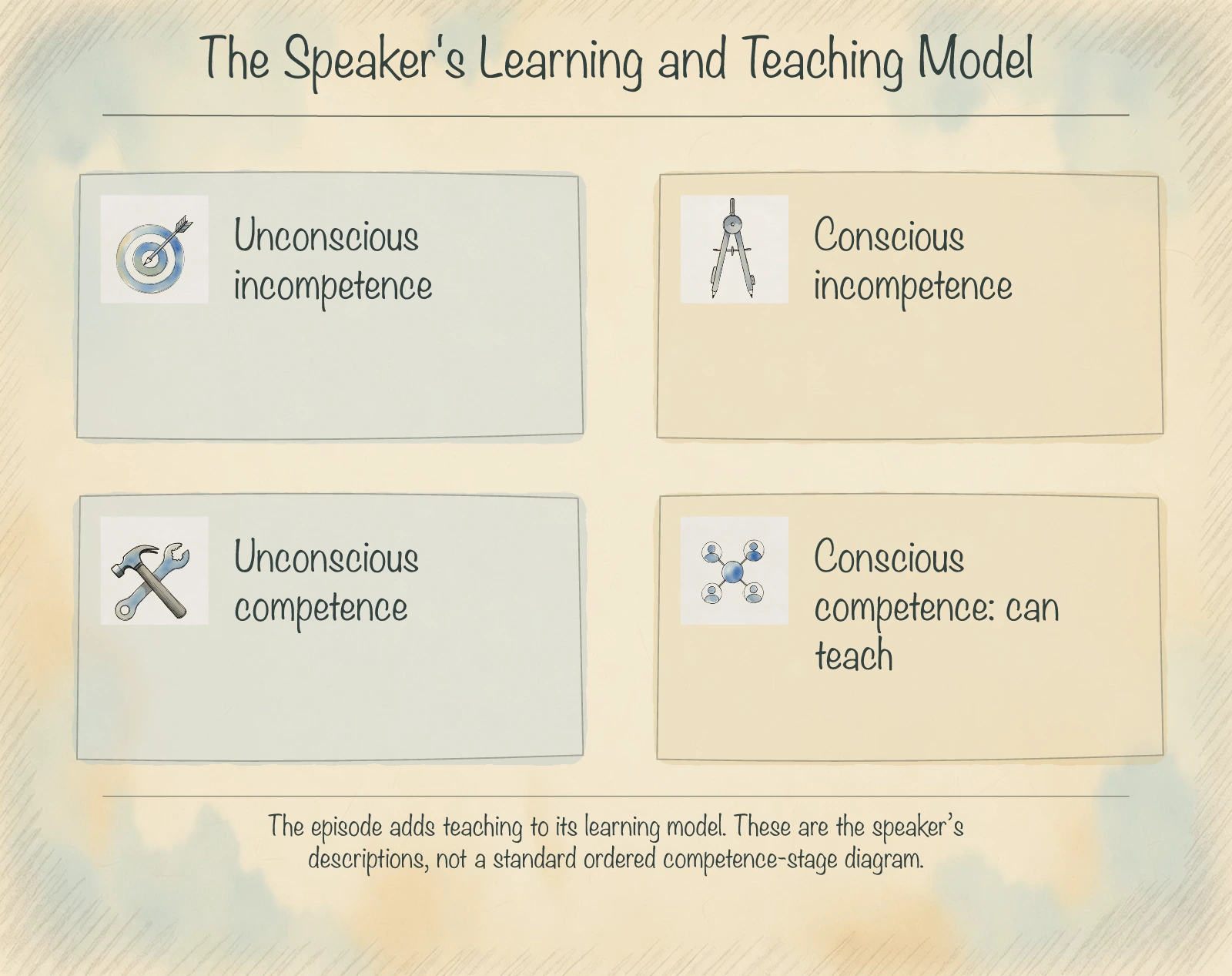
Now there are always four stages to mastery and I want you to take a moment to think about which stage are you in. So usually the first stage is that you are starting to learn and you don't know what you don't, you are just picking up the fundamentals.
This is usually the first stage which is what we call unconscious incompetence. And as you start to know what is out there on this particular subject that you want to master.
For example, if you first join PLBN, you suddenly realize that you are expected to know how to do motion graphics and also you are expected to do a little bit of like a 3D work, or you're expected to also learn how to operate the gimbal or how to operate this camera.
This is the part that you shift to the second portion. You become conscious of what you don't know.
This is what we call conscious incompetence. And then as you start to learn about it, you then go to unconscious competence.
That means you know how to do your work already. You know how to start to do it well.
But you are not at a stage to teach. That means you are not at a stage to teach other people what you already know.
So sometimes you know how to do certain things very well. But if, let's say, I would have put a new teammate beside you, and this
Unconscious Competence, Teaching, and Transcending Your Craft
So if the teammate is brand new, and I ask you to teach the teammate, but you realise that you cannot articulate and explain your skill set, or exactly what you are thinking when you are doing this step A to step B — that is what we call unconscious competence.
Now, if you work your way towards level four, this is the time that not only are you very good at your skill set but you are able to explain and teach and guide, and that is the time that you become like a teacher.
And when you become conscious competence, that is the stage that you can start to master your next skill set.
Because if you are here and then you start to skip, what is going to happen is that you have not completed the whole loop of learning, and most of the time if you don't complete the whole loop of learning, this will start to degrade as well, because you have not been able to master the final stage four.
It's a little bit like your kung fu mastery, right. So the other way of looking at this is this.
Now, this is a Japanese concept called shu-ha-ri. Everybody says shu-ha-ri.
Okay, so what is shu-ha-ri? Who doesn't know who is Picasso?
Anybody doesn't know who is Picasso? Everybody knows, right?
Okay, so I am going to use the journey of Picasso in his artwork to explain this concept.
And this is also something that is related to today, because by the end of today, what is important is that we complete the whole challenge, but when you are doing your team work, I also want you to think and do a little bit like a checklist or stocktake of where your mastery level is at.
And that is going to lead into two weeks later. Because two weeks later, we are going to replace our media huddle.
It is going to be the same group of us and we are going to do what we call individual goal setting as well as team goal setting for 2024.
So I am very — I wouldn't say concerned — I want to be very involved in your growth. Oh, okay.
This is our — somebody opened the door for you. No, don't worry.
Don't worry. It's not a bad guy.
So we are a media company, right? So this is our team that is vlogging us today.
Give him a round of applause. Thank you for coming.
Okay, we are gonna do our individual goal setting and team goal setting two weeks later and this is related to your mastery level. So let me just show you what is this.
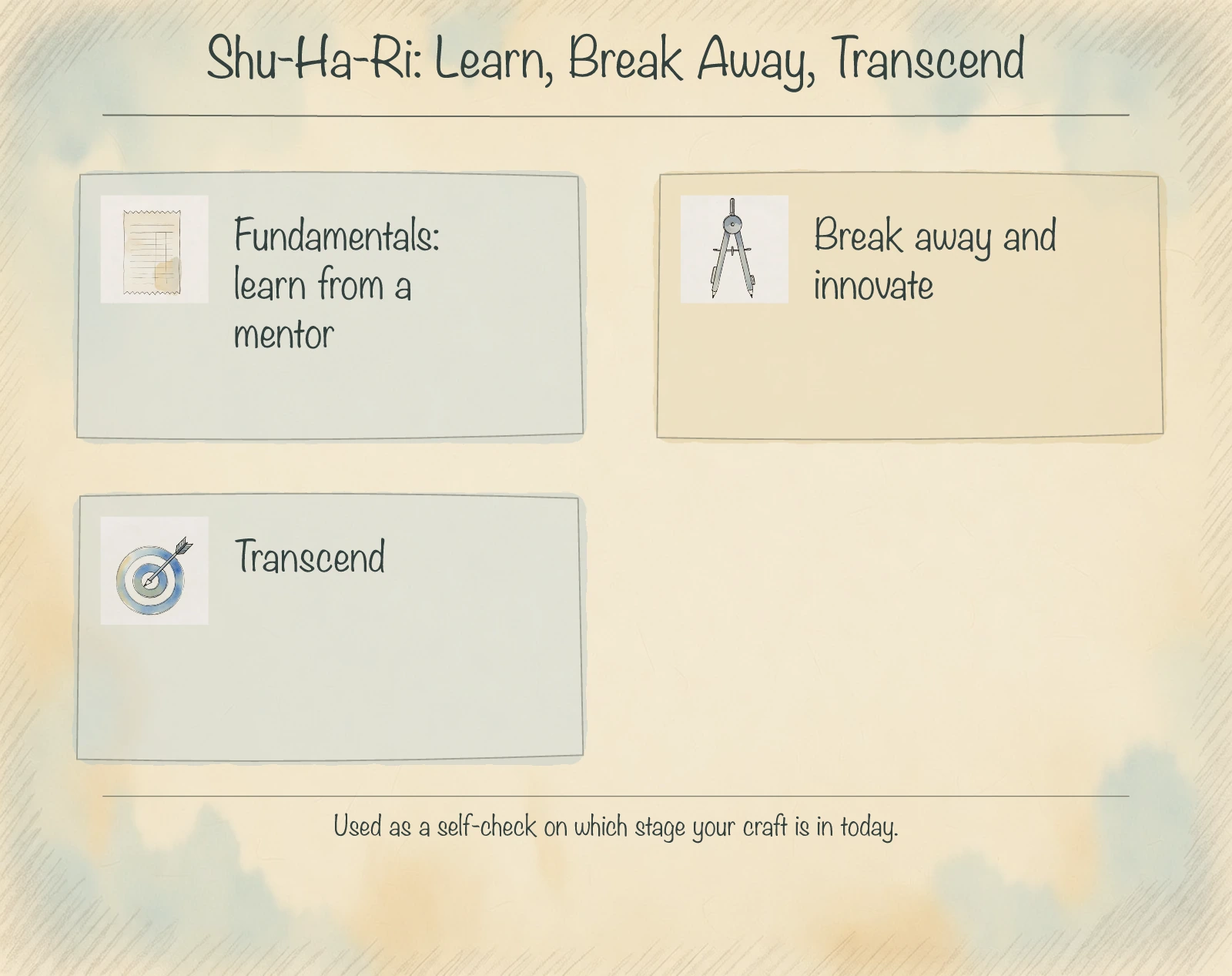
Shu-ha-ri means the first step is fundamentals. Whenever you are mastering a skill, you want to build your fundamentals and you learn from your mentor or teacher and you just absorb everything.
Okay? That is the first step.
Second step is that you start to break away and you innovate in your own work. And of course the last step is to transcend.
So when you look at Picasso, his earliest — his entire journey as a master artist is separated into three portions.
So for example, whatever you are doing now, let's say like Dil, he's building funnels, right? And he's doing what he called performance marketing, running ads and then doing landing pages together with Zen and of course the rest of the team.
There are always stages in your entire journey. And how do you become so good that people will start to sort you out?
They will start to seek you out. So when Picasso started his early years, this basically is the stage that he actually learned from his master.
So the artworks are very similar to existing masters that have done this sort of artwork. This is his early stages.
This is the kind of concept called realism. So he adopted the realism kind of paintings.
And then when he starts to go into the second stage, this is what they call proportionism. So he goes into a stage that he starts to break away and he innovates.
And when he was doing this, nobody during his era was doing this kind of painting.
He was the first to innovate. And during his last stage of his life, he further transcended into what they call cubism.
So this is the final stage. Now in your mastery of your craft, if you are doing graphics, you are doing video, you are doing production, you are doing whether it is tech or funnel or marketing or social media —.
If, let's say, you are somebody in the marketing team, how do you learn fundamentals in such a way that you reach a stage that you are able to break away and innovate and then of course in your final stage to transcend?
If, let's say, you are doing motion graphics, are you at a fundamental stage? Are you at the innovation stage, or are you at a stage that you can transcend and you can make things that nobody has done before?
So these three stages are important to an artist and all of you, you are artists here. You are very different from the IST team.
Because if you understand of course the sales concept,
Understanding Sales and Praising the Home Tour Website
That is, of course, I would say, what is needed for transition. Because only if you can understand the full business and understand what customers want through the lens of the customer — and that is actually sales.
Sales means you understand what customers are thinking and what customers want, and how you add value and solve their problem. That is sales.
Selling is very simple: you just need to understand what people want and then solve their problem. Of course, if you can reach that stage, that is the stage where you can fully complete the cycle.
But now what I'm interested in is this: are you able to look at yourself in terms of your current stage, your work, and then ask yourself which stage are you in? Are you trying to break away and innovate?
Have you fully mastered the fundamentals? And where are you at?
Because all of you are artists. Being an artist, these three stages are very, very important.
Okay? So as we complete the challenge today, keep asking yourself this question, because this will lead into our session two weeks later and that will lead into 2024.
And I think PRBA has always been about this statement: every year we need to ask ourselves how can we add so much value to our customers that they love us more and more each year.
Because only if our customers love us will they come back to us; because if they don't love us anymore, basically they will start to look for other people, right? And how will they love us?
Basically, it's for us to solve their problems, and we value that so much.
So these are the four things that we are doing today. Maybe you might be wondering, hey, why is it that we want to build a school?
Why is it that we want to change the way that we are doing our signature home tours? If all these things are combined together, basically it relates to the same statement: that we want to add so much value so that our customers will love us more and more.
Alright, let me review a little bit about Assembly. Now the main rationale for building this is because if we don't build this, we cannot complete the fourth stage, which is conscious competence.
To me, this project, even if we lose money, is fine, because this is a platform for everybody to work towards conscious competence. Because this is a platform that allows everybody to really take the time to craft your own mastery syllabus, so that you can teach — to help everybody create an audience.
Then maybe you might be wondering, hey Melvin, why do you want us to be a teacher? Because if you are a teacher, basically what is going to happen is that it allows you to scale towards a polymath level, and I'm always for the concept of creating a second revenue stream for everybody.
So we want to make this platform work. So of course later the team that's doing this concept has this in mind: how do we make this school work?
And let's not just think Singapore, because this allows us to think Southeast Asia, it allows us to think global. And I mean most of the content we're going to do online.
We are only going to do in-person events for certain seasons of the year. The content and the courses are going to run 24-7.
So it's going to be a 24-7 mastery course platform. And in-person events are only done when we have enough students.
We do it a couple of times a year — one, two times, three times a year. But you're going to have your own syllabus.
For example, maybe like Kai Wen, right? He's going to have a syllabus on architecture visualization.
Maybe it's like a four-session kind of syllabus, or six sessions, or eight sessions, or it can also be beginner, intermediate, expert kind of modules. And this is a platform where everybody can launch your courses.
So we want to make this work. It's going to be something that's going to be very exciting — not limited to Singapore, think bigger, make it in the ASEAN region or global region, because media work, work that you are doing, creative work, it transcends boundaries.
Alright, number two, we have always prided ourselves in our signature home tours. And last year, we tasked a team to do what we call home tour categorization.
And of course yesterday I just saw the works Zen sent me in the morning. This team is made of Nikolai, Zen, Dil — anyone else, ah, Mark?
Who else is in the home tour categorization team? Nikolai, Zen, Dil, anyone else?
Anyone else? Okay, and the tech team as well, right, with the website, okay.
So I saw the latest website was very well done. Give them a round of applause, please.
I think it's fantastically done. That particular page basically, I think it really showcases our DNA for our home tours.
Shots Versus Long-Form Content and Live Events
The home tour team that is doing this challenge, please have a look at that website. Please send to the group later.
I don't know whether you launch it but just send the draft link. It showcases the entire DNA and one of the reasons why we want to do this firstly is not to take away the home tour.
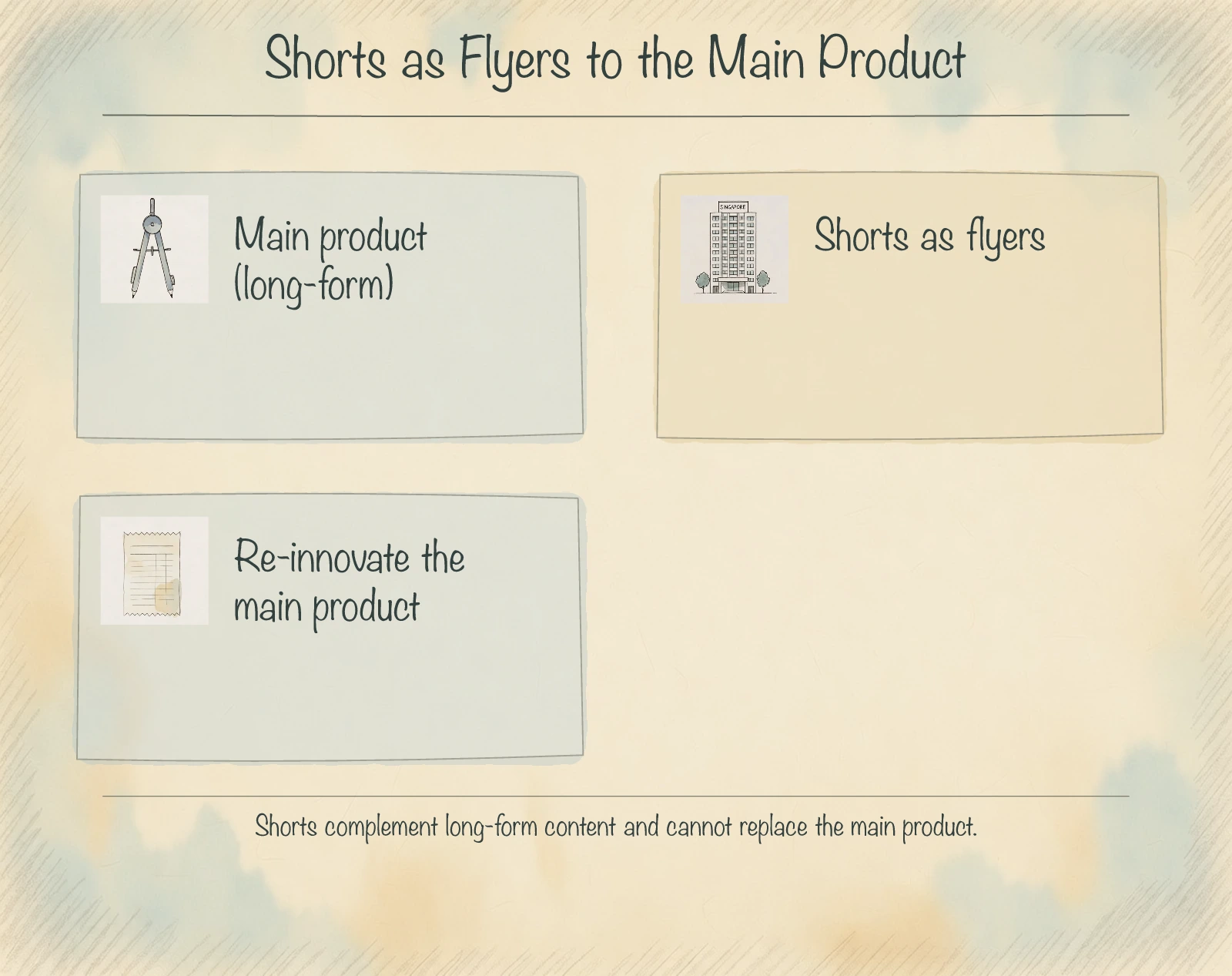
So I want to say two main concepts. Number one, do not be mistaken that shots can replace long-form content.
This is something that we all have to understand in terms of marketing. Shots is a new complement but it's not a brand new thing.
Let me give you an example. The olden days when we walk through the streets right, we always receive flyers.
A store garden just opened. Alright go to this branch.
This has the long just open go to this branch. So now this entire job is disrupted really.
Last time my favorite job is to be a part-time flyer distributor. One hour six dollars.
I just stand on the street outside the shopping mall outside the shop. I can, I can one hour six dollars just to give up flyers.
Now you don't even see flyer distributor right? Where I got flyer distributor?
How are flyers being distributed now? Like that.
Basically it's like that. It's shots are flyers.
Every day you're browsing TikTok rails, you're browsing flyers. You're really looking at thousands of advertisements.
These are flyers. What the flyers do is that it brings you to the main product, or it brings you to the shop front.
Flyers are so powerful now in the terms of shots that now you have unlimited bullets to give out flyers for free. So you can give out a business now, can give out 1000 flyers, 3000 flyers a day.
And it is free. You don't even have to pay part-time people to stand there and distribute.
You only need to pay to create a content because it's organically on the platforms. So shorts are like flyers.
So when you're doing this, do not be mistaken that we want to replace the main product. The main product has to be there.
But how do you create something that is very different that we can re-innovate the main product that is the main challenge alright and of course you can re-innovate it into shorter version longer version doesn't matter but it's about re-innovation.
Now the third thing, this has been something that we have been very proud of for the last two years because after every physical event, the positive ripple effects are just so tremendous.
The amount of new partners that we gain through the live events is really something that is so tangible because every time we finish an event or we finish like an in-person kind of concept with our audiences and clients.
We just build so much more trust and when people come and look at us they see our teamwork, they see our excellence level. And especially after the last two events landed, can, there's just so much new collaborations has created and there are so much more new customers.
And to make events work of course is very tiring and difficult, it's not easy, similarly like tomorrow there's so much work that is being done, but this are worth it. So we want to launch our PLB brand officially.
And how do we structure it? So this is the main challenge, because this is going to be one of the main pillars of PLB.
Last but not least, we're going to group the whole tech in PLB under this concept called shift, because we want to be the movers in the market, to shift the market.
So as you go into your groups about the tech, think about what are some of the things that consumers will be benefited if they use certain kind of technology in the property space.
Think about how consumers will be benefited if they use certain kind of technology in the media space and how can internal technology within us and external technology for the audiences benefit both sides. So this is what we want to think about for 2024.
Okay? And in January, Kerry is going to set out a date that we're going to meet.
It's going to be... how many hours are Kerry?
Three hours, three and a half. 16, huh?
16 January. During this goal-setting submit we're gonna do two things.
Number one, we're gonna do team goals within your team, within your department. Number two, we're gonna do your individual goal for 2024.
And the third thing that's gonna happen is I'm gonna talk about seven marketing concepts that is likely to work in the next season and seven, seven media concepts that's likely to work in 2024.
Okay, so I want to wish everybody that you have fun today and let's come with a mindset to enjoy your teamwork and we look forward to today's hackathon. Give us a round of applause, thank you!