Thinking and decisions
Mastering Niche Branding in Real Estate
Published 2026-11-27. Adapted from the episode published 2024-06-03. Figures, illustrations and data reflect the episode’s original publication date.

Kickstarting MAREC 2024: The Hard Truth About Standing Out in Real Estate
Good morning everyone. Good morning to all the real estate professionals in Malaysia.
Give yourself a round of applause for being here. I want to thank MIEA for inviting me to this awesome event.
It's good to see so many people here on a two-day event. Thank you for inviting me to MARAC 2020.
For many people, I kickstart. Why don't you give the neighbor on your left a high five and say that it's awesome to be sitting beside you.
Just give your neighbor on the left hand side a high five because it's so awesome to be gathered here as real estate professionals and then learning from one another, and also look at your neighbor on the right and say that you know it's awesome to be sitting beside such a handsome and beautiful person, I'll give them a high five as well.
Alright, so back in 2019, that was actually my last trip to KL. I was invited to give a talk to a group of realtors, and of course that was a wonderful event.
Subsequently, just before the pandemic, of course, we invited a small group of them to Singapore. We held like a two-day masterclass to talk about how to create content, how to start a YouTube channel.
A lot of them actually today, they have already started their YouTube channel and they became friends as well with me. And that was my last trip to KL, it's been close to five years already.
And it's good to be back.
So just before coming to KL, I was holding a masterclass. It was a full day event for Proptiline Brothers Realtors back home in Singapore.
And I was telling my realtors this very hard truth, is that the person sitting beside you in the next three to five years, if they do not do something different and they do not start to create their own niche in the real estate market, the friend that's sitting beside you in three or five years' time might not be there anymore in terms of being in the industry.
And that is a very hard truth because when I started real estate 16 years ago, I that this is going to happen in the next 10 years. And as I was holding the masterclass just last month, I realized that a lot of things that's being written here has already came true.
And today, in my short one hour review, I want to add as much value to you as possible. So I want to invite you to pan down your thoughts on the pen and paper right in front of you.
Would that be okay with everybody? All right, awesome, great.
So this is the statistics in Singapore. So why do I want to bring up Singapore is that back 16 years ago when I started real estate, there was no regulations.
There was no Council of Estate Agents. Council of Estate Agents started in 2010.
That was about 14 years back. And they've done a great job since then because back then when I started real estate, 16 years back, everybody looked down on real estate agents in Singapore.
They called it a cowboy industry.
When I started as a... my first month attending training and I go out to the trainer after the class.
It was a very simple class about understanding how to sell HGP properties and I was trying to ask the trainer, Mr. Trainer, is it okay that I have a short 30 minutes with you on how to do a seller presentation?
The trainer look at me and ask me, who is your manager? Go to your manager, don't ask me.
So that was how industry was like 16 years ago. It's like a dog eat dog kind of industry, very toxic, nobody wants to share information and the way that I pick up cellular presentation learning was actually through another realtor from another company.
So he was so kind-hearted to teach me how to do a cellular presentation and that was how I pick up back then.
Now in Singapore right now, there are 35,300 plus professional license realtors. To get a license in Singapore, you need one and a half years.
Can you imagine that right now? Because just to go for a course, you need to go for about, the course is just actually one to two months, but you need to wait for the course to happen.
That's about six months. Just to book the exam is another six months.
And to wait for the results is also another six months. So it's about one and a half years.
But how are the agents now in Singapore trying to stand out against one another?
However, based on our observation, close to 90% of Singapore realtors actually exit the industry within the first year because it's so competitive and Singapore is so small. And in fact, out of 30 over 1000 realtors, I would say there are only about 11,000 realtors are active right now.
How do we know that? It's because when we look at property growth, the most popular portal in Singapore, only about 11,000 realtors have an account with PropertyGuru.
PropertyGuru. And Singapore is a regular cut because it's so small, consumers are very savvy.
If they want to appoint you to sell their home, if you don't even have a basic PropertyGuru account, they don't even want to give you their business. So only about 11,000 realtors have a PropertyGuru account.
And what are the rest of the realtors doing? Basically, I think a lot of people, they got a license, they couldn't really do well within the first year, they park their license.
And how about Malaysia? Malaysia, based on understanding for some of my friends here in Malaysia, is that it is the opposite.
There are probably about 30 over thousand licensed realtors and of course I know in Malaysia the professional term is real estate negotiators. So real estate negotiators probably licensed about 30 over thousand but you have about a hundred thousand maybe realtors without a license and I think you're termed as illegal agents, right.
Now these are the fear points of all the real estate agents in Singapore. Everybody worries that they do not have consistent leads.
They are worried of technology disrupting them. They are very worried that they look the same to the seller and buyer and it's very hard to get exclusive.
And they always are very worried that when they go for a seller presentation, the seller will meet another three to four agents and they will then not sign exclusive and do an open listing. So these are the fears of agents in Singapore.
And agents always fear that, I don't know whether I have leads next month. And because of that, my closings might be inconsistent.
So how about Malaysia? I believe probably it is about the same because we are all real estate professionals.
We want to come into this industry to do well for our loved ones and our families. And of course, one of the most important things is that your revenue has to be consistent.
And maybe you're worried also about many other things like there are a lot of illegal negotiators.
It becomes very competitive. If consumers cannot differentiate who is licensed, who is not licensed.
No regulations. Very hard to stand out.
And of course, maybe your property supply is a lot and very hard to sell, plus because of too much supply, sometimes the price don't appreciate. So I have three objectives today.
Basically, my three objectives is to share with you how to start your real success in the next three, five, seven years by positioning a niche in your particular market or in your business or in your small team or in your agency as well.
How to gain positioning and how to create and start to automate a content strategy because I believe technology always evolves. Now we have AI, we have a lot of tools.
These are tools but a brand and a content strategy is something that people cannot take away from you because it stays with you. It stays with you as an individual person, it stays with your team, it stays with your agency.
So in order to fulfill these three objectives, I have three steps and I want to share with you these three steps.
This is what I call the ultimate business strategy for realtors and I believe that these three steps can create an enormous amount of success, especially in today's era where you have so much technology to leverage on from our panelists, from today's speakers.
And the very first part of course will be niche positioning, followed by an ultimate business model and the last one will be how do you create a leverage hexagon. Now I want to share like a short video about what we do in Singapore and then after that I'll come back on.
Alright. I'm the one, I'm the lady that'll rock this place.
That Rock is Plain, That Rock is Plain, Rock is Plain, Rock is Plain, Rock is Plain. Alright, so this is what we do in Singapore.
If you notice, of course, ever since I started PRB Media and PRB Realty, now we've grown our consultants to be all home tour presenters as well.
This is my background. I've been in real estate since 2007 and I was a water millionaire realtor from the days that I was still practicing sales.
Now I run two companies as CEO and co-founder. PRB Media is a creative agency and of course Realty is a real estate agency in Singapore.
And personally, I've sold more than a thousand plus homes on a personal basis and of course, film a lot of home tours throughout my entire career. However, today I want to write down these two keywords on the paper right in front of you, which is called a paradigm shift.
And this has helped me a lot throughout my journey as a realtor to a business owner and also now running a creative agency and a real estate agency. And what is this paradigm shift about?
Now, this is actually my report card because a lot of people when they now know me as like a new friend or I met them at the networking event
They all thought that I had come from a very good background, rich parents. I got a lot of backing, you know?
Like now my company has about 140 people. You started with a lot of funding, you know?
Like maybe you had a great start. But my report card actually in the first 32 years of my life was not great.
So my dad, my mom — fabulous parents. My mom stayed at home and of course my dad is a taxi driver.
And right through my entire primary, secondary school, everybody says that, you know, they will always tell my parents during the meet-the-parent session, "Your boy is a very quiet boy," and they will write down in the report book, "Melvin is a quiet boy." So that has been my sort of labelling since young.
Because a lot of people were looking at, well, maybe you can speak so well now, do so many home tours, I think you had a lot of training in the past.
Actually, not very so. And I didn't do well in primary school.
Went to a secondary school with a lot of gangsters, trying to survive during my secondary school years. And I started to learn also by doing door-to-door sales when I was in secondary school, just to train my courage.
And I failed my A-Levels, didn't do well. I was not good at studying, went to a private uni, didn't have money to complete it.
So I went to Sion as a prison officer for three years. Partly also because I want to get married and I want to have children, start my own family.
After my born, I started real estate as a real estate 26. I followed the wrong mentor.
I became very greedy. I was very into trying to prove myself to the world.
I want to make sure that I have a lot of material success. So I became very greedy and tried to take a lot of shortcuts.
And in terms of deal negotiation, I was also not doing ethical things.
So that was my background in the past. And actually that resulted in me having a business mistake.
And it was like a wake-up moment at age 32. Because I started from zero again.
And back then I told myself, this time round, when I restart my business, when I go home and look at my kids, and if my children ask me, "Daddy, can you share with me how you talk to customers or how you do your real estate business?" I want to be able to be proud to tell them every single thing.
And I also want to be proud to be able to sleep peacefully at night. So I want to do my deals correctly with integrity.
So that has been my pivotal shift moment. And of course, at 35 years old, I had about four years of restart.
I started to read up a lot. I looked at what people are doing overseas.
I didn't invent anything. Basically, I just have in no faith on what has already been invented.
So my paradigm shift —
Number one was that because I put my heart to do something and make a commitment to do it, I realized that even though I had a slow start to my career and I only restarted at 32, if I put my heart to make things happen, it can happen.
So that was my first paradigm shift. Second paradigm shift, something to do with this photo.
Because actually, this is my girlfriend, of course now it's my wife. Back then when we started dating, I instantly fell in love with her.
We got married in less than 15 months. And I still remember she brought me to look — to meet her grandmother.
The second paradigm shift is that I realized in life, sometimes your impression versus other people's perspective is actually so important. Because if I didn't do the change in my image and how it looks, then her family would have objected to me for marrying her and then I wouldn't be able to have so many children now.
So I realized that a change is needed at a lot of times, even in our career and our personal life as well.
Even though I still love to have that Kim Ma and the Aaron Quok hairstyle, but a change is needed because I need to be somebody that the family can look upon me as reliable. This was my journey and I think that today I'm standing here.
I just want to share a view that I encourage you, that if you have been in industry for a long time or you just started out, I've done every single thing that an old agent and a new agent has done before, all the way from flyers.
I started out with just two equipments, second hand, I bought from Sim Lim Square, and I work at home, I don't have an office. I learned everything from YouTube actually, and I started Channels from zero.
So I didn't buy any lights. I started to build the whole channel account that we are still using today from zero.
And I started with two teammates as well in a very small office. I know the pains and struggles of every single realtor.
Every person that's running a small team, I know team leaders' challenges, I know agency bosses' challenges. In 2019 we started a small inside sales team, and of course in 2022 we launched our own realty.
And today, of course, we have a small amount of success.
I still wouldn't say that we are very big; we are still considered SME in Singapore, but we are happy because I realise over the years that when we succeed together, it's a lot of fulfillment and enjoyment than succeeding alone, because this industry sometimes can be a bit lonely.
Most of the time we spend our time in cars on our own replying to customers, but if you don't have a team that is with you all the time, it can be a very lonely business.
So we have a certain amount of successes over the last two years and also a lot of speaking engagements over the last two years, which we are very thankful for. So that has been my journey.
And I just want to share a view that this paradigm shift is important to you as well today, because sometimes we cannot see how the dots connect. And sometimes if we are not patient in our business, the domino effect cannot kick start.
And the domino effect of us is being borrowed from one of my favourite books, which is The One Thing by Gary Keller. And this is about building one thing at a time.
And in fact, I can just say that you just need to do 1% improvement every single day. And after 365 days, you have 365 different success.
So let's talk about the first thing on niche positioning. So far so good, everybody?
It's good? All right, great.
Now time to write down some stuff. So why should you even position yourself with this thing on what I call a niche, NICHE, as a real estate negotiator in Malaysia in this era?
You have three reasons. Now write down the first reason.
Number one, the day that you do not start to position yourself with a niche, it's the day that you are always anxious about your business. I learned this through the hard way.
Every month I will worry: next month got leads or not? Your seller presentation or not?
I can sell a house or not? Every month I worry.
And I know the worries of realtors on the ground. This is a very hard truth.
It's not easy. And inconsistent leads is the killer to the business.
Which is why, one of the... I'm not saying this is the ultimate solution, but I dare say that if you put your heart to build a niche for yourself, especially so in a noisy market, you already win 75% of the battle.
The balance 25% can come from referrals, but one thing I need to caution you about your referral business: I learned over the years that your referral business and your existing customer will age together with you. As you grow older in this business, your customer grows older as well.
And as they grow older, their buying power sometimes reduces. The speed of transactions reduces.
You need to inject new customers and younger customers all the time, which is why a niche is very important. Number two, a lack of leads is always the killer, as I mentioned.
If you look at it, new leads is the entry point to sustainability in your business. And if you do not have a lead generation framework by building a niche, you are going to suffer your entire business flywheel.
So sometimes I tell realtors in Singapore, I said you can spend all the time to attend all the trainings and you can go for any classes about how to do viewings, how to do financial calculation and all that, but if you do not spend time to build lead generation within your business, your business is going to die.
You can have all the know-hows, or you can even be a very good, honest agent with a lot of integrity, but if there's nobody for you to serve, basically your business cannot sustain and you're out of the market.
So this is unfortunately the reality on the ground for a lot of realtors, and this is what we all hope for. It doesn't have to be $50,000 a month; it can be $20,000, $10,000, $30,000, or at good times, certain months, 60, 70, 80 thousand.
But the most important thing is consistency, because without consistency it is very hard to think about the future. You always think short term, you become very short-term oriented, and you cannot plan forward.
Sometimes you want to do content, you want to do TikTok like just now some of our speakers mentioned. You so fine: that I do this TikTok for business or not, is it worth my time?
Right? So you cannot think long term because of that.
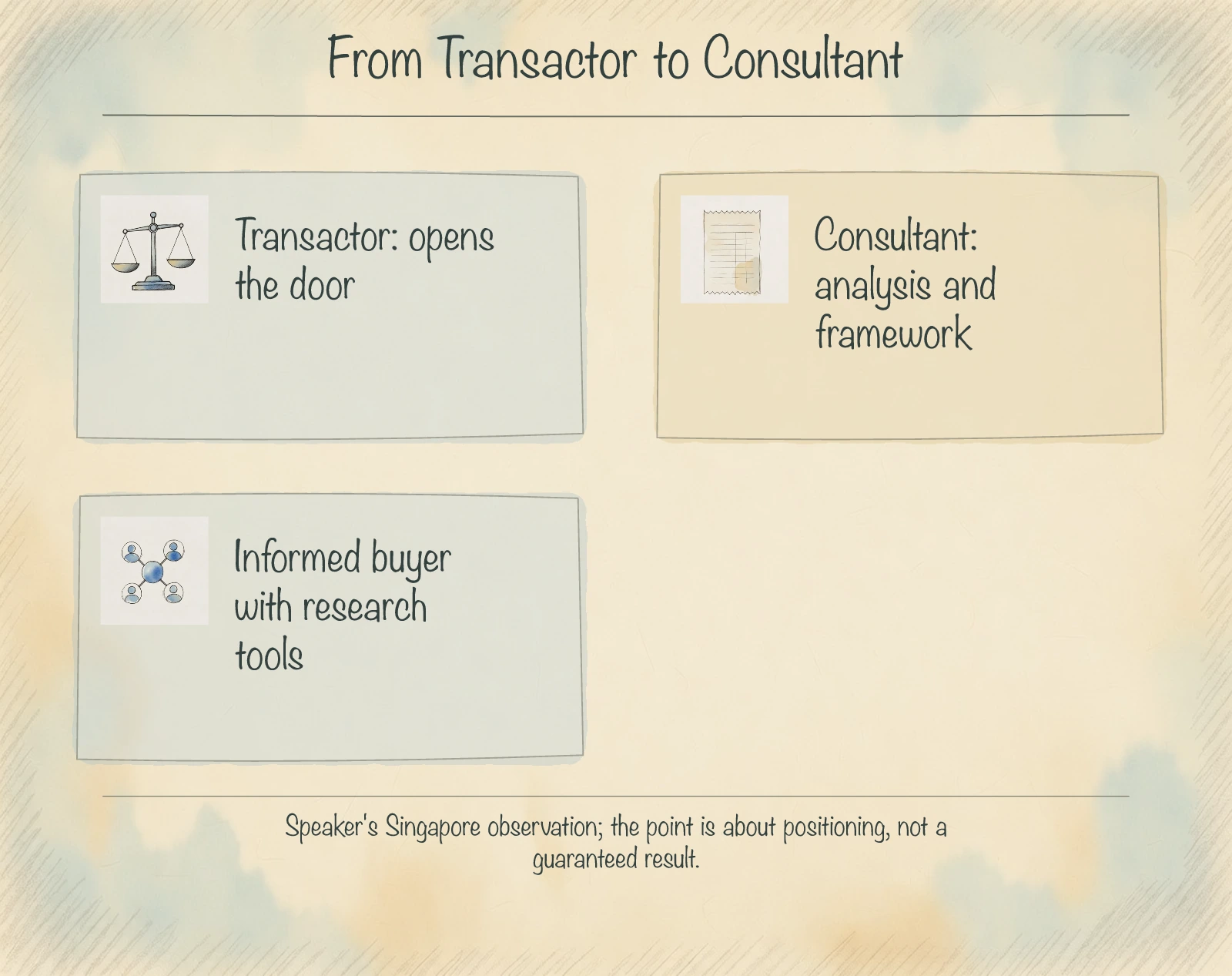
Reason number two, please write it down, is that consumers, as a matter of fact, as the involvement of our technology era, AI era, is that more and more consumers do not need realtors anymore. And the reason that they need a realtor is not as a transactor anymore, it's more as a consultant.
So if you look at all the realm of information, actually in Singapore, nowadays when we meet a client, a buyer or a seller, they already have all the subscription to the research platforms already. They already can see all the past transactions.
They can see the graph. They can tell which condo make profit, which condo don't make profit.
And if you are not better than that and you cannot offer analysis or framework, you cannot stand out from the crowd. And buyers love to go and buy themselves because they don't need realtors anymore.
And that's already happening in Singapore, and realtors that do well position themselves as analysts and consultants. Agents that remain as a transactor, please take this down, is that you will find yourself irrelevant very quickly.
And you will lose confidence as you go about this business because you will feel that I just go an open door only. But more often than not this is the best chance for you to position yourself as a consultant.
However, for that to happen, there's two very simple steps that you need to do. And I want to encourage you today.
It's very easy, it's not difficult. Number one is to change your language.
And number two is to use the right strategy. What do I mean by change the language?
Because our words that we speak to ourselves and to one another shapes our perception. Actually, in my company, I banned my realtors for calling themselves agents.
I said this word agent is out of this company, you cannot say. You only call yourself a realtor or a consultant.
So of course I know in Malaysia you call yourself a negotiator, but actually if I'm a consumer, I'm not sure about the culture over here, but I would say that if you can start to change your language on what you are talking to yourself, you can greatly help your business because sometimes when we tell our customer that hey, I'm a negotiator, customer might feel like you're here to negotiate against me.
You want to close my deal quickly. But if you tell your customer, Mr Tan, I'm here as your consultant.
I'm here to help you. I'm with you together.
I think the language instantly creates a lot of alignment. And sometimes, if we start from a negative belief, you will go to a negative potential on what we can do.
It will then spur a negative action and naturally the outcome will be negative. So I want to encourage you to start with a positive belief first, that you can definitely create a positioning of yourself in one, two or three years time.
And it can be done very simply the moment you start to do it yourself or together with your team. And there's four questions that we need to do for quick acceptance.
So far so good everybody? All right, great.
Let's look at the first question. So how do you view yourself in the real estate industry?
Are you a negotiator, agent, or are you a business person?
Because actually I think that whichever company or agency you are with, you are running your own business within your agency. You're running your own business.
You are actually a business person, right? Unless you're drawing a salary, but if you are a full-time realtor, you're a business person.
And write down maybe very quickly, let's spend 30 seconds on the paper in front of you. What do you always find yourself complaining about?
And this is very common. I mean, I also complain about things, right?
Some certain times. But what do you always find yourself naturally complaining about?
Let's write it down. Let's take about 30 seconds.
Let's write down. And sometimes these words could be limiting your success.
I will give myself 30 seconds before I show you what usually realtors in Singapore complain about. Realtors in Singapore actually complain about a lot of things.
I showed you this one first. They complain about cooling measures.
In Singapore, it's a very tough market. Properties are still appreciating, but very hard to buy.
Got 15 rounds of cooling measures. Very hard to buy.
There's loan, there's cooling measures, ABSD cooling measures, a foreigner buying Singapore property now, first property have to pay additional 60% additional tax. So there's a lot of cooling measures.
Realtors in Singapore usually complain about the brand, disruption, competitors, recession, training their managers, teammates, these are the things. How about here in Malaysia?
What do you guys complain about? What do you find yourself usually thinking about?
And this could be mental roadblocks. Is it about regulations?
Is it about the fact that, hey, if I want to wait for the regulations to be perfect, then I start doing something. When would that be?
Or should I start doing something now? Because actually 16 years ago when I started in real estate, there was no regulations.
I think easily, Singapore also have 100,000 agents. Today there's 35,000 but if I look back back then there are still top producers that do well and I think in any market things can be done and I think we always look
At the wrong things. Actually the most important thing that we need to write down on the paper in front of you is: what do your customers really need?
What do your customers really want? And we always use this to look at the customer.
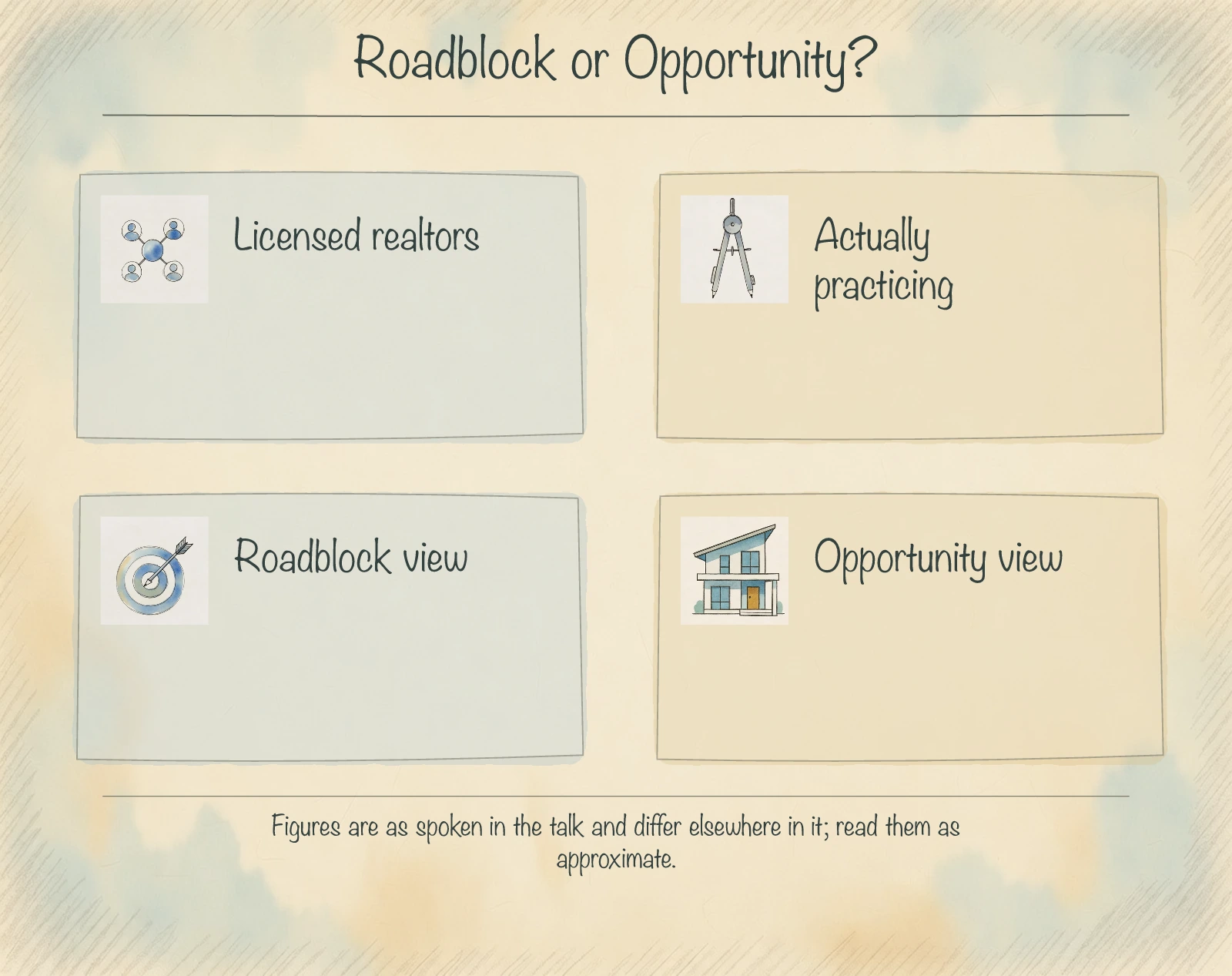
So this is a paradigm shift moment I want to share. I asked my realtors in Singapore, I said that we have 34,000 licensed realtors now, only 11,000 people are practicing.
Is that a roadblock or opportunity? Some of them raise their hand and say that it's a roadblock because it's so tough in Singapore, cannot survive.
That's why all these agents cannot make it. But some realtors, they say it's an opportunity because I only need to compete with 11,000 realtors.
How about this? Is this a roadblock or opportunity?
Everyone: roadblock. Roadblock or opportunity.
Actually I think, actually this is like a Singapore 20, no, I'm not saying that Malaysia is backward. I think based on what I heard, I think we are similarly on par in terms of technology adoption, but maybe in terms of regulation, this is building up.
But while you are waiting for regulation to build up, do not give up. Look at this as an opportunity because actually if you build your positioning and your content, it's very easy to stand out.
It's very easy to stand out. Later I'll show you how easy that is.
Now when there's a lack of regulation, if you can position yourself as professional and analytical and you dare to put yourself out there, I think you can stand out easily.
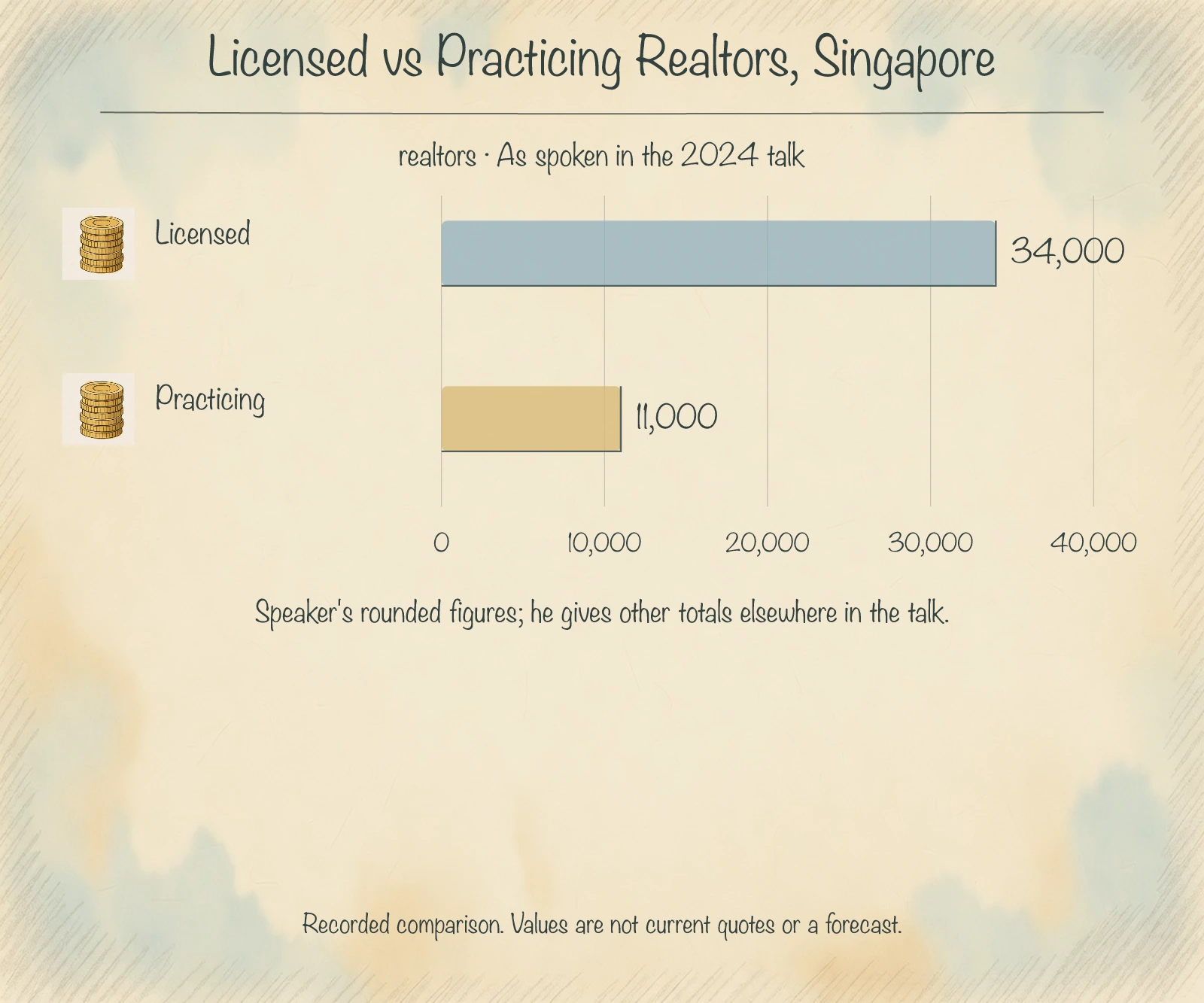
Read chart values
As spoken in the 2024 talk · realtors
| Comparison | realtors |
|---|---|
| Licensed | 34,000 |
| Practicing | 11,000 |
Let me just give you some examples. Even in Singapore, we have to constantly stand out because there's a lot of noise and consumers don't know who to choose.
The best way is to stand out as being analytical and this is what we do. [cut] of properties from developers and basically we noticed a five-year cycle within these two periods.
So we also want to look at will we start a new fire cycle moving off from 2025 and let's have a look at these three ceases. So we started from about 15/16 to 2020.
2020 was the COVID year if you remember and of course now we are in the middle of the second fire cycle which is 2023.
Of course this five-year cycle is a research kind of trending analysis that's being developed by POP Research and of course we think that we are right now in the middle and what does this mean? Now let's have a look at this again.
Basically this will only happen and the disclaimer is that this continues. Now why do I say that is because the quantitative easing in terms of increment in money supply is an important factor as well as a balancing act of interest rates.
So for example when QE happens.
So in Singapore we don't only do home tours. Because most importantly is that we know what consumers want.
We come up with a lot of research charts, investment frameworks. We help consumers to decipher when to invest, what kind of properties to invest, and where to invest.
So there's a lot of things that can be done. And that's how we draw a lot of good customers to us.
Those customers that are serious investing, they are ready to invest. One way is by being professional and analytical.
And I think that can be done here as well because that is how you stand out from the crowd because you spend so much time learning, reading the news, going for training. You just need to articulate out in your niche target audience now.
There's more supply than demand here. In Singapore actually there's more demand than supply.
But Singaporeans want to buy second property also need to pay 20% additional tax and our loan for second property is only 45% then know very hard to buy second property. How about Malaysia?
If there's too much supply, what can be done in terms of your positioning?
Now, if there are too much supply, I think one thing that we can shift in terms of our mindset and paradigm is that we can help buyers decipher where to buy, where to hunt for the right properties, which are the developers that are reputable and good that will deliver, and what are some of the investment frameworks that property investors can use to find the right type of property.
And similarly in Singapore, not all properties see appreciation. And that's an example of what we do in Singapore as well.
Let's have a look at the negative case study. So we just want to debunk the myth that it's not really about new or recent.
It's about characteristics of the property. So this is a new launch in Newton.
It's freehold. So we have selected this because this is 9, 10, 11 freehold.
And maybe some of you might say, hey, only freehold will see appreciation, not the case as well. This has negative, basically, this is a depreciation, basically from the launch date, the TOP date, all the way until today's date.
And of course, if you follow our webinars, there are certain reasons on why this happened. We talk about
Volume impact, we talk about the more transactions. And this is basically the amount of annualized negative gain that the...
So these are just some examples which I think you can stand out. It is to put what you usually speak with your property buyers and investors on a daily basis out on your content.
And of course, number three, please write down on your paper what drives you in this business. Because I realized that sometimes if we are not clear about what drives us in the business, it's very hard to move forward in terms of building a business on a longer term basis.
For me, it's very simple. I call this the impact meaning of freedom.
I realized this a couple of years back is that the more impact and value I give to my customers and my team members, the more meaning that I receive in my daily work and satisfaction in my daily work.
And of course, then I can derive freedom as a positive ripple effect. So that has been my framework.
What about yourself? What has been your driving force in your framework?
And sometimes I think it's because we're just not hungry enough for our family and loved ones and of course for your future.
And number four is that this is the ultimate roadblock to a real estate professional creating their niche in the market. Why do I call this the ultimate roadblock?
This roadblock is about worrying how other people look at you. So are you inward-looking or outward-looking?
And this is a psychological term.
What do I mean by this is that if you adopt an outward-looking mindset, you constantly worry about what other people think about you, think about your content, what you say on social media, and how you present yourself, what are you speaking about, you worry about the comments and because of all this worrying that's inaction and sometimes when you look back five years ago, maybe five years ago you thought about doing something but you keep delaying it because you were out looking and that has delayed your action plan.
And maybe you look back you say that hey actually if I started five years back it wouldn't be so bad right and maybe maybe three years later, if we were to meet, 2027 at Marrec again, maybe you would think, hey, three years ago, Melvin did say that if I were started back then in 2024, my business would have been different.
So have you been outward looking or inward looking? And why should we create content?
Why should we even market advertised? Because maybe now you are doing good work, but nobody knows.
You could be a realtor or professional that is doing so much analysis, you have good properties to recommend, you sell in a way that you know you really fight for the best price for your customers, but nobody knows because you are not creating a niche or maybe there's just not enough documentation of what you're doing in the social media space.
Nobody knows what you're doing and customers customers cannot find you. So actually, if you are doing good work, you're actually responsible to direct the customers to you rather than the illegal agents.
Because if you don't even advertise yourself or you don't even put yourself out there, how can they find you? Naturally, the illegal agents that advertise themselves, customers will find them, right?
So this is actually a mindset shift that I had about six years back.
And of course, I think reason number three is that it's crucial for your success. Why is it crucial is that different session is so tough.
Back then my team, [redacted name] was just putting in this slide for me. So sharing with me that actually apples, guess how many apples are there in the world?
How many types of apples? Very wishy-washy.
Anybody just make a guess. 7,500 different types of apples.
So there are 7,500 different types of apples and how will the customer be able to identify who we are if we don't differentiate ourselves. And sometimes the moment we start to differentiate, they can easily identify us and the service that you provide.
So the rationale is because customers only want to have one expert in different areas of their life, one dentist, one doctor, one realtor, one insurance agent. They only want to deal with one very solid person.
And of course, if you can be that solid person, and you only need to perform on the first time, your first transaction with them. And most of the time based on statistics in the US, more than 70% of the clients, they go back to their first realtor.
So you just need to perform one time very well.
But in order to do that, you need to be able to attract new business and generate new business by building your niche. So how does PRB build our niche through the years?
And of course, I started as a single realtor together with my business partner. Now we have a team of realtors.
But how do we continue to stay focused and to be patient with the results to dispel all the noise by building our niche now as a company? So all the way from a single realtor to a company, how do we do that?
Let me just show you a quick video. And this has something to do with our mind space for being the home tourist category king in Singapore.
Welcome to... Hi there, welcome to the first new Sengkang.
Today we are taking a look at a 4 room apartment in block 445B. Come on in!
Building a Niche: PRB Home Tours and the IFDS Framework
Hi, we are excited to show you a freehold to Black's 2-bedroom penthouse at East Village today. Come on in!
Melvin Lim, [name omitted] Lim, Prophecy Lim Brothers, always happy to show the thing. So back then in 2016, home tours was a very new thing in Singapore.
Nobody has done home tours. The only more marketing back then was only photographs.
Back then I was thinking how can we position homes differently because every property is so unique. There are different renovations of different homes, there's different kinds of views from different properties.
We should really be highlighting all the unique features and benefits of each property very very differently and I think video is one of the best way to do it. Firstly, nobody believes in home tours.
Second thing was that the prep of the home really takes a lot of effort. Of course the third thing is that how can we articulate and how can we film in the fashion that really makes the home tour exciting.
Also that in terms of the number of issues that we face is like I don't know 101 issues in the very first season. The boot house residences were just...
We are happy to show you the place. The biggest problem is less than 5 minutes.
What do you want, man? The key idea back then was really how can we do this so that home buyers and the comfort of their homes can just sit on their couch and watch every single detail of the properties before they even come for physical viewing.
So we tap on pushing. Firstly, we need to figure out what is the right camera to use.
We want to put it in the best-piste, fun-suit, fun-dose and jam-suit, it's tasty. How can we go to a stage where we can just speak normally?
Brother and brothers, right now we are at the Highly Sot after 99 years later. It's time to this drink night today.
We are bringing you to this amazing semi-detach hole that you wouldn't want to miss. If you're ready, let's go check it out.
Here we also show the exterior of the condo project of the Lennon in-clave. We were thinking what if we can't do physical staging?
Can we do virtual 3D staging? What about investment units?
How can we use motion graphics so that can visualize better? We can look at numbers better, location maps better, bring on the floor plans.
How to select a home in terms of framework? Logos will change, show the bias in the comfort of their home.
How can we bring up the best points of their parties? This is the evolution of PRB home-tests.
Okay, last stick, last stick. Okay, okay.
Alright. Give our media team a round of applause.
That's right. And the reason that we keep pushing to do better and better home tours is actually for just one audience is that we want to benefit home sellers, that they can rest assured that when they hand over their home to us, we do a good and excellent job.
It's also for the benefit of the buyers.
Buyers don't need to waste time. Buyers cannot look at the home tours at home.
Then when they contact our realtors, they come for viewing. And most of the properties that we saw over the last six years, when the buyers came, they said, I already watched your home tour two, three rounds really.
And I just want to see the real thing. So everything becomes very clean, it becomes more genuine, it saves everybody's time.
And 62% of our home tour sales, they sell at a positive premium compared to the neighbors that do not have a PRB home tour. And of course, when we track on a year to year basis, it also increases the speed for our home sellers to sell their end exit from their homes.
So that is the reason that kept us focused is that we just keep thinking about a customer. How can we do better for the customer?
We don't think about who has done home tours, which company got done home tours, which competitor is doing home tours. We don't look at that.
We just think about the customer and that has been keeping us focused. So what do you need to do to create a niche for your brand?
Whether it is an individual brand or for your team? Let's have a look at this.
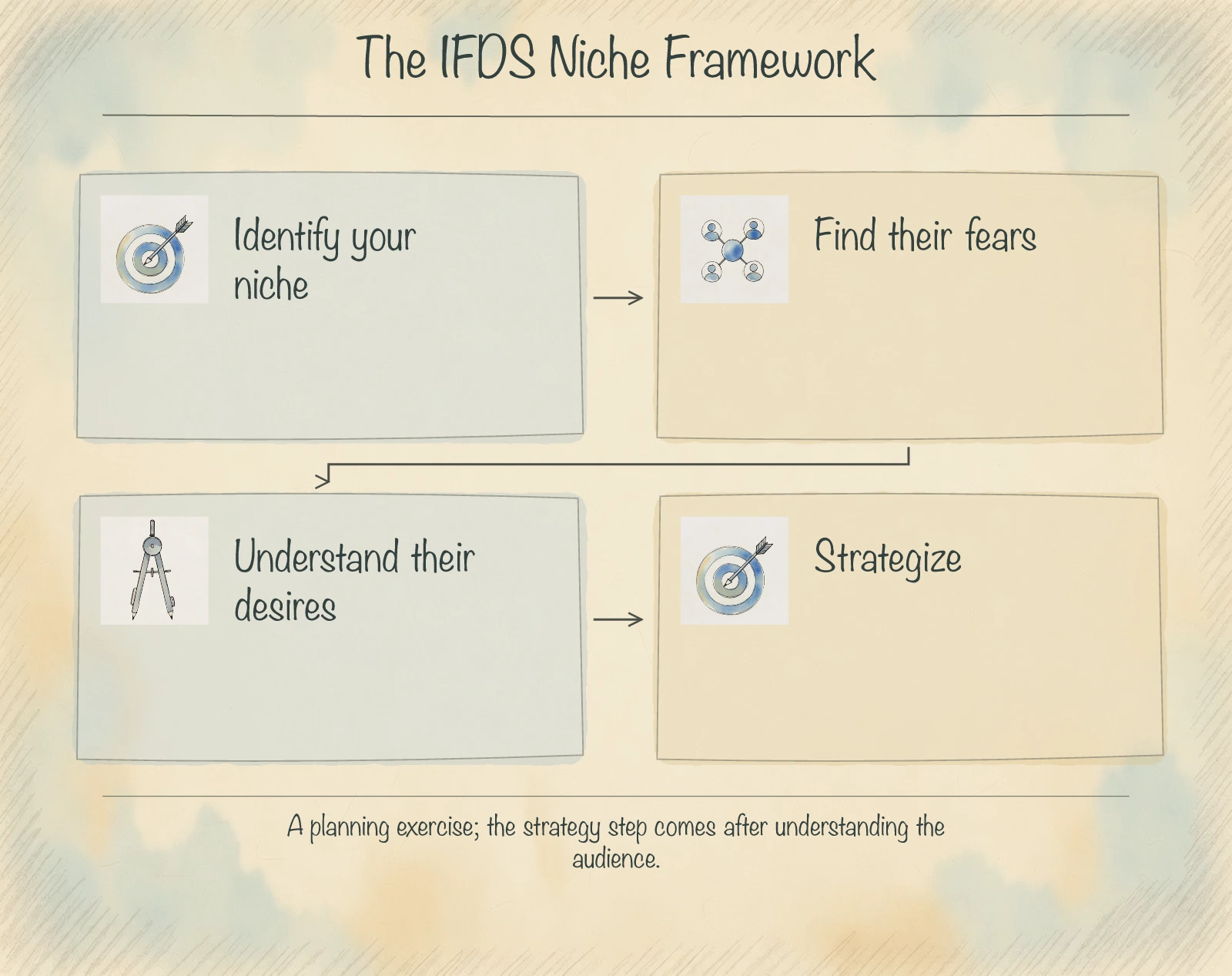
The second part, which is the business model. I call this the IFDS framework.
So for those of you who are keen to create a niche, write down this framework. This is going to help you.
You are free to take photographs as well. This is what we do in terms of a mental strategy exercise back in Singapore.
And the number one thing is to identify your niche. Find out about the fears of your particular target audience.
What are their desires? So desires is D and last is to strategize.
So I call it the IFDS framework. Now, this is what we do in Singapore.
You can do that for your own market as well.
list down in the metrics box all the different types of customers that we can serve, and we zoom in to one maximum two groups that we want to position ourselves to the audience. Later I'll share a view what is the ultimate business model about.
We also do up their thinking mind space as a family. For example, Mr. and Mrs. Stun, this is provided to me by one of my writers in the past.
Basically, we'll write down what do they want to achieve in life, what they fear as well. Number three, we write down all their concerns as a buyer.
So we call this the buyers persona exercise. So think about your target audience.
Let's say if you're doing landed homes or you're doing condominiums with high-end KL, write down all the potential fears of your buyers in this market. And let's say if you are a listing agent, write down all the potential concerns that a home seller owning a high-end KL home or maybe a KL landed property usually will have.
And this is what we call the seller's persona.
The next two things you need to do is to chart their journey. And why has this been important is because actually if you go to our property lembras youtube channel, all the content that we create is based on their journey.
We create content around their journey. That means from the start of their research phase as a buyer to taking action, what are they going through?
And we create journey and education to help them in this journey. So there's one thing that you need to know is that this is a contrary mindset.
Maybe some of you are thinking, hey, I give all this free education to the buyer, then the buyer will go in DIY. I do all this free education to the seller, the seller will DIY.
Actually, I tell you the truth is that the more you give, the more they will give you the business. Because consumers are too busy to do this on their own.
They are just waiting for the right consultant with all this knowledge and then they will give you the business. So sometimes it's a reverse mindset.
So you have to treat it like you're giving free advice and this is the seller's journey that we usually use and we create our action plan around that.
Now, when... come, I know some of you are taking photos, come.
Okay, seller journey. Okay, all good?
Now, this is very important because the buyers market is shifting faster than the sellers market. Most home sellers are actually busy with their own business.
Most home sellers will still give their properties to a realtor. But buyers now love to DIY, they love to go to the show flat themselves, they want to do research themselves.
So you need to understand their pain points. They usually want to understand from a consultant, why should I invest today?
Where should I invest? What should I invest in?
So your content is to answer these three main pillars and these are the three things that will be very helpful for you.
So if you look at all the experts in the world, you look at Gary Vaynerchuk, look at Vin Zhang, you look at Anthony Robbins, they are very clear with their niche target audience. Gary Vaynerchuk is a social media expert to entrepreneurs and solopreneurs.
He always will double down that Ving Jiang talks to people who wants to be better at their speaking articulation. Anthony Robbins talk about pain and motivation.
They are always very clear and they stick with it. And because they stick with it, eventually it allows them to expand into other kinds of niches.
So, So when you look at this, I call this a niche targeting approach. So even for PRB, this is what we have done in the past.
We started from public housing actually. So in 2018, we created a lot of content on HDB.
We then moved to condos. We then moved to landed.
We then moved to new launches. And then we started our agency.
So as an agency, we actually do everything. But we have different content pillars to target different niche.
How about yourself? Actually, you don't have to worry about whether you should do everything or you should give up about what you're already doing.
That's not my point. My point is just to share with you that when you have the right strategy, things will work out because if you do not have the right strategy, your percentage of failure is very high.
If you have the wrong strategy and your tactics is correct, your failure rate is still very high. But the moment you start to have your right strategy, your success rate will drastically improve.
So what do I mean by this? Firstly, you can take this photo.
I think these are questions that you need to ask yourself in order to start to craft out your niche. So once you start to identify the first niche that you want to position yourself in, so let me take an example.
You want to be positioning yourself
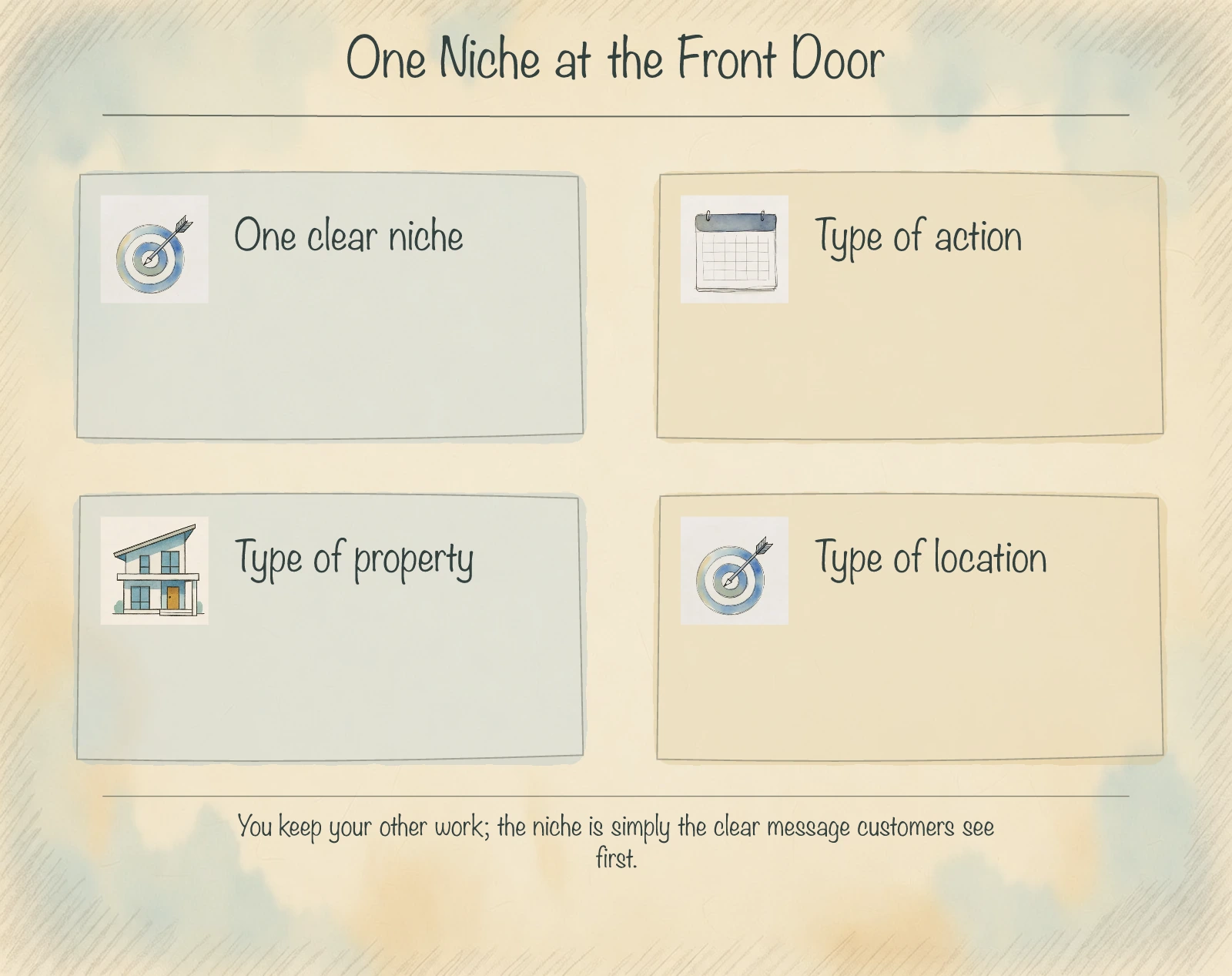
As the KL landed expert in this particular region. Think about do you want to be an expert in a type of action?
That means I help people to move into their first property investment at a faster speed by giving them the right investment framework. That's the type of action.
Do you want to specialise in a product, a type of property, or do you want to specialise in a type of location? So these are the three things you need to ask yourself.
What do you want to specialise in? Okay, once you have figured that out, you need to move to the second step.
It's that you do not have to give up what you're doing. Maybe you are doing rentals.
Maybe you are doing different types of properties. Rental, condo, landed, whatever, developers' project.
But you just need to have one niche that tells the world what you're doing. Because this is what we call the Takashimaya department store approach.
At the back end, you still have a lot of products, but at the front end, you are very clear to the customer: hey, I'm the landed expert in this area. Let me help you.
When they come to you, most of the time a lot of consumers, they have different types of properties. They also need your help for rental.
Their children got properties. Their friends got properties.
And once you position in one niche, you draw them back to your store and that is how you cultivate this to be a long-time customer. So focus on one first.
Do not be greedy. Don't be a jack of all trades.
Just focus on one niche. So far so good?
Alright.
So the best content is to talk to your niche every day, and this is something that I need to caution you first, because the moment you start to do content right, some of your friends or maybe your colleagues or family members or maybe you go for gathering with your schoolmates or your ex-colleagues, then they will start to say, oh wow, I saw you
doing this content, very good, very good, oh hey, but you know a lot of people also doing it, or this other agent in this agency also doing, ma, then you start to get dejected, then you don't want to do already.
Let me share a view: from 2017 until today, every year, every year people will tell us that a lot of people are doing home tours, a lot of... actually it's nothing new, a lot of people doing home tours, home tours.
Actually I tell them, actually long time ago there's a US already start doing home tours, home tour is nothing new. Actually it's about how consistent you are, because most of the time, actually I look back 2017, a lot of people that started to do home tours in Singapore, they are not doing anymore.
Even people who start to do home tours last year, they are not doing anymore. It is about how consistent you are in this business.
You just need to focus on the customer.
Don't care about the noise. Just do it for the customer.
So far so good. And this is the disappointment zone.
When you go for your school gatherings, take note, whatever people say to you, don't care. Just persevere.
Because you are doing it for the customer, you're not doing it to show your competitors. Just remember this fact.
And you just need to break through out from that zone before you start to see success. And this is from The One Thing as well.
Now, if you are consistent, you will start to see dominos. That has allowed us to see dominos in our business.
So starting from 2017 as two percent, we start to see dominos being built. So every home that we sell, we reinvest back into the business.
We believe that it works. We collect feedback from the ground.
Customer tells us that it works. Home tours help them to sell faster and better and higher.
So we persevere and make the home tour better and better each
year. And we start to build more in-house team on how can we...
don't do physical home staging. How can we just use technology to do staging or renovation?
And that's what we've been doing for the whole last year. And we also started a lot of webinars that has brought us a lot of investors and buyers last year.
Speaking engagement, our own event, we held our first landed convention in Singapore, our client precision event as well, and a lot of partnerships has also happened because we persevere.
And since last year we started bringing our own tech and apps and that has allowed us to build also with the leverage of AI, we built our own tech apps for consumers as well as for our realtors as well.
And also importantly, it allows us to reinvest back to the team to build more like-minded teammates in the team and to create more in-house units so that we can ultimately serve the customer better. So last step before I hand over the mic
is how can we start to very simply leverage and start to build your brand, your niche, your content. I call this the ultimate leverage hexagon.
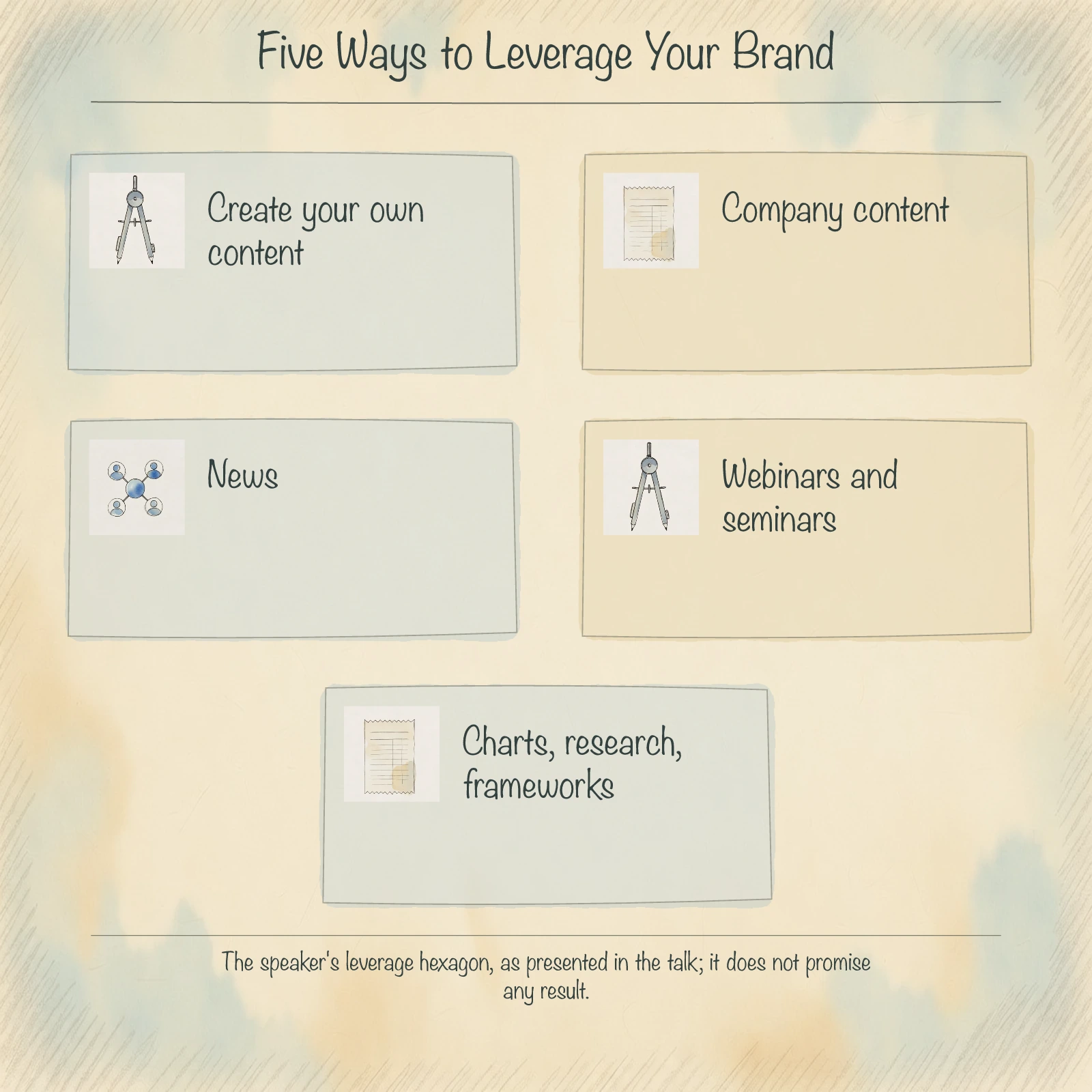
You might want to take this photo. Basically it has five pillars.
The first pillar is the most painful one. But actually now with your phone it's very easy.
It's really very easy, and now even there's AI captions and everything is so easy. Content creation is the hardest but it's also the easiest.
You just need to persevere to do it five days a week. And the second part is to leverage on the content that is in your company.
Third is to leverage on news, fourth webinar seminars that your company is doing. And last but not least is to develop or leverage on the charts, research and frameworks that your company provides for you.
So first step, write this down. 20 times 12.
Every week, every week, spend five days to create content Monday to Friday or Wednesday to Sunday, the most busiest day
actually when you are waiting for the buyer to come you can create content already. You don't have to think so much.
You're down sitting at the car park, your car walking up to the corner, you can create content also. Just then you create a 60 second content every single day, you have 240 content after a year.
The first part is the toughest because nobody will watch, your likes will be very little. But once one of your videos starts to gain traction and go viral, you start to pick up.
You need to persevere. And your content just needs to follow this concept called VAO — value adding, applicable and Organized.
And the good news is it doesn't even have to be organized. You can just create any content that is relating to what your customer needs and how it can help them.
So if you're talking to a landed buyer, every day you just need to talk about the fears and desires of a landed buyer. How to select a good landed property.
Is this the right year to invest? Am I overpaying for this area?
What kind of landed home should I go for? Should I go for a sub-sale market or direct developer's unit?
Is this developer's unit overpriced? Is this sub-sale overpriced in this area, good?
Or should I wait for next year? Right?
You just need to make sure it's value-adding and applicable, and you just need to think, I just want to create free content, if I don't make money it's okay. Once you have that right mindset, you push it for a year, you will start to see dominos happening.
So far so good. And back in Singapore, we create all types of content.
These are our podcasts. Long form.
Long form, actually the easiest to create is podcast discussion plus Q&A. That's the easiest to create.
We also do short form education, long form education. These are our home tours.
These are our vlogs. These are our interviews with customers, we call them chitchat sessions, so you can actually go to our
PropitonBus YouTube, help to subscribe and also look at the different kind of content pillars that we have to draw some ideas, and we're also learning from different realtors in different countries. I constantly look at US, I also look at Malaysia content also, and I think the Malaysia YouTube content is also growing very very rapidly.
So I think the only difference is that who is the most consistent. And actually when you kick start, I want to encourage you that you don't have to think about having a big team.
You can outsource first. You can have a virtual assistant in the Philippines.
You can outsource to a freelancer first. Just make sure that it's consistent for the first year.
Don't need to think too big. Start with a small team or you can go to your office, look at your teammates, ask for two, three like-minded people, hey why don't we group and then we do together first for one year.
After one year we see how it
goes. And we also create a lot of short form contents.
Shorts are very powerful nowadays. We have 66 different funnels.
We call it the lead generation funnels. We have 66 different funnels and this is how we leverage on funnels.
That means we use long form videos, we bring customer to the funnel and then we convert from there. Sometimes we use shorts, we bring to the long form content, long form content bring to funnel.
Sometimes shorts bring to funnel, funnel bring them back to long form content. We use re-targeting and all this you can talk to your digital marketing partners.
And we also track our leads. So all these leads that we track over the years, this was just last year, we have 718 leads that came in with a physical address.
That means we've unit number. So we know that it's real leads.
We met five hundred over of them and of course last year we sold in totality close to about five hundred different homes and
We tracked the leads in terms of where are they coming from.
So if you look at this, I think over the years what has affirmed the use of funnels and niche positioning is that the moment you start to do it, you realise that close to 70% of the leads — actually, that is the first and second bar that we have, landing page and website form.
And hotline happens because they see the ads on social media. Because we only display the hotline on social media, and then they come to our website, they call us.
So close to 70 to 80% of our leads now come from our content and niche positioning. And the rest is from referrals and other things like that.
And this is what I call an automated niche positioning lead gen system. So once you have that, you can leverage on funnels, build your own frameworks.
This is something that people cannot take away from you. So people like to simplify their lives with frameworks.
For example, if you have a method to invest in landed homes, create like an EFG framework, something like that. Create different kinds of frameworks so that they know that it belongs to you.
We create different charts, we leverage on our prop tech, which I think you can leverage on what your company already has. Just think about how to leverage on what your company has for quick win first.
Don't spend the time to develop on your own. The only thing you need to develop on your own is to create content.
Every other thing, look at what your company has, leverage on it. I believe your agency leaders will help you.
Webinars as well. Webinar is something that we leverage a lot and I just want to encourage you that it's going to be hard, but once you start, you realise that after I start for one month it's getting easy, after I start for two months it's getting easy, and you will start to build a team around you.
And of course maybe initially your freelancer might not be the suitable one, you might need to switch and change, but after that it will get easier and easier.
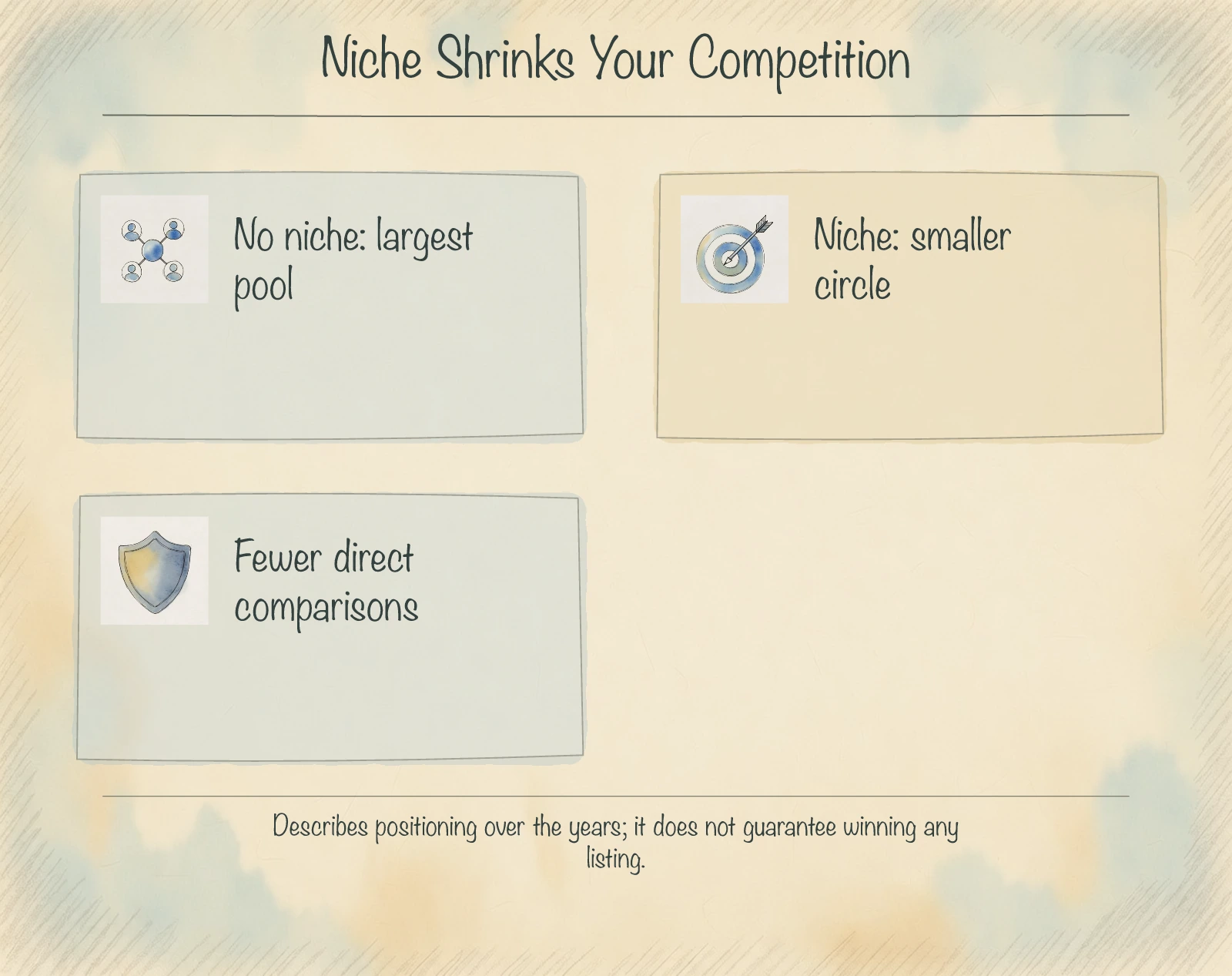
Alright, and before I end, this is what I call the flea zone. People that start to create content have their own YouTube channel, their own niche.
They start to move to smaller circles over the years and end up you are in a circle that is so small that you only need to compete with a few players. If you don't create a niche, you are always competing here in the largest competition pool.
But the moment you start to create a niche for yourself, every time you go and meet a seller, at most they will just compare you with another one to two percent, and that is the reality on the ground.
So the moment you position yourself, you flee from competition. Alright, and a golden rule is when you create content, please do not talk about your competitors.
Don't create content to talk about other agents. Just focus on your customer because your customer also will feel that you are not professional.
Why you keep talking about your competitors, it's like very childish, right. In Singapore, actually a lot of realtors, they start to do this, they got penalised, they got suspended by CEA.
So focus on your customer, create the right kind of content.
And last but not least, these are the three steps that I have for you today. I hope I have added value.
So far so good everybody, is that good? And I just want to share one last thing.
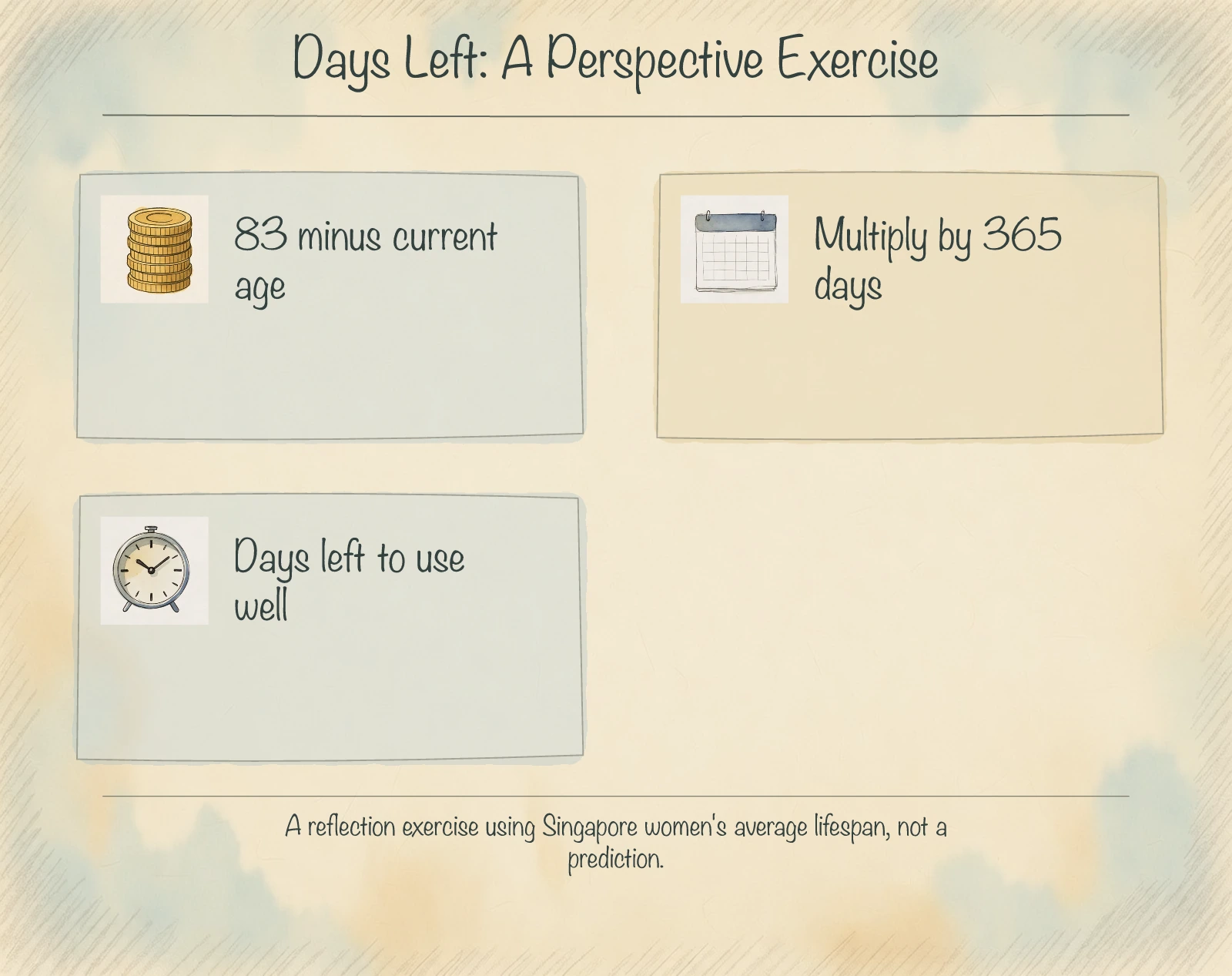
I always want to do this exercise with all my audience, is that this is the average lifespan that we have in Singapore. But 83 years old refers to women.
Men is usually shorter life. Okay.
And I like to do this exercise, and I also hope that you can participate in this exercise. Let's take the 83 years old minus your current age.
Because every time I want to procrastinate or start to fear doing something, I will use this exercise on myself. I will take out my calculator, I think 83 minus my age now, which is 43.
I multiply by 365 days. So do a quick calculation.
This is the time to bring out your phone. Just take out a calculator app.
Calculate how many days we are left with if God gives us until 83. Of course, if he gives 100, that would be the best.
But if God gives until 83, how many days are we left with? Anyone?
What's your answer? I share my answer first.
14,600 days. That's my...
Sorry? How many days?
Okay, you can leave the answer to yourself. 14,600.
After this, I also sometimes, you know, a bit too ambitious. You know, sometimes running businesses can be stressful, right?
I will take a step back, look at this and tell myself that hey, I'm here to also enjoy the journey, enjoy the people that are with me. And I will also do this exercise for my parents
So that I can remind myself to be thankful to them for their time, right?
So most importantly, I think our mind is our greatest asset and our greatest enemy, and change is very difficult, but if you can take one step of paradigm shift forward, your business will be drastically different for you, your family, your loved ones, and build yourself around a good team.
This can be a lonely business. I want to encourage you, and that's also the reason why we invest in a lot of memories with our team.
We do a lot of things day to day, month to month. We love events, we love puddles and things like that.
And I want to encourage you to do that as well with whichever team and company at AJC. And even with everybody here, even though you are from different companies, but I think just being in the same industry is already being in a good community.
All right, thank you very much. Thank you very much everyone.
Take care. All the best.