Thinking and decisions
Mastering Mindshare Positioning: Building Trust, Influence & Success in Real Estate
Published 2026-11-15. Adapted from the episode published 2024-12-13. Figures, illustrations and data reflect the episode’s original publication date.

Mindshare Positioning and Playing the Long Game
Let's talk about this very important concept called Mindshare Positioning. So Mindshare Positioning is something that we advocate here in Proptiline Bros.
There's this thing called Mindshare Positioning. Now over the years, I pick up reading and of course this playbook is a combination of things that we have learned over the years.
And of course a lot of things comes from some of my favorite authors and favorite books. So there's this thing called a mindshare positioning.
If you are thinking about what books to read, there was a post on my Instagram before about some of the top 10 real estate books that I love. Some of them belongs to the Millionaire Real Estate Agent.
There's a book by Tom Hopkins on the art of selling real estate. There's a lot of different kinds of books that I think can help you.
The most important thing is that as a salesperson, you need to come into the industry with a mindset that you want to learn and you need to learn fast.
And mindshare positioning is a concept that consumers love to simplify their lives. So let's take for example, if I'm a consumer, I mean all of us are consumers to a certain extent, right?
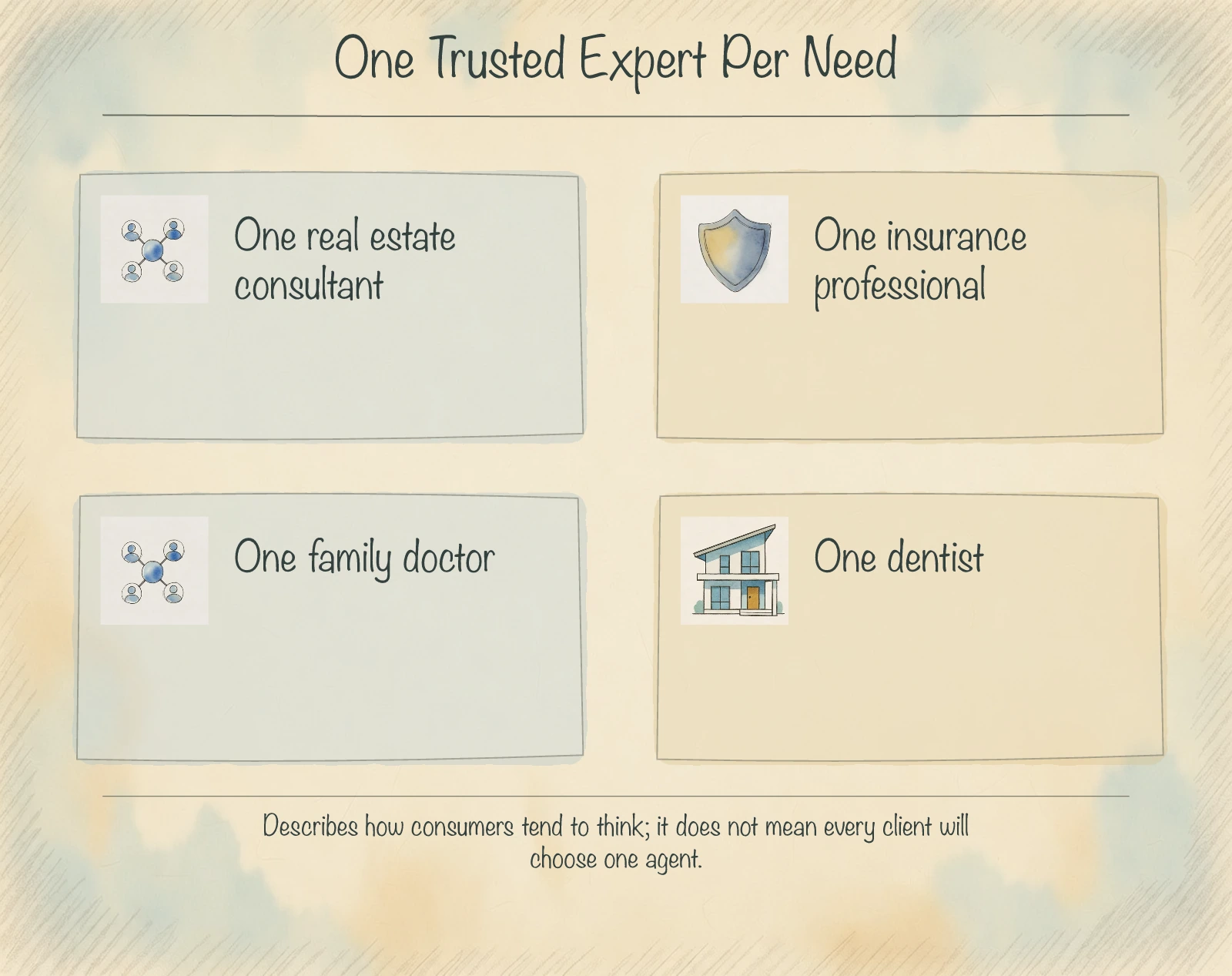
So a consumer or family, they will always want an expert in a certain need of their life. So for example, I only want to deal with one insurance professional that handles all my insurance policies for my family.
I maybe only want to deal with a family doctor. I don't want to have so many different family doctors.
I want to have only one dentist that I visit regularly, one barber or hairdresser that I visit regularly. I want to have maybe one real estate agent that handles all my sale, purchase, rental and things like that for all my properties.
And this is a concept that is very prevalent in the mindset of consumers because we want to simplify our lives. There are so many clutter, so many distractions, so many things happening at the same time in our lives, right?
We need to handle our health,
family, our work, our business, our relationships, you know, meet people, you think about bills to pay, think about the future of our kids, you think about helping our local community, family issues, friends issues, there's so many things that we need to handle right, but the last thing we want is to have so many multiple consultants in the same niche category that we have.
And that's where mindshare positioning then gives us an insight on how we can position ourselves as a very solid real estate consultant. This means that there are two things to learn here.
Number one, an average consumer in Singapore will go through different journeys. So for example, a young couple will usually come out and get a BTO first.
Because BTO as a real estate consultant, you cannot dabble into BTO because BTO is sold directly from HDB to the consumer, right? So you can only dabble with anything resale or brand new private properties.
So usually a consumer will come with BTO first, but people also need BTO advice, right? So maybe you
might be thinking, hey, if I want to give advice to my friends asking for BTO advice, but I also cannot sell BTOs, why should I give that advice? But then that will be a very short term mindset.
A long term mindset will be thinking that it's okay, I can genuinely help my friends because I know about BTO. I studied that.
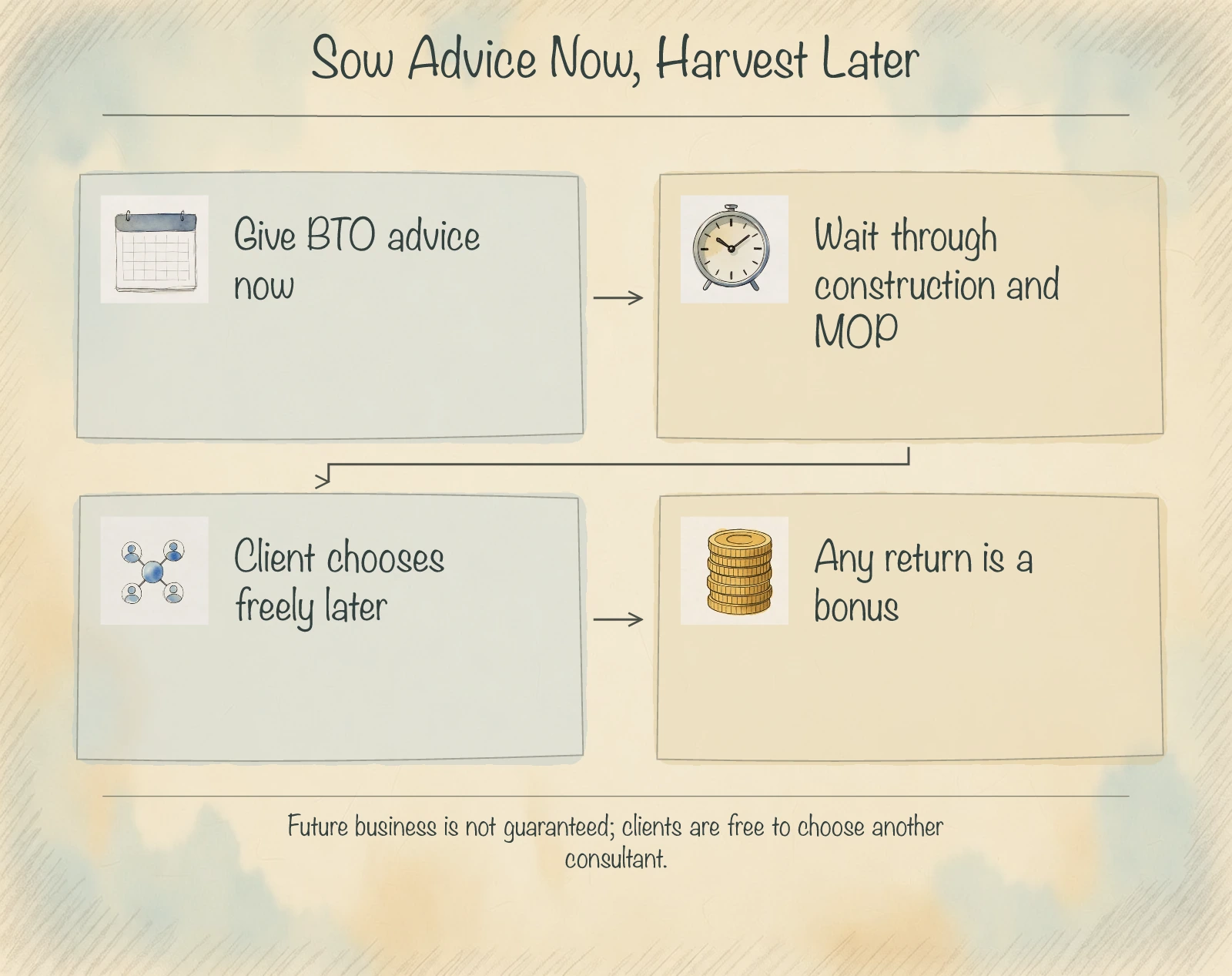
Can just try my friends that once you get a BTO, construction period, 3 to 5 years after another 5 years of MOP, if you want to sell effectively, what should be the correct property, the correct facing, the correct stack to choose, the correct kind of layout to choose for a BTO so that in future after 8 to 9 years if you sell, you will not face an issue.
Of course, you might be thinking 8 to 9 years later, will my friend remember me for the free advice I gave them? Let me show you a view that in this industry, prospecting, marketing, giving value, giving advice, this is all by a leap
of faith. It is really like a farmer's mentality.
A farmer has only one chance in four seasons of a year to sow his seeds, to plow the soil and then he has to sow his seeds by faith and then wait for the harvest seasons later.
Whether that year is going to be a drought year or it's going to be a flooding year, it's all controlled by nature, right? And the farmer don't overthink.
They don't overthink that this year would there be a flood? And if I think there's a flood, maybe I don't want to sow my seeds anymore, right?
I don't want to plow the soil. I don't want to put in this hard work.
But a farmer will do that year after year, year after year by faith. Because whatever the outcome is, he just needs to know that he needs to do his best in this season and leave every outcome to nature, that's fine.
So, being in this business is the same because if you overthink, then technically speaking
Sowing Seeds, Free Advice and Mindset
You are not sowing seeds. Because, for example, let me just change your perspective a little bit.
If 10 of our friends are going for a BTO, all 10 come to you for free advice, and you clearly know that only 10 years later will then be able to reap the fruits. If all 10 friends come back 10 years later and say that, "Mel, my place has reached MOP.
I want to thank you because 10 years back, when I was selecting this project, you gave me free advice, and now I want to sell. I want to let you have the business." You cannot force your friends or consumers to come back to you 10 years later, because everybody has free choice, right?
Maybe another real estate consultant gave them better advice, they decided to award that, or maybe 10 years later, you're already out of business, right? So don't overthink things that will happen 5, 8, 10 years later.
Just do it now. Just do it now.
So the seeds, whatever happens 10 years later, live it and let time take its course. Maybe even if one friend comes back to you, it's a bonus.
Just think of it as a bonus. And I think you'll be happy with your work.
So if 10 friends come to you for free advice, just help your friend. Just give them the advice to your fullest kind of mindset that, you know, I'm just helping somebody, I'm just helping a friend, I'll be happy for them.
Free advice, that's okay, right?
So, mindshare positioning means that understanding the customer journey in their entire life is so important because somebody will go through, let's say a BTO, and then 10 years later, they will sell their MOP HDB apartment, they might move on to a condominium, they might then buy another new project for investment, they might also go to a landed property.
They might also want to buy a private condo plus a commercial property. They might have friends or family or their parents that have other properties or industrial properties to sell off.
They might also have different kinds of friends that want to rent and things like that.
And thus, this is a very important concept, is that by understanding that everybody in Singapore has so many different kinds of needs on different kinds of properties, it's very important to position yourself as a very fluid expert, which has another concept, which is called the polymath concept, meaning that you're a real estate consultant that knows a broad spectrum of properties that you can handle.
Whenever they have any needs and any kind of advice that they need on different kinds of product, they can come to you. So the moment you achieve that positioning, you are then able to take care of all the real estate needs in this person's life.
When you do that, even their network will also come to you because they are going to shout out for you and say that, hey, let's say, for example, they go for a gathering. Somebody says, "Hey, I have a commercial property, I want to rent out, I want to sell," and things like that.
Your customer, because knowing that you are like their go-to person for real estate, would then recommend you to their network as well.
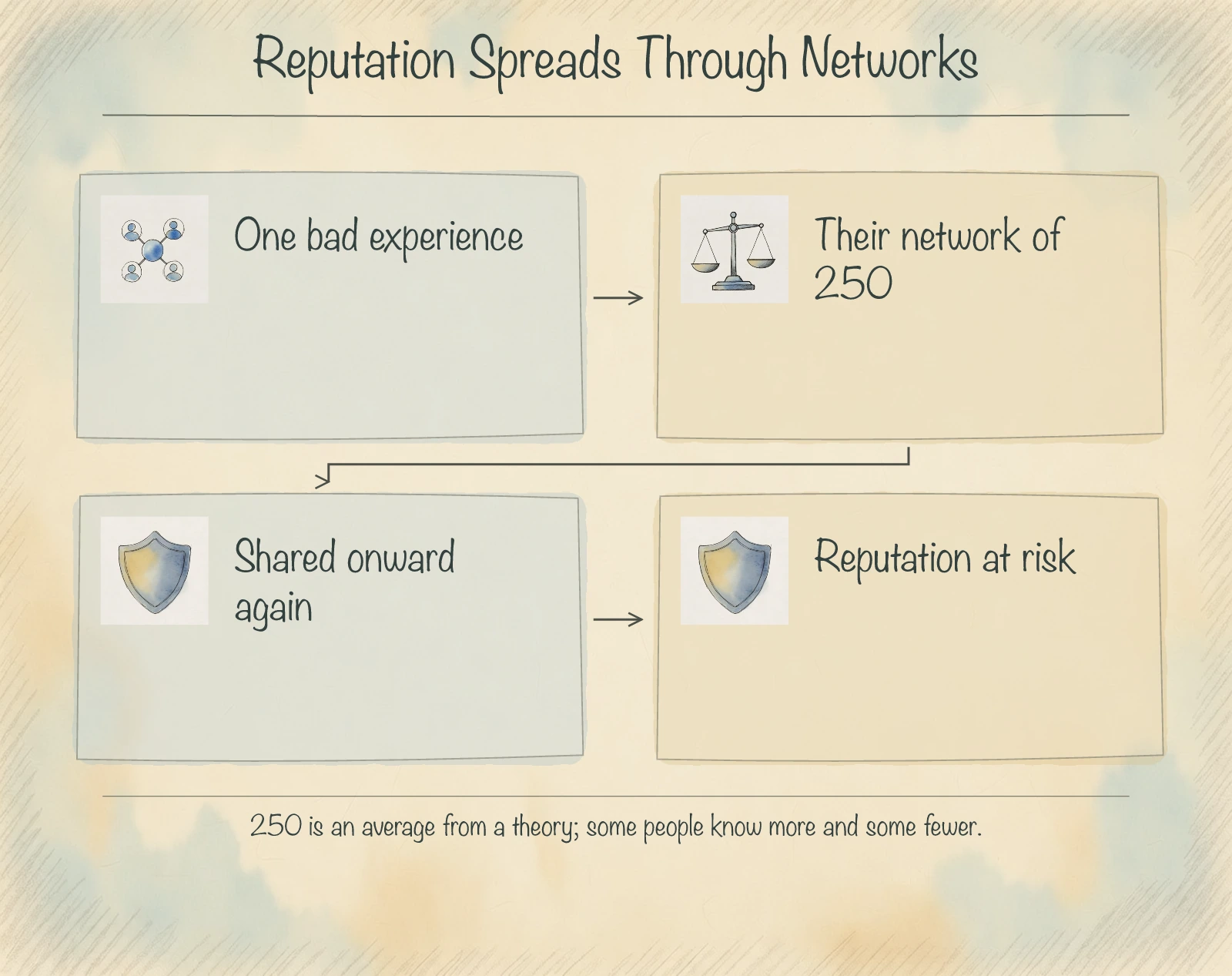
And always remember this Joe Girard theory of 250, meaning that every person that you meet, they have a network of 250. And that is so important because by having this mindset at the back of your mind, you will then not judge anybody that you help because you will have an open mind to help people.
And knowing that everyone knows people, you will not want to treat them in a way that they don't deserve to be treated. So always have a combination of this kind of mindset, mindset positioning, leap of faith in giving advice, serving people, marketing, positioning, and also understand the rule of 250.
Because let's say for example, if you meet a person, this person has a bad experience with you.
What is going to happen is that his or her entire 250 people network — and on average everyone knows about 250 people, on average, of course a lot of people will know more, some people might know less, but let's take an average based on this theory of 250 — is that this 250 people is going to share the bad experience that this friend had with you.
You're gonna lose 250 people, and that 250 people is going to share with another 250 people. There's going to be like a compound maximum effect.
And at the end of the day your reputation is extremely important because you are running a business. And task, mindset positioning, reputation, concept of 250, and being the expert in your consumer's mind in their journey.
I think that's one of the things that you need to invest in. I think at the end of the day, mindset is so important in this business.
And there's a lot of things that will happen later as well. Because maybe you might be asking, hey, what are the things I need to learn in terms of technical skills?
Technical Skills Versus Getting Mindset Right First
In terms of technical skills, is it doing financial calculation for a client, portfolio planning, understanding the rules and regulations, CPF usage, bank loans, mortgage planning. And maybe how to market a property, how to understand the different types of property, how to compare properties, how to make comparisons.
How to analyze properties, how do you do pricing strategy analysis, how do you do kind of delivery for presenting a property, and how do you appear on camera, and how do you do social media marketing.
I mean, there's so many different spectrums of this business, but I think the most important one, for the first part, which is your mindset, and you need to make the mindset right first before all the things will fall into place.
All right, so see you on the next episode. Cheers.