Buying and upgrading
Lentor’s Rejuvenation and What the URA Floor Area Harmonisation means for Buyers
Published 2026-11-12. Adapted from the episode published 2024-02-02. Figures, illustrations and data reflect the episode’s original publication date.
On this page
- Introducing Lentor as a Transformation Area
- Lentor's Surroundings and Launch Plot Comparison
- Luxury Positioning, Schools and Surrounding Upgraders
- Developer Price Control and Harmonisation Introduction
- How Harmonisation Standardises Floor Area Definitions
- AC Ledges, Smaller Floor Areas and Affordability
- URA Master Plan and Investment Factors
- Macro Residential Supply in Land-Scarce Singapore
- Micro Supply and the Pasir Ris Comparison
- Lentor Launch Sales and Transaction Volume
- Resale Listings Competition and Closing Remarks
Introducing Lentor as a Transformation Area
Midtown. All right, welcome back to NOTG.
I hope you had a great start to 2024. And today we're gonna talk about one of the key transformation areas, and of course our viewpoint on this particular zoning.
Let's go. This area that we're going to talk about is the Lentor area.
And why do we want to talk about the Lentor area? One of the reasons is because when we talk about new townships, if you have been following us on NOTG, it has a different kind of behaviour.
And I personally think that this is going to happen for Lentor as well based on how things are moving. Previously, a couple of episodes before, in 2020 we talked about Woodleigh in one of the episodes about BTO effect onto a new township kind of behaviour.
And Lentor, being a new township, has been one of the very exciting and popular zonings since 2021 to where it first launched its first project, Lentor Modern. Let's have a look at this particular area and then we'll talk more about it.
So for those of you who are not sure where Lentor is, this is in the North East zoning. However, this North East zoning is not towards the far portion of the North East where Punggol and Sengkang are.
This is towards the portion whereby it's a little bit more centralised towards the Upper Thomson zoning. So it's like a tuck right near towards the Yio Chu Kang zoning, AMK zoning as well as the Thomson zoning.
It's also very near to Upper Pierce Reservoir. If you move northwards, that's going to bring you to the Seletar area.
So let's have a look at the new MRT station, the Thomson-East Coast Line. Of course, this is the widely anticipated line in accordance to the North-South Highway.
And this line of course leads you directly straight on towards the CBD zoning at Marina Bay as well as Orchard. And of course, this is one of the lines that connects not just from this north area towards the central area, it also connects throughout the entire East Coast Belt.
So a lot of people are anticipating
this line. Lentor is already open and this new zoning is called the Lentor Hills Park.
And later, as we deep dive into the master plan, something to take note is that whenever you see this light orange kind of zoning, these are called residential zoning.
And later, as we blow up even further, you'll start to realise that the master plan has changed for this entire zoning throughout the last revision of the master plan zoning, in the sense that there's going to be a lot more residential plots.
And why is that important?
It's because whenever you look at plots where the government is putting attention to, for example like Hills Park, this is going to be like a brand new concept with a lot of townships for private properties, a centralised park right in the middle, and is going to transform this area that's very near to the Teachers' estate, the Tagore region as well as the entire Thomson, Yio Chu Kang, AMK and Upper Thomson zoning.
So this is like what we call a brand new kind of branding.
And branding sometimes is important in the sense that it creates new excitement for the area. There's going to be an integrated kind of retail, residential as well as shopping, and that's going to be Lentor Modern, which has a lot of units that have already been sold out already.
We're going to talk more about all the developments right here. But for today's episode, we're going to focus on some of the new ones that are coming up, which is precisely this particular plot here, which is seemingly, based on what we have so far, one of the largest plots that is available.
So let me just bring you up to speed for 2024, because 2024 has fewer new launches compared to 2023. Last year we did a webinar talking about all the new launches as well as resale TOP projects as well.
I'm going to deep dive a little bit into the disparity, the performance of TOP versus new launch for this year and next year.
And perhaps if you are thinking about, hey, should we go for a TOP project or maybe a new launch project? What is the PSF play that we're looking at?
What's the quantum play that we're looking at? Upcoming projects as of end of last year.
If we look at some of the projects that will likely be launched this year, it's predominantly fewer launches compared to 2023. In 2023, there are still a couple of balance units from the launches that started from the first quarter.
Later, I promise you, at the end of this episode, when we deep dive into the cycle, I think you'll have clearer clarity on whether to go for a new launch or TOP or resale. So let us have a look at Lentor's transformation.
Basically this area has been like a sleeping town. And why is that so?
It's because predominantly, when you tell people that you're going towards Yio Chu Kang, Lentor, this used to be like a bad plot of greenery land.
Lentor's Surroundings and Launch Plot Comparison
They will usually drive past all the way from Amokyo if you drive across towards Yotukang MRT, and you want to cut across towards Kajurina where there's like a famous row of eateries like Prathale into the night Japanese food.
There's a couple of nice Chinese restaurants along the road as well. There's also like a shop that sells like a lot of nostalgic toys—used to bring my kids to buy some of the toys right there.
So along Kajurina, right beside Upper Pierce Reservoir, there's a very popular eatery place. There's also like hawker centers right across that road as well.
And if you look at this, the ones in black have been the projects that has been in existence for quite a fair bit of years. And this is of course right across from Yotukang MRT.
So this area has not seen new launches for quite a fair bit of time. Deeper in, there's also like Berlin Park.
So the project is closer in towards the north-south expressway. So what happened was that URA decided to rejuvenate the place and then they launched this entire area called the Hilok Green.
So I think what's interesting is that there's like a centralized part right in the middle followed by all these plots of land that is for bidding and of course these are predominantly private properties. And plot ratio is pretty interesting.
Predominantly the plot ratio is high here compared to surrounding because you are surrounded by mainly landed properties in the teacher's estate. And if you look at this, you have plot ratios all the way from 3.0 to 3.8, 3.0, 2.1, 2.1.
And take note, when developers bid for the land, they have to submit the concept for consideration. So the concepts are important to URA because they want to make sure that there's no overcrowding here.
There's like a conceptualised kind of plan for this entire zoning to make it like a very viable township.
So what we mean by a new township is this: Lentor Modern has already been launched by Guaco. Lentor Hill Residences launched, did pretty well.
There's going to be a smaller plot right here that's going to be launched in 2022 for Lentora, 265 units. This has also been successfully bidded by Guaco, 475 units.
And today we're going to explore this because this is going to be launched soon in the first part of 2024 I believe. 533 units, Lentor Mansion.
And the number three reason why I think this is going to be interesting is because of this school which is CHIJ Saint Nicholas Girls' School. One of the most popular schools right here, which is also the key reason why projects such as Panorama has did so well.
If you look at this radius right here from OneMap, basically this is the one-kilometer radius. But if you look at Lentor Modern, Lentor Modern is not within the kilometers, alright, but it's an integrated project.
Did very well, can come down straight on to all the shoppings. And of course Lentor Modern being an integrated project is directly connected to Lentor MRT.
And one of the MRT exits will lead you directly to Lentor Modern Mall. When you look at this plot right here, this is Helot Green, this is Lentor Hughes Residences; some of the blocks are cut off so predominantly probably about 80% of the blocks are hitting the one kilometers but subject to confirmation.
So of course I think if you hit on the show flat the developers and the sales people will be able to advise you which particular blocks are within the kilometers zoning.
This is exciting, huge plot right here but based on what we've seen so far it seems like it's like 90, probably 95% covered right, only with the angular distance right there.
So I think assumption is that most of the units are going to be within 1km which is going to be exciting news for a lot of families right here. So based on our research Lentor Mansion is occupying the biggest land plot in the entire zoning of Lentor so far.
It's 68% larger than Lentora, 48% larger than Helot Green.
So to put things in perspective, let's just have a look at this table right here. So if you look at this Lentor Modern, 605 units, of course this land plot is about 17,279 square meters in terms of its site area.
However, this is of course a different kind of USB because this is like the bread and butter project right there. And of course when we look at integrated project, entire island has less than 6% of the condos being integrated.
So integrated projects are really rare, which is also a key reason why wherever integrated developments are launched, it gets snatched up very quickly by buyers. And then when we look at Lentor Hill Residences, 598 units, Hilock Green 474.
However, look at this, Lantoro has one of the smaller plots, 10,819 square meters, 267 units but the interesting thing is right here, this is the largest plot but the density is very well balanced at 533.
You're going to enjoy the largest plot which I think we don't have like the exact information right here because it's still pending release from
Luxury Positioning, Schools and Surrounding Upgraders
The developer, but I think once the site plan is up, definitely I think it's going to be attractive in terms of the amount of green spaces that it can potentially have, probably like the lap pool as well as like maybe like kind of fun pool areas for the children, and perhaps I think definitely with the large land size there's going to be a tennis court in my own assumption, and of course I think in terms of green spaces, lawn spaces, these are going to be some of the key punch points of this particular development based on what we have gotten so far in terms of some of the key USPs.
I think what is interesting is that this is going to be positioned as a luxury development.
So if you look at Bougies, basically Guoco has sort of shaped the entire kind of landscape in Bougies with its Midtown Modern, Midtown Bay, and of course the integrated development right there, and you have sort of shaped the combination of retail, office units, residential units, and of course integrated with the Bougies MRT station.
And we call this Guoco Midtown.
So this area is going to be interesting in a sense that if you look at what is happening to Bougies, let me just blow up this. Guoco has technically transformed the landscape in Bugis area.
So Bugis of course, you have Guoco Midtown 2, you have Midtown Square, you have the office tower right here, you have Midtown Bay right here, Midtown House, Guoco Midtown, this entire is like a new concept combining residential office that's going to be like retail zoning right here is connected also to Guoco Midtown which is a residential project.
Of course that is like within the entire very exciting Bugis zoning. If you were to drive through from Nicoll Highway, the moment you drive past it, this is very obvious.
It's a very nice architecture on the right hand side. And this has sort of shaped the entire landscape within Bugis zoning.
And I think what Guoco aspired to do is of course, if you look at this news, is that Guoco is emerging as the king of Lentor according to some of the articles online.
So coming back to luxury part, because of that Lentor now has several plots right here within Lentor, and of course that allows them to shape the whole transformation in a very intentional fashion.
And some of the key defining things is to have different themes for different condominium projects, and Lentor mentioned has this luxury theme whereby you know sometimes when you talk about luxury it's not just about the design.
And of course luxury design is very important in terms of facade, the feel, but it's also about the facilities released as well as the convenience that comes with it. All this in essence to get a form the luxury concept of course.
And when we look at Lentor mentioned based on the news that we have now, there's going to be like a black and white colonial style clubhouse. The three bedrooms are also going to feature like a flexible room which is awesome.
And Lentor mentioned is certified as the Green Mark Platinum Super Low Energy Project. One of the first GLS to be certified as super low energy certified building, they basically wants to really make this a very exciting Lentor zoning.
And just by hearing the name Lentor, I think the branding is already there because just by hearing it, I think people already know that it's like a private residential estate.
And going back to the new township kind of concept is that new townships, for example, like Woodleigh, because it started from scratch with BTOs and now with private properties, the potential of it setting new pricing characteristics is very high.
Just like in the past when Bishan was first launched, new pricing characteristics was high. Similarly for Woodleigh, you have Canberra, you have new BTOs, you have new private properties, and of course now with Lentor, this is a very different kind of setup.
Why is it different is because predominantly, you have a very strong Lentor enclave right here in Teachers' Estate as well as further down we have Springleaf.
You also have that school as the anchor in terms of parents' attraction effect, CHIJ and NICS. You also have the HDB properties that are doing well in AMK.
And of course, AMK if you look at the amount of new BTOs and MOP properties right there, it is growing and continuously adding on to the stockpile of good performance kind of HDB properties. Because predominately in AMK, being in a zoning that's very near to the city centre is something that everybody loves in terms of its address.
So with that combination factor plus one last factor is that it's also near the Upper Thomson area D20 that makes Lentor a very unique landscape. Because this firstly brand new new concept beautiful architecture but surrounding all the existing owners that are owning landed properties or condos or HDBs.
Maybe they want to upgrade to this area or maybe they want to buy something for their children or maybe when their children grow up in the surrounding private properties, they want to buy something new to live near to their existing family nucleus.
Developer Price Control and Harmonisation Introduction
Or for the very fact that people are moving from other parts of Singapore here towards the CHRJ-SANNICS parents attraction concept.
And coming back to this article, what the king of Lentor concept means is that because of the fact that when a developer owns majority of the plots within a new township zoning like Lentor, which is like a new private property enclave.
It could also mean that in terms of price control, as a developer's point of view, towards the consumer's responsibility portion, I can sort of have that feeling that, you know, if I'm the early movers advantage.
Kind of bias that brought into the first second or third or fourth project, and in future, if there's going to be other projects by Lentor.
So what the king of Lentor kind of concept means is also that when a developer owns majority of the plots in a new private condo and cliff township, it could translate to the fact that developers definitely have to maintain their reputation.
They have to ensure that for future launches when they launch, they have to protect the price of the previous launches. And they also have to make sure that in terms of price stability, it is there.
In terms of price acceptability is there. And I think in terms of pricing, the lentel pricing, in terms of PSF launches, just on Guaco as well as other developers, it has already been set at that range of pricing acceptability just by judging on how much has been sold in the previous launches.
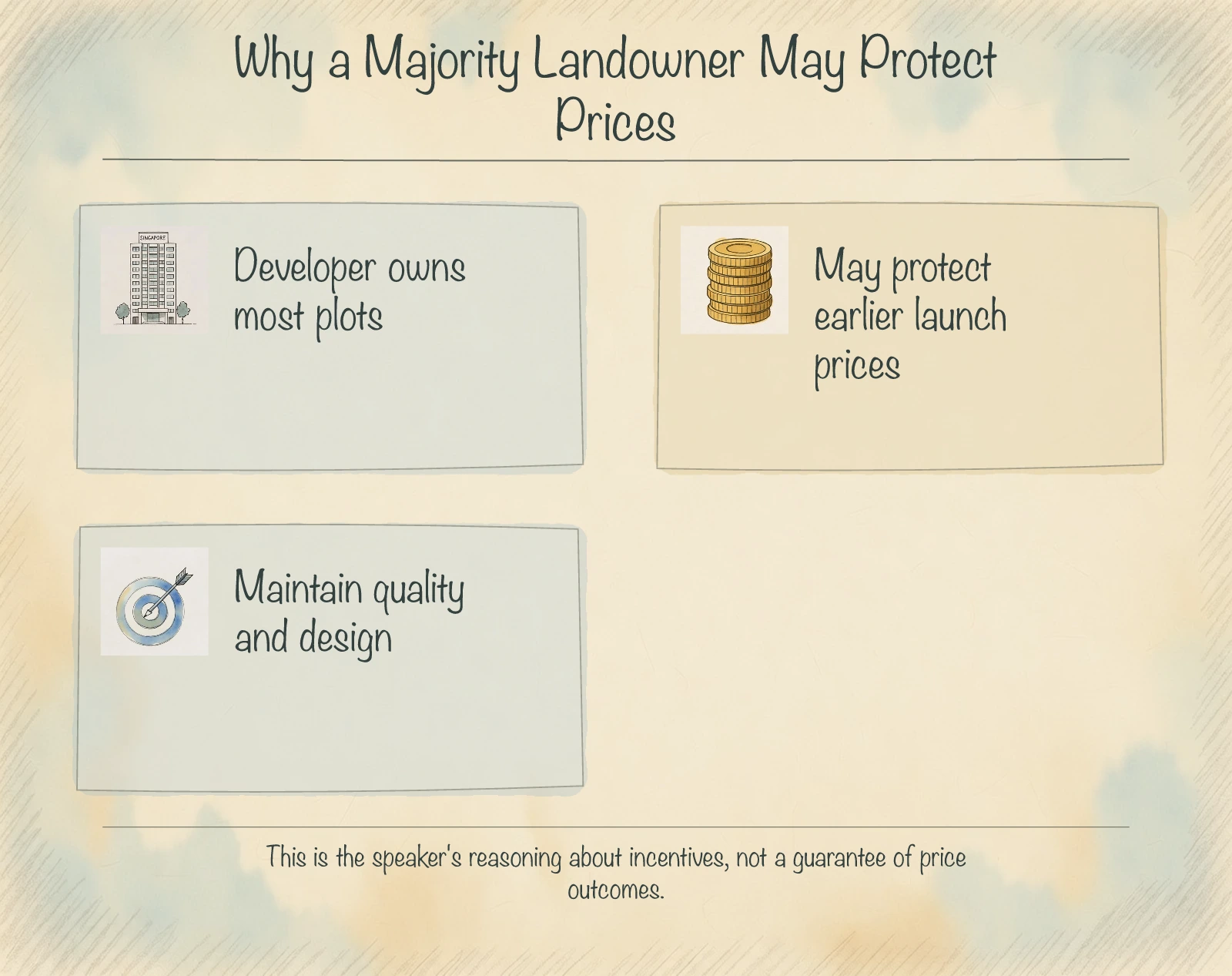
So I think on top of price, it's also going to be a very exciting township because definitely Guaco has to maintain the quality, the standard and the design kind of intricacies in order to attract buyers and have that status as the king of lentor in the entire new zoning.
Based on the information I have, there's going to be a unique mix of two to five betas. There's going to be two zones low and high-rise 8-story all the way to 16 levels.
Definitely this entire area is GRS, they're all 99 years. Nowadays, I mean like if you look at the landscape of new land plots, if you want freehold definitely you have to go for on-block sites and of course on-block sites I think would be boutique developments.
If you want to hunt for like a high-rise big freehold project, the PSF level should be of course of a different kind of price point. GRS predominantly near to MRT stations and if you get a good plot, I think there's an opportunity right here.
So this D26 and if you look at this, in terms of the land bit as well as the estimator break even, I think is of a nice entry point.
Okay, so if we compare Land Tor mentioned, I think other than the fact that it has a huge land plot and the density is not as high, it's not as maxed out, I think what's going to happen is that if you look at the bit, the estimator break even is actually lower than Lentora and Helot Green.
And of course that will bring us to the next topic, which is harmonization. So this will be a project that falls into the new harmonization policy.
And I think it's going to be very interesting moving forward because let me just bring out this chart that I have always brought out during NOTG as well as our webinars. This is the 2013 TDSR effect.
Technically after After this EDSR cooling measure has come out, we saw a shift in the sizes of units that's been created by developers for new launches.
That brought about a new era whereby you get to see more and more 1 and 2 betas being created, lesser 3, 4, 5 betas being created, and sizes of the units starts to shift and change.
Throughout this entire history, there were also seasons where there were sort of like a disappearance of units with bay window areas. I'm not sure whether you remember that season or not.
I mean there were several projects in the past that you go into. There were Bay windows predominant in the common bedrooms and master and even the bathrooms as well.
And of course we have a shift in some of the policies by URA and BCA that actually shape the new landscape as well that now in terms of projects you don't see Bay windows anymore. And most of the units that you see in the bedrooms are all usable space.
What is the harmonization rule? And of course whenever there are new policy for example like 2013 TDSR, there will be a shift in terms of the unit sizes.
I believe the harmonization rule will then create a new shift as well. Let's have a look at the harmonization rules.
This is the article. Basically, the new definitions of floor error could eat into developer-cellable error in terms of GFA calculation.
Let me just bring you through this. And this is going to be a norm starting from 20204.
And there will be some projects that beaded previously, that's not under this rule, but moving forward, all the projects that will be that will be under the new harmonization rule. So what is harmonization?
Basically, it's a
How Harmonisation Standardises Floor Area Definitions
Harmonization of the government authorities — URA, SLA, BCA, and SCDF.
They all will harmonize into the same kind of definitions of how GFA is being calculated and the size of units will be calculated in terms of the floor plan area and how floor areas per floor plan will be calculated as well, in terms of whether it is the midpoint of the wall, start point of the wall, outside the wall.
So in the past, all authorities have different definitions. So actually, this is a good thing moving forward.
All the authorities will standardize and then it's easier for developers and consumers as well. So the first key summary to take note in terms of harmonization rule, and this is important because if you are going to buy new launches, this is the knowledge that I think everybody should have.
You will definitely want to know what is the harmonization ruling and how does it shape unit sizes moving forward. Basically all agencies will take reference in the sense that floor areas will be measured to the middle of the wall.
And all strata areas will be included as GFA. Later I will talk about this because we're going to talk about like the AC ledges and how all these are going to be calculated.
And this is going to create a new shift in our unit sizes as well, moving from 2024 onwards because we're going to see a new era of units having a smaller unit area. And how does it impact us in terms of overall quantum and PSF.
So stay with me.
Now the very interesting thing is point 3, because all voids are going to be excluded from the strata area, meaning that developers cannot and will be discouraged from selling the void area as well as AC ledges for example to buyers.
And BCA and SCDF will adopt an aligned definition for some computation kind of thing. So let us have a look at this.
So this new regulation basically if you look at this. The ledges are exclusive to a strata unit for example that the AC ledges.
And basically what is this all about? Let me just share with you in simple format.
And we have already summarized the entire harmonization rule.
So the first thing is that AC ledges, if developers wants to build buyer AC ledges, because right now, all the way from 20 to 30 until now, or even way beforehand, basically when you look at the floor plan, the AC ledges is included in the strata area that you purchase.
So right now, let's say you go to buy any new launches that was launched in 2003, before the harmonization rule kick in. This is part of the payable strata space that you are paying.
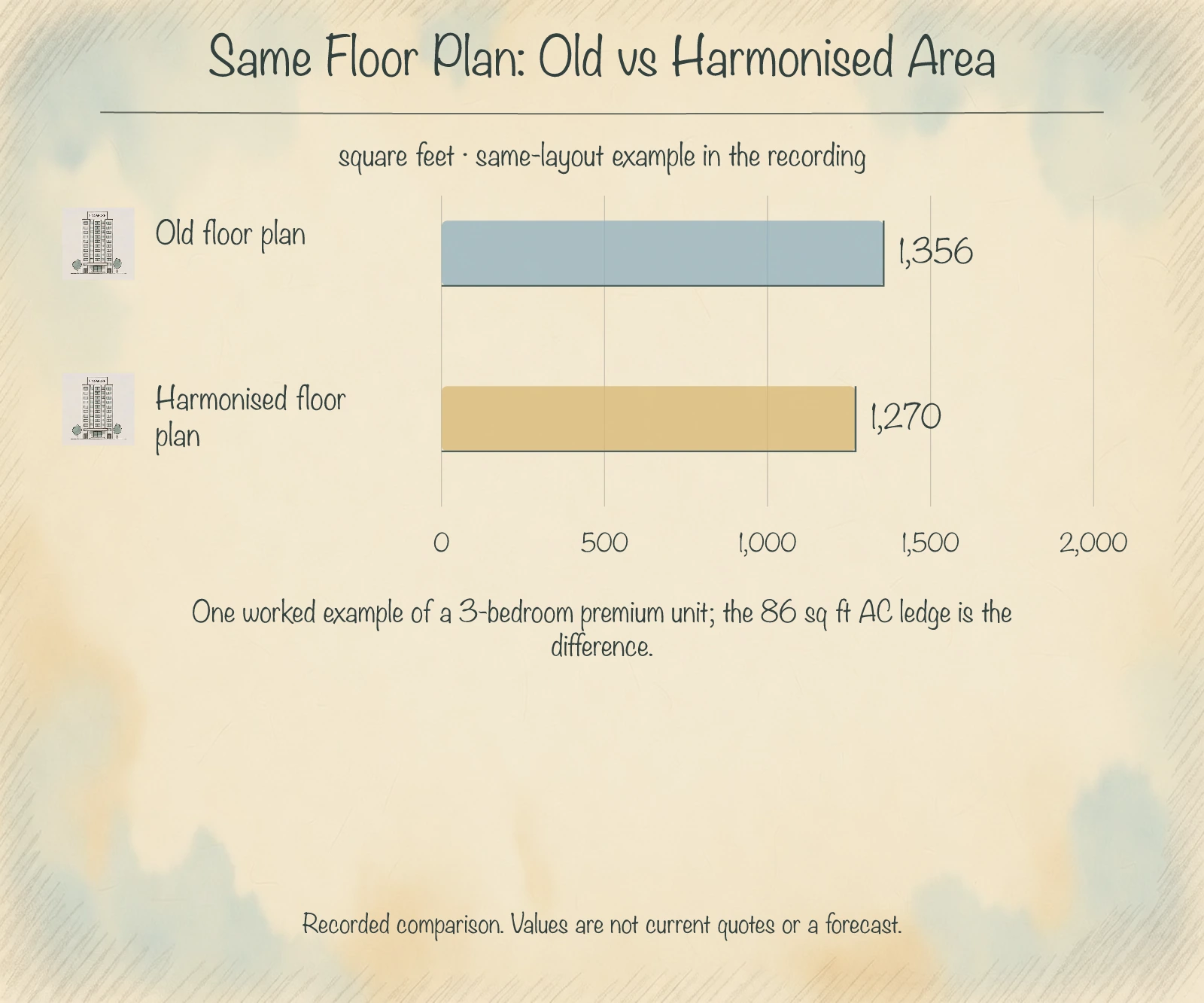
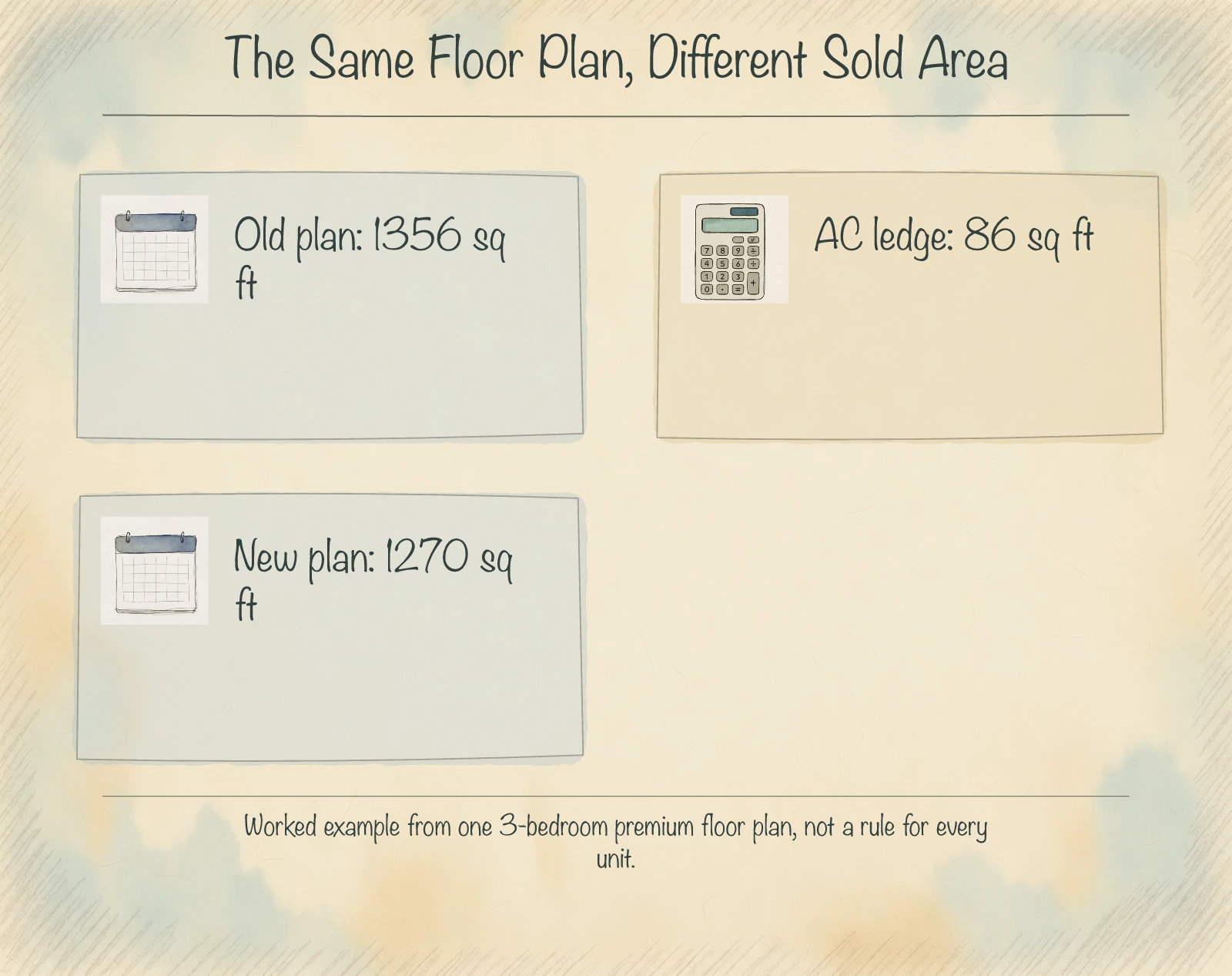
So if you buy a unit for example, you buy 1356 square feet, you pay $2.83 million at $2087 per square foot. Basically, what it means is that you are paying this entire size of 1, 2, 6 square meters inclusive of 8 square meters the AC ledge area which is about 86 square feet.
So technically you are paying for the space to put in your AC compressor.
So what it means is that moving onwards, developers will no longer be able to sell this to you as a buyer. If they want to sell this to you, this is going to eat into their overall GFA for the entire development.
And why is that important is because if it eats into their GFA of the entire development, it means that overall, they are going to be able to only create lesser amount of units to be sold to buyers. And thus, logically developers will be discouraged from doing that.
And then they will not include this basically in the floor plan anymore. And it will still be there, but it's subjected to a new ruling which I'll share with you later on.
So what it means is that in future from now onwards projects that are under the new harmonization rule for example like Lentor mentioned, you're going to go in and you're going to see new versions of floor plans without the AC ledges being sold to you as a buyer.
What it means is that if developers will price it logically and price it correctly, you're going to see lesser unit areas being reflected. For example, this same floor plan that used to be 1356 maybe is a 3B.
It's a 3B premium unit with store. It used to be 1356 with 86 square feet.
Now the AC ledge of 86 square feet is going to remove and they're going to reflect 1270 square feet which was used to be the actual livable area in the first place.
So basically if I want to remove this from the old floor plan which was not under harmonization rule, you are already having a livable area of 1270 square feet.
Just and now if you go to projects moving forward, whether it's a Lentor mentioned or any other new project starting from 2024 under the harmonization rule, you're gonna see smaller floor plan square feet and maybe at the first instance you're gonna be a little bit alarmed.
Why is it that suddenly from 2024 all the units are gonna be smaller
Read chart values
same-layout example in the recording · square feet
| Comparison | square feet |
|---|---|
| Old floor plan | 1,356 |
| Harmonised floor plan | 1,270 |
AC Ledges, Smaller Floor Areas and Affordability
Already? Is it because we're building smaller and smaller units?
Actually no, it's just that they are not selling you the AC ledge anymore. So you're gonna see this same floor plan to be 1270 square feet and AC ledge is there but it's not calculated into the area being sold to you.
And I think developers, because of this, they don't gain in the sense that it's not as if they don't have to build AC ledges anymore. They still have to build AC ledges.
It's just that they cannot sell it to buyers like you and me, and because of this, they're gonna have to adjust the overall GFA as well as the price mechanism. So I think moving forward developers logically is going to price it at the same quantum.
Compared to the past where they could sell the AC ledges to buyers beforehand at the lower PSF, but now because they have to build the AC ledge but they cannot price it in, they will still sell the same quantum logically.
The PSF reflected will then look higher.
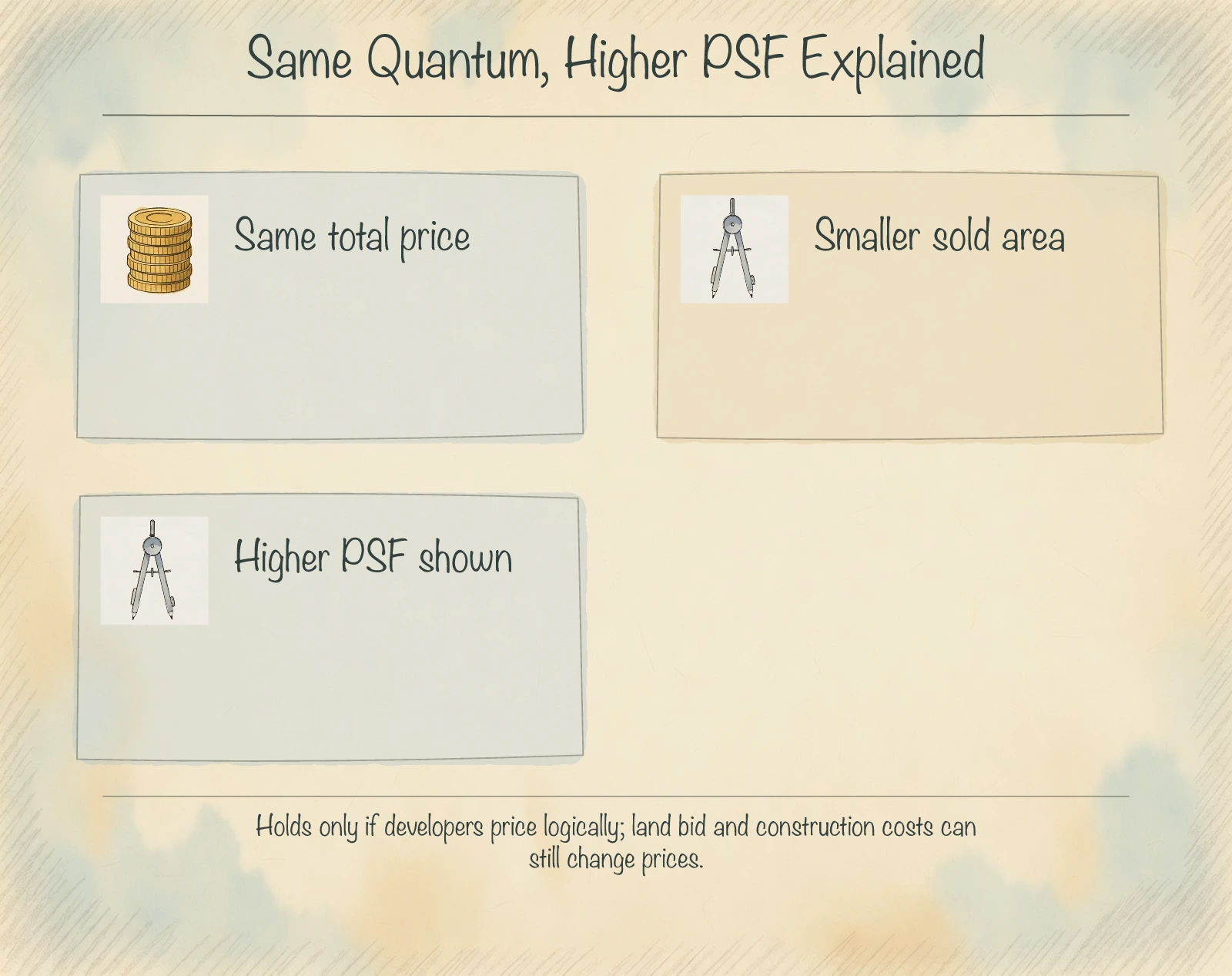
So maybe when you go in, you will say, hey, what is it that I'm paying the same quantum, smaller size, PSF higher. But technically what has happened is that the two floor plans are still the same.
It's just that the AC ledges cannot be priced in anymore. But the overall quantum logically will be around the same if the developer were to price it logically or correctly.
It also depends on the land bid prices moving forward because we all know the land bid prices tend to increase, construction costs increase, and of course there's like different things that developers have to look into, DC charges and things like that.
But if let's say we would just put an apple to apple comparison, which is very difficult, of a project with harmonization and a project without harmonization, it should behave in this manner: that the quantum is the same but the one with harmonization has a higher PSF level.
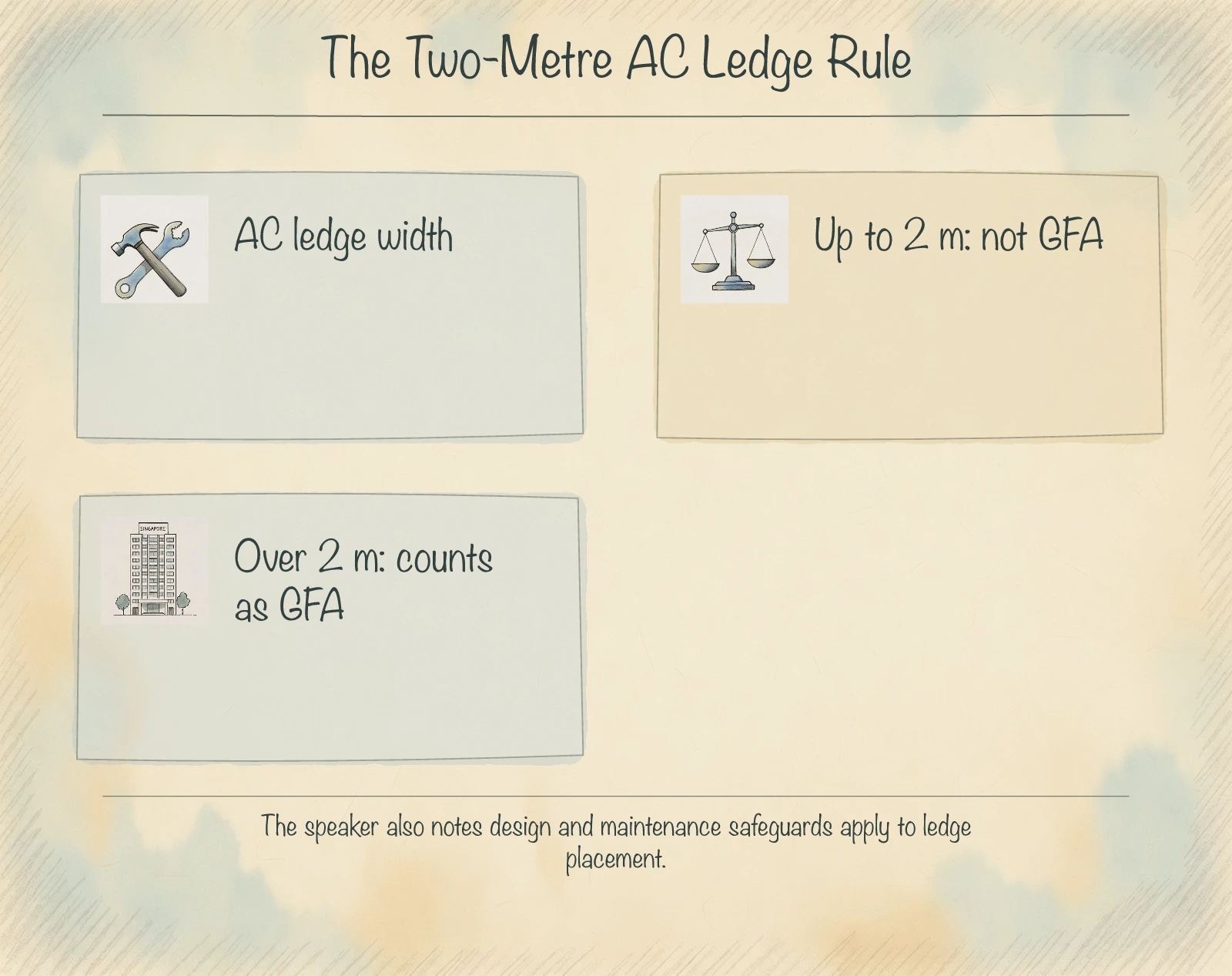
So coming back to this, basically the conclusion is this, so let me just repeat, is that if the developers want to build AC ledges, they will have to include the AC ledge into the GFA, but it will not make sense for developers to do that because it will [increase] the overall GFA, which means that they can build lesser units.
And due to this, this is like a safeguard measure to deter developers from building AC ledges to buyers. So all these AC ledges not exceeding 2 meters in width are not computed as GFA.
So it means the developers still have to build, but as long as it's not exceeding two meters, you will not be computed GFA, which is a good thing, but if it exceeds two meters in width, the error, because of the design, the error will then be in the sense that the part up to two meters will not be calculated in the GFA.
Anything above two meters will be included into the GFA, and the top process is like this. Developers will then try to maintain the AC ledges within two meters.
So at the same time, this will not make sense for developers to build longer AC ledges because this will not be computed as part of the strata area.
And there's also a safeguard measure to ensure that the design makes sense because developers have to make sure that they cannot build AC ledges, for example, too near to a lift lobby that people can just climb onto the AC ledges and stuff like that.
And they also have to make sure that it makes sense for maintenance kind of purposes. So I think these are good measures to safeguard the buyers' standpoint.
And of course developers would then have to adapt to see how they can do it in a very, very practical yet logical way and of course using the design sense. And I think generally it's going to shape, firstly, unit sizes.
It's also going to shape design kind of perspectives to ensure that it's logical. It makes sense from a design standpoint and architect standpoint as well.
So from the pricing perspective, I think we're going to definitely see like an increase in PSF for Lentor Mansion, but quantum level I think is going to be similar.
So perhaps in the past we are used to 900 plus to 1000 over for 3 bedders, but we are going to start seeing 800 over square feet to maybe about 900 over for the premium ones.
Maybe it will be about 900 plus square feet, compact models will be about 850 square feet plus minus, it all depends on what is the removal of size of the AC ledges and stuff like that.
So I think in summary, even though the PSF might look higher, it does not affect the future buyers' affordability because harmonization rule is going to be a crossboard, it's going to be the new norm. And in terms of quantum, it will likely remain the same even though PSF seems higher.
So now that we are clear with the harmonization, let's talk about the Lentor potential in terms of URA master plan. Now when we look at the URA master plan,
URA Master Plan and Investment Factors
I think what is very important is that Singapore, because it moves at a very fast pace — if you look at our development over the years, the amount of MRT stations that has been crafted and of course with this new North-South highway, this is going to be a very exciting thing moving on towards 2030 whereby most of things will already be done.
We are already in 2024. So in six years' time, we're going to see like super well connected Singapore with even the cross-island line and things like that.
But importantly is that I think wherever the government is injecting money and injecting development funds through URA into our landscape, that's the area that we have to pay attention to. Because if we take out our PRB mode analysis, we have 10 pointers.
Number one is because the MRT effect. Number two is the volume effect, which is to buy at best properties that's above 300 units in terms of overall volume and density so that you have a little bit more transaction volume.
With your TOPs and moving forward towards resale — later I'll show what happened to Panorama — and of course, parents attraction effect. And one of the key developments is that is there potential for growth in that area.
So if you look at URA, this has a lot of potential right here, a lot of new residential zoning. So what does this mean is that this is like the first new residential private property zoning to be developed with a concept planning.
In future, I don't know what's going to happen here, but it's already demarcated as residential zone.
I think there's going to be new concepts right here as well because I think URA is in the conceptualization kind of phase that they want to not just launch GIS land plots, they also want to launch homes with a concept so that it creates like better kind of work life play living for Singaporeans as well as residents.
So this I think is going to be exciting in the sense that whatever is going to be launched.
Here potentially if it's going to be launched over the next 10, 20 years, PSF level will definitely be higher than what's happening in Lentor, which then gives opportunities right here towards Lentor.
So things that are already happening: Punggol of course everybody knows that over the last 20 years is now like a wonderful township, water town, Punggol Integrated Development also see a lot of hype; of course you have Long Tram being starting to develop now; and this is of course the Lentor zoning right here.
You also on top of that you have commercial nodes as well as the Lita Aerospace or I'm going to sub regional center, DeFu is going to be developed. Last but not least, Lentor Hills of course is one of the very high zone right now and of course there's nature zoning.
These are all part of URA's plan to ensure that there's a well balance of not just new residential and commercial plots but also nature has been preserved and well integrated into.
All the concepts. So when we talk about URA master plan, there's this principle in terms of property investing as well is that wherever you see the government injecting funds to transform a new era, there's also a very good indication to look at that part as a high priority location for investment.
So when we look at the URA website, of course, this is on ura.gov.sg. This is the part about Lentor Hills.
And what is very interesting is that the linear park is like the central node within this entire condo enclave. It's going to connect every condo to the central green zone and this is like the artist impression.
Of course now with the launches coming up, you can already start to see this taking shape and this linear park is also going to link the residents here directly to Thomson Nature Park.
So I think for families, even for couples or even if you want to, you know, just spend some time in the green zone, this is going to be a good.
Combination of condo living, having the convenience with the MRT station, having shopping facilities within that same zone. And most importantly is that the green portion is being planted into the entire concept.
So if we look at the performance of like Lentor Green, Lentor Green currently is about 31% sold as of date of filming. You still have about 68, 67%.
A lot of these are subjected to change and there was like a 1-4 bedder kind of distribution right here and when you look at Lentor Hills Residences, currently is about 70% sold. Also a 1-4 bedroom kind of concept.
Lentor Modern right now is about 97% sold. Now, one question that might be on your mind is that, hey, you know, there's a couple of projects that's being launched in Lentor, there's also going to be future launches.
How do we look at the supply factor right here? So, we want to talk about supply, we want to look at macro as well as micro.
Let's have a look at.
Macro Residential Supply in Land-Scarce Singapore
Macro first, I promise you, and we'll hit straight into micro because we've already done charts to also think about this portion about the Lentor supply right there, combining the older projects as well as the new ones that are coming up.
So when we look at macro, it's important to note that we are in Singapore, extremely land scarce. At this point in time, what has happened is that we need to look at the total residential inventory stock for all kinds of residential properties, as well as the population that's already living in Singapore.
So every time we like to look at the three main product categories. So first product definitely will be HDB apartments.
Currently, there's about 1.239 million and of course it's growing with new BTOs being injected into the supply every single year.
And private properties in totality when we look at ECs plus condominiums and we usually categorize them together as private non-landed because anyway ECs after they hit the MOP plus the 10 year mark of MOP they are going to be fully privatized.
So we just take it combined to be at about 360 over 1000 condo and apartment units and of course for landed 173,000 unchanged since the last 8 to 10 years because there's no more new supply of landed homes.
And importantly, when we zoom in to look at condos and apartment, the first macro view is to look at who are currently owning the condominiums right now. And it's also important to note that in terms of transaction volume every year, we can just simplify it to note that every year, there's about 20,000 resale HDB transaction.
There's about 1000 plus to 2000 plus landed property transaction. In terms of condominiums resale, there's about 10,000 resale transactions for condos and apartments, for new launches, also about 10,000.
So in totality, we're looking at about 40,000 in terms of transactions for the private residential market. And when we look at condominiums out of the 360,000 available units right now on the land of Singapore, we have about 5%, which is about 19,000 units of this corner that are currently being owned by companies.
And we have about 69,000 being owned by foreigners and PR residents. The rest about 270,000 units are being owned by Singapore.
So what does this mean? This means that when you look at this, combining with the 15 rounds of cooling measures, the one of the latest round is that there's 60% ABSD for foreigners.
And when you look at this 20% plus companies, companies also have to pay the same, foreigners also have to pay the very high tier ABSD and of course when you look at this, the 25% right here is very likely that this 25% which is about 80 over 1000 units of condos and apartments is going to be very sticky.
Why? Because this category of ownership, if they were to sell, they cannot buy back.
If they were to buy back, they have to pay the new ABSD of 60%. Most of them have already purchased before the 60% was introduced, they could have bought it when it was 7%, 10%, 12%, 15%, or even 30%.
But this category is likely to hold their horses, they're going to hold their properties, they will just continue to rent it out, live in it, or they will not exit it because they cannot buy back at the old ABSD.
So we are looking at the revolving stock of this 270,000 units that are being owned by Singaporeans. And of course, every year, there's only going to be about close to maybe 10,000 units is being added into the stockpile.
Maybe by the end of this year, there's going to be 370,000. Next year, it's 380,000.
So on and so forth. Because government also controls GLS very closely.
If you look at the latest news in 2024, first half of 2024, they're going to only release this set of amount. And Singapore is a very different country compared to the rest of the world because land is being controlled by our government.
They release it based on data. They want to make sure that there's gradual growth and not have like an oversupply situation whereby prices became stagnated.
Like some of the countries with enormous amount of land space. But being a scarce land Singapore, I think land is very well controlled.
But let's look at micro as well because on a micro level, maybe we are thinking, what about the overall supply just for Lentor itself? So what we've done is that we have categorized and find out what are the projects within a kilometers from Lentor and Malti Station.
And these are the projects right there with the number of supply indicated that. Of course, take note, in Singapore, I would say that when you go to Realist and look at the data, almost all projects that have been existent are filled up.
When you look at unsold completed units, we just did the NOTG banter the other day, in 2022, there's only 121 unsold completed non-landed private residential units according to data from Realist. This means that projects that have been done and TOP in the whole of Singapore, as of 2022, there's only 121 units
Micro Supply and the Pasir Ris Comparison
Style, and so likely these are the CCR called luxury projects, and in most properties in the rest of Singapore, all are already fully sold. It's owned by somebody, it's been rented out, it's been stayed on.
So let's come back to the micro fashion. These are the projects right there.
Most of them are of a certain age category. So for example, when you look at Far Horizon Garden, it's one of the older projects right there.
Seasons Park is also pretty much of a certain age already. You have, of course, Castle Green, Novo — used to be an easy Boolean Park — and of course, these are the projects that are within a kilometre.
But if I were to further shrink it down to really pure walking distance either towards Lentor MRT station, then definitely all these new projects within that radius is going to be something that will be in a closer proximity.
And if you were to lay them out in a sequential launch fashion: 2022 Lentor Modern, and you have 2023 Lentor Hills Residences, Lentor Green, 2024 Lentor Mansion, Lentora, as well as the Lentor Central GLS land block.
In totality, when you look at this, actually in terms of overall supply, my own opinion is that in the whole of Singapore, it's still like an under-supply situation, because we have to remember that every year there's only like an introduction of probably close to only 10,000 new units.
And we are looking at the existing roving stock of about 270,000 to 280,000 being held by Singaporeans and PRs. The rest of the stock that is being held by foreigners and companies, they are already very sticky.
They are unlikely to be released in the retail market.
So just by looking at the macro and the micro point of view, I think combining this, if I were to add up 475, 2675, 333, 4745, 98 and 605, in totality, this is only close to about 2,000 units, and 2,000 units out of the grand scheme of only having 360,000 condo units in the entire Singapore.
I think this is just a very micro introduction of new supply into the market.
So last but not least, we want to observe this very interesting phenomenon at Pasir Ris, because that will probably give us also a final deeper insight into Lentor as well. Pasir Ris has been interesting because we try to look at two sets of data.
Number one is that this entire plot seems very similar in terms of an introduction of a new condo enclave, because for a very long time there's only Elias Green condo, which is an older project facing towards, of course, the TPE, nice long-ish landscape as well.
And then, of course, when CDL launched the first maiden project, Livia, that brought about a lot of excitement in the past, and Livia was actually launched in 2008. It was TOP in 2011, 724 units, and take note CDL owned the rest of the plots as well, and they went to launch in a sequential approach.
Livia, NB Residences was the second one, Palette was the third one, D'Nest fourth, Coco Palms was the fifth. And when they launch in this sequence, up to today, PSF remains to be the same
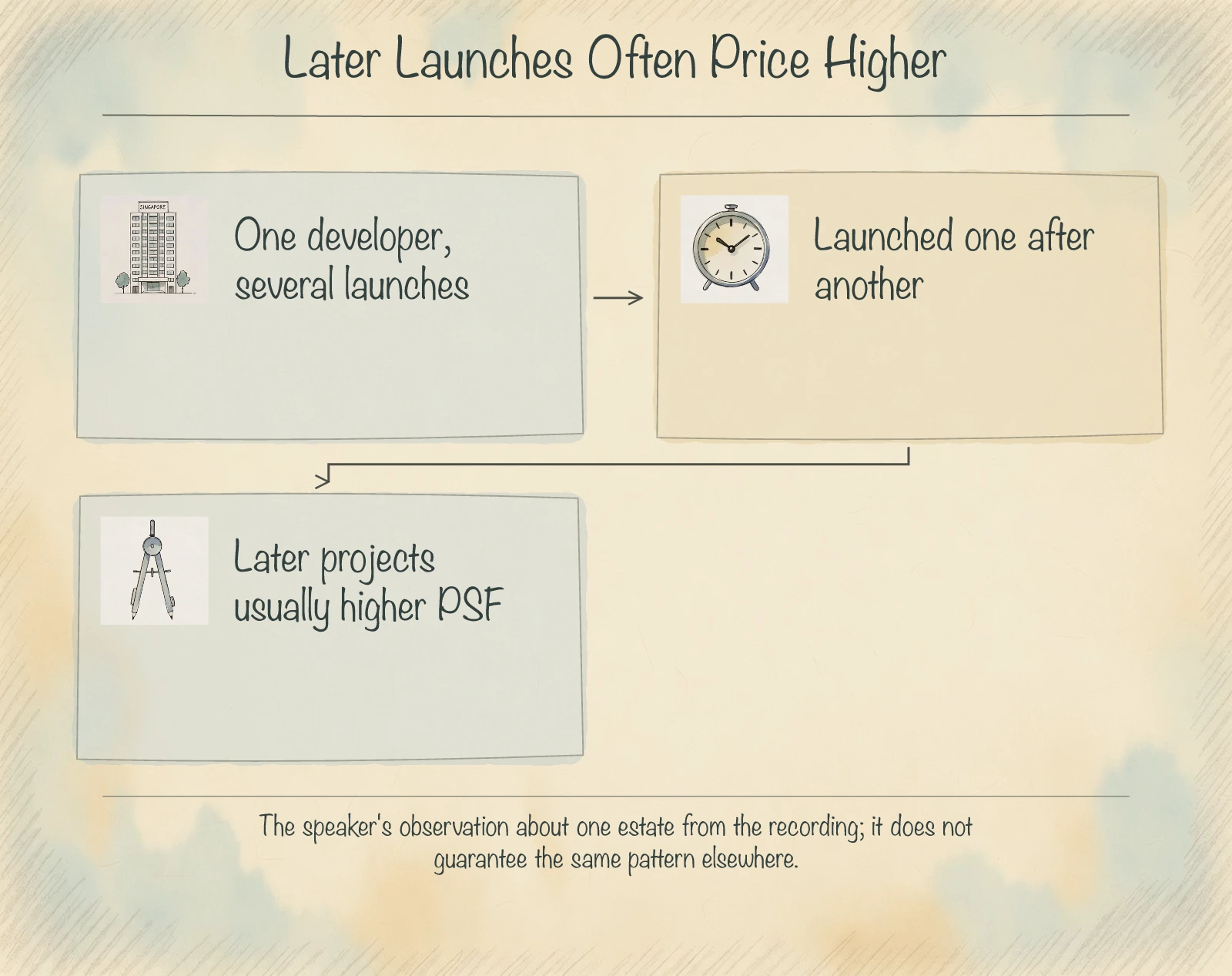
sequential growth norm. What do I mean by that?
It is that Coco Palms is definitely more expensive than D'Nest in PSF level. D'Nest is more expensive than Palette, Palette more expensive than NB.
NB is higher than Livia. So the latest projects usually have the higher PSF advantage.
And of course, last but not least, Pasir Ris 8 has been launched on top of Pasir Ris Mall, which is the new integrated development of FZ, will be the highest benchmark level at about 2000 PSF range.
So if we were to look at this table, lastly, before we end today's NOTG session, this is something very interesting, because when you look at this, the amount of supply right here is actually much more, in the sense that some of the projects like Coco Palms is 944 units, D'Nest is 912, Palette is 892.
Just by adding the first three projects is already close to 2,600, 2,700 units. If I add on the rest, it's going to be like close to 4,000 units in totality, much more than Lentor.
But have a look at their performance from the launch until today. If you have bought them since launch until today, this is the level of PSF change for your capital growth.
We've sought the projects having 46%, 40%, 47%, 73% for Livia. Even with this, I think Pasir Ris is, in and of itself, because of the very fact that it's near to the MRT station, it is still needing introduction of new condo projects as well.
So I think with Singapore having that population growth projection, now it's about 5.9 million. We're trying to hit 20, 30 at 6.9 million, and of course our government is on track to bring foreign talents and expatriates.
Housing is definitely something that is needed, over supply. I don't think there's a situation in Singapore whether on a macro or micro view.
And I want to bring your attention basically to this development before we end today's episode, because this just tells us a little bit more about what is happening here. So basically if you look at the three projects that have already
Lentor Launch Sales and Transaction Volume
been launched, next project Lentor mentioned is exciting not just because of the fact that it's in this new era URA, near MRT, CHIJ school, largest land plot.
It's going to be a luxury kind of concept and based on the news that we have gotten, there's going to be like a clubhouse that is like a heritage mention kind of version so it's going to be like a very beautiful clubhouse concept as well.
And in terms of the launch PSF, these were the ranges sold on the launch day, basically 84% for Lentor Modern, 50% Lentor Hills, Hilok and of course as of today, it's about 97 sold, 73% 31% sold for the three projects.
So we want to bring our attention to Panorama. So Panorama is located right here which is very near to the CHIJ and Nick's school.
Opposite these two batches of landed enclave which is called Horizon Gardens and Horizon Green. And of course as you can see Lentor from here.
Let's have a look at the performance of this
property because this is like one of the rare high rises that was launched among the landed enclave and of course it's near to the Mayflower MRT station. So of course if you look at the curve.
That's like a double round of appreciation. So first launch was around the midpoint towards the tail end of 2014.
All these blue dots were the transaction so-called figures. And then when it TOP around this stage, the first hand owners already made appreciation.
And then till today, even if those people that bought around TOP or bought along the way of 2020-21, they still see appreciation until today. Partly also because of the 2020 run towards 2023 after the recovery of COVID and is even seen when AMO Residences was launched, instance sold out very quickly.
And this just shows that this area has a very strong demand from either family upgraders or even young families that are buying like a one or two beta or families that buying three or four betas.
And I think in terms of demand and supply, it is something that we need to explore because when before you comment to a new launch property, it's very important to note demand and supply level.
So Panorama basically in terms of the latest transaction as of December 2023 is a recent transaction at about $18,000 to $2,000 per square feet.
If Lentor mentioned what to launch at, I'm not sure what's surprising but let's say 2002, 2003 or even 2004 in terms of the gap is actually very close in the sense that this is a development that was launched during the mid-2014 season.
So technically it's about 10 years old and if you're buying a new launch that is within the same zoning within a kilometer from the same school right beside MRT station in a new conceptual area that you are is injecting new concepts here then I think the differential is worth considering in the sense that it's not too far off.
So of course if you can't wait then by all means that you like Panorama is a great development
is a beautiful project but all means if you cannot wait for 3-4 years for construction then go ahead for the resale property but if you can wait and you want to get something new I think the gap is worth the wait because if it's $200 or $300 or $400 psf difference it is definitely worth the wait.
Most of the time I would say that the gap if it's like a far difference of 30 to 40 percent then definitely the resale will look very attractive If let's say you are thinking about resale versus new launch.
So for example, if it's like $2000 versus $2800 then definitely the $800 gap is worth going for the resale because you still have room for the resale to catch up. When we look at the amount of listings, what is very interesting is also this.
There is clearly a lack of listings for Panorama and in fact in this entire area. So we want to track the amount of property guru listings that's available.
So current available listings in PropertyGuru is only 21 listings. There are 3 listings for 1 betas, 2 betas there are 11 listings, 3 betas there are only 6 listings and 4 betas there's only 1 listing.
There's no 5 beta listing and then if you look at AMO Residences of course this was launched in July 2022 at about 2001 PSF transactions at 2023 is about 2289. Why am I looking at the current listings available at Panorama because I want to see whether is this era over supply with resale properties.
And it just shows that for a project like this, because this project has 698 units, but there's only 21 units available for sale. It clearly shows that plus the very fact that in terms of transaction volume, just look at how healthy this is.
One page cannot even contain the full transaction volume on a month to month basis. There's so many transactions going on.
It just shows that most units that were launched has been absorbed.
Resale Listings Competition and Closing Remarks
For a resale market, and it shows the strength in this era. And we also did a further CMA of projects around Lentor Mansion just to have an illustration so that we can see in terms of the resale, would they be like a strong competitor.
So from Maddow's at Pierce, which is near to Kajarina, near to Upper Thompson Road, only two listings available. Far Horizon, the Order of Development, only seven listings.
Season's Park only three. Castle Green only 10.
Panorama only 11. And I'm talking about the two-bedders in the entire region, there's only 33 listings available.
Three-bedders, only 35 listings available and there are four-bedders, nine listings available, five-bedders, five listings available. It's very clear that this zoning has a lack of listings.
And I think one of the rationale is that a lot of the resale properties now, I think they are holding on. The owners of these resale properties, they are definitely holding on.
Why are they holding on? It is because they are holding on to wait for the new Lentor projects
to complete their launch sell out and once all these Lentor projects TOP we are going to see a new, definitely new PSF benchmark level, then they will up their pricing in the resale space to catch up with the pricing right here.
And this is what we call the disparity gap. And before we end, we definitely have talked about disparity gap, let me just show you this portion right here.
I think when you look at 2024, what is going to be very interesting is that the resale properties around any launch, they are going to ask for a higher PSF. Now the newly TOP projects are already asking for higher PSF and I don't even need to go there.
I just need to look at Panorama, they are all asking about $2,000 per square foot, or 2001, because if they see their neighbors doing at 2000, transacted as you can see just now from 2008 plus the 2000, some of the owners probably are already asking 2001 or 2002.
And of course, if you see launches in Lentor between 2001 to 2003 or 2004 or 2005 PSF, the
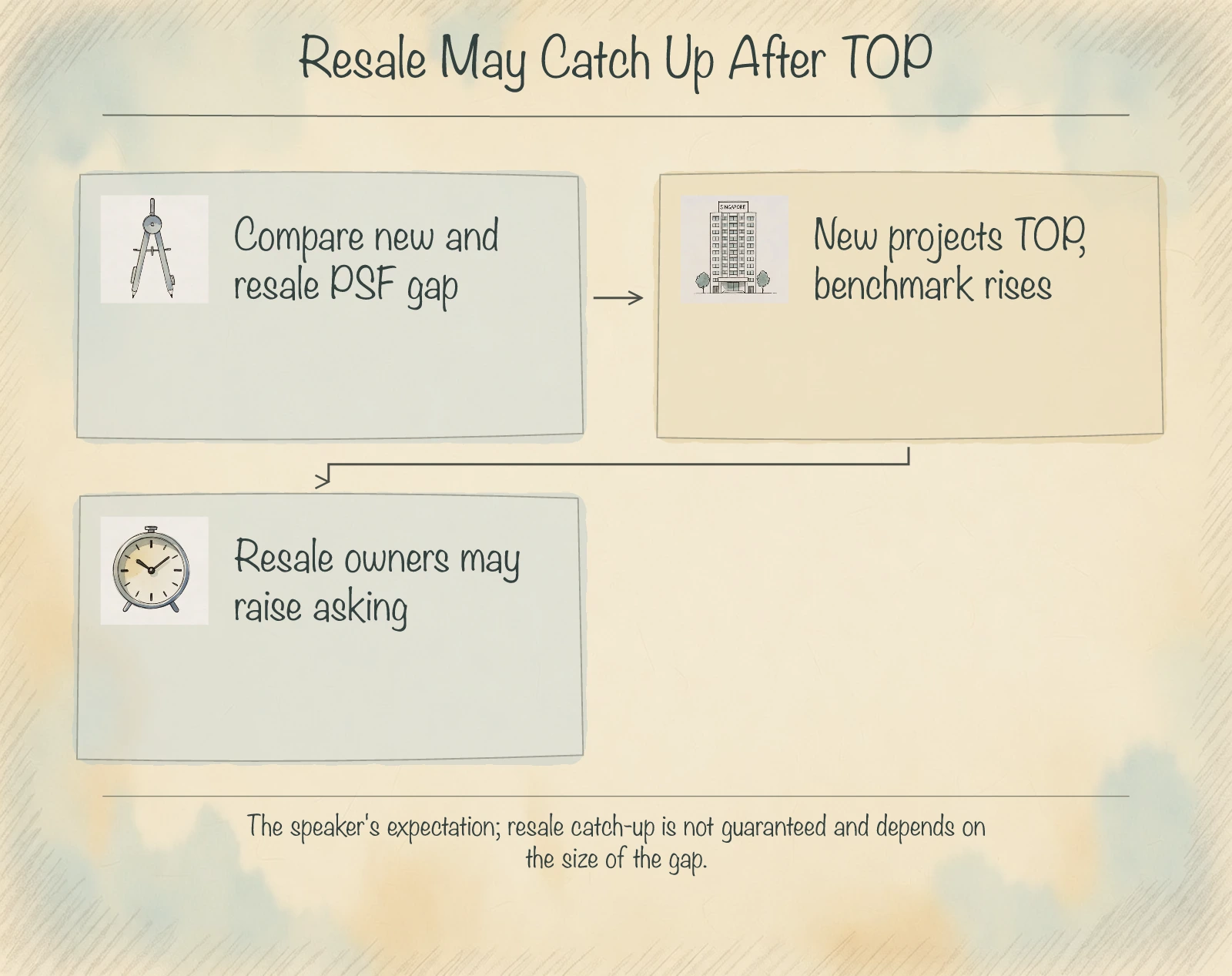
gap is actually very close to some of the resale projects around the region. And this is usually how we look for disparity gaps.
With that, I think why do we want to touch on Lentor is because I think it's going to be exciting zoning right there for everybody to look at and consider. Let's say if you're thinking of maybe a new project downstream in 2024, and I hope that this episode of NOTG has added value to you.
Of course, leave your comments down below on what are the next topics that you want to have looked at in terms of our NOTG episode and my name is Melvin Lim. This will encourage us to create better content and newer content in future.
Now of course for NOTG,
this is where the place that we look at market trends, key highlights of certain developments as well as banter episodes. Hit the can.