Landed property
Is It Too Late to Enter the Landed Market? Here’s the Truth
Published 2026-11-18. Adapted from the episode published 2025-05-23. Figures, illustrations and data reflect the episode’s original publication date.

On this page
- Landed Clinic Opening and Client Journeys
- Appreciation Scenarios and Retirement Asset Planning
- Income Pockets, Exit Frameworks and Session Objectives
- Interest Rate Cuts and D19 Landed Supply
- Hunting in D19: Volume, DNA, Quantum
- Hard Assets, Widening Gaps and Property Objections
- Reading Terrace Size, Surroundings and Five Steps
- Land DNA and D19 Inventory Pricing
- Quantum Limits and Competing Districts
- Exit Quantum, CCR Dilemmas and Switching Choices
- Switching Timing and Positioning Your Property
- Home Tours and Targeted Digital Marketing
- Finding Buyers and Quantum Charts Resources
Landed Clinic Opening and Client Journeys
Alright, hi, good evening everybody. Maybe let us give a round of applause to Weil Collective for hosting us tonight.
Thank you very much. Also to yourself, welcome to our PRP Landed Clinic.
This is the third round that we have. The first round was in D10, and then the second round was in D15 in the east, and of course now we are in the northeast.
So we also just completed our EC clinic for some of the 100 pumps owners just about two weeks back. So today we're gonna talk about landed properties in specific.
However, can I have your permission to talk from a biased point of view? Is it okay?
Okay, everybody. All right, that means whatever that I'm gonna share is really from a biased perspective.
That means you're going to hunt for a landed property, what are some of the things that we want to look at. Now, let me just share a few case studies of our clients.
All right, so of course, over here, every time we run a seminar or EC clinic, I think the first thing that I want to share with our audience is that there are no product peaches. That means we don't represent any developers.
We are very frameworks driven. And of course, a lot of the decisions that you're going to make, we want to also highlight that do your own calculations and of course, stick to your consultant's advice and all that before you make a decision.
Now, we also have taken a look at some of the questions that we collected from you guys and sit over here tonight. Approximately, I think about 40% of the families here already own the landed property.
60% are not owning a landed property yet. You probably are owning a HDB or a majority of your own private properties, condos and apartments.
So I'll do my best to cater the content to suit your life stage as well as your goals.
Now this is one of our clients. We help them to exit one of their EC in D19.
I think that was close to about one to two years back already. And of course they went ahead to secure a penthouse.
All right. And this is also another family that's their entire journey with us, started with a BTO, then went on to a three bedder condo, following with a four bedder penthouse.
And of course, for the penthouse, that was what the penthouse that actually made them quite a fair bit of return on investment. And of course, now they have moved on to our RCR4 bedder as well.
If you notice, I highlighted the total portfolio sum. Later, I'll share with you what is the main objective of this.
And this particular family was George Client and of course they also started from a BTO route, subsequently sold the HDB, move on to a 4 bedder, then exited, move on to a 4 bedder freehold and of course subsequently they also purchased another 2 bedder for a rental strategy.
And of course this is their current portfolio size. And this is another one of our clients also started from HDB and move on to the penthouse plus a 3 bedder and subsequently now at the landed property.
Now you might be wondering, why am I showing you these four different journeys of our clients that have journeyed with us. The key rationale that these four families have is very simple.
They all have the same objective. Their main objective is to gradually, as their income progresses through their highest income potential years, primarily during 25 to about 50 odd years old, they want to shift upwards to quadrant one and quadrant two types of properties.
And the objective is very simple. As long as they can hunt for property with high appreciation potential, or they can move on to a landed property, they can think about whether they want to continue that route and stay put, or they can still switch along the years.
So let's just have a look at this hypothetical example of Daniel, right? So Daniel secured a landed property after selling basically one of his penthouse.
And basically he secured it just right during the COVID season, right? So that time you can still get an inter-terrace that's 2.8 mil.
Now his asset is valued at about 4.5.
So why do I want to share this portion over here is that in the event, let's say for example, if you decide to secure a landed property this or next year, that will be the raw value of an entry-level freehold property.
So for landed properties, we like to talk about freehold or triple NIAs because that is the one with one of the best characteristics of appreciation. And maybe let's take a hypothetical example.
Like, is it even possible for this inter-terrace over the next 25 years to appreciate to, let's say, 15 million? How many of you think you can appreciate to 15 million inter-terraces?
Anybody D19, since you're from D19, anyone, is it even possible? Anyway, make a guess how much is a detached home at Seletar maybe just about 40 years ago, anybody?
Appreciation Scenarios and Retirement Asset Planning
As a club, so to give you an illustration of how much it was a property back then was around the range of about 100,000. A landed property.
All right, so of course, I think this is assuming a growth of about 11.6% growth per annum. It might be a little bit aggressive.
Let me just bring it down a little bit. How about we shift it down to 10 million, the interterrace.
If you secure at four and a half million today, freehold, can it become 10 million? You might still seem a little bit like, don't know how to think, right?
Okay, I'll just shift to eight million. Why don't I just shift it all the way to 6.5 million?
Much more possible, right? All right?
So 6.5 million actually evolved to shift off this 11.6%. It's just a mere 2.2% appreciation per year, which is just nice to maybe fight a little bit of inflation.
And what is going to happen to Daniel is that now he is about 40 years old.
His plan is very simple. He will do a review every five years.
So at age 45, if he appreciates, he will think about what's next. And then maybe another 10 years later at age 55, he will think about what's his next move as well.
All right? But importantly is that what they are looking for is a very disciplined approach to freedom and choices.
Once they reach towards their seemingly retirement stage. All right?
Whether they want to retire or not, it's not the main matter. It is that they're hunting for freedom and choice.
So we are of this methodology of these three types of income. And this is what we always hope to help our clients to achieve.
The first set of income will be an active income. This is usually happening when you're between 25 to about 55 years old.
And we are of this approach whereby since you are in the highest income producing years, it will make a lot of sense to really think
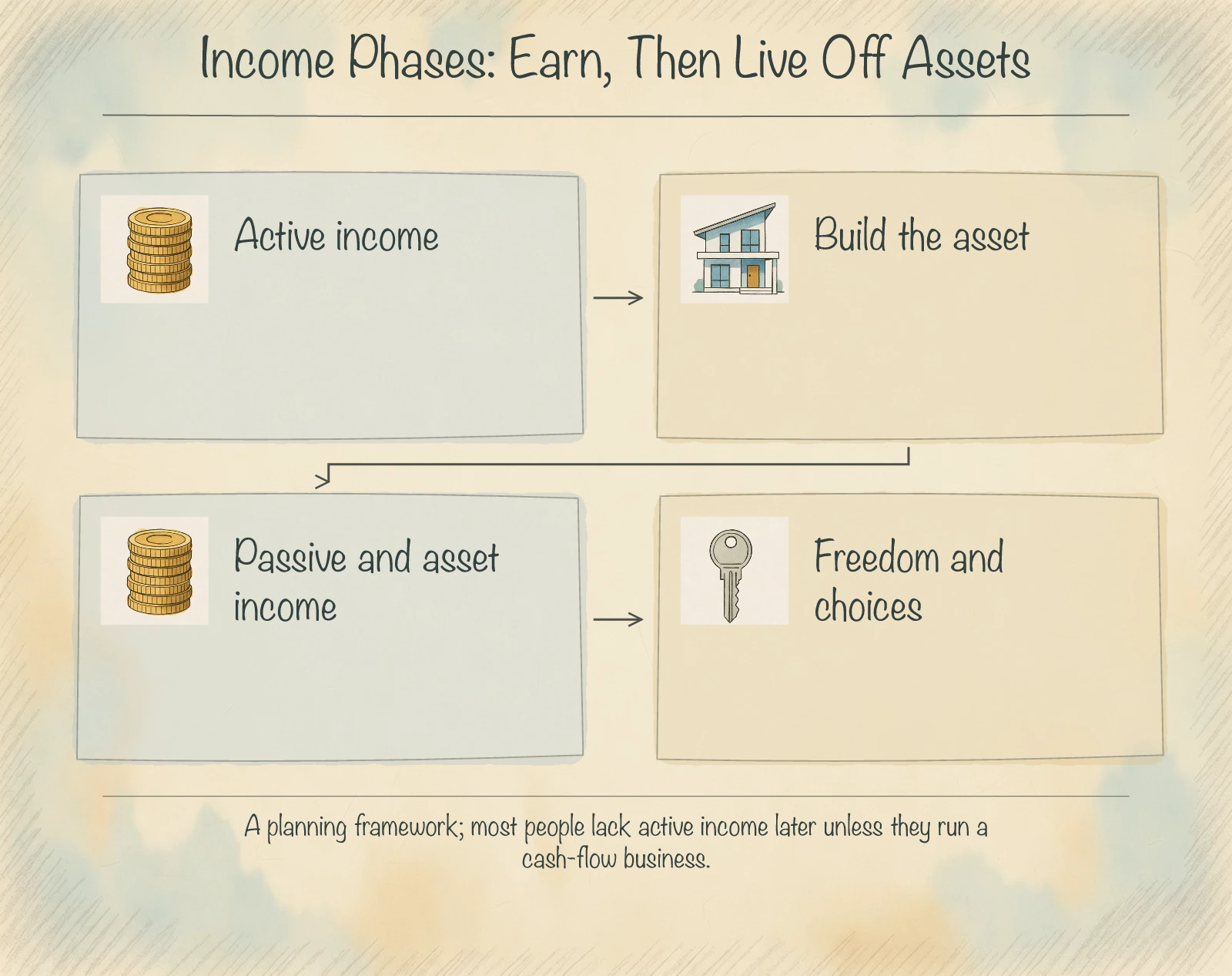
about a disciplined approach to park it into an asset so that eventually you can start to generate passive income as well as asset income for you and your family. So how does this work?
Let's have a look. So from age 25 to 55, it will work very hard, you and your spouse, and then you start to accumulate a chance to own a piece of asset.
And in Singapore, it makes a lot of sense to think about residential properties first. Why?
Because if you look at the last eight years, on a year to year basis residential properties has 10x the transaction volume of commercial or industrial properties. So volume is a very important thing.
So as if you trade stops, if there's no volume basically it's all stagnant. So residential properties has 10x the transaction volume and because we are very high ownership rate country where 9 or 10 people owning properties, it makes a lot of sense to focus on residential first.
Now once you hit towards your
seemingly 55 to 85, most of us will not have our active income, unless of course you have a cash flow business that's running perpetually, but most of us will not have active income.
And by the time if you do not have passive income and if let's say you do not have asset income, then basically I think you will think that or you will have a little bit more anxiousness that hey do I have freedom do I have choices during these 30 years?
So let's have a look at Daniel's plan. Now his plan basically is very simple.
What he's hunting for is that while he's working hard together with his family, he's hunting for these two graphs which are not running in a parallel fashion, meaning that if let's say he can own a property and live it in and the property appreciates in terms of value in the upward trend and at the same time the mortgage reduces and what's going to happen at the end
where he reaches 55 is that that's going to be a fully paid property with zero mortgage and of course he will be sitting on about six and a half million dollars of equity.
And how is he going to look at this six and a half million dollars of equity basically he will look at it like this this will be his asset income at six and a half million when he's about 65 years old in the year 2050.
And then he will think about how can he create about four different buckets. All right.
So how does this four buckets work basically? These four buckets can work in many different flexible ways.
Now, one of the first way is that the six and a half million dollars going by a huge HDB. All right.
So sometimes I know a lot of people are very tempted to go and buy EM and EF fully renovated with three, four hundred thousand on renovation. But this can be done actually at your old age, all right, when you're in 55 to 85.
Income Pockets, Exit Frameworks and Session Objectives
And of course, you can just set aside about $2 million for that. He can also take $2 million to buy a rental property.
And because he's already in the winter season, he can just buy a property with a balance of $65 and low quantum. It doesn't matter because what he's after is the full rental passive income per month.
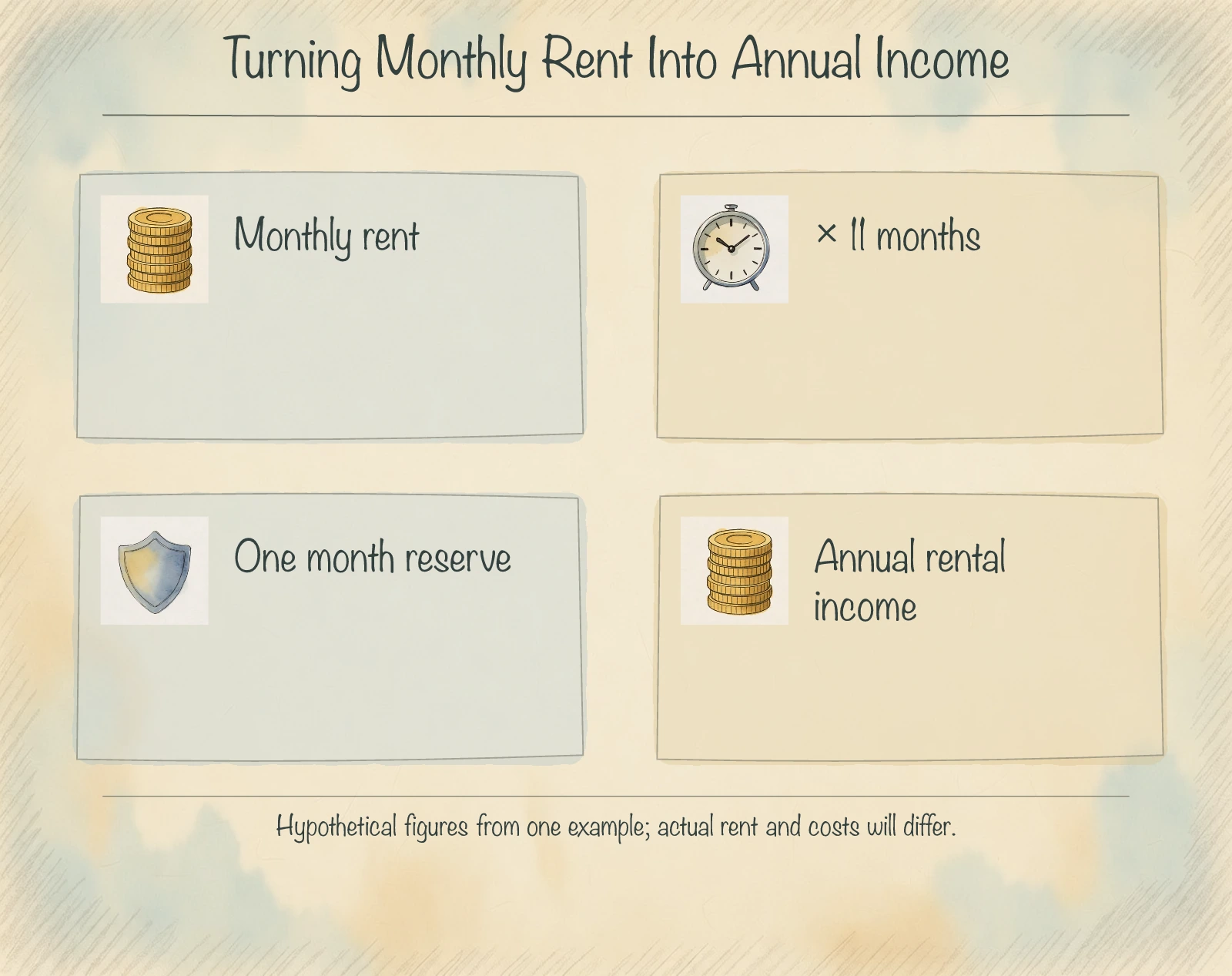
And in a very simple calculation, you just need to take $5,000 times 11 months reserve of about one month for all your agency fees and maintenance fee and stuff like that. And that will easily give him about $55,000 per annum.
So in total, after parking aside liquid cash of about one meal passes in car, about 1.5, just put in a very simple fixed D instrument and stuff like that. That's going to generate him about $875 per month, liquid cash, one meal.
And he still has the asset value of about $4 million if you want to pass on to his kids. All right.
So that's actually Danny's plan now. What happens if
let's say for example something changes—you want to take photo, is it okay? I'll take photo.
You want to take a photo? Okay.
Alright, so if let's say for example, he decides that hey, I want to activate this plan a little bit earlier at 55 years old. He can do so as well because anyway you're not bounded to hold on to your property forever.
You just need to hold it for three years. You can sell at age 55.
By the time if it's like $5.5 million dollars, what's going to happen is that his mortgage is about $880. He's sitting on the equity of $4.62 CPF and cash and of course by 55, he can really extract a majority of his CPF.
And his plan can still look something like this with these four buckets. So about $500,000 cash, $2 mil to a HDB or condo, passive income, rental property, and then put in a fixed-day instrument.
So he can still generate about a passive income of $7.5 per month, liquid cash about $500,000
and asset value $4 million. So basically that's what they are after, that's what they are structuring and which is why they are in a journey as much as they can in a less stressful fashion.
It's not that they are doing in a very stressful way. They're trying to build this portfolio size, until a level that they think that it is okay.
Now, so to sum up, we have this methodology in the sense that we believe that since we are so fortunate to be born in Singapore and our properties are behaving very differently from the rest of the world.
Basically I think there's a chance to work towards your freedom and choice through one of this asset class which is very real estate.
And of course with these three income pockets in the middle we also have structured of course five different frameworks in terms of exit strategy like when should you sell, how do you sell, how do you not leave money on the table, how do you look at trends financing portfolio and of course
different asset types understanding. All right.
And of course, we always want to start from framework first. So most of the time, through my 17 years of experience, a lot of buyers on the ground, what they face first is that usually when they ask a consultant, what should I buy?
They immediately launch into product selection. But the most important thing is that, how do you look at macro first to understand what season we are in?
And then you look at micro factors on the local basis. And then you start with your select strategy later on.
And we just completed one of our seminars in SunTag. This is the new launch convention.
We have closed about nine-hour-over people that came. Where we talk about frameworks for a full eight hours on how to invest in new launches.
This is our landed convention held in Shangri-La in May. And of course, we just completed our property summit as well in Club Key.
It's a two-day masterclass. Plus, this was our last landed clinic in D15.
All right. So based on our statistics, 65% of our homes are sold at a positive premium compared to our client's neighbors.
So most of our owners, they net at least 2.5 to 5% when they engage us to sell their home. All right.
Now, end of today. Please check with our consultants.
We just published the latest District 19 landed research report. It's a full 20-overpage report.
You can look at that in detail. And these are my three objectives for today.
So basically, the first part we'll be talking about some of the key objectives of why people want to go into landed. Second is to avoid certain mistakes if you're selecting a landed property.
And of course, the third will be some of the trends to note. Okay.
All right. So let's move on.
Okay. At this point in time, the market is shifting very fast.
Okay, at the beginning of the year, we have been talking about the possibility of
Interest Rate Cuts and D19 Landed Supply
US cutting interest rates. It has already happened two rounds, November and December; next year, four cars, and another five rounds, possibly.
And of course, usually when this kind of trends happen, this is, I would say like, this round is a little bit different from the last round during COVID.
COVID, you have a very obvious quantitative easing measure from US, because they printed loads of money to inject into the money supply, and of course that is done in conjunction with lowering interest rates. This time round they call it stealth QE.
Alright, it's a little bit heathen, buying back bonds from banks and stuff like that. It's a little bit heathen from the public eye, but it's still happening on the ground.
Money supply is increasing. So if you want to see if money supply is increasing in US and Singapore, just go to tradingeconomics.com and you can see that the graph has spiked up this few months.
All right. Now, whenever that happens, and of course, like stock market is increasing, cryptocurrency is increasing, very likely my old forecast is that Q1 to Q2 next year, a lot of people will start to take profit.
And when they start to take profit, they're going to shift some of this liquid margins from volatile assets into safe assets. And by default, Singaporeans love real estate.
So they will shift to real estate. Now, at this point in time, landed properties in Singapore, the whole Singapore, below $5 million, there's only 179 listings.
If I remove duplicated listings, probably there's only about 140 plus. Listings below 4.5 million, there's only less than 115 listings left.
Listings below 4 million, whole Singapore. If I'm just talking about 3.599, and with at least four to five bedrooms, less than 63 listings.
Now this is a signal of a double-edged sword. The first swap is that buyers are absorbing these units on the ground.
Second swap is that the sellers are delisting their listing. That means they're trying not to sell first.
They want to wait for the market to go up further, then they list at a higher price. Or they have already delisted their listing from this kind of price range, and they have shifted their price upwards.
All right.
So this is usually the full mode effect that will kick in when interest rate starts to drop. And of course, how should we look at this?
And later I'm going to share a view like some of the key strategies. But most importantly, if you notice this, the first thing is that you should not touch anything below 4B.
So if you're hunting for a landed property, you should not touch anything below a 4B type, unless you really want to tear down and rebuild. But if you don't intend to do anything, 4-bedroom is a minimum in the market now.
Later, I'll share some key things and some mistakes to avoid. Now, this is basically our landed price index, the red color one, versus our condo and apartment, the blue color one.
Basically, in terms of volume, we are at pre-COVID volume now. So basically, our volume for 2023, 2024 is around the same as 2019 and 2018.
So COVID 2021, it was the highest volume ever in the history of the last 20 years. But we're back to the norm and the market continued to gradually increase at a single digit growth even during the last two years where interest rates was high.
So last two years interest rates in US was about 5.5%. Singapore was about 3.5% to about 4%.
So let's talk a little bit about D19. Now, D19 is huge.
If you want to invest in a landed property in District 19, this is the northeast chunk in Singapore. It starts all the way from Punggol stretching out to Hougang, Kovan, and of course it will end towards Serangoon Gardens.
But importantly, as I mentioned at the start of this session, I will talk to you as if I'm a buyer as well. So if you are a buyer, you want to buy D19, you need to avoid every enclave except these two enclaves.
So I'll just be very blunt. So if you don't buy Serangoon Gardens and Kovan, don't touch anything else.
Anything outside of these two you avoid. I don't know whether you own any other properties here, but if you talk about any other landed, probably other than this to avoid if you are buying.
If you are selling, it's okay. You come to us.
We're having to stop the problem. It's okay.
We can sell anything. But if you are buying, these two, Serangoon Gardens, Kovan, very clear cut.
Now, D19, you also need to note we are the largest landed district. We have 11,668 landed properties.
So in Singapore, there's only about 73,000. There's no more land.
Of course, when you look at landed property, there's no need to worry why. There's no new supply.
There's forever no new supply. It will always be stuck at 73,356.
But D19 has 11,668. It has about 7,723 terraced houses comprising corner and inter.
And semi-D is also a huge amount, 3,138.
Hunting in D19: Volume, DNA, Quantum
807 detached homes. Now the second largest will be D15, third largest will be D10.
Some things to note when you're hunting for D19 is that because this is a very huge enclave, you will mean two things. Number one, volume is fantastic.
When volume is good, you have a higher speed when it comes to PSF, a precession for your land. But also when you want to sell, it also means that you have a lot more competition.
So that means when you're trying to hunt, whether it's for terraces or detached or semi-D, you have to be very specific. You must hunt for the very good DNA ones.
This is a blowout version. The second tip for the day: the first tip was not to buy anything below 4B.
The second tip is that you have to take note if you're hunting for a detached or semi-D, you have to note the quantum because if your quantum enters into a sandwich class that is very close to a D10 or D21 landed property.
You're gonna face some difficulty in exiting because buyers for landed properties above the range of 8, 9, 10 million think very differently. Once he enters into a specific quantum they will think about shifting districts, either they want to go to D15 or they want to go to D10 or D21.
That's the second thing of the day.
Now let's move on. The whole Singapore from 2828 until today, it has grown by about 35% for landed properties.
And in terms of Q4 2022 till date, if let's say I look on a quarter-to-quarter basis, every quarter will increase by about 5%. In total actually from COVID until now, we increased by about 36%.
But this year, the growth has slowed down. It has went up by about approximately 5%.
How should we look at landed properties? We want to understand this because if, let's say, you're thinking about going into it, this is very important for you to understand.
Firstly, why people go for landed is because this is an asset class with zero new supply. When we compare the overall supply, basically, when you look at the bar chart, it has plateaued over the last 10 odd years.
You see a little bit of micro-increment is because sometimes Bukit Sembawang has spare land. They have agricultural land, they convert into residential landed properties and they sell.
For example, Luxus Hills, Nim Collection and all that kind of stuff. But other than that, the micro-increment is because developers buy big plots and subdivide.
But other than that, the government will not issue GLS for landed properties.
So I shall not dive into this, basically we follow our webinars, we talk a lot about the 16 rounds of cooling measures. Our market is very different, we're stabilized and of course our price has increased even though we still have 16 rounds of cooling measures.
Government cannot backtrack any cooling measures. In fact, I talk about in my last two sessions that my fear is that next year we have new cooling measures.
That's my fear because every time when stress time, business time, report people flooding, show flats, I get very worried and there's a signal for the government to look at it. So my worry is that next year, if they are going to reduce our LTV to 70%, then that's going to delay everybody's plan.
But even though if they reduce, I think the market will still continue to do well.
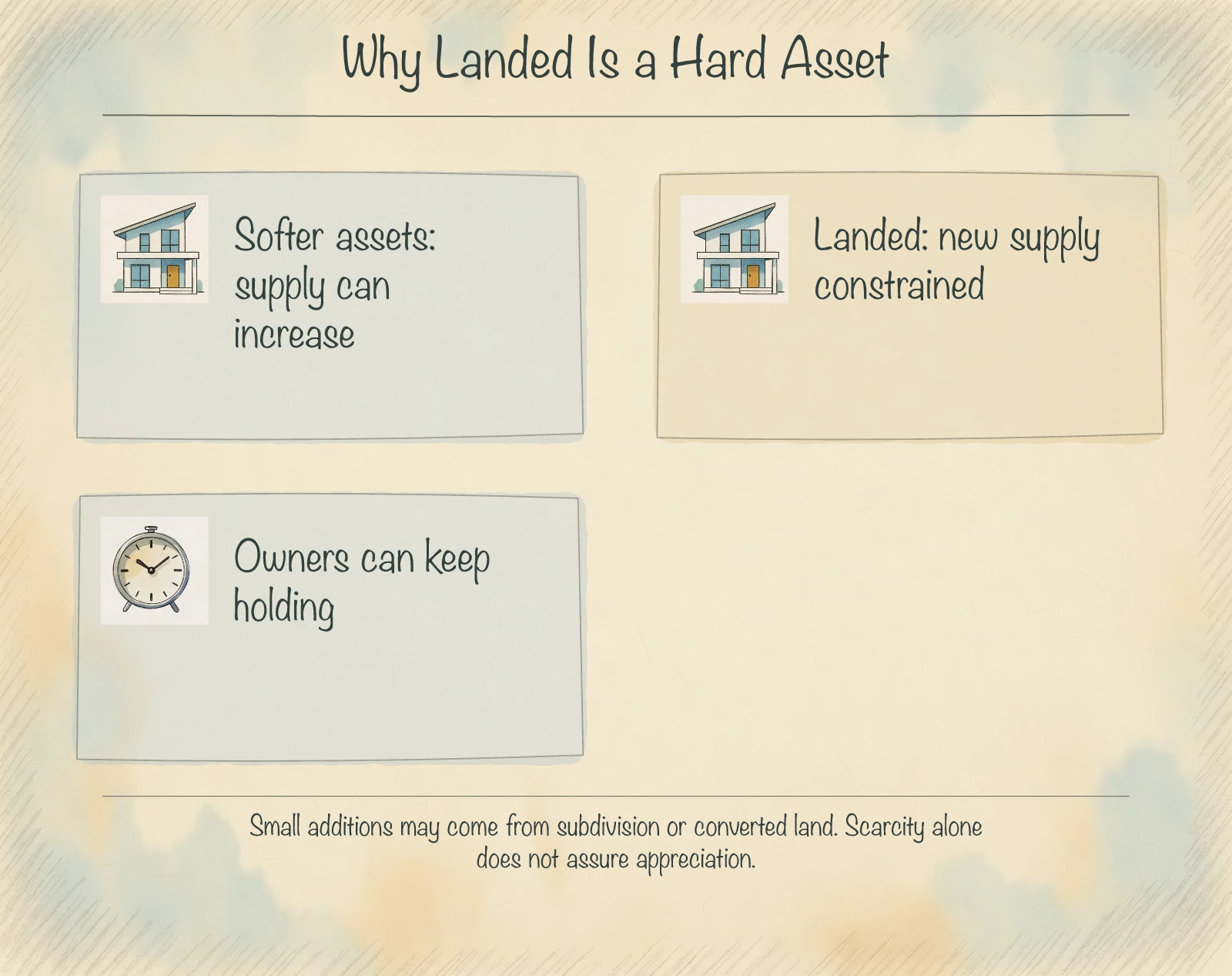
So let's have a look at elasticity just for everybody to understand. Basically we call this the hardness of an asset.
It is linking to elasticity of price and supply. The key rationale is that when you look at landed property, it is the hardest of our assets.
There's no new supply and when price increases, when new people enter the market, there's no new supply to cool the price down. So people will just continue to hold it.
And a lot of landed property owners, they are sitting on equity. So when they see their equity, there's no rush for them to exit.
So hardness and scarcity of that asset is also very obvious to price appreciation.
Let's have a look at two examples. For example, if you own a HDB in Punggol, maybe in the year 2021, right after COVID, this is a five-room HDB flat about 20 years old.
Back then, it was at about 550,000. And maybe you're thinking, hey, should I just cross the street and buy this EC in the resale market.
So back then you can get a pre-veh3 beta at about 1.18. Now the reason I'm showing you this is because if you look at these three circles, this is the softest kind of asset, the supply increased by 15 to 23,000 per annum, BTOs.
This increased by 5 to 10,000 per annum, this increased by 0 per annum. So this is still harder than that.
So when you look at this example, let's say this family decided to not do anything. Back then the gap was only about 630,000 disparity.
And if let's say suddenly today they decide to
Hard Assets, Widening Gaps and Property Objections
Make a decision, "Hey, let's go and buy the Privé 3-bedroom because my HDB appreciated by 100,000 to 650K." But they would then realize that actually Privé has already increased by another 410,000.
So they actually have a missed opportunity of 410,000 appreciation, because they could have bought this at 1.18 but now they have to buy this at 1.69 because the gap has widened. So this is an example of the hardness of an asset.
A harder asset appreciates at a much faster pace. Now, how about a landed property?
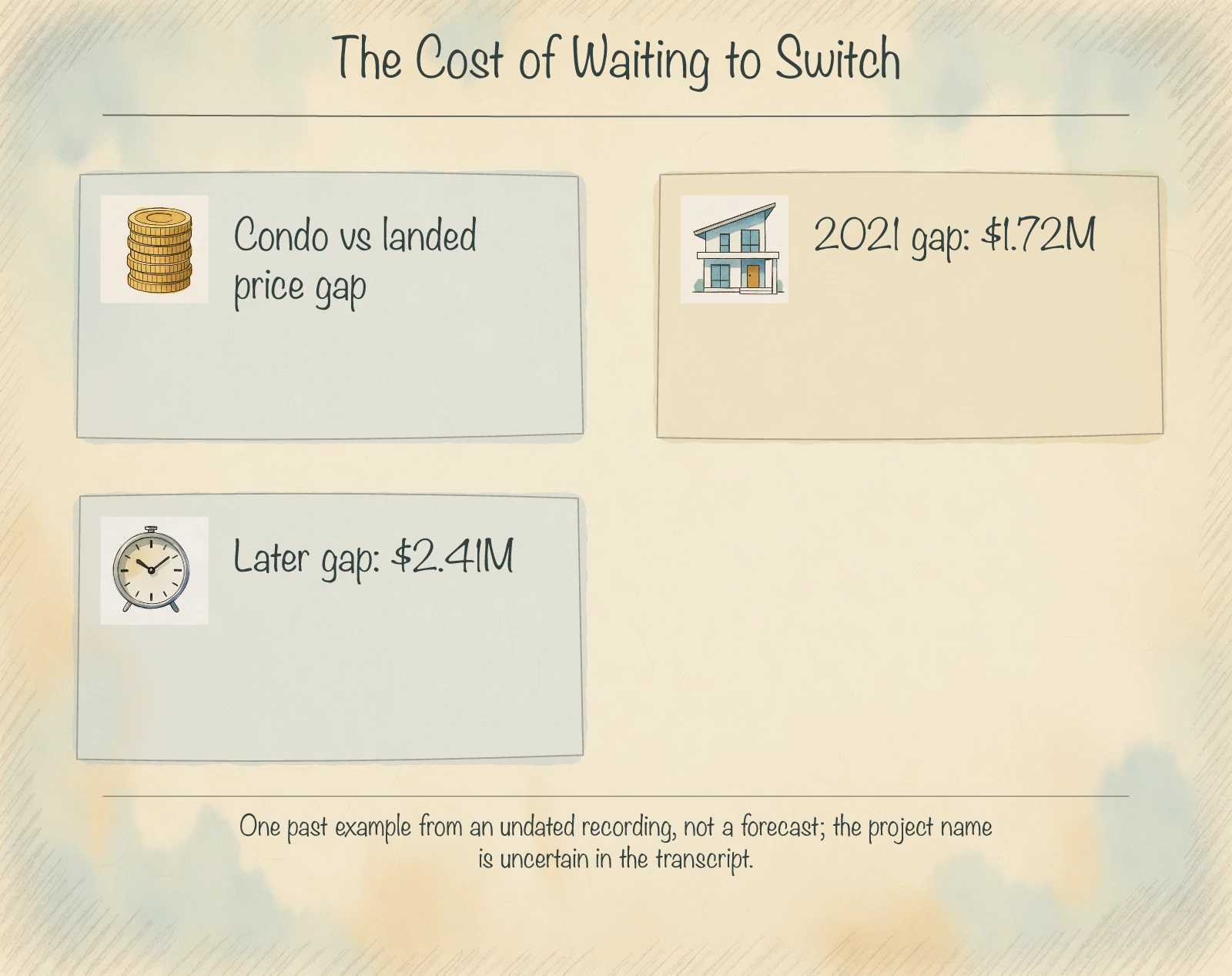
So assuming somebody stays in Privé in 2021, they were thinking of shifting to Interterrace. Back then it was $2.9 million.
The gap was only $1.72 million, but they decided to hold on. And then today, because interest rate has dropped, they decided to come back to the market.
What they will realize is that the gap has widened even further. So now the gap has widened from $1.72 million to $2.41 million.
Even though their condo has appreciated by $510,000, but this has appreciated by about 1.2 million. They have missed out on a capital appreciation of 690,000.
This is just an illustration of the hardness of an asset.
To further illustrate the hardness of an asset, we can have a look at new launches as well, all right? Because our Singapore pricing system is dominated by new launch prices as well as landed property.
Why? Very simple mechanism.
When you go and buy a new launch, you don't need to talk about cash overvaluation. Whatever the developer wants to sell, the bank will match.
All right, so that is a hidden mechanism. No developers here, or?
Okay, no developers. Okay, now the same 1.5 million dollars in 2013 can buy you a 4-bedder, but today can only buy you a 2-bedder.
This is an example of deflation of our dollar as well as asset inflation. My forecast is that by 2028, 1.5 million can only buy you a 1-bedder in the OCR region.
And if you look at this, basically developers, their gain is quite phenomenal.
If you were to compare the hardness of the asset, let's have a look at this. So I highlighted two portions.
So the first blue three bars basically these are HDB properties. Percentage increase for nine years, all right, for maybe a BTO forum, MOP forum, or old five-room in a very good area like AMK.
And then of course you look at new launches, resale property as well as very old property. They still appreciate, but if you look at new launches, it appreciated by 83% over the last nine years, but take note, so this 83% does not belong to you.
It does not belong to me. This 83% belongs to the developer.
So developers' increase in terms of the price that they can sell has increased by 83% over the last nine years. However, landed property can actually combat that.
Because landed property, if I just take a look at an entry level into Terrace freehold, it has appreciated by about 100% over the last nine years.
So basically, landed is the only way to enjoy the same amount of returns as a developer. All right, so far so good?
All right, now let's have a look at number two. Okay, so recently I was helping one of our clients to hunt for property.
Actually, he's here today. Maybe Jaden, maybe just wave.
He just successfully bought a property last week. Okay, so I just want to show some of the research that we have done together with Jaden.
And of course, these are some of the mistakes that actually you can avoid as well if you're hunting for certain properties. Because I'm in D19 today, I won't talk about D19 property in case it's your property.
Okay, so I will just talk about another district's property. So usually when we look at the landed property, the first thing I want to look at is that as straight away, we'll go to one of our app tools, basically will look at basically the lot number, what structure is this,
the two-storey terrace, and of course we want to look at the land size, all right? And then of course we want to look at the plot as well.
Okay, so if this is a property that you happen to see, what is wrong with this property, anybody? This is the third tip of the day, anybody?
What's wrong with this property? Actually nothing wrong.
The only thing is that when you want to sell next time, you will keep hearing this objection from your future buyer, which is a very frustrating one. What is this?
Okay, so this is facing the cross junction. Alright, we call it the Chong Law.
Alright, it's facing the T road. Okay, so the moment you have this property that's facing towards here, usual objection for your future buyers is that at night, they are very worried about cars just keep shining their lights into your house.
And of course, certain buyers who are a little bit more pantang, they will avoid this type of property.
Reading Terrace Size, Surroundings and Five Steps
So that's the first thing to take note of. Now, of course, this is a second example.
So when you look at this 1651 square feet for a three-storey terrace, it's an okay size because, minimally, in the terrace, we try to go for at least 150 square meters, which is 1615 square feet.
However, when you want to look at certain properties, so for example, the usual dimension will be 6 x 25 for 150 square meters interterrace. It's also important to look at what is in the surrounding.
Alright, so what is in the surrounding? Anybody?
Feel free to interact. Don't be shy.
Do you prepare any prize? You're not going to be talking?
Anybody? Anybody want to try?
All right. How about this young gentleman here who is here to learn about landed property?
What do you think is something that you will look out for? You want to try?
Okay, it's okay. All right.
Anyone? Okay.
So of course, when you look at this, the plot is around here.
The first thing to look up for is places of worship. Alright, because future buyers, when you want to sell, always remember that when you buy a landed property in future, what you want to sell, this becomes your product that you want to exit.
And landed property, when you appreciate it becomes a high quantum. And when it's a high quantum product, your buyer shrinks when it's even a higher quantum.
So buyers with high buying power, they become very specific. And they become very, very detailed.
So we want to look for places of worship. You want to look at whether you want to check out, for example, if it's a church, of course check out what the service time means.
Go during the service time, check the road. Is it going to be very crowded?
Is it like basically a road that you can park freely on the left and right flank because if it's a single line in the middle you cannot park? If it's double yellow on both sides you cannot park?
If it's
like this you can park. And of course check the road lines just within the vicinity before you make a decision because these are things that your future buyers will look at now.
We have this two list that you can get from our consultants later. All right, we have a full avoidance list for you to look at that will not be a property that will not have this thing.
So I have to let you know first. So no property is perfect in Singapore.
All properties will have some form of objections but you need to avoid as much as you can. Later our consultants can pass to you, don't worry.
Now let's have a look at another example. So this is a land size of about 150 square feet.
But if you look at the dimension, basically it is not the usual 6 times 25. So it's 7 times 20.
So when you buy something like 7 times 20, you have to take note why. Because 20 you need to less off 7.5 for your car porch and usually small port they might
allow you to stretch all the way towards the back that means you don't have to do the 2 meter step back behind but whether you can or cannot right in the middle you're left with about 11.5 to 13.5 which is very very shallow it's not deep enough so your living dining dry wet kitchen becomes very very shallow if you want to bring granny rule helpers because very very shallow already.
So minimally go for 6 times 25. 20 is a little bit too short already.
So of course we recently helped one of our clients to look at this. Okay sorry, it's not this one as well.
Okay so this is the last example. So this property seems pretty okay because the land size is pretty big.
2,395 square feet. The only thing is it's short of one big move unless you can construct the fourth of feet.
Because a lot of buyers on the ground in the last two years, they hunt for at least four beta.
But of course, when you look at this plot, it's beautiful. But once you zoom into the locale, you need to take note that if you buy something behind shop houses, this will be a concern, especially if the shop houses are F&B shop houses because the exhaust usually comes behind.
So back lane, this will be potential issues. We of course, we utilize a lot of different frameworks, but these are the four main frameworks that we use.
Basically, we categorize the landed property first. Whether are you category one, two, three, four, disparity of prices, the DNA of the property.
And if you're hunting for newer land, we look at the build up. If you're hunting for land to rebuild, we don't look at the build up.
We look at the land PSF. All right?
But when you're hunting for something to move in directly, we look at the build up. These are our five-step process before we hit the ground.
So we want to understand the market first,
Land DNA and D19 Inventory Pricing
Answer a district, then we look at certain inherent factors. So we have designed basically some DNA system to look at landed homes.
Landed properties, because of the fact that you're buying the land, the land is not changeable. You cannot change it.
But if you buy a good land, we call it a good DNA. So it's a good DNA horse.
But if you buy a land with a lot of objections, for example a substation and stuff like that, we call it a poorer DNA horse. So if you have a poorer DNA horse, you'll have to spend money.
You must spend money to enhance it, either by A&A, recon, renovate, or increase the amount of bedrooms that you have. But the moment you have a good DNA horse, even if you don't do anything, if you want to sell next time, people will still buy the land.
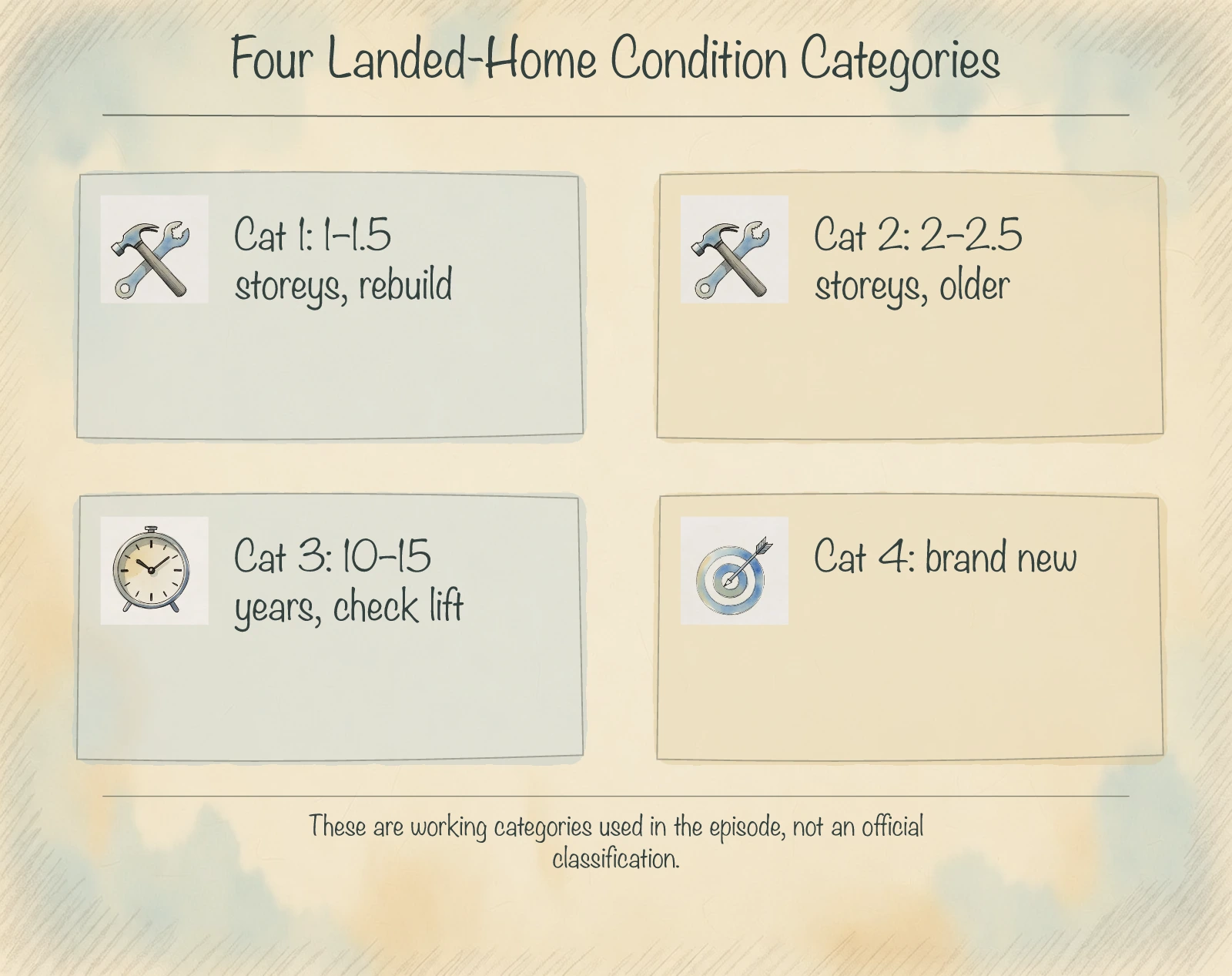
So take note, some of the language we use, and it's very good for you to look at this categorization when you go on the ground, is you categorize Cat 1, 2, 3, 4.
So if you see something single storey or one and a half storey, that's category one; you only buy the land, you tear down and rebuild. You see something about two to two and a half storey, that's category two.
A lot of the category two homes were built 20 to 30 years ago. They only have three bedrooms.
But if you can find something four to five bedrooms, that's a bonus. Now category three, about 10 to 15 years old, more than design.
Usually if you buy, the build up is there, see whether you can fit in a lift. And of course, Cat 4 will be brand new from developers.
So the moment we categorize Cat 1, 2, 3, 4, we then plow in the prices. Let's say for example, you have a certain budget, you have an $8 million budget.
You want to see how does this and crave behaves in terms of asking price, you categorize and then let's say for example you're out on the street to hunt for properties, you have to look at what are the Cat 4 homes asking for.
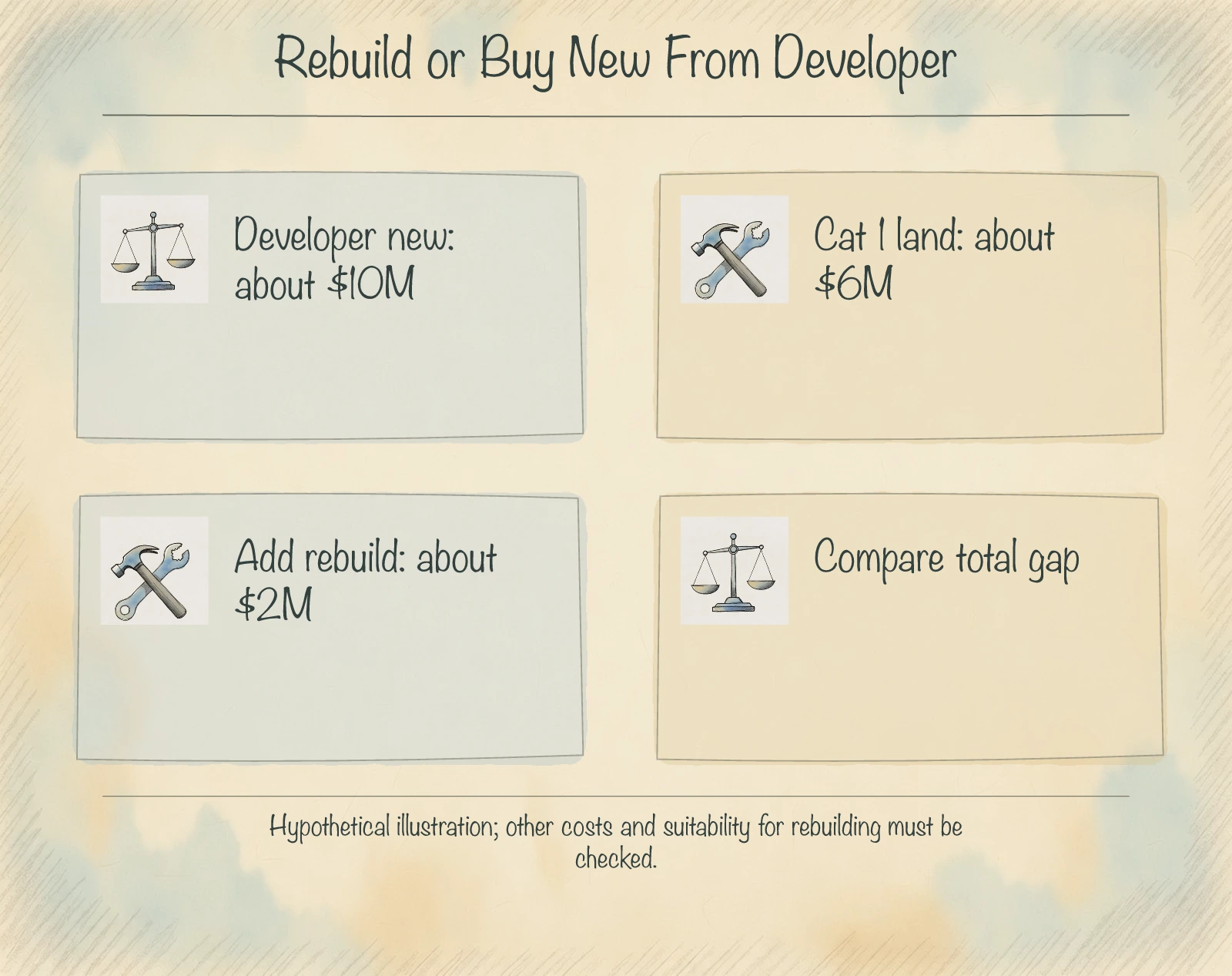
And even, let's say you can buy up to nine or ten million dollars. This is a decision matrix for you.
Why? For example, let's say you want to buy brand new direct from developer, and you saw a lot of properties at about $10 million.
But you realize that the disparity of the pure land is too far apart. If there's a lot of Cat 1 homes at about $6 million, then it doesn't make sense to buy from a developer.
You might as well just head down and rebuild yourself. Just add another $2 million.
All right. So when you look at this and you plow in the numbers, then it starts to make a lot of sense.
And of course, we also want to compare the choices in the market based on their DNA. So once you're applying the DNA, then it helps you to make some decisions.
So let me just show you some example, for example. This is what George has done for one of his clients.
So basically, he has categorized it in terms of category and DNA. And basically, he also plows in the amount of investment that is needed to value add to the house.
And in totality, what will make sense after the assumed closing price as a total investment. So these are examples of some of the homeworks that our consultant do.
And of course, when we sell certain properties, what we do is that we also deploy our builder to come out with a plan. So let's say we are representing sellers to sell their landed homes, we deploy basically plans like this to give the potential buy options like, can you retain and fully do an interior renovation?
What is the cost involved? If you want to do A&A, what is the potential cost involved?
So that's the selling portion. All right, now let's look at some key trends as well.
Okay, so far so good everybody. Can I?
Okay. Now, these are the total inventory in the market.
Okay, there's a lot of charts
that we have plowed into the D19 report. Basically, we plow out the data from PropTiGuru.
We try to shave off the duplicates, all right? And we want to track the inventory on a month to month basis.
Why? We want to see whether certain inventory on certain price ranges are decreasing.
So basically in the report, we will start to see that anything below 5 mil is decreasing at a rapid speed in D19. That means if you are ready to take action, you should take action in the next one to two quarters for landed property.
This should sustain for the next two years in terms of this buying movement, all right, because interest rates will likely remain low for the next one and a half to two years. So these are the D19 inventory.
Of course I wouldn't dive deep into it, but basically, like, this is like semi D. Most of the listings are in the range of about six to seven mil.
Five to six mil usually are
Quantum Limits and Competing Districts
those men to be tear down and rebuild. Alright for semi Ds.
First for detach. Now detach there's quite a high number that's trying to ask for 11 to 12.
Usually for landed properties, once you stretch past 8-9 million in the OCR region, it's going to take you longer to find a buyer because the buyers will start to compare with D15, D10, 11 as well as D21. All right, so they will think about what can my 10-11 million buy me in so-called like a more powerful district.
Okay, so if you want to go into the D19 space, note your quantum. So let's say for example, you saw something at $8 million, but you need to tear down.
You need to plug in $2.5 million. That would be $10.5.
Plus, your buyer's stamp duty is $11. If you want to exit at $13 million, then you need to think about in your holding period, three, five years time, who will you exit to?
All right? So, of course, unless you're going to stay perpetually, if you are not thinking about exiting, then it doesn't matter.
So we have some inventory comparison but I won't dive into the details. So all these are available.
Basically interterraces will always have the highest PSF because the land is small. And number of transactions remain very healthy for intersemede.
Detached house basically in the last three months, there's about 16 transactions but interterraces about 199, semide about 74. This is the price index and volume.
Okay, and of course, property price index. So basically, since 2019, almost a partner of 27% landed about 36%, but this will not continue in my opinion.
That means we will not see double digit every year. It will likely be single digit.
The moment you hit double digit, cooling measures will come in. So, likely it will be about 5, 6, 7% plus minus.
So, volume-wise, we're back to the pre-COVID days. This was COVID-2021.
We're back to the pre-COVID days about 2018, 2019, about the same amount of volume in terms of landed transactions. Price growth continue to be healthy.
It's quite generic with the whole Singapore, because anyway, D90 is very huge as well. Okay, so let me just fast forward to maybe just a summary.
So the forecast for 2025, the LAN PSF likely will continue around this range. Okay, but take note, we cannot compare the LAN PSF with the new launch PSF because the new launch PSF is based on strata error.
The LAN PSF is based on LAN. And when you look at landed properties, why a lot of people continue to want to buy landed is because once you have a big build up of like 6,000 square feet, this is your quantum, your build up PSF is much lower than the strata and it's a freehold status.
So for example, if you buy something at 6 million, but your build up is 6,000, basically your build up PSF is about $1,000 PSF. So compared to what you're getting for size in a condo is very different.
This is of course inching upwards 4 betas deal launch 5 betas deal launch
and of course we believe in this thing called disparity effect and every season there's something that will move. Okay so this is a table for everybody to take note.
Why do we want to understand this table is because this is how buyers think on the ground. Usually buyers will start to get confused if they are starting at this layer.
That means if they are hunting for a condo that is 4 to 5 beta, they will start to think about, hey, can I get something here upwards? Because why some of the quantum price becomes very similar.
So it's very important to note that they have this ranking system in terms of a buyer's mindset. And what does this mean is that sometimes if you buy something that is very close to a superior ranking product, you might enter into a sandwich class.
I give an example. If you buy a 99 years interterrorist at $3.5 million, and let's say across the street is a freehold enclave and the freehold interterrorists are doing at $4.2 million,
In my perspective, the disparity is too close already. Because there's only a 7-hundred K gap.
It's too close. Alright?
So you have to note that there's a ranking system in the mind of buyers and they rank like this. Okay.
Second ranking system for condos, buyers usually rank like this. Alright?
From boutique projects to 9-9 years, 9-9 years do launch freehold and of course freehold new launches and regions also they rank. So when they look at landed properties OCR, CR, CCR, all right?
So D19, D15, well first D15 is chopped into two. Part of D15 is the OCR, but people consider D15 as RCR and CCR as well, all right?
This is an example also of a different type of dilemma. So some buyers, they are exploring CCR4 betas and less than $5 to $6 million.
If you happen to be this buyer, you have to know also why because CCR used to be a foreigners playground and now without foreigners because of the 60% ABSD, a lot of the Singapore buyers basically they
Exit Quantum, CCR Dilemmas and Switching Choices
are thinking also about lender properties. Alright, so these are some disparity that you is thinking and maybe bantering about whether they should go for a new launch rate of $0.5 to $4 million.
These are usually some of the things that they think about. This also means that if you are thinking about this, you should consider this too as well.
Why? Because in future, if you want to sell at $4 or $4.2 million, you'll be potentially competing with landed property buyers and land property owners.
So we have this thing called a condo's buying power triangle. The buyers demographics and quantity usually shrinks at the top.
So you have a wider buyer base at the bottom, it shrinks towards the top. So as you move upwards in terms of your entry quantum, you have to be very specific at what you buy.
And lender properties also the same. Once you hit upwards towards this range, the type of lender, how many bedrooms gopul will not live facing direction DNA is extremely important because bias
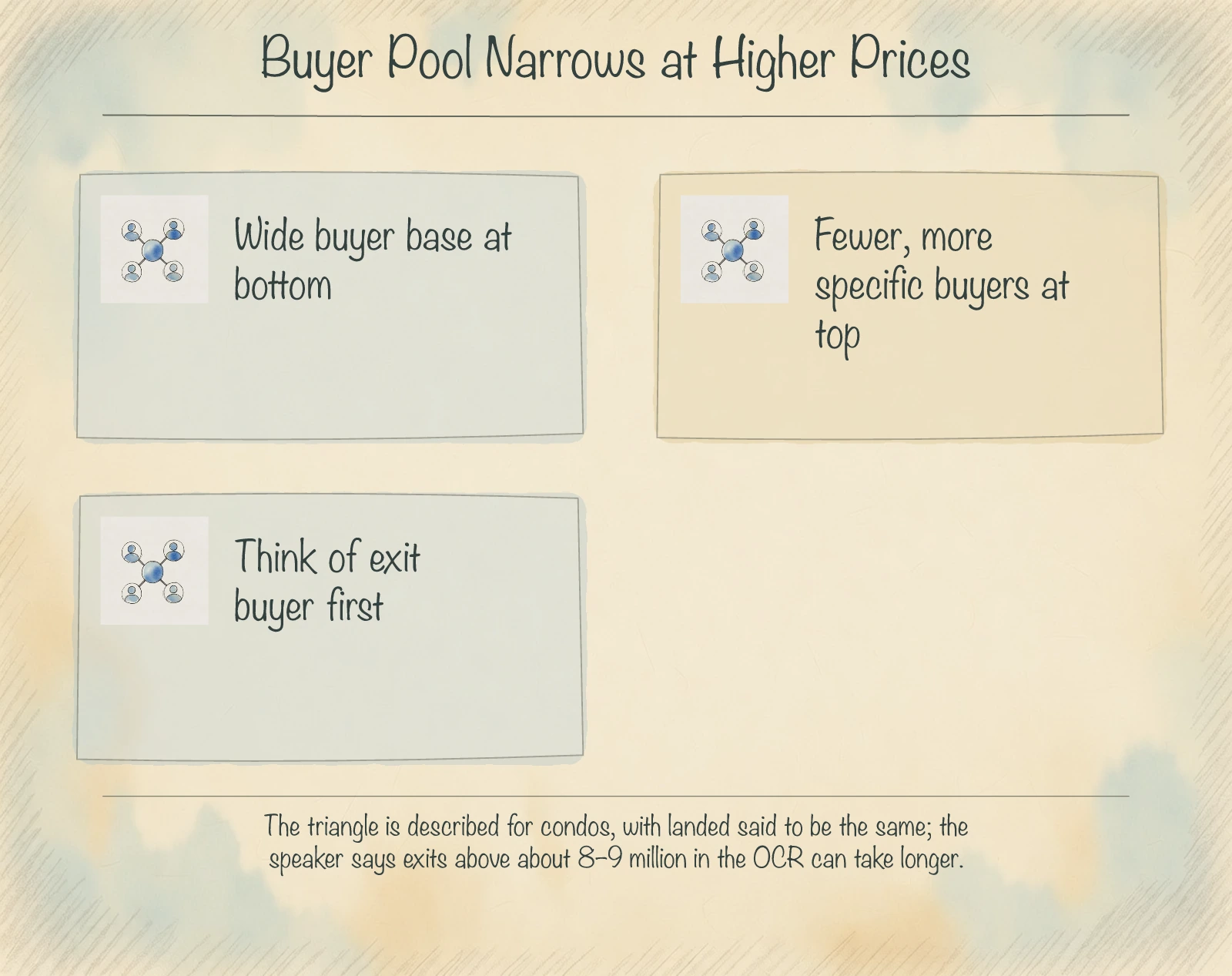
that 8, 9, 10, 11, 12 billion in Hokkien we call very gauze, all right, so they will look for a lot of things. And why is it that they are very gauze is because if they cannot find a specific specification in the resale market they will just buy a bare land head down and rebuild themselves.
So when you want to exit something around this range, you have to make sure that when you enter, you buy a more superior product. Okay.
Now first, the pristine land buying power triangle. Okay.
So the dilemma zones usually fall around here. And what is it important to note is that if let's say now you have a range of about four million dollars, and you're thinking about should we go for apartments or inter-terrors freehold, the clear answer is straight away go into a landed.
If you're hunting for appreciation, that's a very clear answer. Because the moment you touch that categories for apartments, what's going to happen when you want
to exit next time you will cross-fall mail, you will enter into the space of landed properties. So we have some bubble charts over here for D19.
Later you can discuss with our consultants. These bubble charts are meant for you to explore your quantum.
Okay, what does this mean? For example, you got $6 million.
You saw an interterrain brand new, very nice for a developer. But you should consider the upper ranking landed also.
So you should look at maybe the semi-D space and see what you can get for $6 million.
because maybe you can get a category 3 or category 2 semi D which is not brand new but maybe it's about 15 years old but you can get it for 6 minutes at a larger plot of land 2,000 plus 3,000 square feet.
So the moment you have a certain higher tier range do not be emotional look at whether is there a chance for you to cross to a higher ranking at a more superior product okay
Right in the middle, there's corner terrors also. As far as you can, if you can cross directly to semi D, go to semi D.
Because most of the corner terrors' objections on the ground is that you are facing competition for semi Ds. Alright, so corner terrors is unfortunately a little bit like a sandwich class, unless very good quantum.
Very good quantum, okay? Okay, so 2823, you can still get an interterrace for 3.5.
No more already, alright. Now, this is 2024.
As what I showed in the first three slides, you can still get something 4 plus million, but dwindling already, alright. Most of the inter-terrorists, not brand new, they are asking for 4.8.
A lot of people are asking for 4.8. You want to find something low-force, very hard.
Next year, nothing below 4.5 million, my old forecast. So if you are ready to take action for landed, this is basically my forecast.
Because what's going to happen is that the moment next year, people start to take profit for whatever margins they are earning in the stock market,
equity market, they're going to plong into a landed property. All right.
Okay. And of course, partially as well, the rationale is of course of this two product category also.
So Strata landed, they have moved up quite fast in the last one year. Freehold Strata, they are closing in to the same quantum as the entry level, pure landed.
So what is going to happen is that this will propel the pure landed to go upwards. Okay.
All right. So some action steps that you can take.
So I've basically just shared three main things. Is it okay that I sell a bit of koyo?
Can I? Okay.
Now some action steps you can take basically. These are the things to note if you are switching properties.
All right. So all of us have a property.
All right. If you are switching properties, some of the things to note.
Now, if you are switching to a target property that is stronger, harder asset, you should not time the market.
Switching Timing and Positioning Your Property
You should take the chance once you are ready. You have done your finances.
You have prepped your home for sale. You should switch as much in terms of speed as you can.
Because I showed a previous example from the corner to the landed, the longer you wait, the disparity gap and largest. Because landed is a stronger asset.
Now, even if let's say you don't want to buy landed because you love facilities, but if you are planning to buy a bigger baby type, you should also switch. This will further accelerate in a low interest rate environment.
However, if you are thinking today, you are coming here because you are planning to sell your landed and you want to downsize to retire, this is not the time to sell your landed. Okay, because the price of private properties will still appreciate over the next 12 months.
So if you're switching to a HDB, don't do anything. Wait for the price to increase in value for another one year first, then you sell.
Okay, if you're thinking to upgrade by bigger, then you make the move. But you want to downsize, don't do anything.
Because your HDB will not appreciate as fast as your current landed property or your current condo property. So those that are taking out downsizing don't do anything.
Wait first. Wait for 12 months.
Now, things to note if you are switching, some quick advice. Not to leave any money on the table.
We have seen a lot of people leave money on the table because they sell very hastily. Because wherever market is hot, they think that it's very easy to sell just anyhow post photos and sell.
But you will still leave money on the table. Why?
Because every property is different. And a lot of buyers they buy with emotion.
So if your product is not marketed with emotional appeal, you are living money on the table. So how to sell a big plot for example?
There are many ways to position a big plot but research needs to be done. For example, let's say if you own a detach, we have to study whether can you actually subdivide into semi-D and these are potentials to sell to the bias.
So for example, recently, of course, this is a listing by Josh and Tabitha. We listed at about 15 mil.
We closed it at about 13 odd mil. Eventually we sold to a developer.
So basically what was done was that after studying and research, it can be chopped into two corner interterraces. And then we went to pitch the developer and we helped the owner to exit.
So the owners are entering into a retirement phase, a very good exit for them. So things like this, sometimes if you sell hastily, you didn't know that actually you own a plot that has many different ways of positioning the property.
You should find a way to position a property. We also believe that whatever property also can result as long as you match your positioning correctly with your pricing mechanism.
So I will show these examples.
A lot of agents will be employed by this owner. They're trying to sell a home hidden behind a home.
We call it a long driveway, 70D. And basically what happened was that they weren't able to sell for a prolonged period of time because they were just primarily using property grow.
So in the absence of positioning, buyers only look at pricing. And this is detrimental to marketing, all right?
So if you want to market your land property, your land property is very precious. just don't leave $200,000, $400,000 on the table for nothing.
Okay? Patricia and Angela, they should sell it just for seven viewings.
They managed to sell it by straight away talking about the worst feature of the home. So immediately they talk about the long driveway, but what can you do with the driveway?
All right? So previously, during that full 11, 12 months, basically the owners told us there has been and close to 100 viewings.
But a lot of buyers come to the door to what even want to go in, because they see the agent reset their time. So a lot of buyers are very specific.
If it's long drive way, just tell them long drive way is fine. But you have to give them solutions.
How do you utilize the long drive way? All right, so we're still in seven viewings.
Now this is basically our landed investment journey. Later I'll share a little bit more with you, but we see a lot of basically owners that are holding on to a million dollar properties, right?
like two, three, four, five, six, seven million dollars, but they're still deploying just photographs. And in the absence of any fall content positioning, basically people will just compare the size PSF and price, that's all.
All right. So we have six steps to position every property if you want to switch.
So we are thinking of switching to let's say a landed or whatever. There are six steps, but I only talk about a few steps.
These are just some tips for you.
Home Tours and Targeted Digital Marketing
For example, this property was being launched by [redacted] and of course one of the issues with this property is that there are too many 3-bedders with similar sizes in this condo. But this property has a distinct USP that we have to talk about which is 170K of designer rental but even with that it's not enough.
Alright, because a lot of buyers are not willing to pay the premium for the renovation. So what we have done in the home tour is to really educate the buyer that this particular size and stack, they are only very, very small quantity with this special layout.
We've hung everything into the home tour, educate the buyer, then the buyer will understand because sometimes buyers, when they look at certain resale properties, very hard to study the whole site plan and distinction of all the floor plans.
So weaving educational portion into the home tour is extremely important, all right, which is why our home tour usually will not talk about analysis numbers and all that kind of stuff.
Of course, certain other features as well, highlighting the stack differentiation and stuff like that. We also talked about certain tips in our book that we have just launched last month.
And of course, we highlighted certain things that you need to take note when you want to sell a property. And of course, those of you who are holding on to properties that if you are hacked big rooms.
Take note, this is one of the largest objection on the ground. And a lot of time, buyers, when they make offers, the moment you hack bedrooms, they will lower price.
So you must find a way to solve it. This is a property of four plus study at Asparis.
Basically what we have done is that the owner hacked down the study room plus one bedroom. They are only left with three bedrooms.
So we deployed a lot of media tech. We call it visualizations to help the buyers reinvent.
Then of course nowadays we can use the actual footage.
We can deploy furniture within it as well so they can visualize how it looks like. All right.
This is also an example. This is a property that we are currently selling, garden residences.
The fourth bedroom is being used as a legal room. But sometimes buyers find it very hard to visualize.
So it's very important to have the visualized how it looks and feels like once it's being reinstated. And usually when they come for viewing, our consultants will prepare the quotation as well.
Because to put back the bedroom, it doesn't cost that much, maybe about $10,000. Decluttering is extremely important.
Don't sell your property like this. It's going to destroy your price.
Take some effort to really beef it up. Because once you want to put your property in the market, it becomes your product.
Alright? So after decluttering, it looks and feels extremely different.
And of course, if you can't do physical staging, what we do now with this is that, for example, this landed property. Koi pond by the way is no longer very popular.
Even swimming pools are not
popular. Now it takes the same amount to build a swimming pool.
If you want to flatten the swimming pool, it's the same amount as if you were to build a swimming pool. So a lot of buyers are also requesting not to have swimming pools already.
So we use media technology for example like this, is to have the buys to visualize how it looks and feels like. Once the lift is there, of course this is after walking through for a builder and architect.
Also, this home is not suitable for staging but is of a 20-year kind of renovation. So we try to reinvent it with a different kind of fr...
Oh, sorry. All right.
That one is not true. All right, okay.
So we try to reinvent it with basically how it looks and feels like after repainting after like a fresh look on Scandinavian style and stuff like that. And it helps the buys to further visualize.
All right, okay, of course there are things like this
as well. How do you utilize the corner or space in the side set back?
All right. Okay.
So basically don't wait for the buyer to find it as well. We sold this particular two plex to this uncle.
He wants me to address it with uncle Ang. All right.
Basically he's not even our client. He's the eventual buyer that bought this place.
But why was he very excited to share because he said that he bought this property through YouTube. And of course, back then, he was actually one of the owners of an on-block project.
We took the content and we found him. So basically, we targeted his project every day by dropping ads on top of his project.
So every day when he's at home, you will always see the home tour. And that is how he found this property.
So basically, if you have a home that you are targeting to sell, you should think about where is your audience, take that content and drop in using digital marketing
Finding Buyers and Quantum Charts Resources
So that you can find your buyer rather than waiting for your buyer to come and find you. So for some of these things later, you can check with our consultants.
We also have tabulated this entire table based on your quantum value in terms of an investment range. What are some of the choices you have?
What are some of the considerations and things you should look at this season? Because in certain seasons, you should avoid certain types of poplis and certain regions.
So this entire table is for our consultants. Later, you can check with them.
We also have the bubble charts for different districts. So D19, we have D28 as well.
We have D15 and these are what we call the quantum bubble charts. All right, so D20, D10 also.
All right, so you can check with them even if, let's say, you are not thinking about D19 landed properties. Okay, I've come to the end of my segment.
Thank you very much. Thanks for the time.
It's been my pleasure to host you here tonight together at Well Collective.