Ownership and financing
How To Leverage Banks and Tenants Help You Build a Multi-Million Property Portfolio
Published 2026-11-25. Adapted from the episode published 2025-11-14. Figures, illustrations and data reflect the episode’s original publication date.
On this page
- Webinar Intro and Portfolio Appreciation Principle
- Set-and-Forget Investing and Reaching Portfolio Targets
- Age 55 Goal and Condo Listing Example
- Checking Last Transactions; Profit Belongs to Owner
- Owner Risks and Why Numbers Matter
- $800,000 Property Example and Mortgage Breakdown
- Interest, Principal and Two Core Investors
Webinar Intro and Portfolio Appreciation Principle
Alright, so welcome to our PRB webinar. This is a monthly webinar that I think if you have already joined us for the last three years, this is not something new to you.
I've been in the market for 18 years, and of course welcome to our monthly webinar session that has no product features at all. This is really coverage of property investment frameworks as well as data points and methodologies.
Now today we're going to talk specifically about this topic, which is how to turn our portfolio from a starting point in real estate, and predominantly 80% of us in Singapore all start from the BTO route or the resale HDB route.
Of course another 20% they start directly from the private property route, be it from various kinds of seasons. Maybe you started off with a condominium, you started off with an EC, you started off with a landed property, you started off with some inherited properties from your family.
But be it whether you are starting from which point, we want to start from the most fundamental route first, which is from the BTO slash HDB resale route, which is why today's webinar topic is how do we transform an $800,000 portfolio in real estate to a $6.5 million portfolio.
Now, very briefly, I want to share, review, this terminology called the equity triangle. In the last three to five videos, I talked a lot about this concept called equity triangle.
I shall not spend too much time on today's webinar because we only have about an hour review. We're going to really deep dive a little bit more into the concept of how to expand our valuation of the properties that we're holding in our portfolio, or how do we structure this asset class.
And a backdrop is that, let's come to this screen. Now I always talk about the fact about diversification.
Diversification depends on the amount of time and knowledge that you want to invest in a particular asset class. For some people, they want to be multi-diversified.
They want to have a rested portfolio. They want to have a dividend portfolio.
They want to have an equity portfolio. They want to have bonds and fixed D and stuff.
Some people like multi-dimensional diversification. Some people just want to focus on their professional and business and then depend on real estate itself.
Some people don't even want to touch real estate. But I think the very important thing is that you should only diversify into various asset class based on what you have knowledge in.
Because most of the time, if you are too diversified, for example, if you want to diversify into property, maybe this is for your own stay, and then you want to have like an investment property, and then you decided to go into for example, cryptocurrency, right?
You want to go into let's say, equities, S&P 500.
Now, sometimes we need to understand the psychology of investing, which is which one will allow us a disciplined approach not to touch the investment too many times.
Because sometimes when we are in a season of looking at the pricing on a day-to-day basis, for example, let's say if it's equity, it's a very liquid kind of investment because you can enter and exit very, very easily.
Once the market is open, cryptocurrency is trading 24-7. You can enter in and out very, very quickly.
But real estate is a very disciplined approach.
So it's very suitable for people that want to have a disciplined approach of not touching and trading on your asset based on the price movement on a very rapid fashion, because sometimes you can make wrong decisions to exit when the market is still going up and you enter when the market is still going down.
So this is really not talking about very liquid investment. This is more suitable if you want a very, very disciplined approach.
And sometimes a disciplined approach can help us who are very busy professionals or busy business owners, because you just want to set your investment and we call it the set and forget principle. Set and forget.
But then the kicker is that for set and forget kind of terminology, this is a principle when it comes to investing in real estate, but the kicker is that you have to go through what is a real estate investment that is not stagnating.
Because the moment you invest in the stagnated assets that, let's say in the next four to six or eight years, is stagnating in terms of this valuation, it does not appreciate, or it appreciates very, very slowly.
Then technically speaking, this investment is not working well for you, because you are wasting your opportunity cost, you are not letting your capital work hard enough for you. That means your capital is not working hard enough for you.
Set-and-Forget Investing and Reaching Portfolio Targets
Capital is not working hard enough for you and this can be deployed into other stuff like dividend stocks in order to gain a better yield.
So the most important fundamental principle is that when you want to invest in real estate, you want a set-and-forget kind of instrument so that you don't touch it too many times and then four to six years later when you wake up, your investment has appreciated and you want to build your portfolio valuation and you should hunt for properties with appreciation potential.
I talked a lot about this concept, but for today let's come back to this screen here. So how do we then calibrate our portfolio so that we can grow it?
So let's have a look at this example. This family started from an asset value of $670,000.
And then in fact, when they went through this entire route, there was an in-between route over here.
Now this in-between route basically allows them two condos and then subsequently they went to one landed property. And of course, this landed property's plan for this family is that they want to hold it all the way until it hits about $5.8 to $6.9 million.
And the rationale for doing that is because they are after the very disciplined approach of living in the property, because property gives you a utility value to stay in the asset. You enjoy the asset, your kids grow up with the asset and you enjoy the space of the landed property.
They want to enjoy that while the asset grows in value based on just a 2% growth, non-compounding. All right, so we're just talking about asset inflation just based on 2% per year, hold it from age 39 all the way to 55 or 65, to expand this equity triangle.
Now the reason this triangle can expand is because of a few reasons. Number one, because of 2% inflation — if we look at property price indexes, property prices increase between 2 to 6% per annum, be it a landed property, HDB property or condo property.
But of course, HDB and condo property, if it's a 99-year property, you need to take out of this concept called lease decay, but that's a whole topic together. But let's say for example, this is a landed property.
The main ideation is that this can expand to an equity triangle that allows your mortgage to decrease in terms of its outstanding loan and allowing your equity to build up.
Now this equity is built up firstly by the inflation. Number two is by your contribution to the principal amount based on the money installment on a month-to-month basis.
Now this will look very differently if you have two properties and you're renting out one and you're living in one.
So let me just very quickly talk about all this concept because at the start it might seem a little bit complicated but once I break down to you in numbers then it will start to make a lot of sense.
But maybe let me just share with you a few case studies first. Alright, so firstly, the framework that we always deploy is that we have a multitude of frameworks.
The most important thing is really to go for freedom and choice once you are 55 years old onwards.
Because once we are 55 onwards, we perhaps want to do and pursue things that give us a bit more freedom — we want to travel a bit more, spend time with our kids, our grandchildren, we want to travel the world, we want to do maybe volunteer work, you want to really like spend a little bit more time pursuing other passions and interests.
Of course, the key fundamental ideation is that if you don't have passive income that comes from a very strong asset income, sometimes a little bit hard to have freedom and choice because that means that you still have to depend a lot on active income.
And we use this 11th or 12th investment methodologies.
Of course, our investment methodologies, they grow on a year-to-year basis. But the main ideation is that we want to really deploy our active income on the very disciplined approach to enlarge this asset income to be a bigger and bigger asset class.
And that is what we mean by increasing and improving your valuation portfolio of the properties that you're holding. So rather than me holding onto my $800,000 HDB, I want to see if I can, during 25 to 55, expand it to let's say like a $6.5 million portfolio.
Why $6.5 million?
It doesn't need to be $6.5 million, it can be $5.5 million, it can be $4.5 million, it really depends on various mechanisms, for example, your earning power, how much good debt leverage that you can take in terms of a mortgage, what is the down payment that you have, but there's a step-by-step process to hit there once you're approaching towards maybe your 40s or even into your 50s.
But the key ideation
Age 55 Goal and Condo Listing Example
Is that by this, can I achieve this by age 55 to 65 so that I can then have some choices? This and come back to the screen here to really not depend so much on my active income, because my active income sometimes it can be unpredictable.
And once I'm 55 to 85, once this active income disappears, I want to be able to enjoy the equity inside my asset portfolio. And so, for example, Daniel and Sherry, this family, we journeyed with them for the last 17 years, started off with their HDB.
I was the one to help them to purchase their HDB in the first place, and then after the MOP period, they took a HDB resale ground and then they exited for around the range of 500 over 1,000. Now they went to a secondary route in order to build their valuation first.
They didn't go straight into landed property, they actually went into two condo approach, and later let me show you why this approach is actually very powerful, is a very good stepping stone.
And once they go into a penthouse for their own stay because they needed the space with themselves and the kids, they also purchase another three-bedder resale for rental, and in combination they then shifted from a $500 over $1,000 should be and improve it to a valuation point of $2.3 million.
Now they held on to these two properties for a couple of years, once it settles the seller's time duty period, they managed to exit it in totality at about $3.2 million.
All right, so these two properties started at 1.3, appreciated to 1.65, they bought a $1 million condo, appreciated to 1.55, and then they exited at $3 over million.
That allowed them the capability to shift into a landed, and they entered into a landed at 2.85 million back then pre-COVID, and then now it's worth about $4.8 million dollars, and subsequently after they stabilize down they invested in an investment property and now their total portfolio size is six and a half million dollars.
Now once they have achieved this, actually their methodology is following our PLB framework, in the sense that they're hunting for high growth high rental yield, either in the condo space; landed space is high growth low rental yield but this has very good capital appreciation.
So basically what they are trying to build is to shift into this zone here. So now they are around the age of about 40, 40 odd.
The total valuation just based on the landed property is about $4.8 million already. If I would add on to their condo purchase, they already have achieved a $6.5 million portfolio at this point in time.
Now, once they go into their winter season in the 55 to 65 years old range, now, if assuming the property they invested at 1.7 becomes $2 million or $2 over million, then they will have formed maybe about $8 over million in terms of total portfolio size.
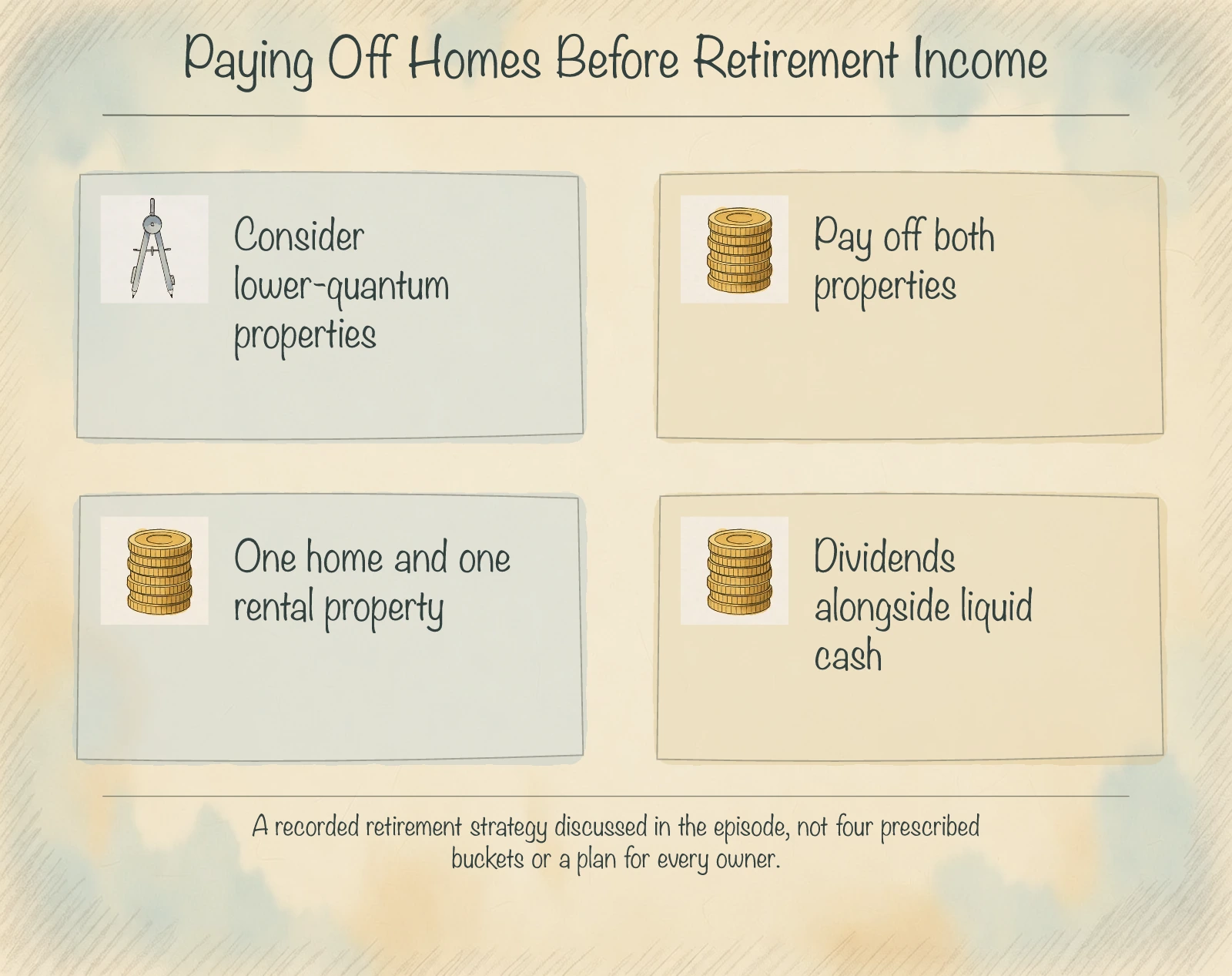
So what are they going to do with it once they hit into their winter season is that they can deploy it into four different buckets of income that generates passive income. So I believe that we should divest the property once we are in our winter season.
There's no real need to hold on to your properties unless you have a lot of properties. But if you want to really enjoy the fruits of the labor from the two properties that you have, you should divest it into properties that are lower quantum, older properties.
You can pay off a HDB, you can pay off an older property and stay and enjoy the space. You don't have to invest in very high quantum new properties.
Because at the end of the day, what you want is to go in low quantum, enjoy good rental yield, one for own stay, one for investment, no more installments, pay them off, and then enter into dividend kind of gameplay, just to enjoy very consistent dividend stocks.
And with this plus your rental property, you can still keep a good sizeable amount of liquid cash. So when you enter into this kind of season, even if let's say they want to press the button at age of 55, they can still deploy it into this four different buckets approach.
All right, so with that as an introduction, let me just kick start with the first case study. Now, I just screenshotted this from PropTGuru.
These are not my listings. They are not my team's listings.
Basically, I just want to share on a very generic asking price approach what is this very popular condo commanding. So this is part S-TAR, very good performance condo, right beside Yunoes MRT station, very beautiful project as well.
And a lot of the owners, they have made gains from investing as a first-hand owner when it was launched. Now, currently the 3-bed 2-bath version for this listing, this is 958 square feet.
There's a listing here asking for $2.37 million. The rental for a similar size 926 square feet is asking for $6,500.
So, of course, these are the asking prices.
Checking Last Transactions; Profit Belongs to Owner
Usually owners will ask for higher compared to the last done, but we still need to check the last done. And let's say if I go to check the last transaction, there was a unit over here in September, contracted date, it was done at 2.3 million, 926 square feet, 3-bed 2-bath.
All right, so 2.3 million. Just now that listing was asking for 2.37; maybe if you were to make an offer for this listing, you could lend yourself at about 2.35.
I'm not sure. It depends on negotiation with the seller and the seller agent.
And of course, there was also a big unit, 1,000 square feet odd, 3-bedder, rented at 6,005. And then if we look at this listing, this is a smaller 3-bedder, asking for 6,5.
Maybe after negotiation, you can get it rented out at 6,2. So just for today's case study, let's assume you are looking at these two sets of numbers to think about investing.
Alright, and you want to invest in this property to secure it with the purpose of renting it out. And this is part S R 2.35 million.
And then once you completed the purchase, you get your hands on the keys, you rented it out for $6,200.
Alright, let's come to the screen a little bit now. So I want to share with you Daniel's journey again.
So Daniel started with a HDB resale and the reason he started with HDB resale is because he didn't want to go to the BTO route because sometimes the BTO route, it needs to let you wait for eight to nine years, including balloting, including waiting for construction to be ready plus your MOP.
Alright, so BTO usually one year balloting, then maybe three to four years of construction, then you wait five years. Total sometimes people don't want to spend nine years.
Because for example, if I started at the age of 30 years, by the time I can sell, I'm already 39. So what Daniel and the family wanted was that they just want a five years.
That's why they went for HDB resale. They also took a HDB grant.
They took a resale grant and then they managed to — this property back then, if I can remember, Corelli was about 500 over 1,000. So this was in the past.
Let's just take for example, this is 500,000. Now they didn't immediately expand their portfolio to six and a half million dollars.
They actually went for a one property for stay and then one property for rental. So this is called an investment asset.
They went for one name each approach and then they went for a utility asset. That means this is for really their family.
Alright, so this is the family asset. This is for stay.
Now take note, fundamental principle in terms of real estate is that real estate for you to make sense, you have to leverage and this is called a good debt. Why is it called a good debt?
It's because it's not like a personal, unsecured loan. A good debt means that there's a collateral.
So you invest 25% plus buyer stamp duty and then the bank loans you 75%. And why the bank is really willing to loan you 75% is because in the event if you cannot pay that installment for three months, they are going to take back your property.
Your property is an asset collateral for the bank as a secured lending. So they feel that it's very secure and they are very happy to loan it to you because with your monthly payment, they are earning interest for your monthly installment.
Take note, when you own a property to stay, you consume the property. That means you are technically like the tenant that is servicing the monthly installment.
Now, when you go for an investment asset, you have another investor. Your first investor is actually the bank.
The bank is your first investor. The tenant is your second investor.
The beauty is that these two investors, they deploy money together with you as the owner. So this is me, I'm the owner.
This three percent deploy money together. This two percent deploy money at a start to own the asset.
Alright? This person comes in later part to stay in the assets and contribute to the money instrument.
But the beauty is that this two person do not own the property. You are the ultimate owner, which means that let's say four years later if you were to sell the property, you are the one that gets the profit.
So this one gets the profit. This two person does not get the profit.
All right. They have no partake in the profit at all if the property appreciates.
I'm saying if the property appreciates.
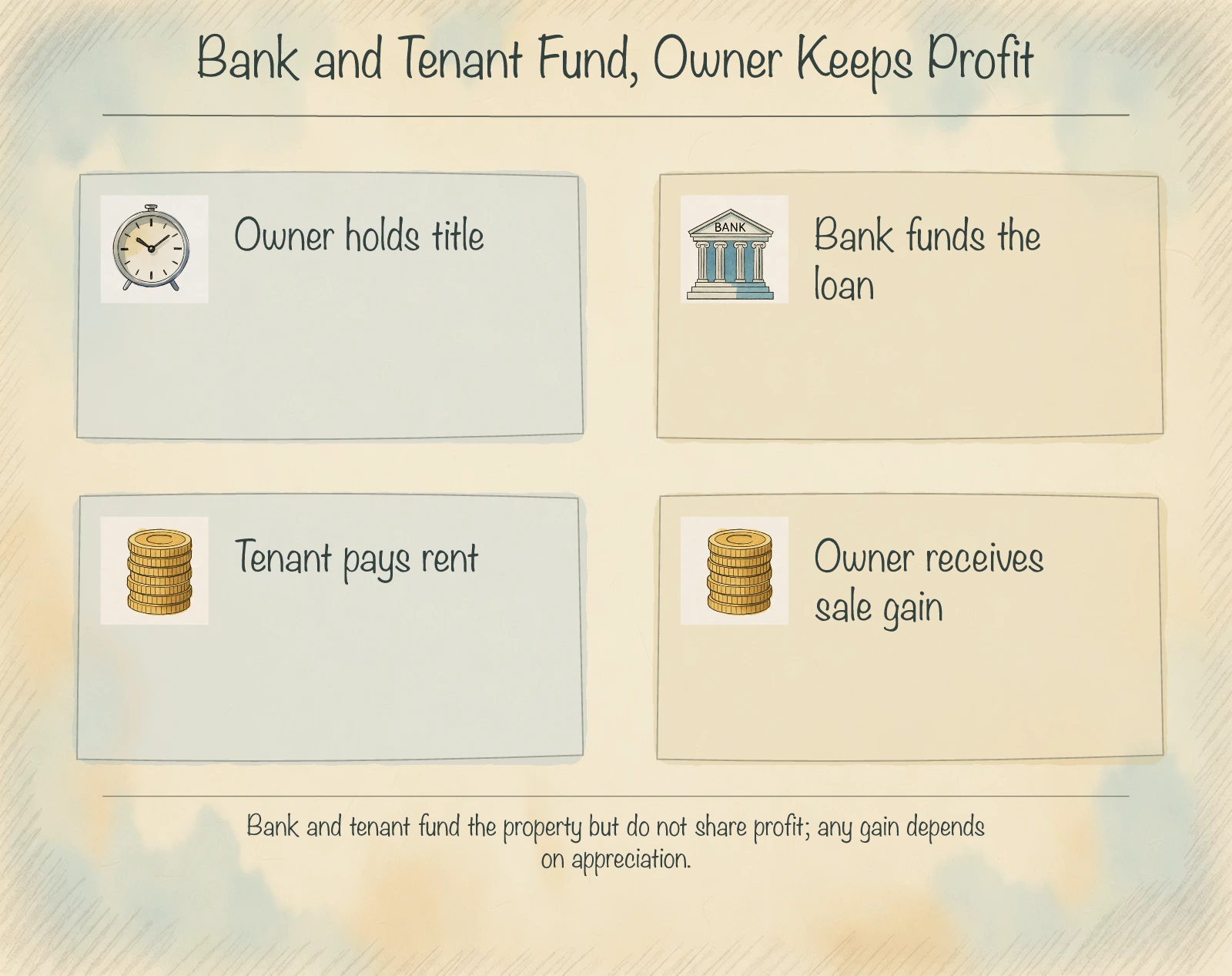
So for example, if you go for this asset at $2.35 million and then you exited at $2.75 million in four years' time, the gain, the paper gain is 400,000 profit.
This 400,000 belongs to the owner and it does not belong to the bank and the tenant, which is why real estate investment is so beautiful, because you firstly have core investors but the core investors have no right to your profit.
Why? It's because this is a very fair game.
So let's get this out of the picture first.
Owner Risks and Why Numbers Matter
Why is it a fair game? You as the owner, you inherit the risk.
You inherit the risk of managing the entire property. You are responsible for the property tax, the MCST, the maintenance of the property, and you need to get the property rented out to a second investor once every two years.
You need to find a new tenant, you need to tahan the vacancy period if you cannot get it rented out for one to two months, you need to pay agency fees when you rent out and when you sell the property.
All right, so it's a fair game but then the beauty is you only need to invest 25% plus buyer's stamp duty plus all the miscellaneous, all right, of maintaining the property.
The bank is pushing 75%, which is actually three times the amount that you put in, but then they have the rights to take back the property if you cannot pay the instalments for three months. So they are also covered in terms of risk and they earn interest off the money instalment.
The tenant gets to stay in the property so that's a win for the tenant.
The tenant gets to use the property in terms of utility value but the tenant has to pay rent, but the tenant doesn't need to maintain the property based on the tenancy agreement; maybe they need to have responsibility in the quarterly air-conditioning servicing and stuff like that and minor repairs.
But then by and large, most of the maintenance is done by the landlord. They pay the rent and then they enjoy the property.
So how does all this work out? And why is it a very powerful mechanism that allows families, at Daniel's, to leverage on these two approaches?
First, because once they have done these two approaches and the property appreciated, they then went into a combination convergence investment into one landed property. So after they go into one landed property, they enter into this landed property and once this property appreciated in terms of value, they then kept the landed property.
So they still hold on to the same landed. Of course, they want to switch the condominium and then they start to expand back into another investment property.
Why did they do that? It is because when they went to this approach, they actually divested their family asset first, and they held onto this investment property until it appreciates to 1.5 million, exited it, and then they went into this approach.
So there's various mechanisms depending on the appreciation speed of the asset that you're holding. It doesn't mean you have to divest both at the same time.
We plan it strategically so that it makes sense to really expand the portfolio on a bigger level.
The most important thing is that once they are here already, now this asset is already worth 1.7. This is worth about 4.8 million.
Total they have already achieved 6.5 at the age of 40 plus. All right, so by then maybe it could be 7.5, it could be 8.5 million dollars by the time they are 55 to 65.
I'm not sure, but at this point in time they already have achieved a portfolio size of this. Now, when they are at this portfolio size, naturally speaking, there is equity sitting inside their property.
All right, so for example, this could have an outstanding; I'm not sure about the actual number. Maybe the outstanding loan is about $2 million.
All right, maybe this one outstanding loan is about $1.2 million. Of course, you don't want to press a button and sell everything today.
They can extract 2.8 million from here. They can extract $500,000 from here.
And then of course they have $3.3 million cash and CPF. This is what we call the equity inside your equity triangle.
So this is still very early. There's no real need for them to press the button to sell everything because they still need a home to stay.
They're still working. They are still having earning power.
They are still so-called in the season that once this property TOPs, they can rent it out as well and they can still service the property based on their monthly salary and income. So there's no real need to press the button, but let's come back to this.
Now, once we look at this, then it's time to come to the mechanics because why? The moment we start to understand that there are core investors with us, if I deploy some of my funds into an investment asset, so for example, let's say now I have an HDB property, I already achieved my MOP.
And I'm thinking, should I go into investing into one property for my family stay, one property for my investment? That's the number that makes sense.
And sometimes we are not motivated to intentionally plan for this. It's because we can't see the numbers clearly.
And thus, I want to share with you the numbers on a deeper level. And once you have seen the numbers clearly, then you will realize that it makes sense to deploy effort intentionally to make this work.
So let's have a look at the numbers first and I will show you more case study. I come back to this.
So when I look at, let's say for example, just on a very simple approach,
$800,000 Property Example and Mortgage Breakdown
Sorry, let's come to this screen again. So let's say for example I have an $800,000 property.
This is a HDB that has hit its MOP already. And maybe my outstanding loan is only 200,000 and I can extract out 600K, plus I also have some level of savings.
So for example, well, I have another $500,000 or maybe $600,000 of savings. So in total, I have about $1.2 million.
And both me and my partner, we are both working. We are in the season of 30 over years old.
We are able to actually own a property that is $2.35 million. And maybe another property that is of a lower quantum.
Let's say this is like $1.8 million. All right.
Now, a simple calculation is to just use your calculator. And of course, there are many ways to do it.
It's just to use a divisible approach. So for example, let's say $2.35 million.
How much do I need? Basically, I just need to multiply by 30%.
It's about $700,000. So why is it 30%?
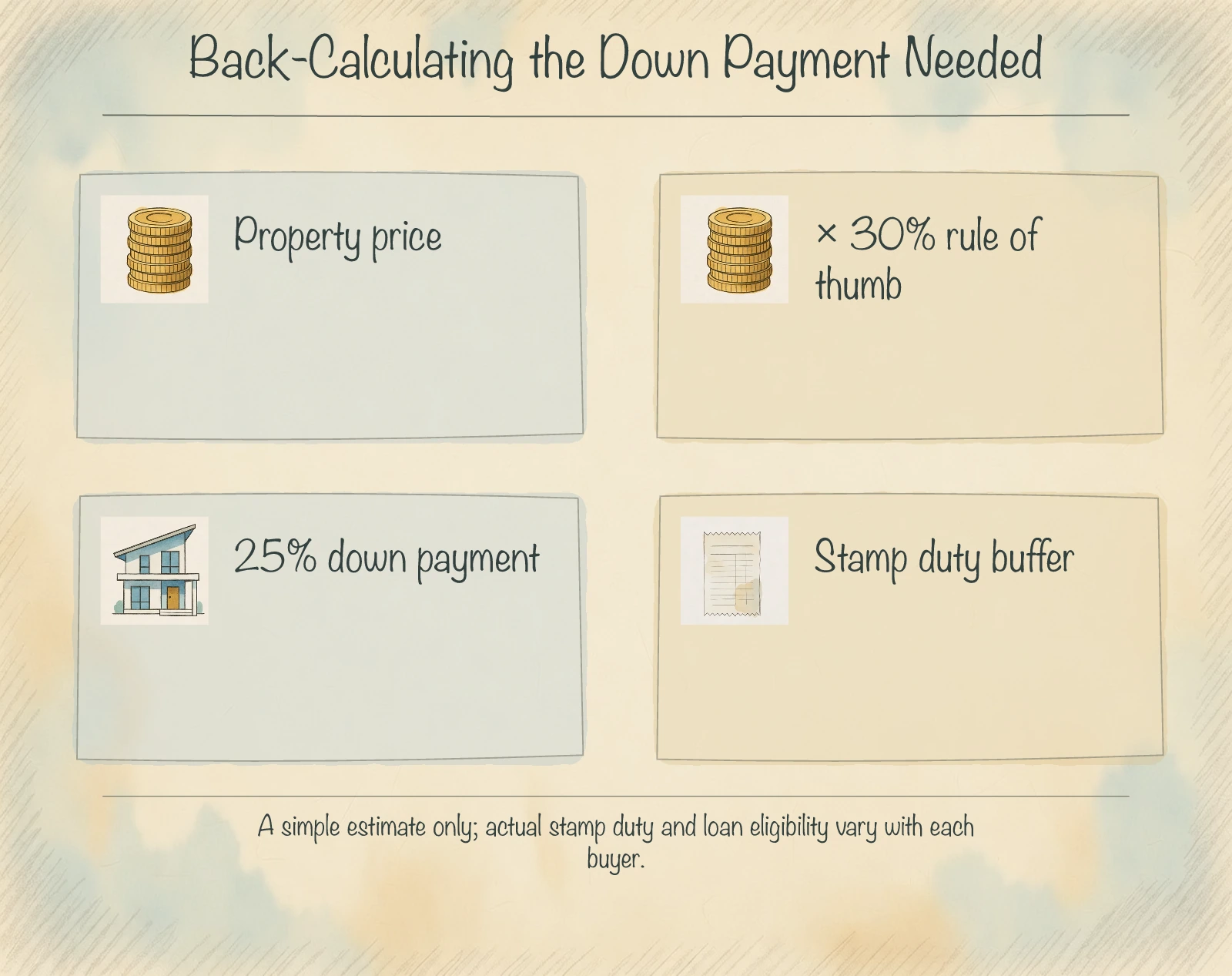
25% is your down payment, 5% cash, 20% CPF, and of course the BSD is 4% to 6%, but BSD is not so much. But then on a simple approach, usually we just take 30%.
If I want to buy a $1.8 million property, I times 30%, that will come up to about 540,000. So basically, once I have so-called really back calculated how much down payment in terms of initial investment that's needed.
All right, so this one I need about 500 over 1000. This one I need about 700,000.
All right, all in, there's about $1.2 million here. And then from that, I want to see if I can actually go into two properties.
Now, sometimes maybe I don't have my own savings. All right, then that's fine.
I can don't go for this property first. I can actually deploy into one property and stay first.
Provided I did a right investment. If it appreciates, then from that next point four years later, then I can split into two properties, family stay as well as investment.
So it depends on your current season in terms of your professional earning power, your TDSR, your capability to loan, and of course the set of down payment that you have.
Sometimes we need to go with an interim approach in order to deploy into two properties because we do not have enough capital to go into the down payment in the first place. Sometimes we can straight away go into another property, let's say $1.8 million, this is for stay.
Now personally, I prefer that my own stay property is of a lower quantum because I want to drive down my monthly costing. So that's basically depending on your needs.
Sometimes you'll find a good buy and let's say the quantum is about the same as my investment property, then I can go bigger on this, this one I can go lower. Or sometimes I really love the project because they are just near the kids and your family, schools and all that kind of stuff.
So it really depends what kind of calibration that you want.
But based on this approach, just looking at this, let's have a sense of the numbers on the deeper fashion. So let's come back to the screen here.
So let's say the investment property that I'm hunting for is $2.35 million and I can rent out for $6,200. I already look at the numbers.
It can be done at Park S star; there are listings at this price at this point in time. And I'm going to break down into numbers.
All right, so let's say it's $2.35 million. Now I can get a mortgage at about 1.5%.
For those of you who are refinancing, do not refinance first. All right, my personal advice is that interest rates might still come down because we still have two more rounds of rate cuts that might come in November and December.
I'm not sure whether they will 100% happen, but if it happens maybe we'll start to see a slightly lower interest rate. I'm not sure, maybe 1.2 over 3%, okay.
Now assuming you're 40 years old, all right, because maybe you went for the BTO route,
you got married at 30, now you waited for one plus four years and FI S MOP you're 40 years old and you are doing this exercise and you can loan 25 years. Of course you can stretch your loan after you pay your loan for one year, you can go for repricing, refinance and stretch it to 75.
That's another topic. But at the start, you can take 25 years based on your TDSR and your TDSR allows you a loan of 1.762.
So assuming you qualify for this, your monthly installment is $7,049 and this is a resale property. You are looking at these numbers over here.
Okay. So basically your monthly installment 7049 is broken down into principal and interest, which is principal 5875, 1174 to the bank.
Now take note when you look at this, this principal means that the amount is in your property until the day you sell it. All right, it's equity that is locked in your property.
It belongs to the owner. It belongs
Interest, Principal and Two Core Investors
to you. This interest belongs to the bank.
Okay, the bank takes this interest because the bank loans use 75% so everything is very fair. Okay, and take note this two calibration will change with interest rate movement.
So it's advisable if it's your own stay property, we try to go for fixed rate so that you don't need to worry about fluctuations on a month-to-month basis. But it really depends on the interest rate movement because sometimes interest rates are going down.
We want to go floating first so that we can pay lesser and lesser interest and take advantage of the interest rate movement. But if it's going up, then we want to lock in the rates.
So it really depends on the rate strategy. Based on this, my down payment is $587,500 because that's consuming 5% cash, 25% CPF.
So in total, that is 25%. So if I look deeper, basically I also have to take into account the total buyer's stamp duty, which is $87,000.
So my total deployment is actually $677,600. So basically, down payment
587 and then I just put in legal fee $3,000, the buyer's stamp duty is about $87,000 or in $90,100, total I need to deploy $677,600. So once we look at this, then I want to go on another secondary level.
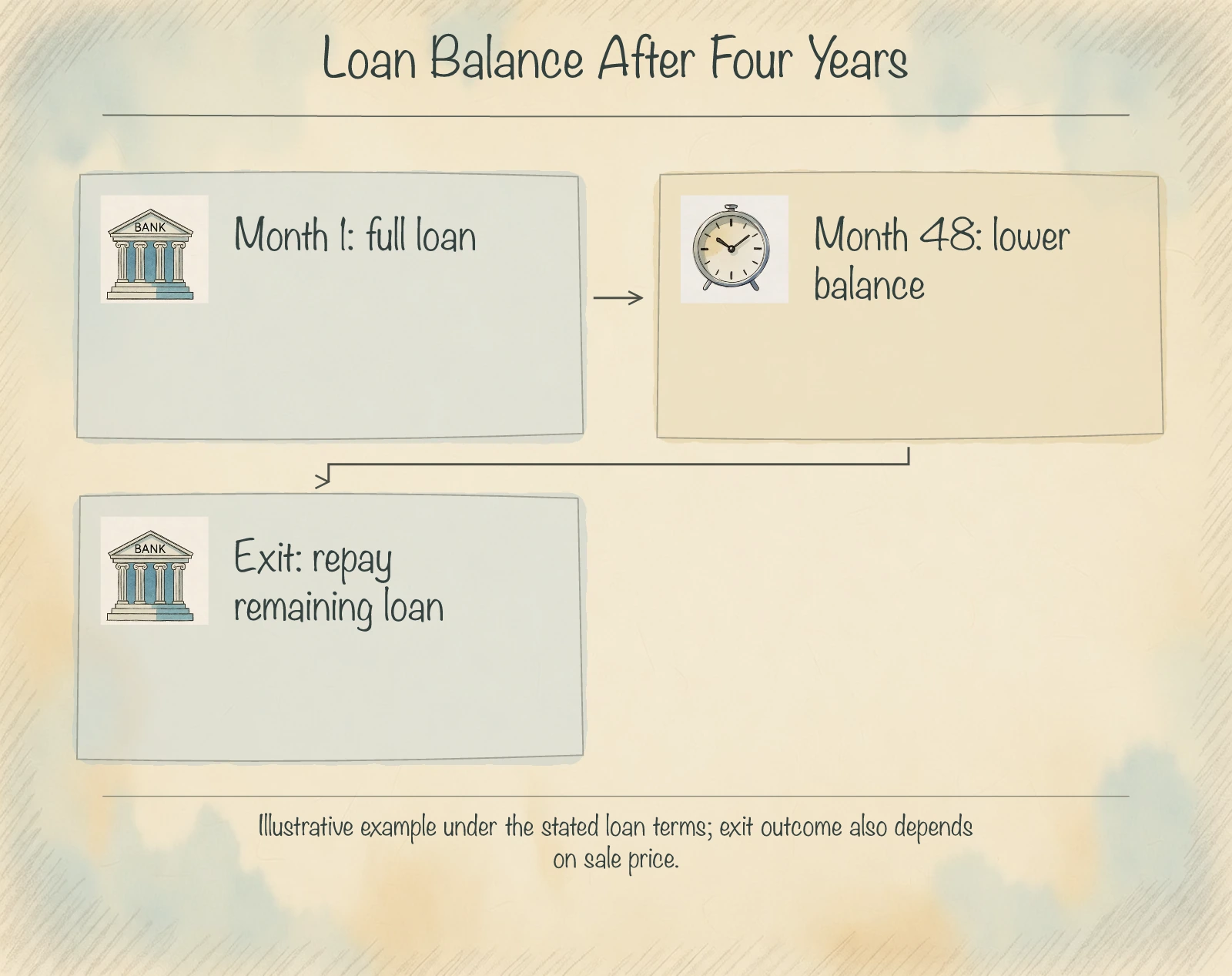
So what is that level over here is that I want to know, let's say you want to hold on to this investment property for 48 months, what is going to happen after 48 months to my outstanding loan if I want to exit from the property.
So basically at the first month, my outstanding loan is going to start of course from the full amount of 75% which is at $1.762 million but then at the end of 48 months, what's going to happen is that at month 48 if I decide to exit and divest from this property, my outstanding is going to drop to $1.522 million.
So the beauty is in the center over here because why? Remember the first approach that we talked about, the fact that you always have two
core investors in your property. So who are your core investors?
Let's have a look.