Evaluating property
How to Analyse, Enter, and Exit a New Launch Safely - More Worth Than Resale?
Published 2026-11-20. Adapted from the episode published 2025-10-01. Figures, illustrations and data reflect the episode’s original publication date.

On this page
- Launch Evening Goals and Six Key Features
- Pricing Disparity Framework and Where Market Stands
- Live Resale Asking Prices and Capital Flow
- Buyer's Future Lens, Developer Seasons, Pre-Catalyst
- Future Lentor Plan and Resale Decision
- Calculating Lease Reset: Resale Versus New Launch
- Resale Catching Up and Delaying Rentals
- TOP Sub-Sale Buyers and Market Cycles
- Sellers Market Returns and Portfolio Expansion Case
- Two Professionals' Portfolio and Closing Remarks
Launch Evening Goals and Six Key Features
All right, good evening everybody. I guess everybody is very excited about this launch.
And of course for tonight, I think the key objective we want to have is to share with everybody some of the key research that we have found and analyzed.
Of course, for all our PRB events, we have been very specific for the last three years whenever we have any webinars or seminars that whether is it talking about landed properties, condo investments is all very framework based and of course for tonight the key function of this event is to share a few frameworks pertaining to Spring Live in this particular launch that's going to happen very soon.
Alright so my segment will take probably about 40 minutes and later I'm going to invite our new launch investment director Rain to share more specifics about a project itself.
So we're just released this new launch market report couple of weeks back and some of the key insights are based on basically this report that is also available for download.
But the main thing that is happening for the rest of 2025 is that when we were analyzing in terms of the land deed prices as well as some of the launches that are going to be launched, I think where we are today tonight in this particular show gallery is that this launch is going to be something that I think has a pre-catalyst kind of opportunity.
So some of the news has happened very, very recently. I guess if you have been following the market, you probably have seen some of this news that has been happening in the last few months.
So for tonight, I'm going to share very specifically and put a lot more time on the six pricing frameworks. This is basically to avoid what we call an entry price trap.
And of course, within this framework, there's going to be a methodology that we will use. In fact, later on as you walk with our consultants one to one, they have two very important tools that is going to help you on the ballot day itself to select the specific stack as well as your exit pricing.
And within my sharing as well, there's going to be core methodologies that you can also adopt, right? So these are the three things that we'll be talking about and of course in terms of the six steps.
Before that, I'm going to share with you whether you are John, like planning to maybe analyze into a new launch and then to invest in a new launch and let's say your plan is that after four years you want to exit.
Or whether you are Shaman that you intend to let's say like invest once you TOP collect your keys you maybe want to stay for about two to three years. And then you want to sell and maybe this could be your first pivot home and you want to buy bigger.
Or you could be Kevin and Felicia that is planning to have a new property for own stay. Because you prefer to go for a new project and then maybe this could also be like a pivot home before you upgrade to like a landed property in future.
So I'm going to share with you this six frameworks and this six frameworks pertain in terms from macro all the way to micro decision and of course the final step which is the most important step is really about a stack and site plan exit simulation.
So later as you walk with our consultants as well they will also be able to help you to do these six main things to calculate your entry exit quantum simulation, your progressive payment, big room type simulation as well as an investment capital simulation.
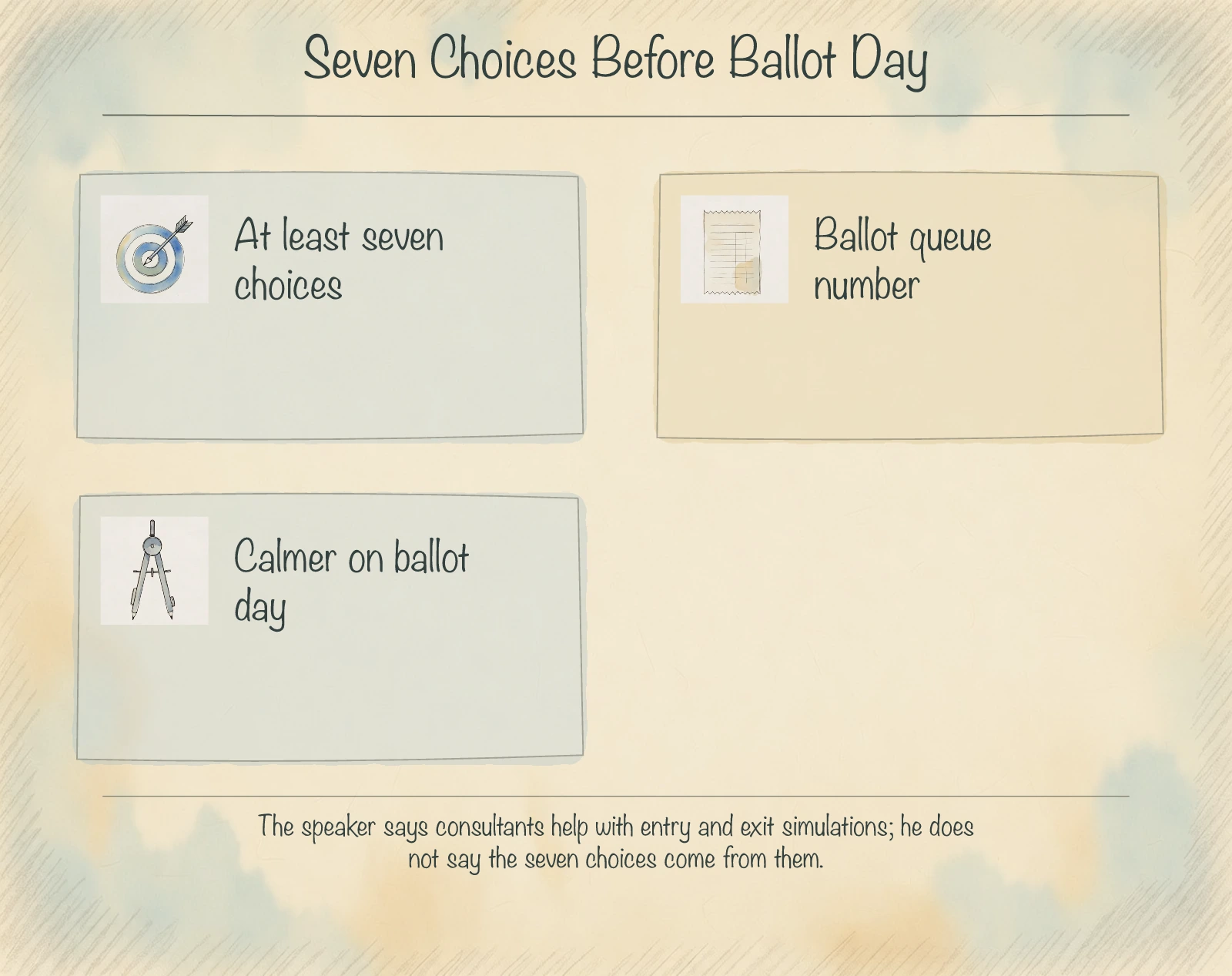
So importantly is that they are very experienced on the balloting day because sometimes on balloting day it could be a little bit emotional so importantly you need to have at least seven choices in your pocket so that depending on your ballot queue number you will not feel emotional on that day.
Alright quick disclaimer: a lot of the things that I'm going to share, it comes from our in-house research team as well as my experience over the last 18 years.
And of course over the years, in the last 18 years, I myself have done a lot of home tours as well as podcast and video analysis. This was some of the events that we have done over the years and of course we love to have these kind of community, seminar events because we get to interact with you.
You can also ask our consultants any questions later on. We have also done a show flat gallery tour in case any of your family members are not here tonight.
So, later on, after this tour and after Rain's segment, please look for our KW or PRB consultants and they'll be able to help you with these six key features.
Pricing Disparity Framework and Where Market Stands
They also have on hand a D26 and Springleaf Residence market report, and this report is very detailed. It contains very important information like the barber charts for you to analyse the quantum entry pricing.
And with them they also have this two very important tools. This first two is what we call the pricing disparity.
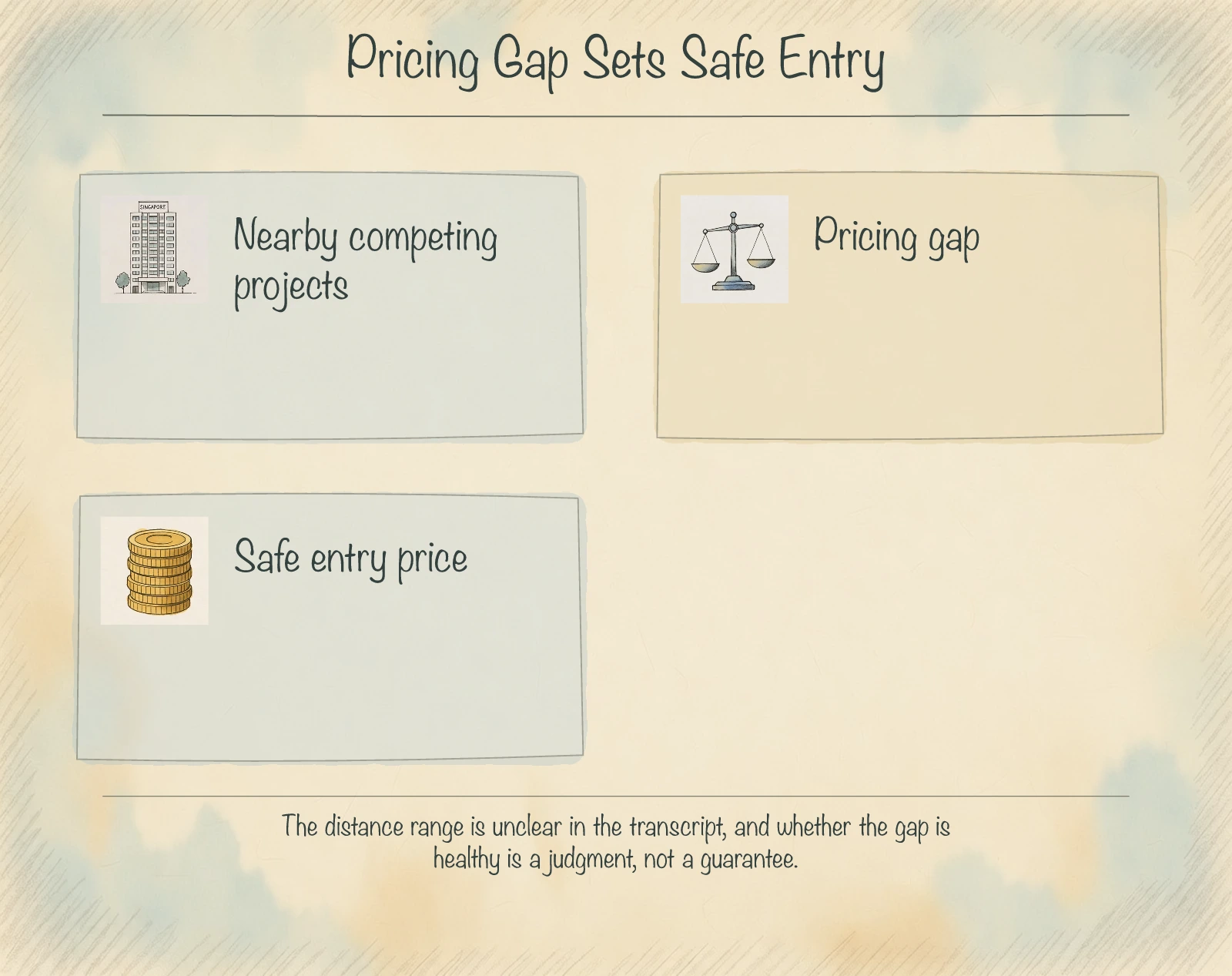
With this pricing disparity, they are analysing your competition around this zone in the range of 500 metres to a kilometre. Basically we are looking for the gap to determine your safe entry price.
Number two is that this is very effective on the launch day because on the launch day, as we key in the live pricing when the developers are releasing different stack kind of indicative pricing, they will be able to advise you which are some of the key resistant pricing and which are some of the very healthy entry and exit pricing.
They will also be able to help you to simulate in terms of the potential gain that might happen, and we try to determine if the gap is healthy or not.
Alright, so let me touch on the first framework, which is the macro season framework. So where are we right now?
Because we already have 16 rounds of cooling measures. Just two weeks back, we were just hit with the latest round of Seller's Stamp Duty.
So it was four years then, went to three years then, went back to four years again, right? But I think importantly, it seems like there's not much impact on the ground.
I just did a talk at IRAS about a couple of days back with the tax division, and of course they were also asking me, Melvin, what is the impact on the ground. I told them there's no impact because traditionally a lot of our launches, it all takes three and a half to four years to complete.
So this of course have very limited impact, including analysts were talking about it, but the most important thing is that Singapore cooling measures over the last 16 rounds since Lehman Brothers, I think it has done a great job in stabilizing the market.
It has allowed less speculative in terms of foreign investment liquidity, but the important thing is to note in the last five years post-COVID, it seems that the rounds of cooling measures cannot be released, so once it's released I think the floodgate will open even further.
But importantly is to note that we're in a very healthy and gradual growth market, and when we look at the key purpose of investment right now, we are off that methodology, is that if you have at least four and a half to five million dollars, of course you can look at landed properties.
But if your range is below four, in terms of a healthy range, you need to identify condos with very high appreciation characteristics.
So let us visit what is the purpose of property investment. Now, 18 years back when I started in real estate, all my investors are always looking for rental yield.
That means whatever that we help them to invest, we want to see rental less of mortgage, less of MCST, we want to see cash flow. But nowadays, because we are one of the most, I would say, popular cities in the world, in fact we are always ranking top 10 in terms of our real estate pricing.
And sometimes, as Singaporeans, we are thinking, ah, is Singapore a little bit too expensive or not? Are we in a bubble?
Or what is the state of the economy right now? And later, I'm going to share with you some key statistics based on our research team on the macro market.
But importantly, the key strategy that I think will be very wise for everybody to adopt is to hunt for these two things in any real estate investment that you touch, which is: it must have the potential to appreciate, but importantly it must have an ease of exit, because if you cannot exit, basically your capital is trapped in an asset.
And a lot of times over the years I've seen investors coming to us is like, Melvin, I've been trying to sell my property for two years, three years, can you and your team help us to really exit, because they really want to free up their liquidity.
So these are two very important points, and in terms of frameworks, we have 11 frameworks and 12 investment methodologies, and later as we head on I'm going to share a little bit more frameworks. But this is the first chart for tonight.
So the very first thing is that the new launch PSF on average for the whole island is at about 2425 PSF. Resale market right now is about 2007 plus.
This is basically based on the whole island approach, and of course importantly Guoco has already indicated in terms of its Springleaf launch indication, PSF is going to be around this range.
And of course when this is in the middle of resale as well as the average new launch in the whole Singapore, I think definitely this could be something that is very interesting to look at.
Live Resale Asking Prices and Capital Flow
Look at, but sometimes when we see that resale is at about thousand seven PSF, but transacted data might not be a true reflection on the ground. True reflection is always in the cellless kind of like expectation based on live pricing.
So let's have a look. I just called this up yesterday and of course this is somewhere right near us.
Panorama, very beautiful development. If you look at that 3-bedder, somebody is already asking, just listed second August.
They are already asking $2.32 million, balance 87 years, and of course this land tenure starts from 2013. Take note, we always look at the land tenure start date.
We don't look at the completion date because you are buying the land tenure, which is very important. So this is already 12 years old, balance 87 years.
PSF is 2176, 2.32 for 3-bed 2-bath, and of course the 2-bed 2-bath is at 1.7, 2133 PSF. So of course, home sellers will definitely want to sell at a specific price because every resale seller also asking what's next, and they want to be able to cash out a certain range so that they can reinvest.
This is in the north, off, of course, integrated development. Not low as well, now is already 2000 plus PSF.
This is in D19, already 2002, 2003. This is of course Woodleigh, RCR, 2425 already for resale, and then part place.
And of course, this I think is something that we need to take note of because this is happening in the next two months. So now, sorry, it's just next one month.
So this is happening in Sep. And what I mean about happening in Sep is that there's going to be a liquidity round that will highly be very possible because in September we are facing two Fed meetings and this is the latest projection from Phillips Capital.
So basically if this will happen because Donald Trump is giving a lot of pressure to the Feds and of course if they a so-called cave into the pressure to drop rates by two rounds, then of course low interest rates coincide with quantitative easing.
And whenever this happens, when you look at the work QE, investors tend to seek safe haven, which is basically to cash out from the equity market. There are Mac 7 tech stocks, and they want to park into something that is stable.
So this basically will be the forecast that has happened in a lot of research reports by analysts and they are projecting that basically by January 2027 the red cards will be even further.
So we might be looking at two rounds by the end of this year and if that were to happen and profit-taking happens then very likely a lot of people will start to really put their funds back into real estate.
So where we are right now in Singapore I think it's very important to understand because we thought that the last 11 rounds of interest rate increase will have an impact on our real estate market. But the strange thing is that when rates are being cut, our price sort of moved up.
When rates are being increased, our price still moved up. So it's like what is happening to the Singapore market.
And I think one of the reasons is because Singapore is really small, our population is very stable. There's a lot of global liquidity still flowing in.
The latest report also shows that the average holding period of Singaporeans is very strong. So whenever they buy a real estate, they tend to hold for at least six to nine years without the stress of having to sell it.
There's also been an increase of first-time buyers directly entering into new developments. This is demarcated by the light orange colour in terms of first-time purchases, and this has happened ever since COVID.
So this is sort of like a demographic change on the ground. We have also been seeing an increase in young people.
So 26 to 35 years old basically are going straight into new home sales. So basically 26 to 35 years old demarcated by this blue, a dark blue bar, they have been going directly to new launch properties as well.
I think it could be dropping kind of like a marriage rate, a delayed marriage as well as like the new kind of like mindset about going straight into investment, one they start to do well in their career.
Now this also has been a catalyst because the ownership in terms of private properties demarcated by this pink color graph over here. Over the last 10 years it has creeped up a fair bit.
I think this was after the realisation that if our profit and capital is continuously parked maybe in our HDB apartments one day in terms of its strength of growth it will be affected so a lot more people are trying to really park their capital into the private property market.
Okay this also sometimes will be a worry because sometimes we think a foreigners cannot come in to buy Singapore real estate because of ABSD, does it affect our pricing? But based on basically our tracking ever since 2018,
Buyer's Future Lens, Developer Seasons, Pre-Catalyst
All the way to last year, foreigners, even though their transaction count went from 5.4% all the way to 1.22% last year in terms of their contribution to residential properties, but it has sort of no impact on our local market.
This just shows that really the entire market is sort of like dominated by Singaporeans and PRs over the last couple of years.
Something to note also is that sometimes we might think that Singapore seems like I drive everywhere there's a lot of properties, but actually we have 1.2 million HDB apartments, we have 73,000 landed properties and we only have 378,000 condos and apartments, but out of 378 condos and apartments, 88,000 are not owned by Singaporeans.
So there's only 280,000 units that are being owned by Singaporeans. So when we look at this, there's two key impact.
Number one, the overall quantity actually is not high because every year there's just an increment of about 10,000 units into the market through GLS. Secondly is that foreigners and companies that own condos and apartments they will never sell
because if they sell they cannot buy back. They will be taxed at the new 60% that EBSD.
So this creates like what we call a sustainable stability in the market. Alright.
Okay. Last part about the macro news is that this was by Henley, a partner's last year.
We ranked because of these nine key reasons, third last year in terms of high net worth millionaires inflow. And behind the scenes, actually since 2010 until today, in the last 15 years, every year we have about 22,000 naturalized citizens granted and we have about 32,000 PRs that are granted annually.
Naturally speaking, a lot of our clients once they get citizenship or PR, they will start to look for properties. We serve a lot of our clients in this category as well.
So sometimes in Singapore, we as Singaporeans we fear the market pricing but globally a lot of people are just waiting to quickly enter into the market. So I think the next portion that we want to look at is that what will your
future buyers think when they look at the property that you have invested? Because take note, the moment you invest in a property, four years later or six years later if you want to exit, it's extremely important to understand this key aspect.
So we want to move into the developer season framework. Let's have a quick look.
So based on our research that has happened, what we notice is that this likely could be one of the last launch that we'll be seeing at a sub 2250 PSF range.
That means in a range that is below 2300 PSF, we might not be able to see this starting from about next year or maybe in Q4 of 2025, because in terms of land bid pricing, not many developers have the opportunity to bid for a land at a very attractive entry bid price.
And I think in terms of Guoco, their key strategy is really to create a win-win situation for of course themselves to build a specific attractive development, but really
passing on value to the investors and consumers they are looking at their projects. If we look at the latest land bid pricing, a lot of developers will likely have to start launching at about 26, 27, 28 even for OCR.
And of course, heading on to the next few years, this project might be one of the last season of 2000 to 2250 PSF. All right, we also might be entering into a new season next year with 25 to 3000.
And we track this also based on the market behavior, pertaining to what is happening on three levels. Number one, when we look at the blue colour graph, this blue colour bar indicates the amount of projects that developers has to hand over at TOP.
So the last two years, 2023 and 2024, developers has been handing over a lot of projects because it has completed. And of course the last two years, this has given the developers liquidity to bid for more land.
And these two years, I believe they are very focused to launch their projects that
they have bidded. I mean in terms of spending time with the architect, pricing as well as developing the assets.
And I think this two years is also coincide with the rate cuts that's happening. But the key thing is that these two years based on our analysis, the resale pricing has already caught up in PSF and quantum.
And that has created a disparity because a lot of buyers when they go into the resale market or when they look at PropertyGuru.
They are thinking should I pay for three-bedder resale 10, 15 years old at about 2 million or 2.3 but it seems like the launch price, I can still get something at about $1.8 or $1.9 million dollars or maybe sub $2 million dollars.
So a lot of buyers are a little bit confused. Should I go for that quantum in the resale market or should I take the opportunity for a new launch product?
Alright, and step number three, we call this a pre-catalyst opportunity. Of course when you look at this whole entire
Future Lentor Plan and Resale Decision
plot, this is where Springley is being located. There's three forested area over here and of course when we look at them, this will be the future three residential plot which will then combine together with Lentor.
So when you look at this, of course we demarket this from the URA master plan but I think this grand plan that URA have is definitely very exciting.
Later Rain is going to share a little bit more about this whole concept over here but when you get a chance to be the first compared to maybe another part of Singapore where you are not the first, I think this is what we call the pre-catalyst opportunity.
So always try to hunt for pre-catalyst opportunity because when I started in real estate in 2006 and 2007, this particular project has a very deep impact on my learning point. When the sale at Marina Bay was being launched back then, it was the first residential to launch in CBD and everybody was very skeptical.
In fact Tower 1 and 2 were launched at different pricing. Tower 1 I remember it was about 900 over dollars per square foot.
Then Tower 2 was like thousand two plus per square foot but it was launched before the announcement of the casino, before MBS happened and pre-catalysts always have a benefit. After whatever news is going to happen in the region.
Some of the consumers of the ground has also been asking us about this comparison. It's like what about Canberra that's launching just up north?
How do we view this? Now of course Canberra is also another fantastic launch.
We're not saying that it's no good but I think there's one key fundamental difference is that the actual site is not as close to the station compared to Springleaf but there's one very important thing is that do you want to be the first among the future 14 condos or do you want to be the most expensive benchmark against the 14 condos that's already existed.
So one
important thing to analyze always is that if you love Canberra for own state by all means please go ahead because sometimes we grow up in certain areas that we just like.
But from an investment methodology point of view, when we look at the existing kind of condominium right there, there's about 14 projects that's already been built in Canberra. So we want to be the first, of course, in Spring Live rather than to be the last where everybody has been already built.
So take note, of course, the moment you enter into an enclave with existing 13-14 projects, when it's launched and when you TOP, you will be the highest PSF. But over here, the future launches is going to happen across in the three residential plots that URI has demarcated.
So very likely there's going to be condominiums, there's going to be HGB apartments as well, or lightly prime or plus kind of categorization from HGB, but then this is the first time to be the pre-catalyst.
Now later as we speak of our consultants, we have also demarcated all the resale competition around here in terms of quantum for each bedroom type.
So let's say if you're very keen in the conserved one beta in Springleaf, we have already compared the quantum and the quantum is very competitive because it's on par and of course some of the resale quantum is much higher than what's happening in Springleaf.
Now take note there are a few freehold developments around this enclave but we have analyzed that there are largely boutique projects which is less than 100 units. So later our consultants will also touch on this as well.
We call this the volume effect. Alright, now two betas over here.
So spring leaf will be the light pink color one and of course we have planted all the resale quantum based on live asking prices from PropertyGuru. Three betas as well.
It's pretty on par or it is lower than some of the resale counterparts. This is four betas as well.
So it's very competitive. Now you
will notice that there are a couple of freehold projects for example, metal set piers. The quantum is pretty high but of course it's not near to the MRT station so you really have to depend on what you're looking for.
Of course this will be the 5 beta alright in comparison to the next two competition. Alright so far so good?
Okay let me move on. Okay this is I think the very interesting thing which we name it as the least reset framework.
So least reset let me just put in one chart in terms of comparison for you. So it's very easy to help you make a decision.
So sometimes we will be a bit confused. Should I go for a resale property nearby because maybe I'm in the midst of selling my home or I have sold my home or this might be my second property that maybe I have a resale that I'm staying in.
I want to invest in a new launch but sometimes I'm in a
Calculating Lease Reset: Resale Versus New Launch
Now, in a situation whereby I need to rent, or sometimes I'm in a situation where I'm forecasting — should I straightaway get a resale and rent out now, or stay versus waiting for three and a half to four years?
One very good exercise we can do as investors is to calculate the lease reset. So what is the lease reset framework?
Basically, firstly, we take the target resale property and we try to find out what is the 10-0 start date. For example, Seasons Park, which is near to Yostrakhan MRT station — start date 10-0 is 1995.
All right, okay, sorry, there's a typo, let's take it as 1996. All right, so 1996, we take the current year less off 1996.
Basically, we try to find the balance lease. So balance lease is currently 70 years.
Now, whatever target property that you're hunting for — for example, let's say you're deciding between this very big 2-bed, 2-bath, 1,044 square feet, 1.33 million, PSF looks really attractive, 1,002 — plonk in that number in terms of quantum,
and then reset it back to 99 years. All right, because take note, this is as if like you are buying a second-hand car compared to a brand new car.
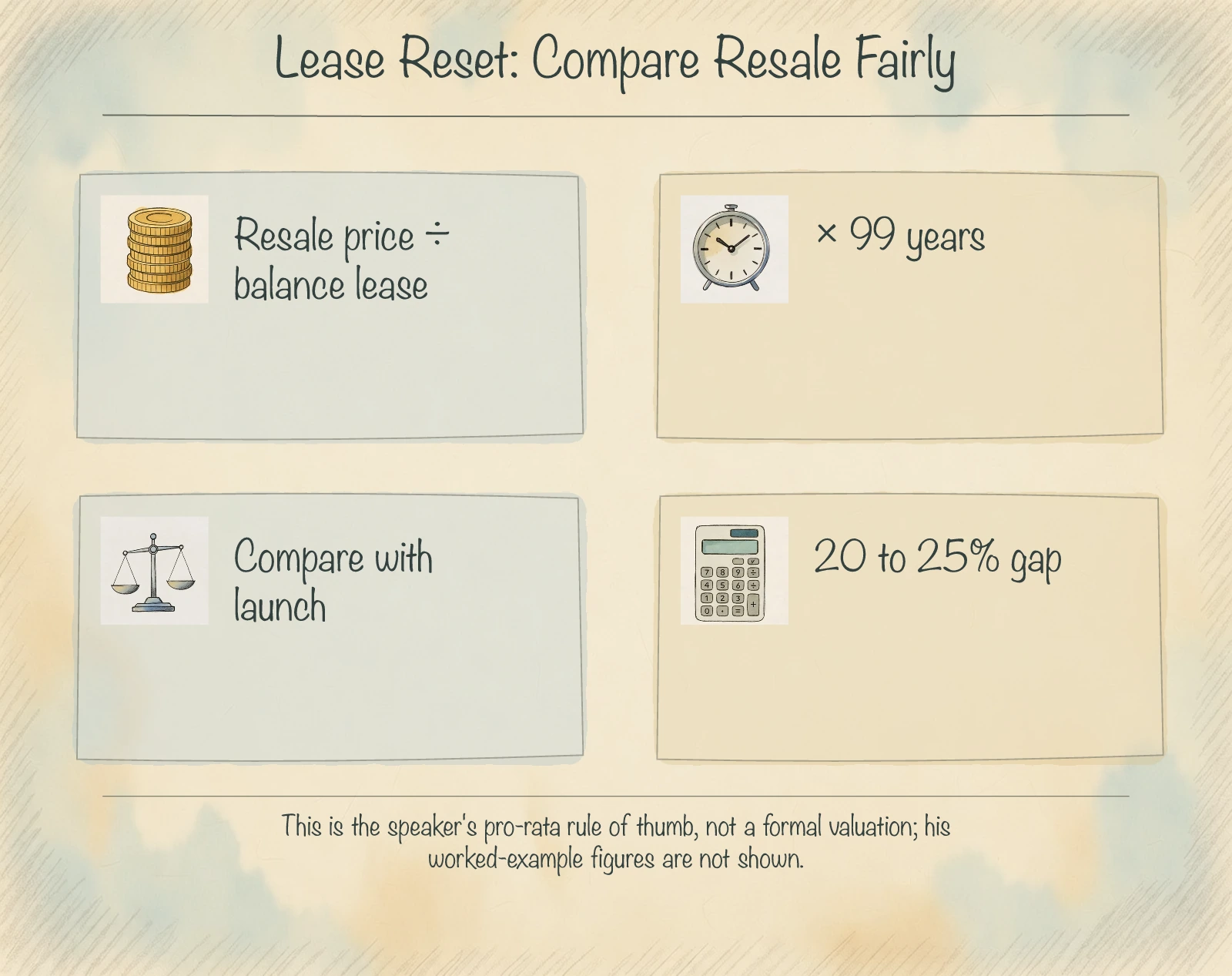
The reason the quantum and PSF is like this is because there's a balance lease of 70 years. So we divide by 70, multiply back by 99, we get the full price based on 99 years.
So on the surface you're buying 1.33 but actually if you reset back to 99 it is 1.88. On the surface you're buying 1,273 PSF but actually you're paying 1,008 if it were to be 99 years.
And also take note of the second mechanism: that four years later, if you want to sell, what will the buyer think about your property, because four years later it is going to be 66 years old.
So take note of the Balas Curve — 60 years and below, CPF valuation limit affected; 30 years and below, cannot take low Canary Wholesale CPF. All right, so of course then we take that target property, Seasons Park.
If you put
it through harmonization, PSF is slightly even higher, and then you compare to the launch that you're thinking about. All right, so for example, if you're thinking about SpringLeaf, if you manage to get something of a high floor at 2250, then is this quantum comparable to whatever that you're going for?
And if you start to feel a bit uncomfortable about this, then you should skew towards the newer one. The reason is because after we compared both, after you do a reset, you must have at least a 20 to 25% disparity gap.
If not, it's not worth sacrificing close to about 30 years of your shelf life. All right, so you must find the gaps.
Try not to overpay for a resale property. All right, now second question is that maybe we're thinking, but Seasons Park is quite big.
All right, and of course now all the new launches are very harmonized. Okay, take note, harmonized means that you don't have to pay for AC ledge anymore.
No more bay windows, no more
planter, getting really, really quite solid footprint. I will compare this to like a big van compared to an EV car.
All right, because in the past most of our projects were paying for AC ledges, paying for bay windows, we are paying for extremely huge balcony but you cannot really use it. Okay, now second comparison I use Novo.
I also calibrated the floor plan over here so you can see a lot of bay windows throughout, even in the bathroom as well. AC ledges, planter — so Novo, nice development.
It was an EC opposite Yutruchakaw MRT station. There's this 3-bed 3-bath launch recently end of July, it's still in the market.
So basically $2 million thousand for PSF. After doing a reset based on its start date 2001.
And of course when you compare these two, this is $2 million, 75 years balance lease. SpringLeaf, I take the 3 plus flex plus HS, basically the home shelter — this is one of my favorite layouts.
And I think the flex kind
of floor plan is really fantastic because you have this extra study room. This is brand new and the quantum starts at 2.15.
So when you compare this, I haven't even done lease reset yet. And after I do lease resets, I think it's even more comparable, because if I were to reset this Novo unit back to its full 99 years, I'm actually looking at $2.64 million if this is brand new.
And PSF is about 1,008. Four years later, SpringLeaf, I still have 94 years balance lease, but Novo I have 71 years balance lease.
So when I look at these two components — the third component is that a buyer will want to buy $2 million and I try to visualize what my future buyer will think about my Novo unit and SpringLeaf unit.
Basically a buyer will sell for at least a 300k quantum gain. That means that in future a buyer will put my Novo unit in the market, I have to launch at least $2.3 million and balance the $71 million.
Resale Catching Up and Delaying Rentals
But of course, if I have a brand new TOP product, I can sell at $2.45 million. If I get it at 2.15, I still have 94 years lease.
All right? So I think the retail market is really creeping up very close to some of the new launch content in PSF, especially for Spring Live.
Let's have a look at some more examples. This is Mintern in D19.
In case you are coming from D19, you are a little bit confused. You are looking at some of the very big projects, right?
That is a beautiful project as well. I love this project.
It is done very well and of course a lot of the good projects unfortunately they're getting a little bit itchy. All right so the lease start from 07 and of course it took them six years to complete because this was an on-block HUDC.
Okay so 07 basically a 3-beta now is about 2.05 for 1346 and after I reset it basically is about $2.5 million.
And if I try to compare basically with maybe one of the unit over here at Spring Lift, I think in terms of quantum, this is pretty attractive for a brand new product. All right, so always take note, use the least reset kind of mindset to check whatever quantum you're entering in.
Further examples would be Florence as well, just TOP last year. So when I reset it back.
Full price basically for this unit is a 3-bit 2-Buff at 1.85. It's actually at about $2 million.
PSF not very low as well. All right and of course after we reset it, it's very comparable to a brand new asset over here.
Okay now our consultants have all the least reset across different projects comparison And of course, I think the important thing is that whatever we see that you're contemplating try to visualize After four years, how are the bias going to think about your assets if you intend to sell?
Okay? Let's move on to the buying power research Okay, buying power is important Buying power is to think about and visualize in future
who are the people that is going to absorb my investment if I want to sell? If I want to sell in four years, eight years or ten years, there's two types of buying power.
First type is the region buying power. Of course when we look at all the launches in this area, Lentor has been absorbed pretty, pretty healthily.
The PSF has also been transacted at a very, very healthy range to set a news kind of good benchmark over here.
The number of balance units I think it's pretty good news for Spring Lift because we know that there's not a lot of competition left over there and of course in terms of the future BTO Upgraders as well, I think the entire North region has quite a fabul of MOP units that are coming up.
So in totality over the next phase, in the next five to eight years, 23,000 future BTOs are going to complete but I think for North area is a little bit exciting because North area attracts people from North
East, from the Thompson region and also from the North region. So this part I think is a very unique portion to the Springleaf project but importantly I think for this site over here we have another set of demand which are the existing private property owners that has really lived here for the last 10, 15, 20 years.
Some of them are owning landed properties, they are owning condos. There are kids and future generations but want to buy near them.
So the private property ownership cluster is pretty strong in this tree and clave over here. So basically Spring Lift, you have the Lentor region, teachers at state, you also have the Thompson and Upper Thompson region.
So we call this the recency effect. Basically when you grow up in that era, you tend to want to buy back the same era, maybe near to your parents or something like that.
All right, so let's talk about the future buying power. Okay, future buying power, of course, I'll leave this to Rain to talk about the interconnecting township, but I think importantly, when we go into a new project, a lot of people don't realize that actually the asset class attracts one more group of buying audience.
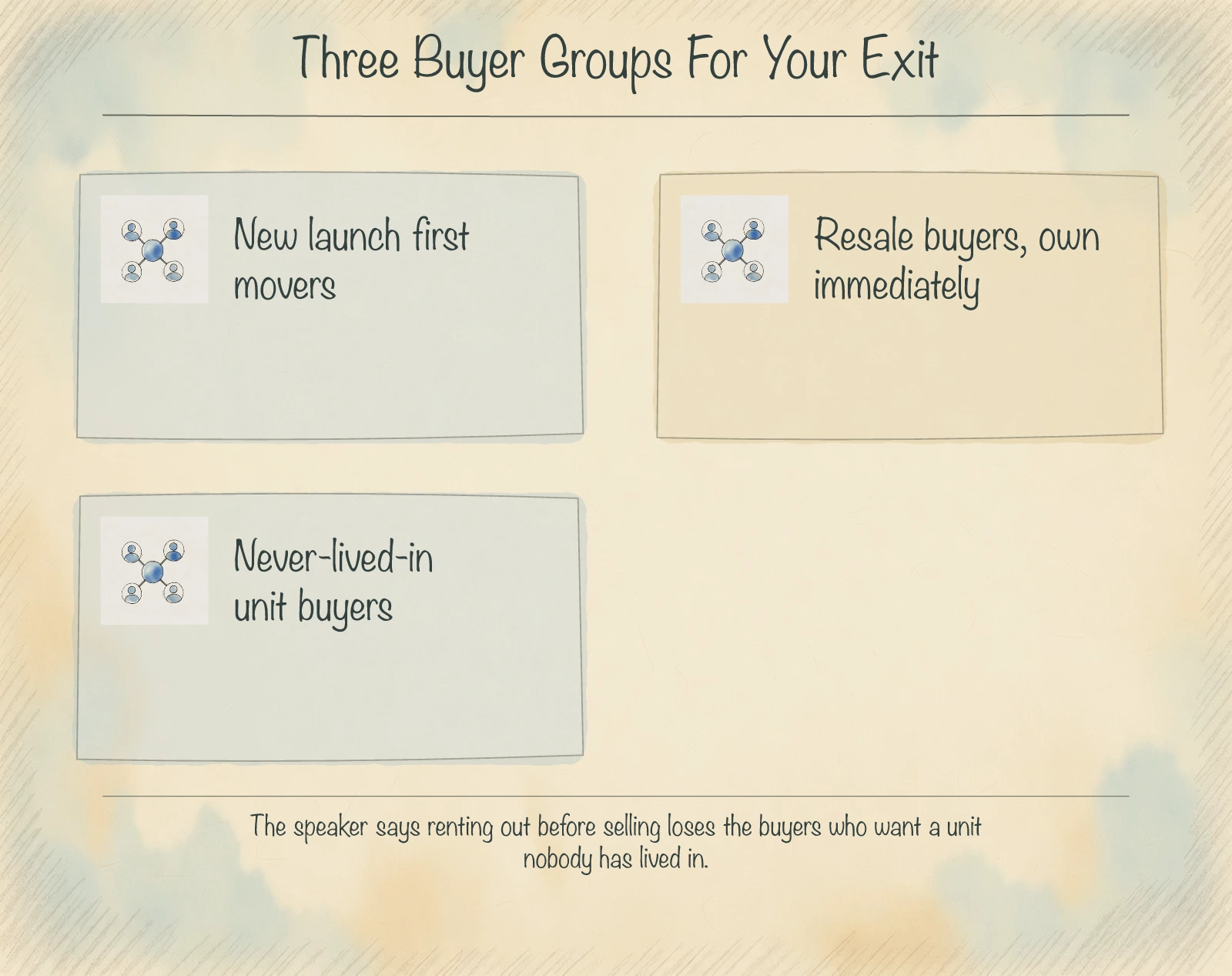
So there's three types of buying audience. One is buyers and investors who love to have the first mover into a new launch development.
Second is people who are hunting for retail properties because they don't want to rent, they want to immediately own. But there's a class of buyers that is in the middle.
So they only want to get a brand new that nobody has lived before. So which is why sometimes when you have a property that you're waited for four years you collected your keys and you want to sell.
But if you go and rent out, you will lose this group of buyers. So if you intend to sell, you need to delay your rental.
Once you start to rent out and sell with Tennessee, you lose out to the units that are vacant.
TOP Sub-Sale Buyers and Market Cycles
Because these group of buyers, they always don't want a unit that people stayed before. And we call them the TOP sub-sale buyers.
But at the same time, they don't want to wait. So these are the group of buyers that in line and waiting for projects that are going to TOP.
And I think it coincides also with whatever seller's stamp duty that has been in place. I don't think there's an impact because we call this a blackout period.
And just nice, of course, once the construction is completed, your SSD is also fulfilled. So it doesn't really impact private property investors.
And importantly, this is basically what is happening for Spring Leaf. And by the time it TOPs, you still have 94 years and you're good to go.
Alright, so this is the Balas Curve to take note if you're hunting for a resale project because most of the time when we look at this.
Sometimes we buy into a project that has a balance lease of 80 over years and maybe we want to live in for five years but by the time we sell, it starts to get a little bit age.
And then your buyers will start to question and sometimes it's feel very frustrated when I have to answer about the balance lease. For example, this project as well, it took them 10 years to complete so importantly look at the Tenno start date as also.
So imagine buying at 83 years and then when you stay for five years, the balance is 78.
Okay, now later as you check in with our consultants, they are going to share with you this very interesting disparity effect sheet that we have that we compared with the resale around this region. They are going to talk about the volume and density, which is a very important aspect for investment.
We're going to lease reset all the quantum of some of the properties in terms of their asking prices back to a full 99s quantum. Of course some of the freehold properties you will see here they belong to the smaller one except metals at Pierce.
Because metals at Pierce doesn't have the MRRT effect and once we reset the PSF level we can also see very clear disparity and the remaining lease if you were to go for the resale property. So this chart is going to help you make decision if you're comparing resale versus Spring Leaf.
Okay. Now let me move on to this portion over here.
Now importantly I think we all don't want to be stuck with a property that is having a potential of low growth or going to be stagnated. We call this the stagnation effect because stagnation will mean that it really delays your investment kind of in and out strategy.
Your boring power will start to deep as well as your age. So importantly I think pre-catalyst opportunities is very important.
So we have also found out, based on our research team, is that the remaining stock basically around this region, especially when compared to Lentor, this is big for 1 beta. So the remaining stock in terms of their asking quantum is quite a huge contrast to the 1 beta over here.
Remaining stock for 2 beta also a pretty huge contrast to some on the Spring Leaf, two-bait one-buff and two-bait two-buff. Three-baiters wise, when you compare that, quite a stark difference as well.
Then four-baiters, as well as five-baiters. All right?
Okay, stagnation, importantly, will link to your volume. So you will see a lot of our consultants highlighting that Spring Leaf, 900 over units, extremely exciting.
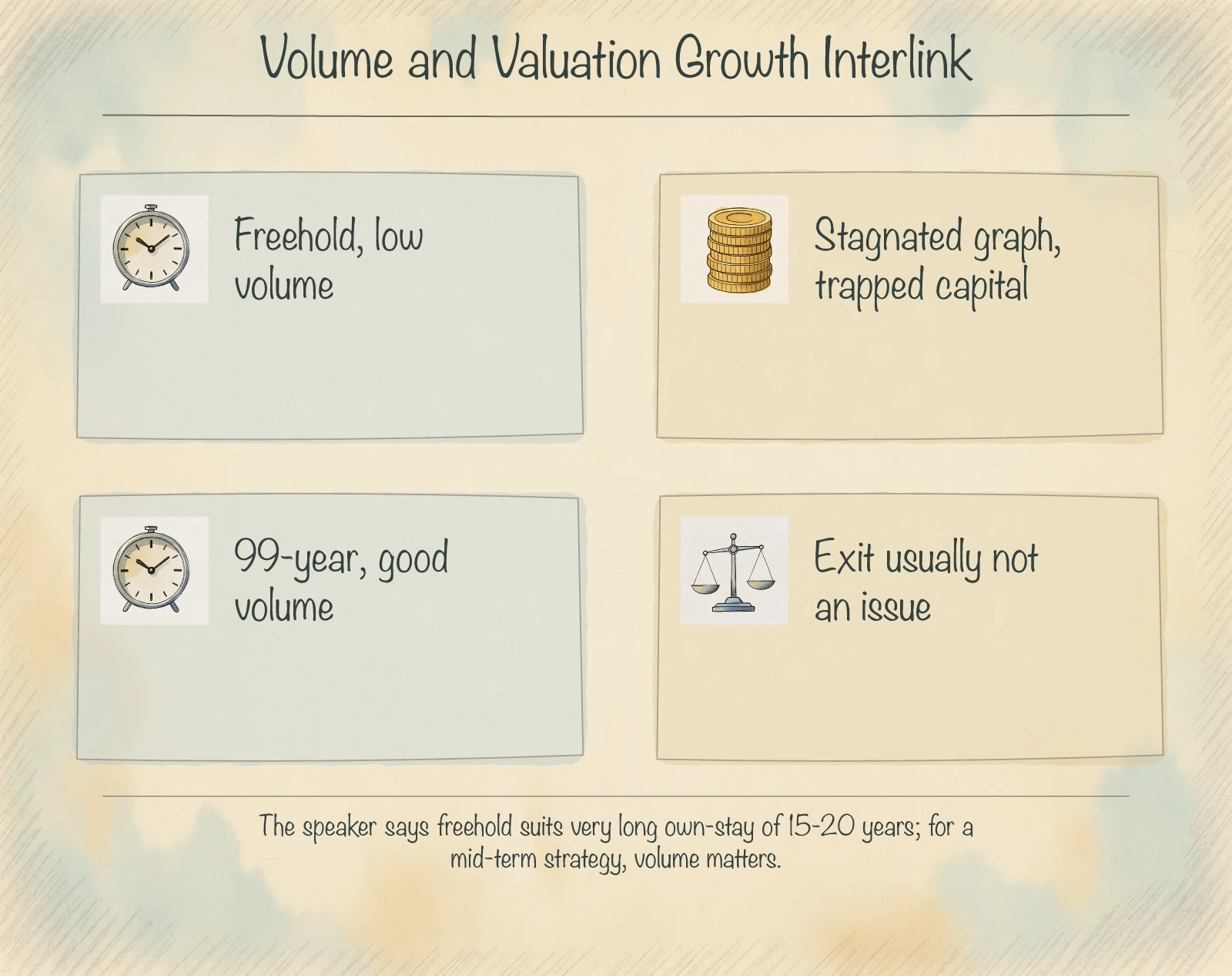
One of the key rationale is that over the last 10 years, volume transactions and valuation growth are all interlink. So sometimes it's not really about freehold because freehold properties if you have not enough volume of transactions you will get to see a stagnated graph and your capital gets trapped.
So these are fantastic for own stay if you tend to stay for very long, 15-20 years but if you want like a meet-term strategy for 5 to 10 years you have to take of the volume effect.
So for example freehold 74 units also pretty stagnant, only one person managed to exit after a long holding period ever since 2022. And of course projects even though 99 years but as long as they got a good volume, most of the time the exit shouldn't be an issue.
Okay, so let's come back to the key purpose.
We talked about this at the start, alright, but the important thing is that no matter what season you are at, take note of these two key things that is very crucial in terms of a decision-making is that whatever property you want to invest, make sure you can exit to create a liquidity event for the next stronger property.
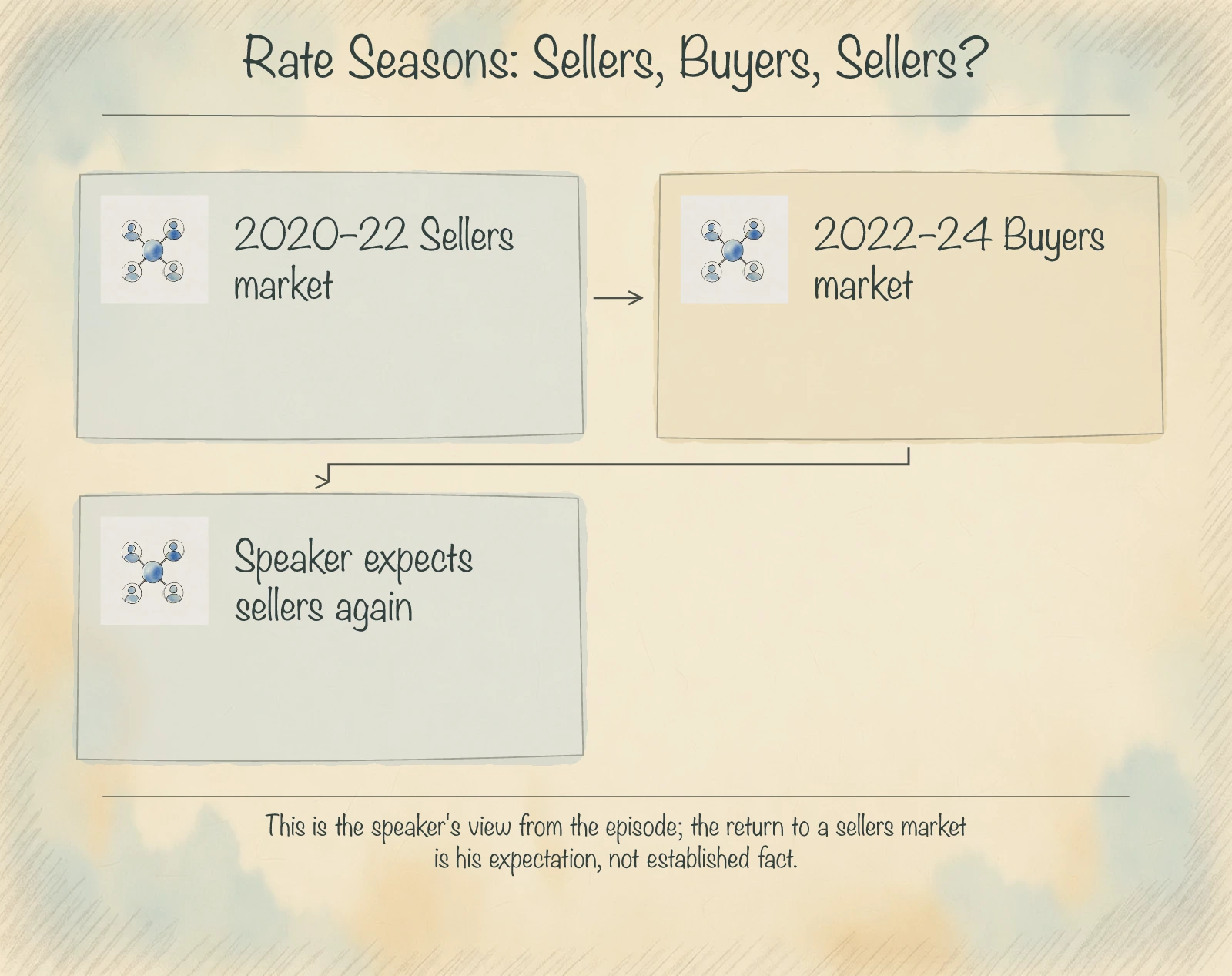
So what kind of market are we in right now? 2020 to 2022 post COVID, we entered into a sellers market.
Why? Because interest rates were extremely low at 1%.
We call it a sellers market, meaning that when interest rates are low, sellers call the shot. Sellers can hold and they can ask for high prices.
Okay? 2022 to 2024, the Fed increased 11 rounds of interest rate.
We went into a high interest rate
Sellers Market Returns and Portfolio Expansion Case
environment. 3 over percent, it was pretty high.
A lot of buyers were very cautious. That is called a bias market.
That means as a buyer, I can wait and see.
But if this is going to happen and in fact right now you look at a mortgage rate you can already start to get 1.99% because the banks are already seeing that indication coming in and we are moving back to a sellers market meaning that resale sellers can call the short, developers can also call the short because FOMO is going to kick in.
So now is about one and a half months to the next Fed meeting. I think is a good chance to really to be in August and this place because I think before the sellers market formally kicking in full gear there's still a chance for a pre-catalyst opportunity.
So take note if you have a property now, if you are planning to go into a stronger asset, whether you're coming from a HDB property or buying a second property, that means you are enhancing your portfolio you should always do it in whatever market possible because it is enhancing your portfolio.
But if you intend to retire you should only do it in the sellers market because you call the shot. That means if you are moving from a condo or landed to a HDB or to a smaller property you should only do it in the sellers market.
But if you're expanding your portfolio you should always do it when you are ready. Alright, that means we don't time the market.
So take note as long as you are going expansion, getting a second property, going into a stronger asset class, you should do it as and when you can. Alright?
You don't time the market. So basically this is the summary.
Alright? But if you're switching to a weaker asset, maybe you are in a season of retirement, then you should do it when the market is very hot.
Okay? So last but not least, the Stack and Side plans exit simulation.
Let me share a little bit
about this. So when we look at the indicative launch price, when I saw this basically I think in my 80s career, compared to whatever is available now.
This I think is really attractive because originally we thought it would be close to about two, three, two, four PSF.
But of course the starting point will be for about $2,000 PSF but the important thing is I think the calibration of the quantum is very attractive especially for the two and three bedders and of course the four bedders as well.
So when you look at basically the two bedders, one odd million, 1.3 plus over million for 2-bed 2-bath at the starting point and then for four bedders starting from about 2.5, five bedders at 3 mil. Later I'm going to show some charts as well with our consultants that five bedders quantity in D26 is extremely low.
So if you can go for a five bedder of course you will be entering into a zone whereby supply is really low
over here and of course for 3 bedders very attractive commencement quantum also in terms of its ranges. So as you move on with our consultants later on they are going to go through these two things with you.
You can do a lot of simulation with them in terms of the stack, the levels that you're hunting for, the stack direction, the potential kind of profit that you're hunting for as well and all these charts are also available for consultants.
So later as you check with them, we have analyzed the entire D26 as well as the entire OCR region for your benefit. So they will be also able to do this couple of things with you.
Okay but last but not least before I hand over to Rain, is that I think the importance of going through the frameworks is that if you are in a season that you also want to calibrate a little bit about your property journey.
Let me just share this case study that we have with some of our clients. So this is a
family that we have moved them through three different phases and of course they went through the entire kind of like four different kinds of transactions with us ever since 2020.
Now one of the things that maybe a lot of people are asked is that well it seems very troublesome to go through so many transactions and why did this couple decide to do that.
So basically they, we sold their HDB through our team, and if they didn't sell the HDB in 2020, I think by now they could have made another $130,000 because last time we sold the HDB at $675, now the HDB is worth $800 over $1,000.
But then because they did an intentional property journey with our team, their portfolio has expanded to $4.3 million instead of $800 over $1,000. And why did they want to expand their portfolio?
very simply and these are two working professionals. They are not business owners, they are just very hard-working professionals with kids and one of the
Two Professionals' Portfolio and Closing Remarks
The key rationale is because if they didn't take action, the valuation on their portfolio is still stuck at over a thousand, but because of a strategic move to really analyze using the capital from their BTO, profit from their BTO, refunneling it with their high-income producing years, they can achieve a $4.3 million portfolio now.
And the key idea is to be able to own two properties with very, very kind of like comfortable cash outlay per month.
Alright, so now basically they come with $5,700 per month to own two properties, one is to stay, one is for investment, and basically all they want is just to safeguard their future by having a store of wealth in two real estate.
Okay, so our consultants believe in this approach. Basically, in your highest income producing years, your active income should be funneled into asset income.
Because why? When you hit 55, your asset income can be funneled into passive income.
So let me share with you why. Why?
Because your active income is the most risky. Okay?
And we are very afraid of loss of active income.
So if you don't funnel it strategically, basically what's going to happen is that if your active income is weak during the age 55 to—most of the time our route is to really downsize because we don't have a very strong asset.
So if that couple were to stay on for that same MOPT-BTO all the way to 55, so likely they will have the downsize. But because of their strategic move, they move from a $670,000 HDB now to a $4.3 million and we are trying to build this equity triangle for them.
All right? And their goal is very simple.
They can choose to press the button at 45 years old, or 65 years old, or 55 years old. They just need to choose when to press the button because our simulation is based on a 2% inflation growth all the way until 65.
We're not even calculating asset inflation. We're just calculating inflation at a national level.
Okay? So at age 55 or 65, let's say for example there are two properties go up to $6.6 million dollars in terms of valuation.
What can be done basically is that my personal belief is that we should divest. That means there's no point to bring your property to the grave on.
You should enjoy your fruits of labour but it is very strategic because you will still have two properties to live for your kids. By that time, you can buy the very old resale properties.
Doesn't matter. All right, go and buy Mandarin Garden.
Left 40 over years of 50, it doesn't matter. Buy the very old properties.
One for stay, one for rental, fully paid, collect rental, no mortgage, put in DBS stock, all right? Get 6%.
Collect $13,000 a month. These two assets pass to your kids, whole $2.5 million dollars in cash.
So this is what we think, all right? Now, if they intend to press the button at 55 as well, basically it can still be funneled into three different pockets over here and you can still have one property passive income of $803 but importantly you can still keep $2.4 million in cash.
Okay, alright, so I've come to the end of my segment. Of course, I'll be here all the way until 10 p.m.
to interact with some of you as well. Alright, thank you very much.