Market and policy
How Rate Cuts Drive the Next Property Seller’s Market
Published 2026-11-13. Adapted from the episode published 2025-10-27. Figures, illustrations and data reflect the episode’s original publication date.

On this page
- Opportunities Ahead in the Next Cycle
- Equity Triangle and Sellers Market Signals
- Switching Assets and Opportunity Cost
- Upsizing, Downsizing and Divestment Strategy
- Passive Income Buckets and Master Plan Zones
- Bayshore Pricing and Region Disparity Gaps
- New Launch Catalyst Disparity and Resale Quantum
- Low-Quantum Opportunities and Buying Power Triangle
Opportunities Ahead in the Next Cycle
Good to see everybody on a Saturday, and of course I think very excited to see you instead of going to a shopping mall to shop on a Saturday on a weekend — but you're here to really learn about property investment as well as our wealth building.
So for my segment I have about a 30-minute segment to talk about what are some of the key opportunities that you have in the next six to 12 months. Of course, I think the main punch point of this topic is really how do we maximize our paper gain in the next season?
Because we all know that now Singapore is really the third most expensive city in the world. Are there still opportunities for us to have as a property investment?
So let's kick start. So even if, let's say for example, you are a single person that is planning to buy a property or your first property later on, as Jeremy comes on for his second segment, he is going to share some of the key five frameworks that we use to select real estate investment today.
So for a single person, if this is your first property, I think there's going to be some value that you can walk away with after today's session.
If you are somebody that is planning to buy for own stay rather than for investment, and let's say you want to buy a new property, stay for two years, and then you want to sell and upgrade to a bigger one, I think there's some value for you as well.
If you belong to what we call a summer or autumn season, and let's say you want to buy a big property and then plan to really up-size before you hit your winter season, I think there's going to be some value as well.
So we use this six stats framework, pairing with our one-to-one consultant strategy, in terms of really understanding, based on your current stage in life, your current capital that you can deploy, what will be a safe approach using data analysis.
So let's have a look at this chart. Now this chart, I have always gotten my research team to update it on a quarter-to-quarter basis.
We want to note how many cooling measures we already have. Up to date we have already the 17th round of cooling measures.
The latest round was the four-year seller's stamp duty that was being implemented. I think the government was thinking about the fact whether the market is going to be heated up very soon towards the tail end of this year.
But one thing to note is that all these cooling measures, there's no turning back anymore. So it's quite impossible for our government to remove any form of cooling measures.
And this is very important to note, that this cycle now, through my 18 years of experience — because when I started, where I stayed, the right strategy in the past is really to hunt for properties that give you very good passive income.
So in the past you can still buy properties, rent out, collect cash after you pay off your property tax, MCST and monthly instalment.
But now it seems like whatever properties that we want to touch, the rental cannot even cover the mortgage, and most of the time you have to top up if you are going for a rental play.
And thus we are of this methodology in PLB that we would do our best to only hunt for Q1 and Q2 types of property investment, meaning that properties that either have very high rental yield and high growth, or one of the strongest asset class, which is landed property.
So we only want to hunt for these two properties. But because landed properties the quantum is high, rental yield is low, but capital appreciation remains one of the best.
All right, let's have a look at the latest cooling measure, which is the four-year seller's stamp duty.
So this measure I think is one of the calibrations that our government tried to kick start, but I'm not sure whether next year there would be new cooling measures, because I'm a little bit worried about the fact that cuts — that is coming in terms of very low interest rate — if the market gets heated up too soon, then there might be a possibility of further kinds of measures coming up.
Let's just hope that there's no more new cooling measures for the time being. But based on this data I think the four-year seller's stamp duty really has no impact on the market, because in many cases over the last five to eight years, most property buyers and investors, they hold their properties for quite a long period of time.
All right, so quick disclaimer: whatever we share is based on our research internally as well as my years of experience on the ground with my team. So do make a wise decision if you want to invest in real estate.
All right, so let's kick start for today's segment. So quick introduction — if this is the first time we are meeting — so my name is Melvin.
I've been in the market for 18 years.
Equity Triangle and Sellers Market Signals
I started as a solo realtor. And of course, over the years, we have always loved to speak at events to connect with the community.
And these are some of the events that we have held over the last three years. And recently, we have been going around different districts.
We call them the clinics. So basically, there are landed clinics, condo clinics that we meet like 50 to 60 audiences.
And then we connect with them one to one after the event. Now after this event, if you want to have some deep dive planning for your property journey, you can of course meet up one to one with our consultants which are outside and they'll be very happy to help you with our frameworks.
All right, so I'm going to simplify our frameworks using this triangle here. I call this the equity triangle.
The first apex at the top will be looking at trends and then of course on the left hand side we look at risk and then on the right side we look at opportunity. So let's kick start with trends.
What do I mean by trends? Trends are very simply in real estate.
This is one of the heaviest mechanism that tweaks the market behavior. So always know that when you want to invest in real estate, real estate is an asset that is very illiquid, meaning that it's very easy to buy.
But when you want to sell, sometimes it's not that easy because if you buy the wrong thing, your capital is trapped inside, you want to release it to buy something better or bigger or you want to maybe divest your real estate investment, it takes time to divest to find an audience that can take over your asset.
Trends is very important to look at what is the trending now before you make a decision and it's largely so-called made by interest rate movement and we always monitor the interest rate movement because we want to see the heat in the market, we call it FOMO.
So basically we want to know in the next six to twelve months are we entering into a sellers or buyers market.
So you can look at basically some of the research reports whether it's from the capital market, from the banks, from the research houses, a lot of people globally, including Singapore, has already known that rate cards from the Federal Reserve is coming up very, very soon.
The latest round that I think that was just two weeks back, just one single comment that a rate card will happen, the stock market already exploded, right, together with the cryptocurrency market.
This report came out late last year and the forecast is that by 2027 we're going to have multiple rounds of rate cuts as long as Trump remains in administration. So this will still last for the next three years.
And most of the time based on what we see is that once people start to take profit from volatile market like equity, MAC7, stock, crypto, they will usually want to shift it to a safer asset which is more stable, real estate.
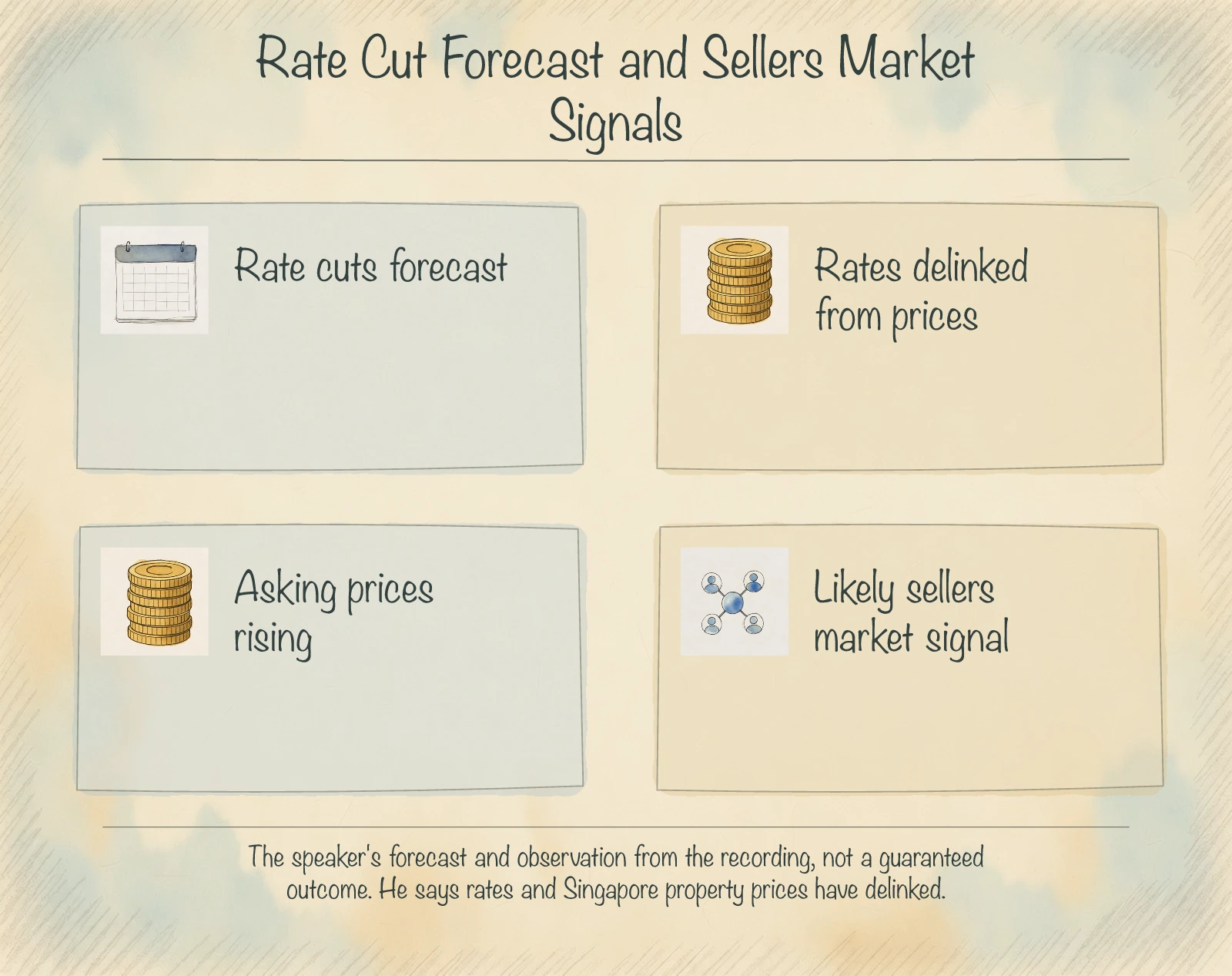
In Singapore, the interest rates sort of has really delinked from our property price. How do we know that is because whenever we have interest rate cuts that coincide with quantitative easing in the past, prices in Singapore tend to go up.
But then the latest round, which was under Presley Biden, is that this 11 rounds of rate cut seems to have almost zero impact.
So basically even though sorry increase not rate cut, so basically after 11 rounds of rate increase we still see basically the landed property market picking up, condo market picking up and HDB market also picking up.
So after we have passed through this phase which we have already passed through, we're now in this new phase of potential rate cuts coming up very very soon. In fact the next one is coming up slightly September, October.
We will likely have about two rounds. All right.
So with that, basically we are off the forecast that we are moving back into a sellers market.
So let me just define what is a sellers market. Basically, sellers market means that we're entering into a bull market where buyers become very optimistic.
So when buyers become very optimistic, usually you will see news that show flats are full. There's a lot of people putting checks for new launches.
Resale sellers start to ask for very high price because the retail sellers also don't want to sell cheap. So they're worried that after they sell, they got nothing to buy.
So they raise their asking price. So when you go to property group and you see all the asking prices started going up, is a likely signal that we're entering back into a sellers market.
Sellers market means that sellers have the upper hand. So we call it the sellers market.
We have exited a buyers market. So in these two years, basically if you're hunting for something, you got more negotiation power.
Now, how do we make decisions in the sales market is very important because with this,
Switching Assets and Opportunity Cost
A few news that is coming up, and of course, this was the stock market bull run in the last one plus week. And if you look at the interest rates right now, it has already started to take effect.
So even the rate cuts has not even started, the banks are already starting to so-called like absorb this news into what they're offering. Alright, so back to the sales market, basically the methodology to know is that if you are switching to a stronger asset, you should switch whenever you are ready.
But if you want to downsize to a weaker asset, for example, you sell landed buy condo, you sell condo buy HDB. Of course, there's a waiting period.
If you sell private to HDB, you need to rent for 15 months. But if let's say you're selling a bigger condo like a 4-bedder to go to a 2-bedder because you want to retire, you shouldn't do it right now because the market is just starting to heat up.
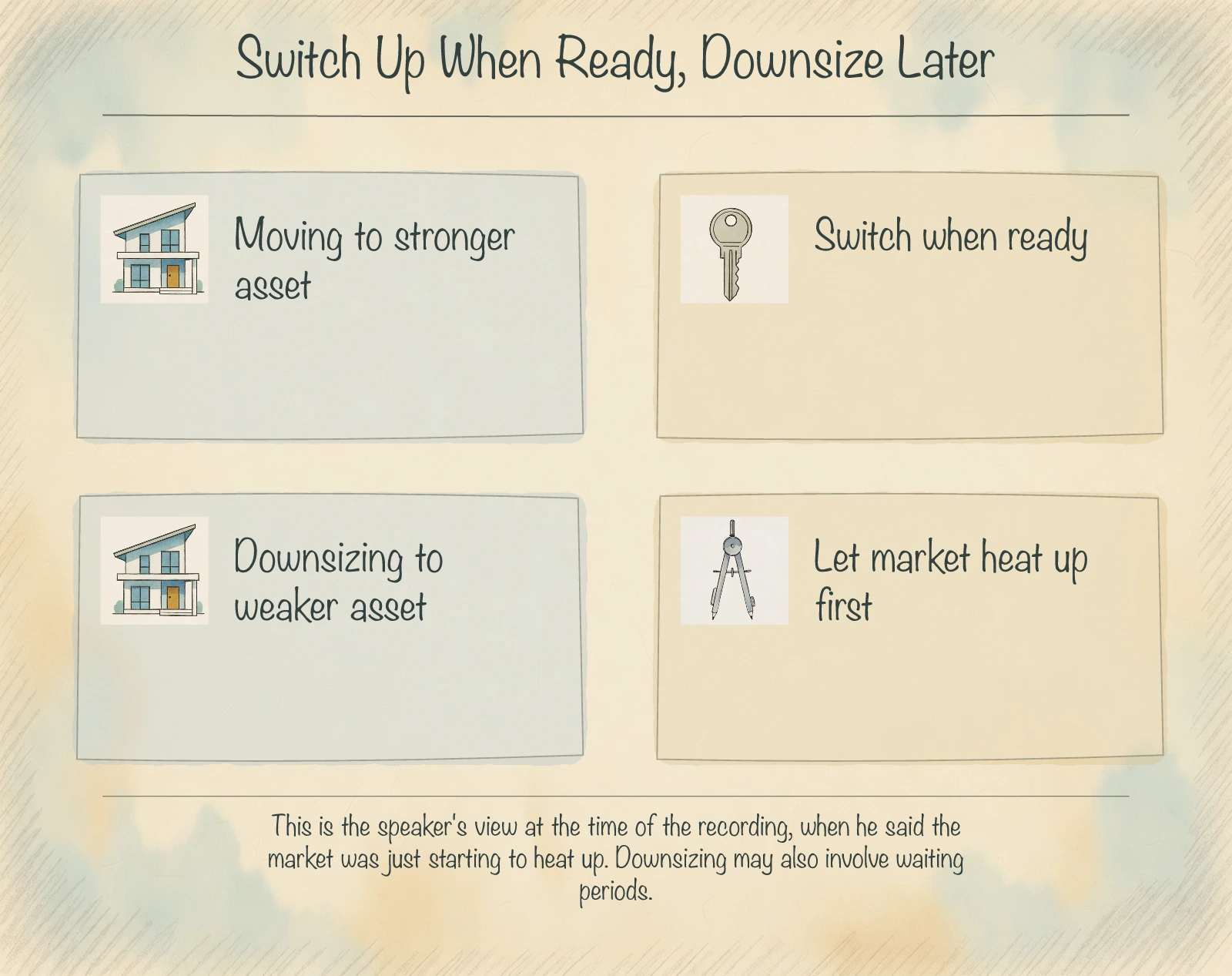
You should let it heat up for about 12 months, let the price go up, then sell. All right, because you need to maximize your exit.
But if you want to move from a condo to a landed or you want to buy an additional property, you should always switch once you are ready. All right, so this is the methodology.
So far so good, everyone? Okay, good.
Now, the second framework to note when we talk about trends is to note this very sensitive buying power triangle.
This buying power triangle is extremely important because as an investor, I want to know that whatever I buy, when I sell next time, after four years seller's stamp duty finishes, what is my audience level of buying power to absorb my assets?
I don't want to go into an asset quantum that is unabsorbable or is very hard for me to find a buyer.
So note that in Singapore, we have to sort of respect the buying power in the sense in pace of public housing margin profit prices, like example, how much are HDB upgraders making every time when they sell their HDB?
How much are condo owners making every time they sell their condo? How much are landed owners making as well?
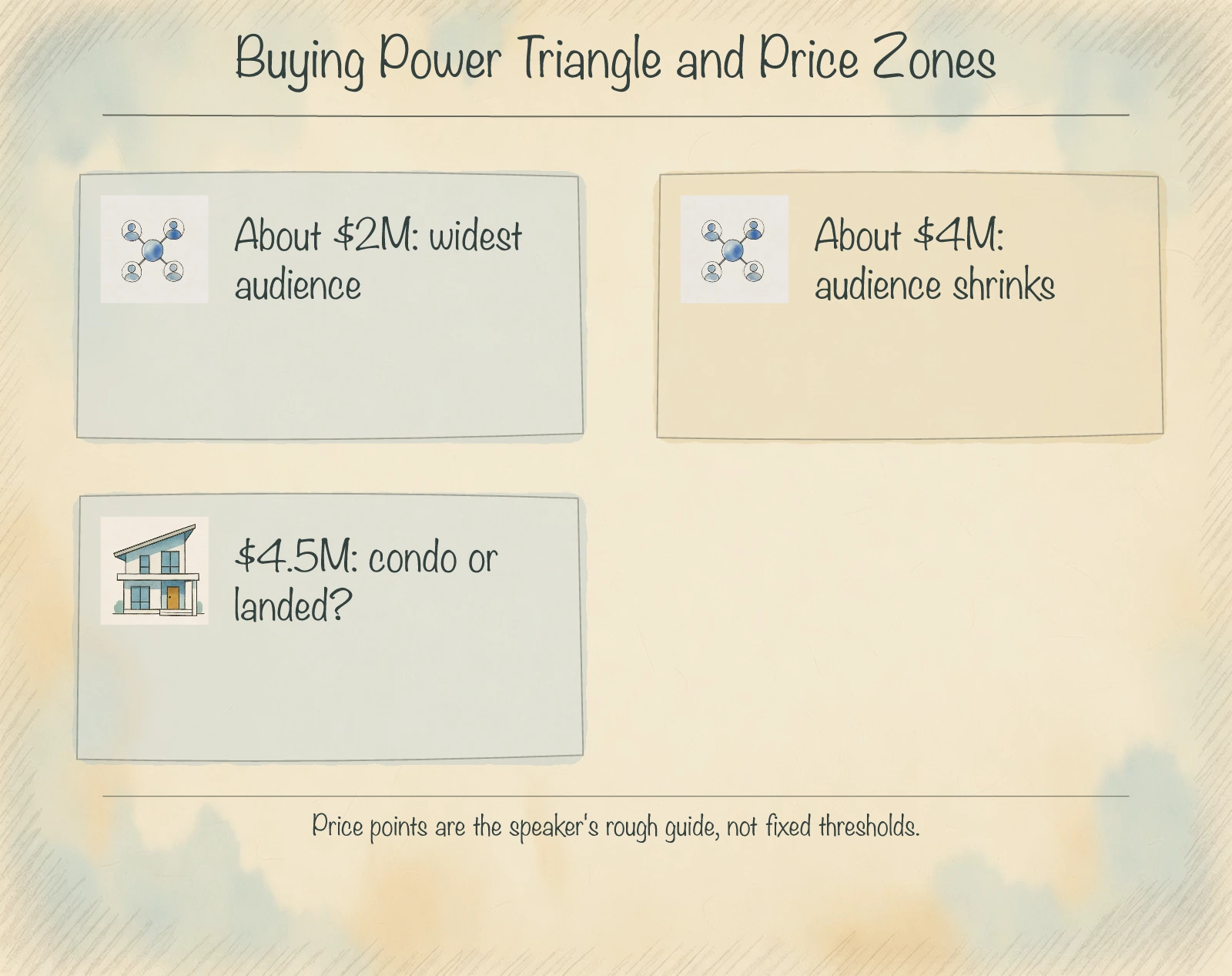
Right now, this is the new buying power triangle. If let's say your property is at about $2 million plus minus, you'll have the widest audience.
If your property moves upwards to about $4 million, your audience will shrink. And take note, if you touch the point of $4.5 million, it's better to go for a landed property.
Because at $4.5 million, your buyers will become confused between a condo and a landed. So it's very important to note this key difference.
And 95% of all transactions in Singapore are largely done by Singaporeans and PR. Foreigners contribution is less than 2%.
So we need to know that our audience are Singaporeans and PR and the buying power triangle twerks their decision.
Alright, so let's have a look at this.
Now this is what I call the base level pressure because anytime somebody goes into three and a half to four and a half million dollars zone, let's say for example I have a property now that I want to buy and I want to buy like a four million dollar property but maybe four hours later, I want to sell for four and a half million dollars.
I need to know that if I want to sell for four and a half to five million dollars, my buyers will hit a dilemma because why? They will start to explore strata-landed interterrace, they will start to explore a stronger asset.
So when you enter into less than a condominium, you must know what is the right range to enter so that you don't restrict your future audience.
Now let's have a look at this. Okay, so let me just summarize for you.
So this is what we call switching to a stronger asset because let's say I got a smaller condo on the switch to a target property, we call it a target property, I switch whenever I can, meaning that I will do my very best to exit this once I'm ready so that I can switch that.
Why? Because any price movement upwards, let's say in the sellers, formal market, a bull market, this will increase faster than what I'm having now.
So it makes sense for me to go there soon.
All right, I shouldn't wait for this increase because by the time this increase, this has already jacked up by more than 400,000. Which means that I've lost about 280,000 in between.
Okay, so sometimes let's say I have a property I want to sell and then I know that oh market is heating up, I want to hit more, I want to hit and I want 200k more. But then my landed property there has already appreciated by 5 to 600k.
All right, it's actually an opportunity cost lost. And this is also an example of current to target.
So from current condo to the next property, similarly, because this is bigger in size,
Upsizing, Downsizing and Divestment Strategy
I just take an example. Let's say you stay in condo A.
You want to sell your three-bedder in condo A and buy back a four-bedder in the same condo. Then this scenario will actually just help us to make some clarity that if I want to switch to a bigger, stronger asset, I should move whenever I'm ready.
But then, if I want to switch to a smaller one, then I will hold my horses first. I wait first because maybe I want to retire, market is heating up, then I don't take action so fast.
Okay, so far so good. Alright, now next, after we look at trends, let's look at risks.
Now risk basically relates to a few key things. Number one is about our seasons of investment.
I don't believe in holding property all the way until I die, alright, because I believe that real estate is an investment to serve us for freedom and choices.
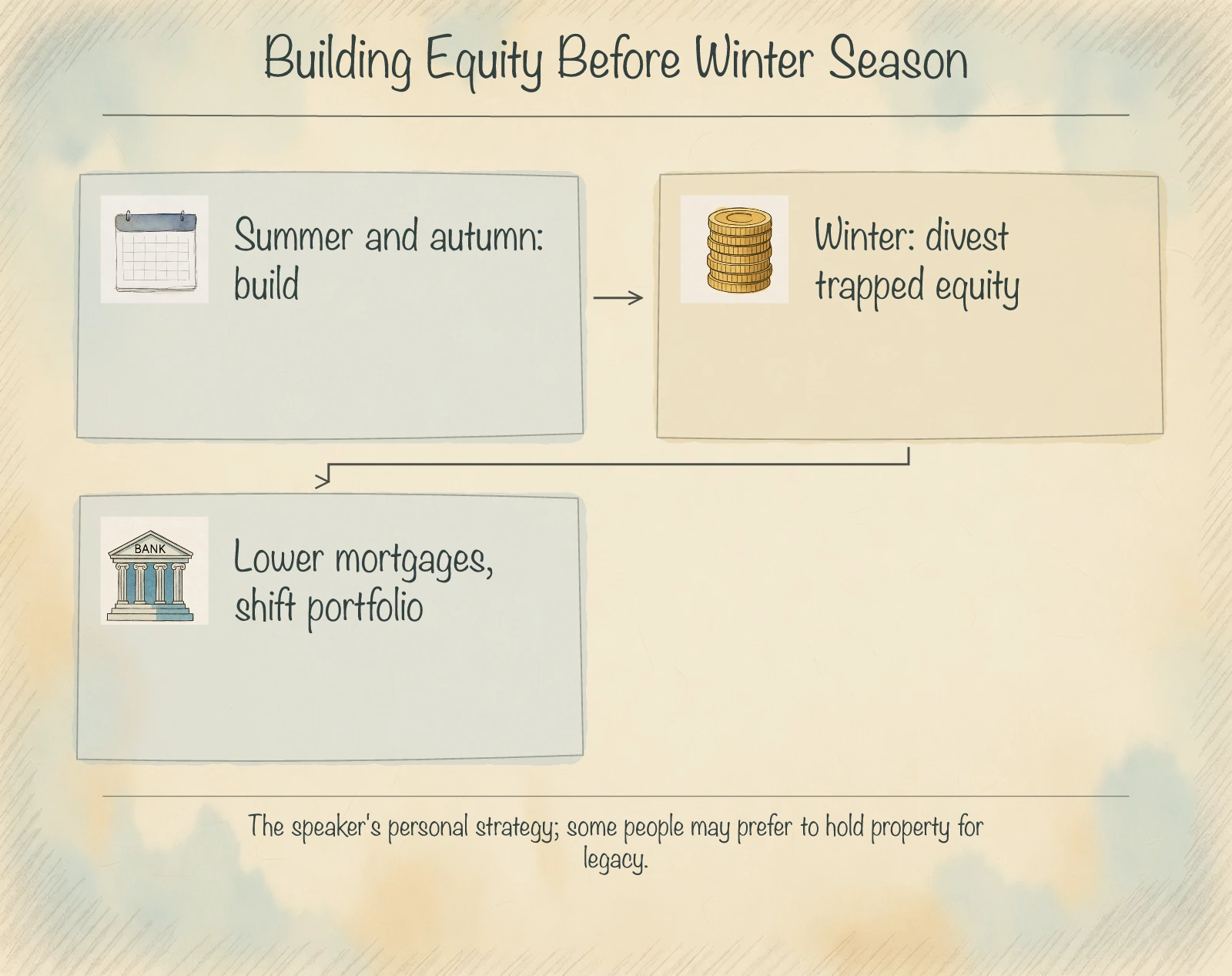
Some people might want to live for legacy, some people don't need to use real estate to make margins and profit, but my methodology is that once you're in the winter season, you should divest it. You should divest and then lower down your mortgages, and then you can actually switch into different ports of portfolio.
Later, I'll show you what I mean.
But as long as you are in the summer and autumn season, for example, you are in your 30s, 40s, these are very strong seasons because you have very strong earning power, you have very strong borrowing capability, and you should do your very best to see how many more rounds of investment that you can leverage on.
So when we look at this, this relates to what we call the equity triangle. Let me give an this strategy to build up this green color triangle before you hit your winter season.
So this is what I call the winter season, 55, 65, all the way to 85 years old. Winter season, you should find a way to divest the equity that is trapped in your asset.
Because if you don't divest it, basically, all your funds are just trapped in the asset that is illiquid, and there are better ways to generate more yield.
So let's have a look at example. This is one of our clients that we have helped them to shift basically four different transactions over the years.
A couple in their mid-summer season, and they are all working professionals, they are not business owners, very disciplined in terms of their investment and very intentional. So we switched out from their HDB to a resale condo and then switched out to a freehold 4-bedder plus a 2-bedder.
And basically they did this four steps over here. And why did they want to do this very troublesome step over the last six years?
One of the rationale is because if actually if let's say they didn't do anything their HDB could have actually appreciated by another hundred and thirty thousand.
Now their HDB is worth about eight hundred K instead of six seven T plus K in the year 2020 but because they have been intentional now their portfolio is about four point three million dollars. They did a live interview with us.
You can go to PRB YouTube channel to have a look at this. And one of the rational is because they want to have intentional planning on their expansion for their portfolio to hit a $4.3 million total size.
So this is basically their strategy. So with one property being rented out, it takes them about $5,700 per month cash out to own two parts, other than them spending on like more extravagant holidays they decided to plonk in into their asset.
And the methodology works like this. It's to shift all your active, not all your active income, I mean majority, of course you have to take into consideration all your disposable income, but it's to try to shift it to an asset income and to prevent the risk of just depending on active income into your winter season.
And once we are in our winter season, this becomes weaker and if less asset income is very weak, most of the time this is the default move of most Singaporeans. That means it will switch down to a smaller asset.
And what is balance is very little as well.
So basically let's come back to the couple strategy. They started from 670k, now they are at 4.3 million, their equity is 1.3 million, their debt is $3 million.
I call this good debt because it's a leverage. And their strategy is to move towards 65 years old.
Once everything is fully paid, and we just base it on very simple 2% inflation without capital appreciation of the property. We just base it on normal inflation.
55 years old, if they want to press the button, it's about 4.41 million. And let's say for example at age 65, they could use a very simple strategy like this.
And this is what I call divestment. That means you don't have to hold on to that two properties, you just pay off a very old condo, balance 50 years doesn't matter because you're already 65 years old.
Pay off another condo for rental, no debt, no mortgage,
Passive Income Buckets and Master Plan Zones
Draw rental income, put in dividend stocks at 5%, take a passive of 13,000 per month, you still have cash of 2.5 million, you still have asset $4 million to pass to your kids. So this is just one strategy.
Second strategy, if you want to press a button earlier on, you can also do it as well with three buckets. You still have passive income, liquid cash and asset value.
This is an example of building the equity triangle. You can design this later with our consultants.
And also we want to look at the second framework, which is what I call TLC, tender loving care. You need to tender loving care your own capability, tenor, leverage and capability.
All right, so this relates to our TDSR, our Boring Capability. Because one very unique feature about real estate investment is that the leveraging component is one of the most powerful components.
And we are very blessed to be in Singapore with very low interest rate. If you go to US now, the fixed rate 30 years is 6% to 8%.
Most countries, their mortgage rates are extremely high. It's just that we are so used to low interest rate.
So have a look at A and B scenario. Somebody that pays full cash, somebody that leveraged with 75%, 500K down payment; the outcome is drastically different, right?
Because this is what we call 4x leveraging in real estate. And with a $2 million full cash, let's say you are very young, but you can loan, but you don't loan, what is going to happen is that your cash on cash return is actually much lower.
So 400K versus your 2 mil cash is only a 20% return. But because of the fact that you leverage, the rough return on capital is actually 4x.
Of course, I haven't taken into consideration your interest costs and so on and so forth, but when you drag through time, always remember your cash weakens in purchasing power. So it's definitely more worth it to leverage.
And one important feature that a lot of people don't realize is that the bank don't share
your profit. All right, so it's not like an investment into a company.
The person that loans you the money, they don't need to share your profit. Your 5-Hero K to get a 4-Hero K investment, this is basically, it does a profit margin, it belongs to the owner of the property itself.
Okay, so let's have a look at the third one, which I think you're most interested in.
All right, so I'm going to talk about some zones that I think in the next 6 to 12 months, there's going to be some potential gaps that you can look at and leverage on. So of course in the title I say three zones but when I was doing research I think there's potential for a fourth zone.
So let's talk about it. Now the first one that we'll talk about is the pre-catalyst opportunity effect.
So what is this? So when you look at this news that came up in the last two weeks, very strangely why is it that over at Springleaf there's nothing but
Everybody buys it. There's really like nothing there.
There's an MRT station. This is what we call a pre-catalyst effect.
As long as the pricing is launched correctly, people will make sense after they look at the numbers, data analysis. So this is of course a bad plot here.
There's actually not much going on. The first development, landed properties.
But of course when you look at pre-catalyst, there's a grand plan by the government in terms of master plan that these three plots are all residential and they're going to link the entire thing with Lentor. All right, so when you look at this, we look at the color coding on the URI master plan.
It's going to be a very, very mega township and the first mover effect is very true because in the past everybody don't dare to buy this, but everybody that bought this, they all become millionaires. All right, and there's like multiple millionaires that's been made just from one project.
In fact, when Tower One was being launched,
averagely it was launched at $800 to $900 PSF, the first 99-ish residential in CBD, because MBS was not announced. After MBS was announced, Tower Two was launched at 1,002 PSF, instantly 400 PSF jump.
And of course now it's much more than that, all right? So this is before MBS is being announced.
And when you look at the first opportunity that I think can be considered is the Bayshore region. All right, so Bayshore region is quite interesting.
This is the entire master plan that has already been planned and it seems like the government is putting a lot of attention, because sometimes when government announced master plan, they drag for very long.
Example, when I started 18 years back, they already announced the master plan around National Stadium but 18 years later, it seems like there's still no new developments around the riverside, the Kalang MRT era, it took them many many years.
So sometimes it could be because of visibility study was below the ground and it could drag on and on but it seems that the speed of this is extremely
Bayshore Pricing and Region Disparity Gaps
Fast. So all the plots are out, they already started government land sales as well, and why is this interesting is because there's a clear segregation of zones.
But let's have a look at the current medium quantum price first for the Bayshore region. So 3-bedders average at about 2.1 plus, 2-bedder about 1.3 plus, and these are basically the median PSF now.
Now, why does this matter? It's because of this.
So sometimes when we look at master plan, it's not like every master plan is very exciting, but when there's a clear distinction that doesn't confuse my future audience, then there's some opportunities that we can study on. Now this zone is interesting because there's a clear four-quadrant segregation.
So landed properties over here, you have low-rise freeholds over here. So just on the data you saw in the previous two slides, they belong to a combination of these two PSF for the resale market.
These three projects are very old already, right?
Costa Del Sol, the Bayshore Park, very old already. Balance lease 50 plus, 60 plus years.
So there's no clear competition with this whole plot over here. These are all low-rise 1.4 plot ratio condos but they are largely freeholds.
So we need to wait and see what is the launch price of that first condo that's going to be launched in the next six months. If the quantum makes sense then there's an opportunity, but if the quantum and PSF don't make sense then I think there's opportunities over here.
So we have to wait and see how these two pair out once the launch price is announced for the first launch at Bayshore. All right, so far so good, everybody.
Okay, let's talk about the next one. So next one is what I call region disparity.
So I think there's a lot of opportunities in the CCR market. We track the strength of the regions between CCR, RCR and OCR.
So basically CCR now in terms of the median quantum price
resale, new launch as well as TOP condos, it works like this. All the charts are available with my consultants, you can get from them later.
In terms of PSF, these are the ranges of the PSF, but let me just summarise for you. Basically what has happened over the last five years is that RCR pre-COVID was a 31% gap from CCR, but now RCR is more expensive than CCR in terms of PSF price.
So it doesn't make sense, all right? It doesn't make sense, why?
Because CCR is the cream of the crop, it's the Prime Zone 9, 10, 11 and the MBS area in Sentosa Cove, but it has already fallen to be 3% cheaper than RCR, City Fringe.
Secondly, OCR was a 71% gap, it has appreciated a lot already in the last five years, now the gap is only 7%, and because of that, there are some opportunities in CCR. So when you look at this, then you need to have a red flag in your mind, right?
If
you're considering something in CCR 2-bedder about 1.8 to 2 mil, then CCR also got 1.8 to 2 mil, then you must think very carefully, okay? Recall this as a region disparity.
So if your 1-bedder is about 1.3, 1.5, but you can still get a 1-bedder in CCR, then you have to think deeper and look at the numbers. These are my list of recommendations if you're hunting for CCR resale, but technically CCR predominantly 80% are freehold properties.
All right, so the freehold properties quantum is also very sensitive because why? Back to the same methodology that most buyers are Singaporeans and PR.
So if your quantum enters too high they get very confused, but some Singaporeans and PR they love to stay in CCR because of schools, because of the location, because of the fact it's freehold, they love to have the Orchard address, River Valley address, Bukit Timah address, they might not like a landed property.
All right, so there are people that just don't like landed
properties because they don't like the lifestyle, they really want to have facilities and they want the status that is in the CCR zone. These are the price kind of recommendations that you can hunt in the next six months.
Okay, so there are going to be some launches and take note all the CCR launches unless it's an en bloc, there's no more freehold.
So this is also very exciting because for this year, the developers are using the harmonisation effect to price their CCR condos very, very competitively, which is one of the reasons why the launch at River Green swap is 80% over percent because the quantum is very low.
So it's a chance for people to live at River Valley, at Great World, at a very low quantum price. So there are opportunities in the new launch market as well.
You just have to note the quantum. And we call this the disparity gap effect, meaning that let's say for example you're comparing between RCR or OCR and CCR.
New Launch Catalyst Disparity and Resale Quantum
But in this case, sometimes I think it reverses. So for example, if let's say OCR has moved up too much, there should be an equilibrium that will come back in future because by right, the gap between regions should be fair.
So sometimes because there is a movement upwards for too much, we should invest in the other one that has not moved. Now let's have a look at the new launch catalyst disparity.
There's going to be this launch coming up. A lot of people are asking, what do I think about this launch?
So one framework that we can use, of course, we don't know the pricing yet, but I think it should be out very soon. This is a launch that a lot of people have been anticipating.
The rationale is because there has not been a launch here for a very, very, very long time. And this is the RCR District 3 zone, very popular, a lot of million-dollar HDBs, very high upgrading power, a very good location.
Okay, one way to look at it is if the developer, take note this is not the developer launch price, I just aga-aga only. Okay, if the developer launch around this price, all right, quantum likely will be around here for three beta, if it's 900 square feet.
Okay, example, example. We just need to use a first layer framework, which is to look at the comparison with some of the strong contenders.
So Sterling is a very good project. A lot of people love it and we want to see if I'll do invest in this new one four years later when I sell, does it make sense?
Okay, so for example if Sterling now is going at 2.583 beta, 2006 PSF for 980 square feet, I'll plonk into my list reset calculator based on the 10-year start date. We don't base on a completion date, we base on a 10-year start date for the land.
It is currently having a balance lease of 91 years. It's eight years old.
And if I reset it back to a full 99 years, the 2.58 actually is 2.8 million dollars. All right?
So I'm actually buying a second hand car, but if I reset it to a first hand car, it will cost 2.8 million dollars. For the new one, it's actually 2.52.
So PSF is comparison. And I have forecast four years later.
If I were to buy this now, sell four later balance this 87 I buy this now sell false later balance is 94. So I need to make a judgment call which one is more popular or more palatable to be absorbed by my future buyer.
So for example four years later if I want to sell 2.8 million do I face competition from this guy which I don't think so. Because if somebody buys this now they also might have to sell 2.8 million then I can sell 2.8 million quite easily because mine is brand new TOP.
His is an older resale. Okay, so we look at the movement.
So I take another comparison, Queens even older.
Balance lease 72 now. If I buy now, four years later, my Queens 3 Beta is going to be 68 years old.
My new one is going to be 94 years balance lease. But actually, if I reset the asking price of this owner, this owner is actually trying to sell me at $3.3 million.
I'm paying this lower quantum because it's a second hand car with a balance list of 72. So that was the reason why at the start of this sharing session, I shared that a lot of retail sellers are pricing future prices.
But of course, all of us have properties that we want to sell. So if you want to sell, then you need to be strategic.
Make sure that the marketing is done solid, it's done right, and then you don't let your current property delay you from making a future investment. So pre-harmonized, post-harmonized, I think the key is to note that as long as you see inefficiencies in the past, you don't have
to worry too much about it because the harmonized version is that they don't count the AC ledge, no RC ledge, no bay windows. So it's very clean, very efficient.
Okay, now let's have a look at the next one. Now this one I think is very exciting.
Of course the latest National Day Rally speech talk about the North a lot, RPM. I think this is one of the last zone that the government want to focus on.
I think now for this the master plan is very focus on the link to JB. But there are a lot of opportunities in the resale market and I think it's the last batch of very low quantum freehold left.
So this category I think is being absorbed very fast. Below 15 years old, that means it's not older than 15 years old.
Below 1.65 I think can buy. All right, so there are still listings, but I think it's being absorbed very very fast I haven't tell my consultants what all these projects are but if I have a spare name
Low-Quantum Opportunities and Buying Power Triangle
I will go for this one — not much listings left. All right.
So this category I think is going to be very exciting because why — if I look at the PSF, I look at the quantum, this I can only buy a two-bedder in most parts of Singapore. All right, I go to CCR, I can only buy a one-bedder.
If I go to the North East, which I think the North East area has already shot up by quite a fair bit already — most of the three-bedders in the North East are asking for $1.6 to $1.8 million.
But if you can get a four-bedder below $1.6 plus, I think it's very comparable. And the new launches in the North for four-bedders are all above $2 million.
So basically, there is a very clear distinct PSF gap also to the new launch there. So for the three-bedders in the North, the current PSF gap from the resale to the new launch is very, very big.
It's $900 PSF.
What this means is that if I buy a resale three-bedder in the North area and the North area new launches are already done at $2,050 — all these buyers in future they have to sell at additionally $300 PSF at about $2,350.
That's going to bring my gap between $2,350 to $1,147 to about $1,230 PSF three to four years later. So when I enter at this price, I got nothing to fear.
If I want to sell $1,500,000, I think easily. The four-bedder gap now is about $730 PSF.
Three to four years later it's going to be $1,000 PSF when all these owners hit their TOP. They want to sell at $2,000.
You will create an even bigger gap with my entry, and if I want to sell $1,500,000 it should be quite easy.
Okay, so we always look at opportunities in resale and new launch as well as landed markets, and of course trends. So-called recap a bit, we look at the current season and now we are entering into a seller's market.
If you have a name ready to go, you should really take your attention to really focus now because I think by early Q1 next year, prices will start to move up already. So the next five months, there are still opportunities.
Buying Power Triangle, then we look at your current season in terms of capabilities to leverage, and of course we look at the three frameworks over here. Okay, so later on, I can chat with our consultants outside — they'll be very happy to share with you.
So now I welcome Jeremy. All right, thank you very much.
I'll see you guys around. Thank you.