Landed property
Here’s Why You Shouldn’t Sleep On This Landed District
Published 2026-11-22. Adapted from the episode published 2025-06-30. Figures, illustrations and data reflect the episode’s original publication date.
On this page
- D16 Clinic and Landed Scarcity
- Inelastic Landed Supply and Category Framework
- Land Categories and Family Property Journey
- Retirement Equity and Big-Small Brother Districts
- Cat 1 Interterrace Demand and District Shifts
- Bottom Pressure and Subdivisible Detached Land
- Detached versus Semi-D Value Comparison
- Avoiding 99-Year Landed and Price Trends
- Developer Land Buying and Case Studies
- Substation Frontage and Split-Level Challenges
- Sloping Land Costs and Closing Resources
D16 Clinic and Landed Scarcity
Thank you, thanks Wain. Thank you very much.
Let me just put my specs. Thanks.
Thank you. Thanks for the introduction.
Pleasure to have everyone with us on this D16 clinic. This is our fifth clinic.
We started with the first one at District 10 and then we went on to 15, went to D19, D28 and this is our fifth run. So the reason why I want to do like a clinic session is because we want to come to every particular enclave and then we speak a little bit about the market here.
So we hope that tonight will be a fruitful evening with everybody. Our first speaker was our partner with solar panels.
We hope that you had a fruitful session with them. Now what's gonna happen is that at the end of today's session there's gonna be some charts that will be with our landed consultants.
You can later interact with them and then send them an email, they'll be very happy to send you the PDF.
So quick disclaimer: everything that we are going to share in this cafe, I think one understanding what we're going to have is that a lot of them come from our PRP research team, a lot of them from our groundwork as well as our experience over the years.
So do make an important informed decision before you want to invest in any property, because this is one of the biggest decisions of your life. Now quick introduction, we started with a couple of big events in the last two years.
This was a new launch convention. We're going to do this in July this year as well and SunTag.
This is specifically focusing on new launch condominiums and how to hunt for disparity and opportunities. So we had about a thousand people came last year and then we started off—of course last year also we had a landed convention.
This year we're not doing a landed convention, but perhaps we will do it next year, which was the reason why we wanna run all these clinics with you guys. So we started going around different estates in the last six months.
And of course the next one, very likely we're still thinking maybe it should be D21 that we'll be going to, all right?
Now, if this is the first time we are meeting, if you have seen a little bit of our content, but maybe not too much understanding about some of our investment frameworks for our webinars, let me just give a quick context on some of the general principles that we adopt.
And this has helped our clients over the years, especially when it comes to landed property investment. Now, one of the key things that we want to always talk about is really demand and supply.
Of course, demand and supply is no new thing, but when it comes to landed property, there's a very important behavior that we want to understand.
When we look at that general residential property stock, Singapore now has about 1.2 million public housing apartments and then of course we have about 370,000 condos, ECs and apartments. Landed property remains at about 78,000.
It has maintained over the last 15 years. So if you look at the supply, landed supply grew by about 10% in the last 15 years.
Now where did all this increment come about? They came about largely because of legacy land.
For example, Bukit Sembawang has some legacy land at the Luxus Hills area bar. If you notice the recent launches at Pollen Collection, Nim Collection, no more triple nine years, it's all 99 years because Bukit Sembawang has to convert agricultural land into landed residential and SLA did not award triple nine.
There's also been a lot of subdivision, but meaning that the Mukim land plot is still the same, it's just that they have been subdivided. So all these small little increments over the last 15 years did not really increase the supply.
So this is something that will give us an insight into some of the certainty when we look at landed property investment.
Condo supply grew by about 96% in the last 15 years. Every year, government land sales accounts for about 10,000 units.
So our government is very stringent now with land supply for GLS, but it is predominantly reserved for high-rise apartments. There's no more new land for landed.
So this is the first principle that we adopt, is that the harder the asset, the better preservation of wealth. Quite similar to some commodities like gold, very little increment over the years.
Of course, in recent years, Bitcoin, there's only 21 million Bitcoin. Similarly, there's only 78,000 landed properties in Singapore.
Sorry, 73,000. Now, so this is basically the scale: 1.2 million.
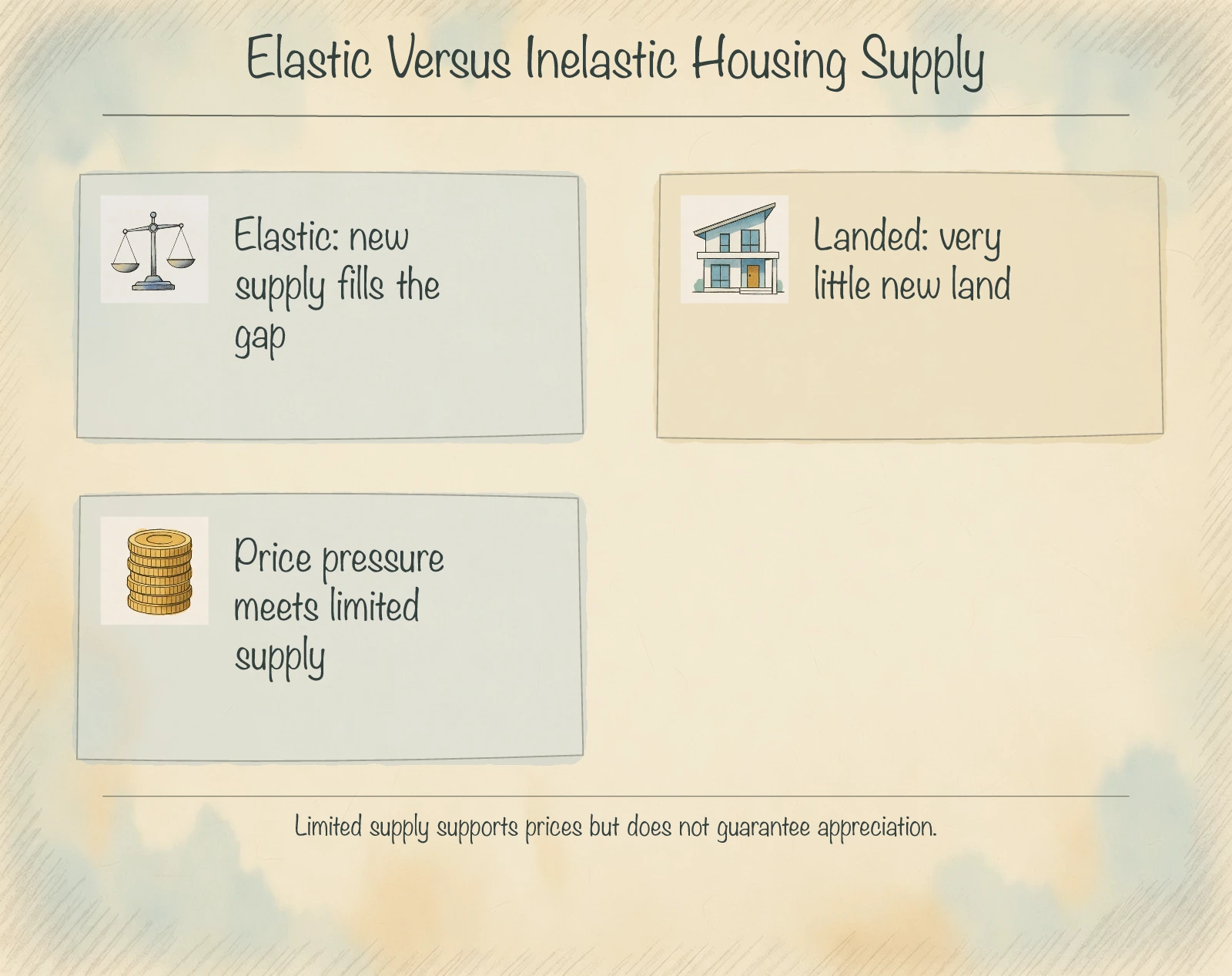
I name it as very elastic. Elastic means that the moment supply increases, there's going to be some level of pressure on price increment.
So supply always comes in to fill the gap when price runs up too fast.
Inelastic Landed Supply and Category Framework
Condos, government sort of direction is to let it grow steadily but it cannot be too fast because it cannot be priced out of the aspiration of Singaporeans.
So we are in of course a country that has been, I wouldn't want to use the word calibrated like election just over but it is an aspiration to go to a harder asset for a lot of Singaporeans.
And of course, when it comes to landed property 73,000, I name it as the most inelastic asset in terms of price to supply ratio. So an e-constant inelastic supply is that when price increase, there is no new supply to come in to support or to lower the price equipment.
Alright, so that is also one of the reasons why landed property prices has grew strong. In fact, if you look at an article that each prop published yesterday I didn't have time to put it in.
This is the first time that Landed Property Land Prices has surpassed $2,000 per square foot for Land.
Price. Later if you want to have this we can give you this is a tabulation of all 73,000 Landed Properties in all districts in Singapore.
Good for decision-making because one of the second framework that we always adopt is that when I want to buy a particular type of Landed Property be it a detached family or terrace, I try my very best to buy into a district or an enclave with a little bit more of that kind.
Alright, I try not to buy something with very little of my type. The reason is because landed properties also follow transaction volumes.
So for example, if you look at certain streets, some of the streets maybe over the last 10 years, nobody buy sell, nobody tear down and rebuild, it is actually not very healthy for the valuation.
I love to look at landed property streets with a lot of variations, especially across the street, people tear down and rebuild, buy and tear down and rebuild because when they rebuild or if developer buys up, they buy and rebuild and sell, it's going to bump up the valuation of my street.
So importantly, I want to hunt for certain enclaves with a little bit more type of the house that I'm hunting for. So when you look at District 15 and 16, I would say in summation, District 16 predominantly has a very good number of semi-D homes.
And to this context, I want to focus a little bit more on semi-D homes. And also just to give a context, I'm going to speak from a perspective that all of us, I'm going to assume all of us here is trying to hunt for opportunities in District 16, lender property as a buyer point of view.
So I'm not going to speak as if I'm a seller, I'm going to speak as if I'm hunting for something. So I know that over here, perhaps 50% of you already own lender property, some of you are exploring to get into the lender market.
I'll do my very best to share context that are relevant to you.
So coming back to this, 73,000 at the end, Also in totality in the entire Singapore, there's about 10,000 detached homes, 22,000 semi-D, 40,000 inter-terrors. One of the key general principles is that inter-terrors always belongs to the most liquid form of landed properties, the most easy to buy, easy to sell.
So anybody that owns inter-terrors, you'll find that the ability to sell or the speed to sell is always faster. Once you hit into semi-D and detached, the speed to exit sometimes becomes a little bit slower.
Later I'll talk a little bit about the buying power that comes with it. So we follow three main principles.
First thing, when we want to invest in a lender property, we always look at the disparity effect across the condition of these properties. So basically we form this four benchmark core category 1, 2, 3, 4.
This is pertaining to the edge of the structure of the landed home. All right.
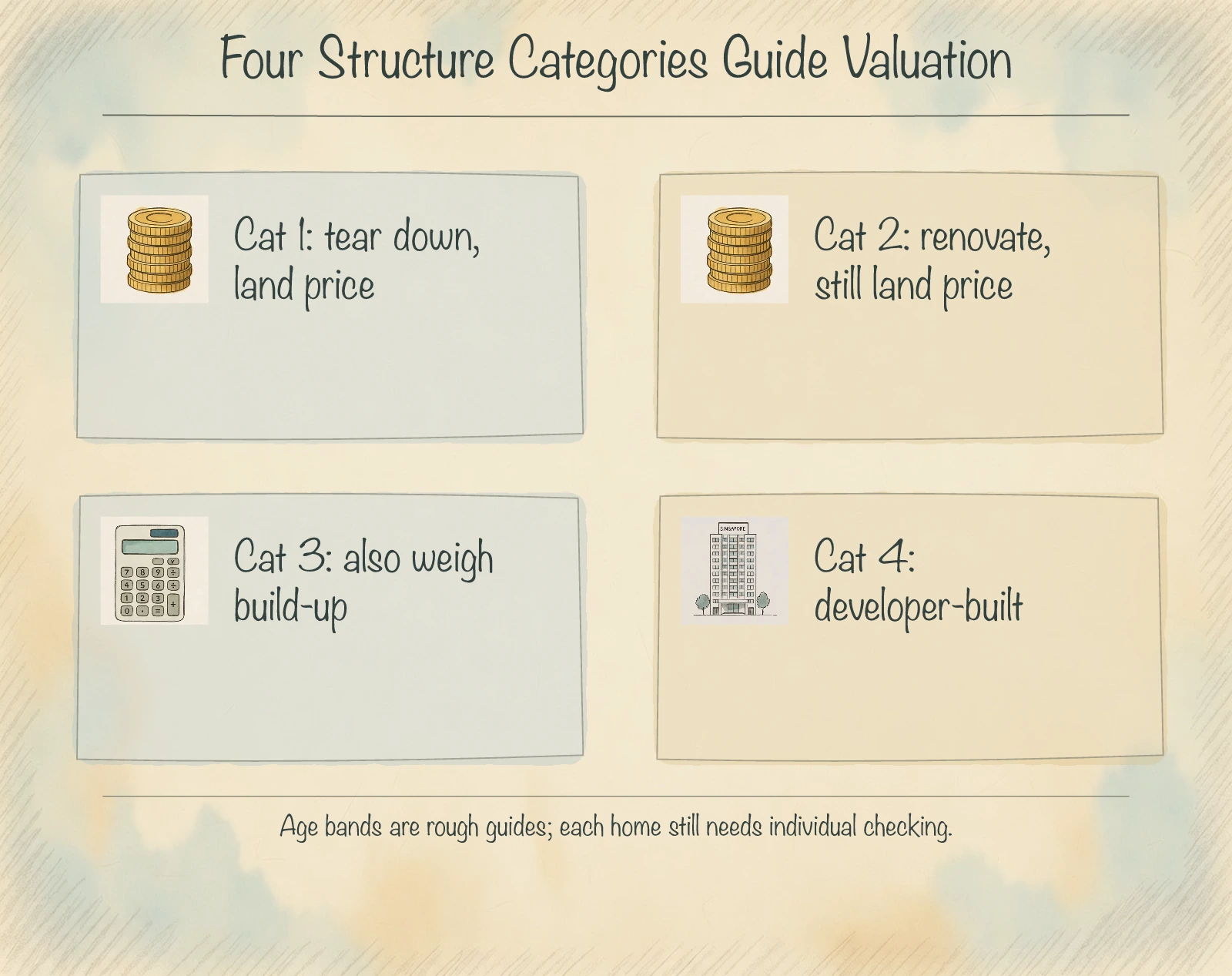
And just to give a visual image, usually what we talk about, we're going to talk about Cat1 Homes. These are homes that are meant to be tear down and rebuilt.
Largely single story house, very old, more than 40 years old. When we look at Cat1 Homes, we only talk about the land price.
Alright, so we will be very sensitive about the land PSF because we are not buying the structure. We are going to tear it down and rebuild it.
When we talk about category 2, these are homes that can sustain for a little bit longer.
perhaps a two-story classic pitch roof with maybe three bedrooms plus one but it's not fully built up ceiling height quite low old structure pillars and a forced car porch having pillars but I can a&a or I can actually improve it with renovation we call it category 2 about 20 to 40 years old and this we also try our very best to look at land price all right now when it comes to.
Land Categories and Family Property Journey
Category 3: these are usually homes that are less than 20 years old. Some of them modern, full glass, with or without lift, but usually it is already fully built up, very suitable for renovation.
Just spend $3,000 to $5,000 and I can move in. And Cat 4 will be from developers.
So why is it important we look at this? Because when we buy Cat 3 and Cat 4 homes we look at the land PSF but we also consider the built-up.
So we try to go for mega built-up, maximise the GFA, our bank for our bug. But Cat 1 and Cat 2 will look very strictly at land PSF.
So category 1, for example, category 2, 3, and then you have the brand new ones from developers. Now the last thing that I want to introduce before we head in to talk about some of the opportunities is we look at the DNA of the land also.
So this is pertaining to land. Cat 1, Cat 2, Cat 3, Cat 4 is pertaining to structure.
This is pertaining to land. Why?
Land is an inherent factor that you cannot change. So when you buy the land, you cannot change the position and the facing of the land anymore.
All right, and why do we look at the DNA is because when we have a good DNA land plot, in future when you value add to it by renovating, A&A and rebuild it, it becomes a stellar horse. All right, it becomes very strong, even stronger.
When you buy a poor DNA house — not saying that is wrong, but provided you get it at a good entry price, you can still enhance it. We call it an enhanced horse which you can still sell, but you have to be very clear with this so that when you make an offer you know your negotiation position.
Later at the end of this segment when George comes in to share very specific case studies, which I think will be very helpful for you, we'll give you these two lists. One is to future-proof your landed purchase.
One is a list of things we have, 24 things to try and avoid — but it's impossible to avoid all 24 things. Max I've seen is to avoid at least just 16 items.
All right, so let's just maybe do a very quick run-off of the purpose right of really even looking at property investment or landed property. I think the main thing in today's market — because our price is already very different, we are very high now, we are much higher than Shanghai, much higher than Hong Kong.
I think we are one of the highest tier cities already in the whole world. The rental game is already passé.
When I started, where I say 18 years ago, a lot of my investors buy for passive income. Now nobody does that anymore because your rental cannot cover your instalment.
So we always want to have two things. One is that it must have the appreciation factor.
Number two is that when we want to sell and exit it must allow us to have ease. We don't want to be stuck with something that is trapping our equity.
Now this main thing can only happen if you fulfil the previous two things. That means your property appreciates, that's ease of exit, because what you want to do is that whatever property portfolio you have now you want to be able to create a liquidity event.
You can press the button to create a liquidity event. You can also press the button to switch to a next stronger asset, but you can only do that if you have ease of exit, if you buy the right thing.
Okay, so we adopt a framework-first approach. We look at macro, micro, selection strategy.
Today we're going to talk a lot more about micro, especially for D16. And then with that, then we think about what to buy, which particular enclave to buy.
All right.
Okay, so this is basically for families that are thinking — basically like if you are thinking about whether you want to come into a landed property market, why do we even want to do that?
So we adopt this principle that we do our very best from 25 to 55 when we have active income, running our business, doing our professional work. Try our very best to funnel it into an asset because why?
That asset is going to serve you once you hit 55 to 85. And this is the most risky income with your business, your job, because we have age limitations as well.
All right. And of course, like loss of active income is prevalent in a lot of macro economic cycles, and once you hit 55 to 85 this is going to be gone, but we want to be able to hit a portion whereby we can have a very good asset income.
So let's have a look at this particular family that we always refer to, right. So why is it that from a HDB property they switch to a condo portfolio and eventually now they own a landed portfolio as well as an investment condo property.
So now they are at stage 4 and 5, they own these two properties.
Retirement Equity and Big-Small Brother Districts
Properties total portfolio size is about 6.2 million, but the main intent is that they want to own one of this and one of this.
Alright, and so that when Daniel and Sherry and family, when they reach the age of 65 years old — now they are coming to about 40 already — their landed property is worth about 4.5 million. This is just based on a 2% growth year-on-year, non-compounded.
Alright, just by very simple inflation, no compounded, no asset inflation. And if, let's say, they fully pay it by 65 years old, they are sitting on a $6.5 million equity, zero mortgage.
And of course, what's going to happen is that this could be one of their plans, which is to funnel into four different buckets. First, of course, they can pay off a condominium, $2 million, just to get a 3 beta.
By then, if you are 55, 65, you can just buy something that has a balance lease of 40 years — Mandarin Gardens or whatever it is, right —. And then you will buy off another rental property, no mortgage, generate a rental passive income; just put in DBS 8003 per mile.
With your $2 million portfolio liquid income, liquid cash at about $500,000; you still own assets of $4 million to pass down to your kids, but you have a passive income generation of about $13,000.
Alright, so that's their general plan if they want to press the button earlier for a liquidity event at 55 — clear off the mortgage, asset value, equity. And sorry, this is just another example, but similarly speaking, they can also funnel it to four different buckets.
Okay.
So, quick sharing for today: we're going to talk about D16 opportunities now. I will share with you some key charts later as well, and then George is going to come in to share a little bit about case study.
Our partner has a reshare part 4. Now, D15 is a larger district.
It has 65% more landed properties, but one thing that is very similar is that if you look at basically the semi-D category, it is quite similar in terms of quantity. Okay, however, because of the demarcation of the district, because of the strength of the district, there's always price disparity.
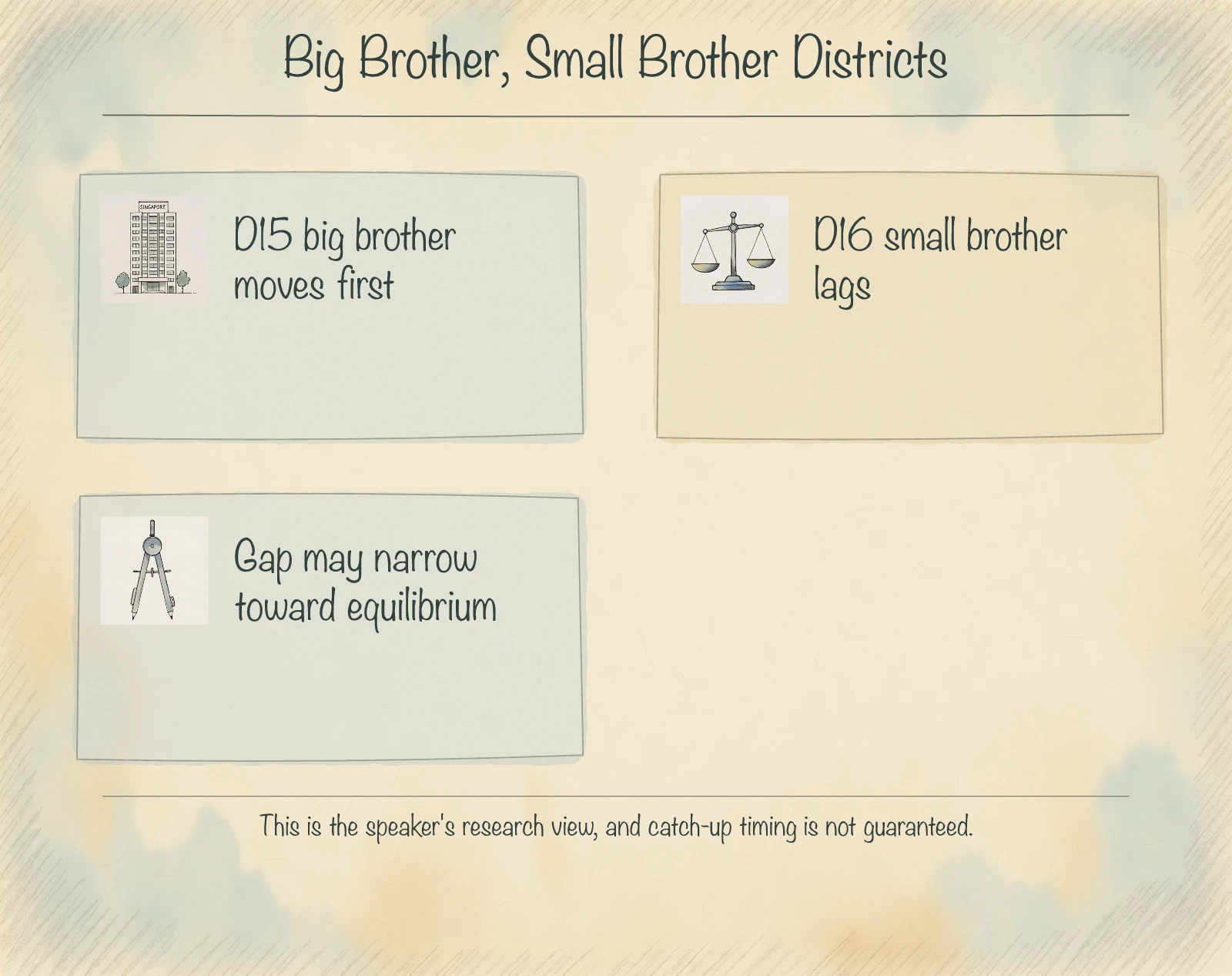
So I'm going to introduce you a concept today; it is called the big brother and the small brother. So D15 is like the big brother.
D16 and D14 are the small brother. And the behavior is that sometimes the big brother moves a little bit faster and the small brother has not caught up yet.
And when the small brother has not caught up, this is an opportunity for investors to look at it because it will eventually go back to equilibrium.
There will always be a same amount of equilibrium gap between the big and small brother, but at this point in time, based on our research, we realize that the big brother has moved out too fast over the last few years.
So it's time for the small brother to shine. And D16 has about 171 transactions in the last 12 months, from May 2024 to May 2025.
Average transacted price is about 4.6, because there's of course a lot of movement for interterrace as well.
So let's have a look at the generic D16 map. So D16 occupies the space all the way starting from Bishan — and then of course it hits towards the tail end of the reservoir, coming back to this portion here, and then we close off at the Upper Changi Road area.
However, just to break it down a little bit more, we start off from the Bishan region over here, so basically you have Sennett — this is a high sloping land ground — and then of course you move to the Kew Estate, Lima, Bedok Ria, Eastwood area, Bedok Walk, and of course now we are at the Piccadilly area at Didad, alright?
So this is the first portion. And then of course, when you move to the second portion, this is where you have Jalan Ain, Laowood, you have Harvey Crescent, Sunbird, and then you move on to Meragi, its view, and Sigao Walk.
So you have this few particular enclave over here.
Now of course, when you look at D16, it is rather big, alright, and based on popularity there are certain kinds of popularity — later we slowly deep dive into it — but end of the day every enclave has its own audience.
Alright, it is a matter, sometimes, about your entry price, that is very important. So when we look at this, this is basically the key comparison between 16 and 15.
So D15 has a total of 9,000 overlanded plots, and then D16 have about 5,800. And let's talk a little bit about the semi-D homes using our disparity effect.
So what is disparity effect? Is the big brother and small brother theory, right.
And for example, where we were doing the D28 clinic, this is how we usually plonk in the categories to hunt for disparity between the different types of interterrace. Now, at current state in May — now, at this point speaking — these are the asking ranges for D15 interterrace.
Okay, so D15, almost they are meant to be tear down.
Cat 1 Interterrace Demand and District Shifts
Between $4.2 to $5 million if you try to hunt for something in the market. Recently Christina and Jess Lee, they are outside of one of our landed consultants, they conducted landed interterrace at Kembangan.
It was quite shocking because that home I think valuation is at about 4.2. They did a one-day open house, 26 groups came, cat 1 home, and the whole road was jammed up, and then they received nine offers in the evening, it was sold at $4.6 million.
2,000 square feet, very mega-sized longish interterrace that belongs to a cat 1 home. Now in my perspective as a buyer, I think cat 1 home, the owners are asking a little bit higher right now.
It is a little bit overpriced, alright, in my context. Alright, so I'm speaking as a buyer's point of view because when you want to buy something, I become very stingy, right?
But if you want to sell any properties, we can sell any properties. Alright, we'll find a way to position your properties.
But when it comes to buying, I'm a little bit more strict.
So cat 4 homes go all the way up to $6 to $9 million. Some of them are very mega big interterraces.
Now when we look at interterraces, we try to buy the correct size. Alright, so one key thing about interterraces, most of them start at about 1,605 square feet because the minimum requirement is 150 square meters.
But of course when you go to the east, there are some landed properties at 1,000, 1,000 square feet. But at best, if you hunt for interterraces, try not to go for mini landed.
Alright, so for example at Upper Thomson, Jalan Hari Raya, there are mini landers at 900 square feet and 1,000 square feet. MacPherson has 900 square feet.
We try to avoid, alright, because these are the outliers, alright. We try to go for more standard size, 1,600, 1,810 plus minus, but we also don't want to go for too big.
We don't want to go for 2,000, 2,000 square feet because it will cross to the next class of corner terrace and semi-d. Because semi-d starts at 2,152 square feet.
So we try not to go into a cross boundary. Alright?
Why? It will cause confusion for my next buyer.
Because when they want to buy my interterrace they will think about, should I just buy a semi-d? Okay?
Now semi-d prices, D15 now. Category 1, you will be able to find 6 to 7 million.
Category 4 all the way from 9.5 to 15. Of course D15 has a range of strength all the way up to Mountbatten and Goodman era.
There's more expensive, more classy. Of course the tail end, Opera, is the lowest quantum but Opera is very close to Bedok already.
So these are the range of prices for semi-d now, category 2, category 3, and then when we look at D16, D16 interterraces 3.8 to 4.5, you can find category 1, category 2, 4.5 to 5.5, cat 3, and then cat 4.
And then for semi-ds, 4.5 to 5.5, you can still find 5.5 to 6.5 category 2. Homes that are more renovated, 6 to 7.8, and then cat 4, there are some very low quantum.
You will notice why is it that sometimes brand new for developers, the price is about the same as the resale market, is because developers buy bigger detached, sub-divide. The land is an entry-level land, 2,152 square feet or 2,000 too.
So the land is smaller, the quantum is smaller. Okay.
So we want to put it together. Last year in 2024, 16 being the orange color bubbles, 15 being the purple color bubbles.
All right. 2024 it looks like this.
All right. And then in 2025, it became like this right now.
Alright, so when you see this movement here, the big brother has moved up quite significantly because previously if I want to buy D15 cat 3, maybe I can still, um, sorry, if I want to buy D16 cat 3, maybe I stretch a little bit more I can still get a cat 3 in D15, but now I cannot already.
Alright, now I have a budget of cat 3 for D60, I can only buy cat 2 in D15. So the bubbles have shifted up pretty significantly this year.
Okay, and what's going to happen next year is that I forecast it is going to look like this. That means there's going to be a little bit more balance.
That means D15 might still go out a little bit but there's resistance already. I can feel the resistance on the ground because very hard to go for entry quantum semi-d or interterraces.
Alright, D15 might still go out a little bit more but I believe the small brother will catch up. Alright, a lot of people are starting to hunt right now in the small brother district, example of D19 last year moved up too much, now people are buying D28.
Last year D15 moved up too much, now a lot of people are looking at D16, so I believe you will shift back up, the equilibrium will be a little bit more balanced.
Bottom Pressure and Subdivisible Detached Land
Alright, and so this is the final chart for this year. Alright, 2020-25.
Okay, you can also get this from our consultants later. Now, there is also some pressure from the bottom.
Okay, what is the pressure from the bottom? It's pertaining to the new launches' pricing and also resale condo sellers asking for future price.
Alright, so a lot of resale sellers now, because they are always thinking, if I sell, what can I buy? It seems that I cannot buy anything.
So I need to ask for a higher price. Okay, so the buying power triangle for condos usually peaks at this apex here.
Once it hits three and a half million, the buyer starts to go into a dilemma. What is the dilemma?
It will come from here. So they will always think, I've got three and a half million dollars, can I stretch to four to go up to maybe a cluster landed or an inter-terrace?
They will always think about that.
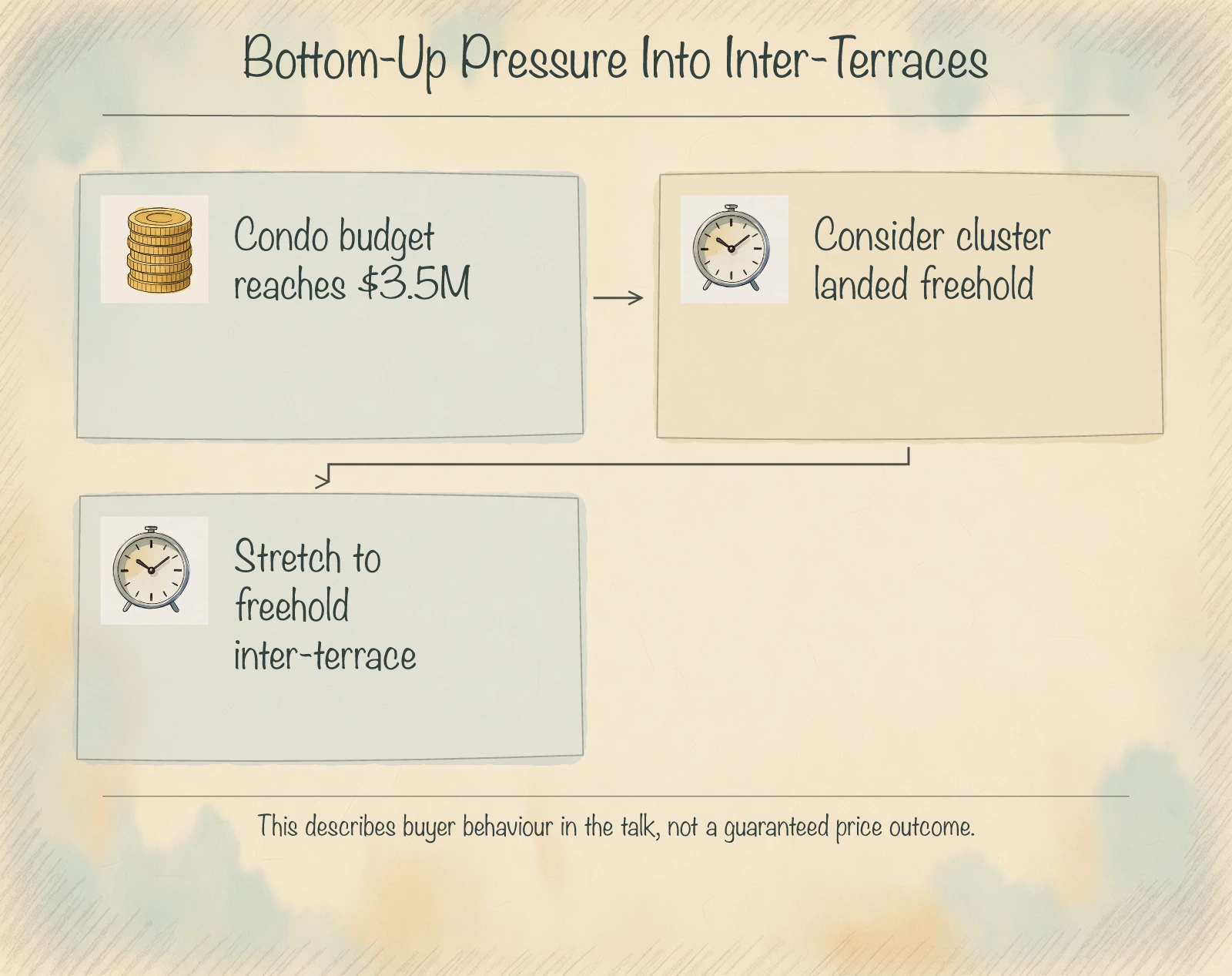
Because maybe somebody has a buying power of three and a half million but they're hunting for four to five bedders, but it seems that every four to five bedder is also three over million dollars. Might as well stretch a little bit to get like a freehold property.
Okay, there's some disparities between the zones as well.
So if you notice, usually when somebody maybe they are looking for a new launch 99 years of a four or five bedder at three and a half, they will also start to think, should I don't touch this, go for a cluster landed freehold and then maybe stretch a little bit more, get a freehold inter-terrace.
Okay, so this is the bottom-up approach. The pressure comes from the bottom.
It comes from the resale condos, the newer TOP, the brand new launches, and then people start to hover into the strata landed, into the inter-terrace. So because of this bottom-up pressure, inter-terraces usually rise up when there's a lot more pressure coming from the quantum perspective.
And of course now, if let's say the top perspective from the semi-D is also moving upwards, then what's going to happen is that this gap will then start to lengthen in the next three years.
So sometimes when we look at this, considering what we have just shared from the start to now, the harder asset classes, until what we have shared till right now, there are usually opportunities in every season.
So let's say for example, if you're thinking to get into the landed market, this might be a good kind of season for you to look into it.
Alright, so let me just come to the first case study. Okay, now first case study: if you want to hunt for landed, always take note of land plot sizes, very, very important.
Some of you here might be keen to go into detached properties. These are some of the ground kind of field that we are getting in the last two years.
So just take note of this. If you want to go for detached, it might be safer because now prices are not low.
Look for detached with subdivisible capabilities. Okay?
Subdivisible means that if I buy a detached now, I might not need to do anything. I don't have to subdivide myself, but at least I own a subdivisible detached land plot that in future somebody that buys over can subdivide.
Why? Because I want to have one more buying audience.
Okay, so recently we just launched this Springleaf. I'll just give you an example.
Alright, so this is a huge detached plot, D26. Anyway, D26 is a small brother, but it's also rising up.
Okay. So as long as you have that ability to allow the next buyer to subdivide, you're owning a very good plot of land, because there's a lot of options.
And when it comes to options, how do we usually think about it, is that even if at any point in time you want to press a button to subdivide yourself, you can always build to sell one, take the profit to offset your own.
Alright, so your own semi-D that you're staying in, right, you can just take the profit and offset it, it becomes cheaper for a brand new house.
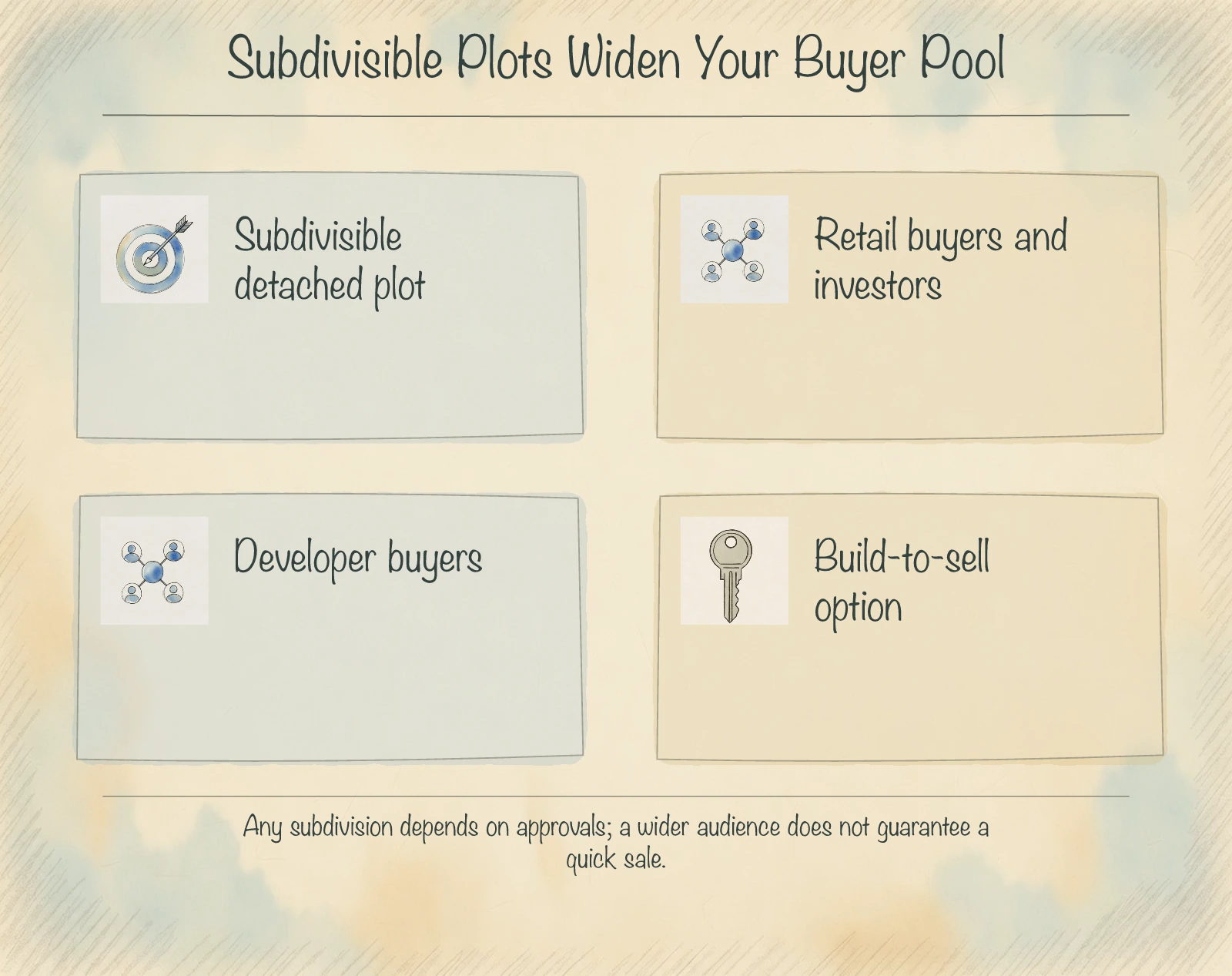
Okay, we recently sold this to a developer, so basically this is subdivisible into two corner terraces and inter-terraces. Okay, so when you sell to certain developers, developers make decisions pretty quickly.
They have their own architect team, and one of the key reasons is because when you go into detached, the quantum is very high. If you're only depending on future retail buyers and investors, sometimes the speed to exit becomes a little bit slower, but when you open up to developers, you have an extra set of buying audience.
So this is just for people who are thinking about detached hopes. Always try to hunt for subdivisible land.
Now let's have a look at the second case study. So which one will you buy?
Let's say you're contemplating between a detached and a semi-D. So you saw a semi-D here at D16, $7 million, 3,005 square feet, 325 square meters, with 10 meters width, 32.5 depth.
Detached versus Semi-D Value Comparison
Meters, with 10 meters, that's 32.5. And then you saw a D-tach, $9 million, bigger land, 4,306 square feet, 33 meters depth, 12 meters width.
Which one will you buy? Difference about $2 million.
Maybe take a minute to ponder. No right or wrong.
Why? Because you can always tell me that I love this, I just love the land plot, I love the house.
There's no right or wrong. But if let's say we come from a value perspective, one thing to note is that if you're buying entry-level detached homes, semi-D sometimes could be a safer option.
Why? Let me share with you.
It's the same. Alright, so when you go for entry level, I call it entry level because minimum plot size 400 square meters.
Alright, but actually if you look at the depth there's no difference, one 33 meters, 32.5 is the same, the feeling is the same. The width is sacrificed with two setbacks at the side, of course the back also has two meters setback, front car porch 0.5 meters, alright.
But what I'm talking about is that the internal width feels exactly the same as a and you can save $2 million. Alright, so this is just an example.
Try not to be very emotional of having that detached status. We have a lot of owners that own mega-sized semi-D.
They can convert to detached. They don't convert because when you convert to detached, you lose more build-up area.
They maintain as a semi-D. Alright, so even though this is the highest status, but sometimes when you want to sell, buy a wallet and they say, why does it feel small?
Alright, you don't want that kind of thing when you want to sell. So this is just something for you to take note.
Also, take note of the buying power triangle. I call this basically the first, the pristine landed tier.
Take note for small brother district. The moment we hit past 9, 10 million, the so-called exit speed starts to lengthen tremendously.
Because why? The big brother hasn't really gone up a lot yet, until everything is 10 over million, 10 over million, 10 over million.
So when you buy into a small brother district, you want to take note of basically this apex triangle. So we try our very best to keep within $8 million, especially for semi; now you can still find something at 5 plus, 6 plus, very safe entry, but we try to cap it at 8.
Alright, so same perspective of a buyer, right? If you own something more than 8, I'm not saying that your house cannot sell, alright, but I'm just saying if you want to buy something we try to keep it within this range.
Why more than this range? So I give an example: I buy something at $8 million, now I value add $1 million A&A, three years later out all the sell all the side 11, 12.
My next buy will think 11, 12, should I go D15, should I go D21? So I try to hunt for something in the core central region.
So you get all these kind of objections already, alright. Now let's talk a little bit, okay, so this is a dilemma zone that I'm talking about.
Basically once I cross it they will start to look for a big brother kind of district, okay, so try to take note of this.
Let's talk a little bit about charts. Okay.
Now charts, charts are boring. Okay.
But charts give us a lot of insight sometimes. So I've broken it down to basically some of the explanation that when you take home with you, easier to understand.
So this is the current market inventory. We extracted everything from PropertyGuru.
We try to see for all the duplicated listing. This are the current number of listings in the market.
Alright, so there are 384 listings of semi-D inter-terrace, 92 listings detached, 90 corner terrace, 65. Now my rule of thumb, I try my best not to touch corner terraced.
Okay, if I want to buy inter I purely buy inter. If I want to buy bigger I go semi.
I try not to go sandwich class unless it is a very good deal, okay, unless it's a very good deal. What does this show us?
If you are hunting for semi-Ds you have negotiation power because there is a lot more listings in the market, I believe, based on the pricing mechanism. Now there's a lot of opportunities here, but there are chances to step up good deals in D16.
Now we are also seeing lessening of below $4 million, but of course this includes the entire property growth, but we only see for triple NIAs freehold properties, we don't see for basically all the 99s property. Alright, so take note in basically D16 area there's a batch of, the batches of 99 years landed property.
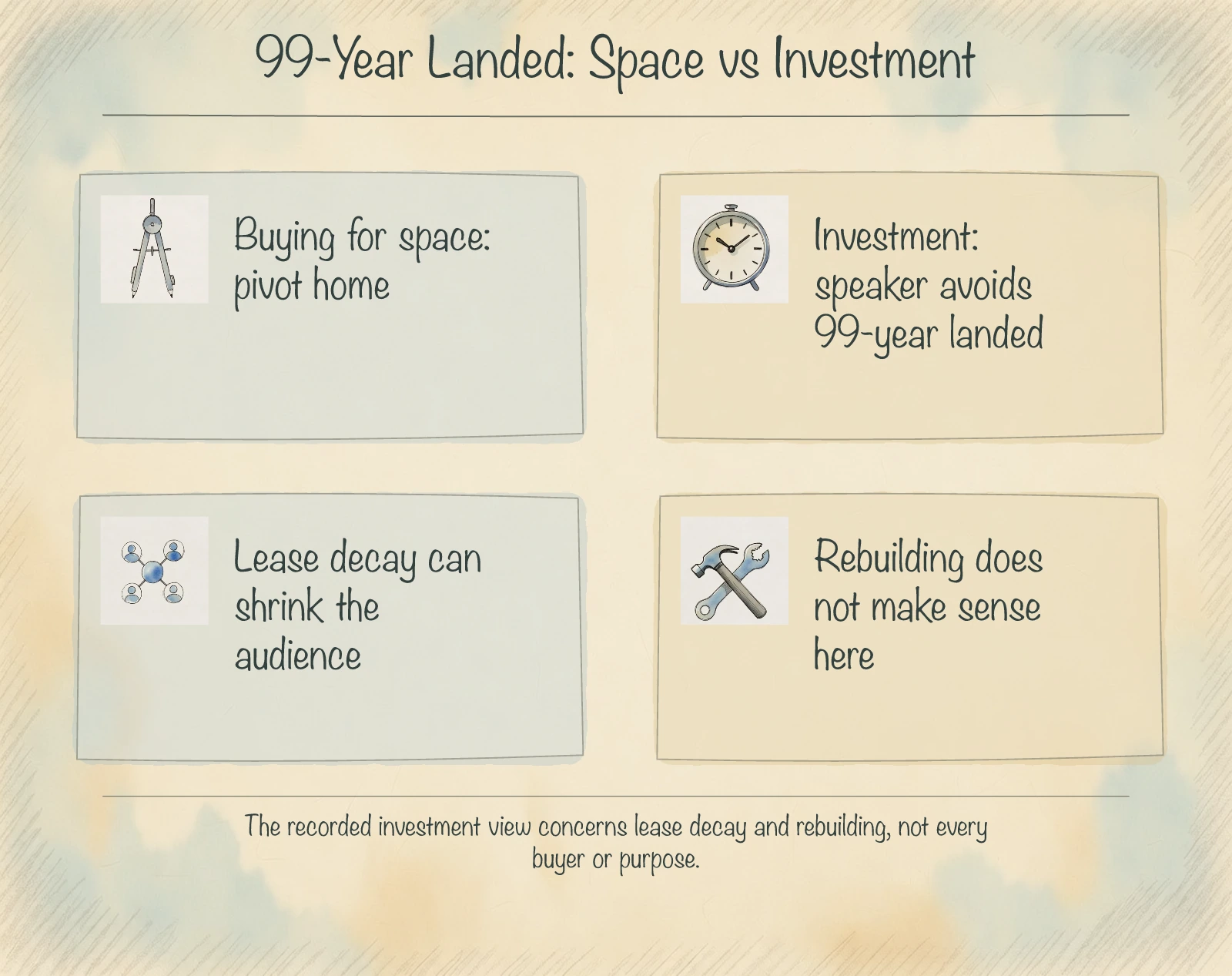
Okay, 99s landed property, perfect if the buyer has a limit of up to $3 million. They are in a dilemma between a condo and a landed, which is all fine because we call this the pivot home strategy.
That means you just want to buy for space. It's not so much
Avoiding 99-Year Landed and Price Trends
Of an investment, alright? But when it comes to investment, as much as we can, we try to avoid 99 years.
We have this framework called Exit Before 65 because once you hit below 65 you will start to see the weakening of your valuation. There's really a batch of 99ers landed.
I think they have about 10 years left. They're all going for below $1 million.
So don't test the SLA system. It will really go to zero.
I think for condos 99ers is safer. Landed 99ers more risky.
Why? Condos 99ers even though left 40-50 years still have a big audience because there are retirees that wants to buy.
Okay, single-level floor plate. But when it comes to landed, your audience will shrink tremendously and you also cannot tie down a rebuild.
It doesn't make sense.
Okay so basically inter-terraces, you can see that the asking quantum is also moving upwards. Corner terraces not a lot of listings but there are still listings between $2.4 to $6 million.
Semi-ds, semi-ds, this range I think is very attractive. 5 to 6, very attractive if you can get something.
Most of them are category 2 homes. You need to A&A, you need to rebuild it, but you can buy based on the quantum price, get the land first.
Alright, in future you can do something about it. Detach, we try our best not to touch anything from this range onwards.
The quantum is a little bit high. Of course a lot of them are brand new cat 4 homes, but to me the quantum feels a little bit high over here.
Of course if you can get something around this range, by all means. About $7-8 million by all means.
So, inter-terraces movement, basically there's a reduction for listings below $5 million. There are increment in terms of people asking $6-7 million already for inter-terraces.
This is rising price expectation. Corner terraces also dwindling asking listings below $6 million dollars now.
The stability is about about here, about five plus to six, then basically for semi-ds the amount of listings increase basically for six to seven million dollars, so sellers are also asking between that range but you can still find listings around five to six.
So this five to six listings pull, I believe it will be absorbed maybe in the next 12 to 18 months, okay, because a lot of buyers are hunting for this category. Inventory movement, these are for detach, and then of course transaction volume.
Inter-terraces still let the volume basically between first gen to first gen 2025, okay. So terrace houses are always the most liquid.
Landed property price index, I don't have to explain much on this, but transaction volume based on what we have seen, D16 now ranks top five.
Alright, it used to not be the case, it used to always be D15, D19, D15, D19, but D16 had risen up basically in the last few quarters based on what we have seen, so it just shows some popularity in terms of strength, and D15 naturally you will always continue to outperform this for the detached segment, but then D16 now has a little bit more undervalue property.
Alright. Okay.
So I will just move past this. Okay.
So D16, this is a chart that you can have a look at along the years. Now I think D16 semi-D which is a focus for tonight, there's a lot of advantage that you can hunt for.
Okay. Let me move basically to this part.
Okay. Let me invite Josh up.
Come, George, let's give him a round of applause.
So George is going to share a view, some specific case. So George, later when you come to the page of the what to avoid, what to buy, let everybody take photo.
Okay, thank you Melvin for catching me a bit unprepared. Okay so what we're going to do is we're going to dive deeper in terms of the numbers just to showcase to what Melvin have talked about.
So let's dive deeper in terms of the pricing for detached, semi-D as well as inter-terrace within District 16.
So in this chart you can see three different lines. The blue line would then be District 15 which is a big brother, and then District 16 is a red line.
Why we want to look at District 19 is also because District 19 has the highest volume in terms of the landed transaction. Right now detached is hovering at about $1000 PSF gap and the gap is widening.
This for detached. For semi-D it is hovering at about $600.
So, transaction volume hasn't been very high for all the landed properties within District 16. We'll touch on that later on.
Terrace has been steady at about $200 since 2023 until now. So, that is the price trend for detached, semi-D as well as inter-terrace.
When we try to call the data from URA, what we notice is that there isn't really a lot of new sale that is happening. Part of the reason could be because maybe what we envisioned is that the developer holds the property and then after that sell it and categorise that under the resale category.
Developer Land Buying and Case Studies
Hence it couldn't be reflected over here. But based on what we understood and we transacted a few units, especially selling some to the developer, all these units have already been transacted.
And what we are seeing right now is that in fact the volume is increasing. We saw one plot in Merraghi and then further down the road at a Long Jalan program is also the same developer that actually bought up the unit.
The exact reason that they mentioned is because District 15 prices have moved up and they want to start to move towards the District 16 area. So I'll show you some case study over there.
Let me just share in terms of what is transacted between the resale and the current asking. So resale as per what we've seen just now for DTESH is holding at about thousand two.
Asking is close to about 1100 PSF and upwards. Some are of course asking as a higher price point purely because maybe their land size are on the smaller side hence the asking PSF is high but we all know asking is always asking right.
So SEMIDI is transiting at about thousand four asking from 2004 to 2006 lastly for Terras right now is at about 1008 inches of the transector.
So if you take a look over here we break down into three different categories inter-Semite as well as DTESH and then comparing that against the black line which is the overall market.
So Terras house naturally is already trending on the higher end in terms of the PSF but again the opportunity lies in the Semite as well as the DTESH. Transaction volume district 19 always lead interns of the volume followed by 28, 15 and then lastly 16.
Just want to bring your attention to the transformation that is happening in and around this area. So if you're not too by now I believe all of you should be very familiar.
This is the entire Bayshore plan. So what's going to happen right over here is this has already been cast in student interns of the ERA master plan.
10,000 homes right over here, 7,000 HDBs, 3,000 private property. The first plot have already been transacted has already been launched and concluded.
So we can read the article that is written in-house by us and what this means to this entire area.
PSF had already transacted at 1388 per square foot per plot ratio. Just to give some context, this per square foot per plot ratio, unit rate is already higher than the unit rate that is concluded at Zion Road.
So just to give some context, this district 16, Zion is then of course in the core central area.
As the estimated launch price could be anywhere from 2006 to 2008, we believe 2008 will be a bit too high in this sort of overall spectrum and that might be the ones that is facing towards the sea front but of course that also comes at the road noise.
There's going to be a few more plots my opinion is this because the plot over here actually attracted about eight beats. Subsequent plots might not be so many I think in view of the economic situation right now because this was concluded actually before whatever terrorist that is happening right now.
So there's subsequent plots but I think it's interesting to see how the plots over here were then set a high pricing benchmark.
If we estimate say at about 2700 per square foot pricing, based on the new harmonized floor plan for about four beta which could be averaging at about 1150, overall price content for 99 years four beta could be in a range of about 3 to 3.1 million dollars and that will be on a 99 years condo.
Just now Melvin talked about the subdivisible plan. So for this particular plot, this is in district 19.
When we marketed this plot, price content was high. Majority of the buyers, again just to reinforce, is that buyers that are looking at this type of plots are usually maybe number one builders themselves that are able to leverage in terms of the cost and then they buy.
Eventually we craft a plan and then we sell it to the developer. Right now, this is the draft plan that they have already gotten the approval.
So this is going to be launching into the market, interterrests hovering at about 6.8 to 7 million asking and then for the corner terrace, they are all going to be asking at about 7.7 to 7.8 million. So we are still ironing out the details.
Once the detail is out, we will be helping them to market for this leather property right over here, which also means that this is going to be setting a new price benchmark if it does go through. So we're going to take a look at the landed framework.
So this is the category that Melvin talked about. Why we want to be talking about this one is extremely crucial.
This particular land plot is in District 20, transacted at about 3.3 million. In my opinion, I think that is way below market valuation.
Substation Frontage and Split-Level Challenges
Why? Because it's facing the substation and then facing the T-junction.
But what is interesting is that a few months later, the neighbour that is just three houses down sold at about 1.16 million more. So that's about 30 over per cent higher.
So there's a lot of opportunity costs if number one, you didn't market yourself or you didn't know what are the things to expect when you buy into a property, and that could be a missed opportunity cost. This is the next one that I'm going to talk about that has been marketed for quite a while.
It took the owners quite a long while to sell. Corner terrace, but the land size is too big at 5566.
So again, contact 5566, it can give you a land plot of a detached plot. This is a corner terrace, odd shape, and at the side of the house it faces at least four to five backs of the terrace houses.
So it's not too ideal. Eventually we managed to sell to a developer.
I'll touch on that later on. This is far-flung out in the area that the majority of the people might not know.
This is at Jalan Bambong. Yeah, I saw some pressure marks.
So this is at Crungy. So great, fantastic condition, category four, but again, because of the location and the lack of amenities, very hard to sell.
Lastly, on the naked eye, the majority of the homeowners or buyers might not know what are the things to look out for. So for this particular plot, there is a drainage reserve.
So what this means is that when you want to go into rebuilding work, there's going to be a lot more intricacies that you need to submit for approval; you have to follow and comply to additional agencies' requirements, and these actually sell below valuation.
So I think as a seller, you want to sell as high as possible in the shortest possible time because you want to leverage on any opportunity cost.
So this is the few houses that actually move pretty fast. So this is original condition in District 20.
So five of us, this is a great location. You can walk to the MRT station, it is one came to good schools.
So managed to sell with five offers and installed in two months even though it's in original condition, cat one. Similarly for this, this is in District 15, of course the land size is big, but that area limited supply, so in one and a half months at $4.5 million.
Same for this particular plot, so in one day basically, so 2300 PSF, quantum-wise is at about 4.06 million dollars. So in our analysis, what we usually do is we'll have these documentations that will help to look at a few key pointers.
Every house has its pros and cons. So what we usually do is we look at what is current asking, assume closing, and then from there, our main objective is if you want to buy into a property and you want to be able to sell in future, it must fulfil a few criteria.
That means number one, the kind of money that I'm putting in to increase the overall investment, I want to be able to increase the category, at least increase the bedrooms or increase the bathroom, because that will allow me to widen the audiences.
And then I need to be able to eliminate some cons and then I increase the pros. So when we take a look at this holistically, we will then be able to compare how does the overall content as well as the PSF compare with some of the category four or some of the brand new houses.
If they say today you buy into something that is say 7 million and you have to sink in say at least two and a half million, bring your total cost to about 9.5 million to maybe a cat four, but maybe there's already something that's about 9.7 to 9.8 out there in the market.
Then do you want to spend that kind of two years to go into rebuilding? Every building might not be so straightforward.
So we will always advocate to our clients to say that before you embark into that journey, not just on a search journey, but you also have to talk to a few architects and builders to ensure that you understand their scope well and where does their responsibility lie.
So these are the lists that we actually compile. So what I'm going to share with you is a few key transactions that took place.
This is at Jialang Anginla Wood. Took us about one and a half years or more to sell.
Why is that so? It's also because the land size and the buildup is beautiful.
It's not too deep into the enclave, but the challenging portion is that you have two split levels. First split from the car porch to the living area, which with about nine steps, from the living to the dining at about another nine steps.
The multiple splits doesn't allow the next buyer to easily reconfigure. If they want to install a lift, there's no way that they can install.
Sloping Land Costs and Closing Resources
The lift on the ground level they still have to install, at the second split level, number one; number two, there's no way that they can flatten. The only way that they can flatten is to tear down.
If they are going to tear down, that means they are viewing it as just a land price.
If they're going to tear down on a sloping land, that means they need to ensure that at the back of the house there's going to be a strong retaining wall to build the supporting structure to support the house at the back.
So this took us a while, which also means that we want to share this kind of perspective to you when you're hunting. So cheap and PSF low doesn't mean that it's good.
This is a case in point. Of course when the buyer, when the owner bought it, they purely buy it for their own perspective: they want the garden for their kids.
But when it comes to selling, it comes with a lot of roadblocks.
PSF is low, 1.053. What we eventually did was we came up with this landed report.
We invested I think close to about $2,000 to come up with this report. This is the triangular plot.
Land footprint is big but the building footprint is actually very small. So what we did was we spoke to an architect, we redrew the floor plan to say that you can potentially, on paper, subdivide this into two subject to your approval.
We get the costing out. We pitch this to the developer.
And what the developer does is they actually embark on the design that they actually subdivided. And this is the lamp plot as well as their asking price.
Right now they're asking at two three as well as two six; two three, of course, is the odd shape one. And this is the current setup.
So naturally, when you have a plot like this, at the end of the day what you want to do is, when you buy, if you can find a plot, of course, that is regular, that can allow you to subdivide, then you can increase the buyers' audience.
Otherwise you might face a difficult time and that will actually lengthen your exit horizon. So this is what we actually did and eventually we managed to sell to the developer.
But right now they have actually torn down and then they are in the midst of building up, and that will be the price now.
This is the exact developer that we spoke with, whereby they are moving their focus from D15 towards D16, probably because D15 the prices have run up a lot and then they view more opportunity in District 16.
And of course for developers, most of the time they look at the per-square-foot pricing and then that's why they enter into here. So there's still quite a lot of opportunities around this area.
So we have a few listings that are on our hands, and of course some of the new builds that are happening around this area — Palm Road, Fidelio, Keral — so some are in, of course, District 15, District 16.
All these pricing are good
for you to use as a reference so that you can really see how the price varies from District 15 to District 16. Yeah, so we have all these fringes, but of...
First, if you want to find out more, you can always feel free to scan and join our club for more updates. We don't just talk about landed properties but also a lot on various other topics as well.
If you want to find out more, we have the books right outside. We have all these tools that are on our website so you can just feel free to utilise the tools over there.
Otherwise, you can speak to any of our consultants later on. And of course, for our consultants, we do have various packages that you can go for.
And with that, we've come to the end of our session.