Buying and upgrading
Hard vs Soft Assets in Singapore and how to reap their benefits?
Published 2026-11-14. Adapted from the episode published 2023-04-14. Figures, illustrations and data reflect the episode’s original publication date.
Supply, Land Release and the Four Quadrants
Welcome back to our next episode of Nuggets on the Go. Today we are going to talk about supply.
Singapore is modestly increasing its private housing land supply in the first half of next year. What is happening in the supply situation in specification to the land market as well as the bedroom types of condos and apartments?
It's part of the government's approach to tackle the root cause of the current housing problem, and that's by increasing the supply of new flats rather than simply reducing prices. Gonna dive deep into some latest charts that RPLB research team has formulated just last week.
Let's hit it!
So we just completed our landed webinar at the tail end of March and thank you for those who have participated in the webinar.
We've seen a lot of attendance because on that particular day there were concurrently about 480 of you that stayed throughout the entire one-hour landed webinar, and we had a lot of questions, we had fun, we did a lot of Q&A as well as some quiz time during the webinar, so thank you for participating.
Now today we're going to dive deep into this particular topic that I have talked a little bit during the Orlando webinar but I'm going to dive deep into some brand new charts.
Let me just show you what are some of the brand new charts that we're showcasing here because these are fresh out of the oven from our research team.
We have broken down basically all the condos and apartments that were created in the last 23 years and we segregated them into the bedroom types and we did a third segregation into freehold as well as 99 years. So we grouped them according to 10 or freehold, 99 we grew as one in the red colour zoning.
Of course, the blue bars that you're seeing are 99 properties. And then we segregate them in two segments in terms of creation year of all these projects from 2000 to 2013, 2014 to 2022.
We also further broke down the landed properties from the last 22 years, in terms of 99 years and freehold as well, and also the size of all these landed properties.
And later we're going to deep dive what does this mean for you as well as segregating them into OCR, CCR, RCR region, and then we'll dive into summarize this entire episode of why understanding this a little bit more macro kind of factors does it affect your decision making whether you're hunting for a condo or landed apartment in this current season?
Of course, if you have not seen our previous banter episode, we talk and dive deep into the recent bank issues that's happening in the US as well as in Switzerland.
We talked about Credit Swiss, we talked about SVB Bank, we talked about the banking crisis that is facing right now and how does that relate to our Singapore property market?
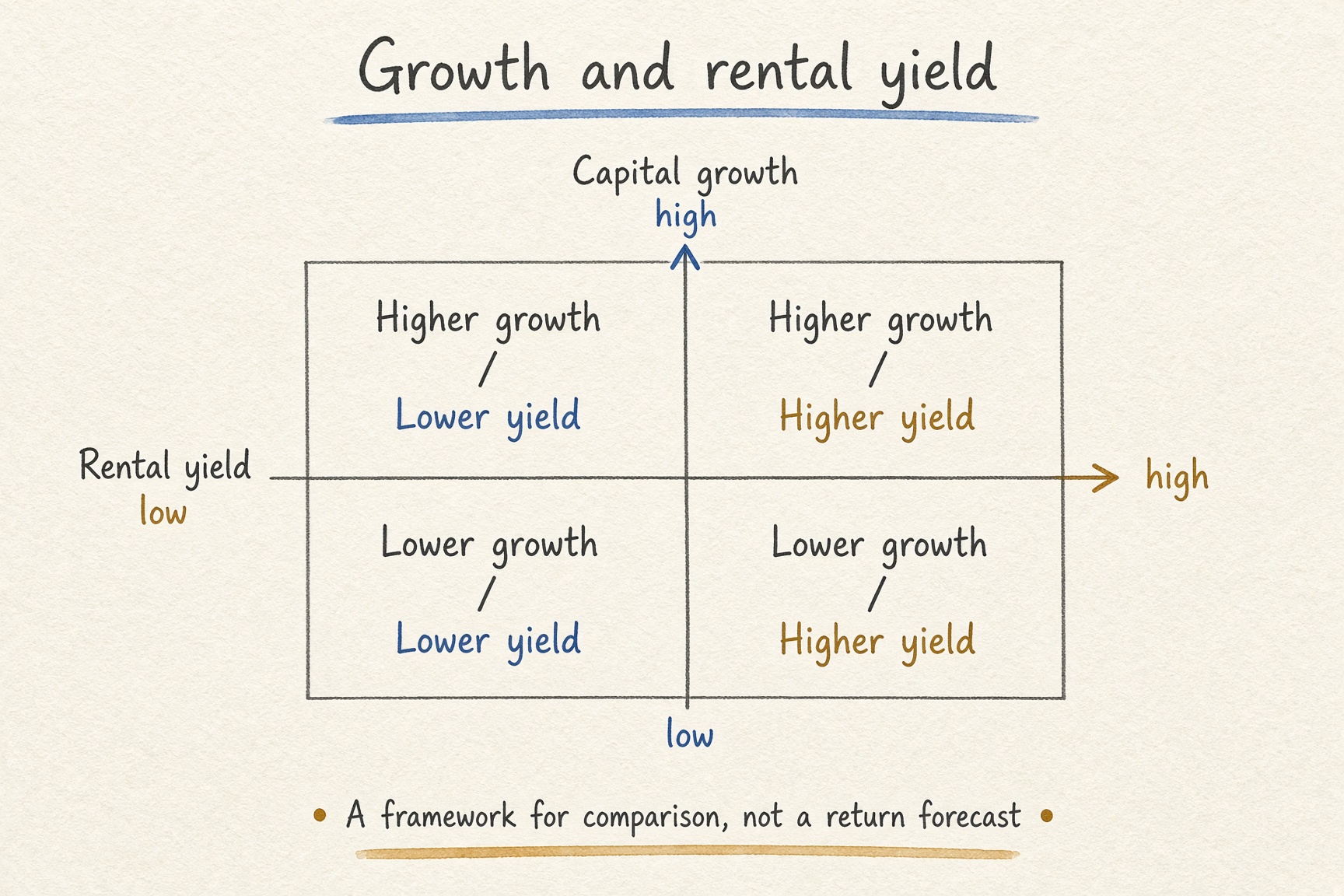
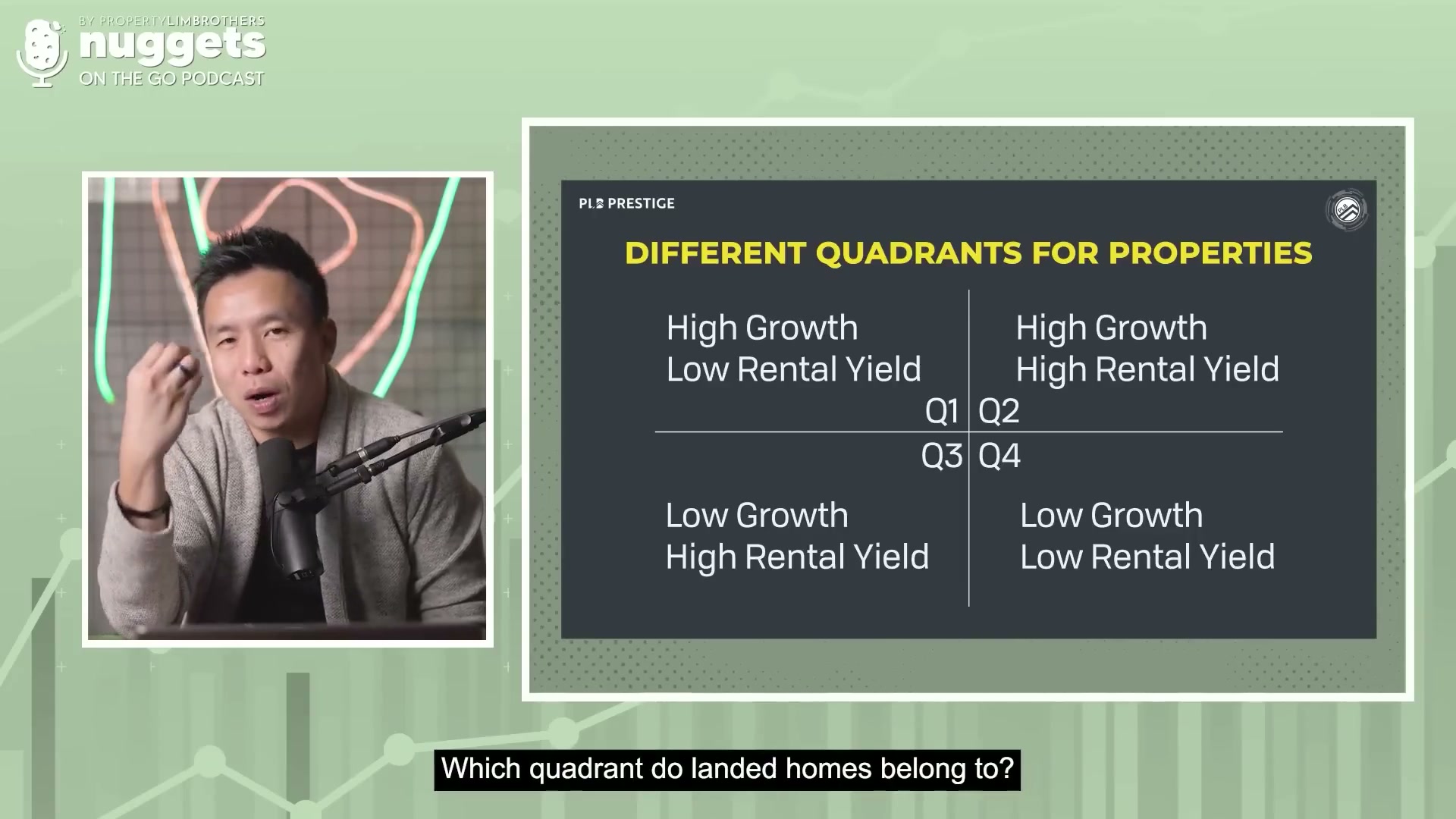
Now coming here, landed property is a very different property. So a quick understanding about landed homes is that landed as a property, whether you are buying for your stay or as an investment, it falls under this quadrant 1 category.
Now quadrant 1 category belongs to properties as a form of asset that are high growth but low rental U. That is of course pulling out from a helicopter view looking at residential properties as a whole.
Of course if you were to ask me which kind of properties has the best rental U, I would say that is HDB apartments. Why?
Because the entry price of a HDB apartment is low.
And of course for those of you who have owned two properties, if you might be holding one HDB and you are holding one private property, first of all you might be puzzled, hey how do you achieve that?
Because on the ground you might have thought that hey it's impossible to own a HDB and a private property at the same time. But yes it is possible.
There are various ways of doing it. But in summary, the way to own a HDB and a private property is by two ways.
Number one is that you have to start from the HDB route first, own a HDB, hold it for five years, fulfill the minimum occupation period, and then you can buy a second property, which is a private property. Of course, nobody can own two HDB.
You can only own one as a couple. And even if you're a single person, if you own a HDB resale property, when you bought it at age 35, at 40 years old, you can pay ABSD and buy a second property,
HDB Route to Private Property
Which is a private home, and then you can move to the private property, you can rent out a HDB. Now, there's also a second way to do it, is of course using the owner occupier method.
Own the HDB from the start, hold it for five years and of course the occupier can come out to buy a private property.
Of course that is subjected to in the event, if any HDB rulings change, you have to take note that of course this method is subjected to future HDB changes and the sole discretion belongs to HDB as well.
Now coming back to this four quadrants, HDB property belongs to maybe make a guess which quadrant and give you probably five seconds just make a guess which quadrant does HDB property belongs to, which quadrant does landed homes belong to, and then which quadrant does small condo and apartments belongs to.
So you're right if you have guessed Q3 that is correct, HDB properties fall under the category of Q3, quadrant 3, so they belongs to low growth but high rental yield. Now I'm not talking about the fact that you have waited five to six years for BTO.
Now if you have bought a BTO congratulations because BTO so far it has performed very well from the date of purchase until the MOP date when you want to exit MOP date or maybe later it definitely will have appreciated from your entry price as a BTO until your MOP date.
Of course you might have waited 4 to 5 years for your construction and you need to stay another 5 years for MOP or in all you're waiting for about maybe 9 years or 10 years it will definitely be much higher when you exit compared to your entry price as a BTO.
I'm talking about the fact that if you were to have purchased a resale HDB five years of MOP period later, in terms of growth rate, it is not as fast as private properties or landed homes. So why an HDB apartment is belonging to Q3 is because the overall quantum entry price is low.
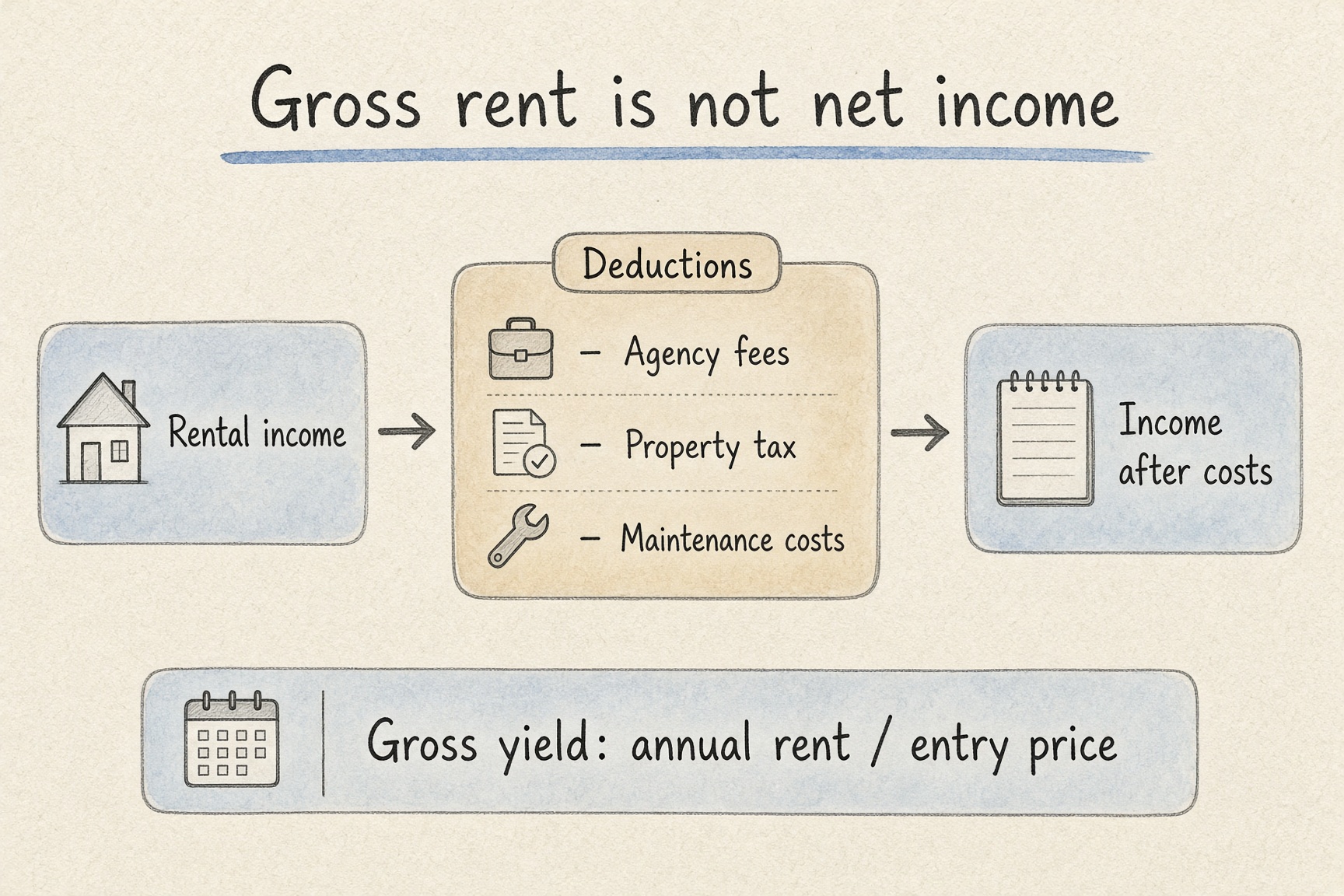
So for example, if you bought the HDB apartment at $500,000, $600,000, $700,000, $800,000, but the amount of rental that you collect every month, if you multiply by 12, and we're talking about gross rental yield.
Of course, there's various calculations to calculate net rental yield because you have to shave off your agency fees, your property tax, your maintenance fee and all that kind of stuff. But gross rental yield is considered as a very high.
You usually four to six or even seven or eight percent in terms of rental yield.
Now when we look at small apartments, some of the small apartments fall under quadrant three, some of course fall under quadrant four. But generally speaking, when we talk about landed homes, they fall under quadrant 1 because they are high growth and the entry quantum is high.
For example, you get an inter-terrace minimally for a class 1 inter-terrace that is meant for rebuild. You're going at about $3.6 to $4 million for OCR landed home.
But the rental yield definitely in conjunction if you divide by the overall entry price is going to be lower than the condominium.
So condominiums of course, they either fall under Q1, Q3, Q2 or Q4. And I will say that condominiums fall under all spectrum depending on in particular what kind of projects, what bedroom types, which area, which region are you buying into.
But that is not for today's topic. Today's topic, we will first understand a little bit about the supply factor.
And because of the fact that landed as an investment is high growth, low rental yield. But the question is that why are people still buying landed home?
Now, the reason is because if you look at the relationship between supply as well as price, I shared this during our webinar is that landed homes in Singapore has the most inelastic price versus supply relationship.
What do I mean by that? When we talk about economics, price, supply, supply, and when we talk about demand supply, there are price inelasticity, price elasticity, demand elasticity, demand inelasticity.
But in this situation, we are relating to the fact that when a price of a product or asset increases, the supply increases. Let me give you an example from top to maybe a micro factor.
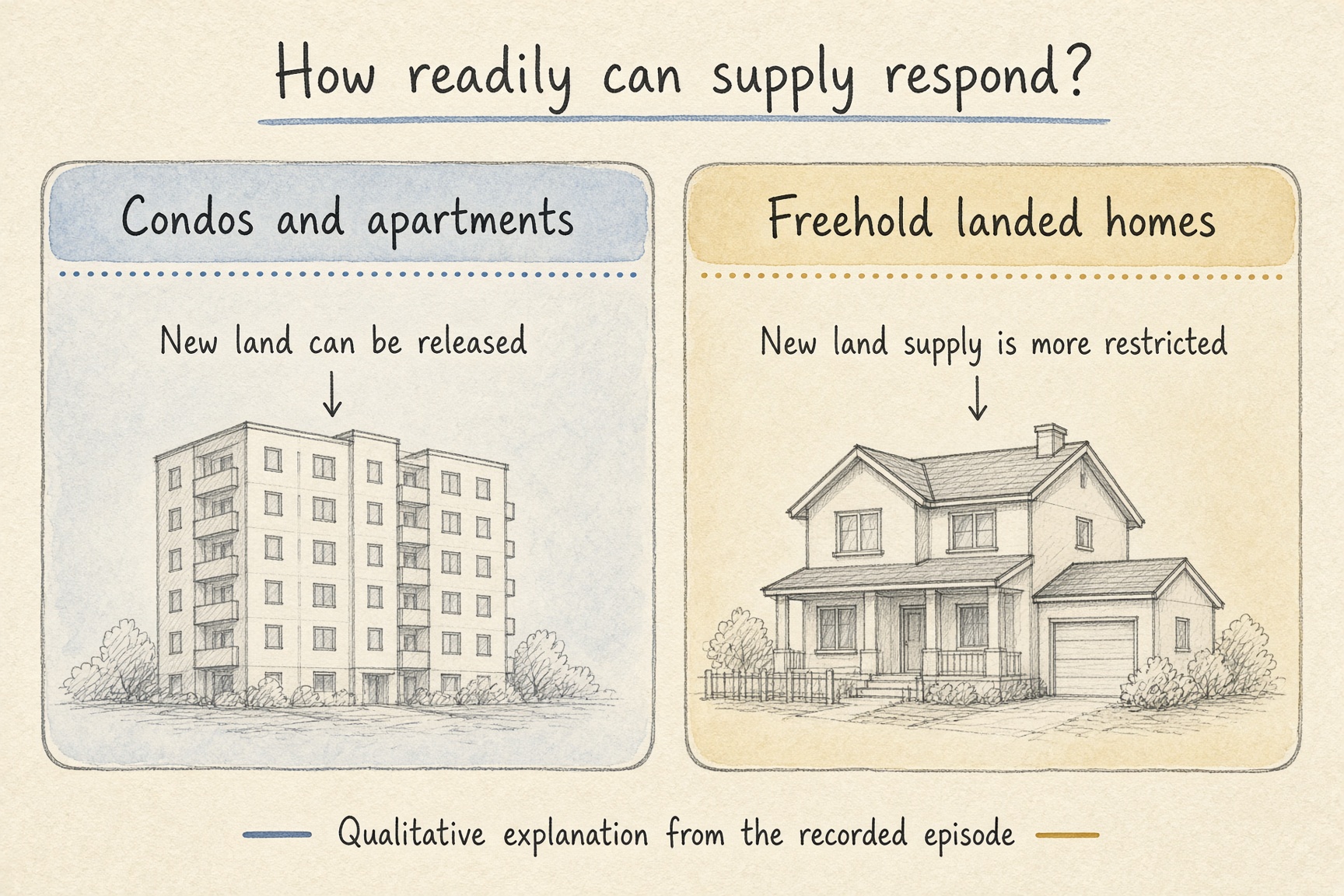
When the price of properties grow in Singapore. For example, private condos and apartments, when the prices search too fast, what is going to happen is that that is going to attract government attention to release more land.
They will release more GLS because they want to satisfy the demand from buyers as well as developers and they want to make sure that there is no extreme escalation in terms of price or they do not want a bubble to be formed.
So naturally, when the price of condos and apartments rises too fast, government will take action to release more land. Have a look at HDB apartments as well.
So let's come out one scale. Recently, of course, there's a lot of parliamentary talk about the cost of BTOs, the cost of HDB.
BTO Supply Response and the Gold Comparison
Apartments. And guess what happens?
The recent announcement is that our government is going to construct and build close to 150 BTO projects by year 2026. That is an example of the relationship between price and supply.
When price rises, supplies come in to fill up the demand so that price don't rise too fast. And that's just an example of condos and HDB.
Now let's come to another factor. Take a look at gold.
When gold was being announced in the past, there was this era called the gold standard. Gold predominantly before 1971, before the gold standard was eradicated, before US currency became a dominant global currency in the world.
So every country and every Federal Reserve and every central bank will keep gold at their vault as base currency. So everybody's currency is based on the amount of gold that you have in your central bank.
But after 1971, gold standard was removed, US dollars caused the short, that becomes the global currency. That is a whole new topic about how it escalated to today's money supply issue that we have
too much money supply, our inflation is rising so high. Let me just have a look at the latest inflation figures in Singapore.
It's at 5.5 to 6%. That's just a CPI inflation figure in the basket of goods.
But let me just give you an example of a 1971 till date inflation and a set inflation has been the major dominant issue. And how do you relate this?
Just take an example of the price of a vehicle three years ago in the year 2020. your $300,000 in the past could have bought you maybe a luxury car but your 300,000 today could only probably just buy you half a luxury car.
That's just an example of inflation of course we have COE and all kinds of stuff but it's just an example of how inflation reduces the real value of your money. Though your nominal value of $300,000 is the same but your real value of $300,000 technically is being inflated by the increase in money supply.
In the past when gold was the gold standard, a lot of gold miners flood in to create more
gold, to dig more gold, to hunt for more gold because they wanted to be part of this game and system in order to enjoy the price appreciation. But when we look at landed homes again, today's context, let's just have a look.
Landed homes are at this current graph. It has not increased since 1995 in terms of the overall landed supply.
The supply has sort of plateaued especially since 2011 until today. That is about 12 years ready of platoon and there's no more government land sales on new land.
In fact, the latest one that I've seen was this project at Haogang. That's part work collection.
I think it's fully sold already. Cluster strata home, beautiful homes, 99 years, released by government, but that was for a cluster strata concept.
That is as good as you get. You don't get large plot of GRS land for freehold triple niers, pure landed homes.
And I'm talking about pure landed properties that are freehold triple niers. You don't get debt increment in supply anymore.
And that's the reason why
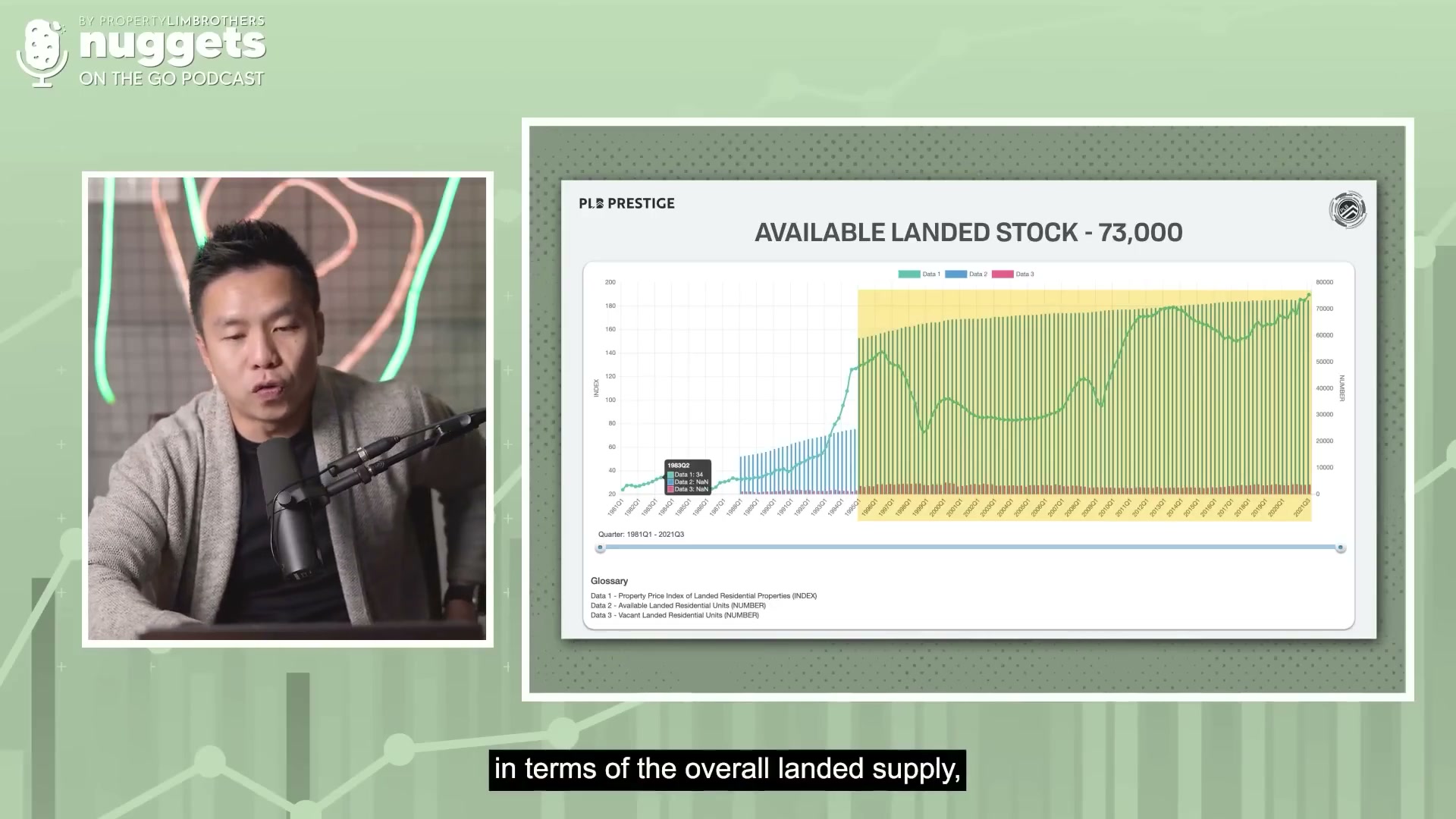
landhold in Singapore has the most restricted amount of supply. And when price goes up, price has an inelastic relationship to the supply.
Supply cannot go up. And because of this, this asset class is very different.
It behaves differently.
And when it behaves differently, it became a very, very valuable asset in the sense that if you were to hold a landed home, you are more or less assured that in terms of an asset value, it's going to appreciate stronger, better and faster through time compared to the other two asset type, which is of course, condominiums and HDB apartments.
So we are talking about capital allocation to the type of property and specifically residential properties and what kind should you put your capital in. And this is also an illustration of weaker money going into stronger money.
So in economics as well, the weak money will always flow towards the strong money. Similarly, people who have capital in weaker assets, they want to divest and switch it to a stronger asset, which is why you see that
pull and push from HDB apartments, people want to upgrade to a private property and then they want to upgrade to a landed property is because they naturally identify in terms of price upwards growth and valuation growth.
They will naturally know as a consumer, as a buyer, as a property investor, you will naturally figure out once you are in the property scene that hey, why is it condominium appreciate faster than my HDB apartment. And once you own a condominium, you realize that why is it that the landed property appreciate much faster than my condominium?
So this relationship shows in terms of the results on the ground. And that is the reason why we say that in terms of price and supply, that forms the relationship of price appreciation as well.
So this forms the rationale on why Landau hosts appreciates much faster in terms of time spend and ROI in terms of valuation appreciation. Now, so we talk about in some of our banter episodes if you are following us, I think that
Landed Supply by Size Segment
We talked in session one or two about the type of new launches that were created before 2013 and after 2013. That was because of TDSR measures — developers started building smaller and smaller apartments.
But let's have a look at landed homes. As you can see, there's a very high focus on semi-Ds as well as corner terraces, and that is of course populated by this bar right here.
We purposefully segregated this into a few key segments. Number one, 1,614 square feet is the entry subdivision requirement for an inter-terrace.
So an inter-terrace minimally has to be 150 square meters after subdivision, so we categorise it here.
2,152 square feet after subdivision — meaning that if any developers, or even yourself, were to buy a big plot of land and if it qualifies for subdivision for you to cut it out into two semi-Ds, or maybe cut it out into one inter-terrace and two corner terraces, the minimum is for a semi-D to have at least 2,152 square feet.
So we categorise it here. The minimum for a detached to be subdivided into a detached is 400 square meters, so we categorise it as 4,306 square feet.
Based on this, basically you can see that there's a very high creation volume in terms of semi-Ds as well as, of course, some corner terraces will also fall into this range.
What we want to see here is this: the entry level into a landed property market are inter-terraces.
Entry level meaning that people, usually when they want to get into the landed market and if let's say they have a first wave of requirements — firstly, I want to own a landed property, but I can only afford something in the range of maybe 4 to maybe about 5 or 4 million — then they will have to kickstart from the inter-terrace range.
And if let's say they come in with about 5 plus to 6, they can kickstart from the semi-D range in the OCR region. And we're talking largely about the OCR region, like D19, D28, some curious, maybe like Springfield or D13, you might be able to get some of these properties.
But what we are trying to say is that if you look at this, in terms of population overall, the semi-Ds and the corner terraces own a large chunk of supply. But I don't know if that doesn't matter, because we're now talking about micro already, because in totality there are only 73,000 landed homes.
Three and a half million Singaporeans can't qualify to buy that. If there were to be just 10% of Singaporeans that want to buy a landed home, you're looking at 350,000 Singaporeans that can qualify to buy 73,000 landed homes.
And take note that when we talk about landed properties, there are various groups of people. Firstly, foreigners who qualify under SLA approval — if let's say SLA deems them, under the LDA policy, that they contribute economically to Singapore, they allow them to buy a landed home; they form the first spectrum.
Number two, existing landed home owners — most of the time they do not sell their homes. They pass on to their children for legacy.
They tear down and rebuild. They might buy more landed homes under their children's name.
And most of the landed owners, because they have enjoyed an appreciation over the years, and they enjoy such a big space over the last 10, 20, 30 years, they do not sell their landed homes.
They keep it, and then they restructure their portfolio in the sense that they might buy a bigger landed home, or they might downsize to a smaller landed home.
But most of the time what we notice is that when an existing owner is already in the landed market, they tend to stay in the landed market for a very long duration. Number three, you have condominium buyers that aspire to buy landed homes.
Number four, sometimes we see HDB apartment upgraders going straight into the landed scene. And of course, when you look at that and then you look back at this supply, you will then also start to realise
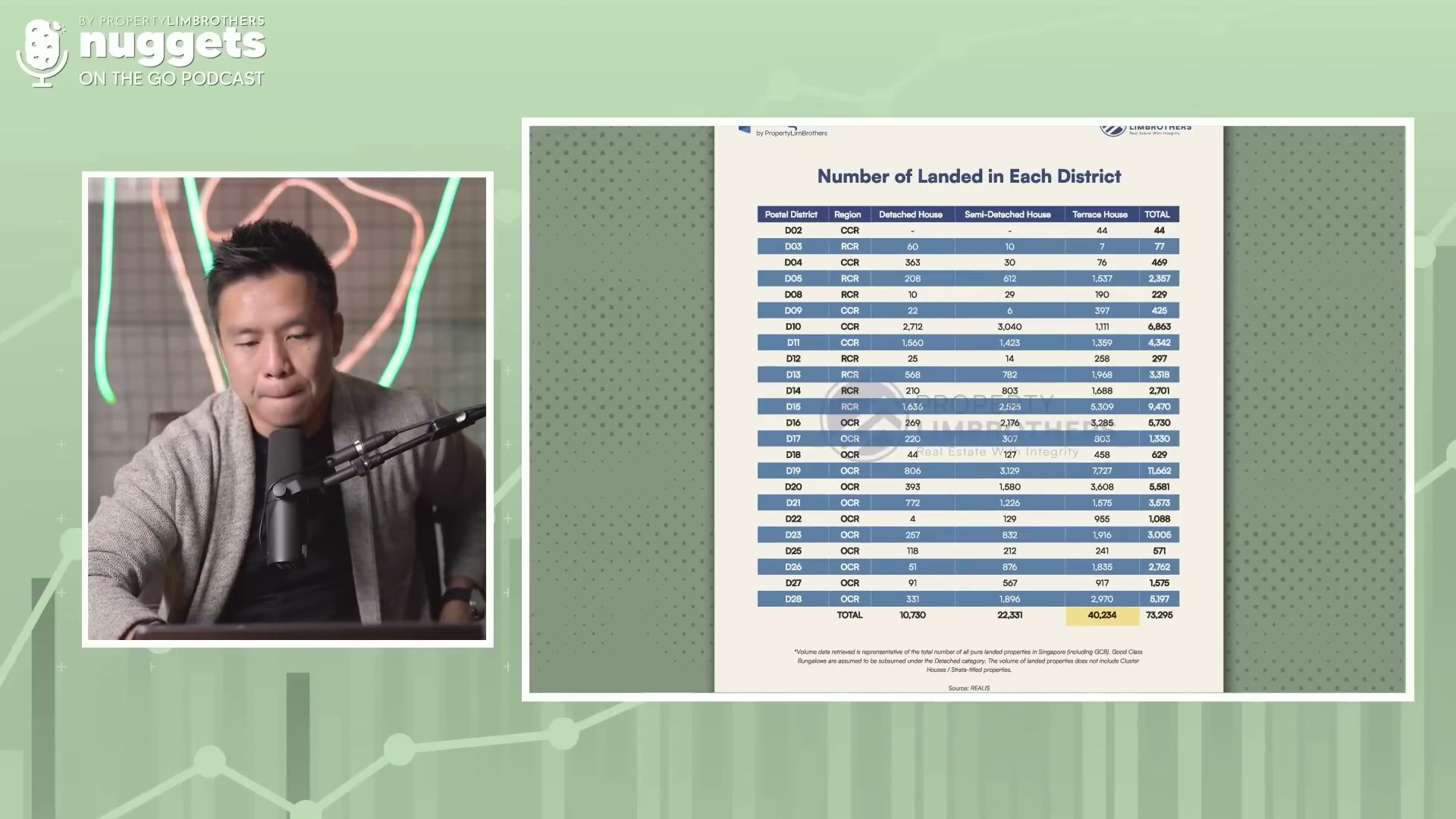
that in terms of the inelasticity between price and supply, this gets even more true when we come to a micro level. So we have this chart, which is the total amount of land in each district as well as the entire island.
So we have a total figure of 73,000 here. Let me zoom in for you.
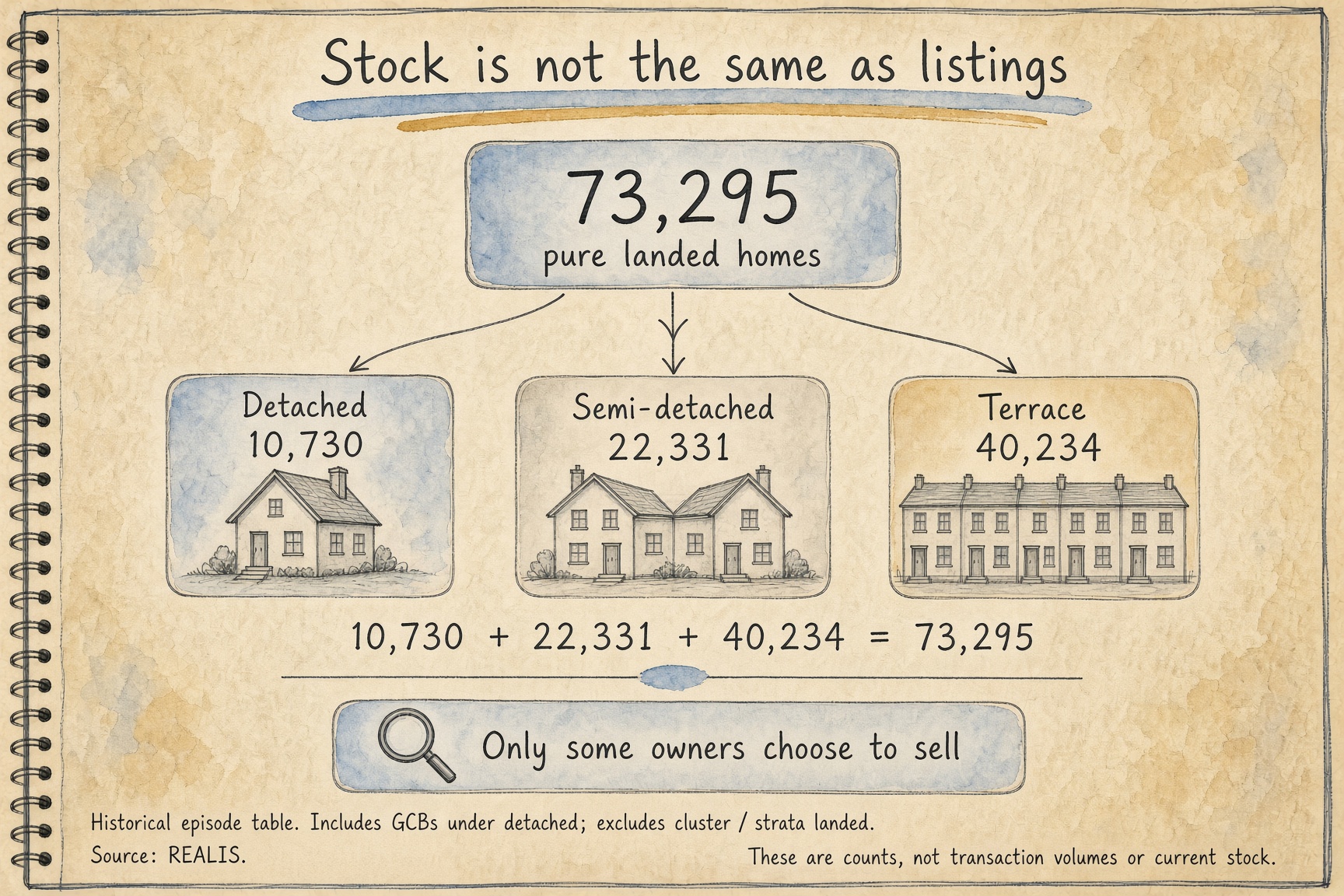
This is after we have compiled district 2 all the way to district 28. The number of detached homes falls in the range of 10,000 homes.
Semi-D homes, 22,000. Terrace houses, 40,000.
Now, terrace homes — we're talking about intermediate as well as corner terraces. And though you see that there are 40,000 homes, these are the most sought-after in terms of demand because of the palatable range.
And the moment that you want to move into a semi-D, you realise that semi-D has only about 22,000. And of course the final one, which is the most high quantum range, will be 10,000 units.
So if you break it down like this, you realise that actually there are not a
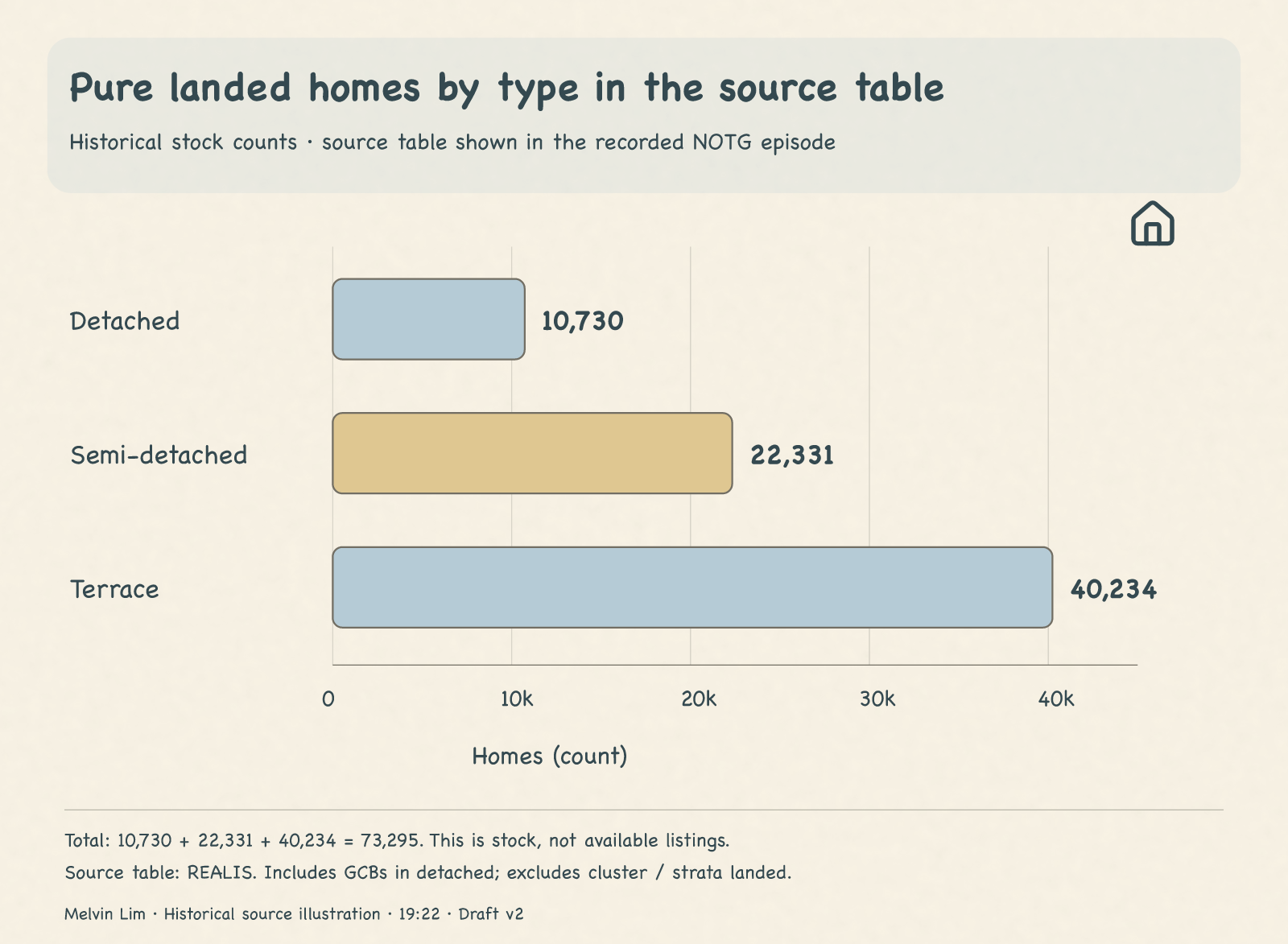
Read chart values
Historical REALIS table shown in episode published 14 April 2023; table as-of date not stated · Pure landed homes (count)
| Property type | Homes |
|---|---|
| Detached | 10730 |
| Semi-detached | 22331 |
| Terrace | 40234 |
Few Landed Choices and Closing Remarks
A lot of choices in the market, and that's the key reason why wherever you look at the landed market, sometimes you're out of choice and sometimes you realise that it's not easy to buy a home in the market because a lot of times people that already own landed homes, they have no motivation to sell unless they want to move bigger, they want to switch to a different district.
And this probably would help you a little bit in terms of ascertaining, in terms of supply and price relationship as well as supply and demand relationship because landed property is already a class of its own.
We talked about this in a lot of our Nuggets on the Go episodes before, and importantly, when you want to get into the land market, it's also very important to understand this concept, is that landed properties are high quantum properties.
So when you want to exit five, eight, ten years later, it is actually an art and a sign to ensure that when you buy something at this point in time, you have to know that this is a high quantum property, is a high quantum asset.
Though for the very fact that there is demand and there's very limited supply, but because it is high quantum, you definitely need more time to find the next buyer.
And the higher the quantum of your landed home goes, the more time it is to find a buyer because if you hold an interterrace that is valued at, let's say, five and a half million now compared to holding a detached home that is $9 million dollars.
Your potential audience that's going to buy your detached home has a nine to maybe $11 million dollars budget compared to your buyer that's going to buy your interterrace has a $5-6 million budget. It's much easier to find a buyer with an interterrace budget compared to a buyer with a detached home budget.
The reason is because firstly, 9-11 million, the audience size will shrink. There is a bigger audience size for a $5-6 million budget.
Secondly, the person with a $9-11 million budget, there's going to be more choices for them because they can hunt around for either a semi-D or a detached home at different districts. They can either go for an extremely huge detached at the OCR region or they can go for a smaller detached or smaller semi-D in the CCR region.
So when you are talking about landed entry right now, it's also very important to note that because of this few key parameters, and this too basically I'm talking about this two in terms of quantum and exit in terms of specific requirements.
There are 21 factors right here in our PW Landed Model analysis that helps our clients determine what are the right type of properties in terms of the landed market to enter into based on the current quantum investment ratio that they have.
So for example, when we meet a client that has about maybe somebody has 6 to 8 million dollars range, we use this concept called the disparity effect as well as seasons of change to how our clients determine using the 21 factors right here.
Seven factors in terms of our increasing buyer audience strategy as well as increasing price acceptability strategy and then seven factors on reducing unexpected outcome.
So basically based on this, we have our clients to determine on totality using our journey maker, and we shared this a little bit during our PRB landed webinar, is that this journey maker basically we have been using it to how our clients ascertain what are the right types of landed homes to go for in a particular district that they prefer.
So for example, if somebody would come to us and they have 5 to 6 million dollars range and they really want to buy something in D28 because of maybe school needs or they want to live near their current family enclave.
Then we use the concept of disparity effect, seasons of change as well as the mode analysis to determine what are the exact type in terms of cat1, cat2, cat3, cat4 homes that they should go for. And in terms of disparity as well, let me just give you a quick glimpse right here.
In terms of disparity, in terms of the type of homes that they should hunt for, and we call this the disparity effect across the different cat regions. We still have about two to three rounds of landed webinars that's upcoming throughout the entire 2023.
And of course, we have a landed convention upcoming as well in the mid of this year. It's going to be 6 to 7 hours event.
More details will be revealed in this link as well. And thank you for staying with us on this particular Nuggets on the Go episode.
We'll see you on the next banter episode and meantime, take care. It's a bird in the studio.
My cardigan is making me very hot.
Sign-Off Before the Banter Episode
Series. We'll see you on the next banter episode and meantime, take care.
It's a bird in the studio. My cardigan is making me very hot.