Evaluating property
Future-Proof Your Property Investments:When to Hold, Sell or Upgrade?
Published 2026-11-26. Adapted from the episode published 2025-01-20. Figures, illustrations and data reflect the episode’s original publication date.
On this page
- Webinar Introduction: Upgrade or Stay in HDB?
- Seven Reasons HDB Owners Move On to Private Property
- MOP Competition and Appreciation Examples Over Time
- Executive Condominium Appreciation and Nominal Versus Real Value
- Real Value, Asset Inflation and HDB MOP Clusters
- Supply and Demand Risk in Your Property Portfolio
- Foreign Demand and the Delayed Gratification Model
- Fully Paying Off HDB Versus Private Condominium
- Mortgage Principal, Interest and Retirement Fund Trade-offs
- Enjoying Savings, Equity Extraction and Policy Risks
- How Cooling Measures Made Prices Stickier
- MSR, Lease Decay and HDB Cooling Rules
- HDB Affordability Policy and Five-Step Framework
- Financial Planning, Timeframe and Selection Methodology
Webinar Introduction: Upgrade or Stay in HDB?
Welcome to everybody. Happy Saturday morning and very good to see you on a Saturday morning on this particular PRB webinar.
So if you have signed up for this webinar, I think you probably are somebody that is contemplating between upgrading to a private property or staying put at your current HDB property.
And of course, if you have signed up for this webinar on a Saturday morning, I also presume that you are in the stage of exploration because you might be thinking about this particular topic for a very long time and maybe you're contemplating is 2023 a right season to make this move.
A quick so-called update about what we're going to cover today. So we're going to talk about three main things.
And to kick start, the very first thing is that we want to explore this particular topic of whether should we sell or keep our HDB property.
And secondly is that, if let's say we have decided to upgrade from our current HDB apartment to a private property, be it a condominium, or landed property, or brand new launch property, then how can we do it safely in the current market condition?
Now, last but not least is that we want to talk about how to pick a good property for great capital appreciation. So my hope is that at the end of today's webinar, we can add value to you.
And a quick disclaimer is that our webinar series is basically for knowledge sharing as well as sharing my opinions in the market based on my 16 years of experience helping a lot of clients along the years in my real estate journey.
So take note that property investment as well as selling and purchasing a property is a huge financial decision as well as your family's decision. So do speak to relevant of your consultants to make this wise decision.
And end of the day, of course, real estate is a very happy thing. New home is a happy thing.
And you want to make sure that it is a cohesive family decision before you make any move.
A quick update, our brand new webinar page is up and live on proptlimbrothers.com slash webinars.
As I mentioned in our last few webinars, we're going to do 23 webinars as well as 7 in this year and why are we doing so many webinars is that we hope that through this series of education sharing as well as discussion and Q&A we can engage more together with you and also thank you for holding Proptlimbrothers over the last many years.
So thank you for the questions. Keep the questions coming during the whole webinar session.
And don't be shy, because my aspiration the solution is that we hope to answer as many questions as we can. Of course, if you have any suggestion for the things people who have been on this topic, do let us know.
Now, I want to dive straight in into 7 key reasons of why. Some of our existing clients along the years, and of course I've been real estate for 16 years.
Along my journey, I'm very thankful to have walked through the journey together with HDB homeowners, private property homeowners, landlord owners, commercial property, multiple property investors. And I myself am a property investor as well.
I have my first property was a HDB 4-room as well. When I first got married at age 24.
So I married very young, I have four children now. And of course, through my entire journey, all the way from my HDB apartment to my current multiple property investment status, I've learned over the years of the mindset.
And of course that has created a lot of empathy in terms of thinking process. And I think that through my past 16 years, I understand some of the struggles as well as the thinking process behind every different property owner.
So whether you are owning a HDB property now for the past 10, 15, or 20 years, or maybe you are owning a condominium right now, or maybe you are in the season that you're planning for retirement because maybe you want to downgrade and downsize.
I think that through my 16 years of experience, I sort of understand much better and of course I'm still learning as well together with all of you.
Now I want to dive straight into this first seven reasons why a lot of HDB owners in the past they have decided to move on from the HDB apartment to a private property is because
Seven Reasons HDB Owners Move On to Private Property
Now, let me share these seven key reasons, and I hope to share them with you. And by sharing these seven reasons, the second part is that we're going to move on also to some of the selection criteria, because I always believe that understanding macro will help us to make micro-decisions.
So in PRB our methodology is to share the macro picture first in terms of the Singapore landscape and then we come to micro selection factors, and last but not least is how to pick the right property. And that is our approach and we hope that you can benefit from here.
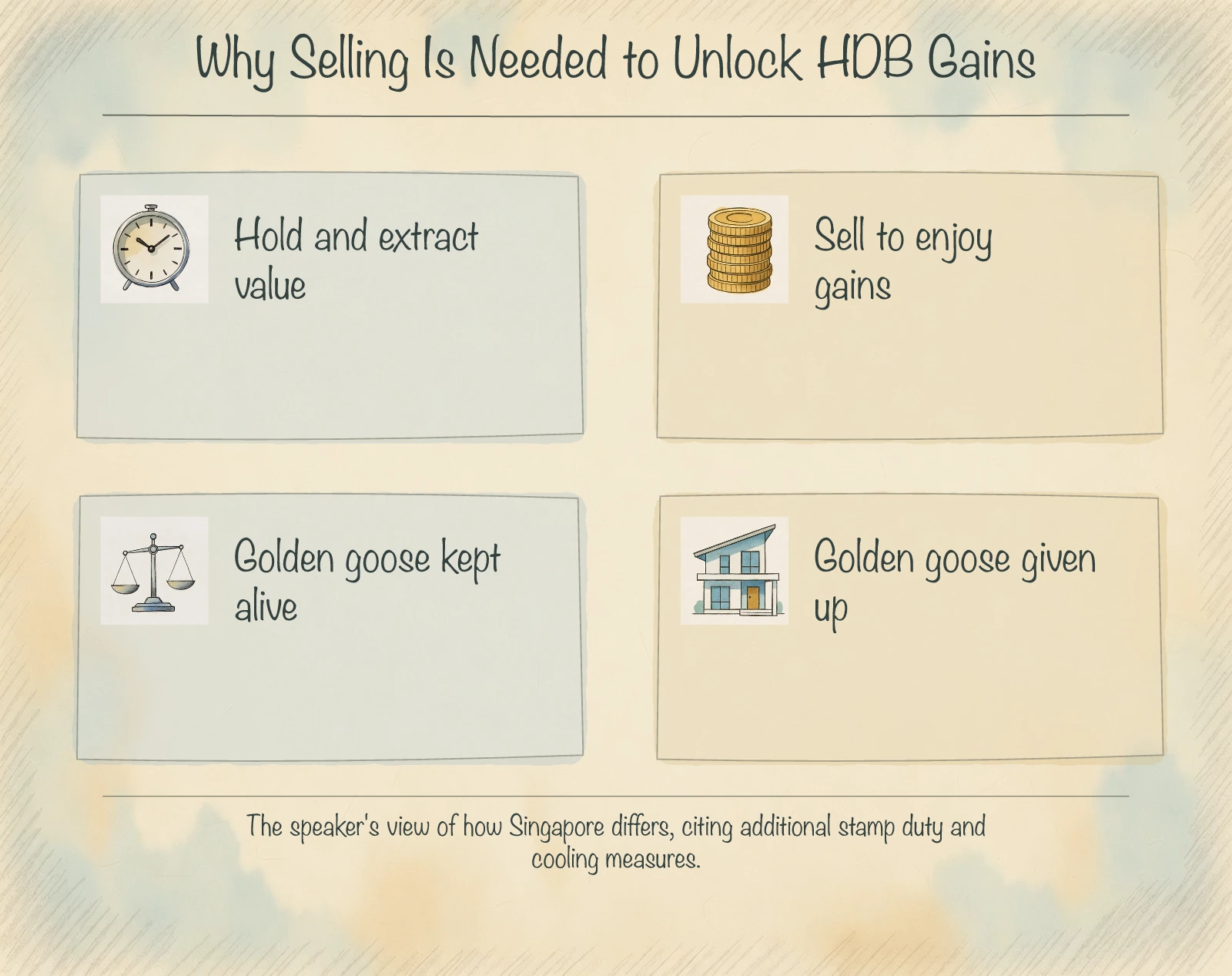
Now, number one key reason why a lot of HDB homeowners, after fulfilling their MOP, whether it's the first or second property, and if they have the financial prudency ability to upgrade to a private property, why do they want to do that is because of the Golden Goose Theory.
Now what is this? Now, a real estate owner allows the owner of the assets to enjoy his equity without killing the Golden Goose.
Now, what do I mean by this is because in Singapore, we are very different because our landscape is so small. You drive from east to west, it only takes you one and a half hours if you drive from Pasir Ris all the way to Jurong.
And in terms of the overall landscape, I study the macro factors in deep details. And we have currently right now about close to 1.1 to 1.2 million HDB apartments in Singapore.
And our home ownership rate, we are very proud of our home ownership rate because we are about 90% home ownership rate. That means out of 10 Singaporeans, Singaporeans own a property.
And that is why Singapore can prosper to a first world country status from 1965 all the way until today. And of course our government is doing a great job in the sense that it ensures every aspiring Singaporean to own a property.
Our HDB property also has a lot of pretty healthy gains over the years.
And of course if let's say you started from a BTO apartment and your property hits its resale property status after you fulfil the MOP, if you have seen gains and of course if you are doing well professionally together with your spouse, then a lot of them have successfully upgraded to condominiums in the OCR region.
Some has moved into CCR region condos, and of course after a couple of years they might upgrade to a landed property.
And of course usually the journey is that they will then upgrade, and in the last season once their children grows up they will most likely downgrade, maybe back to a condominium from a landed, or maybe back to a HDB apartment.
Of course, that is the usual pathway that we have seen.
And why I mention this is because by right, a real estate allows its owner to enjoy the fruits of your assets without you having to sell it.
So for example, in other countries without additional buyer's stamp duty, most of the property investors' mindset is that they will buy the property, they will hold it, and then when the property appreciates they extract value from the current property without selling it, and they reinvest into more properties in order to allow all their property portfolio to appreciate in tandem through time with inflation.
So but in Singapore it is a bit different because in order to enjoy the fruits of your assets when it has appreciated, you will definitely need to sell the property. And that is what I mean by killing the Golden Goose.
And of course we have all gotten used to it because we have additional buyer's stamp duty, we have a lot of cooling measures in place.
And let's have a look at this example. So this is an example of a BTO in Canberra, three-room property, that has started for sale at $187,000 to a first-hand owner that has successfully bid for the BTO.
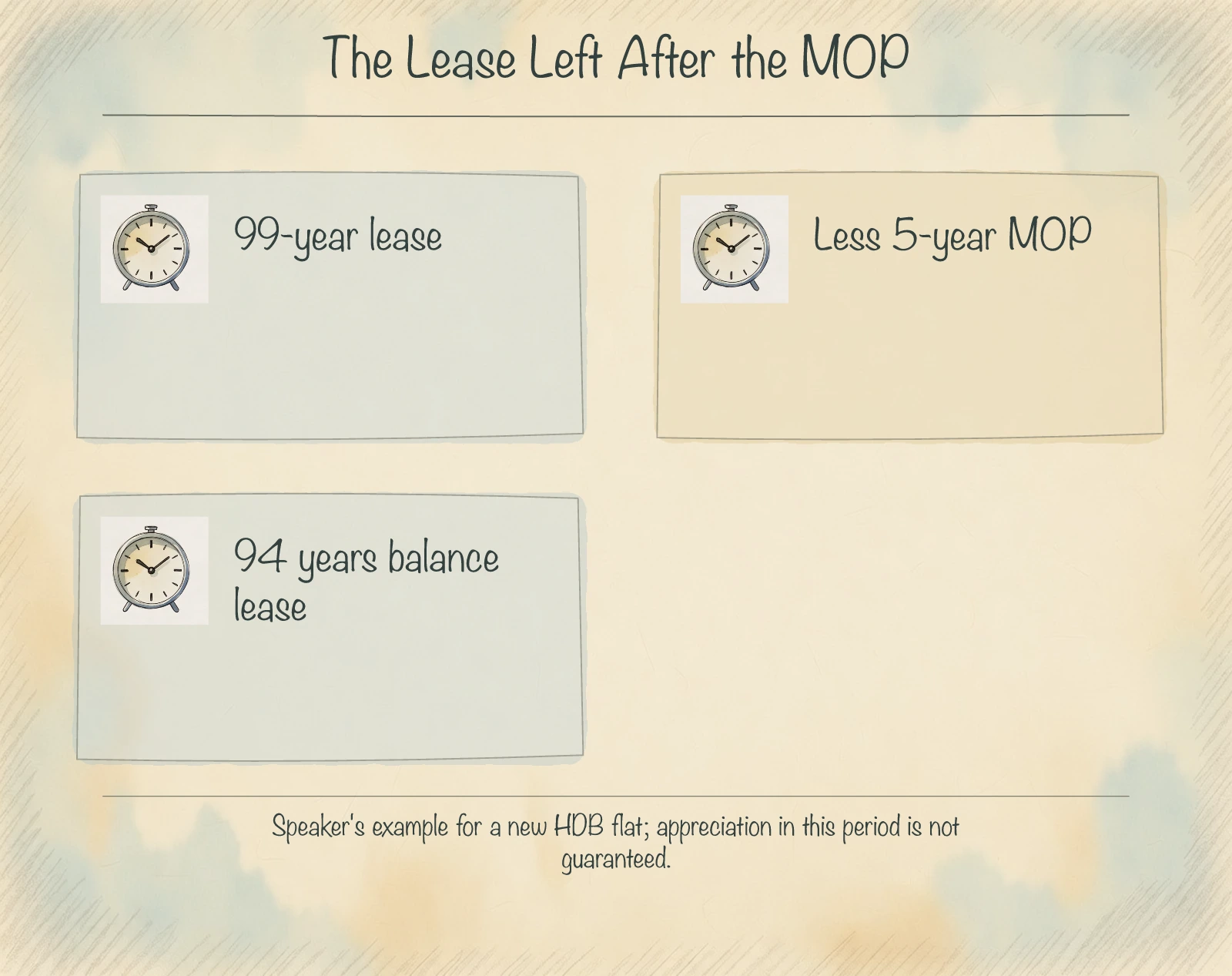
And after about four years later they collected their keys, and the moment once they collected their keys you have to fulfil a five years MOP. Now one quick nugget is that a HDB property's 10-0 and a private property's 10-0 is very different.
So one small benefit that HDB owners enjoy is that your 10-0 study starts from the date that you collect your key. So your 99 years starts from here, but a private property it starts from the land 10-0 age.
So usually when you walk into a show flat you want to buy a private property, the land 10-0 age has already started. So of course when you hit the five years period, and that is what we call the minimum occupation period, usually your property has a balance lease of 94 years.
You take 99 less of 5 years, you have 94 years, and that is one of the most prime period that your property will enjoy is appreciation. Of course some HDB owners would then decide to sell this property to the resale market and then take advantage of the gains from here all the way to here.
And most of the time if it has appreciated in this range then they will move on to the next property.
MOP Competition and Appreciation Examples Over Time
We also notice this trending that usually, once a property hits its MOP period, it will start to enter into what we call a state of plethora.
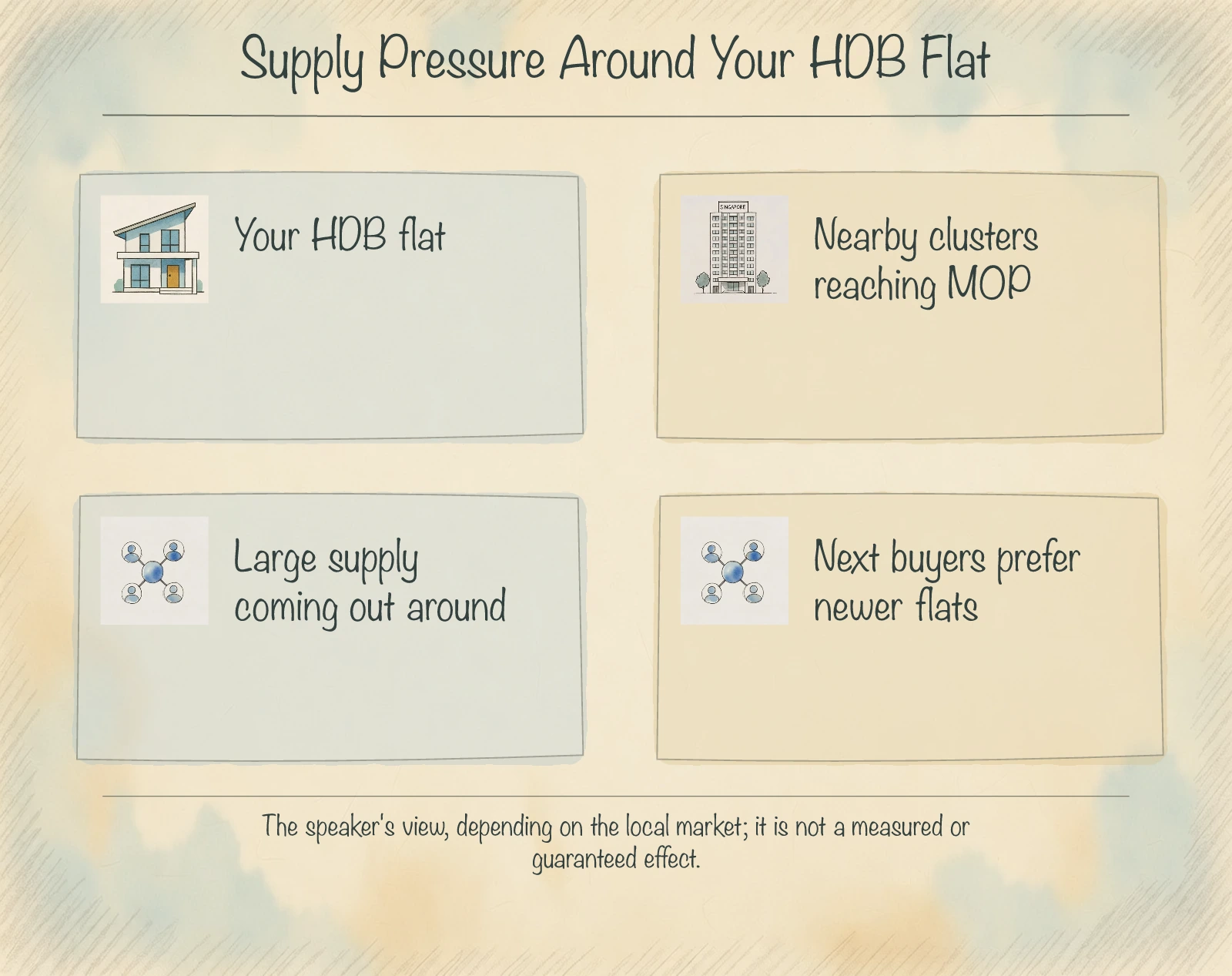
Of course, that also depends on the generic market, but if surrounding this particular flat, there are a lot of other HDBs that are going to hit its MOP, that if I say there are a lot of clusters of HDBs that are surrounding you, then the competition for the newer MOP BTOs are going to definitely stifle your price appreciation because of the large amount of supply that's coming out around you.
And of course, the next buyers, they will definitely prefer something that is brand new, that has just hit its MOP period because the rental ratio is just five years old. And of course, they have just bought into a property that is like 94 years.
So they are always hunting for a lot of brand new MOP properties. So this is a typical Singaporean route.
And in terms of this particular route, we call this the do nothing mode.
So what is a do nothing mode? Meaning that a lot of times we observe that in terms of the life kind of decisions that a typical family will make, this falls into one spectrum and.
Most of the time young couple will go to a BTO and of course they'll buy this property at 450,000 from direct from government, maybe it's a four room flat. And then they will hit their MOP period, maybe by the time they'll be about 35, 36 years old and that probably might have already appreciated to 600,000.
And then of course they will then continue to build their family, career, children and then once they hit maybe towards the age 65 or they will start to make calculated decision once they hit between 50 to 54.
The reason is because if you were to do anything after age 55, a portion of your money would then be transferred to your retirement account and you cannot utilize so much CPF for your final property.
So, a lot of times, we see families making that final move when they are 50 to 54 years old, and they will then downsize to a smaller property.
And maybe by the time, because their property has already aged, and their property maybe is already about 30 over years or 20 over years, maybe the property value will even stagnate or maybe it will just drop a little bit, or maybe it might appreciate, but over the years, if you calculate in terms of interest and stuff like that, you might just break even in the sense.
So let's just assume that the value when this couple was at H36 is 600,000 and by the time that they are planning to sell, probably in their 50s or 60s, the property value is still at 600,000.
Then they might use this amount to pay off a smaller HDB while the kids moved up and then they will retire from that. Or maybe they might apply a true flexi and things like that.
So usually this is what we call the do nothing mode and let's just take another example of a HDB performance as well. So this was a DBSS at Travellers, Clementi.
Averagely, a five room owner was initially buying it at about $700 odd thousand dollars. And of course, after five years later, when they fulfill another five years of MOP, that property value of a typical five room, where it just hit its MOP period in the year 2020, was about $900 odd thousand dollars.
And of course, after about two years, he appreciated slightly even more to about 960, 50, perhaps down to about a million dollars. And later I'll come back to that on why I wanna show you that particular example because just think of this keyword here called TAV and this is what we call the trap appreciation value.
So this property technically enjoy a trap appreciation value of 193,000 when it hits its MOP period in the year 2020. And then in the year 2022, it appreciated a little bit more by about $30 odd thousand.
That brought about its total TAV to maybe about 230K.
So let's just hold the talk a little bit. Let's look at the EC performance.
Now let's have a look at Esperina Residences. Now this EC that has MOP in the year 2018, however this EC has a spectacular performance because as of this MOP year, averagely the three bidders right there has enjoyed about 200K appreciation.
And of course, if the owners would have held on to this property a little bit longer until the year 2022 last year, you will have enjoyed a total TAV of 550,000 all the way from the entry price to the exit price last year.
And of course they have held it for a totality of 12 years from 2010 to 2022. Now this was because when this property was incepted, there was this new launch that was right beside them called Singang Grand Residences and they were doing at about 1,006 to 1,800 dollars
Executive Condominium Appreciation and Nominal Versus Real Value
per square foot. And wherever there's a new launch that is performing very well, and of course Singang Grand has already been sold out, it creates a ripple effect around some of the resale properties that's surrounding this new launch.
So because of Second World Residences, there was this second round of appreciation and of course that brought its total TAV, track appreciation value to 550,000. Now let's have a look at Forestville, another EC that was located in Woodlands and of course in totality, as of last year, it has enjoyed a total TAV of 370,000.
First round, towards MOP, second round just one year later it further appreciated because during the COVID season everything sort of appreciated especially if it's a private property.
Last but not least have a look at studying residences basically as of last year the TAV was around $400,000 for a typical 3-bedder performance from entry price to around the exit price. So what do we mean by all this?
So basically coming back to the travel list example why do we want to
So to talk about this particular example is because it's not pertaining to this particular HDB cluster. It is mainly because of the fact that when you look at the appreciation that happens in the HDB property, the equity is trapped in the HDB property.
And the only way to enjoy your appreciation of your property that you have lived in it, that you have invested in it, of course, HDB apartments is being classified as a place of course to live and grow your family.
is not really for investment but of course every Singaporean hope that their money do not depreciate when they park their capital, when they park their hard-earned money inside a property even if it's a HDB apartment. Everybody hopes that one day their property will appreciate or see maybe again they can at least combat inflation.
Now right now inflation is about 4 to 5 percent if of course you look at a 30-year period and if I do not even compound it, if I do not end a
compound calculator, I just take 30 years, multiply by 4 or 5% per year. That is already close to 120 to 150% of inflation that you have to battle it.
In the sense that if your property that you are servicing the monthly mortgage that you're putting money in stock into it, if it doesn't appreciate by at least 100% to 150% at the end of 30 years, what's going to happen is that you cannot technically combat inflation.
A quick example is like this. Just look at the CPI inflation that we have.
Now CPI inflation is the consumer price inflation index figures. Basically on the broad base level, it tracks the inflation level of food, of a lot of items that are day-to-day usages that Singaporeans would need in order to sustain themselves.
Now that is what we call broad base inflation figures. And of course around the world, governments would usually have a basket of goods and then they would then use it to calculate the consumer inflation index.
Now take note that in Singapore
and of course in many parts of the world, asset prices and I'm talking about property asset prices. Property asset prices are not part of the inflation index.
Car prices are also not part of inflation index. Just to give you a quick example, in the past about maybe about 35 years back, what is it 35 years ago?
So I was just trying to refer to my mom's property. Okay so my mom owned a four-room flat and so this was her second property and of course that was about 35 years ago so by that you roughly can guess my age okay.
So she bought it at $30,000 in fact she told me she regretted it because right across the street she could have bought a maisonette at $60,000.
But she chose to go for a four-room flat at $30,000, $30,000 plus thousand or $40,000 and actually she said that coming back to think of it right because her four-room flat there's about 30 to 40k. Today she has a really fully paid, I mean now it's the year 2023, she has a
really fully paid, her instalment was only $600 a month and she said that if she will do have chose the maisonette, the money instalment probably is about $800 per month and she said that she should have chose that because in today's value her four-room flat is about $500,000 but the maisonette is really close to about $850,000.
And that is actually a huge difference in the sense because that was a bigger property. But what I'm trying to share with you is this.
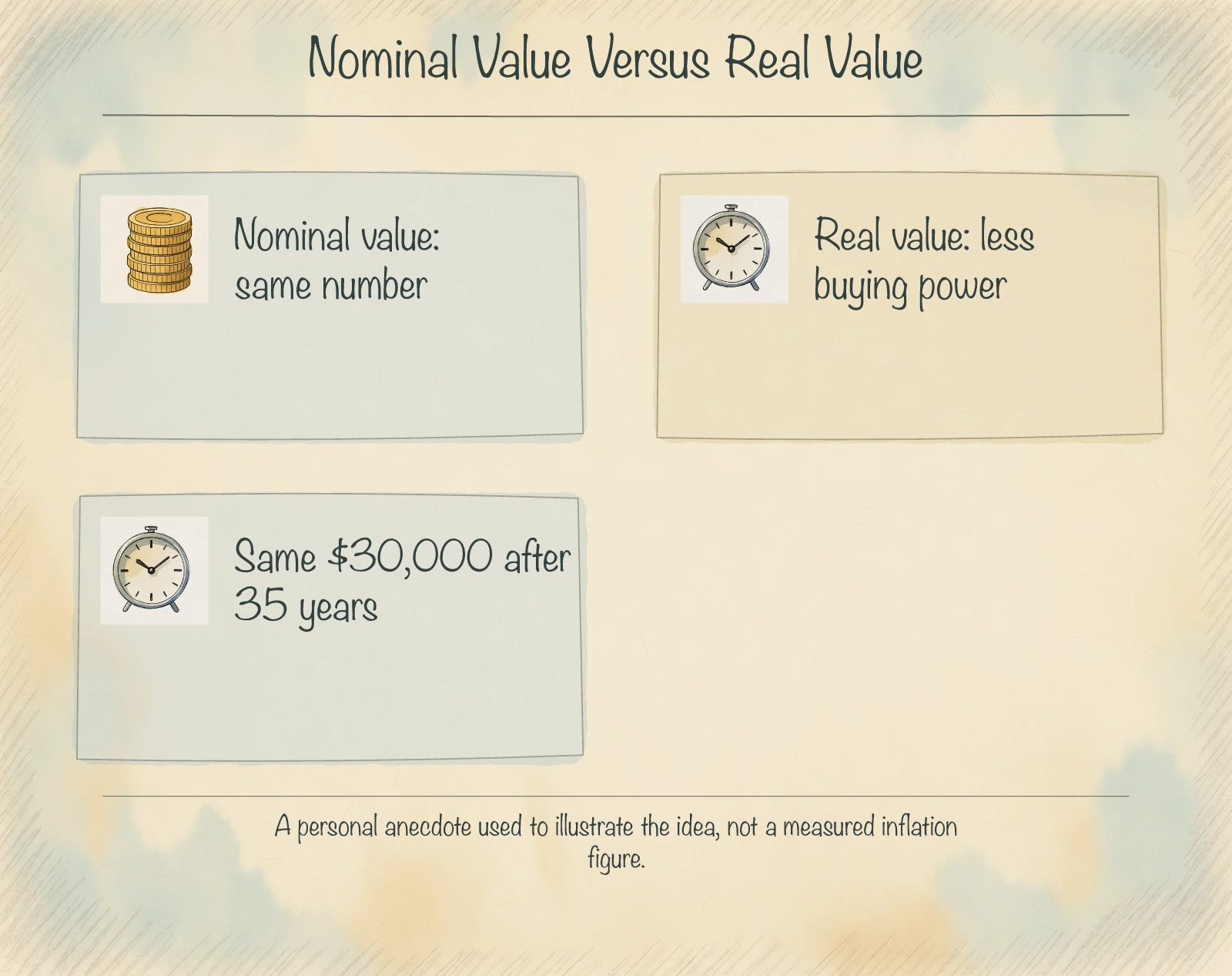
This is the example of what we call a real and nominal value. Meaning that if my mom had not bought that property 35 years ago at $30,000, basically if she didn't buy that property at $30,000, her $30,000 today in the bank, which is 35-litre, would still appear as $30,000.
And that is what we call the nominal value. Nominal value remains the same.
Your bank account has 30,000 last time. 35 years later, if it didn't utilize that 30,000, it will still be 30,000, but what you can buy
Real Value, Asset Inflation and HDB MOP Clusters
With that same 30,000 today, it is different, because with that same 30,000 today, you cannot buy back the 4-room flat that she could have bought last time. And that is what we call real value.
So her real value of her 30,000 has depreciated because these two components, these two kinds of goods, which is firstly real estate in Singapore and your transportation, basically your car, is basically not counted into the CPI inflation index, and this is separated out of the index.
So when you look at that, because your car as well as your property is too fundamental, very important kind of thing that a lot of people want to have in their lifespan.
And of course, if you can understand this concept, then you roughly get where we're going, because the next thing that I'm going to talk about is called asset inflation. And thus, HDB suffers from a plateau effect and a trap equity effect.
Because coming back to that model over here,
this amount cannot be released because it's being trapped in the property and the only way to release it is by selling it.
So a quick disclaimer, a second disclaimer basically is to share that we are not against holding onto a HDB apartment, because HDB apartment, we recognise the fact that this is the staple asset class in Singapore that has already brought about a lot of growth in Singapore, and of course we only will want to talk about this when you have done your financial prudency check.
So if let's say you happen to be in the current stage that you have a stable income, you have a stable employment, you have a stable business, and then basically you have some level of savings.
And of course your property has seen some level of appreciation, and you think that you're in a comfortable position after doing financial prudency check, after checking your in-principle approval with the bank. And you actually have the ability to upgrade to let's say a landed property or condominium but you're
just thinking about this thing right now, then if you're in that current stage then this webinar is for you. So we're not trying to do a hard push that you should definitely sell a HDB and then force yourself into the property.
No, this is not the main logic that we're in, because at the end of the day, the most important thing is that you must make sure that you have done your financial prudency check. We'll talk about that later.
Now second reason, and then everything will link up at the end of the seven reasons: basically supply risk. There is, of course, supply risk when we talk about HDB.
Why is there supply risk? It's because HDB apartments form 1.2 million in terms of quantity and housing stock in the entire island.
Condominiums form about 340,000, landed property 73,000. Later there will be a chart to share with you.
Now, when you look at this, this was the latest news that came out. Now, of course, HDB, they are going to ramp up
about 150 projects. We're talking about projects, we're not talking about units.
And of course, by a project, it means like a cluster of maybe eight to 10 towers, or maybe six to eight towers of HDB properties right there. And there's going to be 150 by the year 2025.
This was to answer the delay in construction that happened during COVID. And of course, a lot of people wanted to bid for BTO.
There was a lot of debate about this, asking HDB about, you know, what is the cost of the land and of course construction costs and all that in parliament. And of course, we don't want to go into that.
But the main thing is that HDB is going to satisfy the demand. And this is an example of what happened in Canberra.
This is an example of one cluster, one cluster, one cluster, one cluster, one cluster. Alright, so these are clusters that will hit MOP, meaning that the first BTO owners are hitting their five years MOP period and they will be ready to put these properties into the
market if they want to. So if we look at another town again, this is in Woodleigh.
Of course, we have circled out basically the different clusters that will hit their MOP period. So if you look at this, 2030, this 2027, the red ones are 2026.
This will be the amount of clusters of properties that will hit their MOP period. So for example, at this particular cluster that will hit MOP in the year 2027, there's about 10 blocks right here.
So this is what we mean by one cluster.
So this is basically what we call a supply kind of thing that you might want to take note of, because for example if let's say you are having one of the properties right here and of course let's say your property is here at Woodleigh and you MOP in 2026, there's going to be fresh competition that will come up from here in 2027, of course in 2030, of course in 2029, so this is what we mean by
Supply and Demand Risk in Your Property Portfolio
Fresher supply of MOP is coming up because there are a lot of HDB apartments in the entire Singapore, and when we talk about fundamental investment principle, the asset with more supply than the demand depreciates in value through time.
This is basic economics fundamentals. So we always want to look for the asset type with more demand and lesser supply, because that is the only way that firstly, you can combat inflation, and secondly, is that your asset will appreciate in value at a faster pace.
Now next, I want to share with you this particular website. Of course, this is the Teoalida website.
Do reference with a link down below. First, with this website it tracks the amount of BTOs that's going to be completed.
First from here we managed to derive this particular charting, and what is this chart? This shows the amount of BTO flats that will hit its MOP period all the way from 2013 to 2029.
So of course we are now right here, and if you notice this is the amount of properties that will hit its MOP. And of course we also have to take note that not everybody sells their property upon MOP.
And these are all the existing newer HDBs in the past MOP; perhaps some of the owners will sell on the 7, 8, 9, 10 year mark. And basically in totality, the amount of newer HDBs are basically at this particular supply range right now.
So HDB has the largest stock at 1.1 million. Non-lander is always hovering at about 340,000 to 350,000.
And then you have landed property at about 73 to 75,000.
And then this is of course the chart that perhaps you have seen a lot of times that through our PRB webinars, basically we talk about the fact that the five-year cycle is a very true cycle that happens for the new launch condo market because it sort of pushes up the new launch PSF by $400 PSF per round in every five years.
We are in this current season, whereby we are now at a brand new PSF level.
So why am I sharing with you this?
It is because supply is a very important factor, because if you have decided to not do anything with your property portfolio, what is essentially going to happen is that your capital is building up in a property, which is your current HDB apartment, that is going to fight against more and more supply through the next 25 to 30 years.
So as you continue to live in your HDB apartment, you will know that there's newer and newer HDBs that are always popping up in terms of its MOP space.
And then these are of course your direct competitors in your particular estate, because the buyers that are going to buy the resale properties, they will always be hunting for newer and newer kind of design, newer and newer kind of tenor, and then they want newer and newer kind of HDB MOP properties.
And for HDB owners, basically the biggest competitor is that HDB keeps having the need to build more and more BTOs.
And of course our government is doing a great job of controlling supply, but they will always have to keep building new BTOs to satisfy demand. And just in the last 17 months, we already have about 37 BTO launches.
And then of course with the article of about 150 projects by 2025.
If you compare that with 17 new launches in condos and ECs for 2022 or first 2023, there's a total of 47, but this 47 will only have perhaps about 19,000 units, and is that technically not a lot, because the total pool of private properties are only at about 300, sorry, and a lot of the HDB owners are trying to move to this asset class in terms of the private property market.
So you can see that kind of big picture, and then as we move on, I will share with you a little bit more and more. So let's move on to the third one.
So hopefully you can see a little bit more.
Now, third one is on demand risk. So if we were to look back at the white paper that was being published in 2013, by 2030, what's going to happen is that our island is going to have 6.9 million in terms of population.
And this population figure, of course, is a population target that is already on its trajectory, because right now we're at about 5.9. We have about seven years to go to hit 6.9 million.
And if we look at the total breakdown, in totality we have 74 percent of our housing stock belonging to HDB apartments, and then you have only about 4% belonging to landed, and then you have about 21% belonging to private condos and apartments and of course resale ECs.
So why is that important? It is because in that 340,000 available stock that we have for private properties, these are the only class of properties that can attract international demand, and a lot of foreign investors and foreign buyers already in Singapore, this is the only thing that they can buy.
Foreign Demand and the Delayed Gratification Model
And as of today, there are already 68,000 of these private properties that are being owned by PRs and foreigners. And there are about 262,000 currently being owned by Singaporeans.
Now, why am I sharing with you this? It is because if you understand this, you will realize that because of the fact that private properties attract international demand, this is the only thing that foreign investors can part their capital in in terms of a real estate asset investment.
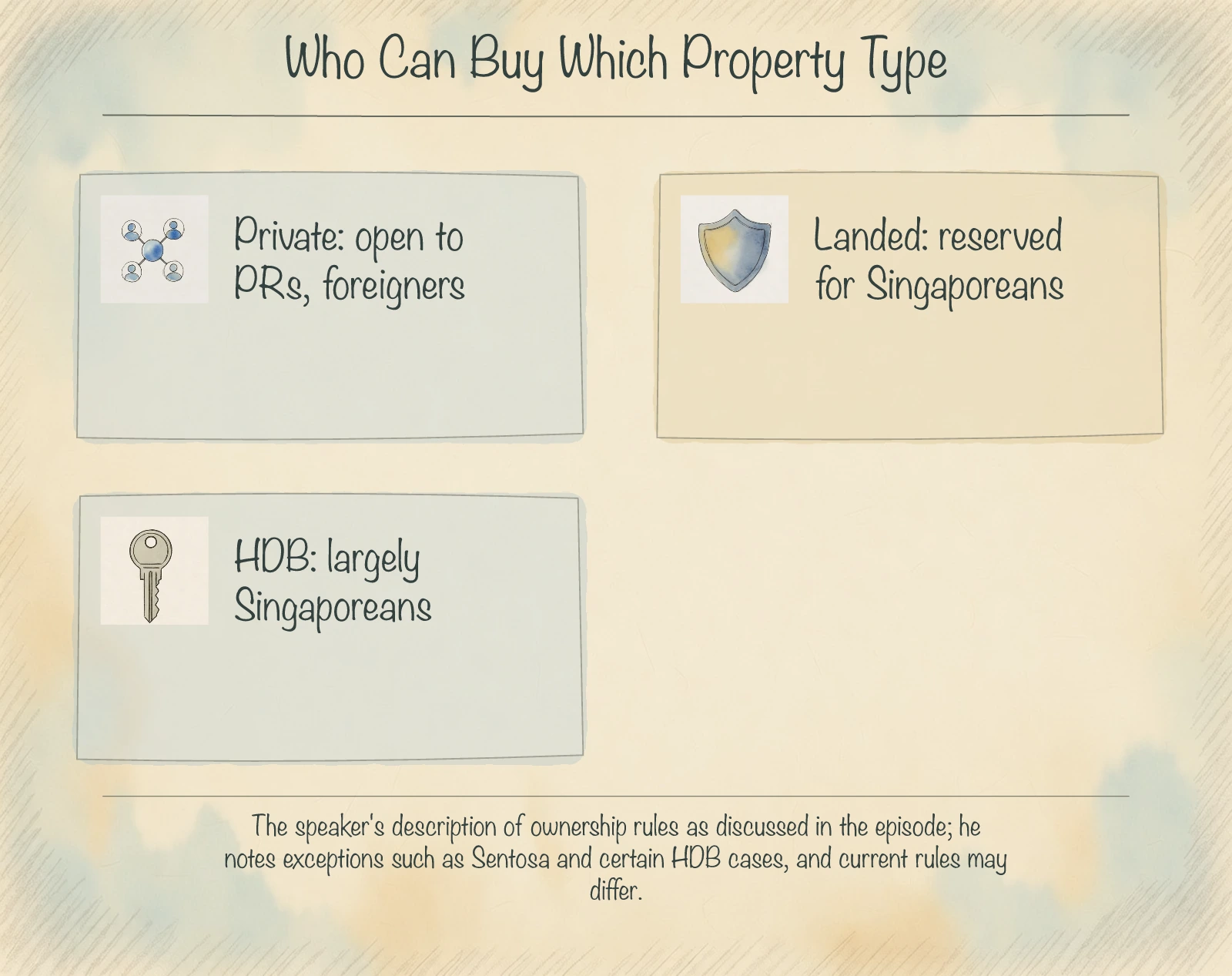
They cannot buy a landed property unless it's Sentosa. They cannot buy a HDB unless they marry a Singaporean, or unless two PRs are married and both PRs have PR status in terms of its blue IC status for three years or more.
And of course there's still a lot of restriction pertaining to HDB property. So what we're trying to ascertain is that with this you can get to see a little bit more clearer in terms of the amount of supply versus demand status, and have a look at this chart again in seven years' time.
What is going to happen is that if you just look at this you might think, okay, a government wants to hit 6.9 million, but technically what's going to show us is that there's going to be 50% and 50% Singapore's versus foreigners.
Meaning that if I were to walk in Orchard Road or I would walk in CBD, basically, I talked to two pedestrians on the road, we're going to speak with one from Singapore and of course a foreign friend that is working in Singapore, or a foreign investor that probably is in Singapore to buy properties or maybe to do business and stuff like that.
So there's going to be of course a one-to-one ratio in the sense. And of course we also have to put in a kicker that not all foreign non-residents are going to buy properties.
Some of them are going to rent. Some of them are going to rent for a long term.
They are not going to be in Singapore for very long. They might be here, they might exit in 2 to 3 years' time, moving from country to country.
So they are going to fulfill rental demand and some of them might even buy.
But when we look at the next chart, then we will also get a new fresh set of ideas because there's this fourth category of foreign investors who are investors but they are not in Singapore.
They are just buying the property through their broker that they got to know in Singapore but they're still in maybe Indonesia, they're still in US, they're still in Hong Kong, they're still in China, they're still in Malaysia.
They can be from different parts of the world but they are very attracted to Singapore as a safe haven because Singapore has already obtained the status as a first-door country, we are safe haven, we ranked top 10 in a lot of different kinds of charts of safety in terms of investments, and of course we are of course a financial hub as well, so we are a very different country.
And this is the only class of properties that satisfy international demand, meaning Singaporeans that has the ability to upgrade from their HDB to condos, they will move here. PRs buy here.
Foreigners in Singapore, they might buy here. Foreigners interested in Singapore but not in Singapore, they might also buy here.
And this is the only thing they can buy because landed is reserved for Singaporeans, HDB is largely reserved for Singaporeans. So if you get to see in terms of the demand status, then we will start to realise that actually when we look at this, we are going back to the same fundamental.
It is to identify the asset type with the most demand and less supply because this only falls about 20% of the residential housing stock in Singapore. And HDB upgraders' co-relation with income sealing has been increasing over the years.
A lot of people are actually moving from HDB to private properties. You can see a decline in this status.
That means more and more people are actually moving away from HDB to private properties and their income are also increasing.
And then we want to talk about this fact of delayed gratification. Now, what do we mean by delayed gratification?
Basically coming back to the typical Singaporean route. This is the do-nothing model.
And if we look at this delayed gratification model, it is what we call a typical model whereby a family makes the decision to exit their HDB, shift the capital from the HDB to a private property.
And typically, let's say example, the same couple decides to shift from H66 to make a decision to move to a condominium by the time they are H37.
And let's say they sell off their 600K property, they get into OCR3 beta at 1.5 million, a resale property because OCR new launch right now is already 2.1, 2.2 million, you cannot get anything at this range. Let's say this is a resale property in the OCR era and let's just assume that this property did not appreciate.
What is going to happen in 28 years' time from age 37 to 65 years is that if let's say
Fully Paying Off HDB Versus Private Condominium
This property did not appreciate. This technically will be their fully paid property by the end of 28 years.
So the mindset over here is like this: eventually you are going to fully pay your HDB apartment. But some families, they think differently because, if let's say they were to shift their current capital and profit margin from the HDB to private, eventually they are also going to fully pay their private condominium.
And if let's say, example, when you make that, two lines, eventually I'm going to fully pay my HDB, eventually I'm going to fully pay my private condominium. This decision can only happen if you have done your financial prudency check.
So if you're confident that you can fulfil the monthly instalment of your private condominium and this is a comfortable rate—let's say husband and wife are both working, your CPF contribution, you talk about a little bit of cash, and then your kids can enjoy the facilities and all that—if you're confident that over the next 28 years you can fulfil your monthly payments, then that actually forms that new mindset.
That instead of you doing that for your HDB apartment, you move it up a tier from a $600,000 valuation to a $1.5 million valuation, and that technically becomes like a new form of forced savings. You can just look at it as like you're buying a bigger insurance plan.
It's just a little bit of that kind of mindset.
So when you do that, and we're just talking about the fact that if this property did not appreciate and if you were to sell by that time—and we always have this lingo because a lot of times, you know, clients will share with us that, you know, "I really love this HDB estate and I really love this particular block and I want to continue to live in this five-room.
But I feel like, you know, my property is depreciating. I want to move to a private property, but I really love this five-room." So actually, sometimes we always have this lingo that's saying that, you know, you can still get back to this particular estate.
Maybe it's not the same unit that you used to live in, but you can do that when you're age 55, 60 or 65. So by the time your private property is fully paid, you can still take that $1.5 million because by the time there's no more loan, $1.5 million, everything will be in cash and CPF.
You can still fully pay the same HDB five-room that you used to live in, in that same estate. Just that it might not be the exact unit, but you can still move back there.
So it's just on whether do you want to continue to live in a five-room or you can come back to the five-room later on.
If that is going to be your plan, rather than you living your asset, your capital, in a $600,000 property—it might depreciate to $500,000 over time and then you have to move and downsize to maybe a two- or three-room flat later on—but with this move, if you're confident of your monthly payments, then basically this allows you a chance to even move back to the same HDB, but you still have $900,000 for retirement.
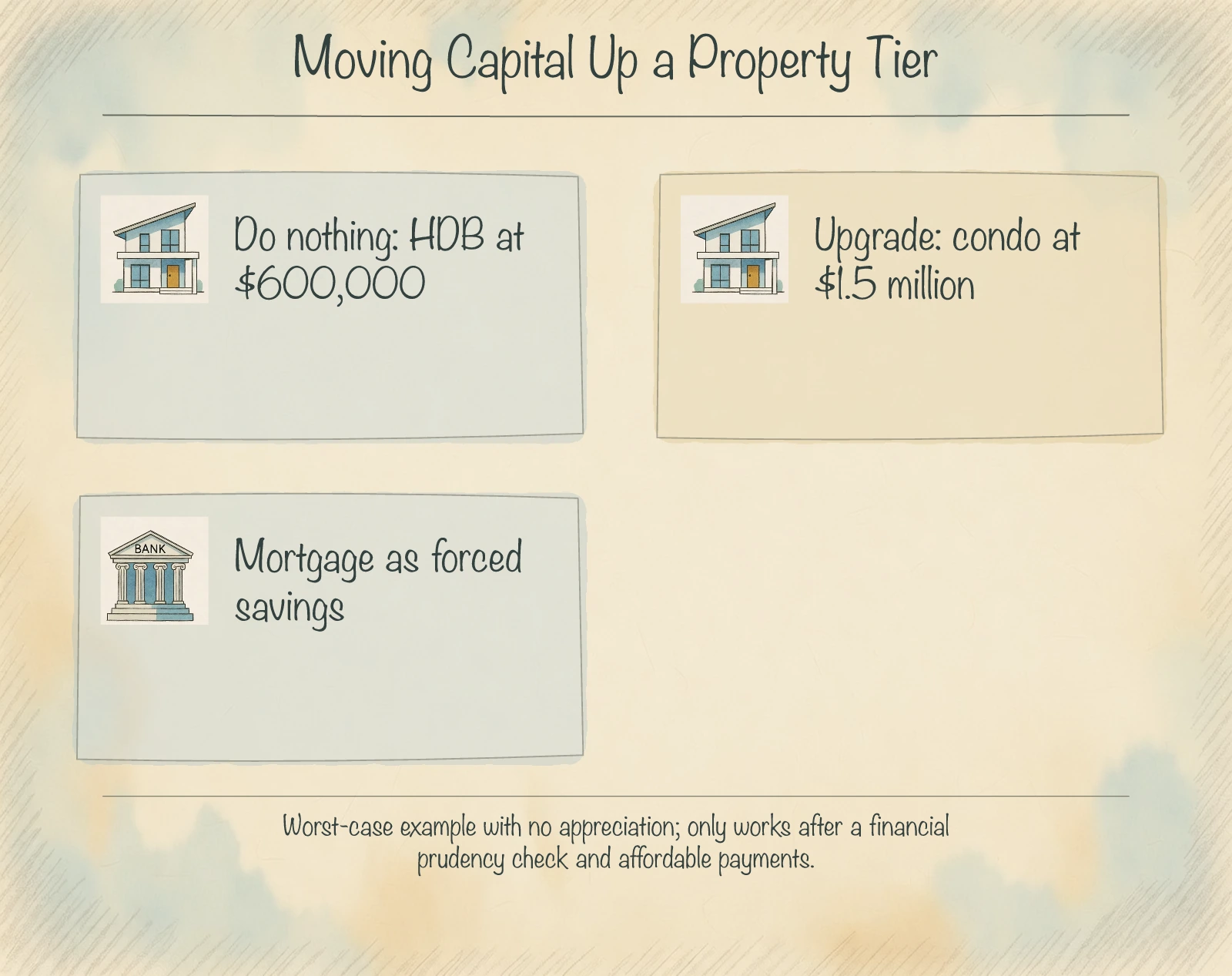
And basically for the next—let's say if you're going to last until 85, for example, for the next 24 years, you still can enjoy $37.5K per year. And this is what we call a forced kind of commitment plan, in the sense that we are taking the worst-case scenario that you probably did not appreciate.
Because if your property appreciates to $2 million, it's a whole new different story. You can pay off your HDB at $600,000, you have $1.4 million left for retirement.
And that is exactly what a lot of homeowners are actually doing and that's how they strategise their thinking, in a sense.
Of course, there's also expansion models that we've heard of, and some clients, of course, if they have the financial ability, both husband and wife are doing well, they might then maybe get a smaller unit to rent out and then get a three-bedder to stay.
And of course, at the end of the day, if both properties appreciate or maybe even if they will just maintain in value, they have a higher asset value at the end of the day and more for retirement compared to maybe doing nothing till their age 58.
Now I want to talk about this key difference as well because there's a key fundamental difference between a passive model as well as what we call a protecting capital model. Okay, of course take note that this example was an old example.
The interest rate right now is about 3.88%. However, if you do stretch over 35, if you look at our past history in Singapore history, average is about 2%, 2.5%, sometimes it's 1.0%, something percent.
So let's just take this as a hypothetical example. This HDB apartment, of course, at $500,000, if you look at bank loan and HDB loan, basically...
Mortgage Principal, Interest and Retirement Fund Trade-offs
This is the breakdown. And we always look at our monthly mortgage as a P and I component.
P means the principal that you're saving into your property which will be released to you at the end of the day. I means the interest that you're paying to the bank.
If let's say you're getting a condominium, of course there's also a P and I component and of course most of the time we want to look at what is this I component in comparison with the I component that you are paying in your current property.
So that's how you make a fundamental key difference and of because this I-component can change when interest rates change. If interest rates will be higher now, you pay more interest to the bank.
If interest rates are lower, you pay lesser interest to the bank. But most importantly is that there is a P that is much higher that you're saving into your particular property, which is why at the end of 28, 30 or 30 odd years, basically, let's say you do refinance and stuff like that,
At the end of that period that you have fully paid your property, the P will be released to you one shot when you sell. And that is a form of forced savings as what we call a forced commitment.
It's called a discipline mindset. And basically, if let's say you have the ability, then this will work for you.
Now, there's various models. Sometimes you might be contemplating, hey, should I keep my HDB?
and then even though I'm doing better, I want to use my additional fund to invest in a dividend stock.
Now take note that if you want to invest in a dividend stock or maybe you want to invest in a portfolio, the compounding effect will kick in provided you have the discipline not to touch the investment for the next 20 or 30 years.
Because take note that the compound interest will only kick in towards the tail end, and the moment you do not fulfill the monthly dollar cost averaging investment into the particular fund, you lose the compound effect, and
you cannot extract out the capital halfway. So this is very similar to buying like an endowment plan or buying an insurance product, and usually when you see that benefits table, you will see that you will only break even towards the end, and this is the same example because this is what we call a compound calculator.
So if let's say you manage to hold it for a long period of time, then you will get to enjoy the compound interest that's being earned on a 4% fund. And of course that works as well.
But take note, what we're trying to reference is the fact that if let's say you were to shift your current profit that you have made in the HDB apartment and then you shift it to a private property, there is a lot of things that is unquantifiable.
Number one, your property might appreciate. Number two, you do not have to stay in the prior property for a very long period of time.
You can sell the property after three
years, after five years, after eight or ten years. There's always flexibility to exit and your property sometimes will appreciate, for example, like the case of Esperina residences where you've seen, you appreciate that when he is his MOP and even after three or five years, he still continue to appreciate because of what has happened in the surrounding region.
So you don't have to hold your property for the next 25 to 30 years. You can technically sell it at a 10-year mark.
You want to move back to HDB. It can also be done.
So there's various ways of looking at this in terms of different kinds of perspective. And this is just an example that we are referencing basically based on the first approach of having a dividend stock and the second approach of going into a prior property.
So basically, if let's say you have a balance cash of $2,200 per month and you decided to put in a dividend stock, the main thing for the dividend stock to work
or the fund to work is that you must make sure that you cannot touch it for the next 28 years in order to fulfill the retirement fund concept. And you can still reach there.
However, by the time you reach there, sometimes we're just thinking, you know, hey, I worked so hard for all my years but I cannot enjoy my fruit and sometimes by the time that we are 65-75 we may be too old to enjoy our retirement fund.
Of course retirement funds is important but sometimes people or families they like to enjoy a little bit more kind of access in terms of their hard work savings along their growing up years with their families and children like maybe you are in your 40s you want a little bit more fun for your traveling you want a little bit of funding to purchase something else, but you cannot enjoy the fruits of your labor because a lot of your money is being trapped in funds like this which technically it combats inflation, it has
Enjoying Savings, Equity Extraction and Policy Risks
Compounding theory to combat inflation as well, but this is basically another mindset that home owners have, in the sense that they are living in a property that fights against inflation and at the same time it has a chance of appreciation over the next 20, 35 or 30 years.
And it still gives them flexibility to exit. They can exit when you appreciate the 1.8 million, they can exit when it becomes $2 million.
They don't have to wait until the end. Now next, instant gratification.
And I think a lot of you might be interested in this because I've been talking about trap appreciation value. Please, if we look at this, this is the example of the flexibility of owning a private property.
And that was what I was trying to ascertain on the fact that when you have a private property like a condominium, an executive condominium or land property, you do not have to kill the golden goose.
Because if your property is performing, you enjoy living in it, you don't have to sell it, you don't have to disrupt your kids' so-called comfort level living in the property that they have been growing up in. You can continue to enjoy the property but you can extract the value.
And why is this possible is because this is a private property, it's not bounded by policies under the HDB property. HDB property is mainly for stay, to live in, to build a family.
But private property is also a form of investment. So for example, let's say you own a Stirling residence, you bought it at $1.75 million dollars when it was launched and then when in TOP last year the appreciation in terms of valuation.
And you call your banker and your banker say oh your particular unit has already appreciated to 2.1 over million of course as this time of filming at 2383 is already 2.2 plus million dollars.
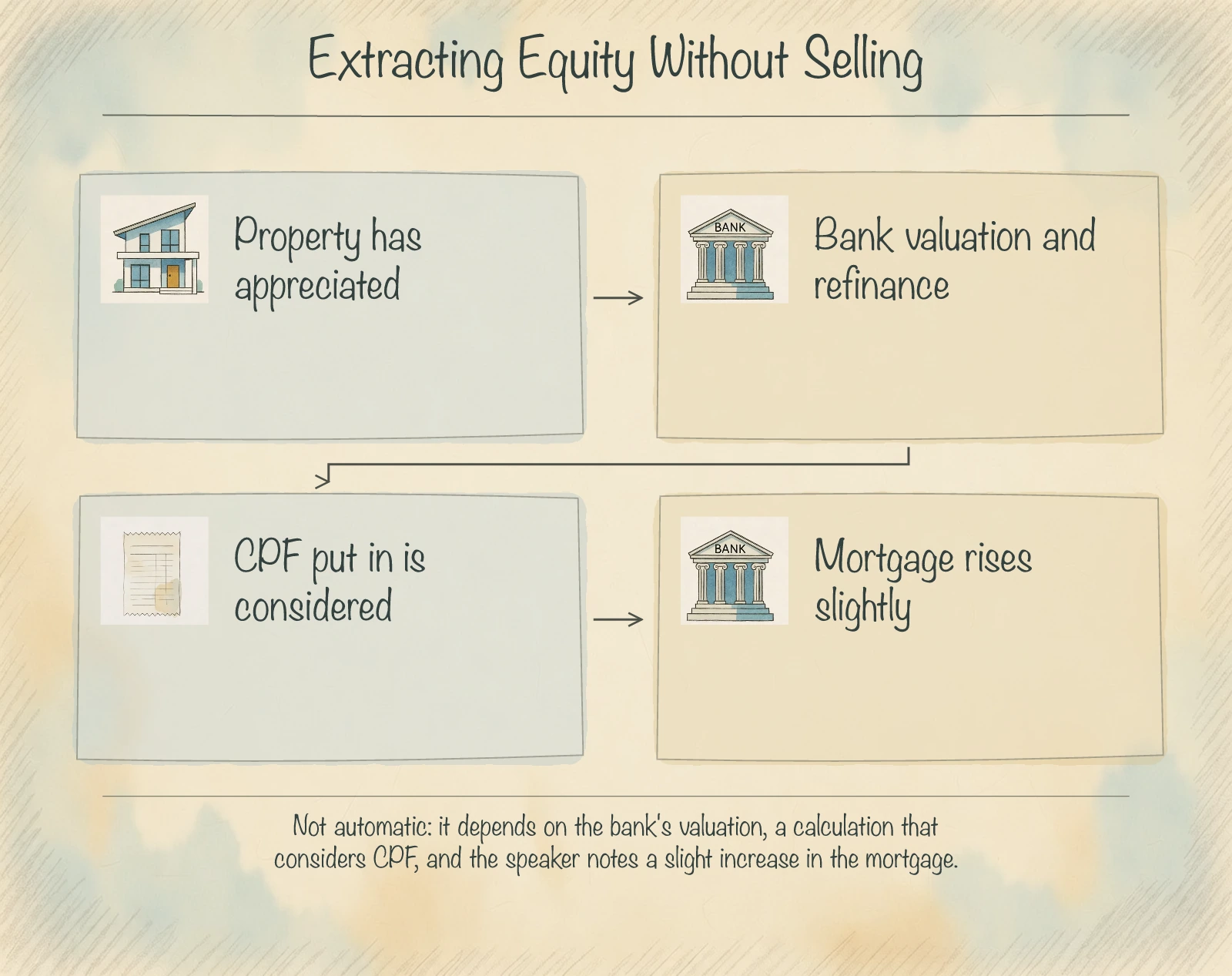
You can technically apply to the same bank for refinance at the same time for fresh rates and at the same time you can apply for equity term arrangement to extract 75% of the value.
Of course there's a calculation method here in terms of the amount that you can extract because you need to take into consideration the CPF that you put in.
That's for another whole topic together but what I'm trying to ascertain is that you don't have to sell this property but you can enjoy the appreciation while you're still living in it. And then when you look at this particular EC, similarly you can also extract its value without selling it.
And of course what you're going to do with the value that you extracted, basically you can use it for your personal use, you can continue to live in the bank, you can use it to invest in some other funds.
And of course what we're trying to ascertain is that this is the example that you do not have to wait until the end, until you're age 65 to sell the property, then you can enjoy the value. You can actually enjoy the value now if you choose to do that, provided your property appreciated.
And of course take note that this is, this kind of equity arrangement, you will definitely have a slight increment in your money mortgage. Of course there's a whole new topic together that we'll talk about in one of the webinars during this entire year.
So an asset that allows the owner to enjoy its equity without selling, it gives the owner more opportunities to invest in other asset. Of course, an asset with trapped equity, kind of characteristics, it restricts the opportunities for you to buy and invest in more properties.
And last but not least is also that if you purchase the property with lesser supply and more demand, this is what is gonna happen. If you look at a typical condominium performance here, this is in the RCR zoning, because this is a very old property right now, it's balanced 59 years.
It continues to appreciate even though of its old age and these are both 99 years property.
Of course when you talk about freehold properties, this is a landed, then of course the performance is drastically different and compared to a HDB apartment and a BTU apartment, of course if you look at the level or appreciation jump, is very different.
Now why is that so? It has a lot to do with demand and supply.
It has a lot to do with the fact that there's only a limited pool of such properties in Singapore plus the fact that it's opening up to international demand.
Thus last but not least we want to move on to the policy risks and then I will move on to how to select some properties that maybe you might be interested in. Firstly cooling measures has changed the entire landscape in Singapore.
The cooling measures even though it has 13 rounds of all these red dots here, we have about 13 rounds or 14 rounds of cooling measures but our price still increased over the past three years that's from 2020 until now.
Why is that so? Of course partially because of
How Cooling Measures Made Prices Stickier
Now, why is that so? Of course, partially because of the quantitative easing that's happening in central banks around the world.
Number two, COVID has changed a lot of behaviors, but also the cooling measures has sort of changed our behavior, in the sense that the price now becomes more sticky, in the sense that it became more stable. So firstly, we have the three-year seller's stamp duty.
So a lot of private property owners, when they bought, they already know they cannot sell within three years. That actually elongates the holding power and holding period that a private property owner will have.
So that technically removes speculators from the market. Most people buy to stay, to invest over the long term.
Secondly, to buy a private property, you need to put in 25% down payment; you can only loan 75% from the bank. And thirdly is that when you want to loan 75% from the bank, you must make sure that you fulfill your TDSR financial prudency check with the bank.
So with all these three factors in line, basically it shapes the mindset of a property investor that this kind of investment is for stability, it's a meet to long-term investment, I'm not in to buy today and sell tomorrow.
So there's no speculators technically in the market, because 35% down payment of a $2 million property is already $500,000. So this investor in the first place already have a level of spare investment resource to put into this property.
And then if you look at even the first-hand buyers, let's say they're buying a $1.5 million property, a 25% down payment is also easily close to already about $400,000 in terms of 25%, and then of course you have to plus the buyer stamp duty, which is now in between 4% to 6%.
So in totality, a buyer will have to have at least 30% of the total property value before they can buy a property. So that technically also shapes the entire mindset, that for private property, landed property, the buyers and existing owners, they are currently owning the properties, they have higher holding power, in the sense.
And why is it important? It is because when an asset class is being owned by more people with better holding power, the asset class becomes stronger.
There's technically no fire sale, there's not much auction sale; people do not fire sale their property easily. When the market is not doing well, they will just hold their property, they will not do anything.
And then if we were to look at this next chart, basically this chart actually shows us that five-year cycle again. And why do I want to show this?
It is because of this portion here that we are in the new five-year season. And this is a very important understanding.
But let's talk about this. Just now I mentioned about TDSR, and one fundamental difference is that HDB properties and private property are doing at a very different level.
What is a different level? In the sense that when you own a HDB apartment, your potential buyer that can buy your HDB apartment, they are restricted with an MSR kind of calculation for their loan affordability.
So this is a stricter rule, because it means that if somebody earns $10,000 and they want to qualify for a bank loan to buy HDB, they can only be considered for about 30% of this income, less of their monthly commitments for other things.
TDSR basically is now at 55%, and this applies for condos and landed properties, and of course this applies for HDB. Now that is of course one of the key policies that our government has placed; back in the days of around 2013, they introduced MSR limit in order to limit the borrowing power of purchases of HDB apartments.
So you might think that this might be just a financial prudency structural kind of implementation, but on a deeper level, it's actually a policy that's so smart and so wisely calibrated to restrict the type of buyers that are buying HDB apartments.
Basically, somebody that is buying a HDB apartment, they will know that, hey, I can only loan so little; that is why when they make an offer for HDB property, they are also restricted by the loan amount. Because the loan amount technically restricts the total quantum that you can pay for HDB property.
And that sort of controls the HDB price movement over the years, ever since 2013 until now. So this buying power shapes the buying affordability of the current demand in the market, and of course this has a higher borrowing power, and thus it also shapes the demand in the market for condominium and land.
MSR is basically quite a permanent rule, and of course since 2013 a lot of people have already realized that the HDB flat will depreciate through time, and of course this is of course a real new realization that happened in the
MSR, Lease Decay and HDB Cooling Rules
To enter in that, everybody started to realize that hey, it doesn't mean that my HDB will appreciate over the years; it will turn to zero when it becomes zero, just like all 99-year properties basically turn to zero the time that the lease runs out.
The only key fundamental difference, of course, is that when you look at a private property — of course Singapore is too young, it started from 1965 — some properties are basically having their balance lease of about 50-odd years.
Of course, there's one class of landed in Geylang that was already returned to SLA; basically it ran to zero and the valuation became zero. So of course, the strategy of owning a 99-year property is to take note of the balance-sheet curve.
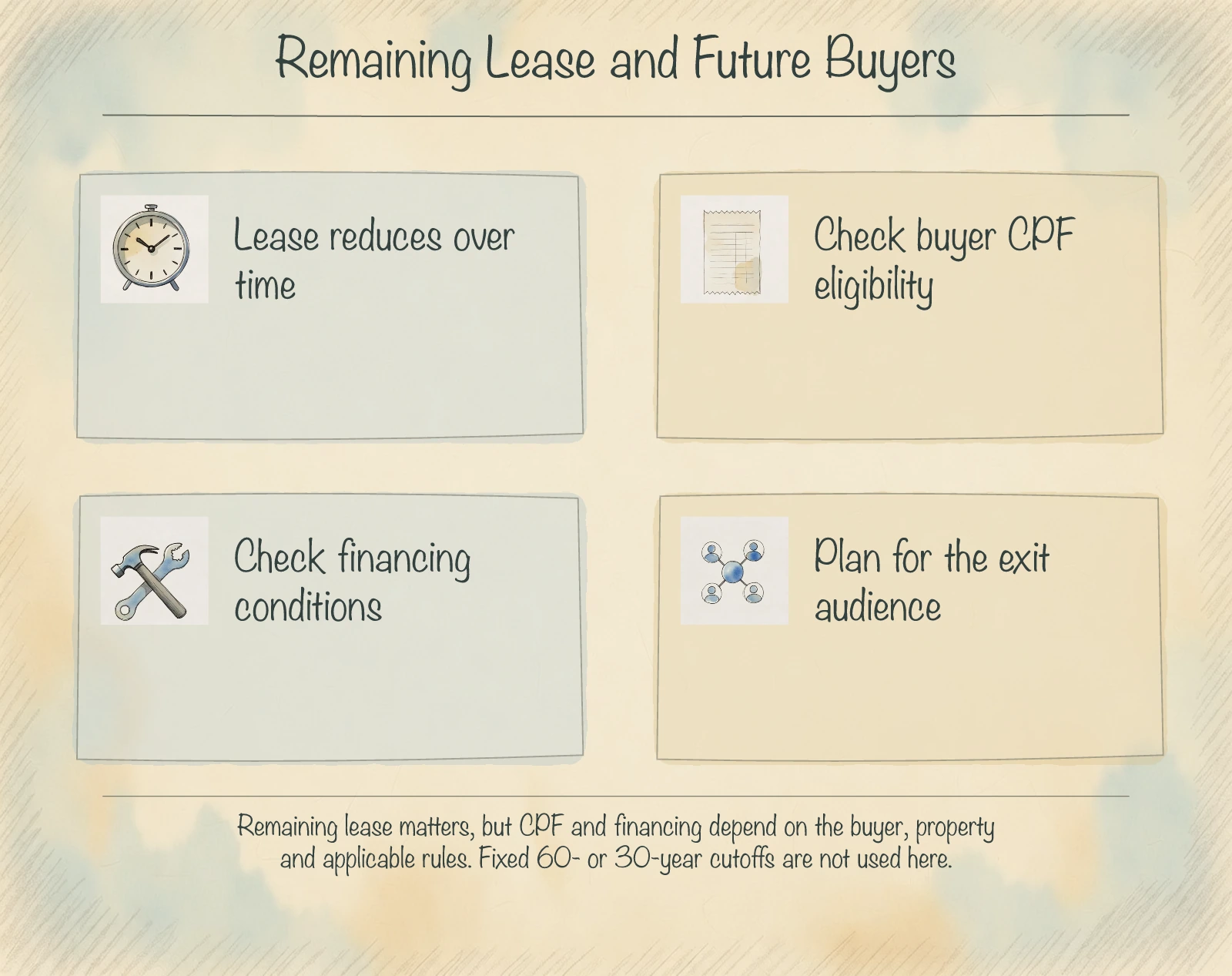
So when it hits 60 years old, take note that your buyer's pool will reduce because the next buyer cannot use their full CPF to make their money commitment. When it hits 30 years, the next buyer cannot use bank loan to buy the property.
So you must take note of these two remaining lease dates because that will be the inception point that your valuation will start to be gradually affected. So the strategy of owning a 99-year condominium property is that you need to exit before here.
So typically we advise our clients to exit by the age of 65 so that your next buyer will still have some room to play with. Of course, have we sold properties that are below 30 years old?
Yes! It has a balance of 20-odd years.
We sold it as well. A buyer paid in full cash because that buyer is in the season of retirement.
And that buyer has already gained from selling off his or her freehold property in the past. He or she just wants to fully pay off a landed property with a balance of about 20 years to fully retire.
And he or she has the cash ability to do that, and they want to enjoy a big space at a low quantum price. So I would say that at every range, there will still be buyers for different types of properties and different types of leases.
All right, last but not least, we want to answer this question: is this a good time for us to upgrade from a HDB to a private property in this particular season? Just have a look at what has happened over the past two to three years ever since we went into COVID.
Of course, everybody didn't expect that HDB resale prices will jump so quickly, record growth.
And of course, that was partly because of the pandemic; construction was delayed for BTO, a lot of people turned from BTO to resale properties, and of course as private properties escalated in terms of increment in percentage gains over the past two to three years, the fallback is that people who cannot afford private properties, they fall back to bigger resale properties.
So that was one of the key rationale why in the last couple of months there was a new rule implementation of a 15-month cooling period. Because there was a record amount of $1 million HDB properties, basically from a lot of private property downgraders that maybe in the season of retirement.
Their properties sell off their private properties at about $2, $3, $4, $5 million and then they pay off $1 million centralized prime HDB properties.
There was also the introduction of the PRH scheme and also the latest round of 15 months cooling off period: from selling a private property, if below the age of 55, you cannot buy a HDB. You can only do that after 15 months.
And that has of course been because of the reasons that you are seeing in all these articles — because HDB prices have risen too aggressively over the past two to three years. So before this bull run, this was the chart.
So basically at this peak 2012, that was the implementation of all the measures that we talked about just now: MSR limit, removal of the valuation report, so there's no more valuation report. Last time before you sell your home, you have to apply for a valuation report, and that gave rise to cash over valuation.
Now, of course, even without the valuation report, there's still cash over valuation in the market, but basically that caused about the on-start of this flattening. Of course, this was being propelled by higher condo prices as well as construction delays in BTO, and of course a lot of people fell back to the bigger HDB properties.
Now right now, at this tipping point, there are of course a lot of new cooling measures that came out.
So to ensure, of course, HDB remains affordable — and take note that HDB properties are the key fundamental property that a lot of Singaporeans get to enjoy, and thus our government puts in a lot of attention to make sure that it remains affordable, but at the same time
HDB Affordability Policy and Five-Step Framework
is accessible by young couples, families, and of course Singaporeans themselves that wants to build families and of course even single Singaporeans as well. So a lot of policy shifts are also always wrapping around this attention on HDB property.
So why do we want to talk about all this is because there is a lot of policy attention of this and with this when of course you hold on to your your HDB property, which is of course, we mentioned a lot of disclaimer at the start already.
So what I'm trying to ascertain is that the property that you're holding on to, and let's say if you're contemplating to move to a private property and you have the ability to do that, this property that you're holding on to will always have risks of policy changes.
And policy changes of course, the more policy changes are there for the particular type of property, just to give you a fundamental example. The recent 15 months policy is a very direct kind of policy to restrict demand
into the HDB resale property market. It technically reduces the amount of buyers pool that are selling their private property.
So now a typical private property owner maybe at about 45 years old or 50 years old that sold off their condominium, they cannot buy a HDB. They have to go and rent and then after 15 months then they can buy.
They might not want to pay the rental, they might not want to live with their parents, they might then go and buy another smaller or resale private property. Now that is the report effect that happened with every policy shift.
So if you're holding on to a asset class that has a lot of policy kind of implications, then technically speaking, that will result naturally in the fact that on top of the demand supply matters, the policy kind of implementation will always cause a lot more stagnation risk in terms of our price growth.
So this is something that we want to share with you and of course
COVID, we talked about the fact that there's more demand in the retail market and stuff like that, but we want to quickly move on to our framework before we end to this webinar. So our framework basically is this very simple five step process.
I'll come to that at the end. Of course, there's some free downloads for you towards the end as well.
And there's this five that process that our consultants do with our clients. Firstly, direction, finance, time frame, micro-selection factors using our mode analysis and our research tools as well as the hunting for the correct asset, the correct entry price.
Direction of portfolio basically is to decide a primary objective and we always want to recognize the fact that with empathy, with understanding,
with the fact that we value people more than things, our consultants are prime and of course we train our consultants in the fact that we always try to visualize what if we were this family.
What will be our key primary concerns, even though we want to move to a private property, but it's a dual usage property, it's for own use, it's matured needs.
But at the same time, I also want to select a property that has that kind of growth potential in terms of ROI, because nobody wants to buy a property that will stagnate for 10 years. And that is of course one key primary factor that we always want to have in our mindset when we advise our clients.
Step 1B is that we want to also look beyond the current property purchase. We want to plan for the exit in future and when you buy a property with the exit in mind, when you want to change your property about five to eight years later,
you'll find that it's easier to do so because if you try to plan a little bit in advance on asking yourself in seven eight years time when I provide property in the retail market will the next family or next buyer find my property valuable or attractive in their eyes.
So try to use this kind of mindset to ascertain the type of property that you want to buy and of course we use this through a tool called the mode analysis that we'll share with you shortly later. Now I want to move on to this portion right here.
On finance, how do we ascertain it is that this is a huge important decision matrix that we want to ascertain for our clients.
We want to understand how much can you loan healthily without straining your finances and we always want to make sure that you do not force through in terms of your commitment because you have to ensure that you're confident of course in terms of your monthly commitments to hold on to this property and of
Financial Planning, Timeframe and Selection Methodology
Of course, as mentioned, after three, five years, you can always sell if you want to. There's always a flexibility in terms of choice.
With this, basically with a 25% down payment by a STEM duty, doing your in-principle approval check, we also want to ask serious questions like, are you confident in terms of employment, in terms of business, in terms of fulfilling your monthly investment commitments into this particular property?
And the third step of course is to ascertain in terms of the bank in-principle approval, together with how much funds will come up for a current property. And we do that through a financial consultation process and then we want to decide what is the money installment that is comfortable for your family.
And at the same time, third step is to plan for a timeframe of selling and buying, timing it perfectly as much as we can, ascertain the steps.
Do you need to brand interim, do you need to ask for an extension from the home buyer and what are you going to do in terms of timing the sale and the purchase for CPF funds to be transferred over for bank load inception and stuff like that.
And of course, our consultants team are experienced to do that because if you were to come and visit our PRB office, you will realize that week on week. We do a lot of in-house trainings talking about financial calculations, timeframe planning for our clients and that is what we train our guys to master on a weekly basis.
Because we believe that if we want to be a professional team, we have to behave like a professional team to train ourselves week on week on all these key fundamentals that our clients depend on us on.
There's this article that we run through on the journey that we help our clients to sell and buy and how we help them to time their time frame. And also we have close to about 33 cheat chat sessions that have we interviewed our actual clients on their experience with us.
And in fact this particular owner was in Australia when we helped them to sell their property and of course we talked about the journey of home staging.
We have our clients to exit their HGP property with an ethical quota restriction, we also helped one of our clients who has been trying to sell his property DIY but couldn't do it.
And then this family we shifted them from their HGP to a private private to a penthouse of course this particular owner, we help him to exit two of his properties together. Of course, this client has been with us for 13 years from HGV apartment to condo to two condos to a lender with a condo.
Of course, you can get to enjoy all this on our PLB YouTube channel. Just Google cheat chat sessions on this panel.
You will be able to find all these particular episodes.
And step number four is to use micro-selection and then we want to use charts research as well as our mode analysis to determine what kind of properties will be good for your property investment.
Whether it is for own stay or maybe you might want to buy two properties we use a lot of charts figures and we try to ascertain the macro factors that's affecting the micro factors. And our PRB investment methodology is to identify the property with high appreciation potential characteristics and we call it the HAPC, High Appreciation Potential Characteristics.
And then basically with our investment methodology of trifacta mode analysis, micro targeting as well as disparity effect, that's how we sit down with our clients. Run through mode analysis that has live feed API of all the condominiums to rank them based on scoring and then to help our clients ascertain a particular region, particular district.
Maybe you like these five condos but you're just not sure what is the scoring and pros and cons, that's how we sit down and use more analysis to analyze for our clients.
And last but not least, we want to move on to the final methodology part is that with our methodology that we're experts in selling homes using aggressive marketing but our consultants are friendly because we work in a team.
And then because of our focus on creative content over the years we help our clients to achieve strong exit prizes and with our signature strategies we also help them to move on to their next home.
Meantime take care.