Evaluating property
Freehold Underdogs and Exit Quantum: What Investors Miss
Published 2026-11-25. Adapted from the episode published 2026-01-02. Figures, illustrations and data reflect the episode’s original publication date.

Landed Strategy and Managing Exit Quantum
I put in 900,000 in the year 2022. In the year 2025, I get back my 900,000 plus another paper gain of $1.5 million.
The gain is more than 100% over 3 years. So let's have a look at this.
Strategy number two is we go strongest if I have the quantum budget, but I need to be careful of the exit quantum. And what market are we talking about?
It is the landed market. Now based on the latest DBS report that they just released about a couple of weeks back, they have released this 100-overpage.
I think it's 100-overpage or 21-overpage. They forecast by 2040, what's going to happen is that HDB properties is going to be 1.34 million, private properties 573 but take note of the breakdown.
Now at this stage in time, 380,000 condos and apartments, 73,000 landed, landed properties is not going to increase. I'm very confident even though we are 573,500 — 500,000 are condos, 73,000 are still landed.
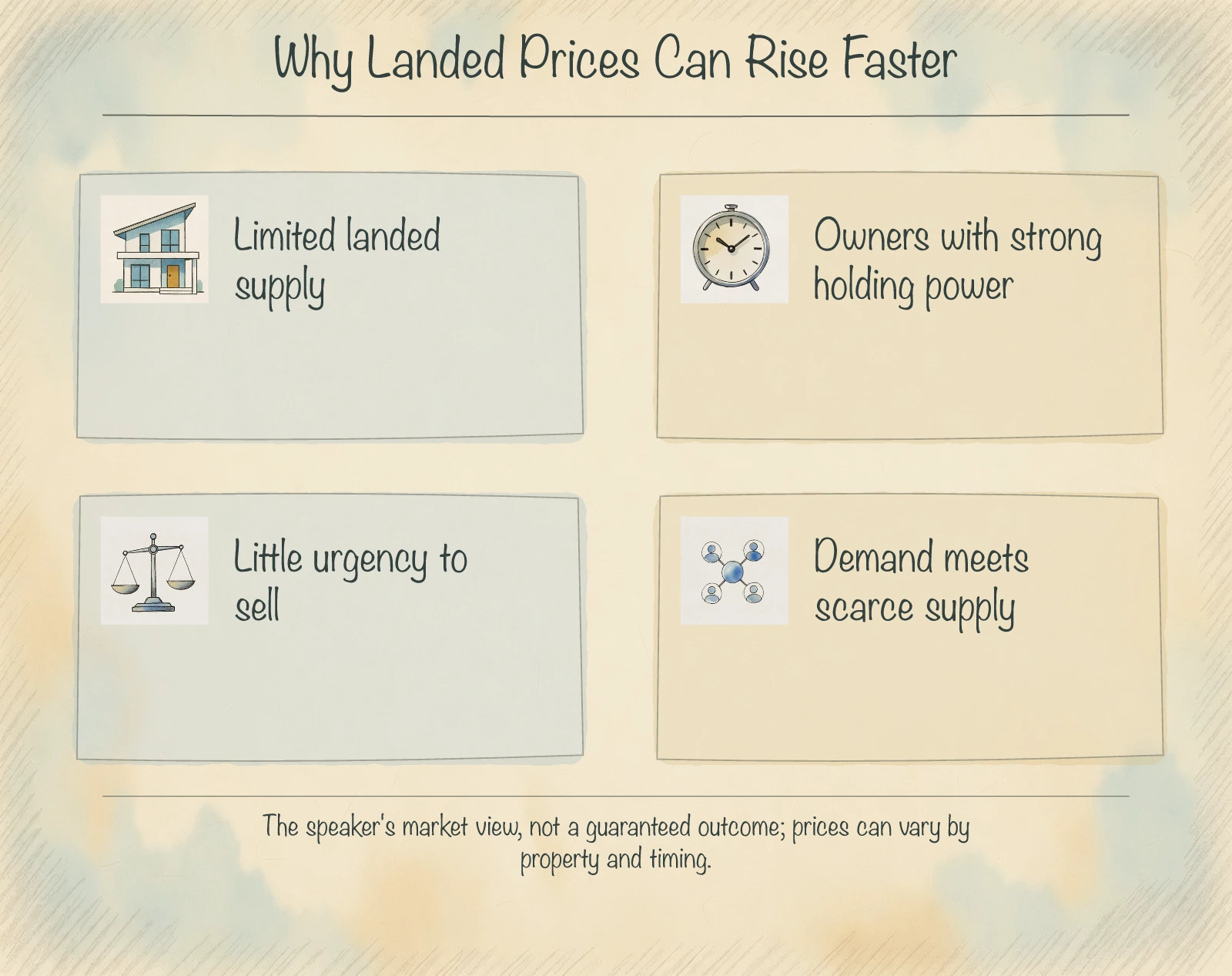
Now just based on economics in terms of demand and supply, any price asset that does not improve or increase in supply but if the demand keeps increasing and the people holding on to this asset has strong holding power, what's going to happen is that the price of this asset is just going to go up much, much faster.
Which is why when we look at landed properties, if you look at the years 2020, 2021, 2022, 2023, 2024 — now if you want to buy an inter-terrace minimally in the OCR region, $4.5 million.
I'm not talking about mini-landed 800 square feet or 1000 square feet, I'm talking about normal inter-terraces, 1500 square feet, land, freehold, triple frontage, minimally $4.5 million. Last year you can still easily find $4 million.
The year before, you can still easily find $3.5 million. The year before, you can still easily find $3 million.
The year before, you can still easily find $2.5 million. 2020 at the start of COVID, you can still find $2.5 million very, very easily.
Now, what has happened is that, yes, people say that it's because of COVID,
but not really, because we had to understand this few years. The interest rate was very high, 3 to 3.5%.
Alright, and economy wasn't doing very well, but this asset is fundamentally very different because there's only 73,000 units of landed plots, there's no more new GRS, 380,000 condos and we have about 1.1 plus million HDB. This is demand and supply, and a lot of people holding the landed here, they're sitting on a lot of equity and profit.
They are not urgent to sell. It's like all the high net worth and ultra high net worth people are holding properties here.
There's a lot of old money. A lot of people have been holding them for 10, 15, 20, 30 years and they're passing on to their kids.
There's also a lot of wealth transfer from the old money here. People here are not desperate to sell.
There is very little fire sale. And what is going to happen is that if you look at this quantum game basis, yes, every year it seems to be increasing by 500k on paper,
but take note your deployment of capital is different because if you deploy and buy a $3 million property you deploy about 900k, here you put in 30% you deploy about 1.05 million, you put in 30% you deploy about 1.2 million, you put in 30% you deploy about $1.35 million or $1.4 million.
Even at a $5 million property, you bring 30% you deploy about $1.5 million. So your capital based on that $500k jump per year is very different.
Because if I were to invest in an inter-terrace at $3 million in the year 2022, I enjoy a gain of $1.5 million over my $900,000. And I put in $900,000 in the year 2022.
In the year 2025, I get back my $900,000 plus another paper gain of $1.5 million dollars. The gain is more than 100% over three years.
1.5 million over what 900,000, let me just calculate for you, is about 166 percent gain divided by three years per year. So this is 166 percent gain over three years.
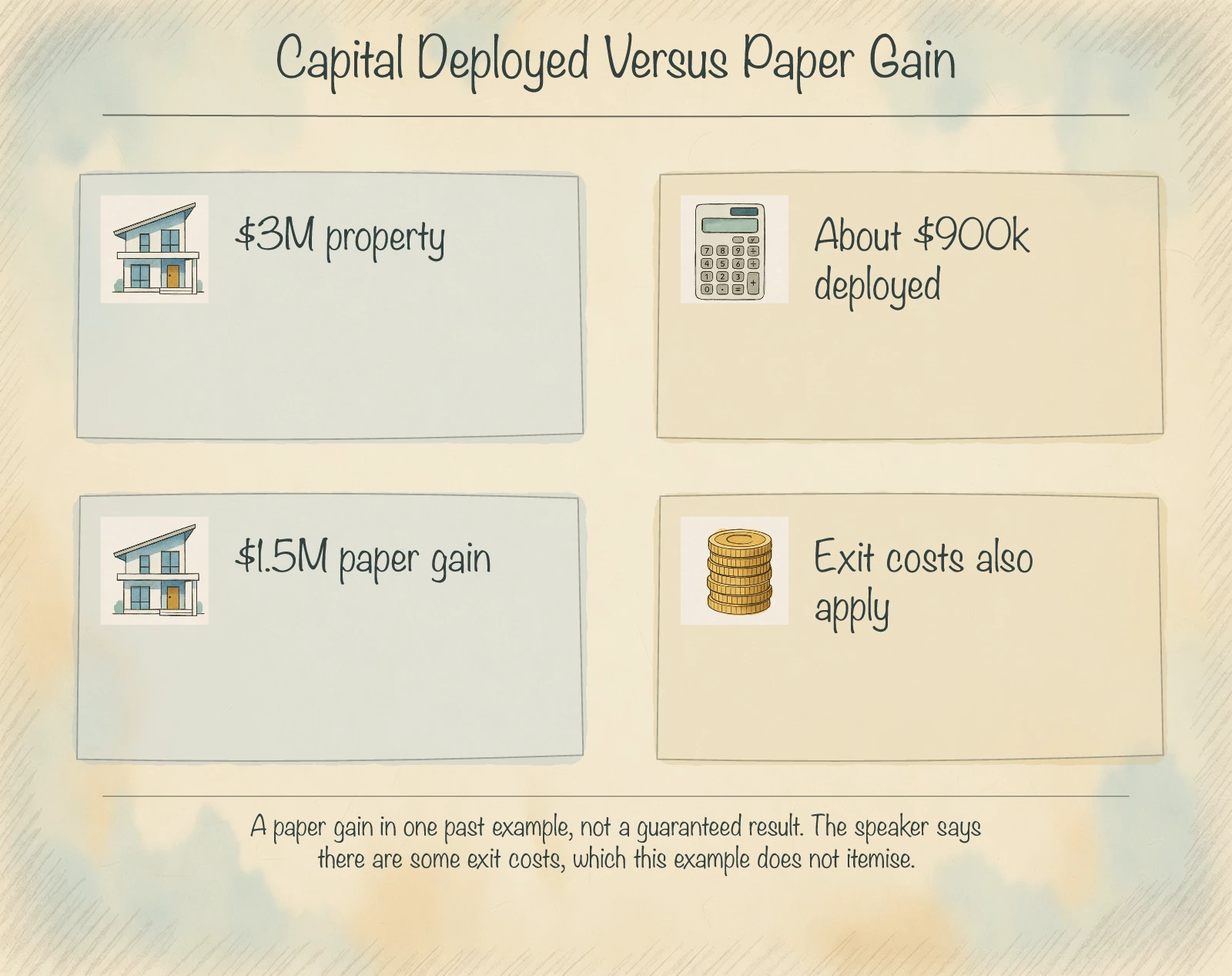
Per year is about 55 percent return on capital. Of course there are some exit costs.
Can we take it as 53% or 50% which beats a lot of other assets. Will this continue on?
My personal opinion, caveat: 2020-26 inter-terraces by the end of 2026, you need at least $5 million to go for inter-terraces, which then fulfills the $500k gain again. So take note, even if let's say now I would go for inter-terrace $4.5M.
I put in $1.35M deployment of my capital plus my buy and sell duty. I own an asset $4.5M.
I just let it ride for one year. By the end of 2026, my same $1.5M has already helped me enjoy a $500K gain.
So is this still possible to make a $500,000 — actually in one year is still highly possible, but provided of course there's mechanics of choosing a landed property. I want to make sure the DNA is good, the build quality, of course there's cat1, cat2, cat3, cat4.
You can of course head back to our landed webinars that are
Landed Resources, Holding Period and Fed Cuts
Just Google Melvin Lim Podcast. There's a lot of webinars there as well that we talk about this.
So what will happen if this is 2025 and 2026 and 2027 and 2028 and I want to hold it until 2029 to exit my landed?
I know it will hold for four years if really the fulfillment is 500k, 500k, 500k, which is very hard to phantom, which a lot of people find very hard to phantom as well, because just in the year 2021 you can still buy an inter-terrace for two and a half million, but now you need four and a half million.
All right, but what if 500k? This is 5 mil, this is 5.5 mil,
this is $6 million, $6.5 million. What if I need $6.5 million in the year 2020 and I just to own an inter-terrace, is it possible?
It's definitely possible because of demand and supply, and we call this inelasticity of the product of the asset because it's inelastic. It's the same as gold.
Gold price now is across $4,000. Nobody has thought of gold price shooting past 4,000 before.
But why? It's because it's a flight to safety, and there's a high correlation based on research in terms of our gold price.
This is a lot of real estate pricing in Singapore. Let me just show you some quick facts before we go to the next few strategies.
All right, so we'll just go talk a little bit about some macro factors. So now, this was some of the latest things that we need to take note of in the Singapore market.
The Henley Private Wealth Migration Report 2025, the latest report was out already. Bad news: Singapore dropped to the 6th position.
Last year, we were at position number 3 in terms of the amount of millenia migrating to our country. This year we dropped to 6.
We lost to a lot of other countries. I think highly likely because of our tax environment.
A lot of people go to UAE because there's no personal income tax, there's no cooling measures, there's no ABSD for buying properties as a foreigner. Our ABSD is really, really 60% for foreigners.
That definitely has defrayed some top process of people buying properties in Singapore, especially if they are foreign, but we remain as a region's top wealth magnet.
Estimated our rise on the upward trajectory of about 2 to 3 percent, and that is being supported by our base population growth and income growth, but actually on paper if you select in the right strength of the asset like what I just mentioned about landed property, the growth story is a bit different.
For example, people have enjoyed 55 percent, 50 percent a year on landed properties,
inter-terrace in the last three years. Now they also put in some emphasis on Orchard and Marina area, and this is where we are, we have about 17 rounds of cooling measures.
One key trend to note is that this is the new launch environment moving forward. We had that pre-TDSR season whereby a lot of units created by developers are big units, but now we are entering into the post-harmonization season, and the first season is one of the most advantageous seasons.
These are very good opportunities because in the previous era developers shrunk from big units to small units, but now we are shrinking again, but this string this time has a lot of benefit in terms of quantum play. So this string is unlike the previous string.
The previous string in size
created some ripple effects in the market. For example, you take a look at these two projects by CapitaLand, Sky Habitat, Sky Vue, both are by the same developer, but one project took a long time to see decent appreciation because, why?
They were the pre-TDSR year, the units are huge. Another unit right on the wave after TDSR immediately right sizing towards quantum play, they appreciated much faster because last time the 1-bedder for Sky Habitat is 710 square feet.
You look at the 1-bedder at Skyvue, 484 square feet, and we call this the post-TDSR season for Skyvue. This is Sky Habitat.
Now you see some of the launches, xion, grant and all that kind of stuff, FABRE, these are post-harmonization era, which is why they did so well. We also want to talk about basically some main things here.
Fed rate cuts, likely to have some rate cuts happening in December and projection is all the way until Trump's administration, and of course take advantage of the interest rate movement now.
Lower Interest Rates and Monthly Instalment Savings
Do not just bang on the fact that you want to wait further. Just by capitalizing on the fact that it's 1.45 million now, you're already saving a lot of money.
So 12 months ago, at 2.5%, you buy a 2.5 million dollars property, your monthly installment is 8,000, and now your monthly installment is 7,000, so you save a thousand dollars—but behind the scene you save even more. 12 months ago, 2.5%; this is 1.45%.
You pay lesser interest by 2005, you save more because you pay down more principal. That's the difference of 2001 per month.
Internally, externally, it looks like it's saving $1,000, but internally the difference is 2001 because you pay lesser interest and yet at the same time you pay more in principal.
Alright, now this hype over here: because if you look at the average PSF that's being transacted in the RCR region, there is a key difference because now RCR PSF is very close to CCR price.
I would highly suggest that always hunt for liquidity—sorry, always hunt for opportunities in the stronger market—and I think there's going to be a lot of opportunities in the CCR market in the next 12 months. So do hunt for CCR as well while you're hunting for the next property.
Market liquidity is strong. We are seeing that a lot of investors are seeking capital, putting their capital because of the increase in money supply.
And gold price—this is what I mentioned—there's a recent study that there's a positive co-relationship between Singapore property prices as well as gold price. And they specifically mentioned residential property price.
And gold price has really short past $4,000. And in five different countries, they actually unravel the interplay between gold prices, and Singapore is one that has a positive co-relationship.
So that now gold price has risen, there's a strong chance that property price will follow suit as well.
And this is always the chart that we shared, that once profit taking—which is already happening, a lot of people are seeking safe haven asset because they don't know when the bull run of the stock market will come to an end.
Okay, now we have more details over here, but then some reports are sharing about this portion about our population growth being back on track. All right, let me just refresh the screen a little bit.
So our population growth is back on track. And at the same time, there are also PRs that are granted annually and naturalized citizens granted annually, which naturally, fundamentally, once I get a PR I get Pink, I've got a red passport in Singapore, I will go and buy properties.
Okay, so let's come back to the last two strategies that I want to share with you. Alright, so in terms of strategy three and four, we talk about just now: go strong but be careful of the exit quantum.
Why am I talking about the exit quantum? It's because in landed property, if it's just from a pure investment play, just follow what the developers are doing.
A lot of developers are buying big plots to subdivide and sell two corner terraces and one inter-terrace. They are also buying big plots to subdivide into two semi-ds, but they also notice the quantum appetite needs to be something that's palatable for landed buyers.
So at the base level, there's inter and then you have corner and semi, you have detached, and now of course you have very high quantum properties at the start. So this is for the landed market.
So if you want to really use landed property as an investment vehicle, you don't really need to stay, or you want to stay for a while. Inter-terraces are still on the safest.
Of course, lower quantum semis also want to save us, because once you shoot past 10, 12, 15 million, your buyer audience will shrink at the top. So we always talk about the exit quantum as well.
Now let's talk about the next part, which is to split your horse and let the investor number three pay for it. What do I mean by this?
Let's take this property as an example. If I have a target property, let's say Park Estar, I saw that somebody is selling for $2.37 million and this 3-bedder can rent out for about $6,000 over dollars because the transactions have proven.
Alright, $2.3 million has been transacted. There's rental at about $6,000 plus, but let me take a discount factor.
Let's say I can only rent out $6,200 fully furnished. And I bought this property at $2.35 million, which is very near to the Unos MRT station.
My monthly mortgage is going to be about $7,000. 25 years—I say I'm 40 years old, I loan for 25.
Loan is $1.762,000, $7,000, and my principal and interest is broken down into this portion here. So every month I put in interest of about 2002, principal is about $4,800.
My starting loan balance is about 1.75 million. I want to hold for four years.
Four years later, it's going to be having a balance of 1.522 million dollars. Now, how will my breakdown look like, including my buyer's stamp duty?
So including my buyer's stamp duty, I have to put in $587,000, 25% buyer's stamp duty plus my
Investment Breakdown and Splitting Your Purchases
Legal fees is about 90,000. So, my original investment is $607,000.
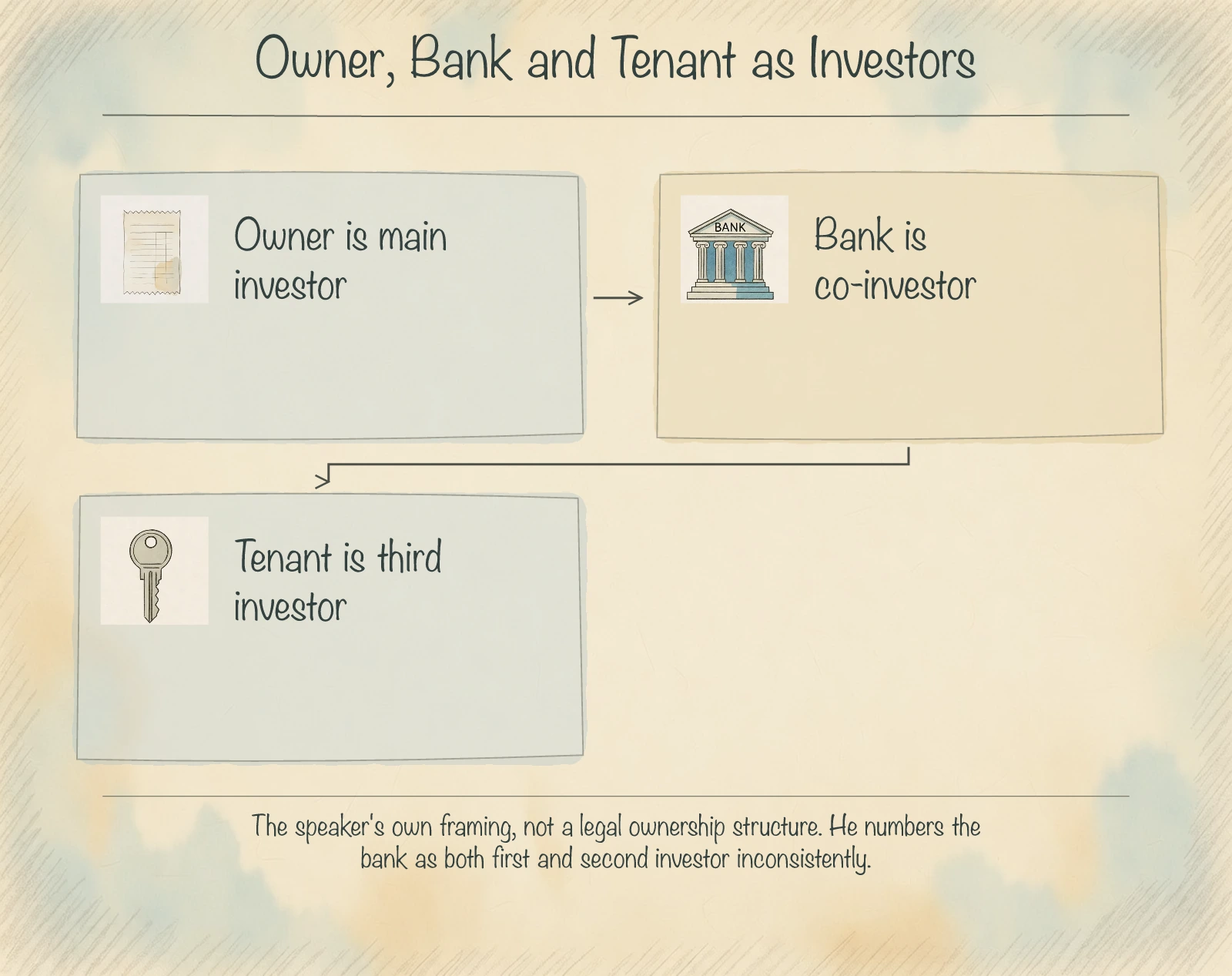
I call myself the main investor. The bank is my first co-investor.
This is the second investor and my tenant is my third investor. So if let's say I want to see $500,000 gain or at least a $400,000 gain but I don't want to deploy everything into a landed property, I can split my horses.
What do I mean by that? I can buy one for stay and one for investment because this investment property, let's say 2.35 million and let's say this own stay property 2.35 million, total I own a portfolio of $4.7 million.
This is an automated engine because I have me as an investor, my bank is the second investor, my third investor is actually the tenant. Now, because of the fact that I'm buying this to stay, I'm the main investor.
My bank is the second investor. Who is my third investor?
It's still me because I'm utilizing the property. I need to pay for the money installment.
If I split my horse, I call it split my horse's strategy because maybe I don't want to just put everything into one basket to a lender first. I want to maybe split 2.35, 2.35 and let the third investor work for me.
Alright, how does this look like? Basically my money installment, principle is 4.8, interest is 2.3, my third investor is paying 6,000 per month.
What is going to happen is that this third investor is going to pay for the interest fully to my bank. Now my bank is my second investor.
So the $6,200, I'm going to split it to $2,300 to cover the installment because the money installment has this interest that the bank wants. So my second investor is my 75% investor.
He or she loans me 75% as a bank. I want to take this third investor to pay him automatically and the balance is contributing to my principle to draw down my loan.
I top up another $900 because there's a difference. My monthly installment is $7.1,
my rental is $6.2, there's a difference of $900 so I top up $900 per month. So basically on a fundamental level, I put in $900 per month, I get back a total of $4,800 per month.
Why? Because my 900 dollars earns me 3,000 nai and that total return is 433% per month.
What business in the world has this good investment return? I put 900, the 10 input 3 nai, I put 900, 10 input 3 nai and everything will be unlocked after 4 years when I sell the property because this 4008 pays down my loan.
All right? It pays down my loan all the way from 1.75 to 1.522 over 48 months is through that 4008 that's been contributed by me and my tenant.
I put 900, the tenant put 39, I put 900, the tenant put 39. You just keep drawing down until I sell my property and that is the beauty why you can see 433% per month because 900 earns you 3,009.
Alright and if I selected the
right property and this property appreciated by 400,000 and I can exit for 2.75 because 400,000 means that I have selected a property with at least a 12% gross return on capital and it's about 400,000 or maybe 10% roughly about that.
And then if I can do that, what's going to happen is this, I exit at 2.75, I lessen my outstanding low, I extract 1.227. My initial investment is 677,000 including my exit fees, I extracted 1.167 and the numbers like this.
I put in 677 my net gain is 490k. In total I get back 1.167 that I'm going to deploy to my next landed property but this in and of itself is already 72% over four years.
Per year is 18%.
If I were to then calculate on another level which is a a net return basis after I remove off what I've invested myself the $900 over the last 48 months I still get basically about 17% and the breakdown is like this why is it that I want to reduce 18% to 70% is because I want to take
into account I put in this $900 also alright so I bring $900 over for the months, 10% this amount, 10% pay to the bank, the market gives me 400k appreciation because I selected the right property. I'm going to get a net of 17% after accounting my entry and exit fees.
So can I still see 500,000, 400,000 possible? I need to select the right product type in the right season but end of the day, if I calculate on a return on capital basis after cost, this amount of percentage is still possible.
Alright, last but not least, I want to hunt for freehold, bigger project under docs. Now this is a season, come back to this screen again, that I feel, I feel that if I can hunt for this particular type of property.
Oh, where is it? Where is it?
Okay. Oh my days.
Okay, great. Let's come to this.
Sorry for my handwriting. Now, last strategy is called hunt for freehold, big size, big density, high rise development
Hunting Big Freehold High-Rise Developments
under docs. I feel that this has a huge opportunity here in the year 2026.
If my quantum is very similar to the new launch quantum, if my PSF have a difference with the new launch and the resale 99 years.
I will put my attention on some of the resale freehold provided they are high-rise big size density and they can fight in terms of that loan sorry they can fight in terms of their base handle. Because there are a few ways to fight we call this a trifactor triangle if freehold is my main USP.
This is a very good solid foundation because I can fight with size, I can fight with quantum, I can fight with PSF but if I have additional bonus that is freehold, it's very very powerful provided.
You try your very best to understand the grapevine on the ground because some people they go for freehold projects they are old because they want to hit the on block lottery effect but there's a lot of grapevine because maybe the demographic is a lot of existing owner they don't want to sell and because of this a lot of people to want to buy or so.
So for example, if I buy the older projects and I see that the quantum is good, the size is good, the PSF is also very reasonable, it's freehold, for all the data on the cell, I keep hearing these objections, people keep saying that, yeah, this project cannot on-block one, the existing owner to want to sell.
And because of that, I don't want to buy. Because I want to make sure that there is this thing called the grid vine, which I need to understand from the consultant and professionals I'm working with to find out the grapevine for me.
Hey what is the insights, the juicy news of this project. I don't want to get myself into a project that in future when I want to sell I hear this new objection that I should have heard about it four years ago and this is the grapevine information that's very important.
So this is just something to note we're hunting for older projects. They're usually grapevine, only very season realtors and consultants, they will know about it.
All right, so with that, we come to the end of this webinar. And of course, we have other models to work with as well.
This will bring you to our paid masterclass where I conduct a two days condo masterclass session on how to hunt for the next right condominium for you. And of course, today's session is really about seeing what are some opportunities that could still help us to see a $500,000 paper gain in real estate investment.
But most importantly, a quick disclaimer is that not all properties perform. There are properties that don't see gains.
There are properties that see gains. There are properties that see more gains.
But importantly do your own homework.
Make sure your TDSR is prudent, financial is prudent, don't invest in property that creates stress for you and your family and importantly don't invest for the sake of investing. Always do your homework with professionals and get the right advice before you take action.
Take care.