Buying and upgrading
Fool-Proof Strategies You Need to Know to Profit from Upgrading Your Property
Published 2026-11-26. Adapted from the episode published 2024-11-19. Figures, illustrations and data reflect the episode’s original publication date.
On this page
- Introduction and Cooling Measures Driving Market Liquidity
- Market Conditions, Interest Rates, and Population Mix
- Singapore's Demand and Supply: Who Rents, Who Buys
- High-Quantum Exit Risks and the Mistake of Inaction
- Owning an HDB and Condo; Random Buying Costs
- Realised Losses and Why Projects Underperform
- Price Disparity and the Case for Resale Condos
Introduction and Cooling Measures Driving Market Liquidity
Thank you 99.co and Seedly for inviting me. Great to be here with all the speakers and of course to kick start the first segment.
I believe all of you are here today to learn and of course to understand and explore more about your options, and of course with the host of topics that Deirus has introduced in terms of finance and property. Very excited to share with you about this particular topic today.
And of course, when I was crafting out the content for today's segment, I think when we look at this particular topic, how to profit from upgrading your property, so maybe you might be here, you have already owned one property that you're currently living in.
Or you might be in the process of looking for a second property to invest, or you might be currently at a stage that you are planning to buy your first home. I think this topic more or less will help you to bring home some very important nuggets.
But what I will be focusing on today is the very fact that I will not be focusing on affordability.
Because if you are thinking about affordability, TDSR, how many months of instalments do you need to have in your bank or CPF to sustain your property investment or your first property, or your stress test level on the percentage of your income.
I think later on in terms of the speakers, because they'll be very wise to advise you on that.
Through the years of journey, doing so many home tour content and of course helping a lot of our clients is that I realised the number one mistake in Singapore, because we are so land scarce and of course our time is precious.
The years to own a real estate up to the low 10 or age of 65, or if you refinance up to 75, actually the period of owning a real estate is actually very little.
So sometimes through the journey of selling homes, I realised that some homes really take very long to exit.
So if you were to go into a property without doing your analysis, without having proper framework and methodology, you might be owning a property that you can eventually sell, but sometimes it jeopardises your next home, because you take very long period to exit from the current home.
So I think importantly for me is that I want to share today how to avoid three very important mistakes that I've seen over the last 16 years, and what are some of the three methodologies that we have been adopting to help some of our clients.
We create a lot of great content. We also started two other channels.
One is NOTG, where we interview entrepreneurs, business owners, property owners, and of course we also have another channel called PRB Insights that we talk about new launches and we study the analysis, pricing and framework. So this is our team.
We have a creative agency arm as well as a realty arm. My dream has always been to marry media content technology with a real estate consultant.
So currently we are a team of about 130 people. And of course, this has been one of the hot questions that a lot of people have because 2023 is a year with a lot of real estate news.
So every week you look at Business Times and Straits Times, you will be flushed with news and we are all thinking, are prices too high now? Will prices come down?
And when we are looking at all the property news and we look at the amount of cooling measures that we have, this entire chart tracks the 16 rounds of cooling measures that our Singapore government has already introduced. All the way starting from Lehman Brothers 2009 until today we have 16 rounds.
We already have five rounds of ABSD. And if we just look at this, it seems that every round of cooling measures sort of spurs the price upwards even more.
And I think we are at a stage that we are quite stuck because our government really cannot remove any form of cooling measures from this 16 kind of dots that you see right there.
So whether you're talking about landed properties, which is the orange colour line, you're talking about condominiums, the red colour line, or you're talking about HDB apartments, the blue colour line, the moment they release any cooling measures, what's gonna happen is that it will open up the floodgate for liquidity to come in again.
Market Conditions, Interest Rates, and Population Mix
So we are sort of trapped right now, that even though with prices going up gradually, volume is still pretty much healthy, and of course I think the key policies is that we don't want prices to go up too quickly.
So these are the latest news that has come up this week. This year, the market didn't start off well because we have US bank collapses.
Of course, Fed is not reducing interest rates. Right now, of course, what is happening in the Singapore market is that even though Fed rates are high, but I think our government was very quick to react and they introduced SORA rates.
And right now, if you look at fixed rates, it's already coming down to about 3.2%, which is quite stable.
And the interesting thing is that even though with a lot of negative news, but why is it that in terms of Singapore's health, in terms of health household income, in terms of sustainability, you're still looking at positive kind of contrary news.
So sometimes it confuses us because on one hand, if we want to buy something, we hope that prices will come down so that we can get a good deal. But on the other hand, we are also thinking about whether are we entering at too high a price.
So Singapore, if you look at this, our median household income actually across major cities has already increased. This was last year's kind of statistics.
And I think on a sustainability level, Singapore is doing well.
So when we move on to today's topic on the three mistakes and methodologies, I think something to ponder about is that why do home owners switch to private properties? Is it even prudent?
Because if you cannot pay your monthly mortgage for the next three months, what's gonna happen is that the bank has the right to repossess your home. And of course, if you didn't do your due diligence, didn't plan out properly, will it be a high-risk kind of move?
And when you see your colleagues or your friends or other property owners making that switch to own the first private property or maybe two or three private homes, what is it that they know that we don't?
And why is it that people tend to want to park capital, your bonuses, your profit, save up for down payment, but you want to park into something that is so illiquid, because real estate is very illiquid.
If you want to exit, it takes a long period of time to exit, including your marketing period as well as the completion period, compared to equities, is pretty much illiquid. So why is it that they still want to do that?
And we're just doing out a heat map across the last three years starting from COVID until today. And if you look at the bottom six rows where all the green colour heat maps are, those are basically the landed condominiums across different segments.
And of course because we compare that with Bitcoin, we compare that with STI, compare that with NASDAQ.
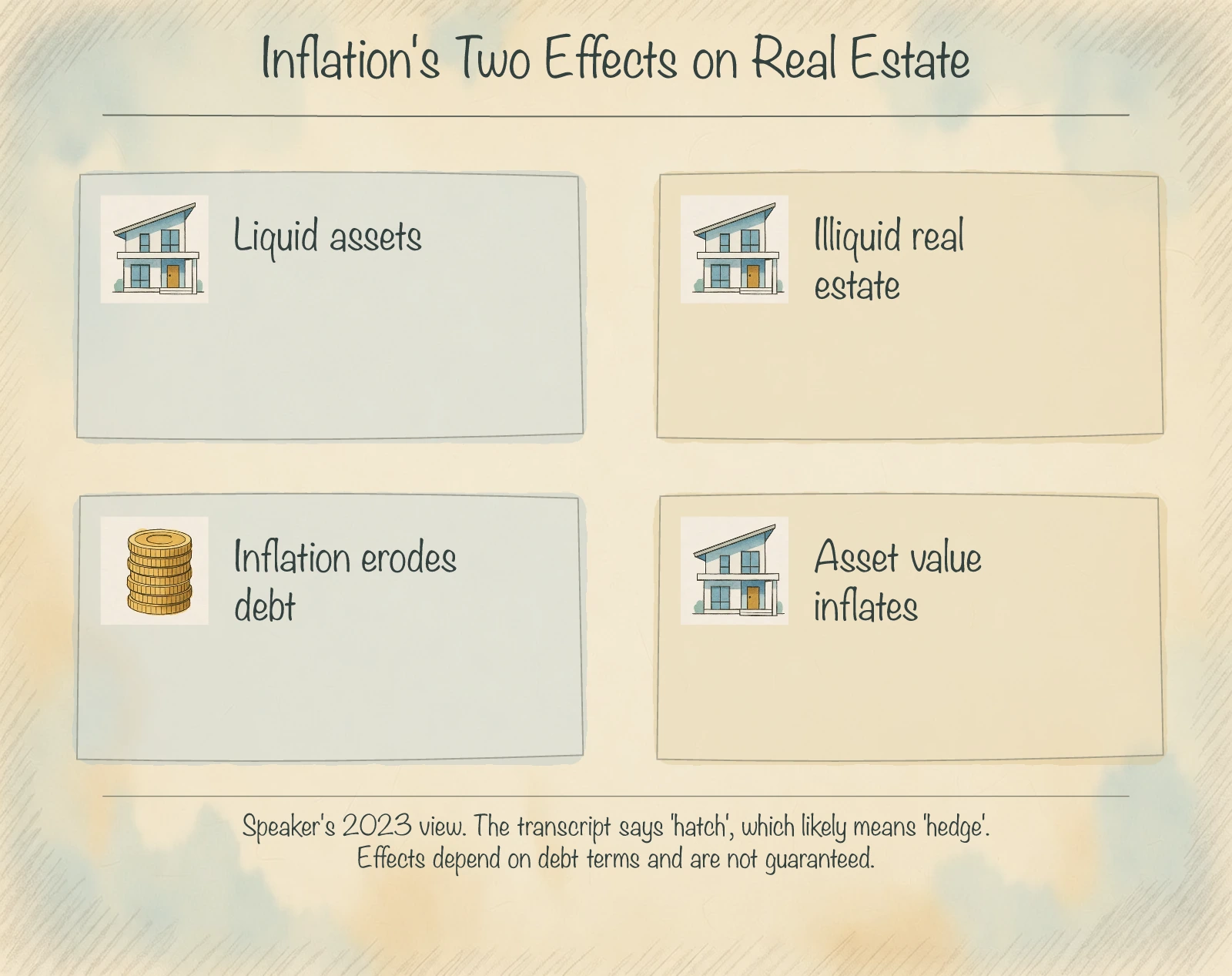
And I think the key thing is about putting diversification in the right basket. Because real estate is illiquid, however, it is a great hedge against inflation.
It is also a great hedge in the sense that you do not have to worry about the expansionary money supply. So we have this term in PRB, we call it real estate eats — it's, sorry, inflation is real estate.
Sorry, real estate is inflation for breakfast, in the sense that inflation erodes your debt that is in the real estate that you own. Subsequently, it also inflates your asset as monetary expansion happens.
So I think it's about finding the right balance, having liquid and illiquid assets.
So what causes assets, particularly real estate assets, to appreciate? Let's have a look.
And I think this will help you to answer some of the questions that you might have whether to take action or inaction today. So very importantly, we have to understand where we are at, because we are not born in another country where we have endless supply of land.
So if we are born in Singapore, it's very important to understand the demand and supply in Singapore. I like to talk about demand first because that will let us understand the next seven to 10 years, what kind of actions do we need to plan.
So this news, I think a lot of people didn't catch it because this was in 2013. That was a white paper and it's already happening.
And the target of course is to go towards 6.9 million in terms of population because our birth rates are extremely low. In a couple of years' time, we can match up to Japan's birth rate already.
And in seven years' time, when we walk on the streets, what's going to happen is that every two friends that we meet, one friend will be a Singaporean, one our foreigner friend will be either working in Singapore or they are a PR.
So if we look at this, that's about 50, 50%.
Singapore's Demand and Supply: Who Rents, Who Buys
I can just take 6.9 million divided by two. And the fundamental thing that I wanna share is that if we look at the classification of the people, they will either need to rent or buy.
There are four classification. First row, sorry, first column will be Singaporeans, second column will be PRs, third column will be foreigners that are working in Singapore.
For foreigners, they are not even working in Singapore, but they want to invest in Singapore, which is already happening over the last 20 years. And when we look on the left column, these are the total housing supply that we have in terms of types of properties.
So if we look at the residential properties, HDB apartments, we have 1.2 million. Condos, we have about 360,000.
Landed properties, we are stuck. They are only 73,000.
So if we just look at residential supply, that is about the supply we have right now. But if you look at the orange color roll, that is the only kind of residential property that suits international demand.
So probably there's a reason why investors wants to shift their capital that they already have in their current property to something that caters to international demand. Now, Singapore is very different.
we are brought up with the DNA of owning properties. Everybody's aspiration is to own a home.
And of course, if you are starting out, maybe your first aspiration is to own a home, get married, have kids. But through my 16 years, I have a lot of young couple customers as well that's been following us for many years.
Initially, most of my clients, when they get married in their mid-20s or early 30s, they usually say that, oh, this will be my forever home. But after five years they would usually call me and say, hey, I think I want to switch.
I want to buy a second one or I want to switch to a bigger home. So sometimes I think it's important to plan forward because if you look at the cost of living,
real estate can be a great hatch in terms of where we are today. So home ownership across major cities, we are close to about 90% year on year.
And when we look at the supply, Currently we have about 1.2 million HDB apartments in about three years time. There's going to be another fresh set of 150,000 BTOs.
Condominiums, we are currently at about 360,000. Per year, we have about an introduction of 10,000 new homes through government land sales.
So this is the landed supply. Pretty much stuck all the way from 1997 until today at about 73,000, no more brand new land.
government will not introduce land for landed homes because every land plot should have a high plot ratio to build high level homes. So the interesting thing about supply is if you look at this, 360,000, but the roving stock is only about 262,000.
The key rationale is this, every round of additional buy and sell duty for foreigners, it traps the existing stock. Why is it that it traps the existing stock?
if you look at the 20% condos that are already owned by foreigners and PR, and the 5% that are owned by companies, this 25% will unlikely be reintroduced into the market. Why?
Because they will not sell. Why is it that they will not sell?
Because if they sell now, they have to buy back with 60% ABSD, and they all bought these homes before the 60% ABSD. They either bought it at the 10%, 20%, or 30% mark, but very unlikely they will sell because they cannot buy back already.
So we are looking at about 262,000 roving stock, which compared to the overall population, is actually quite little. And this cooling measure is important because it sort of helps us to understand what should we buy and what should we avoid buying from now onwards.
So this was the phenomenon that I was talking about because lesser new foreign buyers, Yes, that's correct, but what is going to happen is that in terms of their holding power,
because if they have the holding power, very unlikely they will just put it in the market for fire sale because they can always rent it out and they would not want to do it in the sense that because they cannot buy back and they don't want to buy back with the 60% ABSD.
So we also look at how many percent of transactions belongs to foreigners per year. So right now it has sort of already dropped to about 2% to 3% of the latest ABSD introduction.
But anyway in the past it was always hovering at about 5%. And one of the things that this will then cause is that if let's say foreigners in terms of their transactions volume is dropping, then if you are going for a high quantum product you will need to take note.
because if let's say you are planning to go into D10, D11 or D9 to get a high quantum, $6, $7 million condominium, this is something that you have to be cautious about
High-Quantum Exit Risks and the Mistake of Inaction
Because in future, if the EBSD is not removed, your exit audience is going to drop and you need to think about who is going to absorb your high quantum condominium in future in the CCR region.
So which type of rare estate, after we have seen the demand supply has the most inelastic price to supply relationship, that I have looked at, these three properties. So of course this is like what we have learned in the past in economics.
And when we look at this, we call this the hardness of a set. So if we look from soft, hard to harder, technically what this means is that every time when you see newspapers, when the price rise, for example, for HDB properties, what is the next thing that will happen?
You will start to think that, hey, would that be new policies to curb the price escalation? And if you see prices for landed properties rising, will there be new policies to curb the price rise in landed properties?
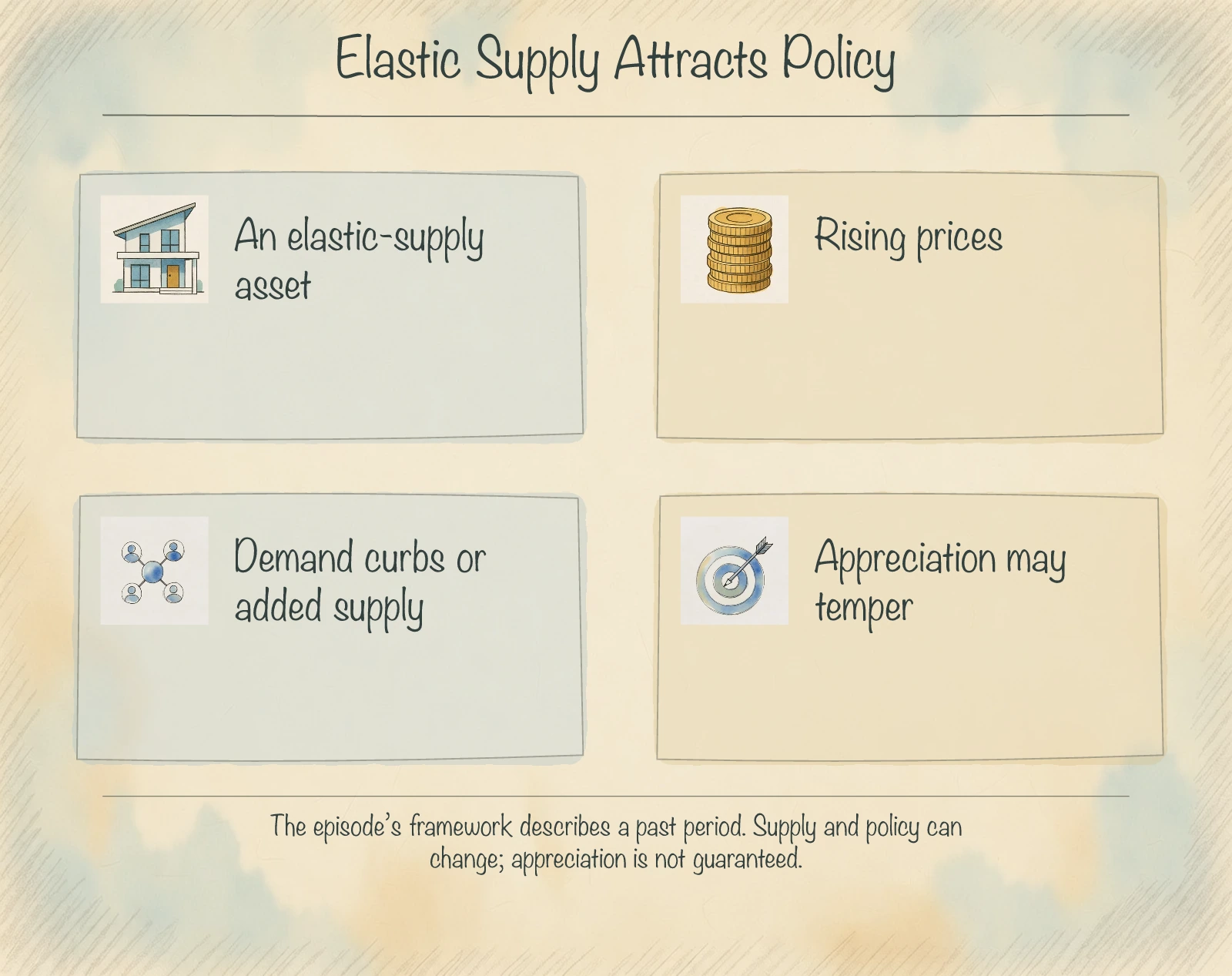
So this is a decision making matrix as well, because that allows you to think about, hey, should I shift my capital into a harder asset? Because what technically happens is that, the more inelastic your asset is in the residential property region, the better is your price appreciation.
And whenever HGB prices rise, this will be the topic in parliament. And that is all good because HGB properties are meant for living.
They are not meant to make money. And this is a very important element in our island-wide kind of policies.
But the fact is that every time when prices rise, it attracts policies because it is very elastic and supply will be introduced. And thus this is always the trend for the past 20 years.
When you see price rise for something that's very elastic, government policy sets in to cut the demand or to increase the supply. And thus your price potential, you will find that over the years, it tends to be more terpid compared to something that's more inelastic.
So beefing out supply, beefing out supply, and of course in PRB, how we help our clients to make decisions is also based on several kinds of framework. This is one kind of framework.
And Lender Properties belongs to the Q1 framework, in the fact that it has great appreciation, but the U is extremely low, because the quantum is big. Q2 and Q3 and Q4 basically belongs to condominiums, but you have to also be careful.
It's not that after today you just head out immediately buy a condo because you will hear people buying new launches or resale, but they don't see appreciation for many years. So you also have to do deeper analysis and framework.
Now for demand and supply, the summation for this part is that if you have the ability and you're in the right season, then plan for something that is harder because of what is going to come in 2030 as well as based on the supply level of properties types in the next seven years.
So how to avoid some of the mistakes when you are thinking about buying, let's say a private property. So let's have a look.
Now, mistake number one is that, what Darius just mentioned is inaction, because your best years are usually between your late 20s all the way until your late 40s. These are your best years.
And sometimes when we try to time the market and we don't take action, we lose these years because when you talk to the bank, in terms of your mortgage loan, you talk about your TDSR, these are all affected.
Now, the highest earning power usually belongs to that period right there. And of course, when you're entering into your mid 50s, a lot of people will start to plan for a retirement strategy because you want to tap into the last portion that you can use most of your OA account for your property.
And you want to make sure that during your best years, you don't forget about planning for your real estate investment.
And sometimes when we look at the most elastic property, which is the HGBS set, most of the time we call this the trapped equity effect. This is the only real estate in Singapore that you cannot extract your equity.
The only way to extract your equity is to kill the golden goose, that means you have to sell it. So sometimes when your property has already appreciated, you're sitting on good margins, but you cannot extract it unlike private real estate where you can go for equity term loan.
There's a lot of different facilities for you to do that. But the only way is that you have to kill the go-to-goose.
But sometimes just thinking about this creates inaction because we feel that, yeah, it's very sayang to sell off my HDB that I've been staying here for many years, but if we compare that with the methodology about not wasting the bestest of our life, I think sometimes the other perspective is that you can always buy back a HDB when you're in your 50s as well.
Owning an HDB and Condo; Random Buying Costs
Oh, sorry, okay. So HDB rates that are meant for living is not for investment.
Recently we released an episode talking about, if you really want to have a safety benchmark to own a HDB as well as a condo, there's a way to do it. So there are two methodologies to own a HDB and a condo.
One with ABSD, one without ABSD, it is still doable today. So watch the episode of NLTG, we talk about the latest framework and the methodology.
And this has essentially created a new spectrum that we will see in the next 14 years.
Because in future, what is gonna happen is that for class and prime kind of properties, it will not allow people to own a HDB and a private property in the sense that you can rent out your HDB as a for rental investment.
So this technically creates a new spectrum that we will see in 14 years' time.
And this was the episode that I was referring to, the standard plus prime. And I just want to share about the first mistake, is that this is a client has followed us for about 10 over years.
We started off with them purchasing the first HDB property. Today they own a landed home, as well as a condo for investment rental.
And their mindset from the start has always been that they want to expand the value of the properties that they're holding. So they're always in like an expansionary mode, but they're extremely prudent.
They are both holding a good professional occupation. They are not running their own business, but they're extremely prudent.
And with a step by step kind of planning over the last 10 over years, they managed to accomplish what they have today. So they started off with a HDB.
We sold it for them after five years MOP. They bought a resale with a grant, and of course they moved into two properties after that, a penthouse and a rental investment,
followed with, they still keep that rental property until today, and of course they have expanded into a landed just about three years back.
And till today, of course, their landed has expanded in valuation as well, because they identify the landed property as a harder asset, that the condominium is still a hard asset, but they want to let it run in terms of rental investment.
So this is an example of a DR plan, and essentially what is going to happen by age 65, they also tell me that maybe they will sell off everything and move back to HDB, and that might happen as well.
So this is Daniel and his family, so we're interviewing him at his landed home. And mistake number two basically is about random buying.
So after today, maybe you feel motivated to take action, but this will be a very costly mistake. What is random buying?
This whole mindset has been one of the most costly mindsets I've seen in my past 16 years, is that
always assuming that new launch is the best. I'm not saying that new launch is no good.
I bought a new launch before as well. New launches, if you select carefully, you can find the right gem.
Assuming that freehold is always the best, which might not be true, but of course, there are great freehold properties. But I think if we look at this, you'll always hear two kinds of advice.
So if you meet anybody on the streets, you ask them, hey, when should I buy? They will say now, right?
What to invest? They will tell you new launch.
And that is dangerous because if you didn't do homework enough, you will not be able to see the blind spots. So firstly, it's not about new launch or resale.
It is really about the particular type of characteristics and factors of that project. And to understand that, a couple of frameworks to share with you.
So this is of course a new launch that has performed very well, this was launched in the early days of 2019.
Until today, the owners are sitting on very good profit margin. Just some example, averagely most owners are sitting about three to 400,000 of profit margin if they bought Park X-Star.
Sterling Residences also did very well. And of course, Panorama.
And Panorama was of course something that has started in 2014, way before the COVID season. And of course, you can see the profit margin over here about four to 800,000.
But not all properties will appreciate. Let me give you some example.
This is a freehold property at D10, and it has not U-turned until today. So the first owners bought in 2013, until today they are still sitting on losses.
And this is a new launch freehold project, one kilometre from a lot of good schools, until today have not recovered. Example of their paper loss, basically it's about $120,000.
99 years project at D19, two batches of owners, owners that went in at 2016, 2017, see paper gain, owners that went in at 2018, still have not seen any paper gain yet.
Realised Losses and Why Projects Underperform
D11 freehold, plateaued all the way from launch. This is of course some of the owners that couldn't wait any longer, they exited and of course they realised they're lost.
99 years D23, some of the losses that have been realised over at that column right there. And of course this is D9, 99 years.
So sometimes when we look at this, and of course you can see the loss can amount to about a million dollars when it's out. So sometimes we see this, then we start to ponder, hey, new launch, confirm will we see gains?
Freehold, near good schools, will we see gains? Why is it that some properties can perform, some cannot perform?
And when it comes to freehold decisions, you also will feel strange. What is it that this property which is already quite old now, Covert Melody, is right now having a balance list of about 80 over years, but in the last 12 years, if you have bought a 3 Beta back then,
a pre-station is about 490,000, but if you bought something that is beside Covert Melody, there's freehold, the gain over the last 12 hours is only 110,000 compared to 490,000. Why is it that a freehold property that's near to the MRT, compared to a 99's beside MRT has such a stuck difference?
Now the key rationale is because in Singapore, the valuation method is very different. The valuation is not based on just 10 or, it's based on volume of transactions.
So in our 11 analytical factors that we do it for our clients. Is that there's two first thing that you must adopt.
If let's say you want to own a property that you want to enjoy staying but you want to see good appreciation in terms of a higher chance of seeing that in the next couple of years is that the amount of units in that project must surpass a
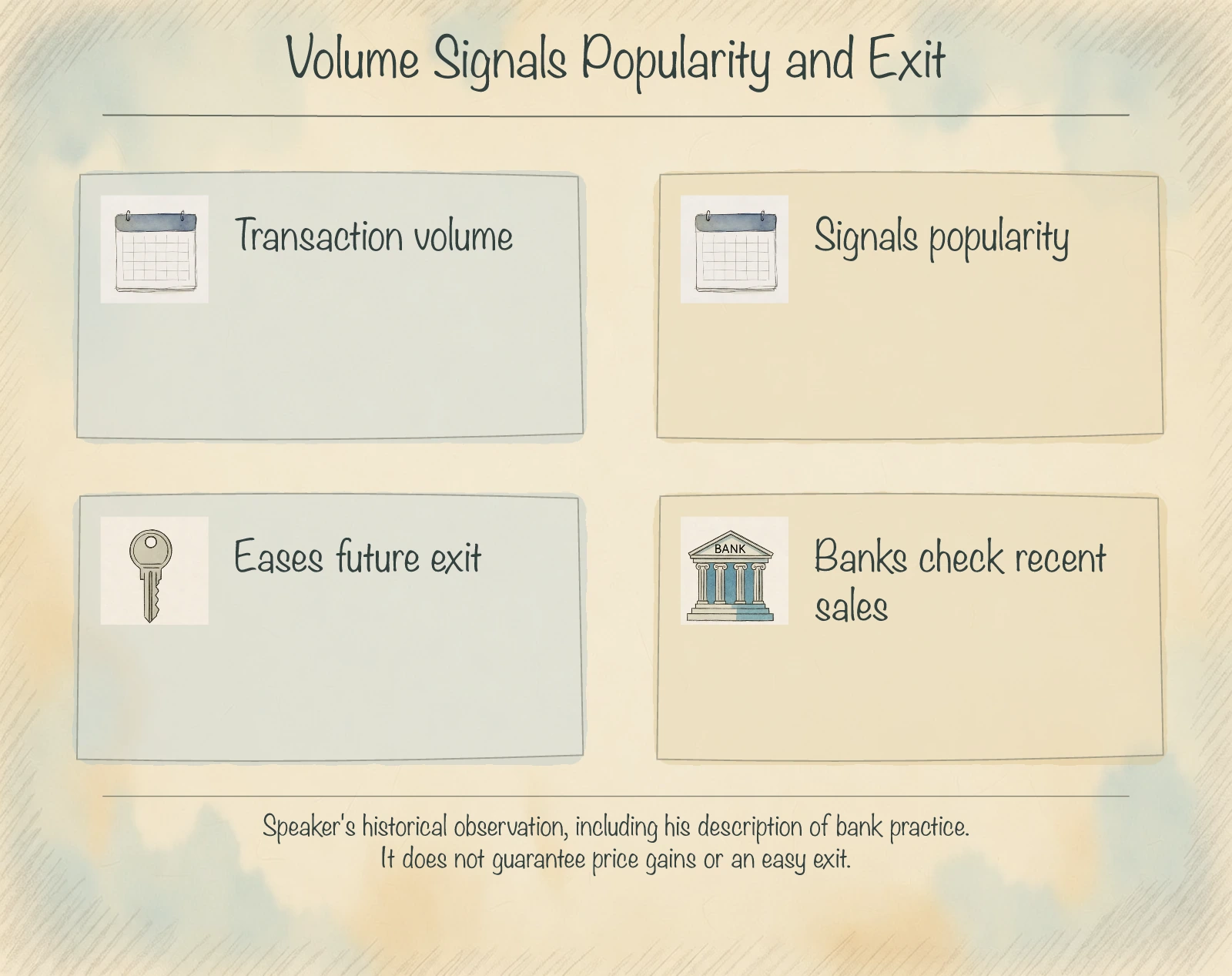
certain range because you want to ensure there's good volume. If there's not enough volume the appreciation is stifled right and transactions, volume and popularity they have a combined relationship.
So what is this relationship? Basically, if you go into a project with healthy transactions, it tells you about the popularity of the project.
It also tells you the very fact that if they are willing buyers and willing sellers, this is a healthy project. And in future, if you want to exit, there will be lesser issues to exit.
Secondly, bankers and valuers, when they work together, when you call your bank to ask them, hey, I want to sell my condo right now, what is my indicated valuation? The very first thing they look at is the past 12 months transactions to determine what will be the desktop valuation right now.
So valuation is actually co-related to volume and this is of course the rationale about why we always look at transaction volumes. So this has a combined relationship because the very strange thing is that I can just
name you just one property that is very old already, which is Mandarin Gardens. Mandarin governance is having a balance of 58, 57 years, but in the last three years, if you have bought a three beta back then, your paper gain right now is already 400,000.
Why is it that it's old, but the appreciation is still strong, combination of reason, COVID, second reason is that it has huge volume, third reason is that the PSF is still low.
But of course you have to take a look of Bala's curve as well, because the moment it hits a certain point, then the least handle will start to kick in to decrease your valuation. So that's something of another topic.
Now moving on, we also use this mode analysis to determine the points of investment. And these are some of our signature strategies that we use in-house.
And let me move on to mistake number three. Is that if you buy the wrong tile properties in the wrong season, that can also be dangerous.
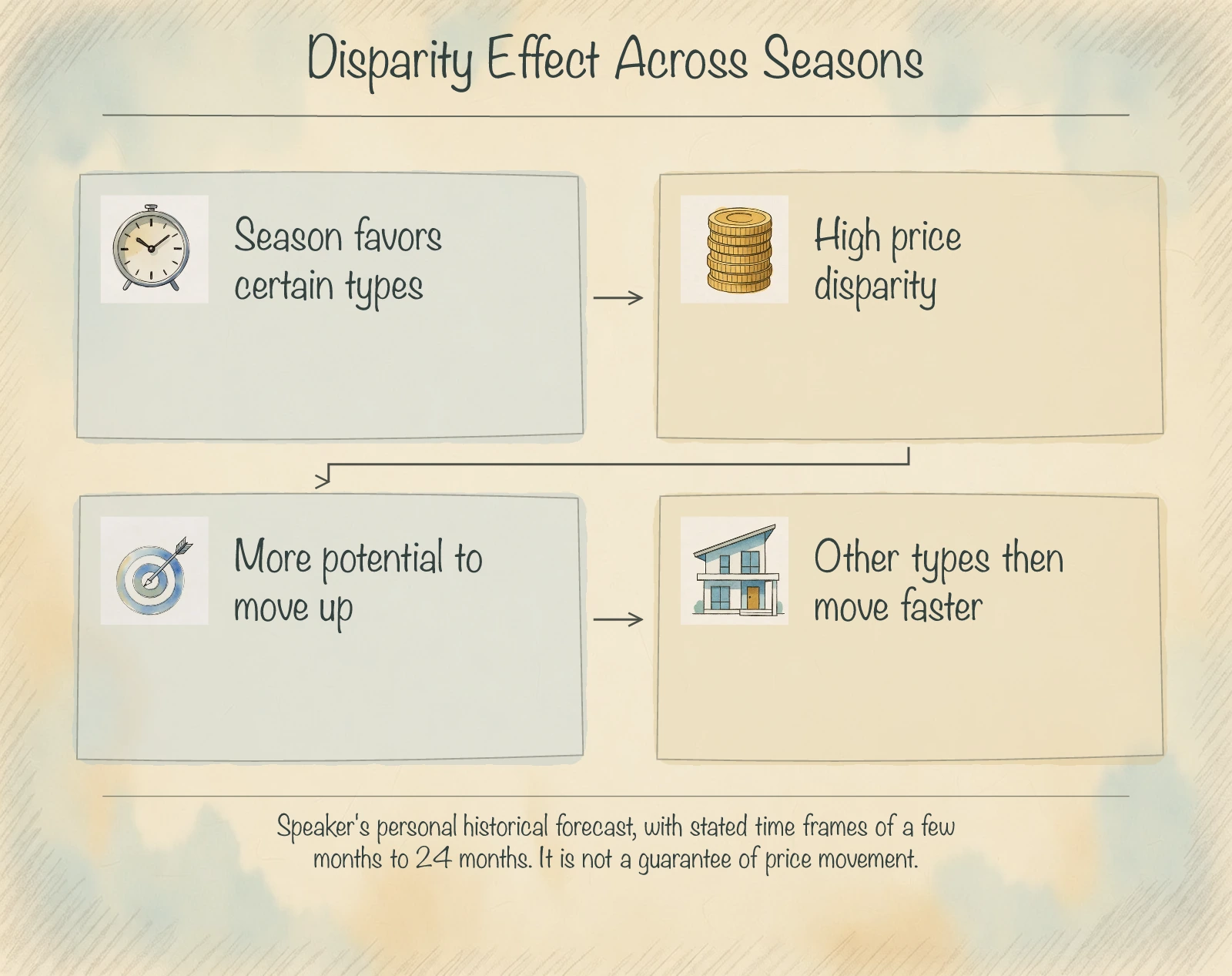
So how do we select the right tile property in the right season? we use this thing called disparity effect.
So disparity effect is that in a particular season, certain types of properties tends to have a higher potential to move up compared to another type of property. So things will always shift in different seasons because in school we call this the substitution effect if you study economics.
And right now, my own personal forecast is that in the next 24 months, what might happen is that resale property will be dominant. The key rationale is because the PSF level of the three types of condos are too close.
So newly TOB projects and new launches, they are too close in the sense that they belong to one segment, all together, that's away from the resale condos. So resale condos right now, it is the key kind of substitute product in the market, in the sense that it makes sense.
But if you look at a new launch PSF level,
Price Disparity and the Case for Resale Condos
So now, newly TOP PSF level, they are currently at a new benchmark which buyers would need some time to be able to absorb to this new level. So in the next three, four months, because of the fact that it has a high disparity away from the other two, you will have more potential to move up.
And once it moves up to a new level, then these two types will start to move faster. So sometimes it's important to study the disparity between prices as well.
Now, just an example. So the rationale is that, let's say somebody is in the market looking for a four-bedder, and when they look at this, three different kinds of choices that they have.
And because of the very fact that if, let's say they want space, but at the same time, they are also concerned about the overall quantum and PSF level. Then you will get to see why is it that in the next 12 to 24 months, a lot of people will be looking at resale condos.
Now, another form of disparity into the landed market. So when we look at disparity, it's also important to understand, if let's say somebody's going for a landed, they look at three different types.
What is the gap in between, and how do they make decisions? So when you enter into something that right now is not in the right season, what will happen is that, if you are the owner of something that is at the new benchmark, it will take longer for you to exit in future.
But if you are the owner of something that is in the benchmark level that has the potential to rise up in the next three to five years, when you want to exit in future, it is easier. So, these are the three choices again.
Of course right now for Kono Minus, there are about 47 launches right now, 38 projects that will hit completion this year, and of course resale choices, 320,000. And an example of disparity effect for Landed is that in 2020,
we released an episode to inform our audience that inter-terraces is now prime for appreciation. So what happened over the next two years is that inter-terraces move up faster than semi-D as well as detached homes.
And once that is fulfilled, what happened was that right now, in the year 2020-23, we released another episode to share that the right season right now could be semi-Ds because inter-terraces has moved up too fast and tasks — the disparity effect is a decision-making tool as well to look at what kind of homes should you go for in the right season.
If you want to understand about disparity effect, I hope that this can add value to you, you can scan this. Later on, I'll pass the slides to the audience as well.
I don't know whether you can share the slides, okay, great. Now the last thing before I hand over to the next speaker
is that if you're somebody that really love brand new properties and you really love new launches, we recently researched 160 projects to look at their eight years performance and we came up with these four frameworks just to ensure that if you wanna buy a new launch, you don't go for something that is overpriced because they are overpriced, they are right priced kind of new launches as well.
And let's say you really want to go for new launch, there are four different frameworks right here. One is called the break even calculator.
The other one is the lease resale calculator, is to resale the property that you're going for and to look at the surrounding projects to see if the PSF makes sense. Third one will be more analysis.
Fourth one is the X percentage threshold. That means the new launch that you go into should not exceed this number compared to the resale that is surrounding it.
If you actually a certain range, then it might mean that it's a little bit more overpriced.
So you can also scan here to watch the full video. And of course with that, thank you for spending time with me.
Hope that this session has added value to you. Thank you.