Evaluating property
Decoding Lease Reset: What Makes a Property Truly Worth It
Published 2026-11-10. Adapted from the episode published 2025-10-03. Figures, illustrations and data reflect the episode’s original publication date.
Comparing Sterling and Penrith through lease reset
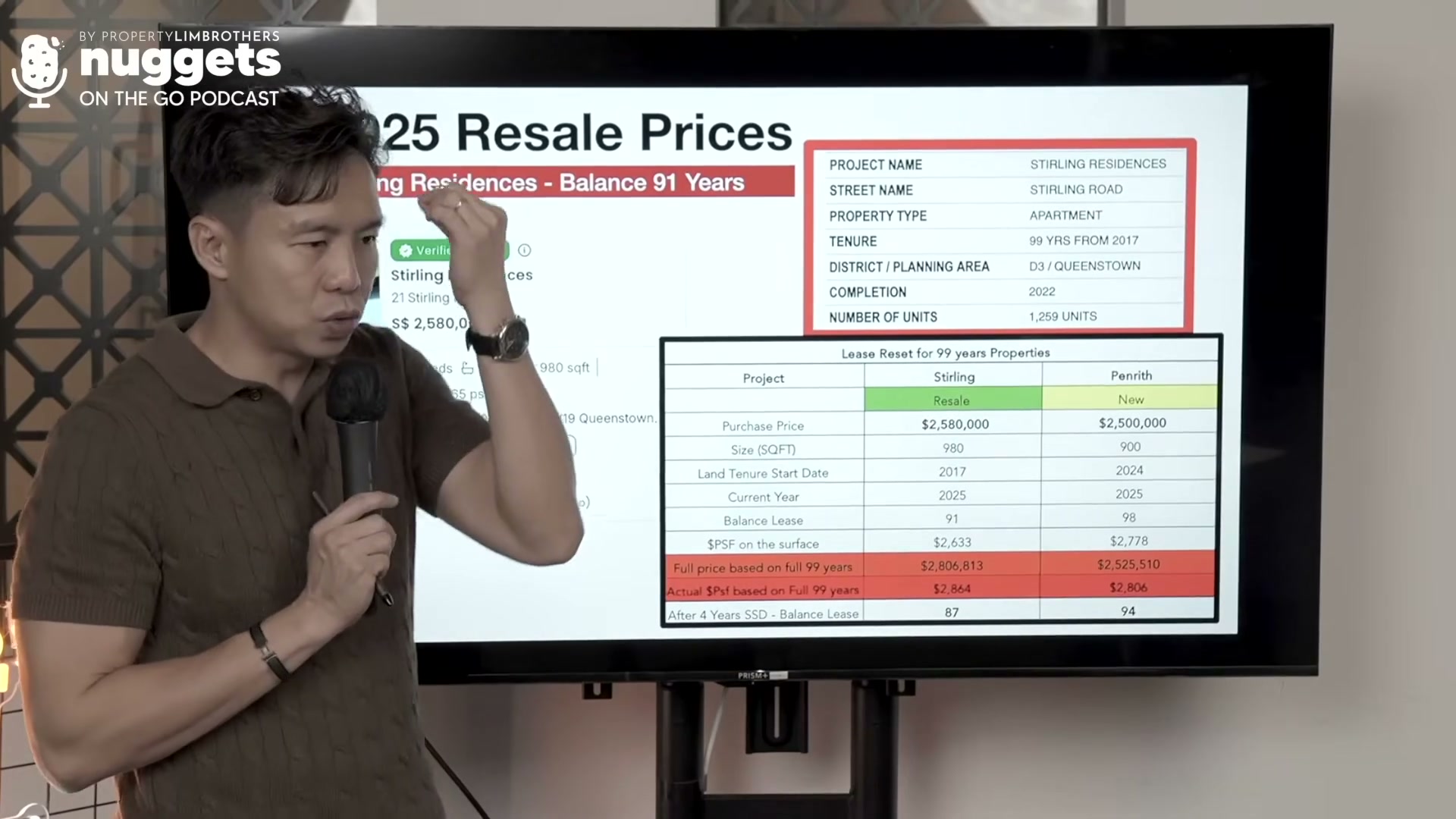
So basically for Sterling, currently is having a balanced lease of 91 years, still very new. But if we were to reset it back to a full 99 years, technically the full price is $2.8 million.
Henry is about $2.52, 2008 PSF. Key difference is that you will start to see that why is it that in the year 2025 Q3, sellers are becoming more aggressive to ask for higher prices is only normal.
And I will unlock a third buyer audience because there's an audience that is okay to buy resale. There's an audience that only wants to buy brand new because they want the first mover.
There's an audience that only wants —
Alright, so I'm just looking at what the latest upcoming launch at Penrith and just some quick thoughts about it.
I was pumping through our lease reset calculator and having a look at some of the very good performing properties surrounding it which has already been transacted at a certain pricing and of course we all know that certain asking prices by homeowners vis-a-vis the transactional price as always a gap.
Example, somebody let's say they transacted their 3-bed at $2.4 million, the next owner might want to sell at $2.58, just an example of a screenshot that we took recently. So Sterling Residences is doing very well, there's a unit that is for sale $2.58 million, and of course these are all public information.
Alright, so asking for $2,600 per square foot, 3-bed 2-bath 980 square feet. Now if Penrith — I don't know the pricing yet, disclaimer, these are all my own estimation just for illustration purpose.
Big disclaimer here, if Penrith has any 3-beds around 900 square feet and doing at about $2.5 million, let's say for a mid-level at $2,778 PSF, after we pump it through our lease reset calculator, this is what is going to happen.
So basically for Sterling, currently is having a balance lease of 91 years, still very new, but if we were to reset it back to a full 99 years, technically the full price is $2.8 million at 2008 PSF.
Penrith, if we were to reset it back to a full 99 years because now it's one year old from the Lambda H, it's about 2.52, 2008 PSF.
Key difference is that after four years of purchase, the balance lease of Sterling, let's see if I were to decide between Sterling and Penrith, four years later in the year 2029, I will have a balance lease of 87 for my Sterling, 94 years for my newly-topped-up Penrith.
This is an example of how we use the lease reset to try and make sense and see the pros and cons whether should I buy Sterling to stay immediately now, I can get to stay for the next four years and then I sell later, or should I go for a Penrith and wait for four years and sell later or maybe move in or rent out later after four years.
So how do we make sense of this lease reset is just to have a justification matrix in our mind. Why?
Read chart values
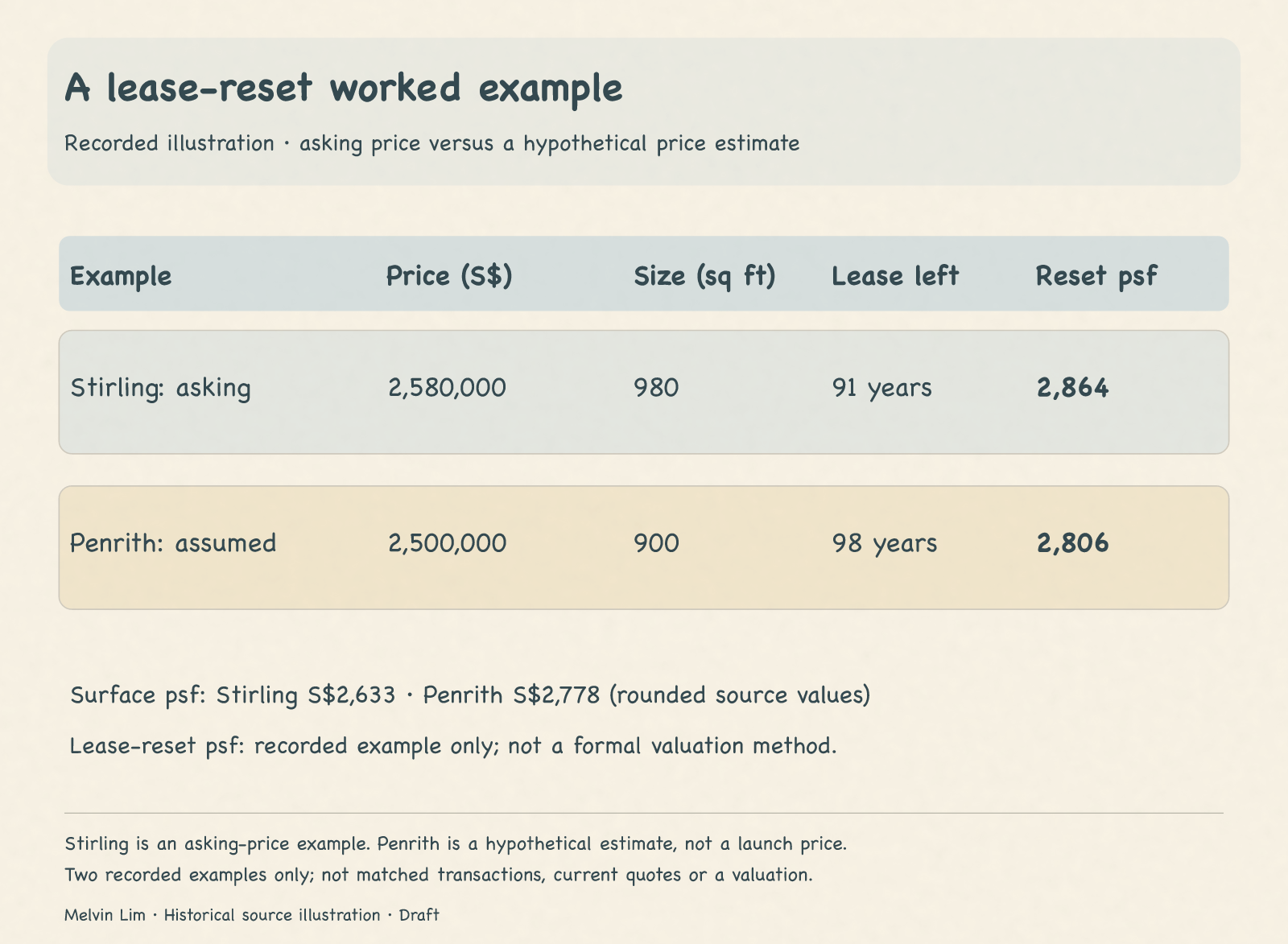
Recorded 3 October 2025; source illustration year 2025 · Mixed units, individually labelled in table
| Example | Price (S$) | Size (sq ft) | Lease left (years) | Surface psf (S$) | Lease-reset psf (S$) |
|---|---|---|---|---|---|
| Stirling: asking | 2,580,000 | 980 | 91 | 2,633 | 2,864 |
| Penrith: hypothetical | 2,500,000 | 900 | 98 | 2,778 | 2,806 |
Example, I need to see what is the strategy of this developer as well. So if they will do launch, let's say a 3-bed quantum at 2.5 million and my budget is 2.5 million and I can buy something, I don't know what level yet.
Alright, what is my potential exit price in the year 2029?
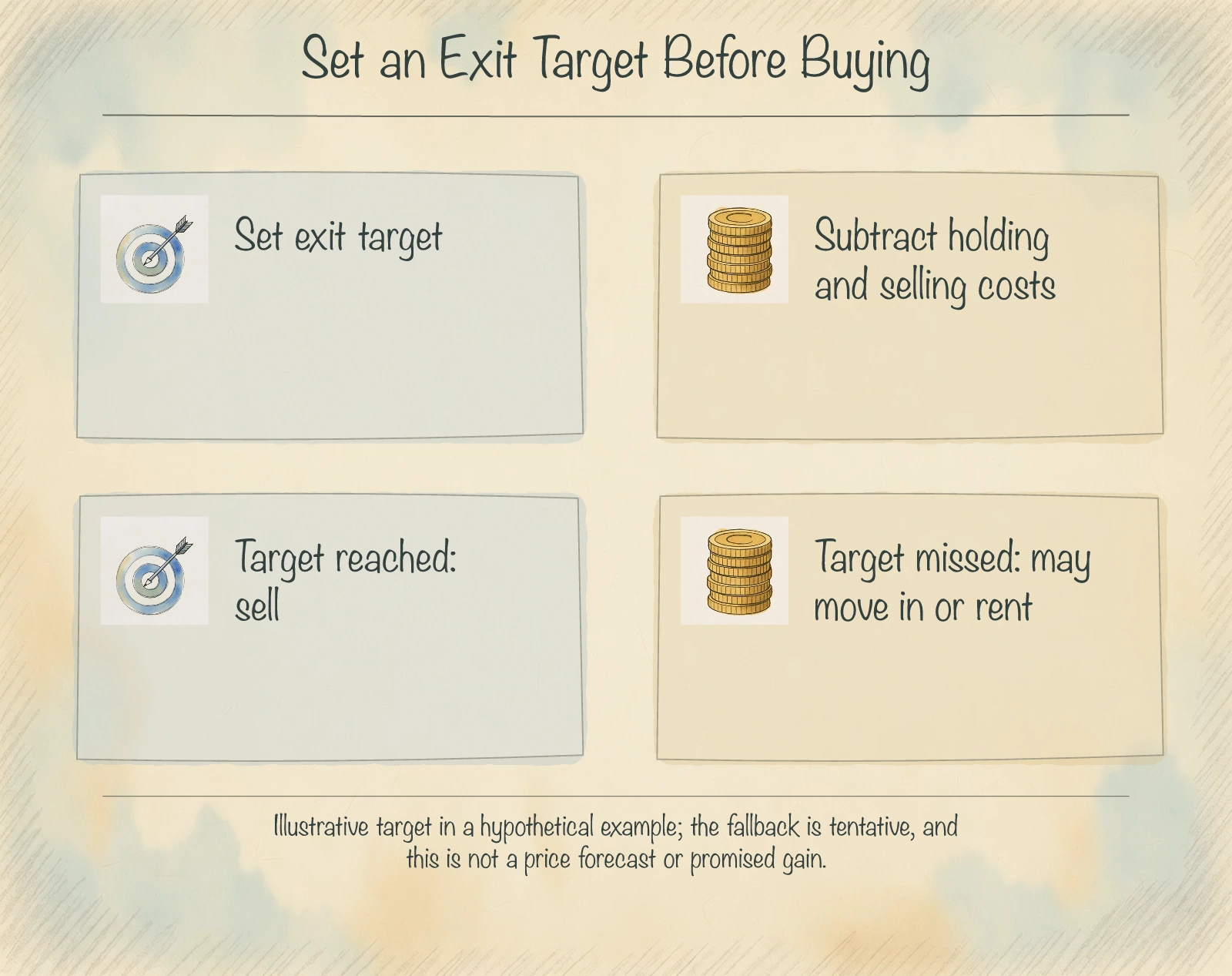
Let's say I buy with a purpose of capital appreciation and investment and if four years later at the year 2029, I cannot hit a certain target and let's say I set my target at $2.8 million dollars and if I cannot hit that target, I don't want to sell because it doesn't make sense for me.
I waited four years, I paid some progressive payment interest, I paid my buyer's stamp duty, when I sell, I need to pay my realtors and then of course I need to make sense of my exit price and let's say it's 2.8 million or maybe 2.9 million, alright I want to see 400k gain.
If I cannot sell at that price, then maybe I will move in or I'll rent out.
So I need to see four years later if I want to sell 2.9 versus I buy Sterling at 2.58 and I want to sell for the same amount of appreciation at 2.98, which one will be easier for me to exit?
Will it be Sterling, my Harris square feet balance 87 years and I want to sell at 2.98, or I buy a brand new Penrith and I sell for 2.9. So a few key decision metrics over here is that what will my buyer think, so in the year 2029 what will my buyer think.
If I buy from a perspective of trying to exit, will my buyer bite the bullet and pay for this or pay for this? So this is one example how we can make certain decisions.
Now you will start to see that why is it that in the year 2025 Q3, sellers are becoming more aggressive to ask for higher prices is only normal. All of us if you want to buy something most of the time we have something to sell.
Seller strength, buyer audiences and the Queens example
...sell, and the key rationale is because now we are already moving into the sellers market. The interest rates are coming down, sellers have more strength if they have more properties and they know that buyers are coming back.
So sometimes sellers will start to ask for a higher pricing, but of course we always share and advocate: if I'm a seller, I want to sell and move to a stronger asset.
Let's say I want to buy a landed or bigger property, then I should sell it in an efficient way so that I can move that faster, because if the market were to move up, my stronger and bigger property is going to appreciate much faster than my current property.
Alright, so the opportunity cost of going there is better rather than hoping that I can sell at a much higher price that the market cannot absorb in the next three months, because sometimes I want to ask for a high price but maybe I can only sell nine months later,
but just to earn another 100k here I already lose 400k on my lender because the lender has moved up by 400k nine months later as an illustration. Now, basically when I look at this, then I will think a few key decision factors is that this has a balance of 87.
I'm not saying that it's no good. The good thing is that here you can stay.
The downside is here you cannot stay. The good thing is this will be newer, brand new TOP, and I will unlock a third buyer audience, because there's an audience that is okay to buy resale, there's an audience that only wants to buy brand new because they want the first mover.
There's an audience that only want to buy newly TOP project because they don't want to wait for four years, they don't want to buy a property that people stayed before, they only want to buy newly TOP. So here I can sell to audience one and audience two, which is a key benefit and
I can also rent out, I can also stay in a brand new unit, or I can rent out then I sell with tendency, so there are multiple ways to do it. But then the chance of this is that after you weigh the pros and cons then you need to see which makes sense.
Because you also need to consider your current property, your own state, like do you have a place to stay, are you going to rent. And are there replacement costs because you need to pay rental, and based on your progressive payment here is that a delta difference in terms of the progressive payment.
Because maybe you start a progressive payment at $600 then increase to $002, increase to $2005, increased to 3,008, increased to 4,008, 6,000 and then gradually it's 8,000 upon CSC. So is that a delta difference to take the difference to pay for your rental?
Alright, let's say you are contemplating between Penrith or Sterling. Can you use the delta difference and rent Sterling first while you invest in Penrith because
you want this opportunity. This is some decision-making kind of like tools that you can deploy.
Or is it better off that you stay here for four years and then you see what happens in the year 2029 and you try to sell for 2.98, but then the next thing to think about is will this property, because it's balance 87, lose up to Penrith as a new competitor that will TOP in the year 2029.
So there's always pros and cons on both side of the coin. Importantly is to measure based on your current season, your preference of your family.
And of course sometimes it's very difficult because we always will tend to think about certain kind of decision-making tool is like, okay, at the same time I want my preferences for my family. But then at the same time, I also want to have some investment kind of decision frameworks.
And I want to so-called like fulfill the part of like maybe having my needs taken care of, right? Whether it's
school or preferences or certain kind of things that I prefer, but I still hope that it can generate capital appreciation. So sometimes it might be not easy to combine both, sometimes it can be done, and which is why some people chose like a rambesting approach.
So they don't want to let their emotion talk their decision, for looking at the investment as a pure investment and thus they deploy what we call a rampesting approach, and of course this is also one method that you can think about.
So when we look at this Queens, then Queens I think is a very popular property as well but the asking price is also pretty strong, 2000 PSF, 3 bed 3 bath, 1195, $2.4 million dollars when we reset it because it has a balance of 72; the current price based on full reset 99 years is actually about $2,700 per square foot.
And of course when we look at Queens there's some bay window, AC ledge, basically this pre-harmonized, and of course new projects are post-harmonized,
Queens details and consultation invitation
so there's a key difference as well so we basically call this the least reset and new launch catalyst And of course, this is just an example how you can use just one framework that we have to make Certain decisions and think about things.
All right. I'll see you on the next episode.
Meantime take care