Ownership and financing
Cracking the Condo Code 9: What Makes Singapore Real Estate Different Yet Lucrative?
Published 2026-11-08. Adapted from the episode published 2023-12-22.

Singapore's Property Moats and Limited Land Supply
Melvin opens by explaining the term "moat". It became popular through the investor Warren Buffett, who talked about hunting for businesses with a very thick moat.
He compares it to the moat around a traditional Japanese castle, which works as a defense system against enemies. The thicker the moat, the better protected the castle.
In business terms, Melvin says, a thicker moat makes a company harder to disrupt and gives it more unique selling points. He applies the same idea to Singapore's real estate market.
He identifies 10 moats that he sees as key strengths of that market, drawing on its demographics, inherent factors, policies, economic factors and the human factor.
Melvin says the point of the 10 moats is to build a macro picture that informs micro decisions about what to invest in. He calls them evergreen topics, because today's market reflects years of accumulation.
The first moat is the government's repeated cooling measures. Melvin says they are bad news for speculators and for investors who could once buy several properties at once or sell almost immediately.
In his view, the market used to show larger swings before such measures. Price movement later became more gradual even as measures were added, apart from a sharp acceleration after COVID that he linked to heavy global quantitative easing.
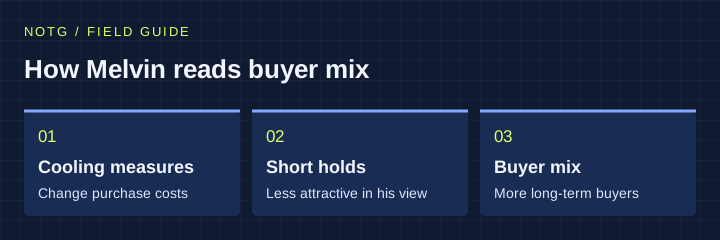
Melvin argues that cooling measures are good for the market overall. They discourage short-term speculation and favor serious mid- to long-term buyers, whether owner-occupiers or investors ready to hold a second property.
In his view, this makes Singapore's market stable without removing the potential for capital appreciation.
The second moat is limited land supply. Melvin notes that Singapore can only add land by reclamation, which takes many years.
As an example, he mentions the Long Island proposal, which was still under discussion when he recorded. It would act as water-level protection for the East Coast while also allowing more housing.
Supply Control, Demand, and Stable Market Growth
Melvin says an asset buyer should always look at demand and supply. In a country with no control over how much developers can build, he suggests the investment leans toward a rental play, provided the yield is good.
He frames real estate investing as either a capital play or a rental play. In his view Singapore suits a capital play, especially in residential property, provided the investor chooses the right kind of project.
The third moat is demand. Melvin says population growth drives it, because people who arrive usually rent first and eventually want to buy.
Without people being attracted to a country, he says, there is no added prospect of buying into its property market. He sees growing demand combined with limited land as a good setup for capital appreciation.
The fourth moat is strong monetary and fiscal policy. Melvin credits the government with managing the interest-rate environment well, and says the introduction of SORA made mortgage rates more controlled.
He thinks the government planned for this well in advance. He also notes that new-launch properties generally follow flexible rates, while completed properties can use fixed rates.
He does not give verified figures for either.
The fifth moat is state control of land through government land sales. Melvin explains that the government decides how much land to release each half-year or quarter.
He says it adjusts supply according to how aggressively developers bid. If bidding gets aggressive and prices rise too fast, more land is released.
Developers then see more land to bid for and can ease off, which Melvin considers a very good policy.

The next moat is that Singapore differs from many other countries. Melvin says big countries often draw people from the outskirts to the capital, creating a large tenant pool.
But if supply is not controlled, he argues, price appreciation will flatten however many tenants there are.
By contrast, Melvin says, Singapore has limited land, and the amount foreigners can buy is controlled through ABSD. He sees the government as wanting to attract people to Singapore.
He also thinks it wants to keep interest rates from rising too high, because so many residents own property. Melvin concludes that these factors tie together, and that the government wants to avoid oversupply and a market collapse while keeping stable growth across property types.
Interest Rates, Rental Demand, and HDB Grants
Melvin says Singapore's high home ownership strengthens market stability. Most owners hold their first property as their own home.
In his view such owner-occupied homes rarely end up in fire sales, except in drastic situations such as both spouses losing their jobs, being unable to rent out rooms to help with the mortgage, or failing to find work for a long time.
In those cases, he says, a family might downsize and sell at a slightly lower price. He described employment and the economy as stable when he recorded, and said high ownership supports stability.
Melvin also sees strong governance as an attraction for expatriates and foreigners who come to work in Singapore, and as a source of property market stability. He links this to Singapore's status as a global financial center.
In Melvin’s view, people coming to Singapore to work can support rental demand. He used proximity to public transport and amenities as examples of features tenants may value.
CPF Grants, Resale Levy, and Overseas Comparisons
The last moat Melvin covers is housing grants, which he says strongly influence the real estate market. He points out that other countries come to learn how the Housing Development Board works and why it solves many social issues.
In his view it gives Singaporeans a safety net, a chance to own a home after marriage. He says couples who qualify can receive grants for resale flats, and that BTO flats carry a subsidy built into the price.
He does not give verified grant amounts.
Beneath this social function, Melvin sees a healthy injection of capital into the residential market. For resale flats, he says the grant is paid into the buyer's CPF and used toward the down payment.
Melvin’s broader point was that support with a first purchase can shape later housing decisions. CPF Board explains that on sale, CPF used for the property, including a housing grant, is refunded to CPF with accrued interest.
Where those funds are credited and how they may be used depend on CPF rules.

Melvin closes with a broader lesson. Because they live in Singapore, he says, people can fail to see how its property market differs from other countries'.
Each country has its own demographics, so investing in the UK, Malaysia, the Philippines or the US each calls for a different approach. He says an investor needs to understand governance, financial-hub status, land supply, demand, any restrictions, interest-rate policy, land control, rental demand and the ownership rate.
For anyone new to the Singapore market, he hopes understanding these 10 macro factors will help.