Ownership and financing
Cracking the Condo Code 8: Buyer-seller Confidence and Interest Rates Over a 5-year Cycle
Published 2026-11-13. Adapted from the episode published 2023-12-15. Figures, illustrations and data reflect the episode’s original publication date.

Why Interest Rates Matter in the Cycle
Why do interest rates play such a big role in this 5 year cycle? It seems that the behavior before 2009, where interest rates increased, price would dip.
And after 2009, once the slew of 15-16 rounds of cooling measures came in, it seems that we don't really follow much about interest rates behavior anymore. If this don't move, this don't move.
This needs to lead the market in terms of PSF price benchmark. And this is like a hidden kind of thing that happens, which a lot of people didn't know that this is actually happening for so many years.
Alright welcome back to NOTG. Today we are going to talk about this 5 year cycle and will — so it happened again.
So let's have a look at this old clip first. I talked about this back then about a year to a year and a half back.
That was during this 2022 period towards the 2020 to 2021 as well. We talked about the fact that the balance inventory in some of the new launches are clearing out very rapidly.
And we should have our audience that if you're in the midst of selecting a property and you have already sold your property, you're deciding whether you want to go for a release of a launch.
There was an opportunity window for new launch properties where a lot of the balance units, for example, in projects like Park Clemente's, Floral Residences, Real Fire Residences, these are the properties that will start to clear out very very soon.
And we actually advise our clients that if you are hunting for something, you might want to take a look at those balance new launches because the new season, the new fire cycle is starting.
So let me just revisit this because this pertains to today's topic is very important as well as we are going into in the midst of this season and it's very important to understand this 5 year cycle and to see whether does it still take place and exist into 2024.
So we are coming to the tail end of 2023.
I hope you are going to prep for a Christmas and then join the year end seasons as well. As we move into 2024, I think it's going to be very exciting.
Now let's have a look at this 5 year cycle. Now for this 5 year cycle to happen, there needs to be some prerequisite that must take place.
Well, all these prerequisites in relation to the fire cycle as well as the disparity gap status basically is this. Interest rates must take place in a very active fashion.
Whether it goes out or comes down, it must have a very important role in this entire money supply kind of system. So QE needs to happen, money supply increases and of course the fire cycle is largely fueled by money supply increase globally and of course locally in Singapore.
And the flight to safety is the default behaviour of most biased mindset in the sense that they want to take profit, preserve their assets in real estate, and from their profit taking or margin taking in commodities or more liquid kind of equities and assets.
So this is the prerequisite but later as we move on to the tail end of today's segment, I'm going to share a view 10 key factors in Singapore whereby this although it is one of the prerequisites, it only forms about 10-20% of all the USP that Singapore has in terms of its residential property market.
So there's going to be 10 factors that will be reviewed at the end of today's NOTG.
Now why do interest rate play such a big role in this 5 year cycle? So as mentioned, the prerequisites for this to happen in the 5 year cycle for new launches, this, condominiums as well as the resulting ripple effect into TOP condos and resale condos is that interest rates must play a big part in this whole cycle.
So why is it that interest rate plays a big role is because of this. Now globally we talk about this in a lot of different episodes, interest rates plays a huge role because the interest rate determines the buying power of property buyers.
Now when interest rate is dropped, buying becomes cheaper, purchasing power rises. Maintenance of a mortgage seems to be lower and easier.
When interest rate is rise, definitely people feel the pinch, property buyers will feel that hey, the amount of interest I need to pay for the money installment in terms of principal interest is going to jack up and the overall money installment increases.
It feels a little bit more like unbreedable to maintain a higher mortgage. Naturally, the optimism dips, buying power dips as well.
Because of this interest rates globally for real estate buyers and investors, it plays a huge role in the entire economy.
However, let's have a look at the entire Singapore behavior in terms of housing price movement. We talked about residential in terms of RISO-HDB, LAND-DAT as well as condos and apartments.
This service, the change in interest rates during some key portion. Now, an example is this.
This is February 2022 until November 2023, when interest rates increase from 0.08 to 5.33.
Rising Rates Did Not Lower Singapore Prices
We have to take this plus Cyborg plus Saw and things like that. Of course, now we are in SORA.
There's another topic that we have talked about in previous episodes; you can reference that. But when the Federal Funds Effective Rate increases, what happened to our prices over this period?
Technically, HDB price increase, landed increase, as well as condos and apartments, they still increase over the last one and a half years. Now, why is this so?
It's because likely what is happening in Singapore is that we are behaving very differently from all parts of the world. There are a lot of other fundamentals that actually superseded the behaviour of interest rates' impact on property prices.
Number two, and we're going to talk about this because this is one of the 10 factors. Number 2, when you look at this: when interest rate dips, 2019 July to 2020 April, that was the pre-COVID season, private property prices dropped.
So it doesn't mean that when interest rate rises, price will drop.
You also doesn't mean that when interest rate drops, price will rise. Because there were a lot of other factors as well.
Back in 2019, it was just the recovery all the way from 2013, until this season, whereby 2013 was a TDSR cooling measures situation; a lot of people were taking time to get used to the new cooling measures requirement for their income level, loanability, seller stamp duty.
There were so many cooling measures, ABSD, that came about. However, if you notice, landed property rise by 15.9, HDB rise.
Now have a look at this again. Very erratic behaviour in Singapore sometimes.
Interest rates increased, 0.12 to 2.4, 2015 November to 2019, that was about a three to four year period, private property prices rise. So when interest rate rise over here, somehow private property rise, landed price rise, HDB price dip.
Now, we track back all the way to 1998, interest rates dip, private property price rise, landed HDB dropped. Why is that so?
And then in 2000, interest rates dip, everything dip. Now, that is very strange, right?
Because
we always think that when interest rates drop, it means that price will rise. Now, one of the key things for why this happens is because of this.
We talk about this at length. Basically, if we look at the slew of cooling measures that we have, one of the key rationales for this behaviour that doesn't follow the global norm in terms of interest rate prices in relation to property prices is because of the 15 to 16 rounds of cooling measures.
There are so many rounds of cooling measures that affect the behaviour. And the behaviour is basically, in summation, that interest rates do not have a direct correlation to basically the up and down part of our price.
Because sometimes interest rates rise, price rise. Sometimes interest rates rise, price dip.
Sometimes interest rates dip but price rise. But there are times that interest rates dip but price dip as well.
But what we are certain of is this, that the behaviour before 2009 follows the global norm.
It seems that the behaviour before 2009, when interest rates increased, price would dip. And after 2009, once the slew of 15-16 rounds of cooling measures came in, it seems that we don't really follow much about interest rates behaviour anymore because all these cooling measures change the behaviour of buyers and sellers.
For example, if somebody buys a property, minimally they have to hold it for 3 years. If not, they will be taxed with very heavy seller's stamp duty, 12-8% if they sell before 3 years.
And thus, even if interest rates increase, it doesn't bother them because they won't sell anyway. They will just refinance their property or hold on to their property.
And the second rationale is that 90% of people in Singapore own their properties if they're Singaporeans. Because we have a 90% home ownership rate, they own properties for their own stay.
And when interest rates increase or decrease, technically, if they're comfortable selling the property, they have their employment, they're running their business, they're okay.
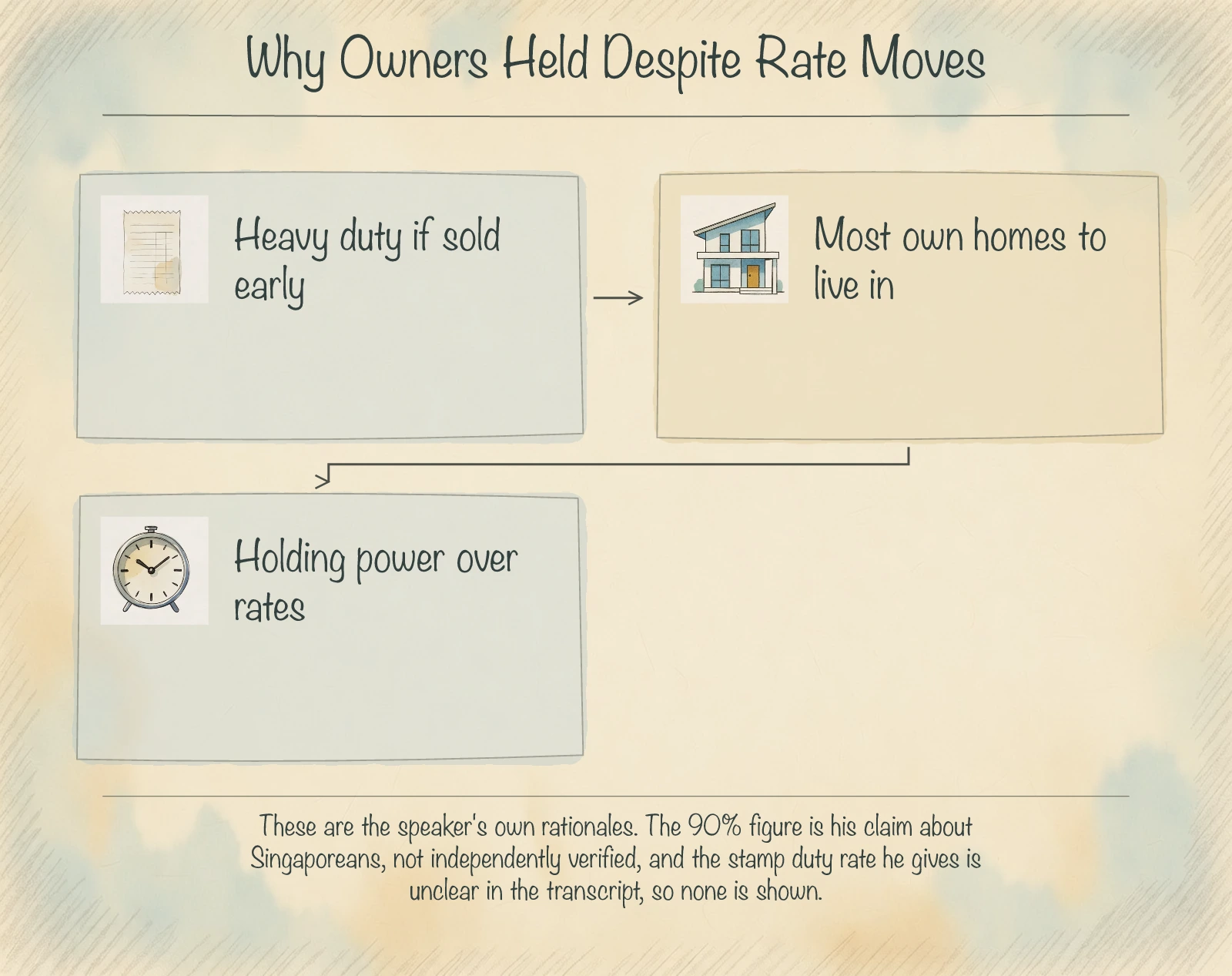
They won't fire sale their property. It doesn't mean that if I'm staying here, my kids are starting around one kilometre from me, and I'm happy here, basically if interest rates were to rise, that doesn't give me a rationale or decision that I have to sell immediately or sell at a very low price.
I will just hold on to it. I live here.
And because of all these different rounds of reasons, the holding power supersedes the interest rates decision. Now, let's come to today's topic.
So, interest rates have, of course, a huge emotional play. It plays with emotions.
For example, if somebody sees this news — of course, disclaimers that all these are like AI images, all right, it's not real. So, if you see this on Straits Times, that home interest rates are expected to drop next year, what do you think a seller will feel?
Maybe you can just keep this in the comments box and then we'll chat about this in the comments.
Seller and Buyer Confidence Around Interest Rates
Naturally, if you're a home seller, you see that the interest rate is coming down, your confidence level next year increases because you know that buyers are coming back. However, if you're a buyer, similarly, when you see this, you will also start to feel excited.
Hey, next year is a good chance for me to buy a property. And thus, the strange thing is this: interest rates play a huge role with our emotions, whether we are sellers or buyers.
If we are sellers, we become more confident. If we are buyers, we also become more confident.
So both parties become more confident. Of course, when you see this, it creates a lot of FOMO.
So for example, if you see a new launch, so at 100%, you will be wondering what is happening. Is there information that these buyers know that I don't know?
So if you are a seller, naturally, you also feel more confident when you see things like this. If you are a buyer, you also feel more confident.
Vice versa, when we see bad news, when we see that launches are not so well, interest rates are extremely high, whether we are a buyer or seller, our confidence level dips at the same time.
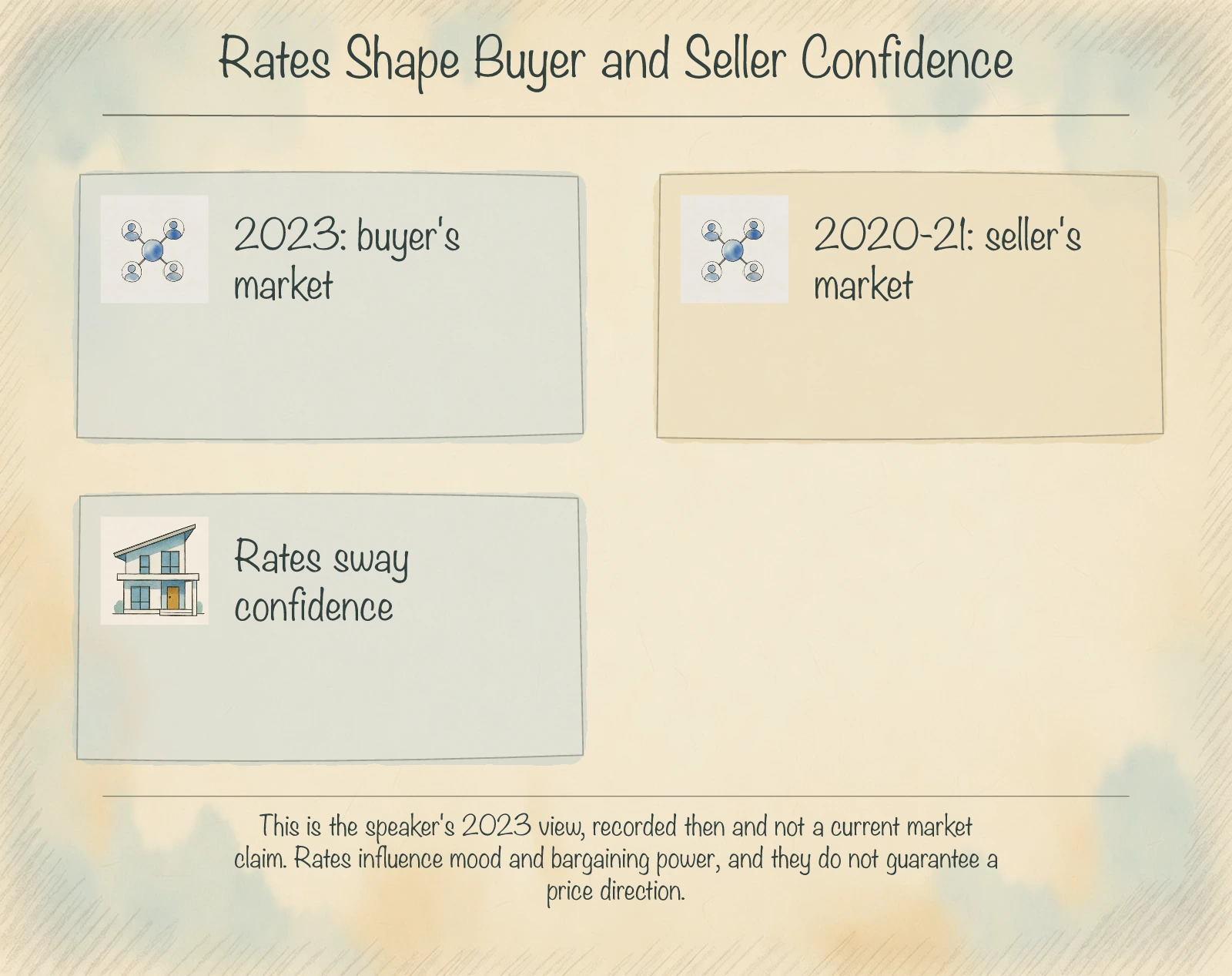
Now to sum it up, interest rates affect our mentality as a seller's market or a buyer's market. Right now, in the year 2023, this is technically a buyer's market because interest rates are high, there are more sellers and fewer buyers.
Asking prices are more reasonable this year if you notice, because this year the transaction volume is similar to 2019. Now back then, in 2020 and 2021, that was a seller's market because sellers called the shots and interest rates were low.
Everybody is more confident, sellers are more confident, buyers are coming into the market to buy because interest rates are low. Now, interest rates are high.
So what is going to happen next year? I mean, we are already talking about the fact that next year, Fed rates are already projected across the board.
Just need to type in interest rates 2024 for Fed funds rate. You will see countless news articles projecting 2024 because at the end of this year, which is now, the Fed has already technically pivoted, and very likely towards Q3, Q4 next year it will start to cut interest rates.
And of course, nobody knows whether that will definitely happen, but major banks and major research centres already have forecasts that that is going to be the projected range moving forward. So when that happens, very likely we'll shift back from here to 2024-2025, back to a seller's market.
Now, whenever we talk about real estate investing, there's always three things that we adopt. Number one, and of course this will be very helpful for you if you're hunting for a property: basically look at fundamentals, trends and frameworks.
Today we're going to talk about trends, which is the 5-year cycle. Whether it's macro, micro or selection factors, the five-year cycle falls into the macro spectrum, and why the five-year cycle is important is because of macro factors, especially interest rates and supply; it somehow forms our real estate cycle into this 5-year bracket.
So let's have a look at this 5-year bracket.
Now back in 2019-2021, that was the first bracket that we have already passed, which was here, 2019 to 2021. Basically what happened back then was that resale condos were at a very affordable price range in relation to new launch condos.
I don't know whether you remember that back then, during this season, this was the launches that had happened in the market. Mega new launches, there was a lot of en bloc activities for HDB, EC properties [correction: HDB, EC properties].
You have beautiful properties at Riverfront, Affinity, Florence Residence, Stirling Residence, Parc Esta. And at that time, these properties were launched at a new high because these were prices that were not used to happen in the previous new launches.
So they were launching, maybe like OCR properties back then, it was in the range of around $1,003 to about $1,005,000 PSF, and then you had like Stirling [Stirling Residence] probably about $1,006,000, $1,007 [thousand], $1,008 PSF, and this was considered the new high.
Of course, now all these prices are unheard of — everything is above 2,000 right now — but back then you buy something at $1,005,000 or $1,006,000, people were saying that the PSF is so high.
So this era, what happened was that PSF was very much higher than resale. Resale was always at about 1,000 PSF back in the OCR region.
And the quantum is very similar to resale because a 3-bedder back then was about 1,000 sqft. You multiply by maybe about $1,400, $1,005 PSF, that is about 1.5 million.
Resale condos were larger, 1,300 square feet, and it was like about maybe about 1.2, 1.3 over million. People were thinking, hey, you know, the gap is pretty similar, or I can go for maybe like a compact 3-bedder, 900 plus square feet, I would end up at about 1.3 million plus minus there, 1.4 million.
So it's quite similar in terms of quantum, and this is new. This is probably about 10, 20 years old in OCR comparison.
So that was what was going through the minds of buyers back then.
Resale and New Launch Quantum Gaps
I pay maybe 100,000, 200,000 more, I get a brand new compared to an older property that is 20 years old right across the street. So there was a disparity in the sense that PSF door was high but quantum looks about the same.
So what happened a year later? Basically, 2022, the balance unit starts to clear.
And when the balance unit starts to clear, the resale condos prices moved upwards. The disparity starts to close up.
This always happens over different seasons because it depends on the stock that's available in the market, the price movement of new launches.
We always want to take note, new launches leads the market. New launches, PSF always brings about movement of TOP projects and resale condos.
If this don't move, this don't move. This needs to lead the market in terms of PSF price benchmark.
And thus, the pricing movement of this needs to be closely monitored because then we can forecast what will happen in the next 1-2 years.
So in 2022, a lot of people were hopping onto the last train. That was when our episode was released.
We asked everybody to quickly go and buy all these properties if you are ready because the PSF makes sense. This was starting to close up in terms of quantum pricing and PSF pricing as well.
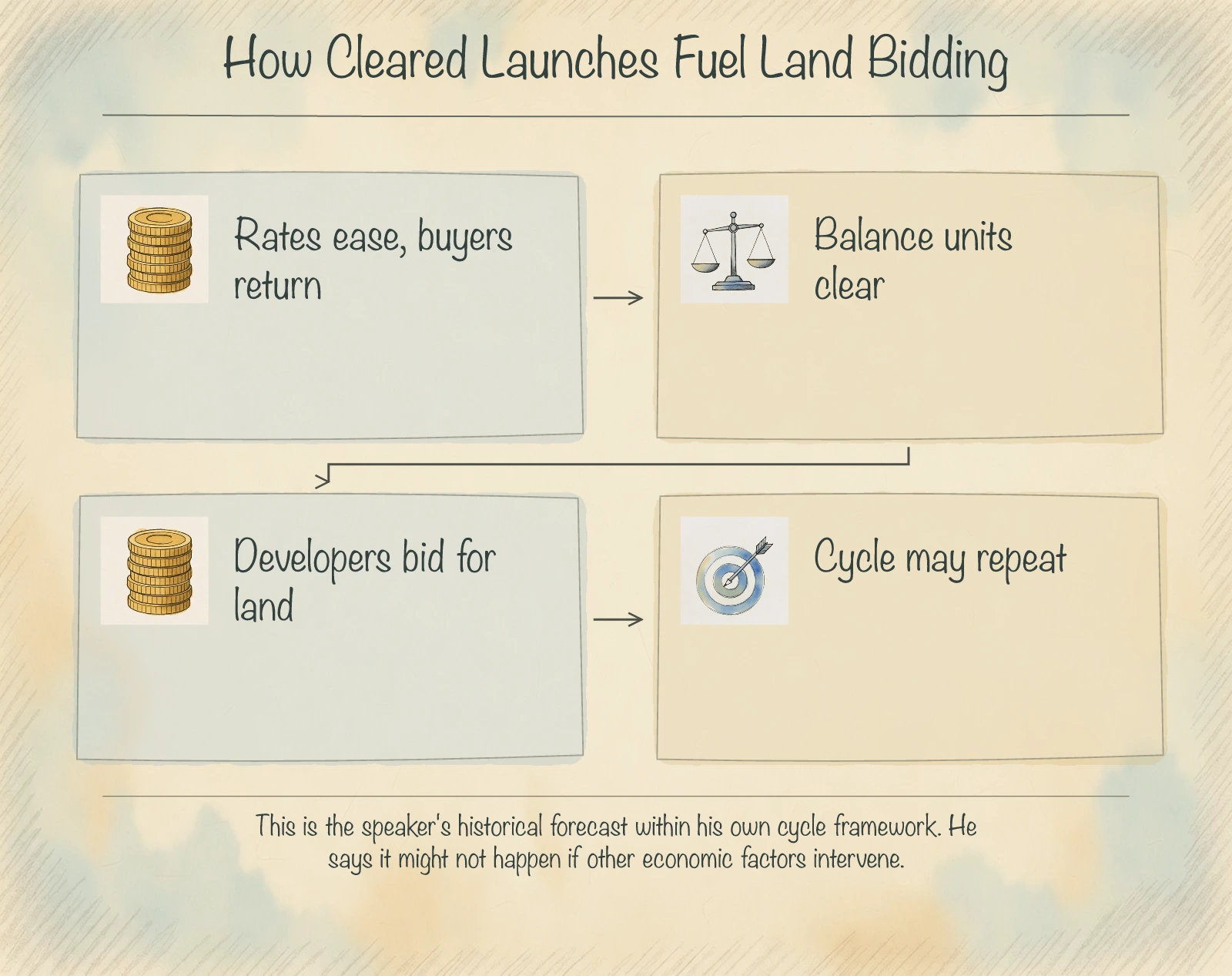
So let's have a look at what happened in 2023. When all those balance units started to get sold out, before that developers were already bidding up land in 2021-2022 and then they started to launch them in 2023 this year.
Now this year, that was the reason why we had 47 launches and the PSF went to a brand new high because the land prices were different.
Developers, take note that when we look at this 5 year cycle, what happened back then was this. When you see this huge bar, this is talking about the amount of properties that is going to be completed by the developers.
Basically, it also means that developers will not need to hand over the keys to the buyers and this is the year of completion. So this table is tabulated from the year of completion of condos and apartments based on URA and 19,291 properties were completed this year and that also means that these are the properties that were TOP.
So take note when it's going to TOP, it means that developers is going to hand over the properties, they have already sold up previously, they are completing and thus their funds are coming in, which is also the reason why the year previous to that, they start the beat up land because they need to top up their land bank.
If not in 2023, when they hand over all this, they have nothing to sell. So 2023 was a year that there was a lot of TOP projects, there was also a lot of new launches because developers started the build up land in 2022.
And if we will fast forward to now in 2023, basically what happens is this, the land bid prices went to an all-time high, thus the new launch prices went to an all-time high. OCR is 2000, 2005 right now.
And the gap then lengthens again compared to the previous year.
So previous year, disparity gap between resale condos and new launch closed up, but it lengthens again. And there was a new player which was this.
The newly TOP projects came in because remember there was 19,000 units at TOP. So this became a new player and guess what?
The sellers here basically were asking prices. This year very close to some of the new launch prices.
You have a look at the asking price of some of the properties. It's just TOP this year.
The PSF range is actually pretty close to some of the new launches. In fact, some PSF levels are higher than the new launches PSF.
So it's very close.
And take note, this season is very different. You shop for a new launch now, you will find that hey, PSF is higher than resale.
Quantum is also higher than resale. Why?
Because technically, the sizes of the units here have not changed. 3B is still at 900-1000 sqft, 2B 500-700 sqft, but with the new PSF overall quantum ballooned to a new level, and thus the disparity then lengthens, resale starts to look more affordable again.
So the cycle repeats in the sense that now resale looks cheaper, TOP looks very close to new launch, so there are 2 behaviours. Number one.
People who are not used to the new quantum of the new launches, for example, you want to get a 3 bedder, definitely $2 over million, $2.3, $2.5, even up to $2.7 million for 3-plus study in even in OCR region.
If you are not used to this, they will go for resale.
If they do not want to buy an older resale, they are considering a newer TOP and they don't want to wait for the new launch to construct for 3 years, they will go for TOP because maybe they will think hey even though this quantum and PSF is quite close to this but anyway I want a brand new, I don't want to wait, I want to move in and there are still transactions.
Quantum Distortions and the 2024 Outlook
Happening here, so this is basically the two sets of behaviour. Let's look at some of the distortion.
So, distortion: take note if you are buying something, let's say a new launch or TOP. Take note of the quantum, because if the quantum is a bit too close to a landed quantum in, let's say, OCR region or RCR region, you have to take note that there's a new set of behaviours that are forming on the ground.
And this is basically the very fact that a quantum that's too close to landed — you might go into a zone whereby your future buyers will be a little bit in a dilemma mode, because they might think that hey, I want to consider a landed compared to, let's say, a three, four million dollars condo.
Maybe there's another class of properties, whether it's strata landed or pure landed, that I want to think about. So you might face a new competition level with that new quantum.
Also, CCR, RCR, OCR have different behaviours, because CCR due to the 60% ABSD now has a new set of behaviours as well. We'll talk about that in another episode.
Now let me come back to this. So, 2023, we talked about the fact that resale becomes more affordable, buyers start to hunt for big units with similar quantum to new launches.
They want to go for more value for size. A lot of the owners that bought in 2019, they are not urgent sellers, because they bought — remember, they bought between 1000, 3000, 4000, 4000, 6000, 6000, 7000 PSF.
Now they are all asking up to about 2000, 3000 PSF for some of the properties, and they are seizing the chance to profit exit. If they can exit, they will exit.
If not, they will sell, or they will rent out. Here, some properties were sold 50%, 60%, 70% start of the year.
Even recently, some projects are doing very well. Some projects are still having a balance of 30–40–50% balance units; this will start to clear out next year.
Let's have a look at what's going to happen next year.
2024, resale will start to move up. And what is going to happen is that some of the new launches will start to look affordable.
Why? Because TOP is close to here.
Once resale moves up, this will start to clear. And the cycle will then repeat itself to 2025.
As we move towards 2025, balance units will start to clear even more aggressively, and then the disparity happens all over again. This is basically the 5-year cycle that we're talking about.
And remember the prerequisite that we have talked about as well.
In summation for today's episode, basically, how does this give you more insight as a property buyer or property seller? Basically, once you understand the movement, how developers always look at land acquisition, the units that they have to hand over, certain periods of time — provided interest rates and QE happens.
Because when interest rates play a component in terms of emotion, for example, next year if interest rates were to drop, people will find that owning a property becomes more affordable.
They might come in to step up on the balance units; it then refuels and clears up new launch inventory on the ground; it allows developers to start to think about bidding for more land a little bit more aggressively towards 2025; then that will fuel the trajectory again.
Of course, all this might not happen if there are other economic factors, but the last part of today's episode is basically to talk about this.
Most importantly, I think it's important to understand that QE and interest rates is one circle of our Singapore's moat. And there are still nice strong factors.
For example, 15 rounds of cooling measures. Singapore market is no longer about speculation.
It's really about looking at the fundamentals, the trending, and also selecting the correct property so that when you want to exit it's easier, you want to see appreciation, it is faster. And limited amount of land, population is increasing.
Our land is controlled by our state, which is by our government. There's no oversupply, and a strong pull of expatriate economy will come in because we are a global financial hub; strong governance is safe; URA master plan is evolving; and of course there's a lot of developments in different parts of Singapore.
High ownership rate of 90% of people own their properties.
However, there's one question mark here, which I'll share with you in the next NOTG episode, which is that this is actually our internal expansion of our residential total transaction value. And this is like a hidden kind of thing that happens, which a lot of people didn't know is actually happening for so many years.
And this is also one of the fundamental reasons why our Singapore resale market is healthy. I'll talk about this in the next episode.
But meantime, thank you for staying tuned on this episode where we talk about the five-year cycle. So, importantly, I think one of the biggest takeaways is everybody is asking about what is going to happen in 2024.
To sum it up, 2024 — this is what will happen in terms of my own opinion and forecast and research.
Resale Focus and Buying Timing for 2024
Resale properties in the lower quantum will start to be the main focus. That means quantum prices of like 1.5 million, 3 bedders, 1.67, 8 million, 4 bedders are going to clear out in OCR.
PSF will start to catch up and buyers will also start to put more focus here in Q3 Q4 because resale will start to look more expensive. Once resale PSF catches up and quantum catches up, the balance units here will start to clear.
And thus I think whether you're hunting for this or this, I'll leave it up to you. If you're hunting for this, I think take action Q1 Q2; if you're hunting for this, Q3 Q4.
This will start to look cheaper, but it will also mean that if you are somebody that loves new launch, if you see something that you like with good fundamentals, then you can consider to go for it. So that's my take for 2024.
In the meantime, take care, Merry Christmas and we'll see you soon.
Sorry, this part, I need to import a slight... Please cut off this part.
Okay. Today we're going to talk about the 5-year cycle and, um, okay, sorry, reset.
But.