Evaluating property
Cracking The Condo Code 5: ROI & How It Affects Your Investment Property
Published 2026-11-26. Adapted from the episode published 2023-10-20. Figures, illustrations and data reflect the episode’s original publication date.
Illiquid Investments and Planning Your Exit
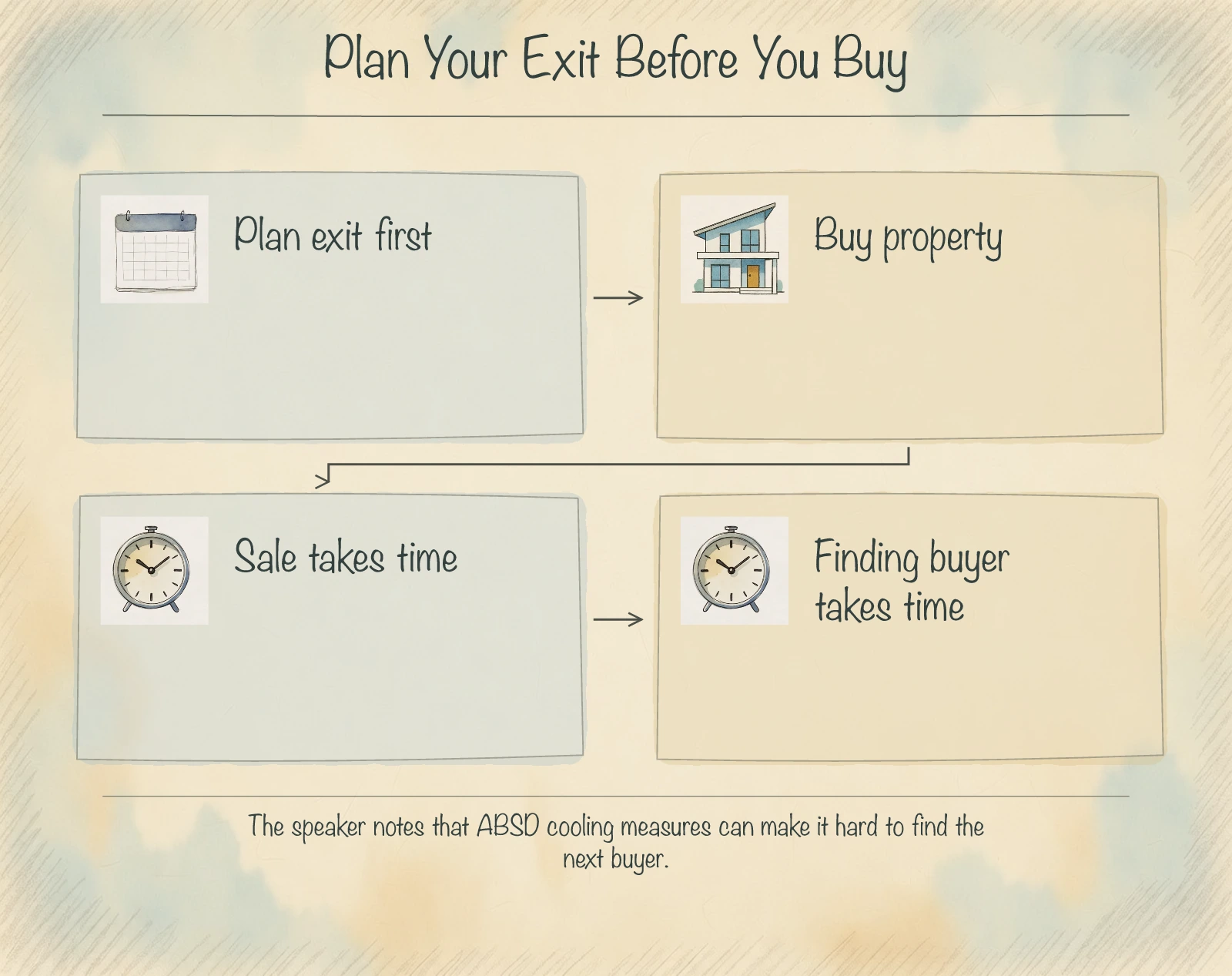
Something to note is that real estate investment is an illiquid investment. And before you buy, you must always note that the moment you buy this, you have to plan for your exit, because you don't want to buy something that is unsellable.
Or you don't want to buy something that takes you a long time to sell. It means that the moment about 5 to 8 years later, when you see something that you like or you want to expand your portfolio to buy a bigger property or a smaller property or split into more properties.
And you cannot exit this because our names are so precious now with all the ABSD cooling measures. Then it will become an event that you feel that hey, why did I buy this property 5 or 8 years ago that now is so hard to find the next right buyer?
Alright, welcome back on Nuggets on the go. Today we're heading into the Cracking the Code series and this time round I'm gonna talk about everything numbers, return on investment, on real estate property investment.
Let's go.
Alright, so I just got back from speaking at an event — not literally, because even though I'm wearing like the same clothes, if you can see behind the screen here, it's already after a week after that event.
So it was a 99.co jointly hosted with Seedly and I was very honored and privileged to be invited as one of the keynote speakers in the morning talking about the real estate market in Singapore, and of course some of the key mistakes that a lot of home owners make when they are upgrading to a private property and how to avoid them using some key frameworks.
And this was some of the sneak preview during the event. It was like a full turnout that 99.co and Seedly hosted, I think there was about 400 plus over audiences at the entire day of this property seminar.
So this was some of the things that we shared.
So there was one very interesting question asked by one of the audiences during our Q&A segment talking about return of investment using real estate as an investment asset vehicle compared to, of course, other equities, or whether it's bonds, REITs, S&P 500 stocks or other forms of investment instruments.
So basically in terms of methodology, I personally invest in equities and more liquid kind of investments, for example S&P stocks, and I hold various kind of instruments across board in terms of my diversification portfolio.
However, of course, because I'm in real estate and after doing real estate for 16 years, I firmly believe in real estate, particularly in Singapore, as a form of investment. And thus a lot of my personal investment is in the real estate segment as a form of investment vehicle for my own wealth portfolio.
So today I want to dive in on this key question about the ROI in order for a real estate investment to make sense. And I'm going to head in to show a lot of numbers later.
This was of course one of the exercises that we just did during our own internal inside sales team consultants training, and I want to share this with you as well. So this will be the scenario for today.
We're going to pump out the numbers for two properties in terms of different price ranges so that you can have a glimpse of roughly how you will feel like in terms of the money instalment, the rental and of course all the different kinds of expenses when it comes to real estate investment.
Of course, something to note is that real estate investment is an illiquid investment. It is more illiquid than liquid investment.
For example, if investing in stocks, bonds, of course you will have a period that you have to fulfil. But in terms of like several instruments, ETF funds and all that kind of stuff, it is more liquid whereby you can exit and enter easily.
But for real estate, take note that because it takes time to purchase the property, it takes time to complete the sale transaction, it also takes time to find the next right buyer. This is very important to plan in advance.
And before you buy, you must always note that the moment you buy this, you have to plan for your exit, because you don't want to buy something that is unsellable or you don't want to buy something that takes you a long time to sell.
Because if it takes a long time to sell, it means that the moment about 5 to 8 years later when you see something that you like or you want to expand your portfolio to buy a bigger property or a smaller property or split into more properties.
And you cannot exit this because our names are so precious now with all the ABSD cooling measures. Then it will become an event that you feel that hey, why did I buy this property 5 or 8 years ago that now is so hard to find the next right buyer?
Avoiding Unsellable Mistakes and Loan Mechanics
And thus we always want to avoid unsellable mistakes. And this is a scenario where I want to talk about a 1.5 million property investment, a 2 million dollar property investment, and this is an investment property, it's not an own stay property.
Take note that there's a key fundamental difference between own stay and investment because there's a mix of emotions. If you are talking about own stay property, basically it's a whole set of criteria.
Why? Because own stay property has a very simple kind of mindset, which is that this is really to fulfil my needs for my own roof over my head, and of course it's to fulfil my needs for my family as well.
Of course there are mixed needs, that maybe I want it to be near school, near my workplace and stuff like that. But very importantly, if you're talking about own stay, if you don't own a property, it means that you have to rent.
If you don't own a property, it means that you probably have to stay with somebody else, maybe your parents or your siblings. So there's always an opportunity cost involved.
But of course, a lot of people want to buy their own stay property with a hybrid engine. That means it fulfils needs and hopefully it also can see some level of appreciation in its price.
Because always note that even though we always talk about the fact that when you pay a set of monthly instalments in your property — sorry, this one I need to lengthen it a little bit — okay, for example, if your property is about $5,000 per month in terms of a monthly instalment.
If I break it down into the calculator format, so very simply, let's say if you head to our PWA website, let me just open it up for you. And you just need to head onto this portion here.
Under tools segment, you can enjoy all the free tools at the property website because our team has already developed them over the past year. And let's just come into this monthly loan repayment.
Just enlarge this. For example, a $1.5 million property.
And then you click on, let's say, 3.2% fixed interest rate now, and let's say you can loan for maybe 25 years. So let's say you're 40 years old now, you can loan for 25 years — you just need to take 65 minus your current age, max 10 or 30 years.
If you want to extend the 10, that is one year after you enter into the loan of your property, and you can refinance it to stretch to 75 years old, alright. So let's just take an example.
Okay, maybe 30 years.
Let's say you're 35 years old, you are upgrading to a property, take a 75% loan, which is the max, of 1.125 million. This is your monthly instalment, 4865.
And let's say if you calculate it, you will see this portion here that though your monthly instalment is 4865 — okay, let me just clean this up — 4865. There's a P and I portion.
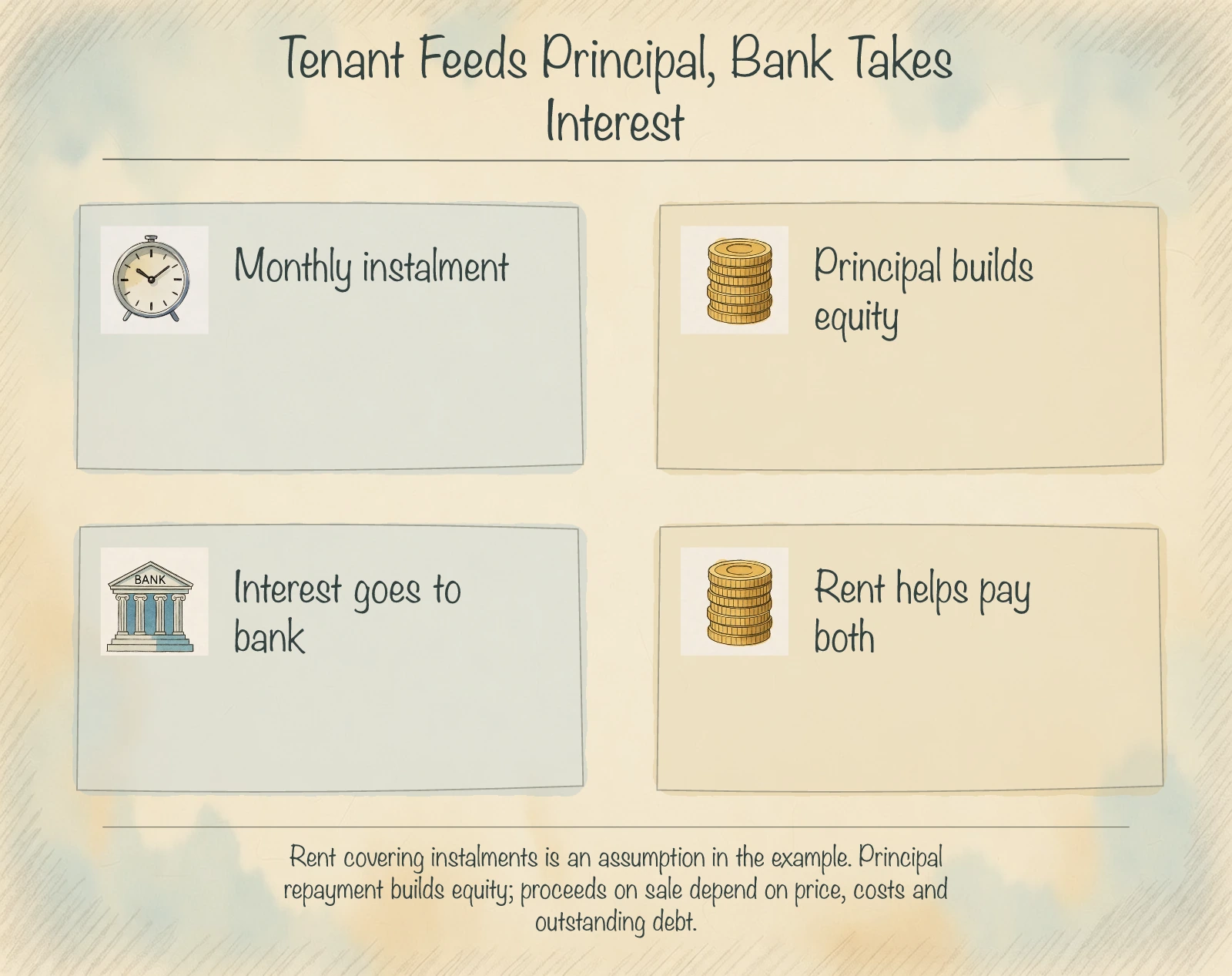
P is principal, I is interest. Because interest is what the bank is interested in because they were the one that loaned you 75% of it.
But they don't have to share your profit when you sell your property for a profit when it appreciates. Basically, how property investment works is like this.
You leverage from the bank, it's considered a good debt, but the bank is only interested that you have to fulfil two things. Number one, every month the monthly instalment, they take the interest.
Number two, you have to pay your monthly instalment. If you cannot pay it for three months, they will take the property.
Alright, so the interest portion right here is $3,000, example. Principal 1865.
Take note that when you take a loan, the loading period, that is the heaviest, is the first four years. Let me just give you an example.
After 48 months, you start to realise that hey, the interest portion drops to about 2007. The principal portion went to about 2002 because the bank is very interested in the front portion, the loading part, because that's the part that they want to have more interest payment at the start.
And of course, as you pay down your property, you'll start to realise that it starts to tweak. Let's say, for example, if I go on to month number 292, which is many, many years later, your interest portion will then drop to about 816.
Your principal portion starts to be up to about $4,000. Now, whatever that goes into principal comes back to you when you sell the property.
All the interest payment goes to the bank, because it's only fair.
Own-Stay Logic and Flat Price Scenario
You come with 25% only, they come with 75% for you to stay in this property. Now this is of course the fundamental explanation of buying your own stay property because technically this is your cost, the interest payment.
It's still better to pay to the bank the interest and own your own property when you have an option to sell next time rather than you pay the full rental of let's say $4,800 to a landlord to rent a property because you do not have an own stay property.
This makes sense in Singapore because our land is scarce, population is increasing, but overseas in countries that there's an oversupply of properties, you have tons of choices.
Actually, sometimes in certain countries renting a property makes more sense because rental is cheaper than the risk of owning a property whereby you cannot sell the property because there are just too many properties. But in Singapore, it definitely makes sense, especially when our home ownership is about 90%.
Okay, but back to this topic. So for today, we're going to talk about the objective of this real estate investment is that this is the second or third or fourth property.
It's not for own stay. And the objective always for buying your property for investment compared to more liquid investments is that you want to leverage, that means you're putting 25%, but you can own something of 100%.
So, if let's say you buy a $1.5 million property, you only need to put in 25% plus certain cost like stamp duty and all that, but you get to own a $1.5 million property. You don't have to save up to $1.5 million to own the $1.5 million property.
That's the power of leverage. And the objective must be that this property must appreciate.
Always remember, if you don't have the intention for your investment real estate to appreciate, don't go into real estate. The key fundamental objective is to let the property appreciate and thus selecting the property is very important.
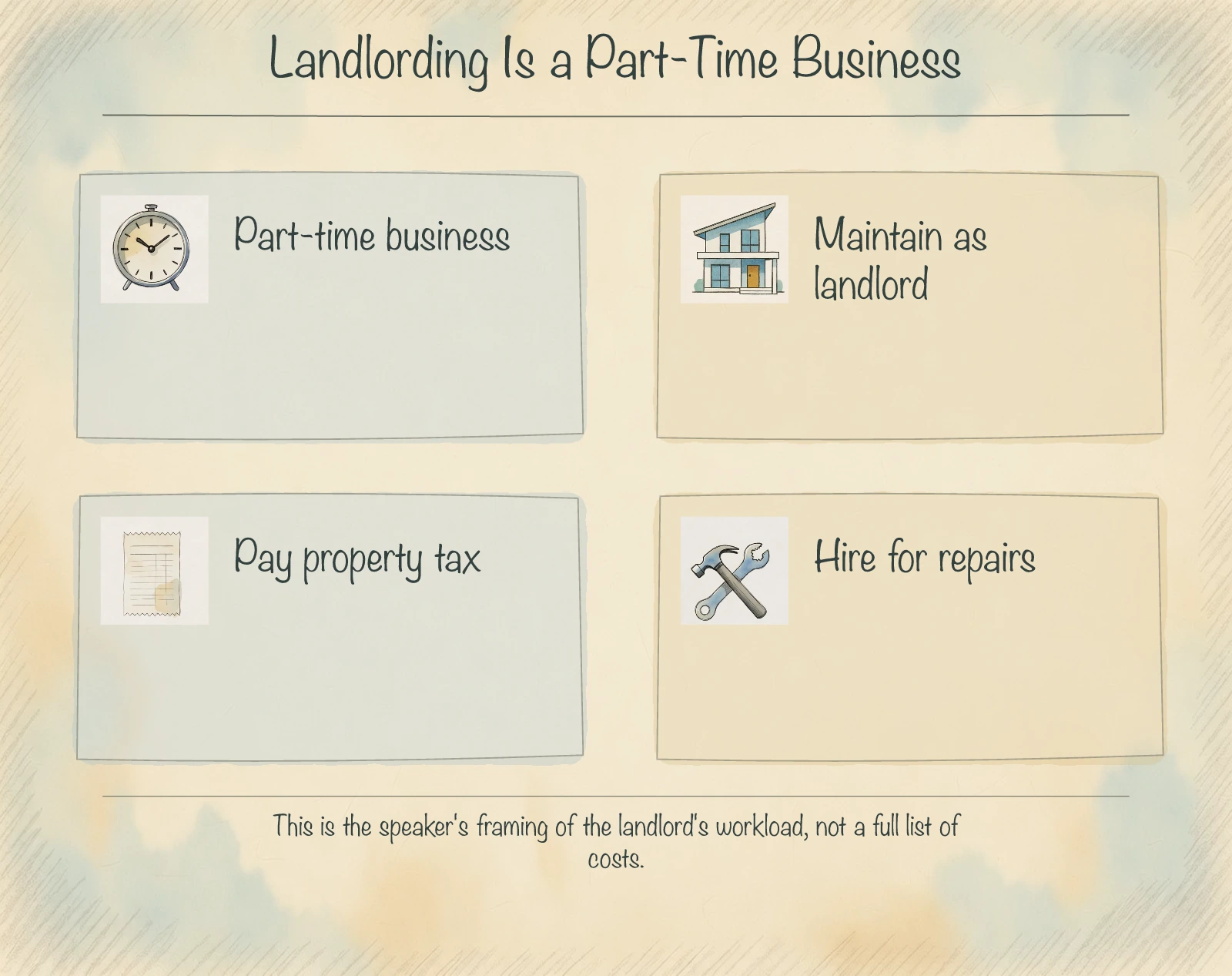
And it must have rental income because a real estate investment is considered like a second kind of like a part-time business that you are starting. There's work involved.
You have to maintain the property as a landlord. You have to pay your property tax.
You have to hire somebody to do repairs and all that kind of stuff. It is considered starting a part-time business, the more investment property you have, the more part-time businesses you are starting.
So as a landlord, you are sort of like a part-time business owner starting all this part-time investment. And I will come to this at the end of today's NOTG is that there are four primary kind of outcome.
And of course, the triple star rating will be the fourth one whereby you see appreciation and you see rental. Let me get to the spreadsheet right now.
The first scenario is that this is a no-no scenario. That means if you happen to own this property and or you are going into an investment property without knowing this, this is a clear sign of danger.
So I put one X right there. Basically if your property did not appreciate and your rental cannot cover the monthly instalment, this is a very worse outcome.
So I put in this like a 10 years investment property. So this is based on a 10 year calculation in terms of all the expenses that you need to fulfill as a property owner.
$1.5 million, $2 million and basically what happened is this.
We are assuming that you have 5% cash and 5% cash of $1.5 million property will be $5,000 in cash, $100,000 in cash in terms of $2 million and assuming you have CPF of $300,000, CPF of $400,000, total CPF views will be this because we added in the buyer stamp duty.
Take note that buyer stamp duty can be paid with CPF but for resale properties, you have to pay in cash first and once the property is completed after three months, your lawyer can actually claw back from the CPF OA account back to you to refund you in cash.
For new launch, you can actually pay directly using your CPF account. Now total cash use is 5% which is here.
Of course, Ligavie is just putting a lump sum figure and task the total amount you need to put in for $1.5 million property is about $422,000 and $572,000 for $2 million property. Now that is the same scenario for all the four objectives we are talking about today.
So basically, whether is it one, two, three, four, we'll be using the same set of calculation. I hope that you follow me so far.
And let's come back to this. Scenario number one is that this property after you own for 10 years, you bought at 1.5, after 10 years when you want to sell, somehow or rather, the price did not grow and it's still at 1.5 million dollars and what will be your final outcome?
Similarly, you bought a 2 million dollar property after 10 years, it did not appreciate in price,
Negative ROI When Rent Cannot Cover
It is still 2 million dollars and then you just feel that hey, you know, I don't want to hold this property anymore because the rental also cannot cover the installment, I don't want to top up every month. Let me just exit.
I just bite the bullet exit. I want to retire already.
Okay, so this is the scenario. Assuming your monthly installment is 5632 based on the loan channel.
And of course, we are basing this on a set of calculations right here, which is $1.5 million on, let me just come back to the calculator to show you the exact calculation based on a 25-year scenario. Okay, so how do we get 5, 6, 3, 2 in terms of money installment?
Basically, we take $1.5 million as the purchase price, average fixed interest rate of 3.5%, which is fair, because there are instances where Singapore goes to 2 over percent, 1 over percent, sometimes 4 over percent. And of course, in the whole old heydays, it was 5 over percent, 6 percent.
But let's base it on 3.5% now that we have SOA rates, which is de-packed away from the international rates. So I think is more stable.
And by 2024, all mortgage rates will be based on Sora, which is the local Singapore interbanks of rates, which is not too volatile. Now, 5632 for $1.5 million property, we take it as 25 years, assuming that you're investing this while you're in your 40s.
And of course, let's say $2 million will be 7509. All right.
So as you can see from these two figures here, Mali installment. So the first scenario is that the property did not appreciate because after 10 years, property price appreciated 0% per annum and your rental cannot cover your installment.
So actually every month, you have to top up about $2,000. So why is it that you have to top up $2,000 is because your monthly installment is $5,600, your MCSC is $400 total cost of holding this investment property is at about $6,000 but you are only collecting $4,000 in rental for this
assuming this 3 beta at the old CR region or maybe a 2 beta at the RCR region or maybe a 1 beta at the CCR region.
Now for this property $2 million you have to top up about $2,900 per month and this will be the worst outcome why because take note after 10 years if you decided to sell the property This is the agency fees you pay to your broker.
You're outstanding law after 10 years. Your CPF views, your accrued interest on your CPF.
And the total cash proceeds that you take from your law firm when you completed the sale will be this amount. However, at the back end, you still have to cover your cost of 10 years of property tax and additional cash top up a month and your rental agency fees.
So technically after we less off all these out-of-pocket kind of expenses, the net cash receive is actually $62,000 negative and negative $124,000. So your cash on cash ROI meaning that initially you put in $75,000 cash at the start but after 10
One year, you lost $62,000. So basically it's a negative 183% ROI on your cash, negative 224% on this $2 million property on your cash, and total ROI for your cash and CPF is also negative 9%.
So basically what has happened is that this is a totally negative investment. And when you look at this, if the property price did not appreciate, if your rental cannot cover the installment.
This is a no-go and this will be a very worst-off kind of scenario for you. Alright, scenario number two.
Scenario number two is depicted here. The price did not appreciate but somehow you bought a property that has good attributes.
The rental gross maybe is very near to the MRT station, international school is near to a kilometers of some very popular schools that Even local families want to rent this property for 30 months to get into the school, fulfill the requirements of Phase 2C.
And somehow, because of URA master plan, and of course maybe it's near to a mall, near
to MRT station, it's near to integrated hub, there's a lot of expertise, there's a lot of traffic there as well. And the property somehow always gets tenanted, low vacancy rate, very popular.
Every time your broker puts out an advertisement on property bottles, the tenants snap out immediately people bid for the price and price appreciates in terms of rental and it can sort of cover the installment over a period of 10 years.
So let's take this two scenario again and here I'm assuming that the rental can cover your installment but it cannot cover your MCST so we're also playing it a bit safe here all right it can cover but cannot cover so you still have to top up some cash for MCST fee.
And what would be the outcome, even though the price did not appreciate, is that when we calculate this, the net cash proceed is better in a sense, because your out-of-pocket expenses is less. Your additional cash top up has dropped to $48,000.
Positive Returns When Rental Covers Instalment
These are all basically into your MCST fee. Of course, your rental agency fees will basically factor in, like, per year, you pay half a month to your broker, property tax will take an assumption.
Of course, we didn't take into consideration, for example, the repairs of the property over the years. Let's say you need to change account and all this kind of stuff.
That would be an additional amount which we didn't put in here.
But overall, if you notice, when your price did not appreciate but somehow your rental can cover the money instalment over the years, what is going to happen is that you're going to see positive cash on cash return because initially you're putting $75,000 cash, putting $100,000 cash, your cash on cash return ROI is different.
Your total ROI is also different. It now becomes a positive number.
So rule number two is that for your property investment to make sense, even though if price never appreciate, if your rental can cover installment, it is considered a positive.
Because when we go back to just now the first explanation to you, the rental that you collect every month from the tenant is helping to pay for these two components. P, principal.
So the tenant is feeding your principal to you. So the principal amount from every month's monthly installment comes to you and is released to you when you sell the property.
The I goes to the bank. So the tenant is actually sustaining this property for you.
And every month as a owner, you put in a 25% down payment and stamp deed at the start, you top up every month for MCST, but end of the day when you exit after 10 years, even though the price did not grow, but you still see a positive gain.
And we give it one star here. Now let's go to the third scenario.
Third scenario, basically I'm shrinking it to five years because I just want to show that even at a five years horizon, if you were to select a property that can appreciate at 5% per annum,
let's just take for example 5% per annum. Now over the past three years, because of COVID, it, the landed property price showed about 20% over the last 3 years from 2020 until now, prior property of also about 20%.
The base scenario is that every year, single digit growth has been happening for the past many many years. But let's just take for example, it appreciates by just 5%.
I didn't think the consideration compounding effect for simplification. But let's just take for example, every year it appreciates by 5%, it's an OCR property, 3 beta, maybe this is a 4 beta, it grows by 5%.
So after 5 years, this property at 1.5 million becomes 1.875, this becomes 2.5. Now this has been happening in the OCR region for the past years.
And we're just taking it as an example. It doesn't have to be OCR, it can be other areas.
After cost. And I'm taking this as scenario 3 whereby it appreciates but the rental cannot cover
your installment. What is going to happen is that if you take a look at this, estimated rental is 4, you cannot cover, it's 5, you cannot, every month you still have to top up, but have a look at the base figures.
Basically, your cash on cash return changes. Initially, you put in 7,500K, it becomes 322 at the end.
Initially, you put in 100K, it becomes 404 at the end, your ROI on cash and CP is 69% and this is 64%. So it becomes better than scenario two.
Now, the key fundamental reason is because this appreciation fuels a lot of revenue into this property investment. Even just for a five-year period, you see a greater ROI on your cash on cash on two-portion already.
And the cash proceeds, of course, is more. You have even though you have cash top up but you are still net quite positive and you can just stick this to a mall together with your CPF that is being released go into another property alright so scenario 3 I give it two stars
renter cannot cover but price grows at 5% now scenario 4 of course it will be the best scenario 4 also over a five years period property appreciates rental covers but you still have the top out MCST and your cash on cash returns becomes even more powerful.
Your total ROI becomes more powerful as well over a five-year period. Of course, you want to take what is one year, you take 87% divided by five, then your annual ROI basically becomes like this.
It goes to this, divided by five years. Anno ROI is 17%.
So of course that gives you an idea about whether do you want to go into like a property investment or can you actually make more returns in the equities market or other forms of instrument. Of course, this is a personal preference kind of thing because for real estate investment, there's still work that needs to be done.
Sometimes for equities is that you just think you just park your funds there. But of course, it depends on a risk appetite.
Real Estate Versus Equities and Risk
Of course, certain more senior traders, they went to leverage and stuff like that. And I always believe that the fundamental framework of whether should we go into real estate investment or other forms of equities or asset kind of investment is that you have to understand the asset that you're investing in, because investment comes with risks.
Investment comes with returns; anything that has returns have risks, the higher the returns the higher the risk, the lower the returns the lower the risk. And you should always understand the pros and cons before you dive into it.
You shouldn't just go into it blindly just because your friends are doing it together, right? So I hope that this episode helps you and I will sum it up with this slide, is that the triple star rating will go to the fourth scenario.
CSIM consultants will be very happy to sit down with you through a 45 minute session if you want to go into some deep dive mechanics of the property that you want to invest in.
So if you are keen to meet our consultants, just scan that and I think our client experience will be in touch with you for appointment. Meantime, take care.
Welcome back to Nuggets on the Go today. Welcome.