Buying and upgrading
Beyond the Numbers: Understanding Singapore’s Property Landscape
Published 2026-11-17. Adapted from the episode published 2024-08-01. Figures, illustrations and data reflect the episode’s original publication date.

On this page
- Evening Agenda: Inventory Data and Three Topics
- Ease of Exit and Shrinking Loan Capacity
- The Three- and Four-Bedder Era and Absorption
- Leverage or Pay Down in High Rates
- Real Estate Triple Movement and Leverage
- Liquidity, Loan Value and Falling SORA Rates
- Rate Cuts, Seller Psychology and Inelastic Capital
- Landed Scarcity, Quadrant Two Condos, Filming Tours
- Virtual Home Tours and Trapped Foreign-Owned Units
- Limited Condo Supply and Choosing Faster Movers
Evening Agenda: Inventory Data and Three Topics
Hi, good evening everyone. Thank you, Sinh Tha, Attica for hosting this event tonight.
So I have 35 minutes with everybody and I'm going to kick start straight on later. I think we're going to have some Q&A.
We'll hang out a little bit outside as well if you've got any questions. We can chat on a little bit later.
So what we are prepared for tonight is that we have tabulated not just transaction figures but also the current inventory in the market.
Our PRP team in terms of research is always very passionate to understand firstly what is the demand behavior of the Singapore restate market but secondly also what is the current trending in terms of the sellers expectation right here in the Singapore lender as well condo market.
So what we've done is that we're tabulated all current listings in terms of lender as well as condos for 28 districts for 2023 and later on I will also be sharing one of the latest framework that we have developed which is
what we call the absorption rate and we have termed this terminology to understand what is the current absorption rate of every singular type of condominium, big room types for example 1, 2, 3, 4, 5 big rooms in every district across the 28 districts as well as the different types of landed homes across 28 districts at the current juncture.
That will allow us to understand a little bit about what should we go into in particularly, let's say you're hunting for 3 beta or 4 beta, what districts has a better absorption rate? There are some so-called like videos as well as analytical tools that you can adopt as well in your in your Proctogen.
Now, 2022-3 has been one of the most interesting year. In fact, this year in terms of performance, it is very similar to 2019.
And if you have remembered what has happened was that 2020 and 2021 was the year that we recovered from COVID, there was a lot of pan out demand. 2021 was the best year.
This year in terms of transaction volume, it is the same amount as 2019, which is what we call quite a year of slow growth.
So I would turn this year as a year that is a fantastic year for us to do research because we want to do research in a very, I would say, terpid market rather than in the bull market so that the research is a little bit more conservative.
This is some of the news that has happened at the start of this year. So basically, there has been news from US after the interest rates has increased.
There has caused a couple of banks to collapse in the first quarter of this year. There's also news locally.
So we have the very hefty ABSD that has been now doubled to 60% for foreign foreigners ABSD,
as well as of course, a lot of different kinds of cooling measures for the HDB market. And of course, this was what was being published over the last couple of months.
Q3, later we'll talk a little bit about that. There was like a slight deep in the landed market and of course after we deep dive we realized that it was being brought on by the detached homes in D10 and 11.
And the puzzling thing every time with media, although we're in the media business as well is that sometimes when we look at news reporting and media there's always like a conflicting kind of like a situation.
Because when we see a lot of bad news but then when we come back to Singapore, we'll ask ourselves why is it that year on year quarter on quarter our price index are still increasing.
So there are also of course a couple of positive news in the sense that why is it that sometimes you know when Singapore were born and raised here we're
so fortunate but at the same time sometimes we can a little bit fearful of our own market but foreigners and foreign investors they are very optimistic about market why is it that they want to bring their liquidity and capital into the Singapore market.
So this was the latest one of the latest report from UBS basically it tracks household wealth and Singapore stands up from a lot of global cities in the last one year and in terms of our median household income it has also been the champion in terms of global cities as well.
So I'm going to help everybody to decipher all this information because I think if you are intending to do some planning over the next one year. I hope this six to seven insights will be very fruitful for you.
So I'm going to talk about three main things, interest rates, market trending for 2024, my personal forecast, as well as how do you select properties. And why is it that I like to use this term called the ease of exit is because right now our names
Ease of Exit and Shrinking Loan Capacity
are very precious. Because of ABSD, unlike the past, we can buy multiple properties without much additional buyer's stamp duty.
Now because of buyer's stamp duty and additional buyer's stamp duty, we have to be very careful to select the type of properties that allow us with an easier exit if we want to switch properties three to five years later.
So you don't want to be stuck with a property that you know when you want to put it in the resale market after 12 months there are no buyers or there are no offers. So we term this terminology as an ease of exit.
A quick disclaimer, our sessions on masterclass that are meant for educational purpose; if you want to make any investment decision, do seek out with your own consultants as well.
My name is Melvin Lim. I've been in the industry for 16 years.
Currently I run and take care of two companies, PLB Media as well as PLB Realty. And of course, we've just concluded two of our largest events for 2023.
This was our landed convention at Panpac. In May this year, we had about 370 audiences that came by.
We showcased about 100 landed properties. And of course, we just concluded our client event last Saturday at 1.00 PM.
We had about 500 over of our clients came. And this is our team.
So we have an in-house team of creatives in our creative agency. So a quick introduction about what we do so that it sums it up and then we'll kick start for the session.
All right, so this is just a one and a half minutes video. That's a lot of time.
Try and take it from me. Must be out your mind.
Big time. Got a sign.
Smoky in the air. That's a lot of time.
Clock is running over with the dollar sign. Try and take it from me.
Big time. Big time.
Big time. Big time.
I got a lot of shim. Running out of numbers, that's a lot of fun.
Try and take it from me, must be out your mind. I'm a beast, I'm a beast, I'm a beast.
No, we're not, we're not a team. I got a lot of shim.
Running out of numbers, that's a lot of fun. Try and take it from me, must be out your mind.
I'm a beast, I'm a beast, I'm a beast. I'm a beast, I'm a beast, I'm a beast.
Let's sub sub what we do and let me fix up with the very first thing that I think is very important to take note of especially if you are planning to switch properties whether is it a second one or you're upgrading or you're intending to buy additional investment homes.
This has of course been something that has happened over the last I would say five to eight years. So what has happened is that ever since the 2013 TDSR cooling measures there was a divide right in the middle.
So I've segregated these two supply charts into two portion. This, as we can clearly see in terms of 99 years or whether it's triple nine years or three whole, the quantity of properties being developed over the last 13 years before the TDSR measure has primarily been larger holes.
So after that measure, because of the very fact that a loaning capability is now more stringent, developers have to build smaller holes. And this has been the latest trend.
As you can see there is a larger supply in terms of 500 to 700 square feet even 700 to 800 plus square feet and of course this will be the current three beta sizes right now. So what has happened is that in terms of the supply level of the
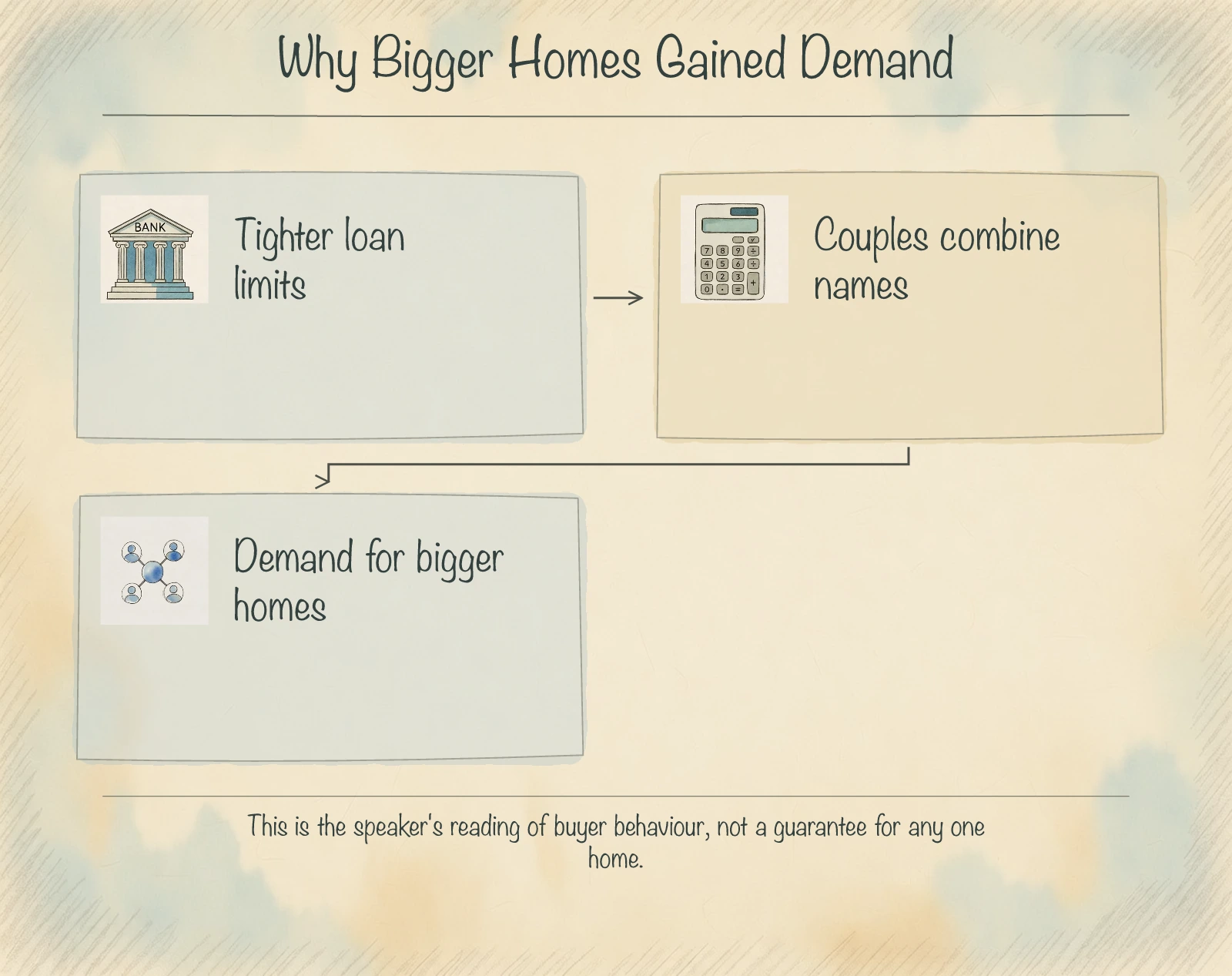
smaller homes it is now in a greater quantity. That also means that with coupled with all these measures, ABSD, a lot of people because of the development over the last 10 years, the demand for bigger homes has increased particularly 3 and 4 betas has increased.
And this clearly shows us the reduction in loan quantum every time TDSR happens so loan quantum drops earning capability even though it increased but with our age getting older our loaning capability drops.
And thus the new trend is that in the past people were tend to say that hey you know husband get one home why get another home and then we try to buy maybe one beta or two beta to rent out and things like that.
But the strategy has sort of changed because of the loaning capability reduction. Couples are now combining names.
And when they combine name, they naturally want to go for a bigger home for their own use. And that's the three and four betas era,
The Three- and Four-Bedder Era and Absorption
So this is the current era right now. What this means is that if, let's say, you're intending to switch properties or you want to acquire more properties, then you want to go for something that in three, five, eight years' time, there is an ongoing demand that is absorbing your whole product market.
So naturally, with a smaller size, what will happen is that in terms of the paper gain, it will be affected, because the larger size properties naturally see a little bit more gain, even if, let's say, the PSF level will increase at the same kind of PSF appreciation.
So in the past there was this very clear kind of segregation: smaller properties, their PSF will be higher; larger properties in the same project, PSF will be lower. But actually, in the last three years, it has balanced out.
A lot of the 1-bedder versus the 4-bedder, their PSF level is right about the same. So the shift is very obvious right now.
So as we can see from this project in Bedok, D16, basically smaller homes, even if your PSF will increase, the paper gain is much affected because you are working on a smaller square footage. So sometimes, after you less off your interest rates, buyer's stamp duty, technically it's break-even or even it's a paper loss.
Larger properties are a little bit more significant. So this is currently the new norm, which will be good to put at the back of your mind.
Basically, small properties, if you already own it, I would suggest that if you want to do proper restructuring, you have to look deeper into the pros and cons, because once you exit from a couple of your properties, when you buy back, you'll be hit with the new ABSD.
So it calls for different kinds of strategies, but generally smaller properties, we term that as more like dividend stocks. And this is the latest research that just came out about two weeks back.
We have the research for all regions in Singapore, basically OCR, CCR, and RCR, and landed homes. So I just want to give everybody a quick glimpse: that when we look at all the OCR across all the districts at the different types of bedrooms, the absorption rate for three-bedders seemingly is one of the best.
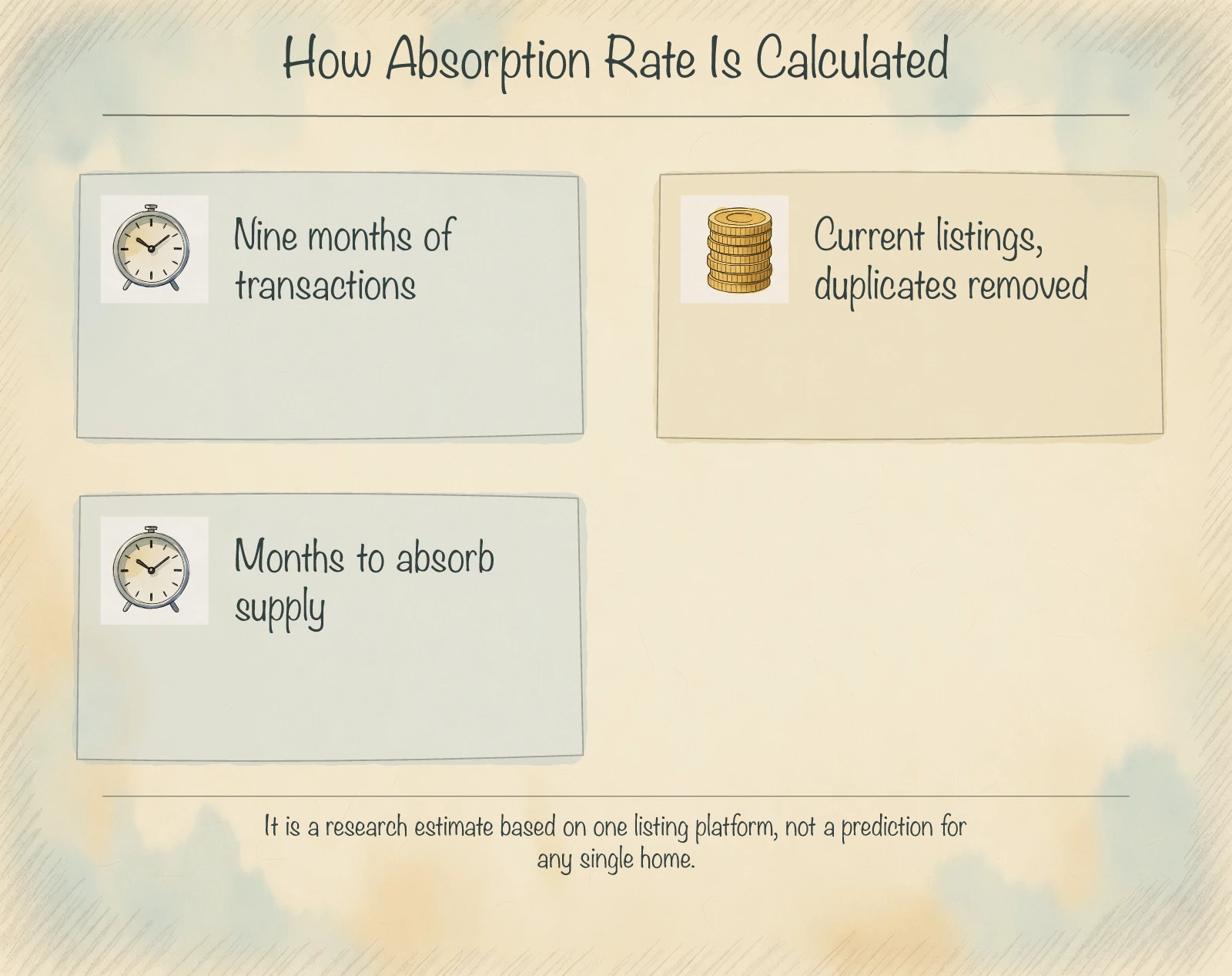
What do we mean by absorption rate? Meaning that the moment we put out this property in the market, how many months does it take for this property to be absorbed by the market?
So the calculation figure, basically we take the first nine months of transactions for this year vis-a-vis the current supply in the market that is listed on one of the largest platforms, PropertyGuru. Of course we take a shave-off figure about 20% to remove duplicated listings, and that's how we get this current figure.
So let me come to number two. Number two is that, based on the research, certain price ranges might also start to disappear in the next 12 to 18 months.
So what do we mean by this? And this is across all the 289 charts that we found, and in terms of the current listings that we have aggregated, it allows us to come up with price ranges like this.
So this is basically the 1-bedder across the entire OCR region in Singapore. So 1-bedder, actually, if anybody is keen, you can still find about 1,459 listings that's asking below $1 million.
So it's still available. But as we look deeper into certain numbers, what does it tell us?
So for example, if, let's say, you're interested in 3-bedders, basically based on the trending, we forecast that in terms of these two particular ranges in the OCR region, this price range might start to disappear in 12 to 18 months, because this is one of the most palatable ranges that HDB upgrading families will want to go after.
So they will definitely start to hunt for these properties once they exit their HDB properties, and these are one of the most palatable ranges.
So the forecast is that firstly this will be absorbed first, then secondly this will be absorbed, then we might start to hit a new norm that all 3-bedders in OCR will definitely be above $1.5 million, probably in about one and a half years' time, should there be no changes in the market.
Four-bedders as well, you can see that this amount is dwindling and of course this amount is also dwindling as well. Probably in about two years' time all 4-bedders in OCR will start to see that it is above $2 million.
So at this point in time, if we were to look at what HDB upgrading families are after, naturally will be the 3-bedders here and the 4-bedders here as well. These are the 5-bedder ranges.
Of course, 5-bedders, they are not much supply in the general market, but there are still a couple of good price ranges across the board. So number three, of course, I think will be a very interesting topic, because a lot of people will be wondering,
Leverage or Pay Down in High Rates
Hey, you know, now interest rates, floating rates are still close to about 4%, fixed rates are still about 3.2%, what should we do? So this is of course a sensitive topic because everybody has different preferences, right?
And when we are in a high interest rate environment, what should we do? Should we leverage or should we pay down?
And this is a very common kind of dilemma. It's like for example, if you have $1 million sitting in the bank, cash and CPF, should you pay off the entire mortgage or should you leverage?
And I would deem this decision as two types of preferences. First type of preference is that all of us hope to have a piece of mind, right?
Because the feeling of paying down your mortgage, having a lower monthly installment, or fully paying off your loan feels good. The desire is that there's a piece of mind.
And the second preference is that some investors or some property owners, they hope that they want to make their money work harder for them. So basically
this entire list that I'm going to share with you are things that over my past 16 years my property investors have shared with me over the years, and I will re-categorize them into four different things. So surprisingly, there are four different groups of property owners.
The first two groups, they both want to have certainty and a piece of mind. One category prefers to pay down mortgage, no loan.
The second category is they prefer to have loan but they want to keep more cash in their pocket, that means they want to see some balance and liquidity in their bank account and they still want to keep that mortgage.
Second category will be a category that definitely wants to leverage but they want to use alternative investments for dividends to pay that money in installment. Of course the third category is that they do not want the opportunity cost to be limited because they have no liquidity.
So there are four groups of property owners and of course
maybe everybody can try to see which category do you fall into so that later as you look through the different kind of learning points from different investors, then perhaps it can give you a little bit more perspective. So number one thing that I've learned over the years is that leveraging is a very powerful tool.
What do we mean by this? Basically if we compare property owner A versus property owner B, property owner A and B buy the same property, $2 million valuation.
And of course, A decides to leverage and go for the standard 75% loan, first property. B has full cash and CPF and wants to pay off.
What's gonna happen is that leveraging takes place when the property appreciates. And when the property appreciates, the return of capital is very different because the return of capital on property owner B basically is four times lower than property owner A.
And of course this is a hypothetical example, excluding all kind of costing,
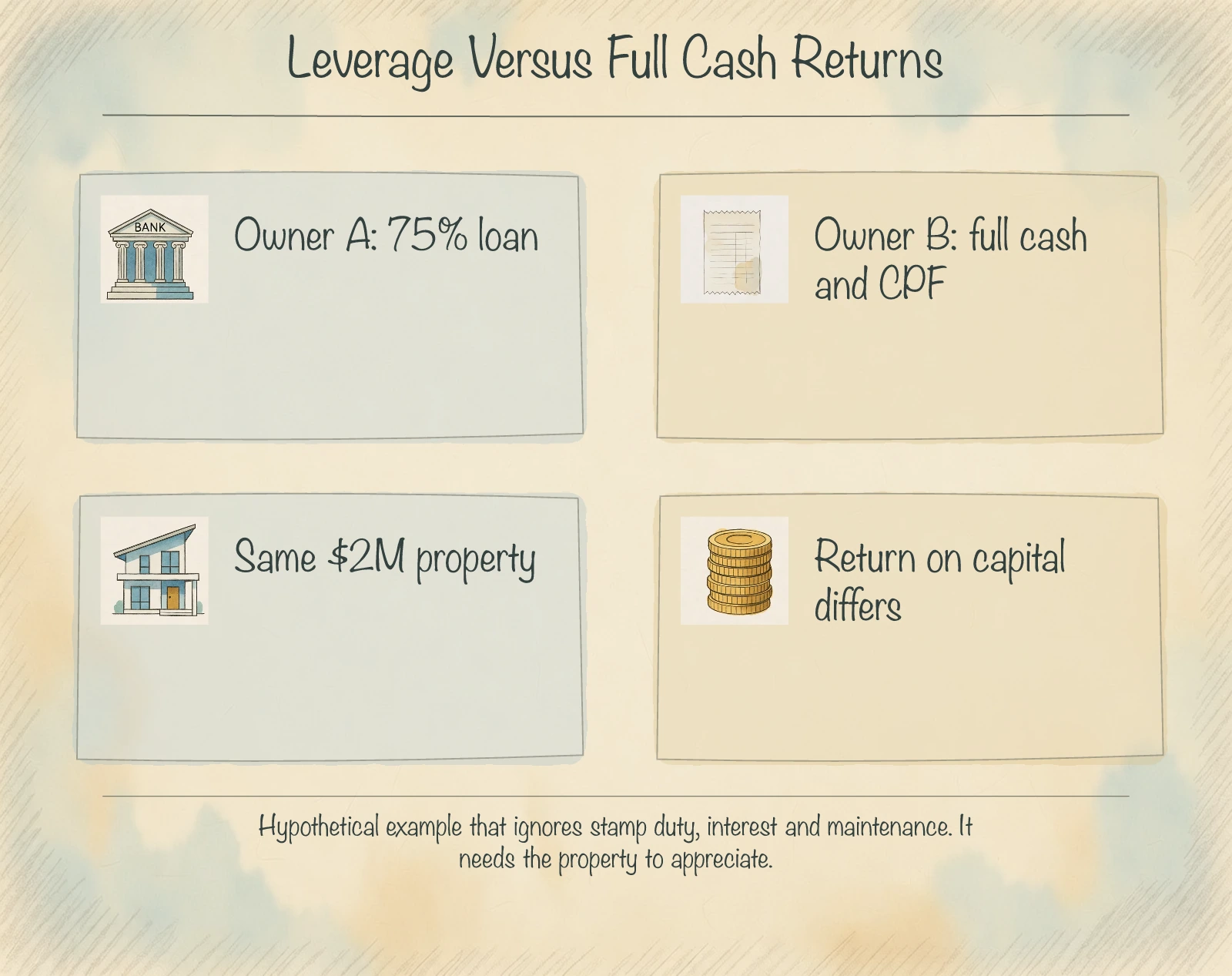
buyer stamp duty, interest rates, and maybe maintenance and things like that. So this is just a very generic example, and we can see that it's very clear that because of the fact that you put in $500,000, the appreciation versus your capital, initial capital, over the period of the next three years, it gives you an 80% total.
And then of course you need to divide by the three years to find out the year on year return on capital. And this is a very different scenario.
But backend, what we do for our clients when we sit down, do tabletop planning, basically this is the level of detail that we go into. But the results are still the same.
Because if we factor in every singular cost, buyer's stamp duty, legal fees, estimated rental, and usually I would like to deem property investment as having four scenarios. If you see these scenarios, I give you a two star.
But what is this scenario? Basically, this scenario states that the property appreciates, but the rental cannot cover the
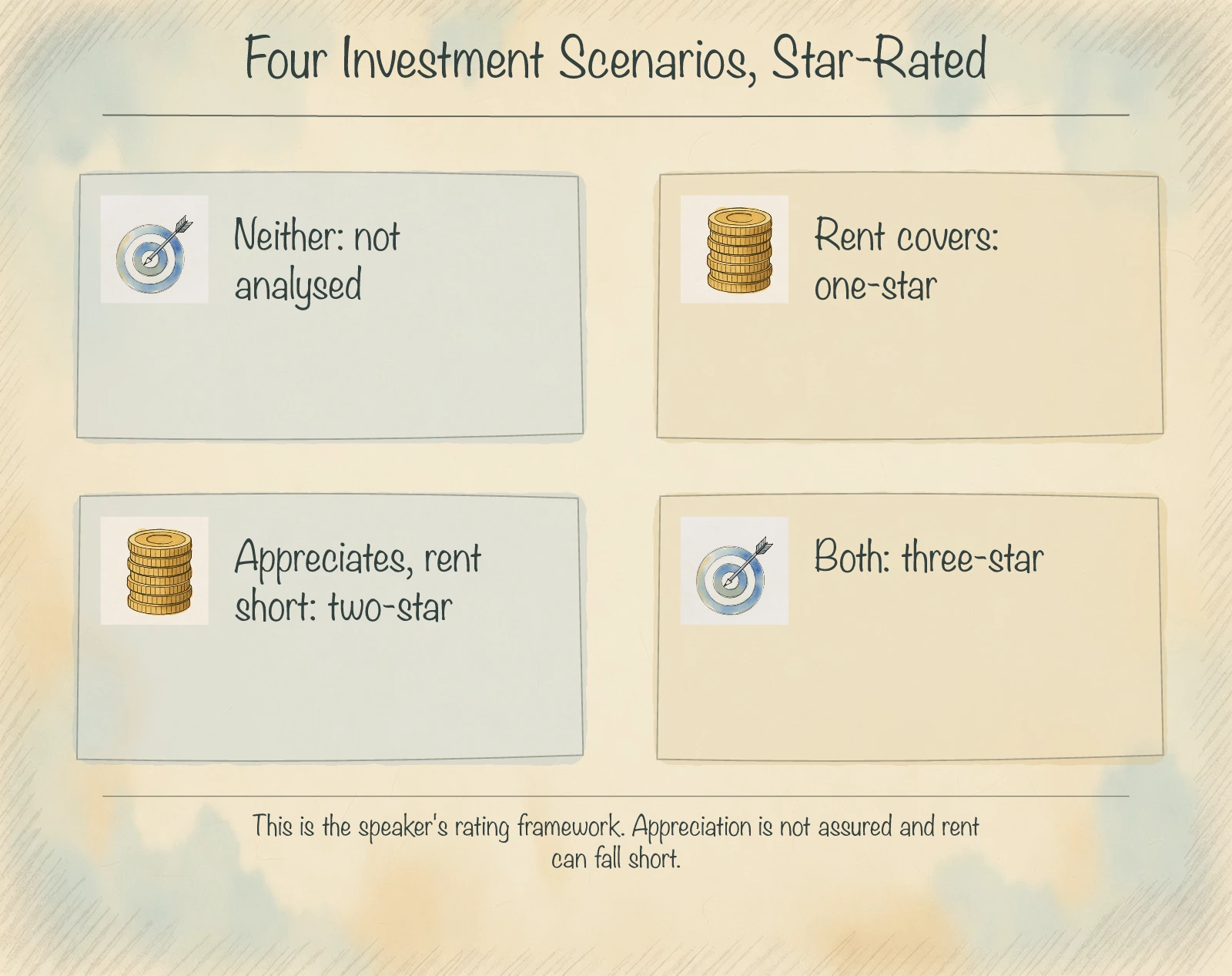
installment.
So this scenario basically is over a case study whereby the rental is only $5,450, MCST, monthly installment is $7,500, you still have to top up cash, but if your property appreciates, basically in a five years period with $100,000 cash, $470,000 CPF, this is what the property, they will exit after paying off and exiting the entire property after five years.
Basically, they will take back $4,000 cash, $432,000 in terms of CPF, and this is the ROI. So this is a leveraging scenario.
But if I were to switch to a full cash scenario, even though the property appreciates, you can see that in terms of the ROI for cash and CPF, it's significantly different because there's no leverage power over here.
So that's one of the reasons why a lot of property investors, they love real estate as a form of leverage because it's a very healthy or we call it good debt in a sense. Now, so in real estate investment basically four scenarios and this is
Real Estate Triple Movement and Leverage
My categorization for investment properties: basically, if you select a property that does not appreciate and your rental cannot cover your installment, basically I would deem it as a property that you have not really analyzed before you enter. But as long as the rental can cover your installment, it's one-star, there's still a positive ROI.
The best scenario is that your price appreciates as well as your rental can cover your installment — that's a three-star investment, right.
So secondly, of course, this is something that a lot of property owners don't realize: when your property appreciates, the bank technically do not need to share your profit. It is a very different thing compared to you starting a business.
Your investors want to share your profit if they invest 75% into your business. But the beauty of real estate investments is that basically whatever you make belongs to you; you just need to make sure that you can pay your mortgage and you do not
so-called, like, you don't default on your mortgage for more than three months. And basically the banks are only interested in the interest that they want to get from you.
Certainly this is the thing that I think is the most powerful, and also a lot of property owners shared this with me, and this can only be felt over the years.
So basically, what an economics professor after calculating the money supply [said]: the whole world, basically if you hold US dollars — or even if you're holding dollars, your dollars in the bank — it erodes by itself because of the expansion of money supply.
Money supply, even after the latest quantitative tightening, even though there's a slight dip in the US money supply, we're still at an all-time high in that entire history. And money supply inflates hard assets throughout the world.
And not forgetting, when we always talk about US news, everything flows towards all parts of the world, because US is the dominant currency, [so] Singapore money supply also has to expand.
It expands automatically because we are pegged against the US. So this is our current money supply.
If you are wondering why is it that real estate prices keep increasing, and why is it that your car prices keep increasing, this is one of the reasons.
And let me just share a basic scenario about inflationary environment. Basically, of course, maybe last year we could buy a car or stuff — I don't know whether we can still buy at this price.
But 10 years later, probably you can only buy half a cup of Starbucks. But you can use that same dollar to pay your monthly installment because technically your mortgage remains the same.
What do you mean by your mortgage remains the same? If you loan $750,000, the bank would not call you and say that now you owe me $900,000.
You still owe them the same initial amount that you signed for. And basically you're paying off the mortgage with a weaker money, and thus it
makes sense to keep your stronger money with you for other purposes.
And this is what we deem as inflation erodes your money installment — because you are technically paying off the [roughly] same amount of money installment; let's say we just take a flat three and a half interest for the 30 years — you're paying off with weaker money.
And we should technically pay off our money... tomorrow with a weaker money, by so-called in the next 10, 15, 20 years.
And thus, I call this like the real estate triple movement, in the sense that it makes sense when you want to invest in real estate, or even if it's your own real estate that you're living in. Basically, there's a triple movement that's happening at the same time.
Number one, your debt is also being eroded. And because of the fact that your debt is eroded, we should part as little cash in the asset as possible, because the entire thing is being eroded but the entire thing is also
gaining inflation. And your stronger cash should be made to work harder for you, in the sense...
Fourth thing, which I think is also very interesting, is that I think the strategy should be to expand the valuation of your portfolio rather than to use your stronger money to pay off your debt. The rationale is because your net worth remains the same.
So for example, let's say if you have $250,000 back-cash in your bank. Rather than doing a partial repayment, calling your bank, say, I want to do a partial repayment because I want to lower my monthly installments — technically, after you do that, after you pay down, your bank depletes, but your entire net worth is the same.
Because if you have to keep some liquidity in your bank and having that same amount of loan, your entire net worth, after asset minus liability, is still the same. And liquidity sometimes might be useful if there's a life-changing scenario.
For example, if you lose your job, there's a
Liquidity, Loan Value and Falling SORA Rates
A little bit more runway. And take note that getting a loan is a little bit like when you buy insurance: you only need to do your health check one time.
And when you sign the letter of offer, you only need to do that finance TDSR check one time. And thus, when you get that loan, it's actually quite precious in a sense because we age and maybe our earning ability will differ through the years.
So some investors, they also look at leveraging in this particular concept, which is that you think that real estate is good in Singapore. Instead of one, there are opportunities for multiple ones.
And thus, having the $1 million, it could be split to diversification. And this is something that I think a lot of our property owners also don't realise: actually when you pay down your loan, you're losing a chance to have compound effect work for you.
Compound effect, of course, is Warren Buffett's favourite, right? And sometimes we think that, hey, compound effect, I have to hold maybe like a fund for 20, 25 or 30 years.
But my question is that since you're already willing to pay down your loan, pay off your property that you will be by right paying for the next 30 years, why don't you take that same amount of 750,000 cash instead of paying down your loan to save 462,000 in terms of interest —.
Why don't you put it in a fixed dividend whereby you reinvest back your interest every year to get back $1.38 million? So compound at the same interest rate is actually more powerful than paying down your mortgage.
So this is another perspective. It doesn't mean that you have to take $750,000 to invest in another property, but you can, of course, there's a lot of investment instruments out there that allows you to do that, right?
Very interesting insurance leverage as well here, which I think later at the car will share a little bit more with you. I personally do this for all my clients as well as for my own properties.
Basically, let's look at property investor A.
So investor A basically today decides to pay off his or her loan. So property investor has $1 million in the bank and one property, decides to pay off, very happy today.
But touch wood, something happens tomorrow. Property owner A passes away.
Basically zero cash in the bank. No more outstanding loan, but the family and kids have no cash, and if they need to extract cash, they will have to sell off this property, or the single parent might have to work.
However, for property owner B, he or she decides to leverage with term of mortgage insurance against this property's outstanding loan and purchases a $1 million loan against the entire outstanding loan.
What's going to happen is that if tomorrow, unfortunately, property owner B passes away, what is going to happen is that the insurance payout can pay off the entire property; the children and the surviving spouse can still utilise the $1 million sitting in the bank.
They do not have to sell off the property, and that's of course the power of leverage as well.
Similarly, even if we are not talking about paying down the entire property, just by the very fact that we look at leveraging, that somebody has in terms of this scenario versus this scenario whereby they believe in paying down as much as possible, the entire estate left for the family is very different if there's some leverage with insurance.
Next one will basically be the fact that this was just out today from some of our UOB colleagues. So basically the forecast is that by the second half of 2024, technically what has happened in the latest Fed meeting is that the Fed has seemed to have pivoted because inflation rate in the US has come down.
The forecast across major banks and a lot of research parties is that they are forecasting the next three quarters we should be seeing a downward trend. And if that happens, basically what's going to happen is that Singapore will also need to react, and allow me to share with you what do we mean by that.
So there's been a lot of articles coming out saying that, you know, it has pivoted; we're raised by about eight to nine rounds, we cannot increase anymore, if not more banks will start to collapse.
And if that happens in terms of rates coming down, basically Singapore — even though our government and MAS has done a very smart decision two years back that they want to delink our mortgage rates so that it's not too influenced by US Fed rates —.
So you will start to notice that SORA is a very common rate that's being used now because by 2024 all mortgage rates have to follow SORA. And that is also the reason why you start to see lower rates compared to the start of this year.
So now you can get fixed rates at about 3.0-something; at the start of the year it was about 4.0-something. But if US Fed rates start to come down, what is going to happen is that
Rate Cuts, Seller Psychology and Inelastic Capital
We also have to match the lower rates, if not we will not be competitive.
And Singapore, based on my 16 years of experience, has a very strong hurt mentality when it comes to property sellers and buyers — that the moment tomorrow when we flip our papers, if we see that the interest rate is now 1.5%, what is going to happen is that property sellers, with properties to sell, they will call all their agents and say, hey, on hold first, I want to increase price.
Why? Because now the buyers are coming back.
Property developers will also increase pricing. But the strange thing is that property buyers will all go out to the market to start to buy, but they will start to buy at higher pricing.
So when interest rate comes down, you will activate a positive momentum in the market again, but naturally you will divert back to a seller's market.
Right now I will deem this year as a buyer's market because the tempo is a little bit slower, transaction figures have dropped, but prices have stayed high, but buyers have more leverage in the sense that when you look at properties, you don't need to really outbeat a lot of people.
You can have a little bit more flexibility. But if interest rates come down, I think buyers will come back to the market, but sellers will also start to raise prices higher.
So the last two things that we have learned over the years is that the first loading period of your loan is the first 48 months. And technically, you don't pay your interest all the way until 30 years or 25 years — you pay until the day you sell the property.
And there's also a lot of offset facilities with your bank that can offset and pair with the mortgage interest rate. So that way you can talk to some of your bankers as well.
Allow me to go to number three. Number three inside is that because of everything that has happened, we have 16 rounds of cooling measures; it is important to plan to switch your capital to the harder asset if you are in a season that allows you to do that.
So this is tracking over three different types of residential homes — HDB at the first three, condominiums, landed. I tracked it until 2022 just to showcase some examples across different types of HDB properties.
So BTO naturally in the past has a lottery effect because you are already buying at a subsidised rate. And naturally, this is the MOP for a five-year HDB; Amoku HDB that is about 40 years old; a balance of 55 years.
The pricing as of last year, a capital appreciation over seven years, quantum increase. So naturally, sometimes you'll be puzzled to see that why is it that an old property, 99 years over here, can still appreciate 37% even though the balance is 55 — sorry, 59, now it's about 58 already.
And you will see the strength of the quantum increase across different types of property.
And this is basically the difference between a softer and harder asset. So what causes assets to appreciate?
Basically it's demand and supply. And we like to further elaborate into increasing demand and limited supply.
So the framework is basically to find the asset in Singapore — because we are so land scarce — to see which one is harder and park part of capital over there. And of course the hardest class will be landed properties, naturally, because the supply is fixed already.
I would say that the supply is dead. There are 73,000 homes; there's not going to be any more release of land anymore.
So supply remains at 73,000, and of course what is going to happen in the next 70 years is, as we go to 6.9 million, we want to identify the two types of properties that have a harder kind of asset classification.
So naturally it will be the private properties as well as landed homes. So all of these three, naturally, HDB homes are the softer asset.
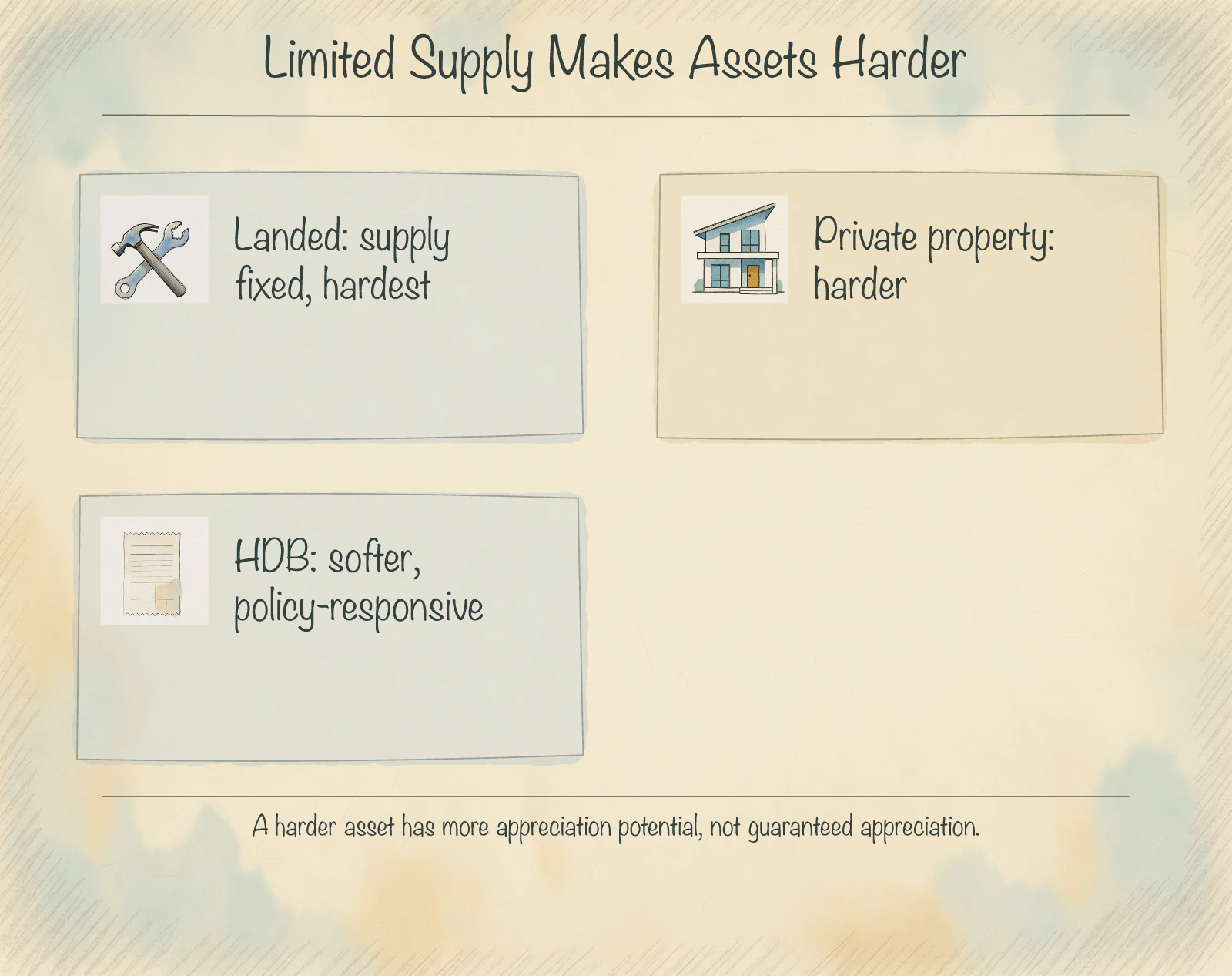
Why? Because we deem HDB properties as a property that our government has created for entire Singapore, that creates the first level of, I would say, chance for us to move upwards, but it's meant as a roof over our heads to get married, have kids and all that.
But it's very elastic. Why is it elastic?
It's because naturally when prices rise, this will be the talk across policies and all that. You will start to see a lot of policies will start to flood the market, a lot of supply will start to flood the market, because we cannot allow our HDB price to go up too fast.
It will be against national policy in a sense. So even for private properties, it's the aspiration class for Singapore home buyers; they also cannot allow you to escalate too quickly, but they cannot allow you to drop as well.
So the more inelastic your capital is in the type of property that you're living in, the better the appreciation potential, because currently at this juncture, landed properties are the hardest class.
Landed Scarcity, Quadrant Two Condos, Filming Tours
are the hardest class. There's no more new supply or land for GRS are reserved for BTOs or condos.
There's no more land for landed homes. And when we classify the four different types of properties, landed belongs to quadrant number one.
It's the highest growth rate, but very low rental yield. And I think if the season for you to invest is to go into condos and not landed, because landed, of course, the price range is at a certain level, then you need to hunt for Q2 condos, meaning that try to avoid condos in Q3 and Q4.
So, certain condos, once you enter, maybe for a good 10 years, you don't see much appreciation because there are characteristics that condos behave very differently in Singapore. And the summary for this is that switch to the harder asset if you can.
So, point number four, I will speed up a little bit more, is that at this point in time, our forecast is that the price gap for resale and new launches is pretty significant.
What will happen over here is that this ranges right here, it will start to move upwards in the next 12 to 18 months to close the gap. So currently the new launchers PSF level is at this range, resale is at this range, TOP condos which are properties that just reaches TOP stage.
They are asking at a range that is very close to new launch pricing. So there's a significant gap from resale to new launch and basically what will happen in the next, okay let me just come back here.
Okay this is the part that you can scan because this is a full video that will explain what we call disparity effect. And our forecast is that resale home will start to move pretty strongly in the next 12 to 18 months.
And then after 12 to 18 months new launches will make a lot of sense because the resale homes internal seller expectation will rise to a level that is very close to new launch asking PSF level.
So this video will explain to you on this priority effect. Now if you are keen in investing in a new launch condo, there is another framework here that you can scan and this will explain to you the four different frameworks for you to analyze.
Basically the break even model, least reset model as well as the modern SZX threshold. So I'm gonna just speed up because I think we have time constraint.
Okay, so last but not least, let me just speed up over here. Okay, basically the final part before I pass on to the next speaker is that trying not to do emotional purchase is very important to use analysis and framework and always purchase with the exit in mind.
Now, I'm going to skip through this. Basically, what has happened over the years is that you will start to realize that there are properties that appreciate.
There are new launches that appreciate. There are also resale properties that appreciate.
But there are also properties, whether it's
freehold, new launches, or resale, that depreciates. So there is basically a list of 11 factors that we use to analyze whether a property has a higher chance to appreciate or not appreciate.
And if I want to come to the last slide, this is the final tool that I want to leave everyone with.
Basically, these are 11 analytical factors that allows you to understand a little bit better before you make that down payment because sometimes you don't want to be trapped in a property that finds it very hard to Exit over the next couple of years.
Hi there, welcome to the Fern New, Sengkang Today we are taking a look at a 4 room apartment in Block 445B. Come on in!
Hi, we are excited to show you a freehold to Black's 2-bedroom penthouse at Yves Village today. Come on in!
Melvin Lim, [name omitted] Lim, Prophecy Lim Brothers, always happy to show the thing. The only more marketing back then was only photographs.
Back then I was thinking how can we position homes differently
because every property is so unique that different renovations of different homes there's different kinds of views from different properties. We should really be highlighting all the unique features and benefits of each property very very differently and I think Vidio is one of the best way to do it.
What is the third thing that makes you feel at home? Firstly, nobody believes in home tours.
The second thing was that the prep of the home really takes a lot of effort. The third thing is that how can we articulate and how can we film in a fashion that really makes the home tour exciting?
I would say that in terms of the number of issues that we face, there are 101 issues in the very first season. The boot house residences were just...
We are happy to show you the place. The space is confirmed is less than 5 minutes.
21 minutes! The key idea back then was really how can we do this so that home buyers and the comfort
Virtual Home Tours and Trapped Foreign-Owned Units
Of their homes can just sit on their couch and watch every single detail of the properties before they even come for a physical view. So we tap on pushing.
Firstly, we need to figure out what is the right camera to use. How can we go to a stage where we can just speak normally?
From the land brothers, right now we are at the highly sought after 99 years later. It's quite a district night today.
We are bringing you to this amazing semi-detach hall. Then you wouldn't want to miss.
If you're ready, let's go check it out. Can we also show the exterior of the condo project of the Lennar Enclave?
We were thinking, what if we can't do physical staging? Can we do virtual 3D staging?
What about investment units? How can we use motion graphics so that can visualize better, we can look at numbers better, location maps better, bring out the floor plans, how to select a home in terms of framework.
Logos will change, watermarks will change, show the bias in the comfort of their home.
How can we bring out the best points of their parties? This is the evolution of PLB Home Tours.
Okay, last stick, last stick, okay. I believe you are asking this question because you want to expand your portfolio.
Something you know about Singapore is that Singapore is very unique and different. We are so small, but yet the whole world knows about us.
And our land is almost backstarted already. So in terms of total quantity of real estate activities, I think if we go back to the first principle when it comes to risk investment about demand and supply is to hunt for the type of real estate asset with a strong demand and limited supply.
Now commercial properties or industrial properties, fantastic properties of course is a business usage. There are various ways of using it.
But of course when you look at, if I were to categorize commercial into four different segments, industrial factories, warehouses, office units, shophouse units.
I would say that if let's say you want to make your money work harder for you, the segment that you should probably be focusing on will be residential because it has proven over the last COVID that this is the only category that is very hard to disrupt.
Everybody needs to stay at home. Industrial properties in terms of the appreciation is pretty limited.
Most of the transactions takes place because owners want to buy them for own use. It can be a little bit harder to exit at certain times.
I own four industrial properties but I intend that is for my own PLB media studio usage. But other than that if I were to buy them for investment I wouldn't do that.
I would look for alternative investment because I think the time horizon for investment is very limited. If you're 30, 35, 40, by the time you're 65 you want to go into defensive stage by the time you are 50 plus 60.
So your horizon is very limited. You don't want to waste your investment bullets on properties that don't really have that high appreciation value.
Yeah, so my advice is if you still have spare names
Or you are married then go for another residential, but it really can't then I wouldn't go for office or industrial. Now the performing one will be shophouses but shophouses quantum is too high really.
Yeah so I will try my best to go for another residential if it's possible. Yeah I hope that answers your question very good question.
In fact we'll be doing a webinar next month to talk about all the different cooling measures and forecasts for trending 2024. This year we've done about 21 webinars so far.
Now the interesting thing about the last 16 years of my journey is that every year actually if you Google Singapore property market crash, every year we'll have articles and research. I myself suffered from timing the market.
So I suffered from timing the market close to about eight years ago. I was trying to time the market by being a pessimist.
But after doing deep research, I realized that now in 2023 we're very different because we have 16 rounds of cooling measures. These cooling measures has changed the entire investment spectrum.
Let me share a view why. Just by the very latest ABSD 60 percent, if let's say any research were to be based on whether the foreigners coming in would then stop supporting the market right.
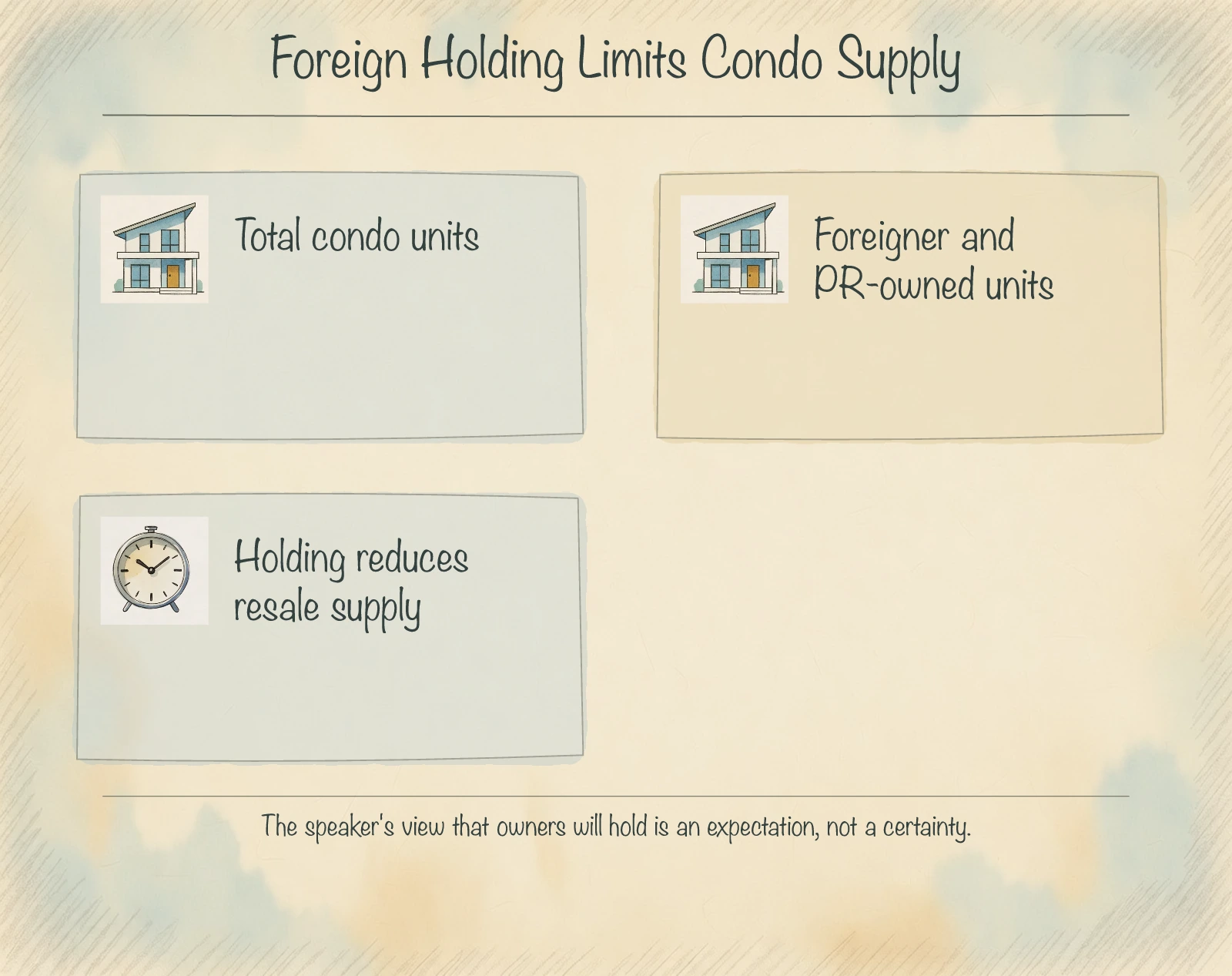
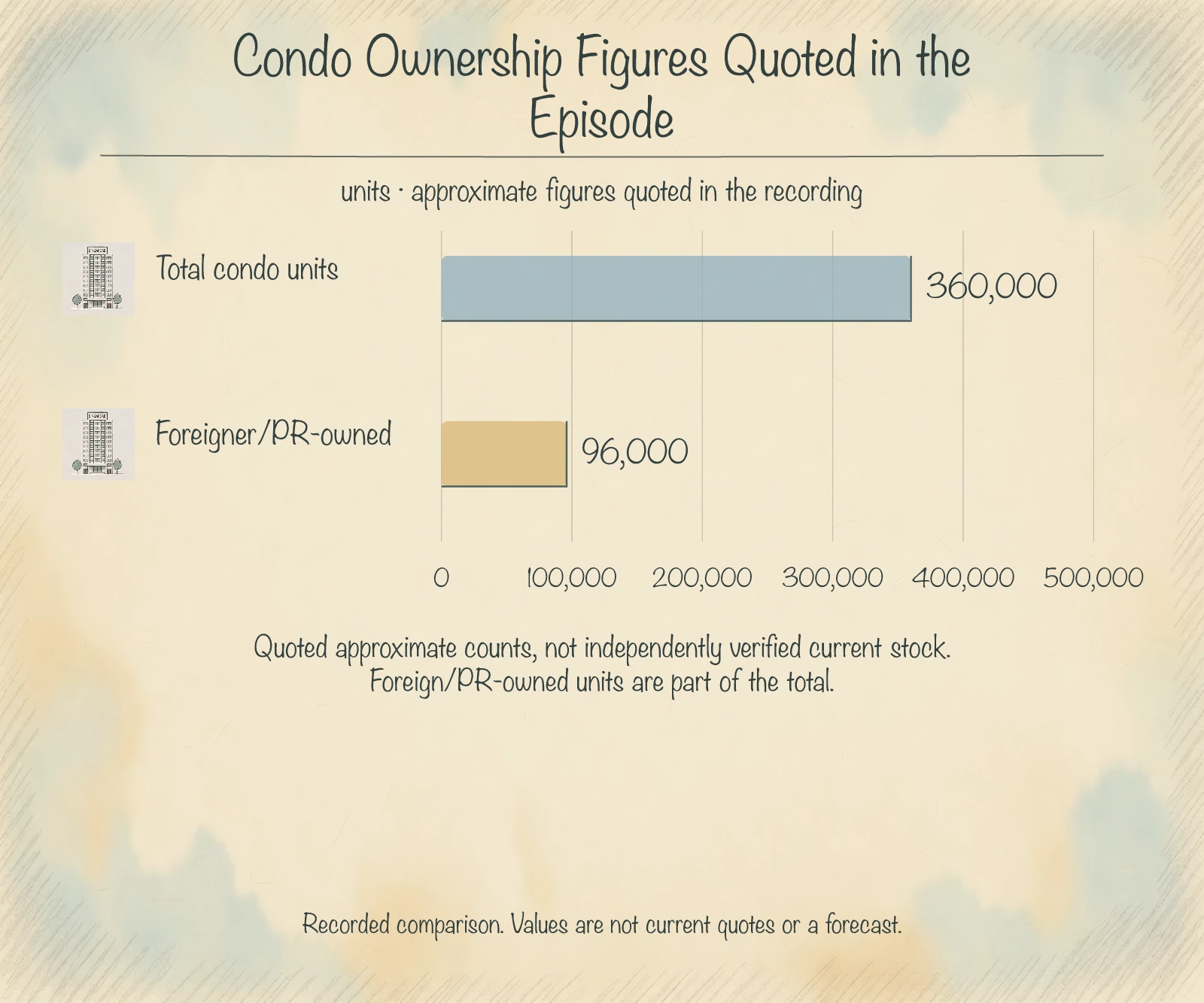
Basically what has happened is that if we look at supply on a deeper level, we only have 360,000 condo units. If I combine all condos apartments and EC, there are only 360,000.
Every year, we will only increase by about 10,000 new units through new launches. And right now, at this point in time, there are about 96,000 units owned by foreigners and PRs.
So technically, we only have 260 over 1,000 units owned by Singaporeans. Now what has happened is that when they double up the ABSD, the psychological effect happens on the reverse.
That means foreigners and PRs, they will not sell. They will hold.
They will continue to rent out or they will stay. Or they can leave it blank if they are holding power.
Read chart values
approximate figures quoted in the recording · units
| Comparison | units |
|---|---|
| Total condo units | 360,000 |
| Foreigner/PR-owned | 96,000 |
Limited Condo Supply and Choosing Faster Movers
Because they bought before the 60% ABSD. So all the more they cannot sell.
Because if they sell, they cannot buy back. So we are trapped in the sense that 90,000 over units are trapped.
We only have a roving liquidity of about 260,000 units. So in fact, if we look at the total supply of condos and apartments, it is actually pretty limited, and we still have various push factors from overseas investors.
We have a lot of internalised citizenship as well, from foreigners internalising into citizens, PRs into citizens, and our government's goal is always to increase population.
Plus, there's one more research that shows that holding power for rest of the owners has increased from three to nine years with the introduction of Seller's Stamp Duty and all the various cooling measures. So I think we are in a very different season.
I think that basically if we look at Singapore as land scarce compared to other countries, where our supply is so limited and increased at such a slow pace, then I think we should be quite confident about the market.
So I think the base analysis is that in every year there is a chance to buy something that has a stronger potential. So it shouldn't be timing the whole market, it should be hunting for the type of property that can move faster.
So I think that should be one of the frameworks that you can adopt.