Landed property
3 Location Mistakes That Limit Your Upsides When Buying $6 Million Landed Homes
Published 2026-11-14. Adapted from the episode published 2026-01-07. Figures, illustrations and data reflect the episode’s original publication date.
Why $6 Million Buys Less Landed Now
Three biggest mistakes landed buyers make when choosing a landed location.
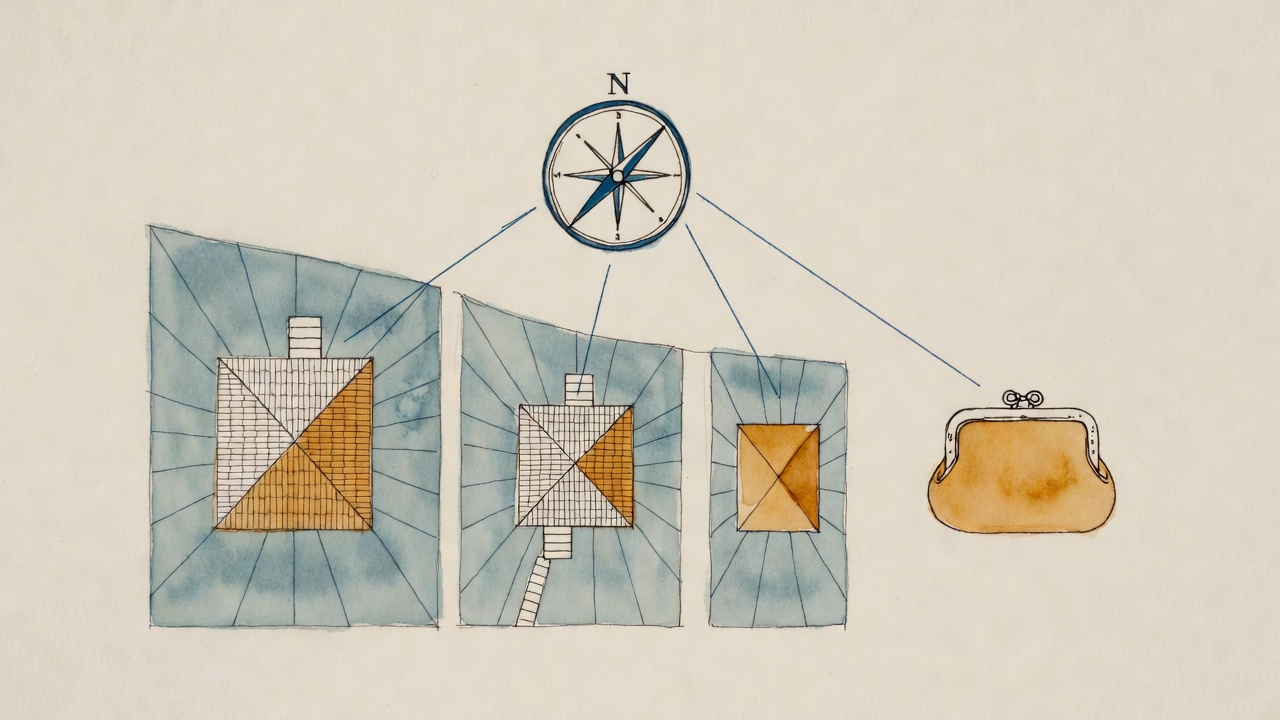
Now first thing, if you have a $6 million investment range, I'm talking about this $6 million, we have to understand that what is happening now is that from a year to year basis, the type of landed you can buy with $6 million is now getting smaller and smaller as the year goes by.
Let me just give you a quick backdrop. So let's have a look at what you can actually afford back in the year 2020.
So in the year 2020, if you have just $2.5 million, you can already get yourself into an inter-terrace. In the year 2021, an inter-terrace in the OCR region, if I'm talking about D19, D28, D16, D14, or even D13, and maybe even D15 as well, you can get something that is sub $3 million for inter-terraces.
Now in the year 2022, that is hovering about 3 to 3.5, 2023, that's hovering about 3.5 to 4, 2024, 4 mil plus minus and now in the year 2025, you can still get something at 4.5
but it's closing in to 5. Now, if you see what's happening in the entry level zone of a freehold and 3-nais inter-terrace in the OCR region, it shifts by about $500,000 in terms of quantum gain per annum.
So somebody that have invested in the year 2020 at $2.5 million dollars, all they need was 25% down payment and another buy-sell temp which is about 30%, they'll bring it to about 750K but then they're seeing close to about a $2 million dollar paper appreciation which vis-à-vis their initial capital that's bringing about close to about I don't know, this is about 150% gain.
So naturally speaking when you look at the price of appreciation of a landed property, entry level, there's a lot of volume coming in into the entry zone which is the inter-terrace space and we're just talking about freehold 3-nais, we're not talking about 99 years property.
So three things, if you have six million dollars, what you need to note is that because of the fact that
the quantum at the base has already shifted. You want to see what is the biggest land plot that you can get for a $6 million property.
So a $6 million property today, you can get an inter, you can still get a corner, you can still get some semi-Ds. And I'm talking about the OCR region.
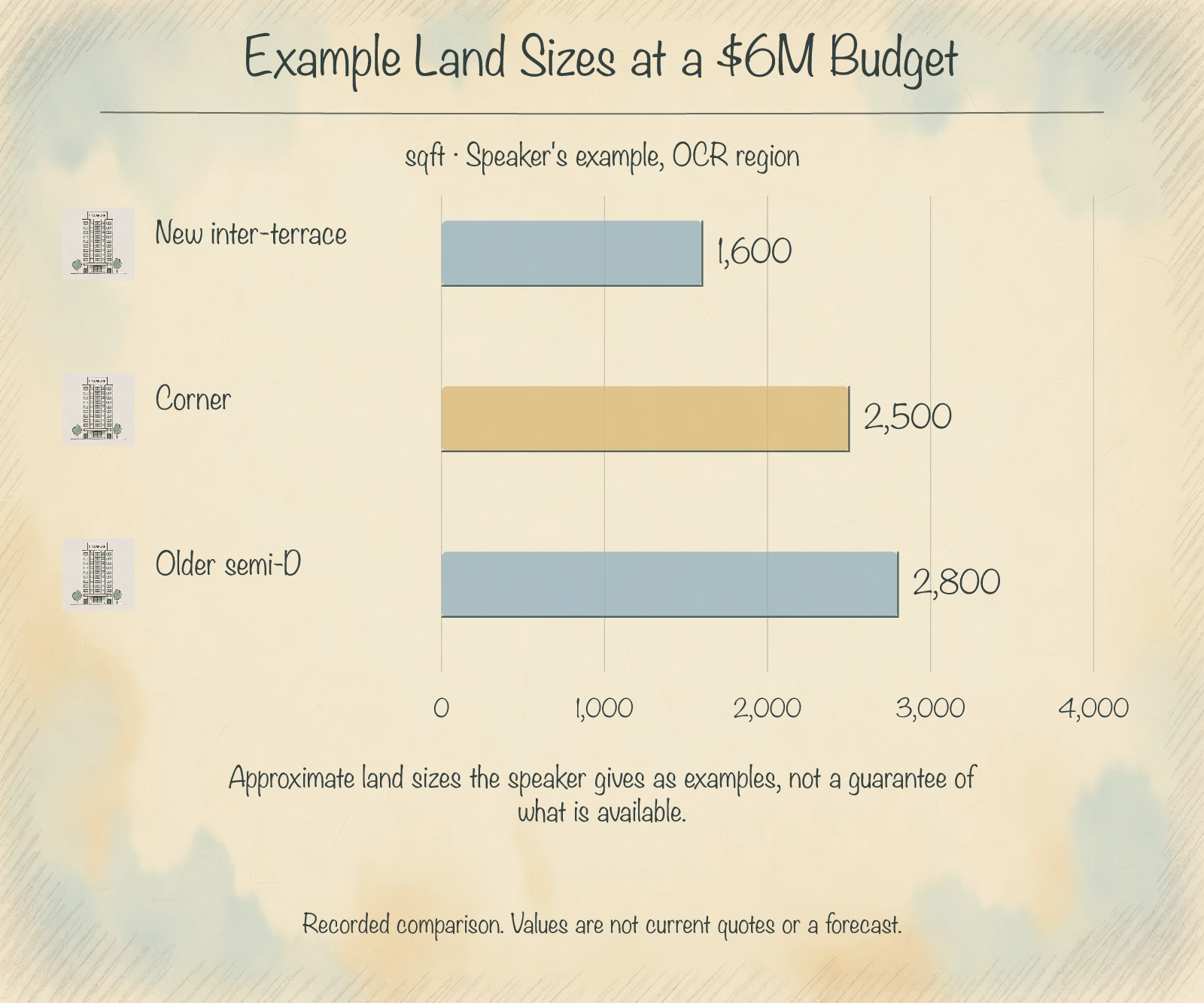
So the key strategy is that: should I go for a very new inter-terrace that is very well built, sitting on a land plot of about 1600 sqft land, or should I take $6 million, get into a semi-D with 2800 sqft land if I can?
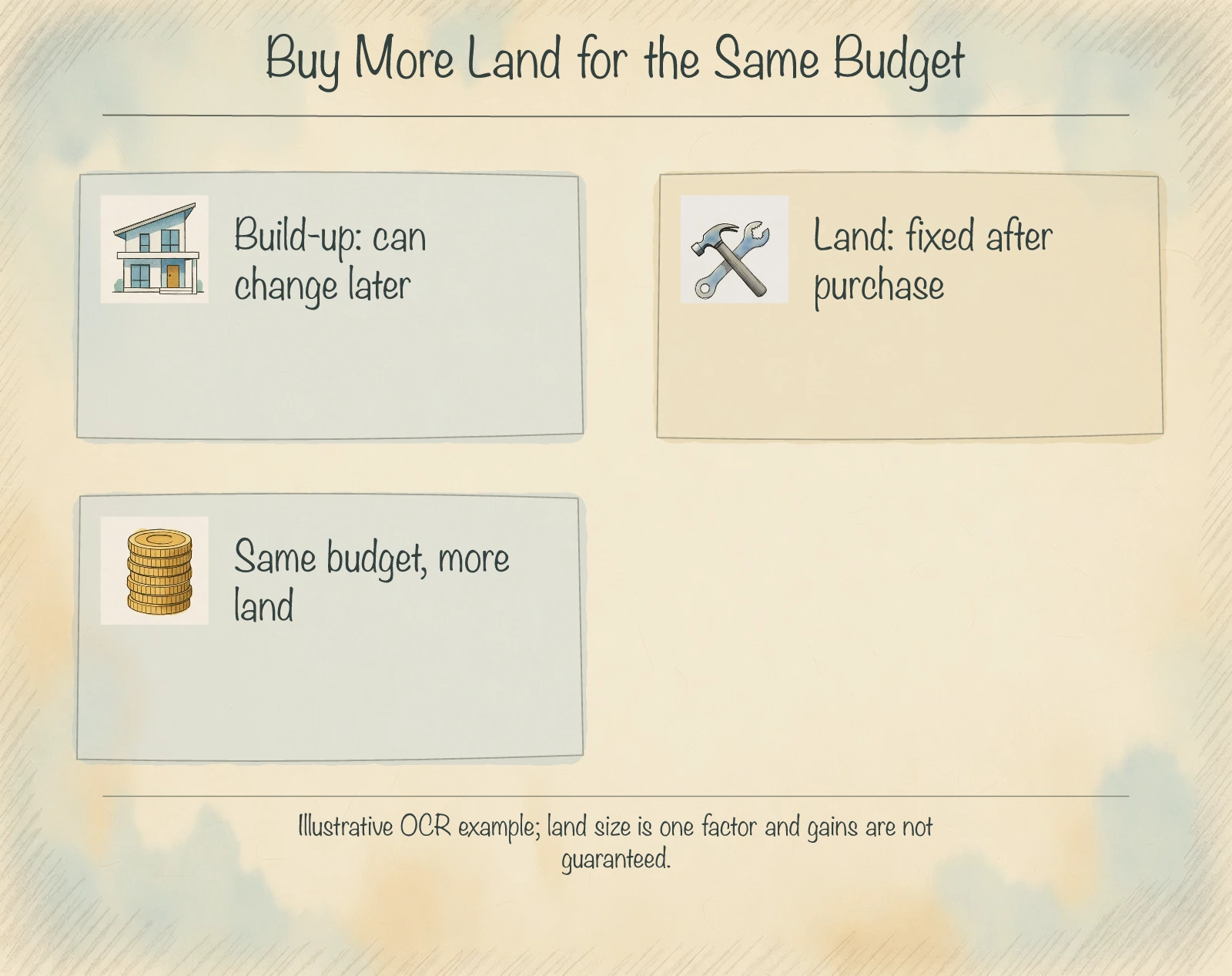
Even though this is the oldest semi-D, let's say category 2 or category 1, but if I can still get my hands on the semi-D or maybe even a corner, which is about 2500 sqft, then it will be better off because the first rule of thumb is that if I can get more land on the same amount, I should try and get more land because land is the thing that you cannot
Read chart values
Speaker's example, OCR region · sqft
| Comparison | sqft |
|---|---|
| New inter-terrace | 1,600 |
| Corner | 2,500 |
| Older semi-D | 2,800 |
change after you invest. You can change the build up through A&A reconstruction and rebuild, but you cannot change the land that you already own.
So these are the key functional difference of what you can change and what you cannot change. Things that we can change are what we call value adding kind of improvements, alright, but things that we cannot change is the DNA of the land.
So if the DNA of the land is that I already have secured a bigger land, the land price improvement in terms of land PSF gain will be significantly different if I own a bigger land compared to a smaller land.
So the first rule of thumb is that with $6 million, can I own a bigger land?
Now let's move to number two. Number two is that I want to see, based on my $6 million, what is my strategy?
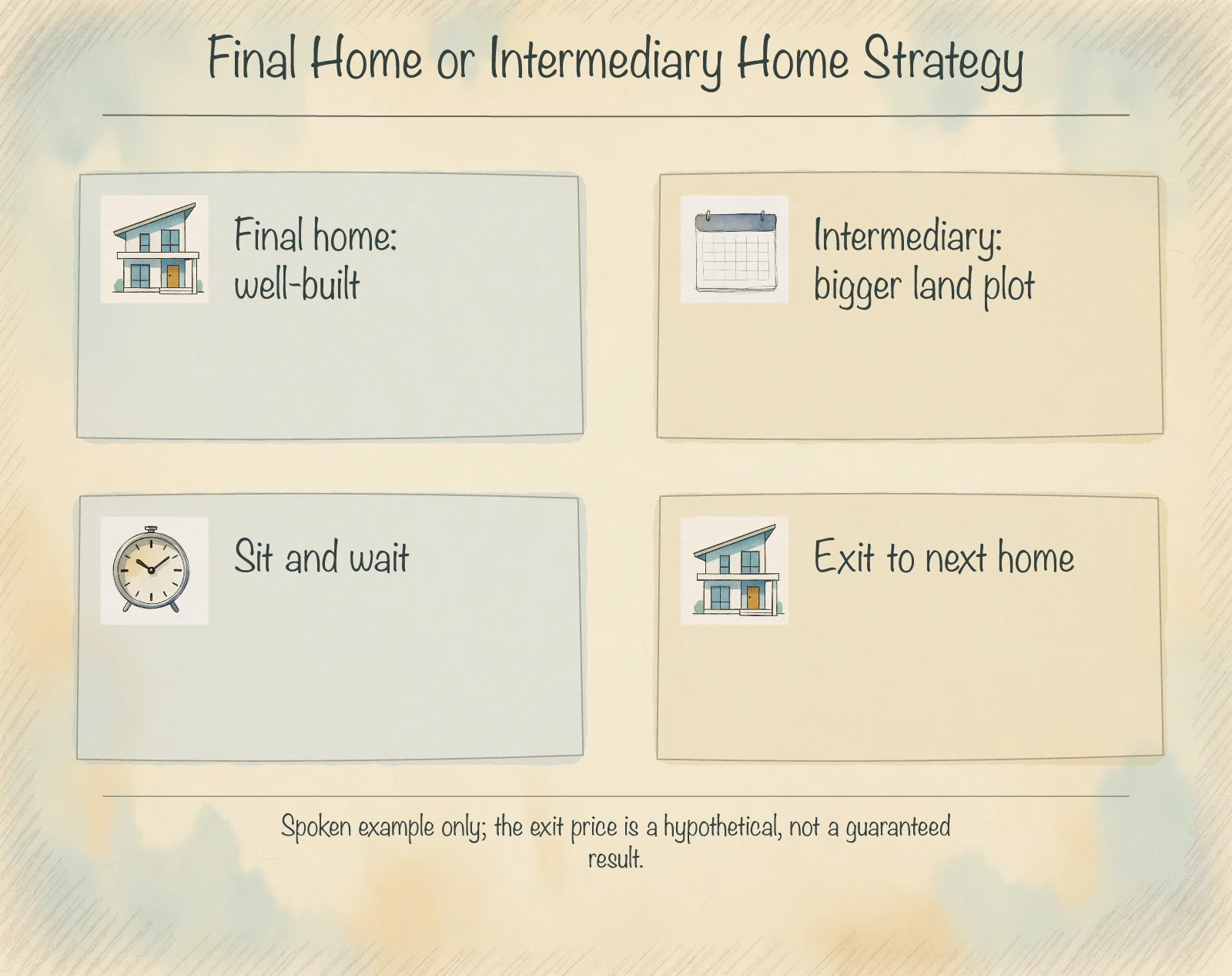
All right, if this is my final home that I don't want to sell anymore, yes, then by all means, I can go for like a well-built home because maybe I don't want to spend additional A&A and construction costs.
I don't want to rebuild it.
I just want to see can I get the most amount of GFA for $6 million and maybe with that amount I might go for a brand new inter-terrace at a cat 4 category inter-terrace with a build up of 5,000 plus, 6 bedrooms, with a lift and wonderful build up, brand new from developer, you can still get it for $6 million, right?
But if this is my intermediary home, that means this is a home that is allowing me to scale up to the next home because maybe I'm still in my 30s or 40s, I still want to head on to a bigger landed or multiple portfolio in future.
I want a stage whereby I can leverage on this landed plot to gain capital and then I move up to the next property. Then I might want to deploy a second strategy, is that can I buy a bigger plot, for example a 2008
Matching Strategy and Exit Liquidity to Purchase Base
Now take note, of course, there's a few categorization inter-terraces — they start from 150 square meters, which is 1,615 square feet. Corner and semi both start from 200 square meters, typically minimum 8 metres width, 25 metres depth, 200 square meters, 2,152 square feet.
But if I can get a bigger semi-D, 2,000 to 3,000 square feet land, will this be a good strategy even though this is like a cat-to-home? Because if I'm having an intermediary strategy, I might want to let the land price appreciate without me doing anything.
It's called a sit and wait approach. Sit and wait is in the sense that in four years' time, I just naturally let this land appreciate.
Maybe — if I want to say — I just spend 200,000 to renovate a little bit, very light renovation — carpentry, flooring and stuff like that, overlay and things like that. Wait for four years, then I exit, get the capital gain that I'm hunting for.
For example, I get in at $6 million, if I can get out at $7.5 million, I exit without doing anything. And I take this gain and move on to my next home that I want, a bigger GFA, maybe a brand new inter-terrace or brand new corner or brand new semi-D.
So it really depends on what is your strategy. It's your strategy — immediate, that you want to settle in and you want to go for a big; you want to use a sit and wait approach.
That's point number two.
All right, now point number three is called the exit absorption triangle. All right, so we need to understand — the triangle's apex at the top in terms of the buyer absorption appetite.
Sorry for my handwriting — buyer absorption appetite and where did we learn this from? We learned this from developers who always buy big land and subdivide.
So developers, they always buy big land and they love to chop it into two corner and inter- or they love to chop it into two semi. Why are they doing that?
It's because they understand this concept that the base is always bigger at the entry level. The base is always bigger at the entry level.
The entry level is inter-terraces — it's always the easiest to sell. So developers are sellers, right?
They buy, invest, rebuild, they sell. And the reason they do that, to chop it up, is because they understand — yes, of course, there are developers that redevelop detached homes as well, but that's a totally different market.
But most of the developers, they are into liquidity. So they understand that if they want a bigger audience, they want to develop more smaller plots.
So similarly, some of the retail investors for landed as well, they are adopting this strategy. So what you can do as well is that once you understand this, then you will know what to invest and what to buy.
So understand that with this, they are more biased at the base.
And the other triangle is that in terms of quantum is the same. The buyer absorption appetite is more biased at a $5 million mark, $6 million, $7 million, $8 million and $10 million at the base.
So naturally speaking, if you own something at a base quantum, in four years' time when everything changes — when this changes to about $7 million, when this changes to 8 million, 9 million, 10 million, 12 million onwards — naturally speaking, there are people coming in at a base and the base is always bigger.
Alright, so if you want more exit liquidity, then hunt for the base, and that's the third point.