Evaluating property
3 Condo Buying Frameworks to Avoid Overpaying for Resale or New Launch in 2025
Published 2026-11-23. Adapted from the episode published 2025-07-18. Figures, illustrations and data reflect the episode’s original publication date.

On this page
- The TOP Effect and Owners' Price Expectations
- Quantum Pressure and the Extra Buyer Audience
- Tenant Appeal and Using the SSD Period
- Blackout Period, Progressive Payments, Consistent Pricing
- Developer Promotions and the Lease Reset Strategy
- Lease Reset Example: Stars of Kovan
- Weighing New Launch and Resale With Frameworks
The TOP Effect and Owners' Price Expectations
New launches, the very first thing is that everybody is always talking about this thing called the TOP effect. We call it like the one-off owners alignment effect.
It's a psychology play. For example, you look at Stirling residence, it was launched around 2006-07.
When a TOP is averaged about 2000-2001, now it's about 23-25 already. People have the same mindset.
I already hold the property for 4 years from launch, if I don't make at least 300-400 PSF, I don't want to sell. Because anyway, I bought cheap.
And then they will be thinking, the new launch is already 2005. I don't want to sell low.
You don't have to form a chat group to tell all the owners that, hey, everybody, let's sell at this price. Everybody will sort of think like this.
Alright, welcome back to NOTG. It's been a long time since I've done like a solo episode to talk about some of the key concepts, frameworks and of course, we've been going through like some of the interviews with business owners, influencers, key opinion leaders about certain domains.
That was like the last season that we had in season three, season four now. Now, if you're started to watch some of the new episodes of Season 4, we are very into the property expansion journey.
We want to understand basically like different kind of routes, different people in different seasons can take when it comes to expanding their portfolio.
We are also getting some of our clients and maybe some property investors in the market to come in, also share their experience on actual real life seasons that they have expanding their property portfolio journey to their different age progress and profession as well.
So really great to start off like with one key session for today's episode.
And of course, over the last 12 months, after watching the new launch versus resale debate, the one that I have been wearing different kind of outfits running here and there, like a crazy person talking about the pros and cons of new launches, the pros and cons of resale debating among myself.
And of course, the conclusion is that it really depends on your objective and your season. Sometimes we really just want to have like a brand new product.
Sometimes we really just want to have a resale product for the comfort of our family without having to rent and all that. Of course, some people can have the flexibility to have a resale at a new launch.
Some people only want to use a new launch strategy as well. We want to use this session because there's been some requests on really deep diving back into some of the benefits of investing in the new launch condo.
Because I think this season, especially the year 2025, based on the five year cycle that I've shown everybody, this is a cycle whereby we look at the amount of inventory that's going to TOP, that means the amount of inventory that developers need to hand over their keys.
And when the amount of inventory is searched up, it means that the developer now have done their responsibility of handing over the projects.
They have more bandwidth to beat for land, launch new projects in the market. Actually, one year before they know that they're going to hand over a lot of their projects is going to be completed.
They will already start to plan and beat for land already. So that once they hand over the projects, they can start to launch.
Now, over the last two years, the developers has been accumulating land from government land sales. And of course, if you look at 2024 and 2025, there has been quite a fair bit of launches.
Now in the Q3 and Q4 of 2025, there's going to be a renewed amount of launches, especially in the CCR region. Not so much OCR, but RCR also has just a fair bit only, but majority are in CCR.
And really it's very interesting to look at what is coming out from the floor plan architecture because they, developers point of view is that they want to make sure that the quantum perspective is a very attractive portion in order to clear their stock.
So I believe that in the year 2025 and 2026, this is the year that demand shifts back to new launches because the resale pricing has also caught up already with a lot of resale owners asking for future price.
Nothing wrong with that because as a resale owner, I also want to make sure that I can sell at a very good price because I'll be asking myself if I don't sell at this price, then what can I buy?
I want to make sure I have enough profit that I can buy something whether it's a lender or new launch or whatever. I also want to make sure that I got a good deal for my own property.
So we can already notice especially in OCR, a lot of owners are starting to ask for future pricing. Three balers can be up to $1.8, $1.9 million.
Of course, average you can still get about $1.5, $1.6 for some of the OCR regions, but we are already seeing people asking for higher tier pricing that is closing into $1.8 and $2 million.
Quantum Pressure and the Extra Buyer Audience
But we are already seeing people asking for higher-tier pricing that is closing into $1.8 and $2 million. That will mean that buyers now will be even more distinct in looking at quantum perspective because some of the new launches that are coming out now, some clients have been asking me about like some CCR, for example Rivergreen.
They've been asking about the new one at Robertson. They've also been asking about Springleaf.
They've been asking about how about the one at Canberra from a quantum perspective. If the developer is strategic enough, I think in terms of the quantum play, they can clear a lot of stock if they hit the right sweet spot for the buyer.
So these two years will be very focused on new launches. And I believe that once the developer clears, we will then hit into a new season whereby we will then hit a new high of what we call a new launch PSF benchmark breakthrough that might happen in the year 2028.
And so far, the fire cycle has been quite consistent over the last 10-15 years. To this episode, we want to deep dive into some of the pros of new launch again, just in case you want to recap.
And of course, there's like 10 over reasons why about 50% of the transactions on a month-to-month basis are new launches, 50% on resale. They are buyers that are very into new launch bias in the resale; some own both, I myself own a resale and new launch as well.
We want to make sure that in terms of the perspective, we understand both sides of the coin. All right, new launches, the very first thing is that everybody is always talking about this thing called the TOP effect.
So TOP effect basically in terms of the effect, we call it like the one of owners alignment effect. It's a psychology play and psychology play means that for example, you look at Stirling Residences, it was launched around 2006, 2007, when a TOP is average about 2000, 2001.
Now it's about 23 to 25 already. Not all projects enjoy this.
Most of the projects that enjoy this are bigger developments, maybe 3, 4, 500 units upwards. There is of course like a combined psychology that people have the same mindset.
That means they always have this mindset whereby I already hold a property for four years from launch. If I don't make at least two, three, four hundred PSF, I don't want to sell because anyway I bought cheap.
So, from the time that I bought, maybe real front is this price. But maybe now, sorry, this was last year's slice.
Basically they are out asking about $2,000, averagely. And then they will be thinking, the new launch is already 2005.
I don't want to sell low. All right.
When my project TOP, I waited, I exchanged my time for comfort. I went to rent.
If somebody wants to buy from me, I make sure I want to see a profit. If not, I don't want to sell.
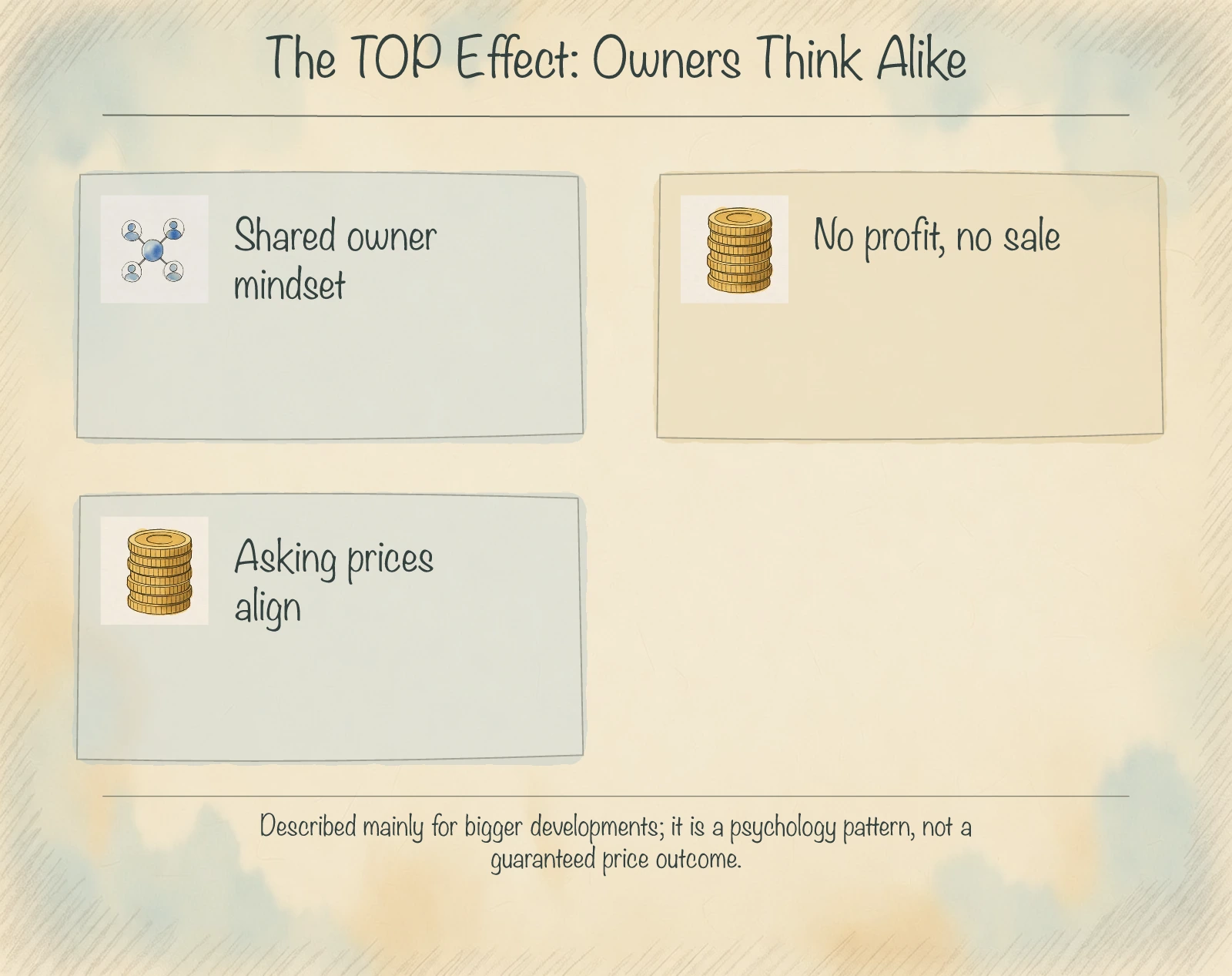
So, this is a one-off psychology that you don't have to form a chat group to tell all the owners that hey everybody let's sell at this price. Everybody will sort of think like this.
So there are other things that if I don't see this profit I don't sell or I will just run out or just stay. So we call it our TOP effect.
All right. Now one beauty is there's no COV.
That means when you put a new launch somehow you don't have to call the bank and ask hey what's the valuation of this new launch. Example, Spring Live is going to launch and you don't have to call the banker and say, I want to buy a 3-bedroom at Spring Live and can you give me the valuation?
You don't have to. Why?
Because that's just the way how it works in Singapore. When you buy a resale property, you have to ask for valuation because for example, the owner asked for $2.5 million,
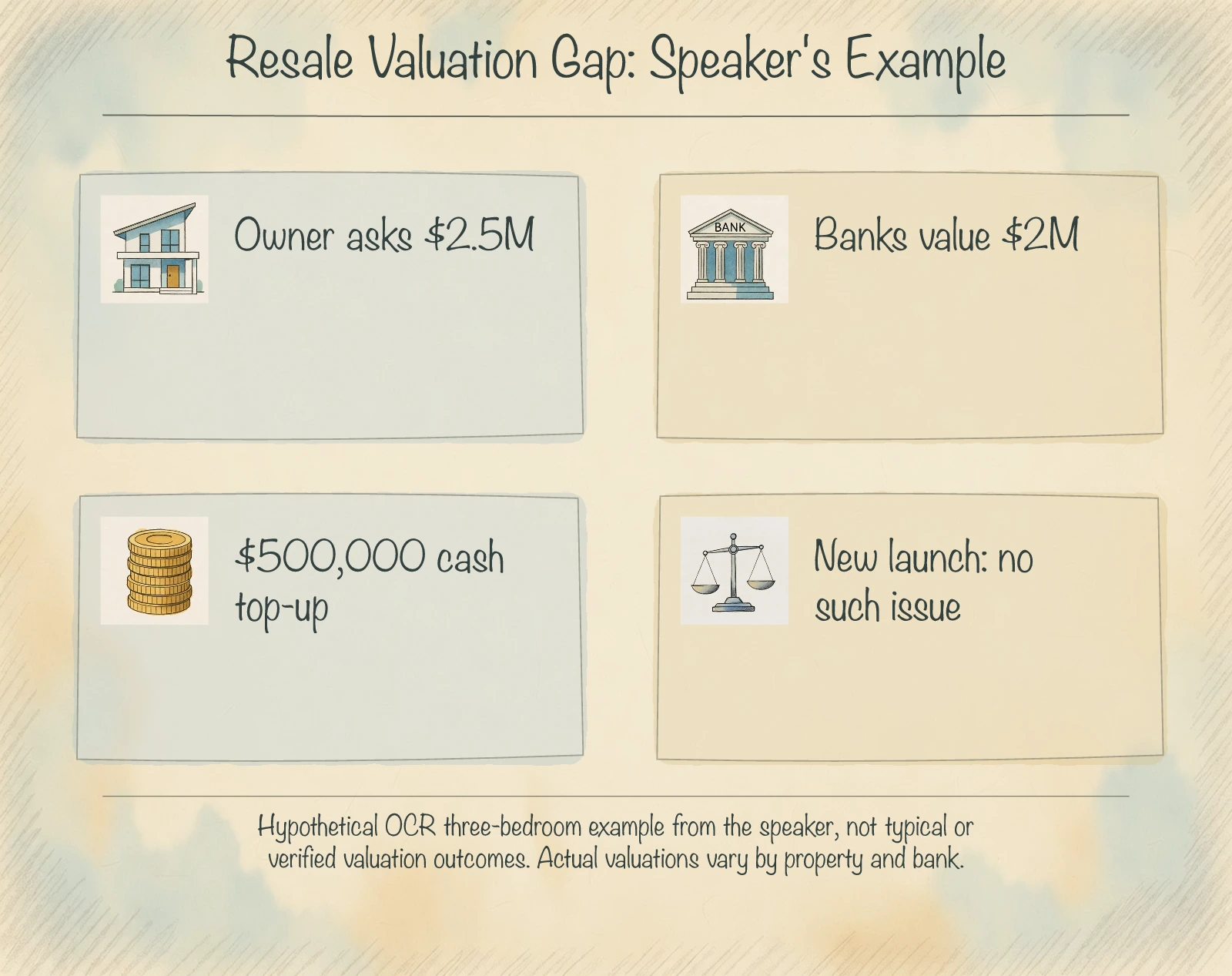
but you call all the banks and every bank only value at $2 million for this 3-bedroom in the OCR region. You have to top up the $500,000 in cash on top of your 25% down payment of the $2 million dollar valuation.
So, resale property potentially can attract COV if the bank cannot match your purchase price. And new launches is no such issue.
So, don't ask me why. I can tell you privately why it does happen like this.
But on a level like this, that's just how the way the valuation system works. The third reason is that you have three audiences when you buy a new launch.
The three audiences is that you have an extra set of buyers that only like to buy properties that nobody stayed before. They like to buy properties that nobody stayed before.
So when you buy a new launch, you hold it for three, four years, when it TOPs, you attract this group of buyers that likes to buy brand new properties that are completed and they don't want to wait on.
So naturally
Tenant Appeal and Using the SSD Period
Speaking of that, you have this extra audience compared to just having one set of audiences, which is a resale audience. Because sometimes resale condo buyers, we need to separate them into two categories, TOP buyers and resale buyers.
So you have an extra set of buyers when you have a new launch product. It's also very popular with tenants because some tenants also want to stay in a brand new development with no other people staying before and brand new facilities, and they know that they will be one of the first few to enjoy.
And when the project is just TOP, there's a lot of units that want to rent and a lot of tenants want to rent; they know that they can negotiate for a low rental, they can be the first to come in.
Even though there's some renovation and stuff like that, but that's okay, at least they enjoy the full facilities brand new. You also enjoy new design, architectural and facilities and everything is brand new.
The rental cost is very low because now developers are even throwing ceiling fans and all that, your kitchen cabinetry, your wet works, your towels, everything is done, your wardrobes are done, your bathrooms are all done, everything is done, just put in curtains and lights.
Some projects also throw in lights as well. And everything is done, ACs are new.
You have defect warranty and the rental cost can be kept really low. Sometimes just spend less than $10,000, you can just do everything.
All right, that's progressive payment, which is the darling of new launches. Everybody loves this, in the fact that the stress is low rather than paying full-on money, which is normal, right, at the start.
After you buy the property, you complete three months later, straight away you need to pay MCST, property tax, start SP services account, then after that full installment kickstart.
And basically when you buy something at progressive, you just need to pay progressively, so your money installment can start all the way from $500 to $2,000, $3,000, $4,000, then the full installment of $8,000 kicks in six to 12 months after you hit CSC.
But when you TOP, you still enjoy a lower amount of installment because the last 15% has not been disbursed. So this is the darling of new launches that a lot of buyers, they like this progressive payment.
Now the SSD period, of course, now is no longer three years, it has been increased to four years already. But nevertheless, if you buy a launch, most of the time it's still take about four years.
For example, Springleaf now is the year 2025, estimated TOP second half 2029. Of course, sometimes it will be earlier than what is written on the paper, but average is about three to four years.
And by the time, most people have already cleared the SSD, unless you are buying a balance inventory unit at launch has been launched, then maybe your SSD period will be later on. But sometimes it's not a bad thing as well.
Let me come to the screen. For example, this property has been launched in the year 2024, all right, then it TOPs 2028, but you only buy in the year 2025 some of the balance unit.
Why? Because that time you saw this, but your house haven't sold yet.
You take time to sell, and when you're ready to commit, you went for the balance units.
Sometimes the strategy of balance unit is not a bad thing as well, as long as the quantum and the PSF compared to the launch now for the new ones, the newly launched, that means the ones that are going to have hit preview date and all that kind of stuff.
As long as your quantum still makes sense. But sometimes the balance unit, the developer is already clearing 80–85%, they will not have any star buys anymore.
And maybe you're all getting high-floor, higher quantum, higher PSF units. So you need to take note.
But let's say you buy a balance unit and your SSD now is 2029, but the TOP date is 2028, it might be a good thing as well.
Why? Because at TOP, a lot of people start to rent out, clocking transactions.
A lot of people start to sell, clocking transactions. It will start to help you to push up the TOP effect in terms of valuation.
And by the time you do in 2019, your SSD for years and you can sell, basically you already cleared your own SSD and you already start to enjoy the TOP effect. So sometimes it might not be a bad thing, buying the balance unit, provided the quantum and PSF makes sense.
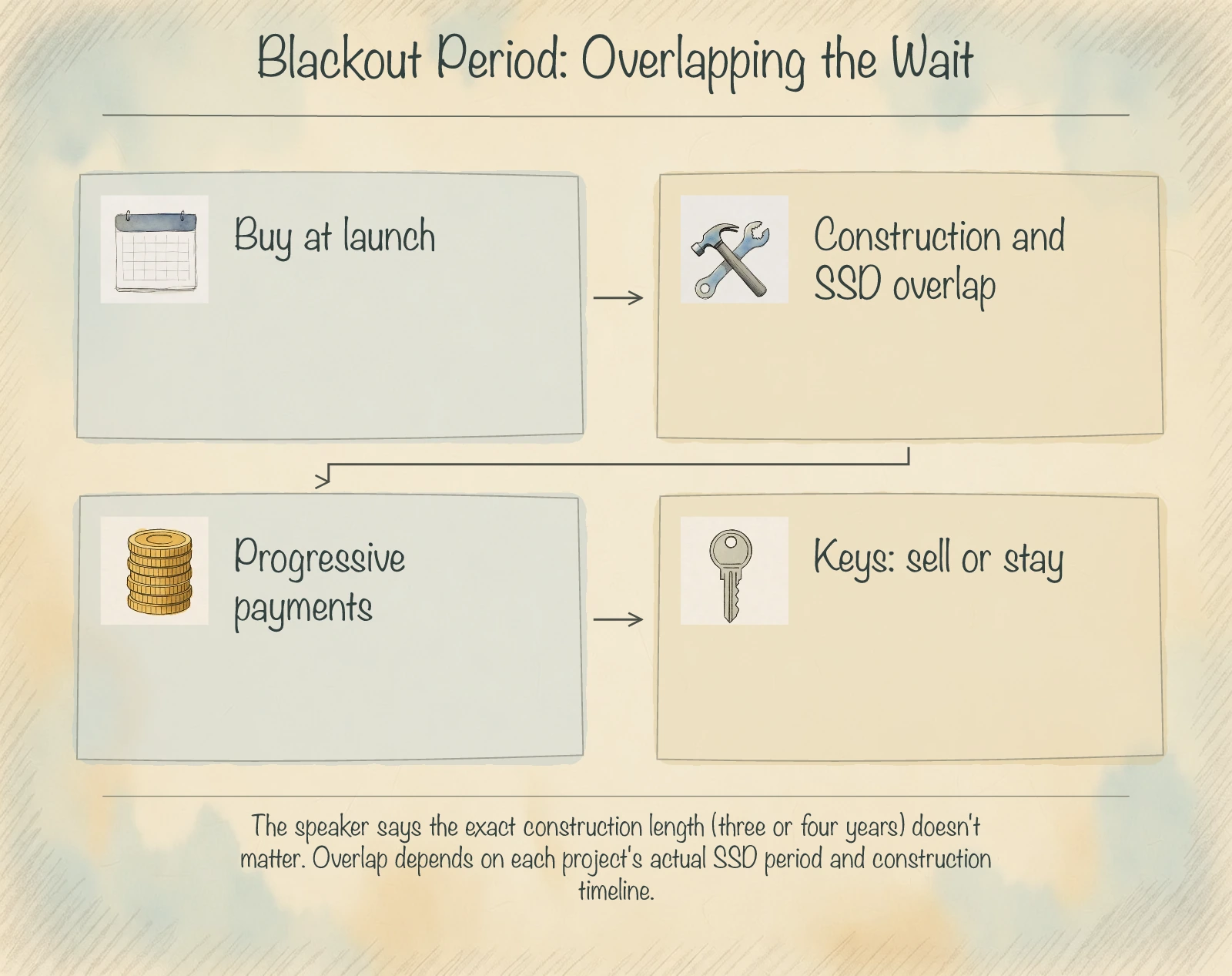
Let's come back to this, we call this a blackout period. So for example, now it's four years SSD, four years construction, or three years construction, doesn't matter.
But let's say when you buy, you sort of utilize the construction period to offset your wait time for SSD. So your construction four years and your SSD four years is like pairing together.
And by the time you collect your keys, your SSD is done. Then you don't have to think about it anymore.
You either can just sell.
Blackout Period, Progressive Payments, Consistent Pricing
And rent out or you can stay. Alright, so we call it the blackout period, meaning that you already buy the property with the intent that I'm going to wait for four years.
And the best thing is that I have progressive payment for the next four years during this blackout period while claiming my SSD while waiting for the project to be built. And once I collect keys for us later, I can sell the BIOS that wants to buy only KOP projects.
So lesser hassle and worry free kind of approach, which is what a lot of you love about new launches. You get a brand new lease of 99s.
Of course, you spend one year when developer beat it usually when they launch is already one year already. So by the time you collect your keys, maybe balance lease of 95 years.
All right. So you have brand new lease, you don't have to do lease reset.
So basically lease starts, they launch one year later or six months later or 12 months later.
They take another three, four years. Usually once you collect your keys, balance 94, 95.
But you are still the most so-called like the youngest guy in the market. All right.
Compared to a lot of the the resale that's already 15, 20, 25 or 30 years, You don't have to worry about this because when you collect your keys, you're still at the top of the market. You can still easily stay for 10 years without worry.
10 years later, it's still about 85 years. When you sell, a lot of people are still after it because it's like a new project, new facilities, like high rise and of course it looks modern.
It beautifies the landscape. The township is new.
One thing about this is that a lot of people always make this mistake for resell properties is that they look at the completion date. But look at this project, the completion date on paper, 2013, but actually the land is 2007.
So 2007, 2013, it takes about six years. And then let's say for example, you decide to buy this resale
and you buy in the year 2024, last year balances 82. By the time you stay for five years, it has left 77.
So take note sometimes when you're buying resale is that when you are buying, You only think about the fact that it's still got 82 years, but you never never Forecast in the sense that if I want to sell five years later in the year 29 what would the buyer think about my balance lease?
So what is the price I can fetch can I sell easier? Do I think a longer time to buy a buyer?
So which is why sometimes people like to buy Then when it to P for example, you left with 94 95 you stay for 10 years you still have 85. In the eyes of the next buyer, it's still okay.
The selling part is not that difficult. So that's the reason why a lot of people like to buy brand new.
Okay, the defect warranty plus of course the delayed installment. Your full installment only kick in about 6 to 12 months
later after TOP. This is the example.
Basically, your installment is about 7 to 2. If you buy a $2.5 million property with TOP about 6 to 12 months later, then you hit the full installment of 2009.
And then of course, defect warranty period one year, you can report, you can get somebody to come and pay stickers for you, and then they can rectify before you start renovation.
Now, new launch BST can also be paid directly from an OE account, resale cannot use cash, then refund back from a CPF, which might affect your cash flow. But the important thing is that this frees up more down payment at the start.
I think a lot of people like this first mover advantage because sometimes the buyers might rate the old, the developer, sorry, once they launch, they sell 60, 70, 80%, then they might launch maybe face two, face three to increase price while they start to focus on other projects.
So this project, they will just leave it there, let it clear by itself, then they will go and bid for new
lands, settle the other project. So let's say if this hit 70, 80%, they are very confident really, they will hold their price or they might increase price because maybe the next land bid price is higher than the whole market most out in tandem, then they might increase price or they just hold their price.
This is an impact whereby if the developer and the market allows, then the developer itself is helping you to increase the price without you doing anything by being the first mover advantage. So we call this like auto increase in price because of the developer's action.
So basically, once you're in TOP, you already start to enjoy the appreciation without doing anything because the developer has increased the price for you. And when people buy it, they launch in the transaction, the PSF is already going up on its own basis.
So last but not least, the price is consistent. You don't have to worry about negotiation with the owner.
Let's say launch, the price is out.
Developer Promotions and the Lease Reset Strategy
The developer won't change their mind unless it's super hot, like certain launches where when you queue up, the price already increased, I don't know how many times already. But most developers, when they launch, means they launch at this price.
And let's say on the launch day, the price is fixed. You don't have to negotiate.
You just see this price, confirm, take your Q number, ballot, then you get this price. All right, so basically the price is consistent for a fixed period.
And when you go for balance launches, first of all, there are star buys, there are certain stacks on promotion, they want to clear this stack, they're a bit more motivated.
Or let's say you get this price list from a consultant, you don't have to have that resale market kind of mentality that you have to spend time on negotiation. You go down, you see, you like, you've done your math numbers, you confirm this price is stacked, then basically you can secure the unit.
We also want to look at
resale property is that you're buying an existing structure. There's always caveat and thought.
What you see is what you get. And of course, the S is where it's crossed is sometimes something that worries clients.
And of course, the lease is not full lease. And of course, I can go through bit by bit.
There's still a lot of things over here. But end of the day, I think for those of you who wants a recap of this, basically about 11 to 13 factors for new launches, because maybe you're also very interested in what's happening now in the market with like some of the new launches after harmonization.
It seems like the project is pretty attractive in a sense. So I'm just going to share with you a little bit about two key things that you need to take note of, because these two things can help you.
I call it the two types of disparity effect strategy. I just shared with you this in a closed-door session with some of the clients at Punggol,
thinking about buying a new launch or resale. Now, you buy a new launch or resale, there are different strategies and of course these are two decision-making metrics.
So let me talk about the first one first. Now, we go back to Emerald of Katong.
So for those people who got Emerald of Katong, congratulations, very lucky people because my perspective is that we have a lot of clients that got Emerald of Katong as well. In terms of quantum play, one of the first few harmonized projects, it makes a lot of sense, especially the four plus study ones.
Fantastic. If you get anything below $3 million, even though you got slightly above $3 million, I think that's fine as well.
And those that missed it, they can deploy this double catalyst approach. We call it DCPP, double catalyst PSF push.
Meaning that when you look at Emerald of Katong, what is happening is that in terms of the project, the moment the project has sold out, what happens is that these three freehold projects that
has sort of the same characteristics, high rise, big land size, very popular and the fundamental thing is that they are freehold, beside a new launch that is 99.
The moment this project has launched between 24 to 29 and it's sold out, after the launch what happens is that they straight away pushed up about $300 PSF in terms of asking price and some of that has been transacted.
So this is the first catalyst push because of an effect of a new launch but it doesn't happen for all freehold. It has to hit certain level of mode analysis characteristics that you can chat with our consultants.
I believe there is going to be a second push I call it round two. Basically at the TOP of Emerald of Katong, where TOP and Emerald of Katong first hand owners are starting to sell at the TOP price, which I forecast they will start to sell at about $2,000 to $3,000.
These three projects, Hickory, Estawa and Bird will also enjoy a second catalyst
push of about $4,000 to $500 in my own forecast. So this is what I call double catalyst push.
This method you deploy if you miss a launch and you should go for the surrounding resale freehold that bears the same characteristic. If you want a deep dive to analyze which one best the DCPP characteristic because don't anyhow press a button then you can DMRs as well.
Or you can just leave a note here to DM myself or just go to my IG. Let's have a look at the next strategy it's called lease reset.
Lease reset means that I deploy this strategy to buy a new launch if I suspect that I'm going to buy this resale but somehow the quantum and PSF to me feels a bit risky. I have to deploy the lease reset.
Alright, so basically example, Stars of Kovan, fantastic development. I love this project as well.
The reason I'm talking about this is that if I take away my emotion and preference that I don't need to stay immediately and I'm okay with
Lease Reset Example: Stars of Kovan
Whether new or new for an investment perspective, then I deploy this. I'm not saying that this product is no good; I'm just using it as an example.
1.9 million, 3-bed 2-bath, 950 square feet, 8,992 PSF, fantastic location. But then I need to go and hunt for the 10-year start date: 2015, balance 89 years.
It's not 2019—2019 is the completion date. Actual PSF that I'm buying now, if I buy at this price, it's not $1,992, it's actually $2,215.
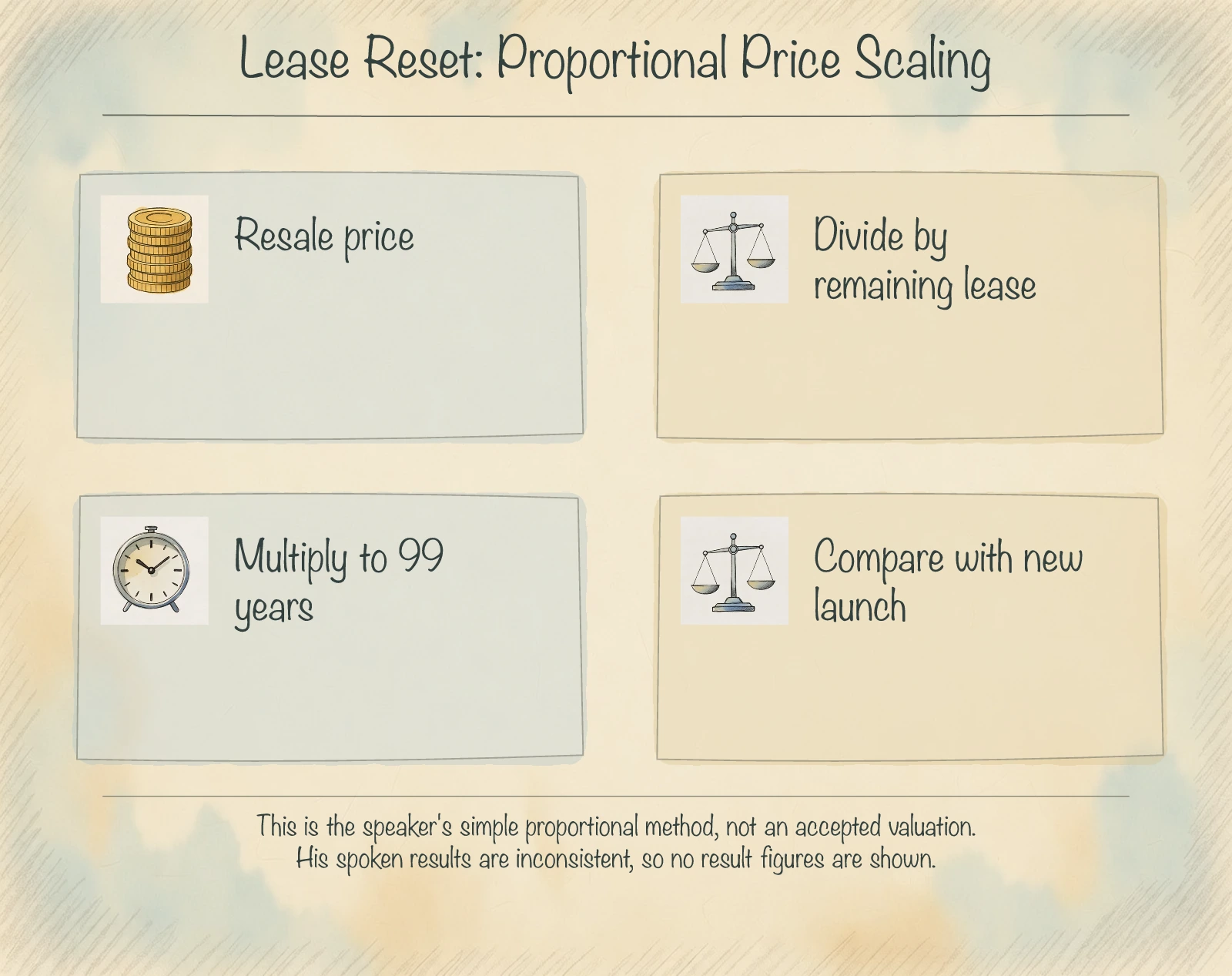
How I calculate it? I take 1.9 mil, I take the start date, I divide by the balance lease of 89 years, I multiply back to 99 years.
I'm actually paying 2,212 if this is a brand new product, and I'm paying 2,002 PSF if this is a brand new 99. So if I'm paying 2,212 and 2,215, I need to see, for example, let's say now I'm comparing with Springleaf, right?
Developers sort of says that they will launch about 2,250, or maybe bigger units might be a little bit lower, I'm not sure.
But let's say I saw a 3-bedder at 900 versus Qwafi and the quantum is about 2 million or 2.1 million, and it's the same as this guy, then I need to think, okay, is that location okay for me as a new launch product?
Of course, Springleaf has first mover advantage, first project in the whole Springleaf and Clive and all that kind of stuff, right near the MRT station. This is also very near the MRT station because this is Covern, that Springleaf, but both are also in OCR.
So I need to ask myself, actually if I buy these resales, this second-hand resale property is like a new and second-hand car; I'm still actually paying 2,212 if it's brand new and 2,215 PSF is brand new, and that at 2,250 and maybe 2.1 million is also brand new.
Three years or four years later, Springleaf is going to be a TOP. This will have a balance of 85 years and technically speaking, how do I foresee?
How do I visualize this? You have to visualize 4 years later.
You buy Stars of Coven, it's going to be 84, 85 years. Spring is going to hit TOP.
You bought that at 2.1 million, 2,250 PSF, 3-bed, 9xx square feet. This, you technically on paper you bought 1.9 but behind the scenes actually you are buying 2.1, you are buying 2.1.9 is because it's 89 years.
So if you get that disparity, you get that kind of mindset, then you need to deploy a lease reset calculation to see if it makes sense for you.
And of course, if you look at, let's say example, if you get something at 2,002 PSF and you buy something at $2 million for brand new product, then maybe you need to think about it. So, Minton as well, we did some lease reset calculations.
Similarly, if I reset the Minton, the big 3-bed is about 2.5 million. If I can get a big 3-bed, maybe at the launch now, at about 2.4 million, then I need to start to visualize what's going to happen three to four years later.
Okay, so sometimes there is an equilibrium state between resale and new launches because they usually have a very healthy gap. But what I'm seeing now in the market is that I think 2025 is a bit abnormal because of the harmonization effect and because of the motivation that developers have to clear their stock.
I think that the resale quantum is a bit too close to the new launch quantum. In fact, this year 2025, I think that new launch quantum, if they're launched correctly, it makes a lot of sense from a quantum perspective.
And I think that there's this disparity gap between new and resale. So you should really take a look at all the upcoming new launches that's coming out for this year.
Of course, not all new launches can touch. I believe every new launch will have its own audience, but when I say not all new launches can touch, I'm saying about the exact stack facing, the bed room type, the quantum perspective, whether low, mid, or high floor, based on certain quantum facing.
I think that's a quantum strategy because the quantum is very important. The quantum is what allows you to exit easier to your next audience if you can serve a bigger buyer audience next time.
So I think right now in terms of quantum, there's this very close gap between you and resale. So there's an opportunity here.
I think that when you look at this opportunity, we invest in this guy. In future, you can invest back into resale after the next round.
Example, when you do this round after you TOP when you sell, but then it could be a resale market. Next year, I believe once by the end of 2026, when a lot of the new launches are cleared out, new GLS are being launched, developer debt a bit higher, launch higher, we might hear a new high towards 2028.
And then by 2028, maybe it will be the year for resale. All right, sorry,
Weighing New Launch and Resale With Frameworks
There's a typo error here. It should be 2028.
All right, so basically, that's for today's episode. It's really to deep dive into some of the key aspects of new launch condos, because a lot of people have been asking me what are the benefits, why people buy new launch, don't look at resale.
It's not that they don't look at resale; it's that there's different pros and cons for each type. There's no right and wrong, it's just a matter of understanding the mechanics and then weighing your options using a few frameworks like the DCPP frameworks and the lease reset framework.
Of course we have a lot of other frameworks as well. If you want to get in touch with us one to one consult, just DM us, DM me, and then I'll be able to arrange something for you.
So meantime, we'll see you on the next NOTG episode and decay.