Market and policy
2026 Property Market Outlook: Key Moves Investors Must Make
Published 2026-11-24. Adapted from the episode published 2026-01-16. Figures, illustrations and data reflect the episode’s original publication date.
Cooling Measures, One-Bedders and Buyer Types
I'm worried for cooling measures because when things are too high-pup, government is very concerned. One bedroom is very easy to buy, very hard to exit.
In the past, a lot of people made money from one beta because you can buy multiple properties that have investors that own like eight one betas. Alright, but now with the limitation on names, the strategy has changed.
We are already in this world that there are central banks that are controlling the money supply. But then a lot of us don't understand why this matters to rest the investment.
And we're going to talk about what's going to happen in 2026. I think everybody is wondering how is the pricing movement going to move for condos, new launches, resale market, landed property 2026, what should be some of the key things, red flags, opportunities that we should be looking at.
How do we navigate the new pricing? How are the landed prices doing?
Is this an overheated market? Is there going to be cooling measures with the interest rates now coming to an all-time low?
What should be the strategy as well? And of course, if you have an existing property, how do we increase our portfolio?
But for this particular segment, I'm going to talk a lot about the trends for next year.
So these are some of the news articles that I will be flashing first because later on I'm going to talk about three to four main frameworks on the key things to focus as a property investor, as somebody that's looking to upgrade into the private property market, as somebody that's looking to expand your portfolio to two or three properties or you're thinking about moving to a landed market.
I'll cover broad segment but most importantly is that later I'm going to share with you a new key concept of a strategy that you can adopt if you feel that you've been priced out of the market.
After looking at all the numbers over the past month, I think that we're entering into an even more matured season that Singapore is entering because Singapore, of course, now we are about 60 odd years as a country, but we're still relatively young.
A lot of our properties that are 99 years have not even touched less than 40 years yet. But I think we're entering into a new mature season, which I am going to share with you a new strategy that we can look at.
Alright, so this year, there are more launches 2025 compared to what might come up in 2026. Alright, so 2026, some news are reporting that there are likely fewer new condo launches.
And of course, there are still plenty of balance units for properties that have been launched in 2024 and 2025. We call them the balance inventory launches.
And next year, I'm going to term it as new launches. There has also been a surge in the amount of properties above $5 million and majority are Singaporeans, which is not a new news.
I mean, this has been very common ever since we had a 60% ABSD in the year 2024.
$5 million in Prime District CCR largely. So from July to September, in this three months, Singaporeans bought 130 out of 171 luxury homes.
The rest, of course, we don't have the numbers, but likely it should be PRs. Minority foreigners, now foreigners has been trading at less than 1% of the overall residential transactions.
So let's have a look at the screen. And of course, a lot of people have also been talking about property agents are actually buying up a lot of the launches as well in these last few months.
And landed property continue to do well. In fact, terraced homes are the one that's been absorbed very, very quickly.
I have also got our research in the tablet, the price movement quantum of all types of landed properties from the year 2020 all the way to 2025.
And this is something that I think we should be aware of because even though there's a lot of hype up news in the market for new launches, but then when property owners try to exit from their current property in the retail market, they are facing so-called difficulty longer waiting time because a lot of the attention have been shifted to new launches.
That means if we look at this screen, let's come to this here because the buyer pool is technically the same. When we look at the buyer pool, their decision is always, what kind of property should I go for?
Should I go for landed? Should I go for condo?
Should I go for HDB? But let's not talk about HDB.
Let's say somebody is very determined to go for a private property market. They'll look at this.
But then this is bounded by the quantum investment range that they have, which it depends, let's say if somebody has $5 million, they have a choice to go for prime condo or landed property. If they have less than $3 million, they have $2 million, they have $1.5 million, then naturally they will look at condominiums.
Loan Limits, Down Payments and Bigger Units
Because this is then determined by the amount of loan that they can take. So it's determined by loan, which is determined by their TDSR, total debt servicing ratio qualification, which is also determined by their income and also their age, because that affects the TDSR plus their debt liability.
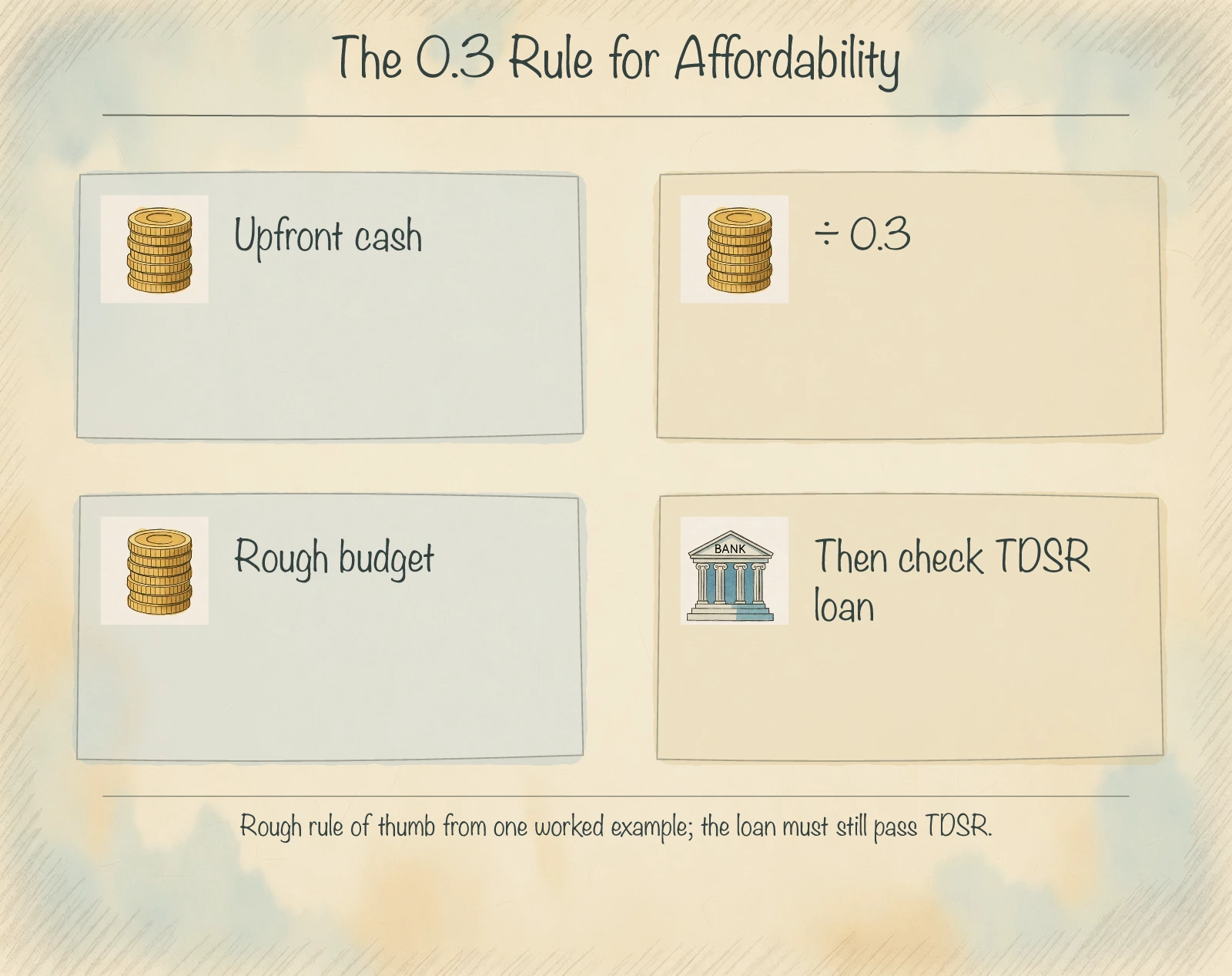
And it's also determined by the amount of down payment capital that they have. Now, a very simple calculation is that we always use the 0.3 calculation, 0.3, alright?
Meaning 30%, because this is about 25% down payment, and then about 5% for buyer's stamp duty. Buyer's stamp duty is 4 to 6%, but just for broad-based calculation's sake, we just round it up to about 5% plus minus.
Okay. And then all is about 30%.
So for example, if somebody has 500,000, just take it divide by 0.3, that's going to bring us to about $1.66 million. All right.
So this will be the rough quantum that this person can afford. And now from there, then we see whether this person can take a loan.
All right, because if they want to buy something at $1.66 million, 25% is down payment. 75% is the loan that the bank needs to loan to them.
So from there, then we calculate, alright, 75%, how much is needed is about roughly $1.2 million. And then we see whether TDSR is so-called like, whether the person passed the TDSR or not.
So when we thread back to this, the buyers pool, firstly, they look at the type of property that they want to invest, then they look at their capability to loan plus the down payment that they have. But then this group of buyers has only two pool.
One is that these are people that have already sold their existing property. There are also people that are still selling.
There are also people that are pondering, that means they are exploring, but they haven't even started selling yet, not yet sold their existing property, not yet decoupled or anything. They're also first time buyers.
So basically the buyers pool are roughly these three to four groups of buyers. And naturally, when there's a lot of launches now, new launches,
the new launches in the year 2025, it's going to see font off, all right, it's going to absorb a lot of the attention of this group of buyers to look at new launches, right, and the resale market.
I give an example, for example, you look at some of the launches this year, there are three-bedder, quantum is roughly the same as a lot of the three-bedder quantum in the resale market in the TOP condo market. The rationale is because this is the year that we are starting to see the harmonization effect taking action.
Now harmonization, it was introduced in 2024, a lot of people were worried, what harmonization means that new launches PSF go shoot up, but then it became an advantage for developers because with the smaller size, they can control the price quantum and they bid for the land at a more conservative pricing in the year 2023 and 2024.
So this year is a combination of lower PSF plus smaller sizes, which made the
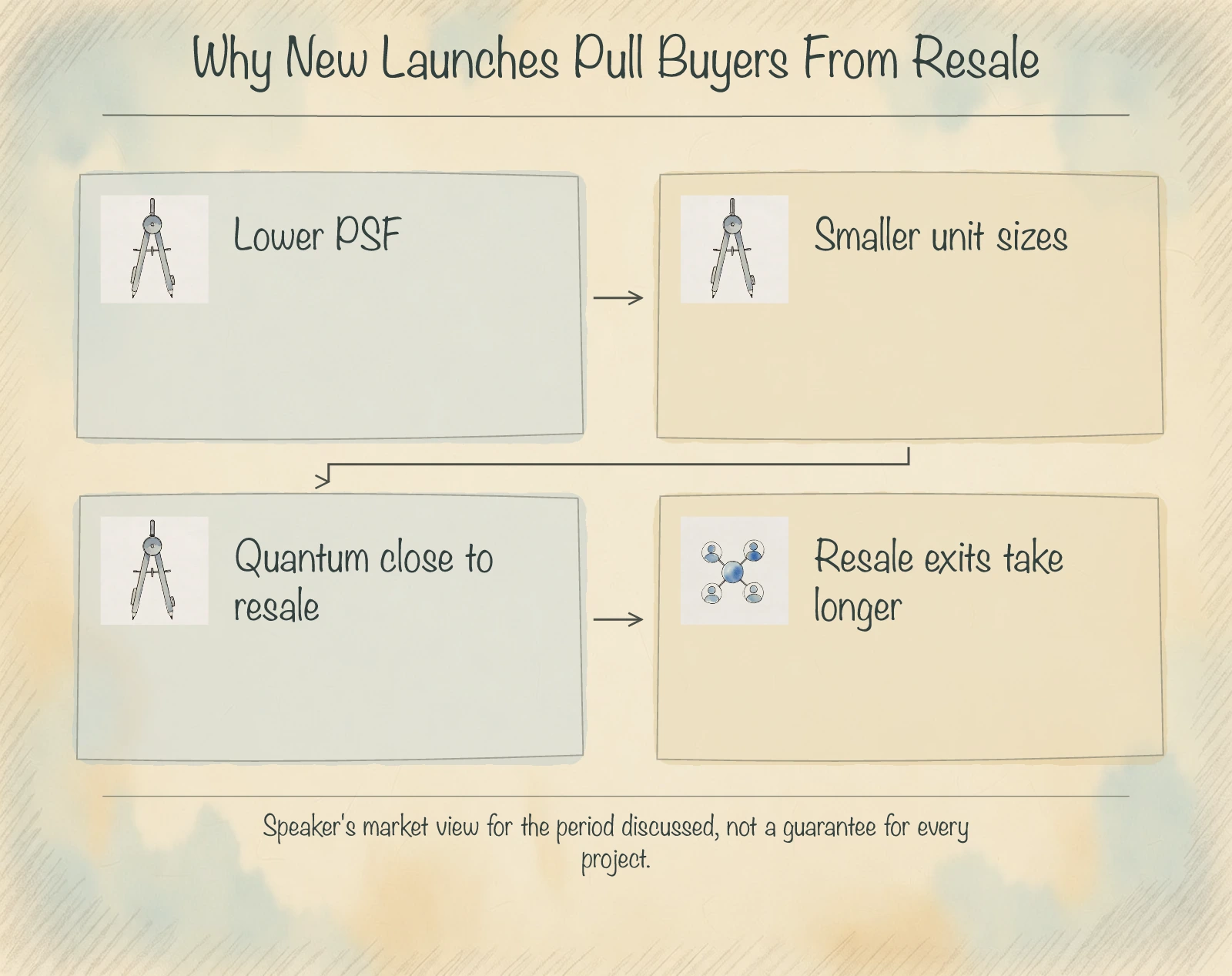
quantum about the same as a lot of resale condos. And that is why a lot of the resale owners now face difficulty in exiting.
All right. And that's one of the reasons why I think this article has shown like some reports about property agents taking a lot more time, months rather than weeks to sell properties for their clients down.
Transaction volumes for resale condos has also dropped. This is largely due to the attraction effect of the new launches.
Average price of resale condos overall, it says that there's a date but later we're going to analyze deep into numbers. Now take note when you see charts like this, this represents median price across the whole island.
It does not reflect on a deep level. The way to look at it is to break it down to district level, to bedroom types, because sometimes we see news like this, we think that market is going down, actually it's not all right, is because there are certain districts and their whole basket affects the overall trending, okay.
These are some of the photo images which I've shared in our previous webinar that I'm worried for cooling measures because when things are too high-pitched government is very concerned. Okay.
And then of course, yeah, basically increasing rease of fierce beating for land and government action. And in fact, this year, and towards next year, I believe that developers are very hungry for land.
I'm going to show some charts as well. And small condos, they draw steady demand, they're harder to sell now.
I have talked about this for a lot of times because of the demographic change of the TDSR and cooling measures is making every buyer to think about going for bigger units. That means with this amount of content, let's say I got 1.5, 2 million, 2.5, 3 million dollars.
How can I get more bang for bucks? That means like, how can I get more bedroom types?
How can I get one more bedroom? How can I get a four-bedder?
How can I get a penthouse? Can I get at least like a two plus study?
Can I get more bedrooms for
One-Bedder Strategy and Money Supply
Or my overall content, because the name is so precious.
And I've shared a lot of times as well, is that unless you are renting and you have less than a million dollars or a million plus and you die die want to go for a one-bedder new launch, then of course, by all means go ahead, because life is not all about making money.
It's also about your utility value. And you are already renting, you better buy, come back to rent, because in Singapore nine out of 10 people own properties.
If you are a rental, you will be priced up as money supply increase. I'm going to talk about money supply as well.
And one bedroom is very easy to buy, very hard to exit. In the past 18 years back, one bedroom is the king.
A lot of people made money from one-bedder because you can buy multiple properties. I have investors that own like eight one-bedders.
But now, with the limitation on names, the strategy has changed.
Naturally, people are going for three, four bedders by default. It's very easy to walk in a show flat and buy one bedder, but therefore, if you want to sell, you find that it's a lot of difficulty to sell.
Some projects that have TOP this year, the whole property group is flooded with one bedders. So you just need to be very clear about the strategy.
There's nothing wrong with buying one bedder because certain of clients that are in, let's say, a winter season, and let's say they have a limitation of their investment range, they just want to buy one bedder to collect rental income.
Nothing wrong with that. It's doable.
And it's very easy to rent. It's just that when you want to exit, you take a longer time to find a buyer because somehow buyers love to go for new launches when it comes to one bedder.
All right. Now, this is the chart that's been talked about every year.
I will talk about this chart every year to look at the behavior of developers. I will put in my comments here.
So far, it has sort of come to fruition based on my projection. I don't have the crystal ball, but just based on this behavior, we can combine two main factors.
Number one, I always look at this blue graph. That means how many units are going to be completed that year by developers.
The higher the blue bar, it means that more condos are going to reach completion. Developers are going to complete handover.
And when they forecast that they need to handover, they will bid for more land because they need to top up their land bank. And they have more cash as well, more liquidity when projects are being completed at TOP.
Number two, I always look at the movement of the Fed interest rate. That means, is the Federal Reserve hawkish or dovish?
That means, is the Federal Reserve lowering interest rate or increasing interest rate? That means, is QT happening or QE happening, quantitative tightening or quantitative easing.
And all these are closely related. What do we mean by this?
Alright, when we talk about QT means tightening, QE means easing, quantitative easing. This means that money supply will so-called be stagnated, money supply will expand.
Now, this is also related to interest rate dropping, interest rate rising. Now, all these are related.
There's no way you can drop interest rate without increasing money supply. The only way that this has to happen is that for money supply to increase, interest rate must drop.
This is a direct relationship. It's just like a formula.
It's just a formula that we call this a debt-based economy. We call this an inflation driven economy, which is an economics term, which is that because we are under the Keynesian economic theory where we want inflation to happen.
But there's a whole new topic about inflation or deflation. But then once you, I mean, we are already in this world that there are central banks that are controlling the money supply, but then a lot of us don't understand why this matters to our investment.
Because the moment you see money supply increase, it means that prices of assets are going to be inflated again.
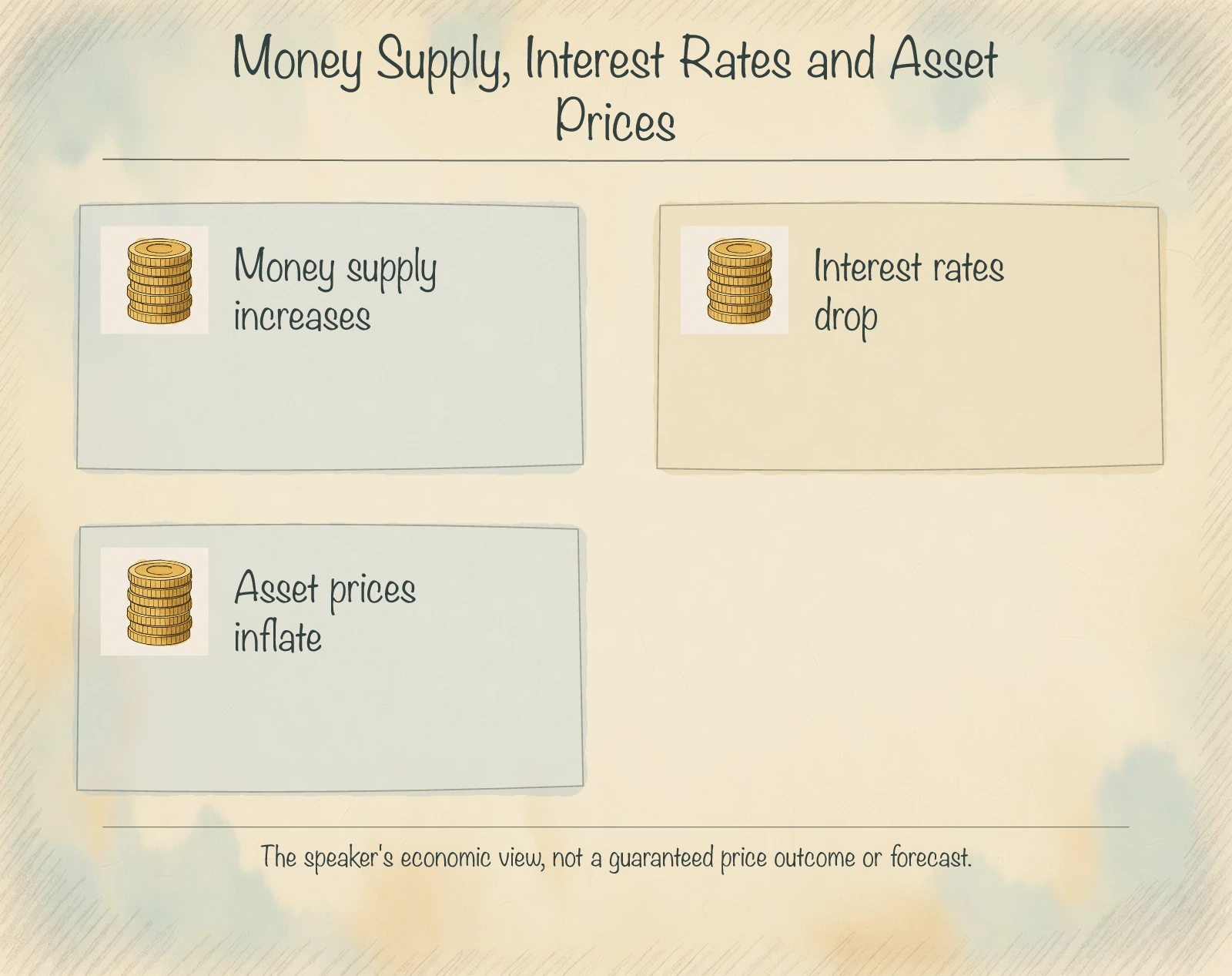
And it's going to inflate very quickly every time this happens. And if we're not cautious, we don't know about this, we will be priced out.
So some people, they always think that the market is going to come down. But in the inflated world, whereby we're under the Keynesian economic theory of central banks, there's no way the asset prices will come down.
Asset prices will only be inflated because stock market is going to be inflated. Now there's cryptocurrency, things are even faster.
And then asset prices is always a safe haven. When we talk about assets, we're talking about real estate.
And we're talking about gold. And these two items will always be inflated because the S&P 500 will also be inflated, and the money has to go somewhere.
So that is the reason why when you talk to your parents, just a very simple calculation is to ask them how much did they buy their properties for.
Old Property Prices Show Weakening Money
For example, my mom bought her HDB for $9,884. She bought her 4-room flat for $60,000.
Now, even though this property is old, we're in the year 2025. This is already like how many years already, all right, about 40 years, coming to 40 years, balance is about 50-odd years.
This is now worth about $600,000. Okay, so it has appreciated by 10 times, this HDB.
But of course, when we look at condos back then in the 1980s, all right, you can buy the condo. Of course, there was a crash in 1997 Asian financial crisis, but then back then, maybe about $400,000.
Okay. Now, this guy probably is about $2.5 million.
Back then, maybe a landed property, probably $600,000. Okay.
Now, this guy $4.5 million. Okay.
So, these are the different types of properties that has blown up. But then we have to understand one thing, is that the properties are the same, in the same location.
And the properties has H. So this property is getting older, but then the price is increasing.
The reason this is increasing is because the money is eroding in purchasing power. Because they keep printing money.
So when you keep printing money, though the amount of properties is the same, even though of course we can argue different factors about building more properties and stuff like that, but that's a totally different thing. But the main issue is that the money is weakening.
That's why you need more units of the money to buy back the same thing, even though this is the older property. So these are not new properties.
These are older properties. So the properties has H, but then you need more units to buy back the same thing.
That is the effect of money supply increase. Ready?
Soundcheck. Test 1, 2, 3.
Good to go. Okay.