Evaluating property
11 Key Factors That Drive The Allure of New Launch Condos!
Published 2026-11-20. Adapted from the episode published 2024-05-24. Figures, illustrations and data reflect the episode’s original publication date.
Why New Launches Stay Popular Monthly
It's a new day with it, huh? Can, I've prepared the skin.
My hair is very slow. Alright, so welcome back to our NOTG.
Today we're going to kick start a new series which is called the White Bought Series. I hope you like a little bit of my graffiti drawing.
I used to draw that a lot during my secondary school days. So we're going to talk about this topic called New Launches.
We're going to talk about some of the key pointers on why new launches remain very popular with home buyers on a month-to-month basis, because if you look at our transaction volume across the last many many years, every single month private property condos and apartment transactions, about 50% are done by new launch projects and another 50% by resale transactions.
So usually on a year-to-year basis sometimes resale will have a little bit more share; perhaps that year there were fewer launches that were being launched by developers, fewer government land sales as well. On the average, let's say on the past 10 year.
Median kind of like a trajectory, most of the time 50% of every month or every quarter's transactions are done by new launch, 50% by resale. So why is it that new launches continue to be so popular and what are some of the key factors that new launches present that attract buyers most of the time?
Today we're going to go through 1, 2, 3, 4, 5, 6, 7, 8, 9, 10, 11 factors all in together. I'm going to do a quick summary for everybody so that you will know what are some of the attraction factors that new launch remains very popular.
Let's kick start with the first one of course. I'm going to talk about the most important one.
This one I will rate it as triple star and this is called the TOP effect. You might have watched our previous NOTG, I talked about TOP effect before during banter as well.
I talked about TOP effect. However, it's very important to understand this main concept.
Take note, this does not apply to all new launches. Some new launches do not enjoy the TOP effect.
You need to reference back to another topic that I talked about before, which is called the volume effect. And these two are correlated.
I'll draw two arrows right here. Let's talk about a TOP effect in terms of its usual psychology.
Take note, when you buy into a project it's also a little bit like a human psychology game. You need to understand firstly what are some of the mechanics to let this TOP effect work.
Now if this works for the project that you bought into, what is going to happen is that when you collect your keys 3 to 4 years later, you have a higher chance to see an instant jump in your appreciation of the property that you just purchased.
Let me just give you an example of usually how a TOP effect works. So for example, this year, 2024, you decided to go and buy a project that has 474 units.
And this is a brand new project, just launched this year. Let's assume that in terms of construction, it's on pace.
It takes three years to complete. Maybe on paper, it puts 2028, but 2027, you receive the letter from your law firm and say, hey, congratulations, you can go and collect your keys.
And let's say, when at 2024, you bought the property in the range of 2000 to 2004. And let's say for example, your particular unit you bought at 2200 PSF.
But, averagely, all the rest of the owners bought at 2000-2004. Why are there differences?
It's because sometimes bigger units are lower in PSF, smaller units like 1-bedder higher in PSF. That's usually how developers price their PSF level.
Units that have a better facing, higher PSF, higher floor, also higher PSF. And then lower floor, poorer facing lower PSF.
That's all very common. That's how developers and architects will position the unit.
There must be a give and take; if not the buyers will not absorb the unit.
So let's say you bought at 2002, the rest of the neighbors all bought at 2000 and 2004 but let's assume you bought a 3-bedder and all the 3-bedder owners bought roughly plus minus 2002. What is going to happen three years later assuming that this project sold out?
So it takes maybe the next 1 to 2 years to sell out and then by 2026, the last unit is sold already.
Take note that most of the time as you move along, once they are balanced units, the developers have achieved most of their listing, sometimes they might raise the price, sometimes they might maintain, but let's say they clear out everything by 2026.
The important thing is what is the human psychology of all the 474 owners at 2027. This is what we call the TOP effect.
So the good thing about a new launch is that everybody bought at around the same price. There's not much variation.
You will not get somebody that bought $1000 PSF unlike a resale project.
Aligned Owners and the Domino Effect
Because the resale project might have existed for 20 years. Some people might have bought $600 per square foot, but recently somebody might have bought at 2000 PSF.
So you will not get that kind of variation. You will only get very rough plus minus range.
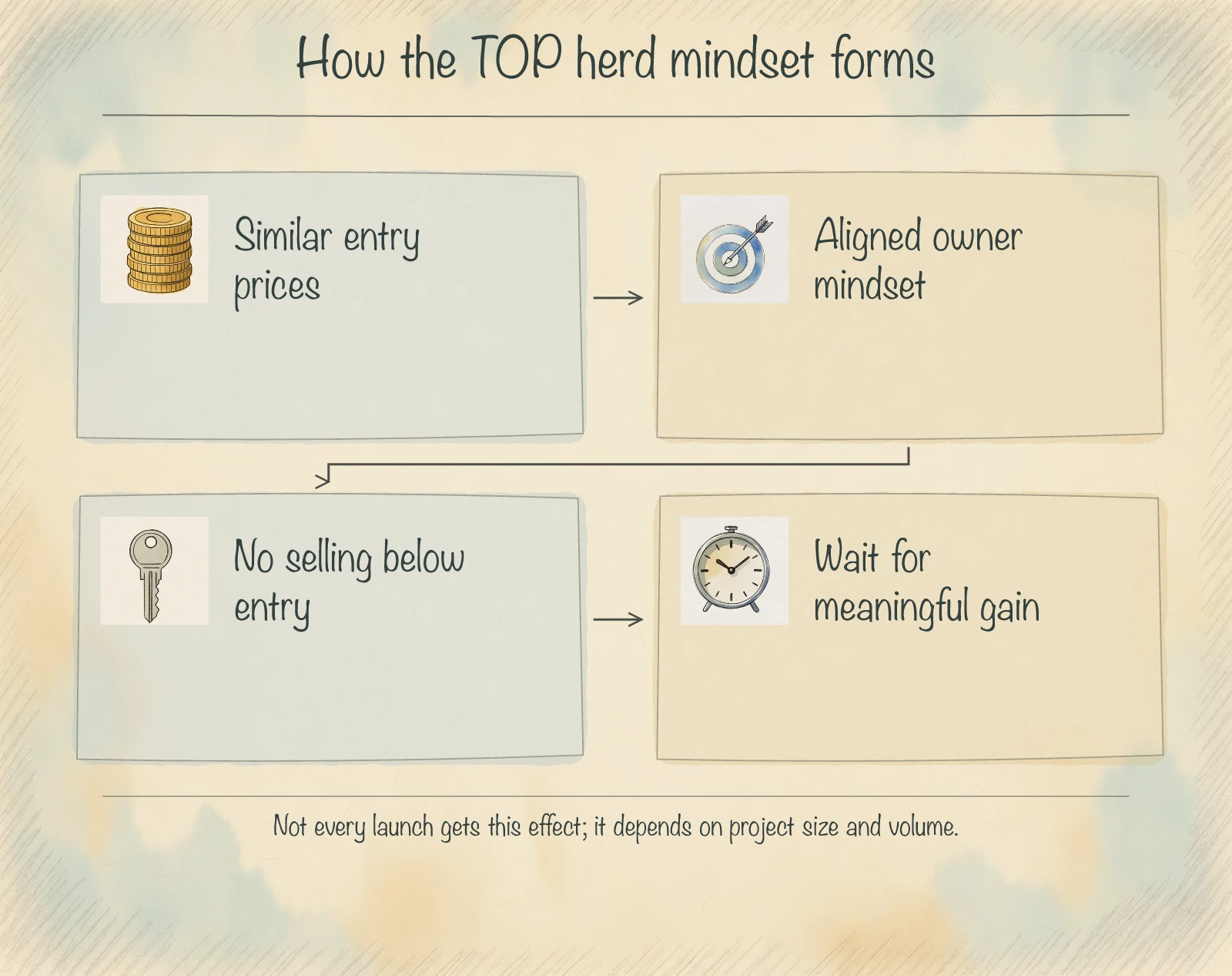
The mindset of all the 474 owners over here is going to align, and this is what we call the Hurt Mentality. Hurt mentality is in the sense that everybody is in it together.
Everybody bought in at about 2000 to 2004 PSF. What is going to happen is that nobody will logically undersell the price that they purchased in.
That means if I bought at 2002, I will never sell below 2002. The 474 buyers that bought back then, now they become owners.
Their mindset is all aligned. Nobody logically will sell at $1500 per square feet.
Nobody. And actually what's going to happen is that this project during the key collection month is going to be flooded by agents.
So a lot of agents will be there offering their services.
Hey, do you want to sell? Do you want to rent out?
I can help you and things like that. That is very common.
But what is going to happen is that the mindset is that number one, I want to move in. Number two, I want to rent out.
Number three, if I want to sell, I will not sell below my entry price. It must be above my entry price.
And likely for me to make sense, because I've already waited three years already. Why should I sell back at the same price?
I might as well just rent it out. I can collect rent.
I'm just moving in. Just enjoy the brand new property.
So, minimally to attract me to sell, maybe I would think okay, I'm buying something at about a thousand square feet, it's a 3-bedder. If I want to sell, it must be at least plus $300 per square feet.
So, I bought at 2002 PSF, if no 2005, don't come and talk to me. Most of the time, most owners will think like this.
It must be a meaningful exercise and a meaningful price for me to make sense to sell. That means if I don't see $300,000 in terms of additional movement on top of my purchase price.
So let's say I bought in at 2.2 million. If I don't see 2.5 million, I don't think it's meaningful.
Why? Take note, I have paid interest over progressive payment over the last 3 years.
I also paid buyer stamp duty. It's not a small amount.
Buyer stamp duty of 2.2 million is easily close to about 80 over 1000 or 70 over 1000 plus minus. And then now I still have to pay commission.
All in is about 100,000 already. If I don't see 300,000 on top of my purchase price, because I less off my cost, maybe my profit is 200,000.
And because of this, if there's no plus 300 dollars per square foot, the seller will not be motivated to sell. So what I've just mentioned is that this is just one of the owners.
But what is going to happen is that all of the owners will think like this. They are all aligned invisibly.
Maybe some people will think, hey, there's no plus $500 I don't want to sell. Some people will think $300.
Maybe some people will think $250 PSF. Maybe some people will think at minimum, I must see a plus 400 PSF, I don't want to sell.
But they are all aligned that they will not sell below their purchase price, they want to see a profit. So that is what we call a TOP effect.
And you only get to enjoy this once when you collect your keys. There's no need to hold a board meeting with 447 people gathering at the pool and say, hey, let's all align to sell at least above 300.
No need. Everybody automatically will think like this.
Of course, when one person achieves, they collect their keys, they can sell and they exit and they successfully achieve maybe plus $300 per square feet.
Just an example, what's going to happen to the entire valuation of this project is that once the transaction starts to be lodged and coveted and it becomes public information on all the platforms, then you will see a transaction that is being done with 2005 PSF.
You will see that somebody bought 2002, 3 years later they sold at 2005. And this is going to help the entire project's valuation benchmark.
So once this benchmark is set, what's going to happen is that it will start to see what we call a domino effect.
A domino effect is when, oh I saw somebody just transacted my neighbor at that stack, 3-bedder sold at 2005, oh I'm slightly higher floor, I think I'm a better face, if I don't see 2006 I don't want to sell.
Once the entire domino effect starts moving, the transaction starts clocking in, the valuation will see a more sticky benchmark at the new range. And when somebody else wants to sell in this development, when they call their bankers,
Three-Year TOP Effect and Progressive Instalments
It's easier for their banks and their valuers to give them the valuation based on the latest benchmark. And that's how you see a one-off search in terms of the entry price.
Three years later, you see that range. So this is what we call a three-year TOP effect.
And you only enjoy this largely for new launches, and largely for new launches with more density, meaning that there are more volume and more units involved. So I'm spending a little bit more time on the first one is because this TOP effect is a very major thing.
Let's move on to the second point. What is a third exit audience?
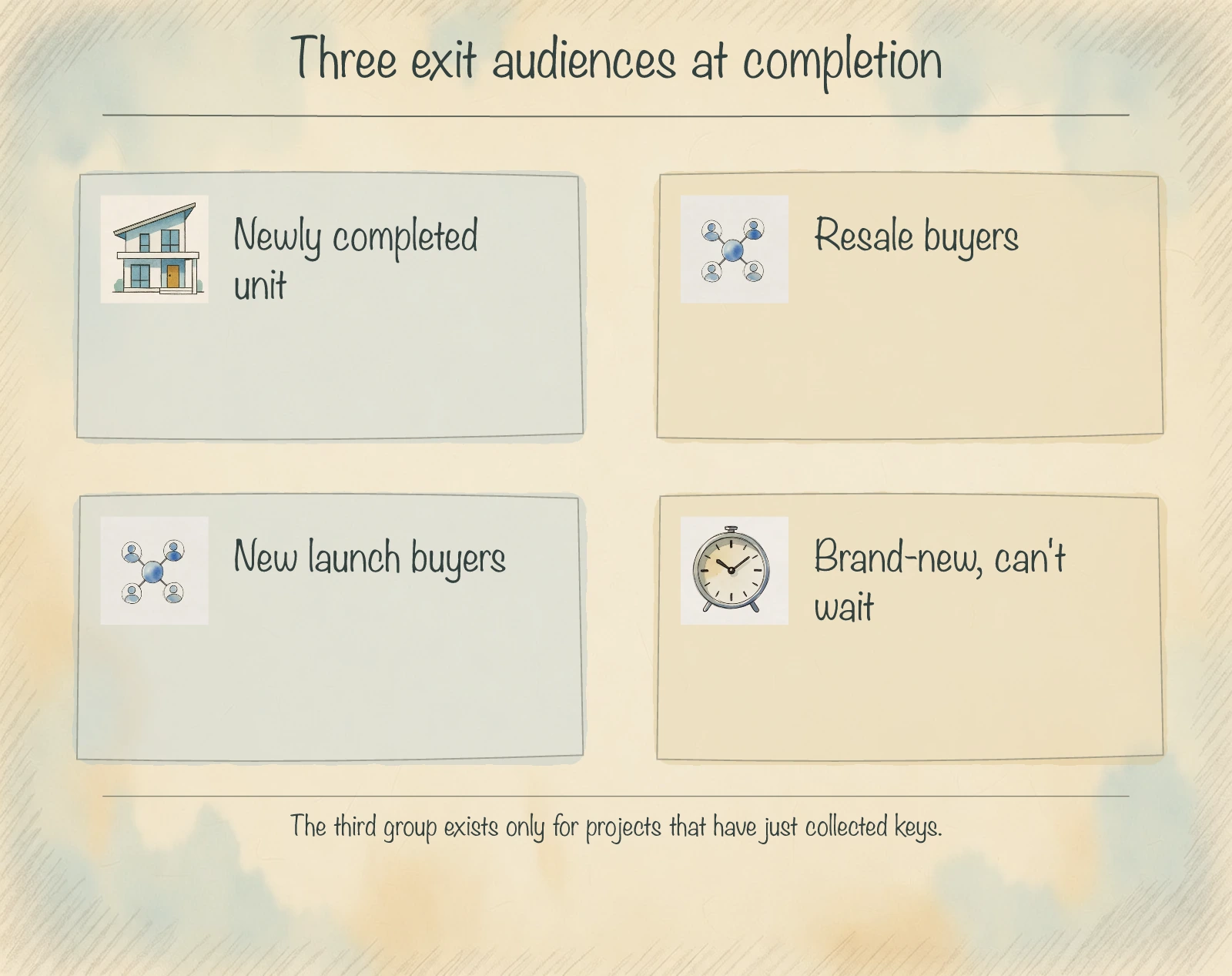
When you want to sell your property, you have three audiences. But the three audiences only exist if it's a brand new project that has just completed, and we call it the TOP bias.
Because if you own any condominiums, you can only sell to buyers that want to buy resale condos, so we call them resale buyers. You cannot sell to people who want to really just buy new launch condos.
Well, some buyers really just want to buy new launch. Why?
Because they have a personal preference that they do not want to have a property that some people stayed before. They don't want a property with history.
They don't want a property that other people have used before. They want a brand new product.
The third group are the people that cannot wait. Because this one you have to wait 3 to 4 years.
This one you can move in immediately. They also want brand new.
They have the same preference as the new launch buyers but they do not want to wait. And thus, this group exists for projects that just collected keys.
So that is also the reason why some people like to buy new launch for investment is because they want to leverage on this particular group. They want to be able to sell because you can sell to an additional group compared to just selling to resale condo buyers.
Alright, so I talked about the first point, TOP effect. Second point is third exit audience.
Let me move on. SSD is now 3 years.
It used to be 4 years. It has been reduced to 3 years by the government.
Once you purchase a property, 2024, you must be ready that there's a blackout period. And what is this blackout period?
It's that, for the next 3 years, don't think of selling. Because if you sell, you make a loss.
What loss do you make? Firstly, you already paid buyer's stamp duty.
You pay 4% to 6%. Alright?
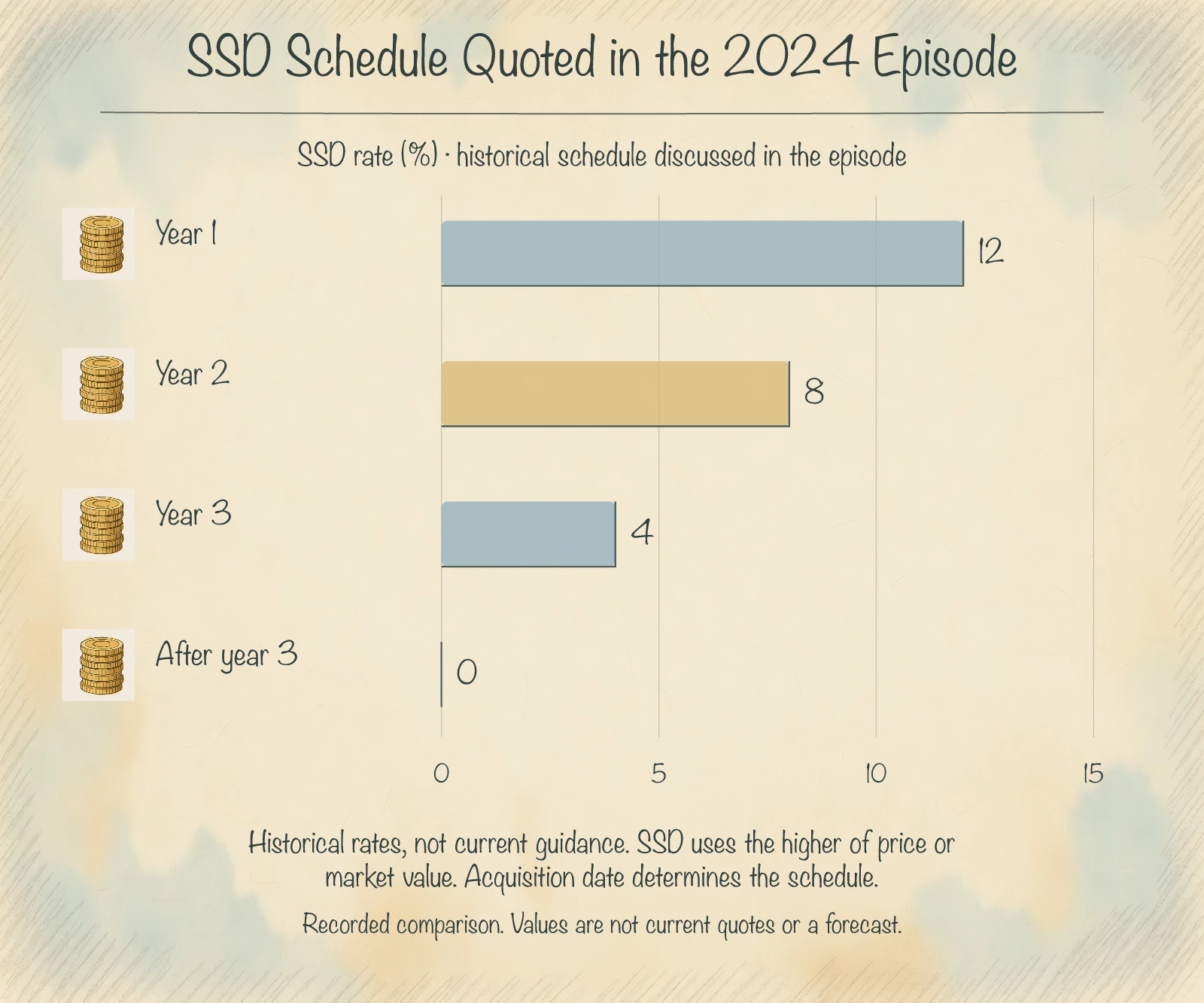
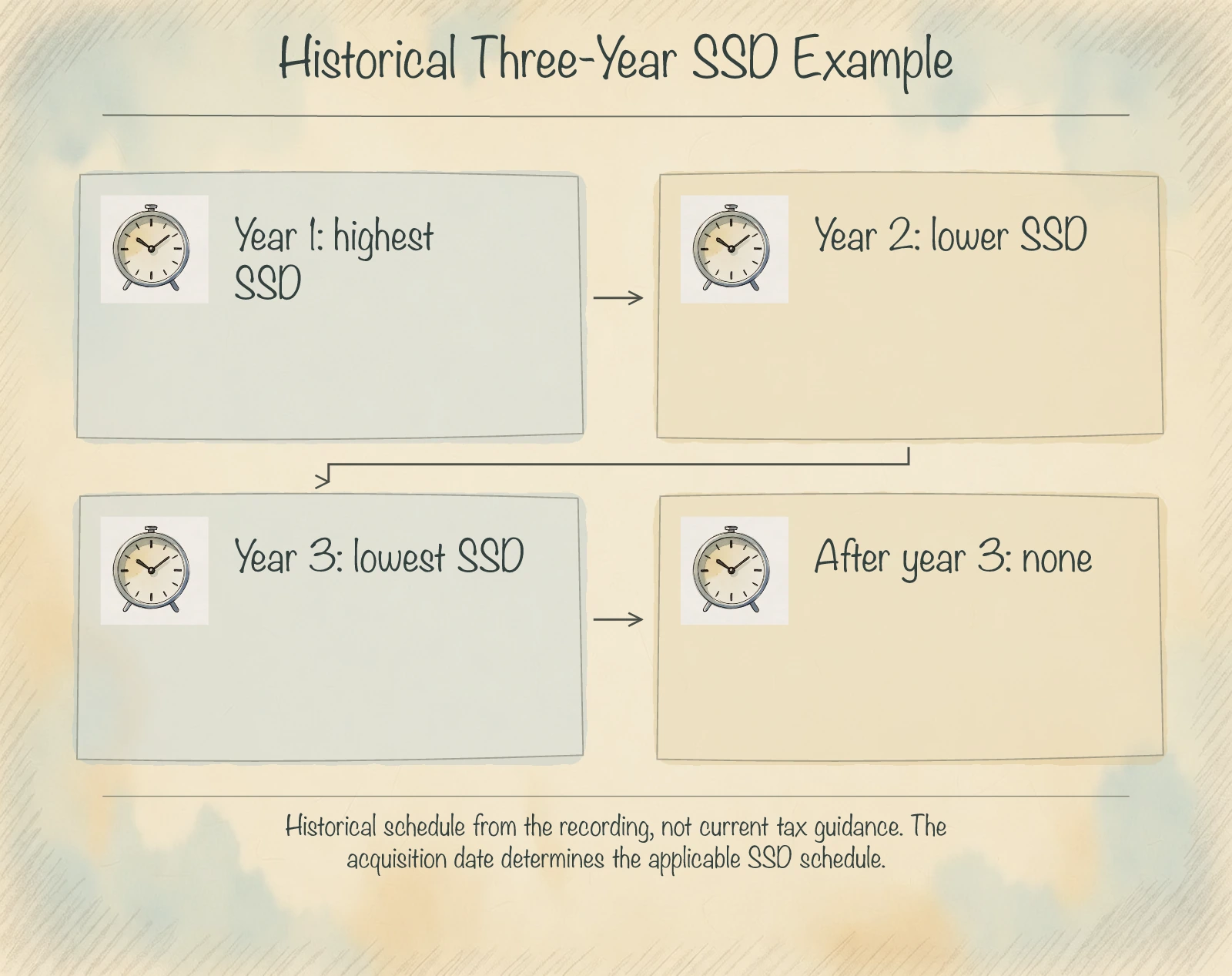
And then now if you sell within 3 years, the first year you have to pay an additional 12% seller stamp duty on your sale price. You sell within the second year is 8%.
You sell before the third year ends is 4%. At the end of the third year, when you sell, that's 0%.
You don't have to pay any seller stamp duty. So every buyer now is very clear of this.
Read chart values
historical schedule discussed in the episode · SSD rate (%)
| Comparison | SSD rate (%) |
|---|---|
| Year 1 | 12 |
| Year 2 | 8 |
| Year 3 | 4 |
| After year 3 | 0 |
I buy a property, now I have to make sure I can only think about selling in 2027, if not I have to suffer pain to sell a stamp duty. So this is what we call the blackout period.
That means during these three years, there's no need to think about selling, just make sure you have the ability to hold. If you don't have the ability or confidence to hold, don't get into the property.
So what this means is also that a lot of buyers think that a new launch is just nice because the construction period is 3 to 4 years.
So by the time at the close of an eye, I buy now, I pay 5% and then 20% by a stamp duty, I sign a loan, I start progressive payment for my installment. Three years later, I just go and collect the keys.
And when I collect the keys, I can decide. I can decide if I want to move in, I want to rent out or if I want to sell, I also can sell.
So it's a very easy kind of decision.
Alright, now next, progressive payment very clear cut, very simple. So compare new launch and resale, basically the setup is the same.
You pay 5% cash, 20% CPF, you pay buyer stamp duty. Here is also the same.
Alright, 520 buyer stamp duty, you sign your loan. So you need to sign your L.O.
letter or offer. You sign already.
Here, immediately, three months later, depending on your completion period, it can be 8 to 12 weeks or 16 weeks. After that, your installment kickstart is one month later.
Alright, so your installment at the full amount, P plus I, principal plus interest, kickstart at the full amount. Over here, what is going to happen is that it's based on stages.
Maybe at the first part, you pay based on 5% release and then it will just gradually move all the way until TOP you collect keys, and then basically your installment is progressive, maybe you'll start off with $600 and then you move to $1,000, then it moves to $1,200, then it becomes like $2,000
Staged Payments and Renovation Cost Awareness
Then it becomes like $2,300 and at the point of your collecting of keys at TOP it's still not the full amount - maybe you're paying $3,000 - but one year later, once you hit CSC stage, Certificate of Statutory Completion, which is the full completion, then you pay your full instalment amount.
Maybe by the time it's $4,000. So what happens is that when you pay progressively, your interest is also lower because you're paying what the bank has dispersed to the developer for you.
It's paying based on the construction stage. Your instalment is lower and most of the time a lot of buyers love it is because the starting point is that the instalments are low, it's all fully paid by CPF, and then they can still have time to build out their CPF and their cash savings.
They don't really have to top out cash at this point in time. And when they collect their keys, when they start renting out, they still get to enjoy 6-12 months at a lower instalment, before they pay the full actual instalments.
So that's why a lot of buyers love progressive payments. It takes stress out rather than comparing to a resale.
So immediately three months later, I have to take the keys. Start to spend time on renovation.
Maybe I need to spend three to four months to renovate and then these three to four months I pay in instalment, I cannot move in yet. I have to rent somewhere, I'll stay with my parents and then after that I move in.
Or if they want to rent out, maybe they have to spend one month to touch up, get in the furniture and stuff. Then spend another one month to advertise and find a tenant and then at the third month, they have already paid about two months of instalment and then they'll start to rent out.
So this is basically the mindset of new launch bias. All right, now moving on to renovation, renovation comparing a new condo versus a resale condo.
Nowadays you go to renovate a BTO
it's already, don't know how much already - a lot of my friends will marry later recently as they share me their renovation cost is like oh my goodness. Of course during COVID everything escalated in terms of manpower cost but now is the material cost.
A BTO you get a 4-room renovate easily $50,000 and this is not including basically the appliances, it's just renovation carpentry. All drops, install aircon and then do a TV console a bit of maybe stuff here in their cabinetry, shoe cabinetry then.
And if they didn't opt for kitchen cabinets, they have to do it themselves. If they opt for it, they have to top up a little bit sometimes.
Plus minus, add in your aircon. Some appliances is easily more than that.
It's about 50 to 70 thousand sometimes, depending on the design. Resale even more.
If you buy a five-room, you need to prepare at least 100 thousand. Because sometimes you have to do guard renovation.
Even if you're safe, caused by overlaying tiles and stuff like that,
things are not cheap nowadays. So when it comes to the psychology of condos, resale condo and new launch is the same.
However, new launch as a key benefit is that a lot of things are inside already. So the developer helps you to install the aircon is given, it's part of the price that you pay.
All the wardrobes are in, all the kitchen, carpentry, your fittings, your appliances, aircon everything is done already. Only thing you need to do, your curtains or blinds and then your lights.
Some projects now, they do lights for you. Some projects they give you a free ceiling and stuff like that.
But by and large, you only need to do these two things. If you want to renovate it until very nicely, actually 50,000 can make it into like a designer rental already.
But technically you don't need to spend that kind of money. Just bring nice furniture, movable, you can shift around, you can bring to your next home and you don't really have to worry about the renovation cost.
So
a lot of buyers love new launch condos because once they move in immediately, they can save costs. Just spend on furniture and lights and curtains.
Actually, I just want to share with you one thing as well. You know, sometimes when we do renovation, because when we bought a new house, we are very excited, all right?
And there's a lot of emotion. Oh, my new home, I want to make it look nice.
I'm really thinking about house warming, who should I invite and stuff. And of course, I want to congratulate you that a new home is a good thing and you're starting to build your family.
But take a little bit of note on actually the percentage of renovation vis-a-vis your purchase price. Because sometimes you see, if I look at a condominium, you buy maybe a 3-bedder in the OCR district, maybe for $1.4 million.
You invest $400,000 on the designer renovation. This is how many percent on top of your purchase price.
It's actually about 30% of your purchase price.
Break-Even Costs and Resale COV Risk
And technically your total break even now is 1.8 million excluding your buyer's stamp duty and stuff like that. So take note of the amount you're investing.
Sometimes when you buy a HDB resale, let's say you buy a 5 room 800,000 and you spend 200,000 on rental, your break even is already 1 million. This is 25% of your total purchase price which is actually quite a hefty amount.
So try to take note of this quantity because sometimes we just don't see it. You don't know that actually you're just adding up to your break even cost.
So next time when you want to sell, basically you will feel the hey why is it that when I sell I don't see money back.
Now let me come to a defect warranty. Defect warranty is another beauty because the developer give you one year defect warranty.
Usually take note when you collect the keys, ding dong a little bit here and there. Once you collect keys usually you need to set aside about one month if there are defects and let's say you've got professional help they come in and paste all the stickers and all that as you pay only 100 stickers.
What's going to happen is that you will ding dong one to two months, book a partner developer, they will kind of rectify the defects.
All right provided the defects are not heavy duty defects like there's like issues with the floor trap and stuff like that but if it just like cracks here and there maybe within the month you can settle then after that you can start your rental.
Do not start your rental before the defects are rectified because after you start rental the defects will not be rectified anymore because there will be a lot of like your back and forth developers will think that all is because of a rental, that's why all these defects came out.
So you must settle your defects before that. But by and large, you enjoy one year defect warranty.
To read that one year, anything that malfunctions or spoils and all that, you can actually go back to the developer.
So let's go to one more thing. One year delayed installment.
I'm talking about a part of progressive payment. So remember just now I was talking about the part that once you hit TOP, you're paying your installment, but this is not the full amount.
Why? Because there's still a portion percentage that's not dispersed.
And usually six to 12 months later, you will hit your statutory completion date. So this is called a certificate of statutory completion.
Then you will pay your full installment. So technically a lot of buyers also like this because if they buy this to rent out, they can actually get so-called like extra arbitrage and leverage over here.
They're not paying the full installment yet while they are already renting out the unit for this 6 to 12 months period or let's say they move in they're still paying a lower installment.
Also in Singapore when new launches are being launched there's no COV compared to the resale condo market. So what is this thing maybe if you have not sold a property you wouldn't know about this or you have not bought a resale you wouldn't know about this.
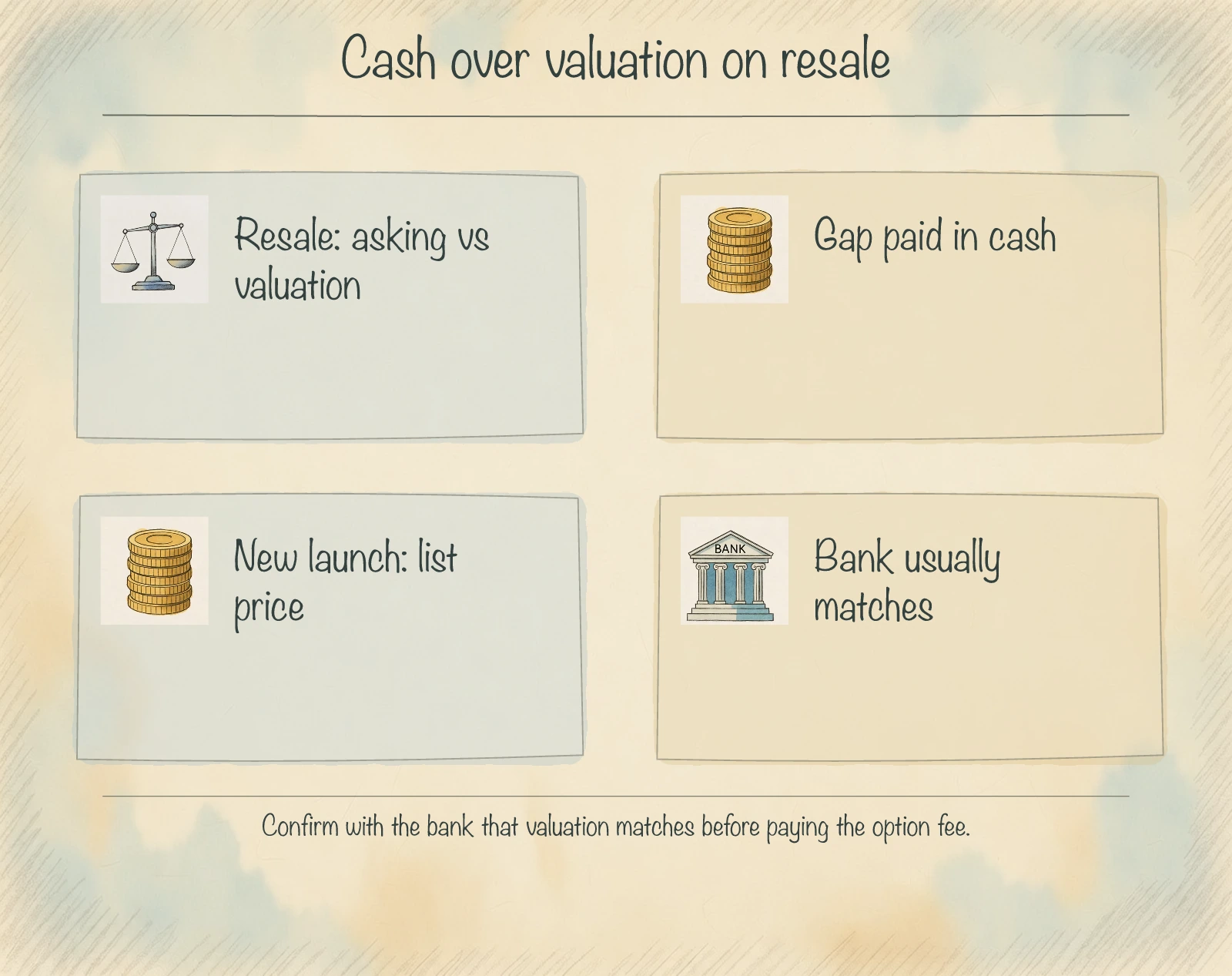
Only people who have sold a property or they have bought a resale property then they will know about this or people that bought a resale HDB then they will know what is COV. Basically it's called cash over valuation.
Now cash over valuation is something that you really have to take away about a resale condo because if you don't take note about it, you might end up paying more cash.
So when let's say you want to go to the resale condo market, you see a listing that you love and then you tell your agent and say I want to offer the seller is asking for 2 million. Okay, I like this seller a lot.
Let me just offer. If your agent is not trained or experienced and they didn't advise you on how valuation work.
You put in the check already, you pay a 1% option fee and what's going to happen is that then after that when you realize that when you want to do your letter or offer your loan.
Your banker come back and tell hey Melvin I already tracked with all my valuers the max valuation they can give me is 1.8 million so what does it mean? It means that you have to top up 200,000 in cash.
Why?
When the banker tell you my max value is 1.8 it means that they can only use 75% LTV of 1.8 so the standard is you have to pay 5% cash 20% CPF 75% and they will base it on the max valuation if they tell you max valuation is 1.8 it means that they cannot match so this is the lingo if they cannot match it means you have to top up 200,000 in cash so before you put in a 1% check to the resale seller you have to make sure that your banker tell you in black and white
Bank Valuation Shortfalls and Cash Top-Ups
And say that this unit I can match. So you need to send in a full address, condo size, unit number and size.
Hey, I want to make an offer, can the valuation match? If the valuation matches at 2 million, or maybe the banker says oh, this is a good deal, actually valuation is 2.5 million, oh, you can get 2 million.
Okay, bye. Okay.
Bye. All right.
So if you can match, it means that they can loan you 2 million, 75 percent of 2 million, and then the rest you pay 5% cash, 20% CPF, and you don't have to top up any COV. So if you need to top up COV, it means that 200,000 is in cash and your 5% is also in cash.
Actually, these 200,000 COV is wasted, one, because why? You could have gotten another property or go and see other properties that can match, because sometimes if you cannot match, it means that this is overpriced, or maybe this unit is really having a super per 1 million dollar renovation that the seller really wants to ask for this price.
And if you really love it and you want to pay for COV, then buy, go ahead. But generally speaking, when we buy resale, we want the valuation to match.
So these 200,000 dollars can actually go into your renovation cost. So take note of that.
Now, when you go for new launches, whatever the developer lists, when we talk about the list price, most of the time there's no negotiation. If you want to negotiate, sometimes pass minus a little bit towards the tail end of the project.
But by and large, whatever is the list price is the price. Especially during the balloting phase, at the start phase, there's no negotiation on pricing.
Based on the developer's price list, the banks will match. So the banks usually support the transaction price with new launches.
So there's no COV involved, by and large, for new launches. So that's of course one thing that a lot of buyers also love.
Now the last slide that I have is that you get a brand new lease. So comparing a new launch and a resale, a resale, take note, every property has two dates.
Do not just look at the completion date. So a lot of times, if you look at portals, you look at whatever platforms, they will only put in the completed date.
Now the completed date, do not be fooled, because if you see a condo being completed 210, sometimes to your horrific discovery, you need to look at the lease start date. Maybe the lease start date is 2000 because some projects take 10 years to complete.
Why? Maybe it's an en bloc development on 99 years land, for example, or maybe there's some construction issues, just take them 10 years and you wasted 10 years of your 99 years.
So take note of this. And of course, by and large, a lot of projects, let's say they launched this year, maybe their lease start date is 2023, okay.
And then, let's say you took your keys in 2027, but maybe on paper the CSC is 2028, so they will put 2028. So take note, for resale or new launches, this is standard, lease start date and completed.
So of course, when you buy a resale property, maybe the completion date was 2010, maybe the lease start date was 2005, and then this is now 2024. So what is the age?
It is not 2024 minus 2010, it's not 14 years. 14 years is the building age from the day it got your keys.
This is the actual land age, because take note, when you buy a 99 years property, after that you need to return to SLA. And of course, there are several options.
If somebody en bloc, congratulations. If nobody en bloc, maybe your MCST will rally and say let's top up lease to SLA, we had to pay based on the prevailing market rate land price in future.
But by and large, all condos, all land, all HDB, it belongs to the government. After 99, the government will take back.
Basically, you need to look at 05 to 24. So it's actually 19 years old.
When you buy a new launch, let's say it starts at 2023, it launched at 2024, this is the lease start date, and then it completes in 2028, and by the time you get your keys, it is five years old.
So you still have a balance of 94 years left. So when you buy this property, you have a balance of 94 years left.
When you buy this property, you have a balance of 80 years left, because 99 minus 19 is 80. So this is one of the key benefits that buyers like also is that I have a longevity.
And then if I want to sell, at least I'm not worried about the lease. If I want to sell four years later, there's still 90 years.
I want to sell 10 years later, there's still 84 more, compared to if I were to buy a resale, let's say at the point of purchase I'm left
Longer Lease Benefits and the Balas Curve
With 80, 5 years later if I want to sell at a left 75, I stay 10 years and it's left 70. And of course this relates to the Balas Curve.
Balas Curve basically talks about two key things. One balance age of 60, the other one is 30.
30, no CPF, no bank loan. 60, you can take bank loan, balance lease of 60 but in terms of CPF usage by your next buyer, not the full CPF provided, they meet basically the minimum sum.
And if they don't meet the minimum sum, basically at the tail end of their money installment, they have to pay cash rather than using CPF. Alright, so there's some limitations in terms of CPF usage.
Last two pointers, new design, you got to enjoy a new architectural design, new facilities and things like that. Tennis popularity, a lot of tennis love to rent brand new because up tennis also love rental units that nobody lived in before.
So condition is good, it's clean and all that.
All right, so I've come to the end. I hope that this 11 pointers are one of the some of the key reasons why people love to buy new launches and these are also some of the plus point USP factors of new launches.
So I hope that this session has benefited you, value added to you. And then moving on, we're going to talk about more topics on our whiteboard session.
We'll see you on the next NOTG whiteboards. Take care.
Yeah.